
TechneLite Technetium Tc99m Generator 250 mCi/mL Injection, Solution — NDC 11994-090-01 (Billing 11994-0090-01)
This is a package of TechneLite Technetium Tc99m Generator 250 mCi/mL Injection, Solution from Lantheus Medical Imaging, Inc., marketed since Nov 1975 and currently FDA-listed. It is the main listing for this product, which comes in 14 package sizes.
NDC database record
One package, one record: these facts belong to NDC 11994-090-01 alone.
- Record
- FDA NDC Directory package listing · Human prescription drug
- Code segments
- 11994 labeler · 090 product · 01 package
- Package marketed since
- Nov 1, 1975
- Sample package
- No — commercial package
- Listing certified through
- Dec 31, 2026
- Barcode (UPC-A, from the NDC)
- 3 1199409001 5
- FDA record last changed
- Jul 24, 2026
Identity & classification
Regulatory identifiers FDA, NLM and CMS codes for this package
Drug-database identifiers Medi-Span GPI and First Databank GCN / HICL / AHFS classification
- GSN (GCN sequence number): 051337
- GCN: 18542
- GPI-14 (Medi-Span): 94359070476420
- HICL (First Databank): 024552
- AHFS class code: 36:68.00.00
Where does this data come from?
- FDA openFDA NDC Directory · synced Oct 1, 2026
- FDA label on DailyMed · label index refreshed Oct 3, 2026
- RxNorm (NLM RxNav) · catalog refreshed Oct 1, 2026
- Medi-Span GPI (licensed)
- First Databank (licensed) · refreshed Oct 1, 2026
Clinical
Patient education
Supplement & herbal interactions
Where does this data come from?
- MedlinePlus (NLM) · refreshed Oct 1, 2026
- FDA label on DailyMed · label index refreshed Oct 3, 2026
Ask a licensed pharmacist directly — free, answered by our team.
Pricing
A drug doesn't have one price. Each row is a different public payment system, and none is what you'd pay at the counter — that depends on your insurance. The ⓘ on each row explains what it measures.
| Price system | Per mL | Per package |
|---|---|---|
| Retail pharmacies payNADAC · weekly | Not in the retail survey — common for institutional, discontinued, or low-volume packs. | |
| Medicaid paysCMS SDUD · 12 mo | No recent Medicaid claims on file for this NDC — rare and low-volume NDCs are suppressed in the public data. | |
| Medicare drug plans payPart D · quarterly | No Part D plan price is available for this NDC in our data. | |
Where does this data come from?
- CMS NADAC weekly file
- CMS ASP pricing files · refreshed Sep 20, 2026
- CMS Medicaid State Drug Utilization Data · refreshed Oct 4, 2026
- CMS Part D plan pricing files · refreshed Sep 24, 2026
- VA National Acquisition Center price file
Packaging — all sizes for this product
| Package NDC | Description | Marketing start | Marketing end | Status |
|---|---|---|---|---|
| 11994-0090-01 You're viewing this Main listing | 1 VIAL in 1 CARTON / 12 mL in 1 VIAL | 1975-11-01 | — | Active |
| 11994-0090-03 11994-090-03 | 1 VIAL in 1 CARTON / 16 mL in 1 VIAL | 1975-11-01 | — | Active |
| 11994-0090-04 11994-090-04 | 1 VIAL in 1 CARTON / 18 mL in 1 VIAL | 1975-11-01 | — | Active |
| 11994-0090-05 11994-090-05 | 1 VIAL in 1 CARTON / 20 mL in 1 VIAL | 1975-11-01 | — | Active |
| 11994-0090-06 11994-090-06 | 1 VIAL in 1 CARTON / 24 mL in 1 VIAL | 1975-11-01 | — | Active |
| 11994-0090-07 11994-090-07 | 1 VIAL in 1 CARTON / 30 mL in 1 VIAL | 1975-11-01 | — | Active |
| 11994-0090-09 11994-090-09 | 1 VIAL in 1 CARTON / 40 mL in 1 VIAL | 1975-11-01 | — | Active |
| 11994-0090-10 11994-090-10 | 1 VIAL in 1 CARTON / 50 mL in 1 VIAL | 1975-11-01 | — | Active |
| 11994-0090-11 11994-090-11 | 1 VIAL in 1 CARTON / 60 mL in 1 VIAL | 1975-11-01 | — | Active |
| 11994-0090-12 11994-090-12 | 1 VIAL in 1 CARTON / 72 mL in 1 VIAL | 1975-11-01 | — | Active |
| 11994-0090-13 11994-090-13 | 1 VIAL in 1 CARTON / 80 mL in 1 VIAL | 1975-11-01 | — | Active |
| 11994-0090-36 11994-090-36 | 1 VIAL in 1 CARTON / 4 mL in 1 VIAL | 1975-11-01 | — | Active |
| 11994-0090-73 11994-090-73 | 1 VIAL in 1 CARTON / 8 mL in 1 VIAL | 1975-11-01 | — | Active |
| 11994-0090-92 11994-090-92 | 1 VIAL in 1 CARTON / 10 mL in 1 VIAL | 1975-11-01 | — | Active |
Pack size FAQ
What quantity is in this package?
What NDC number is used to bill for this package of TechneLite Technetium Tc99m Generator 250 mCi/mL Injection, Solution?
Therapeutic equivalents
| Product | Labeler | Pack | NADAC/unit | TE | Status | Price vs. this |
|---|---|---|---|---|---|---|
| TechneLite 250 mCi/mLthis 11994-0090-01 | Lantheus | 1 vial | — | — | FDA listed | — |
| TechneLite 250 mCi/mL 11994-0091-01 | Lantheus | 1 vial | — | — | FDA listed | — |
Where does this data come from?
- FDA openFDA NDC Directory · synced Oct 1, 2026
- FDA Orange Book · refreshed Oct 3, 2026
- CMS NADAC weekly file
Availability & generic status
We did not find an FDA-approved generic match for this exact strength, form and route.
Where does this data come from?
- FDA Orange Book · refreshed Oct 3, 2026
Inactive Ingredients / Excipients
Inactive ingredients, also called excipients, are components of the drug product other than the active ingredient. They may include fillers, dyes, coatings, preservatives, flavors, or other formulation ingredients.
Where does this data come from?
IACT rows and label-wide narrative are kept separate; availability and product-level specificity depend on the submitted label.- FDA label on DailyMed · label index refreshed Oct 3, 2026
- FDA openFDA NDC Directory · synced Oct 1, 2026
Inactive ingredient FAQ
Are inactive ingredients the same for every manufacturer?
Why might an inactive ingredient be missing?
Can inactive ingredients matter?
Manufacturer & labeler
More NDCs from Lantheus Medical Imaging, Inc. labeler code 11994
- Cardiolite TETRAKIS(2-METHOXYISOBUTYLISOCYANIDE)COPPER(I) TETRAFLUOROBORATE 1 mg/mL Injection, Powder, Lyophilized, For Solution NDC 11994-001-20
- Kit for the Preparation of Technetium Tc99m Sestamibi TETRAKIS(2-METHOXYISOBUTYLISOCYANIDE)COPPER(I) TETRAFLUOROBORATE 1 mg/mL Injection, Powder, Lyophilized, For Solution NDC 11994-003-20
- NEUROLITE Bicisate dihydrochloride Kit NDC 11994-006-02
- Definity perflutren 6.52 mg/mL Injection, Suspension NDC 11994-011-01
- DEFINITY RT perflutren 6.52 mg/mL Injection, Suspension NDC 11994-017-01
- TechneLite Technetium Tc99m Generator 250 mCi/mL Injection, Solution NDC 11994-091-01
- Xenon 10 mCi Gas NDC 11994-127-11
- Xenon 20 mCi Gas NDC 11994-128-21
Where does this data come from?
- FDA openFDA NDC Directory · synced Oct 1, 2026
- Drugs@FDA
Full prescribing information FDA SPL
🎯 Indications and Usage ▾
INDICATIONS AND USAGE: The Technelite generator is a source of sodium pertechnetate Tc 99m for use in the preparation of FDA-approved diagnostic radiopharmaceuticals, as described in the labeling of these diagnostic radiopharmaceutical kits. Sodium Pertechnetate Tc 99m Injection is used IN ADULTS as an agent for: Thyroid Imaging Salivary Gland Imaging Urinary Bladder Imaging (direct isotopic cystography) for the detection of vesico-ureteral reflux. Nasolacrimal Drainage System Imaging Sodium Pertechnetate Tc 99m Injection is used IN CHILDREN as an agent for: Thyroid Imaging Urinary Bladder Imaging (direct isotopic cystography) for the detection of vesico-ureteral reflux.
⏱️ Dosage and Administration ▾
DOSAGE AND ADMINISTRATION: Sodium Pertechnetate Tc 99m Injection is usually administered by intravascular injection. For imaging the urinary bladder and ureters (direct isotopic cystography), the Sodium Pertechnetate Tc 99m Injection is administered by direct instillation aseptically into the bladder via a urethral catheter, following which the catheter is flushed with approximately 200 mL of 0.9% Sodium Chloride Injection, USP directly into the bladder. The dosage employed varies with each diagnostic procedure.
When imaging the nasolacrimal drainage system, instill the Sodium Pertechnetate Tc 99m Injection by the use of a device such as a micropipette or similar method which will ensure the accuracy of the dose. The suggested dose range employed for various diagnostic indications in the average ADULT PATIENT (70kg) is: Vesico-ureteral Imaging 18.5 to 37MBq (0.5 to 1mCi) Thyroid Gland Imaging 37 to 370MBq (1 to 10mCi) Salivary Gland Imaging 37 to 185MBq (1 to 5mCi) Nasolacrimal Drainage System Maximum 3.7MBq (100µCi) The recommended dosage range in PEDIATRIC PATIENTS is: Vesico-ureteral Imaging 18.5 to 37MBq (0.5 to 1mCi) Thyroid Gland Imaging 2.22 to 2.96MBq (60 to 80µCi)/kg body weight The patient dose should be measured by a suitable radioactivity calibration system immediately prior to administration of the dose.
Parenteral drug products should be inspected visually for particulate matter and discoloration prior to administration whenever solution and container permit. The solution to be administered as the patient dose should be clear and contain no particulate matter. Do not use an eluate of the TECHNELITE ® , Technetium Tc 99m Generator later than one (1) working day after elution (12 hours).
Radiation Dosimetry The estimated absorbed radiation doses to an average ADULT and Pediatric patient from an intravenous injection of a maximum dose of 1110MBq (30 millicuries) of Sodium Pertechnetate Tc 99m Injection distributed uniformly in the total body are shown in Tables 5 and 6. Table 5. Adult Absorbed Radiation Doses (mGy) from Intravenous Injection Organ Absorbed Radiation Dose (mGy) for a 1110 MBq (30mCi) dose To obtain radiation absorbed dose in rads (30 mCi dose) from the above table, divide individual organ values by a factor of 10 (does not apply for effective dose).
Adrenals
4.1 Urinary Bladder Wall 20 Bone Surfaces
6.2 Brain
2.2 Breasts 2 Gallbladder Wall
8.3 Stomach Wall 29 Small Intestine 18 ULI Wall 63 LLI Wall 23 Heart Wall
3.5 Kidneys 6 Liver
4.7 Lungs
2.9 Muscle
3.6 Ovaries 11 Pancreas
6.3 Red Marrow
4.1 Skin 2 Spleen
4.8 Testes
3.1 Thymus
2.7 Thyroid 24 Uterus 9 Remaining Tissues
3.9Effective Dose (mSv) 14 Table 6. Pediatric Absorbed Radiation Doses (mGy) from Intravenous Injection Age 15 years 10 years 5 years 1 year To obtain radiation absorbed dose in rads (30 mCi dose) from the above table, divide individual organ values by a factor of 10 (does not apply for effective dose). Administered activity in MBq (mCi) 1110 (30) 740 (20) 555 (15) 370 (10) Organ Adrenals 5.3 5.4 6.2
7.1Urinary Bladder Wall 26 22 18 22 Bone Surfaces 7.6 7.5 8.1 10 Brain 2.8 3.1 3.7
4.5Breasts 2.6 2.6 3.2
4.1Gallbladder Wall 11 12 13 13 Stomach Wall 38 36 43 59 Small Intestine 22 23 26 30 ULI Wall 81 89 110 140 LLI Wall 31 33 40 48 Heart Wall 4.5 4.6 5.2
6.4Kidneys 7.2 6.9 7.8
8.5Liver 6 6.7 8
9.1Lungs 3.8 3.8 4.4
5.3Muscle 4.5 4.5 5 6 Ovaries 14 13 14 17 Pancreas 8.1 8.2 8.9 10 Red Marrow 5.1 5 5.2 6 Skin 2.5 2.6 3.2
3.8Spleen 6 6 6.7
7.8Testes 4.1 4.3 4.9 6 Thymus 3.6 3.5 4.2
5.3Thyroid 40 41 67 81 Uterus 11 11 12 14 Remaining Tissues 4.8 4.8 5.4
6.4Effective Dose (mSv) 19 19 23 29 The estimated absorbed radiation doses to an average ADULT from the instillation of Sodium Pertechnetate Tc 99m Injection for imaging the nasolacrimal drainage system are shown in Table 7. Table 7. Absorbed Radiation Dose from Dacryoscintigraphy Using Sodium Pertechnetate Tc 99m Absorbed Dose Target Organ mGy/ 3.7MBq (rad/ 100µCi) * Assuming n… [Excerpted — this section continues on DailyMed.]
⛔ Contraindications ▾
CONTRAINDICATIONS: None known.
⚠️ Warnings ▾
WARNINGS: Radiation risks associated with the use of Sodium Pertechnetate Tc 99m Injection are greater in children than in adults and, in general, the younger the child, the greater the risk owing to greater absorbed radiation doses and longer life-expectancy. These greater risks should be taken firmly into account in all benefit-risk assessments involving children. Long-term cumulative radiation exposure may be associated with an increased risk of cancer.
🤒 Adverse Reactions ▾
ADVERSE REACTIONS: Allergic reactions including anaphylaxis have been reported infrequently following the administration of Sodium Pertechnetate Tc 99m Injection.
🤰 Pregnancy ▾
Pregnancy Animal reproductive studies have not been conducted with Sodium Pertechnetate Tc 99m. It is also not known whether Sodium Pertechnetate Tc 99m can cause fetal harm when administered to a pregnant woman or can affect reproduction capacity. Sodium Pertechnetate Tc 99m Injection should be given to a pregnant woman only if clearly needed.
Ideally examinations using radiopharmaceuticals, especially those elective in nature, of a woman of childbearing capability should be performed during the first few (approximately 10) days following the onset of menses.
🧒 Pediatric Use ▾
Pediatric Use See INDICATIONS and DOSAGE AND ADMINISTRATION sections. Also see the description of additional risks under WARNINGS.
🧓 Geriatric Use ▾
Geriatric Use Clinical studies of TechneLite ® did not include sufficient numbers of subjects aged 65 and over to determine whether they respond differently from younger subjects. Other reported clinical experience has not identified differences in responses between the elderly and younger patients. In general, dose selection for an elderly patient should be cautious, usually starting at the low end of the dosing range, reflecting the greater frequency of decreased hepatic, renal, or cardiac function, and of concomitant disease or other drug therapy.
🧬 Clinical Pharmacology ▾
CLINICAL PHARMACOLOGY: The pertechnetate ion distributes in the body similarly to the iodide ion but is not organified when trapped in the thyroid gland. It also concentrates in the choroid plexus, thyroid gland, salivary glands, and stomach. However, in contrast to the iodide ion, the pertechnetate ion is released unchanged from the thyroid gland.
After intravascular administration the pertechnetate ion gradually equilibrates with the extracellular space. A fraction is promptly excreted via the kidneys. Following the administration of Sodium Pertechnetate Tc 99m Injection as an eye drop, the drug mixes with tears within the conjunctival space.
Within seconds to minutes it leaves the conjunctival space and escapes into the inferior meatus of the nose through the nasolacrimal drainage system. During this process the pertechnetate ion passes through the canaliculi, the lacrimal sac and the nasolacrimal duct. In the event of any anatomical or functional blockage of the drainage system there will be a backflow resulting in tearing (epiphora).
Thus the pertechnetate escapes the conjunctival space in the tears. While the major part of the pertechnetate escapes within a few minutes of normal drainage and tearing, it has been documented that there is some degree of transconjunctival absorption with a fractional turnover rate of 0.015/min in normal individuals, 0.021/min in patients without any sac and 0.027/min in patients with inflamed conjunctiva due to chronic dacryocystitis. Individual values may vary but these rates are probably representative and indicate that the maximum possible pertechnetate absorbed will remain below one thousandth of that used in other routine diagnostic procedures.
📦 How Supplied / Storage and Handling ▾
HOW SUPPLIED: Lantheus Medical Imaging TechneLite ® , (Technetium Tc 99m Generator) for the Production of Sodium Pertechnetate Tc 99m Injection is supplied in a multi-dose container and is available in the following quantities of radioactivity of Mo99 on the calibration date (date of manufacture) as specified on the product lot identification label affixed to the generator: Table 9 Available Quantities of Radioactivity High Enriched Uranium (HEU) Low Enriched Uranium (LEU) NDC # GBq of Mo99 Ci of Mo99 NDC # GBq of Mo99 Ci of Mo99 11994-090-36 37.0 1 11994-091-36 37.0 1 11994-090-73 74.0 2 11994-091-73 74.0 2 11994-090-92 92.5 2.5 11994-091-92 92.5 2.5 11994-090-01 111.0 3 11994-091-01 111.0 3 11994-090-03 148.0 4 11994-091-03 148.0 4 11994-090-04 166.5 4.5 11994-091-04 166.5 4.5 11994-090-05 185.0 5 11994-091-05 185.0 5 11994-090-06 222.0 6 11994-091-06 222.0 6 11994-090-07 277.5 7.5 11994-091-07 277.5 7.5 11994-090-09 370.0 10 11994-091-09 370.0 10 11994-090-10 462.5 12.5 11994-091-10 462.5 12.5 11994-090-11 555.0 15 11994-091-11 555.0 15 11994-090-12 666.0 18 11994-091-12 666.0 18 11994-090-13 740.0 20 11994-091-13 740.0 20 Each generator is supplied with the following standard components: Collect Needle Seal Eluant Charge Vials (may be supplied separately) Eluate Collection Vials (may be supplied separately) 1 Package Insert 6 Radiation Labels (Collection Vial) 6 Radiation Labels (Eluting Shield) First order generators are shipped with the following accessory components: 2 Eluting Shields Additional quantities of these components may be obtained at the customer's request.
📦 Storage and Handling ▾
STORAGE: Store generator and Sodium Pertechnetate Tc 99m Injection at 20° to 25°C (68° to 77°F) [see USP Controlled Room Temperature].
📋 Description ▾
DESCRIPTION: Sodium Pertechnetate Tc 99m Injection, as eluted according to the elution instructions with Lantheus Medical Imaging, Inc. TECHNELITE ® , Technetium Tc 99m Generator, is in 0.9% Sodium Chloride Injection, USP as a sterile, non-pyrogenic, diagnostic radiopharmaceutical suitable for intravenous injection and direct instillation. The pH is 4.5-7.5.
The eluate should be clear, colorless, and free from visible foreign material. Each eluate of the TECHNELITE ® , Technetium Tc 99m Generator should not contain more than 0.0056MBq (0.15 microcuries) of Molybdenum Mo99 per 37MBq (1 millicurie) of Technetium Tc 99m per administered dose at the time of administration, and not more than 10 micrograms of aluminum per milliliter of the Technetium Tc 99m Generator eluate, both of which must be determined by the user before administration. Since the eluate does not contain an antimicrobial agent, it should not be used later than one (1) working day after the elution (12 hours).
Lantheus Medical Imaging, Inc. TECHNELITE ® , Technetium Tc 99m Generator consists of a column containing uranium fission produced Molybdenum Mo99 adsorbed on alumina. The terminally sterilized and sealed column is enclosed in a lead shield; the shield and other components are sealed in a cylindrical plastic container with an attached handle.
Built into the top surface are two recessed wells marked SALINE CHARGE and COLLECT. Needles protruding from these two wells accommodate supplied sterile eluant charge vials and sterile eluate collection vials. The eluting solvent consists of 0.9% Sodium Chloride Injection, USP, prepacked into septum-sealed vials, to make the solution isotonic.
The eluate collection vial is evacuated, sterile and non-pyrogenic. A sterile 0.22 micrometer bacteriological filter is incorporated between the column outlet and the collection vials. During and subsequent to elution, the eluate collection vial should be kept in a radiation shield.
The Generator is shipped with a silicone needle seal over the charge needle and a vented needle cover over the collect needle. A sterile collect needle seal is supplied for the customer to aseptically reseal the collect needle after each elution. Physical Characteristics Technetium Tc 99m decays by isomeric transition with a physical half-life of 6.02 hours.
1 Photons that are useful for imaging studies are listed in Table 1. Table 1. Principal Radiation Emission Data - Technetium Tc 99m Radiation Mean %/Disintegration Mean Energy (keV) Gamma-2 89.07 140.5 External Radiation The specific gamma ray constant for Technetium Tc 99m is 5.4 microcoulombs/Kg-MBq-hr (0.795 R/mCi-hr) at 1cm.
The first half-value thickness is 0.023cm of lead (Pb). To facilitate control of radiation exposure from millicurie amounts of Technetium Tc 99m, for example, the use of a 0.27 cm thick standard radiation elution lead shield will attenuate the radiation emitted by a factor of about 1000. A range of values for the relative attenuation of the radiation emitted by this radionuclide that results from interposition of various thicknesses of lead is shown in Table 2.
NOTE : Because the generator is well contained and essentially dry, there is little likelihood of contamination due to damage in transit. Table 2. Radiation Attenuation of Technetium Tc 99m by Lead Shielding Shield Thickness lead (Pb) cm Coefficient of Attenuation 0.023 0.5 0.09 10 -1 0.18 10 -2 0.27 10 -3 0.33 10 -4 Molybdenum Mo99 decays to Technetium Tc 99m with a Molybdenum Mo99 half-life of 66 hours.
This means that only 78% of the activity remains after 24 hours; 60% remains after 48 hours, etc. (see Table 3). All units have a minimum of 38 mm, 1.5 inches (~ 6 half-value layers) of lead surrounding the activity.
(See Table 3.) Table 3. Molybdenum Mo99 Decay Chart Half-Life
66.0Hours Days Percent Remaining Days Percent Remaining 0 100 10 8 1 78 11 6 2 60 12 5 3 47 13 4 4 37 14 3 5 28 15 2 6 22 20 0.6 7 17 25 0.2 8 13 30 0.05 9 10 The physical decay characteris… [Excerpted — this section continues on DailyMed.]
⚠️ Precautions ▾
PRECAUTIONS: General As in the use of any radioactive material, care should be taken to minimize radiation exposure to the patient consistent with proper patient management and to ensure minimum radiation exposure to occupational workers. Since the eluate does not contain an antimicrobial agent, it should not be used after 12 hours from the time of TECHNELITE ® , Technetium Tc 99m Generator elution. After the termination of the nasolacrimal imaging procedure, blowing the nose and washing the eyes with sterile distilled water or an isotonic sodium chloride solution will further minimize the radiation dose.
Radiopharmaceuticals should be used only by physicians who are qualified by training and experience in the safe handling of radionuclides and whose experience and training have been approved by the appropriate government agency authorized to license the use of radionuclides. Carcinogenesis, Mutagenesis, Impairment of Fertility No animal studies have been performed to evaluate carcinogenic potential or whether Sodium Pertechnetate Tc 99m affects fertility in males or females. Pregnancy Animal reproductive studies have not been conducted with Sodium Pertechnetate Tc 99m.
It is also not known whether Sodium Pertechnetate Tc 99m can cause fetal harm when administered to a pregnant woman or can affect reproduction capacity. Sodium Pertechnetate Tc 99m Injection should be given to a pregnant woman only if clearly needed. Ideally examinations using radiopharmaceuticals, especially those elective in nature, of a woman of childbearing capability should be performed during the first few (approximately 10) days following the onset of menses.
Nursing Mothers Sodium Pertechnetate Tc 99m is excreted in human milk during lactation; therefore formula feedings should be substituted for breast feeding. This radiopharmaceutical preparation should not be administered to pregnant or lactating women unless expected benefits to be gained outweigh the potential risks. Pediatric Use See INDICATIONS and DOSAGE AND ADMINISTRATION sections.
Also see the description of additional risks under WARNINGS. Geriatric Use Clinical studies of TechneLite ® did not include sufficient numbers of subjects aged 65 and over to determine whether they respond differently from younger subjects. Other reported clinical experience has not identified differences in responses between the elderly and younger patients.
In general, dose selection for an elderly patient should be cautious, usually starting at the low end of the dosing range, reflecting the greater frequency of decreased hepatic, renal, or cardiac function, and of concomitant disease or other drug therapy.
🍼 Nursing Mothers ▾
Nursing Mothers Sodium Pertechnetate Tc 99m is excreted in human milk during lactation; therefore formula feedings should be substituted for breast feeding. This radiopharmaceutical preparation should not be administered to pregnant or lactating women unless expected benefits to be gained outweigh the potential risks.
📄 Carcinogenesis, Mutagenesis, Impairment of Fertility ▾
Carcinogenesis, Mutagenesis, Impairment of Fertility No animal studies have been performed to evaluate carcinogenic potential or whether Sodium Pertechnetate Tc 99m affects fertility in males or females.
📄 Package Label / Principal Display Panel ▾
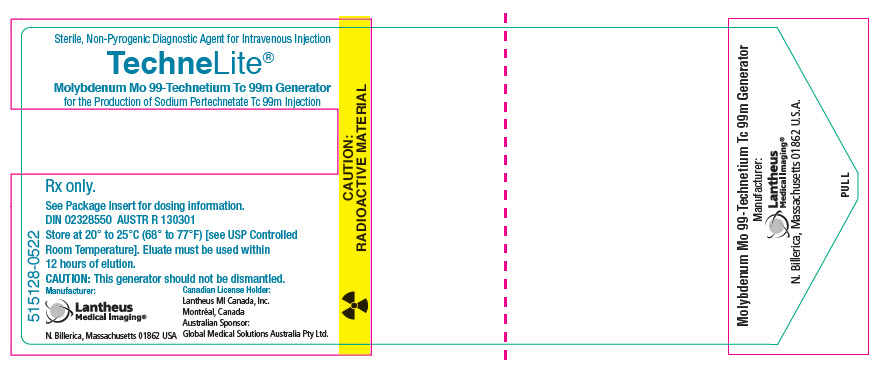
PRINCIPAL DISPLAY PANEL - Generator Label - NDC 11994-090 Sterile, Non-Pyrogenic Diagnostic Agent for Intravenous Injection TechneLite ® Technetium Tc 99m Generator for the Production of Sodium Pertechnetate Tc 99m Injection Rx only. See Package Insert for dosing information. DIN 02328550 AUSTR R 130301 Store at 20° to 25°C (68° to 77°F) [see USP Controlled Room Temperature].
Eluate must be used within 12 hours of elution. CAUTION: This generator should not be dismantled. Manufacturer: Lantheus Medical Imaging ® N.
Billerica, Massachusetts 01862 USA Canadian License Holder: Lantheus MI Canada, Inc. Montréal, Canada H4M 2X6 Australian Sponsor: Global Medical Solutions Australia Pty Ltd. 515128-1023 CAUTION: RADIOACTIVE MATERIAL PRINCIPAL DISPLAY PANEL - Generator Label - NDC 11994-090
PRINCIPAL DISPLAY PANEL - Generator Label - NDC 11994-091 Sterile, Non-Pyrogenic Diagnostic Agent for Intravenous Injection TechneLite ® Technetium Tc 99m Generator for the Production of Sodium Pertechnetate Tc 99m Injection Rx only. See Package Insert for dosing information. DIN 02328550 AUSTR R 130301 Store at 20° to 25°C (68° to 77°F) [see USP Controlled Room Temperature].
Eluate must be used within 12 hours of elution. CAUTION: This generator should not be dismantled. Manufacturer: Lantheus Medical Imaging ® N.
Billerica, Massachusetts 01862 USA Canadian License Holder: Lantheus MI Canada, Inc. Montréal, Canada H4M 2X6 Australian Sponsor: Global Medical Solutions Australia Pty Ltd. 515128-1023 CAUTION: RADIOACTIVE MATERIAL PRINCIPAL DISPLAY PANEL - Generator Label - NDC 11994-091
Reported adverse events (FAERS)
Top reported reactions
Reporter sex
Serious outcomes
Where does this data come from?
About this NDC listing & data coverage
What data is (and isn’t) available for this NDC — tap to expand
| NDC identity (package / product / labeler codes) | ✓ Available |
| Labeler | ✓ Available |
| Product & package description | ✓ Available |
| Marketing category & status | ✓ Available |
| Active ingredient / dosage form / route | ✓ Available |
| FDA label (SPL via DailyMed) | ✓ Available |
| Package photos | ✓ Available |
| Inactive ingredients (structured) | — Not published for this NDC The labeler did not submit a structured excipient list, or no SPL is available. |
| NADAC pharmacy acquisition price (CMS) | — Not published for this NDC CMS publishes NADAC only for NDCs reported in its retail-pharmacy survey. |
| Orange Book / therapeutic-equivalence data | — Not published for this NDC Applies only to products approved under an NDA/ANDA; many listings are out of scope. |
| HCPCS J-code billing crosswalk | — Not published for this NDC Most self-administered / retail products have no J-code — that is normal. |
| Medicaid utilization (CMS SDUD) | — Not published for this NDC CMS reports utilization only for NDCs with Medicaid claims above its privacy threshold. |