
Detectnet copper Cu 64 Dotatate 1 mCi/mL Injection, Solution — NDC 69945-064-01 (Billing 69945-0064-01)
This is a package of Detectnet copper Cu 64 Dotatate 1 mCi/mL Injection, Solution from CURIUM US LLC, marketed since Sep 2020 and currently FDA-listed. It is this product's only package size.
NDC database record
One package, one record: these facts belong to NDC 69945-064-01 alone.
- Record
- FDA NDC Directory package listing · Human prescription drug
- Code segments
- 69945 labeler · 064 product · 01 package
- Package marketed since
- Sep 14, 2020
- Sample package
- No — commercial package
- Listing certified through
- Dec 31, 2026
- Barcode (UPC-A, from the NDC)
- 3 6994506401 1
- Medicaid fills, this package
- 12 prescriptions in the last four reported quarters
- FDA record last changed
- Jul 24, 2026
Identity & classification
Regulatory identifiers FDA, NLM and CMS codes for this package
Drug-database identifiers Medi-Span GPI and First Databank GCN / HICL / AHFS classification
- GSN (GCN sequence number): 081441
- GCN: 48554
- GPI-14 (Medi-Span): 94354025202020
- HICL (First Databank): 046814
- AHFS class code: 36:68.00.00
Where does this data come from?
- FDA openFDA NDC Directory · synced Oct 8, 2026
- FDA label on DailyMed · label index refreshed Oct 8, 2026
- RxNorm (NLM RxNav) · catalog refreshed Oct 1, 2026
- Medi-Span GPI (licensed)
- First Databank (licensed) · refreshed Oct 8, 2026
Clinical
Patient education
Supplement & herbal interactions
Where does this data come from?
- MedlinePlus (NLM) · refreshed Oct 8, 2026
- FDA label on DailyMed · label index refreshed Oct 8, 2026
Ask a licensed pharmacist directly — free, answered by our team.
Pricing
A drug doesn't have one price. Each row is a different public payment system, and none is what you'd pay at the counter — that depends on your insurance. The ⓘ on each row explains what it measures.
| Price system | Per mL | Per package |
|---|---|---|
| Retail pharmacies payNADAC · weekly | Not in the retail survey — common for institutional, discontinued, or low-volume packs. | |
| Medicaid paysCMS SDUD · 12 mo | $506.19 | $2,024.76 / 4 ml |
| Medicare drug plans payPart D · quarterly | No Part D plan price is available for this NDC in our data. | |
Where does this data come from?
- CMS NADAC weekly file
- CMS ASP pricing files · refreshed Sep 20, 2026
- CMS Medicaid State Drug Utilization Data · through Q1 2026
- CMS Part D plan pricing files · refreshed Sep 24, 2026
- VA National Acquisition Center price file
Packaging — all sizes for this product
| Package NDC | Description | Marketing start | Marketing end | Status |
|---|---|---|---|---|
| 69945-0064-01 You're viewing this Main listing | 1 VIAL, SINGLE-USE in 1 CAN / 4 mL in 1 VIAL, SINGLE-USE | 2020-09-14 | — | Active |
Therapeutic equivalents
| Product | Labeler | Pack | NADAC/unit | TE | Status | Price vs. this |
|---|---|---|---|---|---|---|
| Detectnet 1 mCi/mLthis 69945-0064-01 | CURIUM | 1 vial | — | — | FDA listed | — |
Where does this data come from?
- FDA openFDA NDC Directory · synced Oct 8, 2026
- FDA Orange Book · refreshed Oct 3, 2026
- CMS NADAC weekly file
Availability & generic status
We did not find an FDA-approved generic match for this exact strength, form and route. Patent/protection dates below may affect future generic timing.
Why the date isn’t exact: Generic timing can change because patents may be challenged, settled, licensed, added, removed, or worked around with a narrower label — and FDA approval does not always mean a pharmacy can get the generic today.
🛈 What do these terms mean?
- Patent
- Legal protection listed in the Orange Book that may delay generic approval or launch. Issued by the U.S. Patent & Trademark Office.
- Substance patent
- Covers the active drug molecule itself — the hardest to design around. A generic generally can’t launch until it expires.
- Formulation (product) patent
- Covers a specific formulation or dosage form. A generic can sometimes work around it with a different formulation.
- Method-of-use patent
- A patent covering one specific approved use of the drug — not necessarily the whole molecule. A generic can sometimes launch with a “skinny label” that carves out the protected use and keeps the others.
- Skinny label
- A generic label that omits a still-patented use when the FDA allows it — letting a generic reach the market for the unprotected uses.
- Exclusivity
- FDA-granted marketing protection, separate from patents — e.g. 5-yr new chemical entity, 7-yr orphan drug, or a +6-month pediatric extension.
- Paragraph IV
- A generic applicant’s formal challenge to a listed patent. It can potentially lead to earlier generic entry, but often involves litigation or a settlement.
- RLD / RS
- Reference Listed Drug — the brand product the FDA uses as the reference for generic applications. Reference Standard — the product the FDA expects generics to compare against in bioequivalence testing.
- TE / AB rating
- FDA therapeutic-equivalence rating. An AB rating generally means the FDA considers a generic therapeutically equivalent to — and substitutable for — the brand.
- LOE (loss of exclusivity)
- The latest patent or exclusivity currently listed — the loss-of-exclusivity / latest-listed-protection date shown on this page. Paragraph-IV challenges and settlements can move the real date earlier; FDA approval and a manufacturer’s decision to market can move it later.
Built from the FDA Orange Book. The bars above are scaled to each protection’s expiry; the red LOE marker is the last one to lapse.
| Patent | Type | Use code | Expires |
|---|---|---|---|
| US 10159759 ↗ | Method of use | U-2951 | Aug 23, 2032 |
| US 10383961 ↗ | Method of use | U-2951 | Jul 2, 2033 |
| US 11160888 ↗ | Method of use | U-2951 | Aug 23, 2032 |
| US 12102696 ↗ | Drug product | — | Sep 3, 2041 |
| Code | What it grants | Expires |
|---|---|---|
| ODE-317 | Orphan Drug Exclusivity (7-year) | Sep 3, 2027 |
Is there a generic version of DETECTNET 148 MBQ (4 MCI)/4 ML?
The FDA approved a generic — why can’t I get it at my pharmacy yet?
Why do different websites show different generic release dates?
What does “FDA listed” mean?
What does a patent or protection date mean here?
What does “current Orange Book estimate” mean?
Can a generic come out before the last patent expires?
Can a generic come out after the listed dates?
What is the difference between patents and exclusivity?
Why are there multiple patent dates?
Where does this data come from?
- FDA Orange Book · refreshed Oct 3, 2026
Inactive Ingredients / Excipients
Inactive ingredients, also called excipients, are components of the drug product other than the active ingredient. They may include fillers, dyes, coatings, preservatives, flavors, or other formulation ingredients.
💡 Tap an ingredient (hover on desktop) to see what it is and why it’s used.
-
0.05 mL / 1 mL
UNII 3K9958V90M
A liquid solvent derived from fermentation or chemical synthesis. In medicines, alcohol dissolves active ingredients, helps preserve the product, and improves how the body absorbs certain drugs.
-
40 mg / 1 mL
UNII PQ6CK8PD0R
Ascorbic acid, also known as vitamin C, is a white crystalline powder. It serves as an antioxidant to prevent degradation of other ingredients and may also function as a preservative in the formulation.
-
UNII QTT17582CB
A strong acid used to adjust and maintain the proper pH level in liquid medicines, ensuring stability and preventing breakdown of active ingredients.
-
UNII 55X04QC32I
A strong alkaline chemical used to adjust and maintain the pH balance of liquid medicines. It helps keep the medicine stable and ensures it stays effective during storage.
-
UNII 059QF0KO0R
Water is a liquid solvent that dissolves and mixes ingredients together in liquid medicines, syrups, and injections. It helps distribute the active drug evenly throughout the product.
5 inactive ingredients listed in the exact product block matched to this NDC.
Where does this data come from?
ingredient classCode="IACT" elements from the exact product block matched by this NDC. Label-section narrative from DailyMed / the openFDA label index is shown separately when available.- FDA label on DailyMed · label index refreshed Oct 8, 2026
- FDA openFDA NDC Directory · synced Oct 8, 2026
Inactive ingredient FAQ
Are inactive ingredients the same for every manufacturer?
Why might an inactive ingredient be missing?
Can inactive ingredients matter?
Manufacturer & labeler
More NDCs from CURIUM US LLC labeler code 69945
- Ultra-Technekow V4 Technetium Tc-99m 2.5 Ci Injection, Solution NDC 69945-025-06
- Ultra-Technekow V4 Technetium Tc-99m 3 Ci Injection, Solution NDC 69945-030-07
- Ultra-Technekow V4 Technetium Tc-99m 3.5 Ci Injection, Solution NDC 69945-035-08
- OCTREOSCAN Indium In -111 Pentetreotide Kit NDC 69945-050-40
- Ultra-Technekow V4 Technetium Tc-99m 5 Ci Injection, Solution NDC 69945-051-09
- Ultra-Technekow V4 Technetium Tc-99m 6 Ci Injection, Solution NDC 69945-060-10
- Ultratag RBC Kit for the Preparation of Technetium Tc 99m Red Blood Cells Kit NDC 69945-068-20
- Ultra-Technekow V4 Technetium Tc-99m 7.5 Ci Injection, Solution NDC 69945-075-11
- Strontium Sr-82 Chloride 50 mCi/50mCi Solution NDC 69945-082-00
- Technescan HDP Technetium Tc 99m Oxidronate 3.15 mg Injection, Powder, Lyophilized, For Solution NDC 69945-091-20
- Technetium Tc 99m Sestamibi 1 mg/mL Injection NDC 69945-092-20
- Technescan PYP Technetium Tc 99m Pyrophosphate 11.9 mg/10mL; 3.2 mg/10mL Injection, Powder, Lyophilized, For Solution NDC 69945-094-20
Where does this data come from?
- FDA openFDA NDC Directory · synced Oct 8, 2026
- Drugs@FDA
Full prescribing information FDA SPL
🎯 Indications and Usage ▾
1 INDICATIONS AND USAGE Detectnet is indicated for use with positron emission tomography (PET) for localization of somatostatin receptor positive neuroendocrine tumors (NETs) in adult patients. Detectnet is a radioactive diagnostic agent indicated for use with positron emission tomography (PET) for localization of somatostatin receptor positive neuroendocrine tumors (NETs) in adult patients. ( 1 )
⏱️ Dosage and Administration ▾
2 DOSAGE AND ADMINISTRATION Recommended dose is 148 MBq (4 mCi) administered as an intravenous bolus injection. ( 2.2 ) Begin acquiring images 45 to 90 minutes after drug administration. ( 2.4 ) See full prescribing information for additional preparation, administration, imaging and dosimetry information. ( 2 )
2.1Radiation Safety – Drug Handling Handle Detectnet with appropriate safety measures to minimize radiation exposure [see Warnings and Precautions ( 5.1 )] . Use waterproof gloves, effective radiation shielding and appropriate safety measures when preparing and handling Detectnet. Radiopharmaceuticals should be used by or under the control of physicians who are qualified by specific training and experience in the safe use and handling of radionuclides, and whose experience and training have been approved by the appropriate governmental agency authorized to license the use of radionuclides.
2.2Recommended Dosage and Administration Instructions Recommended Dosage In adults, the recommended amount of radioactivity to be administered for PET imaging is 148 MBq (4 mCi) administered as an intravenous injection over a period of approximately 1 minute. Administration Use Detectnet within 2 hours after calibration time. Use aseptic technique and radiation shielding when withdrawing and administering Detectnet.
Inspect Detectnet visually for particulate matter and discoloration before administration. Do not use the drug if the solution contains particulate matter or is discolored. Calculate the necessary volume to administer based on measured activity, volume, calibration time, and date.
Use a dose calibrator to measure the patient dose immediately prior to administration of Detectnet. After injection of Detectnet, administer an intravenous flush of 0.9% sodium chloride injection, USP. Dispose of any unused drug in a safe manner in compliance with applicable regulations.
2.3Patient Preparation Somatostatin Analogs Image patients just prior to dosing with somatostatin analogs. For patients on long-acting somatostatin analogs, a wash-out period of 28 days is recommended prior to imaging. For patients on short-acting somatostatin analogs, a washout period of 2 days is recommended prior to imaging [see Drug Interactions ( 7.1 )] .
Patient Hydration Instruct patients to drink water to ensure adequate hydration prior to administration of Detectnet and to continue to drink and void frequently during the first hours following administration to reduce radiation exposure [see Warnings and Precautions ( 5.1 )] . Pregnancy Status Assessment of pregnancy status is recommended in females of reproductive potential before administering Detectnet.
2.4Image Acquisition For Detectnet PET imaging, a whole-body acquisition from the skull vertex to mid-thigh is recommended. Image acquisition can begin between 45 to 90 minutes after the intravenous administration of Detectnet. Adapt Detectnet uptake time and scan duration according to the equipment used and the patient and tumor characteristics, to obtain the optimal image quality.
2.5Image Interpretation Copper Cu 64 dotatate binds to somatostatin receptors. Based upon the intensity of the signals, PET images obtained using copper Cu 64 dotatate injection indicate the presence and density of somatostatin receptors in tissues. Uptake can also be seen in a variety of non-NET tumors that contain somatostatin receptors or as a normal physiologic variant [see Warnings and Precautions ( 5.3 )] .
NET tumors that do not bear somatostatin receptors will not be visualized.
2.6Radiation Dosimetry Estimated radiation absorbed doses per injected activity for organs and tissues of adult patients following an intravenous administration of copper Cu 64 dotatate injection are shown in Table 1. Table 1. Estimated radiation absorbed dose per injected activity in selected organs with copper Cu 64 dotatate injection Target Organ Mean Mean of 5 patients. absorbed dose (mGy/MBq) Adrenals 0.137 Brain 0.013 Breasts 0.01… [Excerpted — this section continues on DailyMed.]
💊 Dosage Forms and Strengths ▾
3 DOSAGE FORMS AND STRENGTHS Injection; sterile, clear, colorless to yellow solution in a single-dose vial containing 148 MBq (4 mCi) (37 MBq (1 mCi) per 1 mL) of copper Cu 64 dotatate at calibration date and time. Injection: 148 MBq (4 mCi) (37 MBq (1 mCi) per 1 mL) of copper Cu 64 dotatate in a single-dose vial.( 3 )
⛔ Contraindications ▾
4 CONTRAINDICATIONS None. None ( 4 ).
⚠️ Warnings and Cautions ▾
5 WARNINGS AND PRECAUTIONS Radiation Risk: Ensure safe handling and preparation procedures to protect patients and health care workers from unintentional radiation exposure ( 5.1 ). Advise patients to hydrate before and after administration and to void frequently after administration. ( 2.3 ) Hypersensitivity Reactions: Most reported reactions were rash and pruritus and reversible either spontaneously or with routine symptomatic management.
( 5.2 ) Risk for Image Misinterpretation: Uptake of Detectnet can be seen in a variety of tumor types other than NETs, in other pathologic conditions, and as a normal physiologic variant (e.g., uncinate process of the pancreas). ( 5.3 )
5.1Radiation Risk Diagnostic radiopharmaceuticals, including Detectnet, contribute to a patient’s overall long-term cumulative radiation exposure. Long-term cumulative radiation exposure is associated with an increased risk of cancer. Ensure safe handling and preparation procedures to protect patients and health care workers from unintentional radiation exposure.
Advise patients to hydrate before and after administration and to void frequently after administration [see Dosage and Administration ( 2.1 , 2.3 )] .
5.2Hypersensitivity Reactions Hypersensitivity reactions following administration of somatostatin receptor imaging agents predominantly consisted of cutaneous reactions such as rash and pruritus. Reactions reversed either spontaneously or with routine symptomatic management. Less frequently hypersensitivity reactions included angioedema or cases with features of anaphylaxis.
5.3Risk for Image Misinterpretation The uptake of copper Cu 64 dotatate reflects the level of somatostatin receptor density in NETs, however, uptake can also be seen in a variety of other tumors that also express somatostatin receptors. Increased uptake might also be seen in other non-cancerous pathologic conditions that express somatostatin receptors including thyroid disease or in subacute inflammation, or might occur as a normal physiologic variant (e.g. uncinate process of the pancreas) [see Dosage and Administration ( 2.5 )] .
A negative scan after the administration of Detectnet in patients who do not have a history of NET disease does not rule out disease [see Clinical Studies ( 14 )] .
🤒 Adverse Reactions ▾
6 ADVERSE REACTIONS The following clinically significant adverse reactions are described elsewhere in the labeling: Hypersensitivity reactions [see Warnings and Precautions ( 5.2 )] Reported adverse reactions include nausea, vomiting, and flushing. ( 6.1 ) To report SUSPECTED ADVERSE REACTIONS, contact CURIUM US LLC at 1-866-789-2211 or FDA at 1-800-FDA-1088 or www.fda.gov/medwatch.
6.1Clinical Trials Experience Because clinical trials are conducted under widely varying conditions, adverse reaction rates observed in the clinical trials of a drug cannot be directly compared to rates in the clinical trials of another drug and may not reflect the rates observed in practice. In safety and efficacy trials, 71 subjects received a single dose of Detectnet. Of these 71 subjects, 21 were healthy volunteers and the remainder were patients with known or suspected NET.
The following adverse reactions occurred at a rate of < 2%: Gastrointestinal Disorders : nausea, vomiting Vascular Disorders : flushing In published clinical experience, 126 patients with known history of NET received a single dose of copper Cu 64 dotatate injection. Four patients were reported to have experienced nausea immediately after injection.
6.2Postmarketing Experience The following adverse reactions have been identified during postapproval use of other somatostatin receptor imaging agents. Because these reactions are reported voluntarily from a population of uncertain size, it is not always possible to reliably estimate their frequency or establish a causal relationship to the drug. Immune System Disorders: Hypersensitivity reactions, predominantly rash, pruritus, less frequently angioedema or features of anaphylaxis
🔄 Drug Interactions ▾
7 DRUG INTERACTIONS Somatostatin Analogs: Somatostatin analogs competitively bind to the same somatostatin receptors as copper Cu 64 dotatate and may affect imaging. Image patients just prior to dosing with somatostatin analogs. For patients on long-acting somatostatin analogs, a wash-out period of 28 days is recommended prior to imaging.
For patients on short-acting somatostatin analogs, a washout period of 2 days is recommended prior to imaging. ( 2.3 , 7.1 )
7.1Somatostatin Analogs Non-radioactive somatostatin analogs and copper Cu 64 dotatate competitively bind to somatostatin receptors (SSTR2). Image patients just prior to dosing with somatostatin analogs. For patients on long-acting somatostatin analogs, a wash-out period of 28 days is recommended prior to imaging.
For patients on short-acting somatostatin analogs, a washout period of 2 days is recommended prior to imaging [see Dosage and Administration ( 2.3 )].
👥 Use in Specific Populations ▾
8 USE IN SPECIFIC POPULATIONS Lactation: Advise patients to interrupt breastfeeding for 12 hours after Detectnet administration. ( 8.2 )
8.1Pregnancy Risk Summary All radiopharmaceuticals, including Detectnet have the potential to cause fetal harm depending on the fetal stage of development and the magnitude of the radiation dose. Advise a pregnant woman of the potential risks of fetal exposure to radiation from administration of Detectnet. There are no data on Detectnet use in pregnant women to evaluate for a drug-associated risk of major birth defects, miscarriage, or adverse maternal or fetal outcomes.
No animal reproduction studies have been conducted with copper Cu 64 dotatate injection. The estimated background risk of major birth defects and miscarriage for the indicated population is unknown. All pregnancies have a background risk of birth defects, loss, or other adverse outcomes.
In the U.S. general population, the estimated background risk of major birth defects and miscarriage in clinically recognized pregnancies is 2% to 4% and 15% to 20%, respectively.
8.2Lactation Risk Summary There are no data on the presence of copper Cu 64 dotatate in human milk, the effect on the breastfed infant, or the effect on milk production. Lactation studies have not been conducted in animals. Advise a lactating woman to interrupt breastfeeding for 12 hours after Detectnet administration in order to minimize radiation exposure to a breastfed infant.
8.4Pediatric Use The safety and effectiveness of Detectnet have not been established in pediatric patients.
8.5Geriatric Use Clinical studies of Detectnet did not include sufficient numbers of subjects aged 65 and over to determine whether they respond differently from younger subjects. Other reported clinical experience has not identified differences in responses between the elderly and younger patients. In general, dose selection for an elderly patient should be cautious, usually starting at the low end of the dosing range, reflecting the greater frequency of decreased hepatic, renal, or cardiac function, and of concomitant disease or other drug therapy.
🤰 Pregnancy ▾
8.1Pregnancy Risk Summary All radiopharmaceuticals, including Detectnet have the potential to cause fetal harm depending on the fetal stage of development and the magnitude of the radiation dose. Advise a pregnant woman of the potential risks of fetal exposure to radiation from administration of Detectnet. There are no data on Detectnet use in pregnant women to evaluate for a drug-associated risk of major birth defects, miscarriage, or adverse maternal or fetal outcomes.
No animal reproduction studies have been conducted with copper Cu 64 dotatate injection. The estimated background risk of major birth defects and miscarriage for the indicated population is unknown. All pregnancies have a background risk of birth defects, loss, or other adverse outcomes.
In the U.S. general population, the estimated background risk of major birth defects and miscarriage in clinically recognized pregnancies is 2% to 4% and 15% to 20%, respectively.
🧒 Pediatric Use ▾
8.4Pediatric Use The safety and effectiveness of Detectnet have not been established in pediatric patients.
🧓 Geriatric Use ▾
8.5Geriatric Use Clinical studies of Detectnet did not include sufficient numbers of subjects aged 65 and over to determine whether they respond differently from younger subjects. Other reported clinical experience has not identified differences in responses between the elderly and younger patients. In general, dose selection for an elderly patient should be cautious, usually starting at the low end of the dosing range, reflecting the greater frequency of decreased hepatic, renal, or cardiac function, and of concomitant disease or other drug therapy.
🆘 Overdosage ▾
10 OVERDOSAGE In the event of a radiation overdose, the absorbed dose to the patient should be reduced where possible by increasing the elimination of the radionuclide from the body by reinforced hydration and frequent bladder voiding. A diuretic might also be considered. If possible, estimation of the radioactive dose given to the patient should be performed.
🧬 Clinical Pharmacology ▾
12 CLINICAL PHARMACOLOGY
12.1Mechanism of Action Copper Cu 64 dotatate binds to somatostatin receptors with highest affinity for subtype 2 receptors (SSTR2). It binds to cells that express somatostatin receptors including malignant neuroendocrine cells, which overexpress SSTR2 receptors. Copper Cu 64 is a positron (β + ) emitting radionuclide with an emission yield that allows positron emission tomography (PET) imaging.
12.2Pharmacodynamics The relationship between copper Cu 64 dotatate plasma concentrations and successful imaging was not explored in clinical trials.
12.3Pharmacokinetics Distribution After 1 to 3 hours of a single dose administration of copper Cu 64 dotatate injection, the maximum radioactivity is observed in adrenal glands, kidney, pituitary glands, spleen, and liver. Elimination Metabolism The metabolism of copper Cu 64 dotatate is unknown. Excretion Following a single intravenous dose (4.15 ± 0.13 mCi) of Detectnet (n = 6), between 16% to 40% radioactivity of the injected dose was recovered in urine over a 6-hour collection time.
Specific Populations The effect of hepatic impairment or renal impairment on copper Cu 64 dotatate pharmacokinetics has not been studied.
🧬 Mechanism of Action ▾
12.1Mechanism of Action Copper Cu 64 dotatate binds to somatostatin receptors with highest affinity for subtype 2 receptors (SSTR2). It binds to cells that express somatostatin receptors including malignant neuroendocrine cells, which overexpress SSTR2 receptors. Copper Cu 64 is a positron (β + ) emitting radionuclide with an emission yield that allows positron emission tomography (PET) imaging.
📦 How Supplied / Storage and Handling ▾
16 HOW SUPPLIED/STORAGE AND HANDLING How Supplied Detectnet (NDC 69945-064-01) is supplied as a sterile, clear, colorless to yellow solution in a 10 mL single-dose vial containing 148 MBq (4 mCi) (37 MBq (1 mCi) per mL) of copper Cu 64 dotatate at calibration date and time. The sealed vial is contained in a shielded (lead) container for radiation protection. The product is shipped in a Type A package.
Discard unused portion from the single-patient use vial. Storage and Handling Store Detectnet in an upright position within the lead shielding to protect handlers from exposure to radiation. Store Detectnet at controlled room temperature 20 ° C to 25 ° C (68 ° F to 77 ° F).
Do not use and discard Detectnet 2 hours after the calibration date and time. This radiopharmaceutical is for distribution and use by persons under license by the U.S. Nuclear Regulatory Commission or the relevant regulatory authority of an Agreement State.
Store and dispose of Detectnet in compliance with the appropriate regulations of the government agency authorized to license the use of this radionuclide.
📋 Description ▾
11 DESCRIPTION
11.1Chemical Characteristics Detectnet contains copper Cu 64 dotatate, which is a radioactive diagnostic drug for use with PET imaging. Chemically, copper Cu 64 dotatate is described as copper (Cu 64)-N-[(4,7,10-Tricarboxymethyl-1,4,7,10- tetraazacyclododec-1-yl) acetyl]-Dphenylalanyl-L-cysteinyl-L-tyrosyl-D-tryptophanyl-L-lysyl-L- threoninyl-L-cysteinyl-L-threonine-cyclic (2-7) disulfide. The molecular weight is 1497.2 Daltons and the following is the structural formula: Detectnet is a sterile, clear, colorless to yellow solution for intravenous use.
Each 10 mL single-dose vial contains 148 MBq (4 mCi) of copper Cu 64 dotatate at calibration date and time in 4 mL solution volume. Additionally, each mL of the solution contains 40 mg ascorbic acid, 0.05 ml of dehydrated alcohol, USP (ethanol) in sterile water for injection, USP. The pH is adjusted with sodium hydroxide, hydrochloric acid and is between 5.5 to 7.5. chemical structure
11.2Physical Characteristics Table 2 and Table 3 display the principal radiation emission data and physical decay of copper Cu 64. Copper Cu 64 decays with a half-life t 1/2 =12.7 hours: 17.6% by positron emission to Ni 64 followed by emission of two 511 keV annihilation photons, 38.5% by beta decay to Zn 64, 43.8% by electron capture to Ni 64, and 0.475% by gamma radiation/internal conversion. Table 2.
Principal radiation emission data (>1%) of copper Cu 64 Radiation/Emission % Disintegration Mean Energy (keV) Positron (β + ) 17.6 278 Beta (β - ) 38.5 190.7 Gamma (γ) 35.7 0.48 511 1346 Table 3. Physical decay chart of copper Cu 64 Hours Fraction Remaining Hours Fraction Remaining 0 1.00 18 0.374 1 0.947 24 (1 day) 0.270 3 0.849 36 (1.5 days) 0.140 6 0.721 48 (2 days) 0.073 9 0.612 72 (3 days) 0.020 12 0.520 96 (4 days) 0.005
11.3 External Radiation Gamma constant:
3.6X 10 -5 mSv/hr per MBq at 1 meter (0.133 mrem/hr per mCi at 1 meter) Table 4 displays the radiation attenuation by lead shielding of copper Cu 64. Table 4. Radiation attenuation of copper Cu 64 by lead shielding Shield Thickness cm of Lead (Pb) Coefficient of Attenuation 0.51 0.5 1.60 0.1 3.45 0.01 6.83 0.001
💬 Information for Patients ▾
17 PATIENT COUNSELING INFORMATION Radiation Risk Advise patients to drink water to ensure adequate hydration prior to their PET study and recommend they drink and urinate as often as possible during the first hours following the administration of Detectnet, in order to reduce radiation exposure [see Dosage and Administration ( 2.3 ) and Warnings and Precautions ( 5.1 )] . Pregnancy Advise a pregnant woman of the potential risks of fetal exposure to radiation doses with Detectnet [see Use in Specific Populations ( 8.1 )] .
Lactation Advise a lactating woman to interrupt breastfeeding for 12 hours after Detectnet administration in order to minimize radiation exposure to a breastfed infant [see Use in Specific Populations ( 8.2 )] . Manufactured, Packed and Distributed by: Curium US LLC 2703 Wagner Place Maryland Heights, MO 63043 © 2025 Curium US LLC Detectnet TM , Curium TM , and the Curium logo are trademarks of a Curium company.
🧬 Pharmacokinetics ▾
12.3Pharmacokinetics Distribution After 1 to 3 hours of a single dose administration of copper Cu 64 dotatate injection, the maximum radioactivity is observed in adrenal glands, kidney, pituitary glands, spleen, and liver. Elimination Metabolism The metabolism of copper Cu 64 dotatate is unknown. Excretion Following a single intravenous dose (4.15 ± 0.13 mCi) of Detectnet (n = 6), between 16% to 40% radioactivity of the injected dose was recovered in urine over a 6-hour collection time.
Specific Populations The effect of hepatic impairment or renal impairment on copper Cu 64 dotatate pharmacokinetics has not been studied.
🧬 Pharmacodynamics ▾
12.2Pharmacodynamics The relationship between copper Cu 64 dotatate plasma concentrations and successful imaging was not explored in clinical trials.
🔬 Clinical Studies ▾
14 CLINICAL STUDIES The efficacy of Detectnet was established in two single-center, open-label studies. Study 1 prospectively evaluated a total of 63 subjects, including 42 patients with known or suspected NET based on histology, conventional imaging, or clinical evaluations and 21 healthy volunteers. Of the 42 patients, 37 (88%) had a history of NETs at the time of Detectnet imaging.
Among the total study population of 63 subjects, 28 (44%) were men and 35 (56%) were women with most subjects being white (86%). The mean age of the subjects was 54 years (range 25 to 82 years). Detectnet images from each subject were interpreted as either positive or negative for NET by three independent readers who were blinded to clinical information and other imaging results.
PET imaging results were compared to a composite reference standard consisting of a single oncologist’s blinded assessment of subject diagnosis based on available histopathology results, reports of conventional imaging (MRI, contrast CT, bone scintigraphy, F 18 fludeoxyglucose PET/CT, F 18 sodium fluoride PET/CT, In 111 pentetreotide SPECT/CT, Ga 68 dotatate PET/CT) performed within 8 weeks prior to Detectnet imaging, and clinical and laboratory data including chromogranin A and serotonin levels. The proportion of subjects positive for disease per composite reference who were identified as positive by Detectnet imaging was used to quantify positive percent agreement.
The proportion of subjects without disease per composite reference who were identified as negative by Detectnet imaging was used to quantify negative percent agreement. Table 5 shows the performance of Detectnet in the detection of NET for Study 1. Table 5: Performance of Detectnet in the detection of NET by reader in Study 1 n: number of patients, CI: confidence interval, *Reader 1 interpreted one of the 63 PET scans as “not evaluable”, **Wilson score interval with continuity correction NET status as identified by reader Reference Positive Negative Reader 1 (n=62)* Positive 30 1 Negative 3 28 Percent Reader Agreement (95% CI)** 91 (75, 98) 97 (80, 99) Reader 2 (n=63) Positive 30 6 Negative 3 24 Percent Reader Agreement (95% CI)** 91 (75, 98) 80 (61, 92) Reader 3 (n=63) Positive 30 3 Negative 3 27 Percent Reader Agreement (95% CI)** 91 (75, 98) 90 (72, 97) Study 2 showed similar performance through retrospective analysis of published data collected in 112 patients (63 males, 49 females; mean age 62 years, range 30 to 84 years) with a known history of NET.
🧪 Nonclinical Toxicology ▾
13 NONCLINICAL TOXICOLOGY
13.1Carcinogenesis, Mutagenesis, Impairment of Fertility Carcinogenicity and mutagenicity studies have not been conducted with copper Cu 64 dotatate injection; however, radiation is a carcinogen and mutagen. No animal studies were conducted to determine the effects of copper Cu 64 dotatate on fertility or embryology.
📄 Carcinogenesis, Mutagenesis, Impairment of Fertility ▾
13.1Carcinogenesis, Mutagenesis, Impairment of Fertility Carcinogenicity and mutagenicity studies have not been conducted with copper Cu 64 dotatate injection; however, radiation is a carcinogen and mutagen. No animal studies were conducted to determine the effects of copper Cu 64 dotatate on fertility or embryology.
📄 Package Label / Principal Display Panel ▾
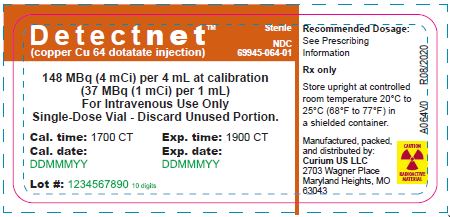
Principal Display Panel - Vial Detect net TM Sterile (copper Cu 64 dotatate injection) NDC 69945-064-01 148 MBq (4 mCi) per 4 mL at calibration (37 MBq (1 mCi) per 1 mL) For Intravenous Use Only Single-Dose Vial - Discard Unused Portion. Cal. time: 1700 CT Exp. time: 1900 CT Cal. date: Exp. date: Lot #: vial label
Principal Display Panel - Can Detect net TM (copper Cu 64 dotatate injection) NDC 69945-064-01 148 MBq (4 mCi) per 4 mL at calibration (37 MBq (1 mCi) per 1 mL) For Intravenous Use Only. Single-Dose Vial - Discard Unused Portion. Rx only Recommended adult dosage: 148 MBq (4 mCi) - See Prescribing Information.
Each mL contains: 37 MBq (1 mCi) of copper Cu 64 dotatate at calibration date and time, 40 mg ascorbic acid, 0.05 ml of dehydrated alcohol (ethanol) in sterile water for injection. Sodium hydroxide and / or hydrochloric acid is added for pH adjustment. Store upright at controlled room temperature 20°C to 25°C (68°F to 77°F) in a shielded container.
CURIUM TM Manufactured, packed, and distributed by: Curium US LLC. 2703 Wagner Place, Maryland Heights, MO 63043 can label
Medicaid utilization & spend
About this NDC listing & data coverage
What data is (and isn’t) available for this NDC — tap to expand
| NDC identity (package / product / labeler codes) | ✓ Available |
| Labeler | ✓ Available |
| Product & package description | ✓ Available |
| Marketing category & status | ✓ Available |
| Active ingredient / dosage form / route | ✓ Available |
| FDA label (SPL via DailyMed) | ✓ Available |
| Package photos | ✓ Available |
| Inactive ingredients (structured) | ✓ Available |
| NADAC pharmacy acquisition price (CMS) | — Not published for this NDC CMS publishes NADAC only for NDCs reported in its retail-pharmacy survey. |
| Orange Book / therapeutic-equivalence data | ✓ Available |
| HCPCS J-code billing crosswalk | — Not published for this NDC Most self-administered / retail products have no J-code — that is normal. |
| Medicaid utilization (CMS SDUD) | ✓ Available |