
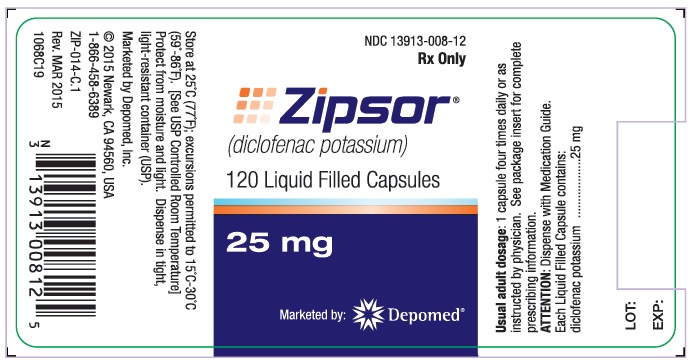
Zipsor diclofenac potassium 25 mg Capsule, Liquid Filled, 4-count — NDC 13913-008-94 (Billing 13913-0008-94)
This is a package of 4 capsules of Zipsor diclofenac potassium 25 mg Capsule, Liquid Filled from Assertio Therapeutics, Inc., no longer marketed (first marketed Jun 2009), no longer in the FDA NDC Directory.
NDC database record
One package, one record: these facts belong to NDC 13913-008-94 alone.
- Record
- FDA NDC Directory package listing · Human prescription drug
- Code segments
- 13913 labeler · 008 product · 94 package
- Listing certified through
- Dec 31, 2026
- Barcode (UPC)
- 0313913008125
- FDA record last changed
- Jul 24, 2026
Identity & classification
Regulatory identifiers FDA, NLM and CMS codes for this package
Drug-database identifiers Medi-Span GPI and First Databank GCN / HICL / AHFS classification
- GPI-14 (Medi-Span): 66100007100120
- RxCUI (RxNorm): 858342
Where does this data come from?
- FDA openFDA NDC Directory · synced Oct 8, 2026
- FDA label on DailyMed · label index refreshed Oct 8, 2026
- RxNorm (NLM RxNav) · catalog refreshed Oct 8, 2026
- Medi-Span GPI (licensed)
- First Databank (licensed) · refreshed Oct 8, 2026
RxNorm drug class
This medicine belongs to the Nonsteroidal Anti-inflammatory Drug class.
Where does this data come from?
- RxClass (NLM) · catalog refreshed Oct 8, 2026
Clinical
Diclofenac capsules (Zipsor, Zorvolex) and tablets (Cataflam) are used to relieve mild to moderate pain. Diclofenac extended-release tablets (Voltaren XR), tablets (Cataflam), and delayed-release tablets (available generically) are used to relieve pain, tenderness, swelling, and stiffness caused by osteoarthritis (arthritis caused by a breakdown of the lining of the joints), and rheumatoid arthritis (arthritis caused by swelling of the lining of the joints). Diclofenac extended-release tablets and delayed-release tablets are also used to treat ankylosing spondylitis (arthritis that mainly affe...
Read the full MedlinePlus article ↗- It's an NSAID used for pain and inflammation. Depending on the form, that may be arthritis, period pain, acute pain, strains and sprains, or migraine attacks. Check that your produ...
- Take oral forms by mouth and apply gels, solutions and patches to the skin as directed. Use the lowest dose for the shortest time that works. Food won't change how much you absorb,...
- Stomach upset, nausea, gas, diarrhea or constipation, headache and dizziness are common. Skin products can cause dryness, redness or irritation where applied. Call me or your docto...
- Get emergency help for chest pain, trouble breathing, weakness on one side, black or bloody stools, vomiting blood, or swelling of the face or tongue. Stop it and call for a new ra...
Patient education
Supplement & herbal interactions
Some supplements/herbs that may interact with Diclofenac Potassium — tap one for details:
Diclofenac Potassium may be associated with lower levels of 1 nutrient — worth a chat with your pharmacist, not a cause for alarm.
Where does this data come from?
- MedlinePlus (NLM) · refreshed Oct 8, 2026
- FDA label on DailyMed · label index refreshed Oct 8, 2026
Ask a licensed pharmacist directly — free, answered by our team.
Pricing
A drug doesn't have one price. Each row is a different public payment system, and none is what you'd pay at the counter — that depends on your insurance. The ⓘ on each row explains what it measures.
| Price system | Per mL | Per package |
|---|---|---|
| Retail pharmacies payNADAC · weekly | Not in the retail survey — common for institutional, discontinued, or low-volume packs. | |
| Medicaid paysCMS SDUD · 12 mo | No recent Medicaid claims on file for this NDC — rare and low-volume NDCs are suppressed in the public data. | |
| Medicare drug plans payPart D · quarterly | No Part D plan price is available for this NDC in our data. | |
Where does this data come from?
- CMS NADAC weekly file
- CMS ASP pricing files · refreshed Sep 20, 2026
- CMS Medicaid State Drug Utilization Data · refreshed Oct 9, 2026
- CMS Part D plan pricing files · refreshed Sep 24, 2026
- VA National Acquisition Center price file
Packaging — all sizes for this product
| Package NDC | Description | Per unit | Per pack | Marketing start | Marketing end | Status |
|---|---|---|---|---|---|---|
| 13913-0008-11 13913-008-11 | 100 CAPSULE, LIQUID FILLED in 1 BOTTLE | — | — | 2009-06-16 | — | Discontinued by firm |
| 13913-0008-12 13913-008-12 Main listing | 120 CAPSULE, LIQUID FILLED in 1 BOTTLE | $13.78 / ea | $1,653.19 | 2015-12-01 | — | Active |
| 13913-0008-94 You're viewing this | 1 BLISTER PACK in 1 CARTON / 4 CAPSULE, LIQUID FILLED in 1 BLISTER PACK | — | — | 2009-06-16 | — | Discontinued by firm |
Pack size FAQ
What quantity is in this package?
How does this package differ from NDC 13913-0008-11?
What NDC number is used to bill for this package of Zipsor diclofenac potassium 25 mg Capsule, Liquid Filled?
Prices are the latest CMS NADAC pharmacy acquisition cost per NDC; per-pack figures are per-unit × pack quantity, shown only when the pack is denominated in the same measure NADAC prices.
Therapeutic equivalents
| Product | Labeler | Pack | NADAC/unit | TE | Status | Price vs. this |
|---|---|---|---|---|---|---|
| Diclofenac potassium 25 mg 00480-9435-89 | TEVA | 120 capsules | $2.807 | AB | Availability likely | — |
| diclofenac potassium 25 mg 23155-0840-12 | Heritage | 120 capsules | $2.807 | AB | Availability likely | — |
| Diclofenac Potassium 25 mg 59088-0131-73 | PureTek | 120 capsules | $2.807 | AB | Availability likely | — |
| Diclofenac Potassium 25 mg 62135-0469-12 | Chartwell | 120 capsules | $2.807 | AB | Availability likely | — |
| Diclofenac Potassium 25 mg 69315-0275-20 | Leading | 120 capsules | $2.807 | AB | Availability likely | — |
| Diclofenac Potassium 25 mg 72336-0432-12 | Lifsa | 120 capsules | $2.807 | AB | Availability likely | — |
| Zipsor 25 mgthis 13913-0008-94 | Assertio | 4 capsules | — | AB | Discontinued | — |
| Diclofenac Potassium 25 mg 59651-0353-01 | Aurobindo | 100 capsules | — | — | FDA listed | — |
| Diclofenac potassium 25 mg 63629-4871-01 | Bryant | 30 capsules | — | AB | FDA listed | — |
| diclofenac potassium 25 mg 64380-0841-06 | Strides | 100 capsules | — | AB | FDA listed | — |
| Diclofenac Potassium 25 mg 71335-2550-01 | Bryant | 30 capsules | — | AB | FDA listed | — |
| Zipsor 25 mg 82497-0008-12 | Assertio | 120 capsules | — | AB | FDA listed | — |
Where does this data come from?
- FDA openFDA NDC Directory · synced Oct 8, 2026
- FDA Orange Book · refreshed Oct 9, 2026
- CMS NADAC weekly file
Availability & generic status
FDA-approved generic versions are listed, and recent pricing/market data suggests they may be available — see Therapeutic equivalents.
Why the date isn’t exact: Generic timing can change because patents may be challenged, settled, licensed, added, removed, or worked around with a narrower label — and FDA approval does not always mean a pharmacy can get the generic today.
🛈 What do these terms mean?
- Patent
- Legal protection listed in the Orange Book that may delay generic approval or launch. Issued by the U.S. Patent & Trademark Office.
- Substance patent
- Covers the active drug molecule itself — the hardest to design around. A generic generally can’t launch until it expires.
- Formulation (product) patent
- Covers a specific formulation or dosage form. A generic can sometimes work around it with a different formulation.
- Method-of-use patent
- A patent covering one specific approved use of the drug — not necessarily the whole molecule. A generic can sometimes launch with a “skinny label” that carves out the protected use and keeps the others.
- Skinny label
- A generic label that omits a still-patented use when the FDA allows it — letting a generic reach the market for the unprotected uses.
- Exclusivity
- FDA-granted marketing protection, separate from patents — e.g. 5-yr new chemical entity, 7-yr orphan drug, or a +6-month pediatric extension.
- Paragraph IV
- A generic applicant’s formal challenge to a listed patent. It can potentially lead to earlier generic entry, but often involves litigation or a settlement.
- RLD / RS
- Reference Listed Drug — the brand product the FDA uses as the reference for generic applications. Reference Standard — the product the FDA expects generics to compare against in bioequivalence testing.
- TE / AB rating
- FDA therapeutic-equivalence rating. An AB rating generally means the FDA considers a generic therapeutically equivalent to — and substitutable for — the brand.
- LOE (loss of exclusivity)
- The latest patent or exclusivity currently listed — the loss-of-exclusivity / latest-listed-protection date shown on this page. Paragraph-IV challenges and settlements can move the real date earlier; FDA approval and a manufacturer’s decision to market can move it later.
Built from the FDA Orange Book. The bars above are scaled to each protection’s expiry; the red LOE marker is the last one to lapse.
| Patent | Type | Use code | Expires |
|---|---|---|---|
| US 7884095 ↗ | Method of use | U-1111 | Feb 24, 2029 |
| US 8110606 ↗ | Method of use | U-980 | Feb 24, 2029 |
| US 7662858 ↗ | Method of use | U-1035 | Feb 24, 2029 |
| US 7939518 ↗ | Method of use | U-980 | Feb 24, 2029 |
| US 8623920 ↗ | Method of use | U-1482 | Feb 24, 2029 |
| US 9561200 ↗ | Method of use | U-1482 | Feb 24, 2029 |
Is there a generic version of this drug?
The FDA approved a generic — why can’t I get it at my pharmacy yet?
Why do different websites show different generic release dates?
What does “FDA listed” mean?
What does a patent or protection date mean here?
What does “current Orange Book estimate” mean?
Can a generic come out before the last patent expires?
Can a generic come out after the listed dates?
What is the difference between patents and exclusivity?
Why are there multiple patent dates?
Where does this data come from?
- FDA Orange Book · refreshed Oct 9, 2026
What it looks like
Where does this data come from?
- FDA label on DailyMed · label index refreshed Oct 8, 2026
Inactive Ingredients / Excipients
Inactive ingredients, also called excipients, are components of the drug product other than the active ingredient. They may include fillers, dyes, coatings, preservatives, flavors, or other formulation ingredients.
🧪 Avoiding an ingredient? See Diclofenac inactive ingredients by manufacturer: every current product's list side by side, so you can ask your pharmacy for the version that does not list it.
💡 Tap an ingredient (hover on desktop) to see what it is and why it’s used.
-
UNII 2G86QN327L
Gelatin is a protein derived from animal collagen, commonly used in medicines as a gelling agent and capsule material. It helps create soft or hard capsule shells that hold and release medication, and can also thicken liquid formulations.
-
UNII PDC6A3C0OX
Glycerin is a clear, thick liquid derived from plant oils or fats. It acts as a humectant to retain moisture, a sweetener, and a solvent in medications.
-
UNII QTT17582CB
A strong acid used to adjust and maintain the proper pH level in liquid medicines, ensuring stability and preventing breakdown of active ingredients.
-
UNII ND2M416302
Isopropyl alcohol is a clear liquid solvent derived from petroleum. In medicines, it dissolves active ingredients and other components, helps the product flow smoothly, and aids in sterilization during manufacturing.
-
UNII T5L8T28FGP
Mineral oil is a clear, odorless liquid derived from crude oil. It acts as a lubricant and emollient in medications, helping pills slide smoothly during manufacturing and aiding moisture retention in topical products.
-
UNII B697894SGQ
Polyethylene glycol 400 is a clear, thick liquid made from petroleum-derived polymers. It acts as a solvent and humectant in medicines, helping dissolve active ingredients and retain moisture in the formulation.
-
UNII 6OZP39ZG8H
Polysorbate 80 is a synthetic emulsifier derived from sorbitol and oleic acid. It helps mix oil and water-based ingredients together in medications and improves how the product disperses in the body.
-
UNII FZ989GH94E
Povidone is a synthetic polymer made from a plastic-like material. It acts as a binder to hold tablet ingredients together and as a disintegrant to help the tablet break apart in your stomach so the medicine can be absorbed.
-
UNII 506T60A25R
Sorbitol is a natural sugar alcohol derived from glucose. It serves as a sweetener, humectant, and bulking agent in medications to improve taste and help maintain moisture in the product.
9 inactive ingredients listed in the exact product block matched to this NDC.
Where does this data come from?
ingredient classCode="IACT" elements from the exact product block matched by this NDC. Label-section narrative from DailyMed / the openFDA label index is shown separately when available.- FDA label on DailyMed · label index refreshed Oct 8, 2026
- FDA openFDA NDC Directory · synced Oct 8, 2026
Inactive ingredient FAQ
Are inactive ingredients the same for every manufacturer?
Why might an inactive ingredient be missing?
Can inactive ingredients matter?
Manufacturer & labeler
More NDCs from Assertio Therapeutics, Inc. labeler code 13913
Where does this data come from?
- FDA openFDA NDC Directory · synced Oct 8, 2026
- Drugs@FDA
Full prescribing information FDA SPL
🚨 Boxed Warning ▾
WARNING: RISK OF SERIOUS CARDIOVASCULAR AND GASTROINTESTINAL EVENTS Cardiovascular Thrombotic Events Nonsteroidal anti-inflammatory drugs (NSAIDs) cause an increased risk of serious cardiovascular thrombotic events, including myocardial infarction and stroke, which can be fatal. This risk may occur early in treatment and may increase with duration of use [ see Warnings and Precautions ( 5.1 ) ]. ZIPSOR is contraindicated in the setting of coronary artery bypass graft (CABG) surgery [ see Contraindications ( 4 ) and Warnings and Precautions ( 5.1 ) ].
Gastrointestinal Bleeding, Ulceration, and Perforation NSAIDs cause an increased risk of serious gastrointestinal (GI) adverse events including bleeding, ulceration, and perforation of the stomach or intestines, which can be fatal. These events can occur at any time during use and without warning symptoms. Elderly patients and patients with a prior history of peptic ulcer disease and/or GI bleeding are at greater risk for serious GI events [ see Warnings and Precautions ( 5.2 )].
WARNING: RISK OF SERIOUS CARDIOVASCULAR AND GASTROINTESTINAL EVENTS See full prescribing information for complete boxed warning . Nonsteroidal anti-inflammatory drugs (NSAIDs) cause an increased risk of serious cardiovascular thrombotic events, including myocardial infarction and stroke, which can be fatal. This risk may occur early in treatment and may increase with duration of use ( 5.1 ) ZIPSOR is contraindicated in the setting of coronary artery bypass graft (CABG) surgery ( 4 , 5.1 ) NSAIDs cause an increased risk of serious gastrointestinal (GI) adverse events including bleeding, ulceration, and perforation of the stomach or intestines, which can be fatal.
These events can occur at any time during use and without warning symptoms. Elderly patients and patients with a prior history of peptic ulcer disease and/or GI bleeding are at greater risk for serious GI events ( 5.2 )
🎯 Indications and Usage ▾
1 INDICATIONS AND USAGE ZIPSOR is indicated for relief of mild to moderate acute pain in adult and pediatric patients 12 years of age and older. ZIPSOR is a non-steroidal anti-inflammatory drug indicated for relief of mild to moderate acute pain in adult and pediatric patients 12 years of age and older. ( 1 )
⏱️ Dosage and Administration ▾
2 DOSAGE AND ADMINISTRATION Use the lowest effective dosage for shortest duration consistent with individual patient treatment goals ( 2.1 ) The dosage is 25 mg four times a day
2.1General Dosing Instructions Carefully consider the potential benefits and risks of ZIPSOR and other treatment options before deciding to use ZIPSOR. Use the lowest effective dosage for the shortest duration consistent with individual patient treatment goals [ see Warnings and Precautions ( 5 )]. For treatment of mild to moderate acute pain in adult and pediatric patients 12 years of age and older, the dosage is 25 mg four times a day.
2.2Dosage Adjustments in Patients with Hepatic Impairment Patients with hepatic disease may require reduced doses of ZIPSOR compared to patients with normal hepatic function [see Clinical Pharmacology ( 12 ) ]. As with other diclofenac products, start treatment at the lowest dose. If efficacy is not achieved with the lowest dose, discontinue use.
2.3Non-Interchangeability with Other Formulations of Diclofenac Different dose strengths and formulations of oral diclofenac are not interchangeable. This difference should be taken into consideration when changing strengths or formulations. The only approved dosing regimen for ZIPSOR is 25 mg four times a day.
💊 Dosage Forms and Strengths ▾
3 DOSAGE FORMS AND STRENGTHS ZIPSOR (diclofenac potassium) capsule: 25 mg ZIPSOR (diclofenac potassium) capsule: 25 mg ( 3 )
⛔ Contraindications ▾
4 CONTRAINDICATIONS ZIPSOR is contraindicated in the following patients: Known hypersensitivity (e.g., anaphylactic reactions and serious skin reactions) to diclofenac or any components of the drug product [ see Warnings and Precautions ( 5.7 , 5.9 ) ] History of asthma, urticaria, or other allergic-type reactions after taking aspirin or other NSAIDs. Severe, sometimes fatal, anaphylactic reactions to NSAIDs have been reported in such patients [ see Warnings and Precautions ( 5.7 , 5.8 ) ] In the setting of coronary artery bypass graft (CABG) surgery [ see Warnings and Precautions ( 5.1 ) ] ZIPSOR contains gelatin and is contraindicated in patients with known hypersensitivity to bovine protein.
Known hypersensitivity to diclofenac or any components of the drug product ( 4 ) History of asthma, urticaria, or other allergic-type reactions after taking aspirin or other NSAIDs ( 4 ) In the setting of CABG surgery ( 4 ) ZIPSOR contains gelatin and should not be given to patients with known hypersensitivity to bovine protein. ( 4 )
⚠️ Warnings and Cautions ▾
5 WARNINGS AND PRECAUTIONS Hepatotoxicity : Inform patients of warning signs and symptoms of hepatotoxicity. Discontinue if abnormal liver tests persist or worsen or if clinical signs and symptoms of liver disease develop ( 5.3 ) Hypertension : Patients taking some antihypertensive medications may have impaired response to these therapies when taking NSAIDs. Monitor blood pressure ( 5.4 , 7 ) Heart Failure and Edema : Avoid use of ZIPSOR in patients with severe heart failure unless benefits are expected to outweigh risk of worsening heart failure ( 5.5 ) Renal Toxicity : Monitor renal function in patients with renal or hepatic impairment, heart failure, dehydration, or hypovolemia.
Avoid use of ZIPSOR in patients with advanced renal disease unless benefits are expected to outweigh risk of worsening renal function ( 5.6 ) Anaphylactic Reactions : Seek emergency help if an anaphylactic reaction occurs ( 5.7 ) Exacerbation of Asthma Related to Aspirin Sensitivity : ZIPSOR is contraindicated in patients with aspirin-sensitive asthma. Monitor patients with preexisting asthma (without aspirin sensitivity) ( 5.8 ) Serious Skin Reactions : Discontinue ZIPSOR at first appearance of skin rash or other signs of hypersensitivity ( 5.9 ) Drug Reaction with Eosinophilia and Systemic Symptoms (DRESS) : Discontinue and evaluate clinically ( 5.10 ).
Fetal Toxicity : Limit use of NSAIDs, including ZIPSOR, between about 20 to 30 weeks in pregnancy due to the risk of oligohydramnios/fetal renal dysfunction. Avoid use of NSAIDs in women at about 30 weeks gestation and later in pregnancy due to the risks of oligohydramnios/fetal renal dysfunction and premature closure of the fetal ductus arteriosus ( 5.11 , 8.1 ). Hematologic Toxicity : Monitor hemoglobin or hematocrit in patients with any signs or symptoms of anemia ( 5.12 , 7 )
5.1Cardiovascular Thrombotic Events Clinical trials of several COX-2 selective and nonselective NSAIDs of up to three years duration have shown an increased risk of serious cardiovascular (CV) thrombotic events, including myocardial infarction (MI) and stroke, which can be fatal. Based on available data, it is unclear that the risk for CV thrombotic events is similar for all NSAIDs. The relative increase in serious CV thrombotic events over baseline conferred by NSAID use appears to be similar in those with and without known CV disease or risk factors for CV disease.
However, patients with known CV disease or risk factors had a higher absolute incidence of excess serious CV thrombotic events, due to their increased baseline rate. Some observational studies found that this increased risk of serious CV thrombotic events began as early as the first weeks of treatment. The increase in CV thrombotic risk has been observed most consistently at higher doses.
To minimize the potential risk for an adverse CV event in NSAID-treated patients, use the lowest effective dose for the shortest duration possible. Physicians and patients should remain alert for the development of such events, throughout the entire treatment course, even in the absence of previous CV symptoms. Patients should be informed about the symptoms of serious CV events and the steps to take if they occur.
There is no consistent evidence that concurrent use of aspirin mitigates the increased risk of serious CV thrombotic events associated with NSAID use. The concurrent use of aspirin and an NSAID, such as diclofenac, increases the risk of serious gastrointestinal (GI) events [ see Warnings and Precautions ( 5.2 ) ]. Status Post Coronary Artery Bypass Graft (CABG) Surgery Two large, controlled clinical trials of a COX-2 selective NSAID for the treatment of pain in the first 10–14 days following CABG surgery found an increased incidence of myocardial infarction and stroke.
NSAIDs are contraindicated in the setting of CABG [ see Contraindications ( 4 ) ]. Post-MI Patients Observational studies conducted in the Danish National Registry have demonstrated that patients tre… [Excerpted — this section continues on DailyMed.]
🤒 Adverse Reactions ▾
6 ADVERSE REACTIONS The following adverse reactions are discussed in greater detail in other sections of the labeling: Cardiovascular Thrombotic Events [ see Warnings and Precautions ( 5.1 ) ] GI Bleeding, Ulceration and Perforation [ see Warnings and Precautions ( 5.2 ) ] Hepatotoxicity [ see Warnings and Precautions ( 5.3 ) ] Hypertension [ see Warnings and Precautions ( 5.4 ) ] Heart Failure and Edema [ see Warnings and Precautions ( 5.5 ) ] Renal Toxicity and Hyperkalemia [ see Warnings and Precautions ( 5.6 ) ] Anaphylactic Reactions [ see Warnings and Precautions ( 5.7 ) ] Serious Skin Reactions [ see Warnings and Precautions ( 5.9 ) ] Hematologic Toxicity [ see Warnings and Precautions ( 5.12 ) ] Most common adverse reactions (incidence ≥ 1%) are gastrointestinal experiences including abdominal pain, constipation, diarrhea, dyspepsia, nausea, vomiting, dizziness, headache, somnolence, pruritus, and increased sweating ( 6.1 ) To report SUSPECTED ADVERSE REACTIONS, contact Assertio Therapeutics, Inc. at 1-866-458-6389 or FDA at 1-800-FDA-1088 or www.fda.gov/medwatch.
6.1Clinical Trials Experience Because clinical trials are conducted under widely varying conditions, adverse reaction rates observed in clinical trials of a drug cannot be directly compared with the rates in clinical trials of another drug and may not reflect the rates observed in practice. The safety of ZIPSOR was evaluated in 965 adult subjects. In patients treated with ZIPSOR 25 mg (N=345) or a higher dose, three or four times a day, for 4 to 5 days, the most common adverse reactions (i.e., reported in ≥ 1% of ZIPSOR treated patients) were as follows: gastrointestinal experiences including abdominal pain, constipation, diarrhea, dyspepsia, nausea, vomiting, dizziness, headache, somnolence, pruritus, and increased sweating.
(see Table 1 ). The safety of ZIPSOR was evaluated in 125 pediatric patients, 12 years to 17 years of age. Forty-nine (49) patients with mild to moderate acute pain from a surgical procedure or an acute painful condition were treated with ZIPSOR 25 mg up to four times a day, for 4 days.
Seventy-six (76) pediatric patients who underwent insertion of either orthodontic separators or arch wires were treated with a single-dose of either ZIPSOR 25 mg or ZIPSOR 50 mg after completion of the procedure. The most common adverse reactions in the multiple-dose studies were nausea (14.3%), headache (10.2%), constipation (8.2%), abdominal pain (4.1%), vomiting (4.1%), dizziness (4.1%), back pain (4.1%), and musculoskeletal pain (4.1%). Table 1 Incidence of Treatment Emergent Adverse Reactions with Incidence ≥ 1% of ZIPSOR Treated Patients in Multiple-Dose Studies *There was greater use of concomitant opioid rescue medication in placebo treated patients than in ZIPSOR treated patients MedDRA System Organ Class and Preferred Term ZIPSOR* 25 mg n=345 n (%) Placebo* n=327 n (%) Any Adverse Events 144 (41.7) 181 (55.4) Nausea 57 (16.5) 66 (20.2) Headache 43 (12.5) 56 (17.1) Abdominal Pain 24 (7.0) 11 (3.4) Vomiting 20 (5.8) 17 (5.2) Dizziness 12 (3.5) 66 (20.2) Constipation 11 (3.2) 9 (2.8) Somnolence 9 (2.6) 6 (1.8) Diarrhea 8 (2.3) 9 (2.8) Pruritus 5 (1.4) 6 (1.8) Dyspepsia 4 (1.2) 8 (2.4) Sweating Increase 4 (1.2) 2 (0.6) In patients taking other NSAIDs, the most frequently reported adverse experiences occurring in approximately 1%-10% of patients are: Gastrointestinal experiences including: abdominal pain, constipation, diarrhea, dyspepsia, flatulence, gross bleeding/perforation, heartburn, nausea, GI ulcers (gastric/duodenal) and vomiting.
Abnormal renal function, anemia, dizziness, edema, elevated liver enzymes, headaches, increased bleeding time, pruritus, rashes, and tinnitus. Additional adverse experiences reported in patients taking other NSAIDs occasionally include: Body as a Whole: fever, infection, sepsis Cardiovascular System: congestive heart failure, hypertension, tachycardia, syncope Digestive System: dry mouth, esophagitis, gastric/pept… [Excerpted — this section continues on DailyMed.]
🔄 Drug Interactions ▾
7 DRUG INTERACTIONS See Table 2 for clinically significant drug interactions with diclofenac. Table 2: Clinically Significant Drug Interactions with diclofenac Drugs That Interfere with Hemostasis Clinical Impact: Diclofenac and anticoagulants such as warfarin have a synergistic effect on bleeding. The concomitant use of diclofenac and anticoagulants have an increased risk of serious bleeding compared to the use of either drug alone.
Serotonin release by platelets plays an important role in hemostasis. Case-control and cohort epidemiological studies showed that concomitant use of drugs that interfere with serotonin reuptake and an NSAID may potentiate the risk of bleeding more than an NSAID alone. Intervention: Monitor patients with concomitant use of ZIPSOR with anticoagulants (e.g., warfarin), antiplatelet agents (e.g., aspirin), selective serotonin reuptake inhibitors (SSRIs), and serotonin norepinephrine reuptake inhibitors (SNRIs) for signs of bleeding [ see Warnings and Precautions ( 5.12 ) ].
Aspirin Clinical Impact: Controlled clinical studies showed that the concomitant use of NSAIDs and analgesic doses of aspirin does not produce any greater therapeutic effect than the use of NSAIDs alone. In a clinical study, the concomitant use of an NSAID and aspirin was associated with a significantly increased incidence of GI adverse reactions as compared to use of the NSAID alone [ see Warnings and Precautions ( 5.2 ) ]. Intervention: Concomitant use of ZIPSOR and analgesic doses of aspirin is not generally recommended because of the increased risk of bleeding [ see Warnings and Precautions ( 5.12 ) ].
ZIPSOR is not a substitute for low dose aspirin for cardiovascular protection. ACE Inhibitors, Angiotensin Receptor Blockers, and Beta-Blockers Clinical Impact: NSAIDs may diminish the antihypertensive effect of angiotensin converting enzyme (ACE) inhibitors, angiotensin receptor blockers (ARBs), or beta-blockers (including propranolol). In patients who are elderly, volume-depleted (including those on diuretic therapy), or have renal impairment, co-administration of an NSAID with ACE inhibitors or ARBs may result in deterioration of renal function, including possible acute renal failure.
These effects are usually reversible. Intervention: During concomitant use of ZIPSOR and ACE-inhibitors, ARBs, or beta-blockers, monitor blood pressure to ensure that the desired blood pressure is obtained. During concomitant use of ZIPSOR and ACE-inhibitors or ARBs in patients who are elderly, volume-depleted, or have impaired renal function, monitor for signs of worsening renal function [ see Warnings and Precautions ( 5.6 ) ].
When these drugs are administered concomitantly, patients should be adequately hydrated. Assess renal function at the beginning of the concomitant treatment and periodically thereafter. Diuretics Clinical Impact: Clinical studies, as well as post-marketing observations, showed that NSAIDs reduced the natriuretic effect of loop diuretics (e.g., furosemide) and thiazide diuretics in some patients.
This effect has been attributed to the NSAID inhibition of renal prostaglandin synthesis. Intervention: During concomitant use of ZIPSOR with diuretics, observe patients for signs of worsening renal function, in addition to assuring diuretic efficacy including antihypertensive effects [ see Warnings and Precautions ( 5.6 ) ]. Digoxin Clinical Impact: The concomitant use of diclofenac with digoxin has been reported to increase the serum concentration and prolong the half-life of digoxin.
Intervention: During concomitant use of ZIPSOR and digoxin, monitor serum digoxin levels. Lithium Clinical Impact: NSAIDs have produced elevations in plasma lithium levels and reductions in renal lithium clearance. The mean minimum lithium concentration increased 15%, and the renal clearance decreased by approximately 20%.
This effect has been attributed to NSAID inhibition of renal prostaglandin synthesis. Intervention: During concomitant use of… [Excerpted — this section continues on DailyMed.]
👥 Use in Specific Populations ▾
8 USE IN SPECIFIC POPULATIONS Infertility : NSAIDs are associated with reversible infertility. Consider withdrawal of ZIPSOR in women who have difficulties conceiving ( 8.3 )
8.1Pregnancy Risk Summary Use of NSAIDs, including ZIPSOR, can cause premature closure of the fetal ductus arteriosus and fetal renal dysfunction leading to oligohydramnios and, in some cases, neonatal renal impairment. Because of these risks, limit dose and duration of ZIPSOR use between about 20 and 30 weeks of gestation, and avoid ZIPSOR use at about 30 weeks of gestation and later in pregnancy ( see Clinical Considerations, Data ). Premature Closure of Fetal Ductus Arteriosus Use of NSAIDs, including ZIPSOR, at about 30 weeks gestation or later in pregnancy increases the risk of premature closure of the fetal ductus arteriosus.
Oligohydramnios/Neonatal Renal Impairment Use of NSAIDs at about 20 weeks gestation or later in pregnancy has been associated with cases of fetal renal dysfunction leading to oligohydramnios, and in some cases, neonatal renal impairment. Data from observational studies regarding other potential embryofetal risks of NSAID use in women in the first or second trimesters of pregnancy are inconclusive. In animal reproduction studies, no evidence of malformations was observed in mice, rats, and rabbits given diclofenac during the period of organogenesis at doses up to approximately 1, 1, and 2 times, respectively, the maximum recommended human dose (MRHD) of ZIPSOR, despite the presence of maternal and fetal toxicity at these doses.
In published studies, administration of clinically relevant doses of diclofenac to pregnant rats produced adverse effects on brain, kidney, and testicular development [ see Data ]. Based on animal data, prostaglandins have been shown to have an important role in endometrial vascular permeability, blastocyst implantation, and decidualization. In animal studies, administration of prostaglandin synthesis inhibitors such as diclofenac, resulted in increased pre- and post-implantation loss.
Prostaglandins also have been shown to have an important role in fetal kidney development. In published animal studies, prostaglandin synthesis inhibitors have been reported to impair kidney development when administered at clinically relevant doses. The estimated background risk of major birth defects and miscarriage for the indicated population(s) is unknown.
All pregnancies have a background risk of birth defect, loss, or other adverse outcomes. In the U.S. general population, the estimated background risk of major birth defects and miscarriage in clinically recognized pregnancies is 2 to 4% and 15 to 20%, respectively. Clinical Considerations Fetal/Neonatal Adverse Reactions Premature Closure of Fetal Ductus Arteriosus: Avoid use of NSAIDs in women at about 30 weeks gestation and later in pregnancy, because NSAIDs, including ZIPSOR, can cause premature closure of the fetal ductus arteriosus ( see Data ).
Oligohydramnios/Neonatal Renal Impairment: If an NSAID is necessary at about 20 weeks gestation or later in pregnancy, limit the use to the lowest dose and shortest duration possible. If ZIPSOR treatment extends beyond 48 hours, consider monitoring with ultrasound for oligohydramnios. If oligohydramnios occurs, discontinue ZIPSOR and follow up according to clinical practice ( see Data ).
Labor or Delivery There are no studies on the effects of ZIPSOR during labor or delivery. In animal studies, NSAIDS, including diclofenac, inhibit prostaglandin synthesis, cause delayed parturition, and increase the incidence of stillbirth. Data Human Data Premature Closure of Fetal Ductus Arteriosus: Published literature reports that the use of NSAIDs at about 30 weeks of gestation and later in pregnancy may cause premature closure of the fetal ductus arteriosus.
Oligohydramnios/Neonatal Renal Impairment: Published studies and postmarketing reports describe maternal NSAID use at about 20 weeks gestation or later in pregnancy associate… [Excerpted — this section continues on DailyMed.]
🤰 Pregnancy ▾
8.1Pregnancy Risk Summary Use of NSAIDs, including ZIPSOR, can cause premature closure of the fetal ductus arteriosus and fetal renal dysfunction leading to oligohydramnios and, in some cases, neonatal renal impairment. Because of these risks, limit dose and duration of ZIPSOR use between about 20 and 30 weeks of gestation, and avoid ZIPSOR use at about 30 weeks of gestation and later in pregnancy ( see Clinical Considerations, Data ). Premature Closure of Fetal Ductus Arteriosus Use of NSAIDs, including ZIPSOR, at about 30 weeks gestation or later in pregnancy increases the risk of premature closure of the fetal ductus arteriosus.
Oligohydramnios/Neonatal Renal Impairment Use of NSAIDs at about 20 weeks gestation or later in pregnancy has been associated with cases of fetal renal dysfunction leading to oligohydramnios, and in some cases, neonatal renal impairment. Data from observational studies regarding other potential embryofetal risks of NSAID use in women in the first or second trimesters of pregnancy are inconclusive. In animal reproduction studies, no evidence of malformations was observed in mice, rats, and rabbits given diclofenac during the period of organogenesis at doses up to approximately 1, 1, and 2 times, respectively, the maximum recommended human dose (MRHD) of ZIPSOR, despite the presence of maternal and fetal toxicity at these doses.
In published studies, administration of clinically relevant doses of diclofenac to pregnant rats produced adverse effects on brain, kidney, and testicular development [ see Data ]. Based on animal data, prostaglandins have been shown to have an important role in endometrial vascular permeability, blastocyst implantation, and decidualization. In animal studies, administration of prostaglandin synthesis inhibitors such as diclofenac, resulted in increased pre- and post-implantation loss.
Prostaglandins also have been shown to have an important role in fetal kidney development. In published animal studies, prostaglandin synthesis inhibitors have been reported to impair kidney development when administered at clinically relevant doses. The estimated background risk of major birth defects and miscarriage for the indicated population(s) is unknown.
All pregnancies have a background risk of birth defect, loss, or other adverse outcomes. In the U.S. general population, the estimated background risk of major birth defects and miscarriage in clinically recognized pregnancies is 2 to 4% and 15 to 20%, respectively. Clinical Considerations Fetal/Neonatal Adverse Reactions Premature Closure of Fetal Ductus Arteriosus: Avoid use of NSAIDs in women at about 30 weeks gestation and later in pregnancy, because NSAIDs, including ZIPSOR, can cause premature closure of the fetal ductus arteriosus ( see Data ).
Oligohydramnios/Neonatal Renal Impairment: If an NSAID is necessary at about 20 weeks gestation or later in pregnancy, limit the use to the lowest dose and shortest duration possible. If ZIPSOR treatment extends beyond 48 hours, consider monitoring with ultrasound for oligohydramnios. If oligohydramnios occurs, discontinue ZIPSOR and follow up according to clinical practice ( see Data ).
Labor or Delivery There are no studies on the effects of ZIPSOR during labor or delivery. In animal studies, NSAIDS, including diclofenac, inhibit prostaglandin synthesis, cause delayed parturition, and increase the incidence of stillbirth. Data Human Data Premature Closure of Fetal Ductus Arteriosus: Published literature reports that the use of NSAIDs at about 30 weeks of gestation and later in pregnancy may cause premature closure of the fetal ductus arteriosus.
Oligohydramnios/Neonatal Renal Impairment: Published studies and postmarketing reports describe maternal NSAID use at about 20 weeks gestation or later in pregnancy associated with fetal renal dysfunction leading to oligohydramnios, and in some cases, neonatal renal impairment. These adverse outcomes are seen, on average, after days to weeks of tr… [Excerpted — this section continues on DailyMed.]
🧒 Pediatric Use ▾
8.4Pediatric Use The safety and effectiveness of ZIPSOR in pediatric patients 12 years to 17 years of age have been established. Use of ZIPSOR in this age group is based on extrapolation of efficacy from adequate and well-controlled studies in adults and supported by pharmacokinetic and safety data from two open-label studies in 49 patients 12 years to 17 years of age with mild to moderate acute pain and one active-controlled study in 76 pediatric patients 12 years to 16 years of age with orthodontic discomfort. Based on the available data, the plasma diclofenac concentration in adolescent patients was comparable to that observed in healthy adults.
The safety profile of ZIPSOR in adolescent patients was similar to adults. The safety and effectiveness of ZIPSOR in patients less than 12 years of age have not been established.
🧓 Geriatric Use ▾
8.5Geriatric Use Elderly patients, compared to younger patients, are at greater risk for NSAID-associated serious cardiovascular, gastrointestinal, and/or renal adverse reactions. If the anticipated benefit for the elderly patient outweighs these potential risks, start dosing at the low end of the dosing range, and monitor patients for adverse effects [ see Warnings and Precautions ( 5.1 , 5.2 , 5.3 , 5.6 , 5.13 )]. Diclofenac is known to be substantially excreted by the kidney, and the risk of adverse reactions to this drug may be greater in patients with impaired renal function.
Because elderly patients are more likely to have decreased renal function, care should be taken in dose selection, and it may be useful to monitor renal function.
🆘 Overdosage ▾
10 OVERDOSAGE Symptoms following acute NSAID overdosages have been typically limited to lethargy, drowsiness, nausea, vomiting, and epigastric pain, which have been generally reversible with supportive care. Gastrointestinal bleeding has occurred. Hypertension, acute renal failure, respiratory depression, and coma have occurred, but were rare [ see Warnings and Precautions ( 5.1 , 5.2 , 5.4 , 5.6 ) ].
Manage patients with symptomatic and supportive care following an NSAID overdosage. There are no specific antidotes. Consider emesis and/or activated charcoal (60 to 100 grams in adults, 1 to 2 grams per kg of body weight in pediatric patients) and/or osmotic cathartic in symptomatic patients seen within four hours of ingestion or in patients with a large overdosage (5 to 10 times the recommended dosage).
Forced diuresis, alkalinization of urine, hemodialysis, or hemoperfusion may not be useful due to high protein binding. For additional information about overdosage treatment contact a poison control center (1- 800-222-1222).
🧬 Clinical Pharmacology ▾
12 CLINICAL PHARMACOLOGY
12.1Mechanism of Action Diclofenac has analgesic, anti-inflammatory, and antipyretic properties. The mechanism of action of ZIPSOR, like that of other NSAIDs, is not completely understood but involves inhibition of cyclooxygenase (COX-1 and COX-2). Diclofenac is a potent inhibitor of prostaglandin synthesis in vitro.
Diclofenac concentrations reached during therapy have produced in vivo effects. Prostaglandins sensitize afferent nerves and potentiate the action of bradykinin in inducing pain in animal models. Prostaglandins are mediators of inflammation.
Because diclofenac is an inhibitor of prostaglandin synthesis, its mode of action may be due to a decrease of prostaglandins in peripheral tissues.
12.3Pharmacokinetics The pharmacokinetics of ZIPSOR was assessed in 24 healthy, normal adult volunteers who received 25 mg ZIPSOR under fasting conditions. The mean pharmacokinetic parameters for ZIPSOR are shown in Table 3 . The pharmacokinetics of ZIPSOR was also assessed in pediatric patients 12 to 17 years of age [ see Specific Populations: Pediatric ] and was found to be similar to adults.
Table 3 Mean Pharmacokinetics of ZIPSOR in Adults PK Parameter Number of Subjects Mean ± Standard Deviation T max (hr) 24 0.47 ±
0.17Terminal Half-life (hr) 24 1.07 ±
0.29C max (ng/mL) 24 1087 ± 419 AUC(0-∞) (ng·h/mL) 24 597 ± 151 Absorption Diclofenac is 100% absorbed after oral administration compared to IV administration as measured by urine recovery. However, due to first-pass metabolism, only about 50% of the absorbed dose is systemically available. After repeated oral administration, no accumulation of diclofenac in plasma occurred.
The extent of diclofenac absorption is not significantly affected when ZIPSOR is taken with food. However, the rate of absorption is reduced by food, as indicated by a two-fold increase of T max and a 47% decrease in C max . Distribution The apparent volume of distribution (V/F) of diclofenac potassium is
1.3L/kg. Diclofenac is more than 99% bound to human serum proteins, primarily to albumin. Serum protein binding is constant over the concentration range (0.15-105 μg/mL) achieved with recommended doses.
Diclofenac has been shown to cross the placental barrier in humans. Diclofenac diffuses into and out of the synovial fluid. Diffusion into the joint occurs when plasma levels are higher than those in the synovial fluid, after which the process reverses and synovial fluid levels are higher than plasma levels.
It is not known whether diffusion into the joint plays a role in the effectiveness of diclofenac. Elimination Metabolism Five diclofenac metabolites have been identified in human plasma and urine. The metabolites include 4'-hydroxy-, 5-hydroxy-, 3'-hydroxy-, 4',5-dihydroxy- and 3'- hydroxy-4'-methoxy diclofenac.
The major diclofenac metabolite, 4'-hydroxy-diclofenac, has very weak pharmacologic activity. The formation of 4'-hydroxy diclofenac is primarily mediated by CPY2C9. Both diclofenac and its oxidative metabolites undergo glucuronidation or sulfation followed by biliary excretion.
Acylglucuronidation mediated by UGT2B7 and oxidation mediated by CPY2C8 may also play a role in diclofenac metabolism. CYP3A4 is responsible for the formation of minor metabolites, 5-hydroxy and 3'-hydroxy- diclofenac. In patients with renal dysfunction, peak concentrations of metabolites 4'-hydroxy-and 5-hydroxy-diclofenac were approximately 50% and 4% of the parent compound after single oral dosing compared to 27% and 1% in normal healthy subjects.
Excretion Diclofenac is eliminated through metabolism and subsequent urinary and biliary excretion of the glucuronide and the sulfate conjugates of the metabolites. Little or no free unchanged diclofenac is excreted in the urine. Approximately 65% of the dose is excreted in the urine, and approximately 35% in the bile as conjugates of unchanged diclofenac plus metabolites.
Because renal elimination is not a significant pathway of elimination for… [Excerpted — this section continues on DailyMed.]
🧬 Mechanism of Action ▾
12.1Mechanism of Action Diclofenac has analgesic, anti-inflammatory, and antipyretic properties. The mechanism of action of ZIPSOR, like that of other NSAIDs, is not completely understood but involves inhibition of cyclooxygenase (COX-1 and COX-2). Diclofenac is a potent inhibitor of prostaglandin synthesis in vitro.
Diclofenac concentrations reached during therapy have produced in vivo effects. Prostaglandins sensitize afferent nerves and potentiate the action of bradykinin in inducing pain in animal models. Prostaglandins are mediators of inflammation.
Because diclofenac is an inhibitor of prostaglandin synthesis, its mode of action may be due to a decrease of prostaglandins in peripheral tissues.
📦 How Supplied / Storage and Handling ▾
16 HOW SUPPLIED/STORAGE AND HANDLING ZIPSOR (diclofenac potassium) 25 mg, are translucent, pale yellow, liquid-filled capsules printed with “X592” in black ink supplied as: Bottles of 120 Capsules NDC# 13913-008-12. Storage Store at room temperature 20°C to 25°C (68°F to 77°F); excursions permitted between 15°C to 30°C (59°F to 86°F) [see USP Controlled Room Temperature]. Protect from moisture Dispense in tight container (USP).
📋 Description ▾
11 DESCRIPTION ZIPSOR (diclofenac potassium) capsule is a nonsteroidal anti-inflammatory drug, available as liquid-filled capsules of 25 mg base, equivalent to 28.3 mg potassium salt for oral administration. Diclofenac potassium is a white to slight yellowish crystalline powder. It is sparingly soluble in water at 25°C.
The chemical name is benzeneacetic acid,2-[(2,6- dichlorophenyl) amino]-, monopotassium salt. The molecular weight is 334.24. Its molecular formula is C 14 H 10 Cl 2 NKO 2 , and it has the following chemical structure.
The inactive ingredients in ZIPSOR include: ProSorb ® (a proprietary combination of polyethylene glycol 400, glycerin, sorbitol, povidone, polysorbate 80, and hydrochloric acid), isopropyl alcohol, and mineral oil. The capsule shells contain gelatin, sorbitol, isopropyl alcohol, glycerin, and mineral oil. Structural Formula
💬 Information for Patients ▾
17 PATIENT COUNSELING INFORMATION Advise the patient to read the FDA-approved patient labeling (Medication Guide) that accompanies each prescription dispensed. Inform patients, families, or their caregivers of the following information before initiating therapy with ZIPSOR and periodically during the course of ongoing therapy. Cardiovascular Thrombotic Events Advise patients to be alert for the symptoms of cardiovascular thrombotic events, including chest pain, shortness of breath, weakness, or slurring of speech, and to report any of these symptoms to their health care provider immediately [ see Warnings and Precautions ( 5.1 ) ].
Gastrointestinal Bleeding, Ulceration, and Perforation Advise patients to report symptoms of ulcerations and bleeding, including epigastric pain, dyspepsia, melena, and hematemesis to their health care provider. In the setting of concomitant use of low-dose aspirin for cardiac prophylaxis, inform patients of the increased risk for and the signs and symptoms of GI bleeding [ see Warnings and Precautions ( 5.2 ) ]. Hepatotoxicity Inform patients of the warning signs and symptoms of hepatotoxicity (e.g., nausea, fatigue, lethargy, pruritus, diarrhea, jaundice, right upper quadrant tenderness, and “flu-like” symptoms).
If these occur, instruct patients to stop ZIPSOR and seek immediate medical therapy [ see Warnings and Precautions ( 5.3 ) ]. Heart Failure and Edema Advise patients to be alert for the symptoms of congestive heart failure including shortness of breath, unexplained weight gain, or edema and to contact their healthcare provider if such symptoms occur [ see Warnings and Precautions ( 5.5 ) ]. Anaphylactic Reactions Inform patients of the signs of an anaphylactic reaction (e.g., difficulty breathing, swelling of the face or throat).
Instruct patients to seek immediate emergency help if these occur [ see Contraindications ( 4 ) and Warnings and Precautions ( 5.7 )]. Serious Skin Reactions, including DRESS Advise patients to stop taking ZIPSOR immediately if they develop any type of rash or fever and to contact their healthcare provider as soon as possible [ see Warnings and Precautions ( 5.9 , 5.10 ) ]. Female Fertility Advise females of reproductive potential who desire pregnancy that NSAIDs, including ZIPSOR, may be associated with a reversible delay in ovulation [ see Use in Specific Populations ( 8.3 ) ].
Fetal Toxicity Inform pregnant women to avoid use of ZIPSOR and other NSAIDs starting at 30 weeks gestation because of the risk of the premature closing of the fetal ductus arteriosus. If treatment with ZIPSOR is needed for a pregnant woman between about 20 to 30 weeks gestation, advise her that she may need to be monitored for oligohydramnios if treatment continues for longer than 48 hours [ see Warnings and Precautions ( 5.11 ) and Use in Specific Populations ( 8.1 ) ]. Avoid Concomitant Use of NSAIDs Inform patients that the concomitant use of ZIPSOR with other NSAIDs or salicylates (e.g., diflunisal, salsalate) is not recommended due to the increased risk of gastrointestinal toxicity, and little or no increase in efficacy [ see Warnings and Precautions ( 5.2 ) and Drug Interactions ( 7 ) ].
Alert patients that NSAIDs may be present in “over the counter” medications for treatment of colds, fever, or insomnia. Use of NSAIDs and Low-Dose Aspirin Inform patients not to use low-dose aspirin concomitantly with ZIPSOR until they talk to their healthcare provider [see Drug Interactions ( 7 ) ]. US Patents: 6,365,180; 7,662,858; 7,884,095; 7,939,518; 8,110,606; 6,287,594; 8,623,920 Distributed by: Assertio Therapeutics, Inc.
Lake Forest, IL 60045, USA Issued: 09/2025
💬 Medication Guide ▾
This Medication Guide has been approved by the U.S. Food and Drug Administration. Issued or Revised: April 2021 ZIP-001-C.7 Medication Guide for Nonsteroidal Anti-inflammatory Drugs (NSAIDs) What is the most important information I should know about medicines called Nonsteroidal Anti- inflammatory Drugs (NSAIDs)?
NSAIDs can cause serious side effects, including: • Increased risk of a heart attack or stroke that can lead to death . This risk may happen early in treatment and may increase: ○ with increasing doses of NSAIDs ○ with longer use of NSAIDs Do not take NSAIDs right before or after a heart surgery called a “coronary artery bypass graft (CABG)." Avoid taking NSAIDs after a recent heart attack, unless your healthcare provider tells you to. You may have an increased risk of another heart attack if you take NSAIDs after a recent heart attack. • Increased risk of bleeding, ulcers, and tears (perforation) of the esophagus (tube leading from the mouth to the stomach), stomach and intestines: ○ anytime during use ○ without warning symptoms ○ that may cause death The risk of getting an ulcer or bleeding increases with: ○ past history of stomach ulcers, or stomach or intestinal bleeding with use of NSAIDs ○ taking medicines called “corticosteroids”, “anticoagulants”, “SSRIs”, or “SNRIs” ○ increasing doses of NSAIDs ○ longer use of NSAIDs ○ smoking ○ drinking alcohol ○ older age ○ poor health ○ advanced liver disease ○ bleeding problems NSAIDs should only be used: ○ exactly as prescribed ○ at the lowest dose possible for your treatment ○ for the shortest time needed What are NSAIDs?
NSAIDs are used to treat pain and redness, swelling, and heat (inflammation) from medical conditions such as different types of arthritis, menstrual cramps, and other types of short-term pain. Who should not take NSAIDs? Do not take NSAIDs: if you have had an asthma attack, hives, or other allergic reaction with aspirin or any other NSAIDs. right before or after heart bypass surgery.
Before taking NSAIDS, tell your healthcare provider about all of your medical conditions, including if you: have liver or kidney problems have high blood pressure have asthma are pregnant or plan to become pregnant. Taking NSAIDs at about 20 weeks of pregnancy or later may harm your unborn baby. If you need to take NSAIDs for more than 2 days when you are between 20 and 30 weeks of pregnancy, your healthcare provider may need to monitor the amount of fluid in your womb around your baby.
You should not take NSAIDs after about 30 weeks of pregnancy. are breastfeeding or plan to breast feed. Tell your healthcare provider about all of the medicines you take, including prescription or over-the- counter medicines, vitamins or herbal supplements. NSAIDs and some other medicines can interact with each other and cause serious side effects.
Do not start taking any new medicine without talking to your healthcare provider first. What are the possible side effects of NSAIDs? NSAIDs can cause serious side effects, including: See “ What is the most important information I should know about medicines called Nonsteroidal Anti- inflammatory Drugs (NSAIDs)? new or worse high blood pressure heart failure liver problems including liver failure kidney problems including kidney failure low red blood cells (anemia) life-threatening skin reactions life-threatening allergic reactions Other side effects of NSAIDs include: stomach pain, constipation, diarrhea, gas, heartburn, nausea, vomiting, and dizziness.
Get emergency help right away if you get any of the following symptoms: shortness of breath or trouble breathing chest pain weakness in one part or side of your body slurred speech swelling of the face or throat Stop taking your NSAID and call your healthcare provider right away if you get any of the following symptoms: nausea more tired or weaker than usual diarrhea itching your skin or eyes look yellow indigestion or stomach pain flu-like symptoms vomit blood there is blood in your bowel moveme… [Excerpted — this section continues on DailyMed.]
🧬 Pharmacokinetics ▾
12.3Pharmacokinetics The pharmacokinetics of ZIPSOR was assessed in 24 healthy, normal adult volunteers who received 25 mg ZIPSOR under fasting conditions. The mean pharmacokinetic parameters for ZIPSOR are shown in Table 3 . The pharmacokinetics of ZIPSOR was also assessed in pediatric patients 12 to 17 years of age [ see Specific Populations: Pediatric ] and was found to be similar to adults.
Table 3 Mean Pharmacokinetics of ZIPSOR in Adults PK Parameter Number of Subjects Mean ± Standard Deviation T max (hr) 24 0.47 ±
0.17Terminal Half-life (hr) 24 1.07 ±
0.29C max (ng/mL) 24 1087 ± 419 AUC(0-∞) (ng·h/mL) 24 597 ± 151 Absorption Diclofenac is 100% absorbed after oral administration compared to IV administration as measured by urine recovery. However, due to first-pass metabolism, only about 50% of the absorbed dose is systemically available. After repeated oral administration, no accumulation of diclofenac in plasma occurred.
The extent of diclofenac absorption is not significantly affected when ZIPSOR is taken with food. However, the rate of absorption is reduced by food, as indicated by a two-fold increase of T max and a 47% decrease in C max . Distribution The apparent volume of distribution (V/F) of diclofenac potassium is
1.3L/kg. Diclofenac is more than 99% bound to human serum proteins, primarily to albumin. Serum protein binding is constant over the concentration range (0.15-105 μg/mL) achieved with recommended doses.
Diclofenac has been shown to cross the placental barrier in humans. Diclofenac diffuses into and out of the synovial fluid. Diffusion into the joint occurs when plasma levels are higher than those in the synovial fluid, after which the process reverses and synovial fluid levels are higher than plasma levels.
It is not known whether diffusion into the joint plays a role in the effectiveness of diclofenac. Elimination Metabolism Five diclofenac metabolites have been identified in human plasma and urine. The metabolites include 4'-hydroxy-, 5-hydroxy-, 3'-hydroxy-, 4',5-dihydroxy- and 3'- hydroxy-4'-methoxy diclofenac.
The major diclofenac metabolite, 4'-hydroxy-diclofenac, has very weak pharmacologic activity. The formation of 4'-hydroxy diclofenac is primarily mediated by CPY2C9. Both diclofenac and its oxidative metabolites undergo glucuronidation or sulfation followed by biliary excretion.
Acylglucuronidation mediated by UGT2B7 and oxidation mediated by CPY2C8 may also play a role in diclofenac metabolism. CYP3A4 is responsible for the formation of minor metabolites, 5-hydroxy and 3'-hydroxy- diclofenac. In patients with renal dysfunction, peak concentrations of metabolites 4'-hydroxy-and 5-hydroxy-diclofenac were approximately 50% and 4% of the parent compound after single oral dosing compared to 27% and 1% in normal healthy subjects.
Excretion Diclofenac is eliminated through metabolism and subsequent urinary and biliary excretion of the glucuronide and the sulfate conjugates of the metabolites. Little or no free unchanged diclofenac is excreted in the urine. Approximately 65% of the dose is excreted in the urine, and approximately 35% in the bile as conjugates of unchanged diclofenac plus metabolites.
Because renal elimination is not a significant pathway of elimination for unchanged diclofenac, dosing adjustment in patients with mild to moderate renal dysfunction is not necessary. The terminal half-life of unchanged diclofenac is approximately 1 hour. Specific Populations Pediatric: The pharmacokinetics of ZIPSOR was assessed in 24 pediatric patients 12 years to 17 years of age with mild to moderate acute pain who received 25 mg ZIPSOR every six hours as needed for pain for up to four days.
The mean pharmacokinetic parameters of ZIPSOR on Day 1 in pediatric patients 12 years to 17 years of age are shown in Table 4. Peak plasma levels were noted in one hour, with an elimination half-life of less than 2 hours. The pharmacokinetics of ZIPSOR in pediatric patients 12 years to 17 years of age was s… [Excerpted — this section continues on DailyMed.]
🔬 Clinical Studies ▾
14 CLINICAL STUDIES The efficacy of ZIPSOR in adults was demonstrated in two multicenter, randomized, double-blind, placebo- controlled, parallel arm, multiple-dose clinical trials comparing ZIPSOR 25 mg and placebo in patients with pain following bunionectomy with osteotomy. Once patients met the criteria for randomization (pain intensity ≥4 on a 0-10 numerical pain rating scale) they received their initial dose of study medication followed by a remedication dose when requested by the patient, and were then dosed every six hours over four days.
Pain intensity was recorded at 3 and 6 hours postdose during the fixed dosing period. In Study 1, mean baseline pain intensity scores were 6.9 in the ZIPSOR group (range: 4 – 10) and 7.3 in the placebo group (range: 4 – 10). In both studies, patients treated with ZIPSOR had a lower mean pain intensity score over the 48-hour inpatient period following the first remedication dose (see Figure 1 ).
The median time to onset of pain relief was less than one hour for ZIPSOR 25 mg across the clinical trials. The results were similar in Study 2. Figure 1 Mean Pain Intensity Scores at the Midpoint and End of Each Dose Interval in Postbunionectomy Pain Study 1 Figure 1
🧪 Nonclinical Toxicology ▾
13 NONCLINICAL TOXICOLOGY
13.1Carcinogenesis, Mutagenesis, Impairment of Fertility Carcinogenesis Long-term carcinogenicity studies in rats given diclofenac sodium up to 2 mg/kg/day (approximately 0.2 times the maximum recommended human dose (MRHD) of ZIPSOR, 100 mg/day, based on body surface area (BSA) comparison) have revealed no significant increase in tumor incidence. A 2-year carcinogenicity study conducted in mice employing diclofenac sodium at doses up to 0.3 mg/kg/day (approximately 0.014 times the MRHD based on BSA comparison) in males and 1 mg/kg/day (approximately 0.04 times the MRHD based on BSA comparison) in females did not reveal any oncogenic potential.
Mutagenesis Diclofenac sodium did not show mutagenic activity in in vitro point mutation assays in mammalian (mouse lymphoma) and microbial (yeast, Ames) test systems and was nonmutagenic in several mammalian in vitro and in vivo tests, including dominant lethal and male germinal epithelial chromosomal aberration studies in Chinese hamsters. Impairment of Fertility Diclofenac sodium administered to male and female rats at 4 mg/kg/day (approximately 0.4 times the MRHD based on BSA comparison) did not affect fertility.
However, published studies report that treatment of adult male rats with diclofenac by the oral route at 10 mg/kg (1 times the MRHD based on BSA comparison) for 14 days and at 0.25 mg/kg (0.025 times the MRHD based on BSA comparison) for 30 days produced adverse effects on male reproductive hormones and testes.
📄 Carcinogenesis, Mutagenesis, Impairment of Fertility ▾
13.1Carcinogenesis, Mutagenesis, Impairment of Fertility Carcinogenesis Long-term carcinogenicity studies in rats given diclofenac sodium up to 2 mg/kg/day (approximately 0.2 times the maximum recommended human dose (MRHD) of ZIPSOR, 100 mg/day, based on body surface area (BSA) comparison) have revealed no significant increase in tumor incidence. A 2-year carcinogenicity study conducted in mice employing diclofenac sodium at doses up to 0.3 mg/kg/day (approximately 0.014 times the MRHD based on BSA comparison) in males and 1 mg/kg/day (approximately 0.04 times the MRHD based on BSA comparison) in females did not reveal any oncogenic potential.
Mutagenesis Diclofenac sodium did not show mutagenic activity in in vitro point mutation assays in mammalian (mouse lymphoma) and microbial (yeast, Ames) test systems and was nonmutagenic in several mammalian in vitro and in vivo tests, including dominant lethal and male germinal epithelial chromosomal aberration studies in Chinese hamsters. Impairment of Fertility Diclofenac sodium administered to male and female rats at 4 mg/kg/day (approximately 0.4 times the MRHD based on BSA comparison) did not affect fertility.
However, published studies report that treatment of adult male rats with diclofenac by the oral route at 10 mg/kg (1 times the MRHD based on BSA comparison) for 14 days and at 0.25 mg/kg (0.025 times the MRHD based on BSA comparison) for 30 days produced adverse effects on male reproductive hormones and testes.
📄 Recent Major Changes ▾
RECENT MAJOR CHANGES Warnings and Precautions ( 5.9 ) 11/2024
📄 Package Label / Principal Display Panel ▾
Principal Display Panel - 25 mg - 120-count Bottle Label NDC 13913-008-12 Rx Only ZIPSOR ® (diclofenac potassium) 120 Liquid Filled Capsules 25 mg 120-count Bottle Label
Medicare Part D spend CMS · PART D · 2026 (Q1)
Reported adverse events (FAERS)
Top reported reactions
Age at onset
Reporter sex
Serious outcomes
Where does this data come from?
About this NDC listing & data coverage
What data is (and isn’t) available for this NDC — tap to expand
| NDC identity (package / product / labeler codes) | ✓ Available |
| Labeler | ✓ Available |
| Product & package description | ✓ Available |
| Marketing category & status | ✓ Available |
| Active ingredient / dosage form / route | ✓ Available |
| FDA label (SPL via DailyMed) | ✓ Available |
| Package photos | ✓ Available |
| Inactive ingredients (structured) | ✓ Available |
| NADAC pharmacy acquisition price (CMS) | — Not published for this NDC CMS publishes NADAC only for NDCs reported in its retail-pharmacy survey. |
| Orange Book / therapeutic-equivalence data | ✓ Available |
| HCPCS J-code billing crosswalk | — Not published for this NDC Most self-administered / retail products have no J-code — that is normal. |
| Medicaid utilization (CMS SDUD) | — Not published for this NDC CMS reports utilization only for NDCs with Medicaid claims above its privacy threshold. |