
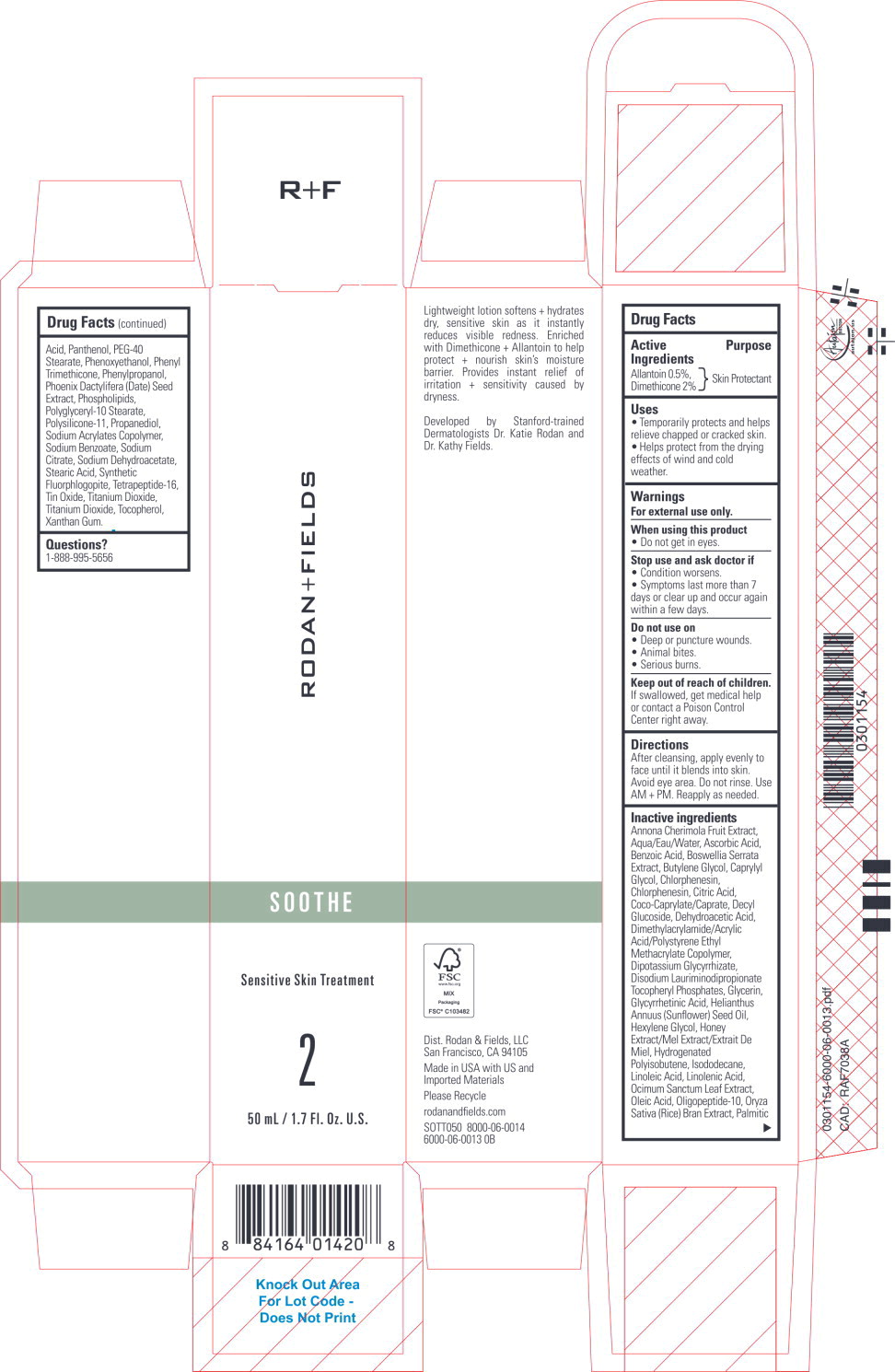
SOOTHE Sensitive Skin Treatment Allantoin, Dimethicone .5 g/100mL; 2 g/100mL Lotion — NDC 14222-2420-1 (Billing 14222-2420-01)
This is a package of SOOTHE Sensitive Skin Treatment Allantoin, Dimethicone .5 g/100mL; 2 g/100mL Lotion from Rodan & Fields, marketed since Mar 2021 and currently FDA-listed. It is the main listing for this product, which comes in 3 package sizes.
NDC database record
One package, one record: these facts belong to NDC 14222-2420-1 alone.
- Record
- FDA NDC Directory package listing · Human OTC drug
- Code segments
- 14222 labeler · 2420 product · 1 package
- Package marketed since
- Mar 9, 2021
- Sample package
- No — commercial package
- Listing certified through
- Dec 31, 2026
- Barcode (UPC)
- 0884164014208
- FDA record last changed
- Jul 24, 2026
Identity & classification
Regulatory identifiers FDA, NLM and CMS codes for this package
Where does this data come from?
- FDA openFDA NDC Directory · synced Oct 1, 2026
- FDA label on DailyMed · label index refreshed Oct 5, 2026
- RxNorm (NLM RxNav) · catalog refreshed Oct 1, 2026
- Medi-Span GPI (licensed)
- First Databank (licensed) · refreshed Oct 1, 2026
Clinical
SOOTHE Sensitive Skin Treatment is a topical lotion containing allantoin and dimethicone. Allantoin is a skin-conditioning agent typically used to help soothe irritation and promote skin healing, while dimethicone is a silicone that functions as a moisturizer and skin protectant. This is an over-the-counter monograph product marketed under FDA's established rules for skin-care lotions rather than as an individually reviewed drug application.
Patient education
Supplement & herbal interactions
Where does this data come from?
- MedlinePlus (NLM) · refreshed Oct 1, 2026
- FDA label on DailyMed · label index refreshed Oct 5, 2026
Ask a licensed pharmacist directly — free, answered by our team.
Pricing
A drug doesn't have one price. Each row is a different public payment system, and none is what you'd pay at the counter — that depends on your insurance. The ⓘ on each row explains what it measures.
| Price system | Per g | Per package |
|---|---|---|
| Retail pharmacies payNADAC · weekly | Not in the retail survey — common for institutional, discontinued, or low-volume packs. | |
| Medicaid paysCMS SDUD · 12 mo | No recent Medicaid claims on file for this NDC — rare and low-volume NDCs are suppressed in the public data. | |
| Medicare drug plans payPart D · quarterly | No Part D plan price is available for this NDC in our data. | |
Where does this data come from?
- CMS NADAC weekly file
- CMS ASP pricing files · refreshed Sep 20, 2026
- CMS Medicaid State Drug Utilization Data · refreshed Oct 5, 2026
- CMS Part D plan pricing files · refreshed Sep 24, 2026
- VA National Acquisition Center price file
Packaging — all sizes for this product
| Package NDC | Description | Marketing start | Marketing end | Status |
|---|---|---|---|---|
| 14222-2420-01 You're viewing this Main listing | 1 BOTTLE in 1 CARTON / 50 mL in 1 BOTTLE | 2021-03-09 | — | Active |
| 14222-2420-02 14222-2420-2 | 1 TUBE in 1 CARTON / 10 mL in 1 TUBE | 2021-06-01 | — | Active |
| 14222-2420-03 14222-2420-3 | 2 mL in 1 PACKET | 2022-04-12 | — | Active |
Pack size FAQ
What quantity is in this package?
What NDC number is used to bill for this package of SOOTHE Sensitive Skin Treatment Allantoin, Dimethicone .5 g/100mL; 2 g/100mL Lotion?
Therapeutic equivalents
| Product | Labeler | Pack | NADAC/unit | TE | Status | Price vs. this |
|---|---|---|---|---|---|---|
| SOOTHE Sensitive Skin Treatment .5 g/100mL; 2 g/100mLthis 14222-2420-01 | Rodan | 1 bottle | — | — | FDA listed | — |
Where does this data come from?
- FDA openFDA NDC Directory · synced Oct 1, 2026
- FDA Orange Book · refreshed Oct 3, 2026
- CMS NADAC weekly file
Availability & generic status
We did not find an FDA-approved generic match for this exact strength, form and route.
Where does this data come from?
- FDA Orange Book · refreshed Oct 3, 2026
Inactive Ingredients / Excipients
Inactive ingredients, also called excipients, are components of the drug product other than the active ingredient. They may include fillers, dyes, coatings, preservatives, flavors, or other formulation ingredients.
💡 Tap an ingredient (hover on desktop) to see what it is and why it’s used.
-
UNII PQ6CK8PD0R
Ascorbic acid, also known as vitamin C, is a white crystalline powder. It serves as an antioxidant to prevent degradation of other ingredients and may also function as a preservative in the formulation.
-
UNII 8SKN0B0MIM
Benzoic acid is a naturally occurring organic acid used as a preservative in medicines and foods. It helps prevent bacterial and fungal growth to extend shelf life and maintain product stability.
-
UNII 3XUS85K0RA
Butylene glycol is a clear liquid derived from petroleum or plants that acts as a humectant, solvent, and preservative booster in medicines. It helps keep formulations stable, dissolve active ingredients, and maintain moisture in topical products.
-
UNII 00YIU5438U
Caprylyl glycol is a clear liquid derived from coconut oil. In medicines, it acts as a humectant to retain moisture, a preservative booster to prevent microbial growth, and a solvent to help dissolve or mix other ingredients.
-
UNII 33WVT714QS
A natural plant extract from the cherimoya fruit, used as a flavoring agent to add taste to the medicine. It helps mask bitter or unpleasant flavors in oral formulations.
-
UNII I670DAL4SZ
A preservative that fights bacteria and fungi. It keeps medicines and topical products stable and safe from microbial contamination during storage and use.
-
UNII 2968PHW8QP
A weak organic acid derived from citrus fruits or made through fermentation. It works as a buffer to control pH, a preservative to extend shelf life, and a flavoring agent in medications.
-
UNII 8D9H4QU99H
A synthetic fatty acid ester derived from coconut oil, used as an emulsifier and solubilizer to help mix oil and water-based ingredients and improve how the body absorbs certain drugs.
-
UNII Z17H97EA6Y
A plant-derived mild cleanser made from natural sugars and oils. It acts as an emulsifier and surfactant to help mix water and oil-based ingredients together in the medicine.
-
UNII 2KAG279R6R
Dehydroacetic acid is a synthetic preservative that prevents mold, yeast, and bacterial growth in medicines. It extends shelf life by protecting the product from spoilage during storage and use.
-
UNII 9E4CO0W6C5
A silicone-based polymer that forms soft, spongy particles. Used as a texture modifier and suspending agent to improve how the product feels and flows, and to help keep ingredients evenly distributed throughout the formulation.
-
UNII 0K5Y9U1P6M
A synthetic compound combining vitamin E derivative with fatty acid chemistry, used as an antioxidant and preservative to prevent ingredient degradation and extend shelf life in medications.
-
UNII P540XA09DR
Enoxolone is a naturally derived compound from licorice root that acts as a skin-soothing and anti-inflammatory agent. In medicines, it helps reduce irritation and supports the healing of mucous membranes or damaged skin.
-
UNII PDC6A3C0OX
Glycerin is a clear, thick liquid derived from plant oils or fats. It acts as a humectant to retain moisture, a sweetener, and a solvent in medications.
-
UNII CA2Y0FE3FX
A salt derived from licorice root extract, used as a flavoring agent and sweetener. It may also help soothe and protect mucous membranes in throat lozenges and cough products.
-
UNII KEH0A3F75J
Hexylene glycol is a clear liquid alcohol used as a solvent and preservative in medicines. It helps dissolve other ingredients and keeps the product stable during storage.
-
UNII SCJ765569P
Holy basil leaf is a plant-derived ingredient used in some formulations as a flavoring agent or botanical additive. It may contribute taste and aroma to the medicine.
-
UNII Y9H1V576FH
Honey is a natural sweetener made by bees from flower nectar. In medicines, it adds sweetness to improve taste and may help soothe throat irritation in lozenges or syrups.
-
UNII 7D1YQ9Y5EZ
Hydrogenated polybutene is a thick, wax-like ingredient made by chemically processing petroleum. It acts as a binder and lubricant, helping hold tablet ingredients together and allowing pills to slide smoothly during manufacturing and packaging.
-
UNII 4PW41QCO2M
Indian frankincense is a natural resin extracted from trees native to India. It is used in medicines as a binder and thickening agent to help hold ingredients together and improve texture.
-
UNII A8289P68Y2
Isododecane is a lightweight liquid hydrocarbon used as a solvent and spreadability agent in topical formulations. It helps dissolve active ingredients and makes the product easier to apply and absorb into the skin.
-
UNII 1DI56QDM62
A natural fatty substance from soybeans that helps mix oil and water-based ingredients together. It acts as an emulsifier and lubricant in medicines to improve texture and help the product break down properly in your body.
-
UNII 9KJL21T0QJ
Linoleic acid is an omega-6 fatty acid derived from plant oils. It serves as an emulsifier and skin conditioning agent in topical formulations, helping ingredients mix smoothly and improving product texture.
-
UNII 0RBV727H71
A natural fatty acid derived from plant oils. It helps dissolve other ingredients and improve how the medicine spreads or absorbs in the body.
-
UNII YK3DC63Y5M
A mineral compound derived from natural or synthetic sources that acts as an anti-caking agent and flow aid. It helps prevent clumping and improves the powder's ability to flow smoothly during manufacturing and tablet formation.
-
UNII 2UMI9U37CP
Oleic acid is a naturally occurring fatty acid derived from plant or animal oils. It functions as an emulsifier and solvent in medicines, helping blend water and oil-based ingredients together and dissolving other components.
-
UNII Q46328TRNK
A short-chain protein fragment made of 10 amino acids linked together. Used in formulations as a skin-conditioning agent or penetration enhancer to help active ingredients absorb into skin or improve product texture.
-
UNII 2V16EO95H1
Palmitic acid is a saturated fatty acid derived from plant and animal sources. It serves as an emulsifier and lubricant in medicines, helping ingredients mix smoothly and preventing sticking during manufacturing.
-
UNII WV9CM0O67Z
Panthenol is a humectant and skin-conditioning agent derived from pantothenic acid. It's added to medicines to help retain moisture and soothe skin irritation.
-
UNII ECU18C66Q7
PEG-40 stearate is a synthetic compound made by combining polyethylene glycol with stearic acid. It acts as an emulsifier and solubilizer to help mix oil and water-based ingredients together and improve how the medicine dissolves and is absorbed.
-
UNII HIE492ZZ3T
Phenoxyethanol is a synthetic preservative and antimicrobial agent used to prevent bacterial and fungal growth in medicines and cosmetic products, extending shelf life and maintaining product safety.
-
UNII DR0K5NOJ4R
Phenyl trimethicone is a silicone-based lubricant and glidant. It helps powder particles flow smoothly and reduces friction during tablet or capsule manufacturing and filling.
-
UNII 0F897O3O4M
A naturally occurring alcohol derived from plants or synthesized chemically. It functions as a preservative and flavoring agent in medicines, helping prevent microbial growth and add pleasant taste to oral products.
-
UNII 73NE6T0Q00
A natural plant extract from date palm seeds used as a binder and filler in tablets and capsules. It helps hold ingredients together and adds bulk to the medication.
-
UNII 90TF85HH91
A fatty substance made from glycerin and stearic acid. It works as an emulsifier to help mix oil and water-based ingredients together in the medicine, and may also help with texture and consistency.
-
UNII 5965N8W85T
Propanediol is a clear liquid organic compound derived from vegetable sources or synthesized chemically. It acts as a humectant to retain moisture, a solvent to dissolve active ingredients, and a preservative booster in liquid medications and supplements.
-
UNII R60QEP13IC
Rice bran is a natural powder made from the outer layer of rice grains. It's used in medicines as a filler and flow agent to add bulk and help the product mix and flow smoothly during manufacturing.
-
UNII OJ245FE5EU
Sodium benzoate is a salt derived from benzoic acid, a preservative. It's added to medicines to prevent growth of bacteria, fungi, and other microorganisms that could spoil the product.
-
UNII 1Q73Q2JULR
Sodium citrate is a salt derived from citric acid. It works as a buffer to maintain the medicine's pH level and may also help improve taste or act as a preservative in the formulation.
-
UNII 8W46YN971G
Sodium dehydroacetate is a salt derived from dehydroacetic acid, a compound used as a preservative. It helps prevent mold, bacteria, and yeast growth in medicines, extending shelf life and maintaining product safety.
-
UNII KM7N50LOS6
Tin oxide is an inorganic mineral compound used in medicines as a colorant and opacifying agent. It provides white or off-white color to tablets, capsules, and coatings while helping make formulations less transparent.
-
UNII 4ELV7Z65AP
Stearic acid is a fatty acid derived from plant or animal sources. It acts as a binder and lubricant in tablets and capsules, helping them hold together and flow smoothly during manufacturing.
-
UNII 3W1JG795YI
Sunflower oil is a natural vegetable oil derived from sunflower seeds. It serves as a solvent, lubricant, and carrier in medicines, helping dissolve active ingredients and improve how the medication flows and absorbs in the body.
-
UNII 15FIX9V2JP
Titanium dioxide is a bright white mineral powder commonly used as a colorant and opacifying agent. It makes pills and tablets white or lighter in color and helps make coatings non-transparent.
-
UNII R0ZB2556P8
Tocopherol is a form of vitamin E derived from plant oils. It acts as an antioxidant in medicines to prevent oils and fats from breaking down and spoiling during storage.
-
UNII 059QF0KO0R
Water is a liquid solvent that dissolves and mixes ingredients together in liquid medicines, syrups, and injections. It helps distribute the active drug evenly throughout the product.
-
UNII TTV12P4NEE
Xanthan gum is a thickening and stabilizing ingredient made from fermented corn or other sugars. It's added to medicines to improve texture, prevent separation of liquids and solids, and help the product stay consistent.
47 inactive ingredients listed in the exact product block matched to this NDC.
Label-section wording can be broader than the structured product block and may mention additional formulation ingredients.
Where does this data come from?
ingredient classCode="IACT" elements from the exact product block matched by this NDC. Label-section narrative from DailyMed / the openFDA label index is shown separately when available.- FDA label on DailyMed · label index refreshed Oct 5, 2026
- FDA openFDA NDC Directory · synced Oct 1, 2026
Inactive ingredient FAQ
Are inactive ingredients the same for every manufacturer?
Why might an inactive ingredient be missing?
Can inactive ingredients matter?
Manufacturer & labeler
More NDCs from Rodan & Fields labeler code 14222
- UNBLEMISH Dual Intensive Acne Treatment BENZOYL PEROXIDE .025 g/mL Lotion NDC 14222-2120-1
- UNBLEMISH Invisible Matte Defense HOMOSALATE, OCTOCRYLENE, OCTISALATE, AVOBENZONE .1 g/mL; .1 g/mL; .05 g/mL; .03 g/mL Gel NDC 14222-2131-1
- UNBLEMISH 30-Day Regimen SALICYLIC ACID, BENZOYL PEROXIDE, HOMOSALATE, OCTOCRYLENE, OCTISALATE, AVOBENZONE Kit NDC 14222-2150-1
- REDEFINE Triple Defense AVOBENZONE, OCTISALATE, OCTOCRYLENE .07 g/mL; .05 g/mL; .03 g/mL Cream NDC 14222-2251-1
- REDEFINE Triple Defense AVOBENZONE, HOMOSALATE, OCTOCRYLENE, OCTISALATE .02 g/mL; .068 g/mL; .044 g/mL; .034 g/mL Lotion NDC 14222-2252-1
- REVERSE Brightening Defense Fluid AVOBENZONE, HOMOSALATE, OCTOCRYLENE, OCTISALATE .028 g/mL; .093 g/mL; .061 g/mL; .0467 g/mL Lotion NDC 14222-2300-1
- SOOTHE Moisturizing Rescue Cream OATMEAL .01 g/mL Cream NDC 14222-2430-1
- SOOTHE Daily Mineral Sunscreen TITANIUM DIOXIDE, ZINC OXIDE .036 g/mL; .0234 g/mL Lotion NDC 14222-2440-1
- Rodan and Fields Plumping Lip SPF 28 Sunscreen Octinoxate, Zinc Oxide 7.4 g/100mL; 7 g/100mL Oil NDC 14222-3000-1
- Rodan and Fields Reverse Brightening Defense Broad Spectrum SPF 50 Mineral Sunscreen Titanium Dioxide, Zinc Oxide 5.2 g/100mL; 5.15 g/100mL Lotion NDC 14222-3001-1
- 12 Days of Derm-Loved Skincare Octinoxate, Zinc Oxide, OATMEAL, BENZOYL PEROXIDE, AVOBENZONE, OCTISALATE, OCTOCRYLENE Kit NDC 14222-7000-1
- RECHARGE Regimen for Balancing, Boosting and Defending Healthy-Looking skin TITANIUM DIOXIDE, ZINC OXIDE .032 g/mL; .077 g/mL Cream NDC 14222-8000-1
Where does this data come from?
- FDA openFDA NDC Directory · synced Oct 1, 2026
- Drugs@FDA
FDA label — Drug Facts FDA SPL
🎯 Indications and Usage ▾
Uses Temporarily protects and helps relieve chapped or cracked skin. Helps protect from the drying effects of wind and cold weather.
⏱️ Dosage and Administration ▾
Directions After cleansing, apply evenly to face until it blends into skin. Avoid eye area. Do not rinse. Use AM + PM. Reapply as needed.
⚠️ Warnings ▾
Warnings For external use only. When using this product Do not get in eyes. Stop use and ask doctor if Condition worsens. Symptoms last more than 7 days or clear up and occur again within a few days. Do not use on Deep or puncture wounds. Animal bites. Serious burns. Keep out of reach of children. If swallowed, get medical help or contact a Poison Control Center right away.
🧪 Active Ingredient ▾
Active Ingredients Allantoin 0.5%, Dimethicone 2%
🧪 Inactive Ingredients ▾
Inactive ingredients Annona Cherimola Fruit Extract, Aqua/Eau/Water, Ascorbic Acid, Benzoic Acid, Boswellia Serrata Extract, Butylene Glycol, Caprylyl Glycol, Chlorphenesin, Chlorphenesin, Citric Acid, Coco-Caprylate/Caprate, Decyl Glucoside, Dehydroacetic Acid, Dimethylacrylamide/Acrylic Acid/Polystyrene Ethyl Methacrylate Copolymer, Dipotassium Glycyrrhizate, Disodium Lauriminodipropionate Tocopheryl Phosphates, Glycerin, Glycyrrhetinic Acid, Helianthus Annuus (Sunflower) Seed Oil, Hexylene Glycol, Honey Extract/Mel Extract/Extrait De Miel, Hydrogenated Polyisobutene, Isododecane, Linoleic Acid, Linolenic Acid, Ocimum Sanctum Leaf Extract, Oleic Acid, Oligopeptide-10, Oryza Sativa (Rice) Bran Extract, Palmitic Acid, Panthenol, PEG-40 Stearate, Phenoxyethanol, Phenyl Trimethicone, Phenylpropanol, Phoenix Dactylifera (Date) Seed Extract, Phospholipids, Polyglyceryl-10 Stearate, Polysilicone-11, Propanediol, Sodium Acrylates Copolymer, Sodium Benzoate, Sodium Citrate, Sodium Dehydroacetate, Stearic Acid, Synthetic Fluorphlogopite, Tetrapeptide-16, Tin Oxide, Titanium Dioxide, Titanium Dioxide, Tocopherol, Xanthan Gum.
🎯 Purpose ▾
Purpose Skin Protectant
📄 Do Not Use ▾
Do not use on Deep or puncture wounds. Animal bites. Serious burns.
📄 When Using This Product ▾
When using this product Do not get in eyes.
📄 Stop Use and Ask a Doctor If ▾
Stop use and ask doctor if Condition worsens. Symptoms last more than 7 days or clear up and occur again within a few days.
📄 Keep Out of Reach of Children ▾
Keep out of reach of children. If swallowed, get medical help or contact a Poison Control Center right away.
📄 Questions or Comments ▾
Questions? 1-888-995-5656
📄 Package Label / Principal Display Panel ▾
Principal Display Panel – 50 mL Carton Label RODAN+FIELDS SOOTHE Sensitive Skin Treatment 2 50 mL /
1.7Fl. Oz U.S. Principal Display Panel – 50 mL Carton Label
Principal Display Panel – 50 mL Bottle Label RODAN+FIELDS SOOTHE Sensitive Skin Treatment Skin Protectant Lotion 2 Principal Display Panel – 50 mL Bottle Label
About this NDC listing & data coverage
What data is (and isn’t) available for this NDC — tap to expand
| NDC identity (package / product / labeler codes) | ✓ Available |
| Labeler | ✓ Available |
| Product & package description | ✓ Available |
| Marketing category & status | ✓ Available |
| Active ingredient / dosage form / route | ✓ Available |
| FDA label (SPL via DailyMed) | ✓ Available |
| Package photos | ✓ Available |
| Inactive ingredients (structured) | ✓ Available |
| NADAC pharmacy acquisition price (CMS) | — Not published for this NDC CMS publishes NADAC only for NDCs reported in its retail-pharmacy survey. |
| Orange Book / therapeutic-equivalence data | — Not published for this NDC Applies only to products approved under an NDA/ANDA; many listings are out of scope. |
| HCPCS J-code billing crosswalk | — Not published for this NDC Most self-administered / retail products have no J-code — that is normal. |
| Medicaid utilization (CMS SDUD) | — Not published for this NDC CMS reports utilization only for NDCs with Medicaid claims above its privacy threshold. |