
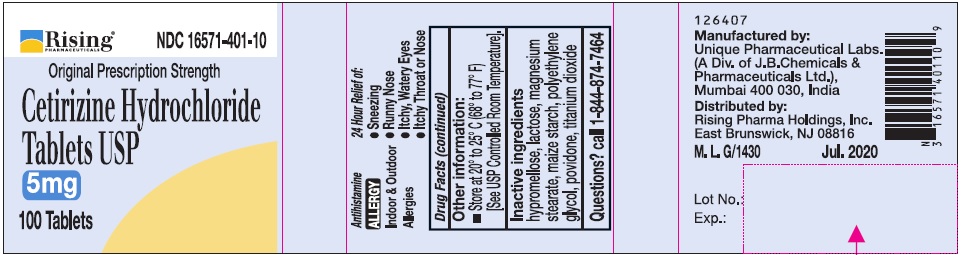
Cetirizine Hydrochloride 5 mg Tablet, 100-count — NDC 16571-401-10 (Billing 16571-0401-10)
This is a package of 100 tablets of Cetirizine Hydrochloride 5 mg Tablet from Rising Pharma Holdings, Inc., marketed since Oct 2009 and currently FDA-listed; retail pharmacies pay about $0.0476 per tablet (NADAC). It is this product's only package size.
NDC database record
One package, one record: these facts belong to NDC 16571-401-10 alone.
- Record
- FDA NDC Directory package listing · Human OTC drug
- Code segments
- 16571 labeler · 401 product · 10 package
- Package marketed since
- Oct 1, 2009
- Sample package
- No — commercial package
- Listing certified through
- Dec 31, 2026
- Billing quantity
- 100 EA per package
- Barcode (UPC-A, from the NDC)
- 3 1657140110 9
- Medicaid fills, this package
- 161,835 prescriptions in the last four reported quarters
- FDA record last changed
- Jul 24, 2026
Other active recalls for Cetirizine Hydrochloride (different manufacturers) — 2 · tap to view
Identity & classification
Regulatory identifiers FDA, NLM and CMS codes for this package
Drug-database identifiers Medi-Span GPI and First Databank GCN / HICL / AHFS classification
- GSN (GCN sequence number): 024484
- GCN: 49292
- GPI-14 (Medi-Span): 41550020100310
- HICL (First Databank): 006544
- AHFS class code: 04:08.00.00
- RxCUI (RxNorm): 1014676
Where does this data come from?
- FDA openFDA NDC Directory · synced Oct 8, 2026
- FDA label on DailyMed · label index refreshed Oct 8, 2026
- RxNorm (NLM RxNav) · catalog refreshed Oct 8, 2026
- Medi-Span GPI (licensed)
- First Databank (licensed) · refreshed Oct 8, 2026
RxNorm drug class
This medicine belongs to the Histamine-1 Receptor Antagonist class.
Where does this data come from?
- RxClass (NLM) · catalog refreshed Oct 8, 2026
Clinical
Cetirizine is used to treat allergy symptoms: sneezing runny nose itching of the nose or throat red, itchy, or watery eyes Cetirizine is also used to treat urticaria (hives; itchy raised red bumps on skin). Cetirizine is in a class of medications called antihistamines. It works by blocking the action of histamine, a substance in the body that causes allergic symptoms. Cetirizine is also available in combination with pseudoephedrine. This monograph only includes information about the use of cetirizine alone. If you are taking the cetirizine and pseudoephedrine combination product, read th...
Read the full MedlinePlus article ↗- It relieves allergy symptoms. Over-the-counter versions ease runny nose, sneezing, itchy, watery eyes and an itchy nose or throat from hay fever. Specific products treat hives, yea...
- It can. Drowsiness was reported, and it was more common at higher doses in children. Be careful driving or using machinery until you know how it affects you, and avoid alcohol.
- The oral solution can be taken with or without food. Food slightly delays how fast it works but does not change how much your body absorbs.
- Check with me first if you take sedatives or tranquilizers, since they can add to drowsiness. The label found no significant interactions with azithromycin, pseudoephedrine, ketoco...
Patient education
Supplement & herbal interactions
Some supplements/herbs that may interact with Cetirizine Hydrochloride — tap one for details:
Where does this data come from?
- MedlinePlus (NLM) · refreshed Oct 8, 2026
- FDA label on DailyMed · label index refreshed Oct 8, 2026
Ask a licensed pharmacist directly — free, answered by our team.
Pricing
A drug doesn't have one price. Each row is a different public payment system, and none is what you'd pay at the counter — that depends on your insurance. The ⓘ on each row explains what it measures.
| Price system | Per ea | Per package |
|---|---|---|
| Retail pharmacies payNADAC · weekly | $0.048 | $4.76 / 100 tablets |
| Medicaid paysCMS SDUD · 12 mo | $0.2481 | $24.81 / 100 tablets |
| Medicare drug plans payPart D · quarterly | No Part D plan price is available for this NDC in our data. | |
Where does this data come from?
- CMS NADAC weekly file · file of Oct 7, 2026
- CMS ASP pricing files · refreshed Sep 20, 2026
- CMS Medicaid State Drug Utilization Data · through Q1 2026
- CMS Part D plan pricing files · refreshed Sep 24, 2026
- VA National Acquisition Center price file
Packaging — all sizes for this product
| Package NDC | Description | Marketing start | Marketing end | Status |
|---|---|---|---|---|
| 16571-0401-10 You're viewing this Main listing | 100 TABLET in 1 BOTTLE | 2009-10-01 | — | Active |
Therapeutic equivalents
| Product | Labeler | Pack | NADAC/unit | TE | Status | Price vs. this |
|---|---|---|---|---|---|---|
| Cetirizine Hydrochloride 5 mg 00378-3635-01 | Mylan | 100 tablets | $0.048 | — | Availability likely | — |
| Cetirizine Hydrochloride 5 mgthis 16571-0401-10 | Rising | 100 tablets | $0.048 | — | Availability likely | — |
| Cetirizine Hydrochloride 5 mg 49483-0682-01 | TIME | 100 tablets | $0.048 | — | Availability likely | — |
| Cetirizine Hydrochloride Tablets, 5 mg 25000-0219-03 | MARKSANS | 30 tablets | — | — | FDA listed | — |
| Zyrtec Allergy 5 mg 50580-0754-15 | Kenvue | 1 tablet | — | — | FDA listed | — |
| Cetirizine Hydrochloride (Allergy) 5 mg 58602-0444-09 | Aurohealth | 30 tablets | — | — | FDA listed | — |
| Cetirizine Hydrochloride (Hives Relief) 5 mg 58602-0446-09 | Aurohealth | 30 tablets | — | — | FDA listed | — |
| Cetirizine Hydrochloride 5 mg 63629-4914-01 | Bryant | 30 tablets | — | — | FDA listed | — |
| Cetirizine Hydrochloride 5 mg 65162-0045-03 | Amneal | 30 tablets | — | — | FDA listed | — |
| Cetirizine Hydrochloride Hives Relief 5 mg 65162-0145-03 | Amneal | 30 tablets | — | — | FDA listed | — |
| Cetirizine Hydrochloride 5 mg 71205-0093-15 | Proficient | 15 tablets | — | — | FDA listed | — |
| Cetirizine HCl 5 mg 72657-0128-03 | GLENMARK | 300 tablets | — | — | FDA listed | — |
| Cetirizine HCl 72657-0130-05 | GLENMARK | 90 tablets | — | — | FDA listed | — |
| Cetirizine Hydrochloride 5 mg 81469-0352-01 | First | 100 tablets | — | — | FDA listed | — |
Where does this data come from?
- FDA openFDA NDC Directory · synced Oct 8, 2026
- FDA Orange Book · refreshed Oct 9, 2026
- CMS NADAC weekly file · file of Oct 7, 2026
Availability & generic status
This product is an FDA-approved generic. Other versions of the same drug are listed under Therapeutic equivalents, least expensive first.
Where does this data come from?
- FDA Orange Book · refreshed Oct 9, 2026
What it looks like
Where does this data come from?
- FDA label on DailyMed · label index refreshed Oct 8, 2026
Inactive Ingredients / Excipients
Inactive ingredients, also called excipients, are components of the drug product other than the active ingredient. They may include fillers, dyes, coatings, preservatives, flavors, or other formulation ingredients.
🧪 Avoiding an ingredient? See Cetirizine inactive ingredients by manufacturer: every current product's list side by side, so you can ask your pharmacy for the version that does not list it.
💡 Tap an ingredient (hover on desktop) to see what it is and why it’s used.
-
UNII 3NXW29V3WO
Hypromellose is a plant-based thickener made from cellulose. It's used in medicines as a binder to hold ingredients together, a coating for tablets, and a thickener for liquids.
-
UNII J2B2A4N98G
Lactose is a natural sugar derived from milk. In medications, it serves as a filler and binder to add bulk and help hold tablet or capsule ingredients together during manufacturing.
-
UNII 70097M6I30
Magnesium stearate is a salt made from magnesium and stearic acid, a fatty substance. It's used in tablets and capsules as a lubricant and glidant to help ingredients flow smoothly during manufacturing and prevent sticking.
-
UNII 3WJQ0SDW1A
Polyethylene glycol is a synthetic liquid or solid polymer used in medicines as a solvent, lubricant, and humectant. It helps dissolve active ingredients, reduces friction during manufacturing, and retains moisture in the final product.
-
UNII FZ989GH94E
Povidone is a synthetic polymer made from a plastic-like material. It acts as a binder to hold tablet ingredients together and as a disintegrant to help the tablet break apart in your stomach so the medicine can be absorbed.
-
UNII O8232NY3SJ
A plant-based carbohydrate derived from corn kernels. It acts as a filler to add bulk, a binder to hold ingredients together, and a disintegrant to help the tablet break apart in your stomach for absorption.
-
UNII 15FIX9V2JP
Titanium dioxide is a bright white mineral powder commonly used as a colorant and opacifying agent. It makes pills and tablets white or lighter in color and helps make coatings non-transparent.
7 inactive ingredients listed in the exact product block matched to this NDC.
Label-section wording can be broader than the structured product block and may mention additional formulation ingredients.
Where does this data come from?
ingredient classCode="IACT" elements from the exact product block matched by this NDC. Label-section narrative from DailyMed / the openFDA label index is shown separately when available.- FDA label on DailyMed · label index refreshed Oct 8, 2026
- FDA openFDA NDC Directory · synced Oct 8, 2026
Inactive ingredient FAQ
Are inactive ingredients the same for every manufacturer?
Why might an inactive ingredient be missing?
Can inactive ingredients matter?
Manufacturer & labeler
More NDCs from Rising Pharma Holdings, Inc. labeler code 16571
- Itraconazole 100 mg Capsule NDC 16571-245-03
- Mesalamine 1000 mg Suppository NDC 16571-246-03
- Clindamycin Phosphate 10 mg/mL Solution NDC 16571-256-60
- Dicyclomine hydrochloride 20 mg Tablet NDC 16571-259-01
- Dicyclomine Hydrochloride 10 mg Capsule NDC 16571-260-01
- Sulfasalazine 500 mg Tablet NDC 16571-261-01
- Cetirizine Hydrochloride 10 mg Tablet NDC 16571-402-10
- ciprofloxacin 250 mg Tablet, Film Coated NDC 16571-411-05
- ciprofloxacin 500 mg Tablet, Film Coated NDC 16571-412-05
- ciprofloxacin 750 mg Tablet, Film Coated NDC 16571-413-05
- CROMOLYN SODIUM 100 mg/5mL Solution, Concentrate NDC 16571-600-96
- Cevimeline Hydrochloride 30 mg Capsule NDC 16571-657-10
Where does this data come from?
- FDA openFDA NDC Directory · synced Oct 8, 2026
- Drugs@FDA
FDA label — Drug Facts FDA SPL
🎯 Indications and Usage ▾
Uses Temporarily relieves these symptoms due to hay fever or other upper respiratory allergies: runny nose sneezing itchy, watery eyes itching of the nose or throat
⏱️ Dosage and Administration ▾
Directions Adults and children 6 years and over 1 to 2 tablets once daily depending upon severity of symptoms; do not take more than 2 tablets in 24 hours Adults 65 years and over 1 tablet once a day; do not take more than 1 tablet in 24 hours Children under 6 years of age Ask a doctor Consumers with liver or kidney disease Ask a doctor
⚠️ Warnings ▾
Warnings: Do Not Use if you have ever had an allergic reaction to this product or any of its ingredients or to an antihistamine containing hydroxyzine. Ask a doctor before use if you have liver or kidney disease. Your doctor should determine if you need a different dose.
Ask a doctor or pharmacist before use if you are taking tranquilizers or sedatives. When using this product drowsines may occur avoid alcoholic drinks alcohol, sedatives, and tranquilizers may increase drowsiness be careful when driving a motor vehicle or operating machinary. Stop use and ask a doctor if an allergic reaction to this product occurs.
Seek medical help right away. If pregnant or breast-feeding: if breast-feeding: not recommended if pregnant: ask a health professional before use. keep out of reach of children. In case of overdose, get medical help or contact Poison Control Center right away.
(1-800-222-1222)
🧪 Active Ingredient ▾
Active Ingredient (in each tablet) Cetirizine HCl USP 5 mg
🧪 Inactive Ingredients ▾
Inactive ingredients hypromellose, lactose, magnesium stearate, maize starch, polyethylene glycol, povidone, titanium dioxide.
🎯 Purpose ▾
Purpose Antihistimine
📄 Keep Out of Reach of Children ▾
keep out of reach of children. In case of overdose, get medical help or contact Poison Control Center right away. (1-800-222-1222)
📄 Questions or Comments ▾
Questions? Call 1-844-874-7464
📄 Package Label / Principal Display Panel ▾
PRINCIPAL DISPLAY PANEL-100'S COUNT Rising NDC 16571-401-10 Original Prescription Strength Cetirizine Hydrochloride Tablets USP 5 mg Antihistamine ALLERGY Indoor & Outdoor Allergies 24 Hour Relief of: •Sneezing •Runny Nose •Itchy, Watery Eyes •Itchy Throat or Nose 100 Tablets T10 - M.L. G/1430 cetrizine-5mg-1 cetrizine-5mg-2 cetrizine-5mg-3
T20 - M.L. G/25/2188 cetrizine-5mg-4 cetrizine-5mg-5 cetrizine-5mg-6