
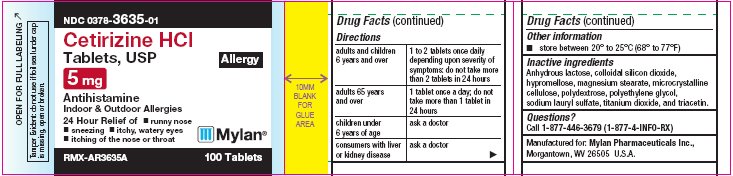
Cetirizine Hydrochloride 5 mg Tablet, Film Coated, 100-count — NDC 0378-3635-01 (Billing 00378-3635-01)
This is a package of 100 tablets of Cetirizine Hydrochloride 5 mg Tablet, Film Coated from Mylan Pharmaceuticals Inc., marketed since Dec 2007 and currently FDA-listed; retail pharmacies pay about $0.0476 per tablet (NADAC). It is this product's only package size.
NDC database record
One package, one record: these facts belong to NDC 0378-3635-01 alone.
- Record
- FDA NDC Directory package listing · Human OTC drug
- Code segments
- 0378 labeler · 3635 product · 01 package
- Package marketed since
- Dec 27, 2007
- Sample package
- No — commercial package
- Listing certified through
- Dec 31, 2027
- Billing quantity
- 100 EA per package
- Barcode (UPC-A, from the NDC)
- 3 0378363501 9
- Medicaid fills, this package
- 26,058 prescriptions in the last four reported quarters
- FDA record last changed
- Oct 8, 2026
Other active recalls for Cetirizine Hydrochloride (different manufacturers) — 3 · tap to view
Identity & classification
Regulatory identifiers FDA, NLM and CMS codes for this package
Drug-database identifiers Medi-Span GPI and First Databank GCN / HICL / AHFS classification
- GSN (GCN sequence number): 024484
- GCN: 49292
- GPI-14 (Medi-Span): 41550020100310
- HICL (First Databank): 006544
- AHFS class code: 04:08.00.00
- RxCUI (RxNorm): 1014676
Where does this data come from?
- FDA openFDA NDC Directory · synced Oct 8, 2026
- FDA label on DailyMed · label index refreshed Oct 8, 2026
- RxNorm (NLM RxNav) · catalog refreshed Oct 1, 2026
- Medi-Span GPI (licensed)
- First Databank (licensed) · refreshed Oct 8, 2026
RxNorm drug class
This medicine belongs to the Histamine-1 Receptor Antagonist class.
Where does this data come from?
- RxClass (NLM) · catalog refreshed Oct 1, 2026
Clinical
- It relieves allergy symptoms. Over-the-counter versions ease runny nose, sneezing, itchy, watery eyes and an itchy nose or throat from hay fever. Specific products treat hives, yea...
- It can. Drowsiness was reported, and it was more common at higher doses in children. Be careful driving or using machinery until you know how it affects you, and avoid alcohol.
- The oral solution can be taken with or without food. Food slightly delays how fast it works but does not change how much your body absorbs.
- Check with me first if you take sedatives or tranquilizers, since they can add to drowsiness. The label found no significant interactions with azithromycin, pseudoephedrine, ketoco...
Patient education
Supplement & herbal interactions
Some supplements/herbs that may interact with Cetirizine Hydrochloride — tap one for details:
Where does this data come from?
- MedlinePlus (NLM) · refreshed Oct 8, 2026
- FDA label on DailyMed · label index refreshed Oct 8, 2026
Ask a licensed pharmacist directly — free, answered by our team.
Pricing
A drug doesn't have one price. Each row is a different public payment system, and none is what you'd pay at the counter — that depends on your insurance. The ⓘ on each row explains what it measures.
| Price system | Per ea | Per package |
|---|---|---|
| Retail pharmacies payNADAC · weekly | $0.048 | $4.76 / 100 tablets |
| Medicaid paysCMS SDUD · 12 mo | $0.3144 | $31.44 / 100 tablets |
| Medicare drug plans payPart D · quarterly | No Part D plan price is available for this NDC in our data. | |
Where does this data come from?
- CMS NADAC weekly file · file of Oct 7, 2026
- CMS ASP pricing files · refreshed Sep 20, 2026
- CMS Medicaid State Drug Utilization Data · through Q1 2026
- CMS Part D plan pricing files · refreshed Sep 24, 2026
- VA National Acquisition Center price file
Packaging — all sizes for this product
| Package NDC | Description | Marketing start | Marketing end | Status |
|---|---|---|---|---|
| 00378-3635-01 You're viewing this Main listing | 100 TABLET, FILM COATED in 1 BOTTLE, PLASTIC | 2007-12-27 | — | Active |
Therapeutic equivalents
| Product | Labeler | Pack | NADAC/unit | TE | Status | Price vs. this |
|---|---|---|---|---|---|---|
| Cetirizine Hydrochloride 5 mgthis 00378-3635-01 | Mylan | 100 tablets | $0.048 | — | Availability likely | — |
| Cetirizine Hydrochloride 5 mg 16571-0401-10 | Rising | 100 tablets | $0.048 | — | Availability likely | — |
| Cetirizine Hydrochloride 5 mg 49483-0682-01 | TIME | 100 tablets | $0.048 | — | Availability likely | — |
| Cetirizine Hydrochloride Tablets, 5 mg 25000-0219-03 | MARKSANS | 30 tablets | — | — | FDA listed | — |
| Zyrtec Allergy 5 mg 50580-0754-15 | Kenvue | 1 tablet | — | — | FDA listed | — |
| Cetirizine Hydrochloride (Allergy) 5 mg 58602-0444-09 | Aurohealth | 30 tablets | — | — | FDA listed | — |
| Cetirizine Hydrochloride (Hives Relief) 5 mg 58602-0446-09 | Aurohealth | 30 tablets | — | — | FDA listed | — |
| Cetirizine Hydrochloride 5 mg 63629-4914-01 | Bryant | 30 tablets | — | — | FDA listed | — |
| Cetirizine Hydrochloride 5 mg 65162-0045-03 | Amneal | 30 tablets | — | — | FDA listed | — |
| Cetirizine Hydrochloride Hives Relief 5 mg 65162-0145-03 | Amneal | 30 tablets | — | — | FDA listed | — |
| Cetirizine Hydrochloride 5 mg 71205-0093-15 | Proficient | 15 tablets | — | — | FDA listed | — |
| Cetirizine HCl 5 mg 72657-0128-03 | GLENMARK | 300 tablets | — | — | FDA listed | — |
| Cetirizine HCl 72657-0130-05 | GLENMARK | 90 tablets | — | — | FDA listed | — |
| Cetirizine Hydrochloride 5 mg 81469-0352-01 | First | 100 tablets | — | — | FDA listed | — |
Where does this data come from?
- FDA openFDA NDC Directory · synced Oct 8, 2026
- FDA Orange Book · refreshed Oct 3, 2026
- CMS NADAC weekly file · file of Oct 7, 2026
Availability & generic status
This product is an FDA-approved generic. Other versions of the same drug are listed under Therapeutic equivalents, least expensive first.
Where does this data come from?
- FDA Orange Book · refreshed Oct 3, 2026
What it looks like
Where does this data come from?
- FDA label on DailyMed · label index refreshed Oct 8, 2026
Inactive Ingredients / Excipients
Inactive ingredients, also called excipients, are components of the drug product other than the active ingredient. They may include fillers, dyes, coatings, preservatives, flavors, or other formulation ingredients.
🧪 Avoiding an ingredient? See Cetirizine inactive ingredients by manufacturer: every current product's list side by side, so you can ask your pharmacy for the version that does not list it.
💡 Tap an ingredient (hover on desktop) to see what it is and why it’s used.
-
UNII 3SY5LH9PMK
Anhydrous lactose is a milk sugar with no water content. It acts as a filler and binder in tablets and capsules, adding bulk and helping ingredients stick together.
-
UNII 3NXW29V3WO
Hypromellose is a plant-based thickener made from cellulose. It's used in medicines as a binder to hold ingredients together, a coating for tablets, and a thickener for liquids.
-
UNII 70097M6I30
Magnesium stearate is a salt made from magnesium and stearic acid, a fatty substance. It's used in tablets and capsules as a lubricant and glidant to help ingredients flow smoothly during manufacturing and prevent sticking.
-
UNII OP1R32D61U
Microcrystalline cellulose is a purified form of cellulose, a natural fiber from plant sources. It acts as a binder and filler in tablets and capsules, helping hold ingredients together and give the medicine its shape and size.
-
UNII VH2XOU12IE
Polydextrose is a synthetic polymer made from dextrose (sugar) that acts as a bulking agent and filler in medicines. It helps give tablets and capsules proper volume and texture while often adding slight sweetness.
-
UNII 3WJQ0SDW1A
Polyethylene glycol is a synthetic liquid or solid polymer used in medicines as a solvent, lubricant, and humectant. It helps dissolve active ingredients, reduces friction during manufacturing, and retains moisture in the final product.
-
UNII ETJ7Z6XBU4
Silicon dioxide is a naturally occurring mineral used as a glidant and anti-caking agent. It helps powder ingredients flow smoothly and prevents clumping during manufacturing and storage.
-
UNII 368GB5141J
A detergent and foaming agent derived from coconut or palm oil. In medications, it helps break down and mix oil and water-based ingredients, aids in tablet disintegration, and improves how the drug dissolves and spreads in the mouth or digestive system.
-
UNII 15FIX9V2JP
Titanium dioxide is a bright white mineral powder commonly used as a colorant and opacifying agent. It makes pills and tablets white or lighter in color and helps make coatings non-transparent.
-
UNII XHX3C3X673
Triacetin is a clear, oily liquid made from glycerin and acetic acid. It works as a plasticizer and solvent in medicines, helping soften coatings and improve how liquids mix together in formulations.
10 inactive ingredients listed in the exact product block matched to this NDC.
Label-section wording can be broader than the structured product block and may mention additional formulation ingredients.
Where does this data come from?
ingredient classCode="IACT" elements from the exact product block matched by this NDC. Label-section narrative from DailyMed / the openFDA label index is shown separately when available.- FDA label on DailyMed · label index refreshed Oct 8, 2026
- FDA openFDA NDC Directory · synced Oct 8, 2026
Inactive ingredient FAQ
Are inactive ingredients the same for every manufacturer?
Why might an inactive ingredient be missing?
Can inactive ingredients matter?
Manufacturer & labeler
More NDCs from Mylan Pharmaceuticals Inc. labeler code 00378
- Armodafinil 250 mg Tablet NDC 0378-3433-93
- Azelastine Hydrochloride and Fluticasone Propionate 137 ug; 50 ug Spray, Metered NDC 0378-3458-23
- Mirtazapine 15 mg Tablet, Film Coated NDC 0378-3515-01
- Fosamprenavir Calcium 700 mg Tablet, Film Coated NDC 0378-3520-91
- Mirtazapine 30 mg Tablet, Film Coated NDC 0378-3530-01
- Mirtazapine 45 mg Tablet, Film Coated NDC 0378-3545-01
- Cetirizine Hydrochloride 10 mg Tablet, Film Coated NDC 0378-3637-01
- Phenytek phenytoin sodium 300 mg Capsule, Extended Release NDC 0378-3750-01
- Clozapine 25 mg Tablet, Orally Disintegrating NDC 0378-3813-01
- Clozapine 100 mg Tablet, Orally Disintegrating NDC 0378-3815-01
- Clozapine 150 mg Tablet, Orally Disintegrating NDC 0378-3816-01
- Clozapine 200 mg Tablet, Orally Disintegrating NDC 0378-3817-01
Where does this data come from?
- FDA openFDA NDC Directory · synced Oct 8, 2026
- Drugs@FDA
FDA label — Drug Facts FDA SPL
🎯 Indications and Usage ▾
Uses temporarily relieves these symptoms due to hay fever or other upper respiratory allergies: • runny nose • sneezing • itchy, watery eyes • itching of the nose or throat
⏱️ Dosage and Administration ▾
Directions adults and children 6 years and over 1 to 2 tablets once daily depending upon severity of symptoms; do not take more than 2 tablets in 24 hours. adults 65 years and over 1 tablet once a day; do not take more than 1 tablet in 24 hours children under 6 years of age ask a doctor consumers with liver or kidney disease ask a doctor
⚠️ Warnings ▾
Warnings Do not use if you have ever had an allergic reaction to this product or any of its ingredients or to an antihistamine containing hydroxyzine. Ask a doctor before use if you have liver or kidney disease. Your doctor should determine if you need a different dose.
Ask a doctor or pharmacist before use if you are taking tranquilizers or sedatives. When using this product • drowsiness may occur • avoid alcoholic drinks • alcohol, sedatives, and tranquilizers may increase drowsiness • be careful when driving a motor vehicle or operating machinery Stop use and ask a doctor if an allergic reaction to this product occurs. Seek medical help right away.
If pregnant or breast-feeding: • if breast-feeding: not recommended • if pregnant: ask a health professional before use. Keep out of reach of children. In case of overdose, get medical help or contact a Poison Control Center right away.
🧪 Active Ingredient ▾
Active Ingredient (in each tablet) Cetirizine hydrochloride USP, 5 mg
🧪 Inactive Ingredients ▾
Inactive ingredients Anhydrous lactose, colloidal silicon dioxide, hypromellose, magnesium stearate, microcrystalline cellulose, polydextrose, polyethylene glycol, sodium lauryl sulfate, titanium dioxide, and triacetin
🎯 Purpose ▾
Purpose Antihistamine
📄 Do Not Use ▾
Do not use if you have ever had an allergic reaction to this product or any of its ingredients or to an antihistamine containing hydroxyzine.
📄 Ask a Doctor Before Use If ▾
Ask a doctor before use if you have liver or kidney disease. Your doctor should determine if you need a different dose.
📄 Ask a Doctor or Pharmacist Before Use If ▾
Ask a doctor or pharmacist before use if you are taking tranquilizers or sedatives.
📄 When Using This Product ▾
When using this product • drowsiness may occur • avoid alcoholic drinks • alcohol, sedatives, and tranquilizers may increase drowsiness • be careful when driving a motor vehicle or operating machinery
📄 Stop Use and Ask a Doctor If ▾
Stop use and ask a doctor if an allergic reaction to this product occurs. Seek medical help right away.
🤰 If Pregnant or Breast-Feeding ▾
If pregnant or breast-feeding: • if breast-feeding: not recommended • if pregnant: ask a health professional before use.
📄 Keep Out of Reach of Children ▾
Keep out of reach of children. In case of overdose, get medical help or contact a Poison Control Center right away.
📄 Questions or Comments ▾
Questions? Call 1-877-446-3679 (1-877-4-INFO-RX) Manufactured for: Mylan Pharmaceuticals Inc. Morgantown, WV 26505
📄 Package Label / Principal Display Panel ▾
PRINCIPAL DISPLAY PANEL - 5 mg Allergy NDC 0378-3635-01 Cetirizine HCl Tablets, USP Allergy 5 mg Antihistamine Indoor & Outdoor Allergies 24 Hour Relief of • runny nose • sneezing • itchy, watery eyes • itching of the nose or throat RMX-AR3635A 100 Tablets Tamper Evident: do not use if foil seal under cap is missing, open or broken. Cetirizine Hydrochloride Tablets 5 mg - Front Layer - Bottle Label Cetirizine Hydrochloride Tablets 5 mg - Back of Front Layer - Bottle Label Cetirizine Hydrochloride Tablets 5 mg - Base Layer - Bottle Label
PRINCIPAL DISPLAY PANEL - 10 mg Allergy NDC 0378-3637-01 Cetirizine HCl Tablets, USP Allergy 10 mg Antihistamine Indoor & Outdoor Allergies 24 Hour Relief of • runny nose • sneezing • itchy, watery eyes • itching of the nose or throat RMX-AR3637A 100 Tablets Tamper Evident: do not use if foil seal under cap is missing, open or broken. Active Ingredient (in each tablet) Cetirizine hydrochloride USP, 10 mg Directions adults and children 6 years and over one 10 mg tablet once daily; do not take more than one 10 mg tablet in 24 hours.
A 5 mg product may be appropriate for less severe symptoms. adults 65 years and over ask a doctor children under 6 years of age ask a doctor consumers with liver or kidney disease ask a doctor Cetirizine Hydrochloride Tablets 10 mg - Front Layer - Bottle Label Cetirizine Hydrochloride Tablets 10 mg - Back of Front Layer - Bottle Label Cetirizine Hydrochloride Tablets 10 mg - Base Layer - Bottle Label