
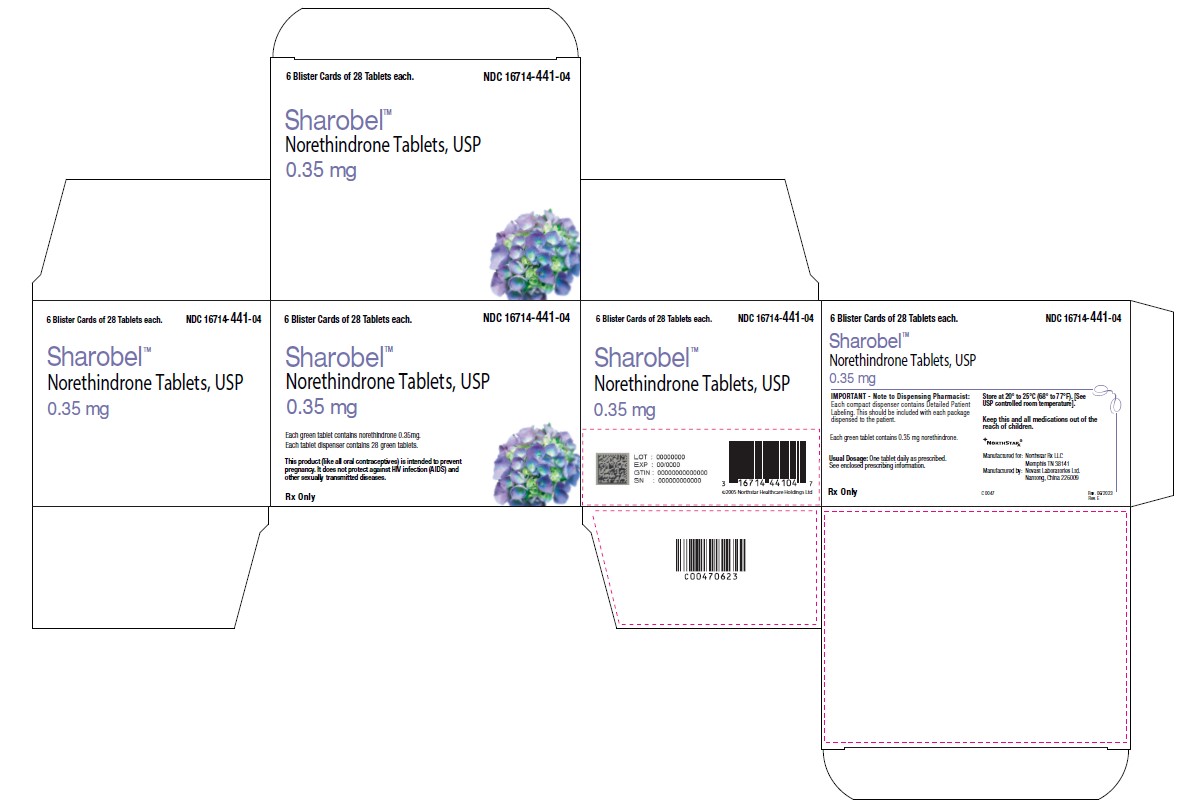
SHAROBEL Norethindrone Kit, 1 packet — NDC 16714-441-01 (Billing 16714-0441-01)
This is a package of 1 packet of SHAROBEL Norethindrone Kit from Northstar Rx LLC, marketed since Sep 2013 and currently FDA-listed; retail pharmacies pay about $0.0924 per packet (NADAC).
Identity & classification
Regulatory identifiers FDA, NLM and CMS codes for this package
Drug-database identifiers Medi-Span GPI and First Databank GCN / HICL / AHFS classification
- GSN (GCN sequence number): 003313
- GCN: 11520
- GPI-14 (Medi-Span): 25100010000305
- HICL (First Databank): 001459
- AHFS class code: 68:12.00.00
- RxCUI (RxNorm): 198042
Where does this data come from?
- FDA openFDA NDC Directory · synced Oct 1, 2026
- FDA label on DailyMed · label index refreshed Oct 1, 2026
- RxNorm (NLM RxNav) · catalog refreshed Oct 1, 2026
- Medi-Span GPI (licensed)
- First Databank (licensed) · refreshed Oct 1, 2026
RxNorm drug class
This medicine belongs to the Progestin class.
Where does this data come from?
- RxClass (NLM) · catalog refreshed Oct 1, 2026
Clinical
Norethindrone is used to treat endometriosis (a condition in which the type of tissue that lines the uterus [womb] grows in other areas of the body and causes pain, heavy or irregular menstruation [periods], and other symptoms). Norethindrone is also used to treat abnormal periods or bleeding and to bring on a normal menstrual cycle in women who menstruated normally in the past but have not menstruated for at least 3 months and who are not pregnant or experiencing menopause (change of life; the end of monthly menstrual periods). Norethindrone is in a class of medications called progestins. It...
Read the full MedlinePlus article ↗- Most norethindrone products, like Errin, Camila and Emzahh, are progestin-only birth control pills that prevent pregnancy. Norethindrone acetate tablets, such as Gallifrey, are use...
- Take one tablet by mouth every day at the same time. Don't take a break between packs. Following the schedule exactly gives you the best protection, so follow your label and the pa...
- Changes in your bleeding are the most common, including irregular or frequent bleeding. Some people get headache, breast tenderness, nausea or dizziness. Call me or your doctor if...
- It's best not to. Smoking greatly raises the risk of heart attack and stroke in women using oral contraceptives. If you smoke, let's talk about options and quitting.
Patient education
Supplement & herbal interactions
Some supplements/herbs that may interact with Norethindrone — tap one for details:
Where does this data come from?
- MedlinePlus (NLM) · refreshed Oct 1, 2026
- FDA label on DailyMed · label index refreshed Oct 1, 2026
Ask a licensed pharmacist directly — free, answered by our team.
Pricing
A drug doesn't have one price. Each row is a different public payment system, and none is what you'd pay at the counter — that depends on your insurance. The ⓘ on each row explains what it measures.
| Price system | Per ea | Per package |
|---|---|---|
| Retail pharmacies payNADAC · weekly | $0.092 | $0.09 / 1 kit |
| Medicaid paysCMS SDUD · 12 mo | $0.2662 | $0.27 / 1 kit |
| Medicare drug plans payPart D · Q2 2026 | $0.1735 | $0.17 / 1 kit |
Where does this data come from?
- CMS NADAC weekly file · file of Sep 30, 2026
- CMS ASP pricing files · refreshed Sep 20, 2026
- CMS Medicaid State Drug Utilization Data · through Q1 2026
- CMS Part D plan pricing files · refreshed Sep 24, 2026
- VA National Acquisition Center price file
Packaging — all sizes for this product
| Package NDC | Description | Per unit | Per pack | Marketing start | Marketing end | Status |
|---|---|---|---|---|---|---|
| 16714-0441-01 You're viewing this | 1 BLISTER PACK in 1 PACKET / 1 KIT in 1 BLISTER PACK | $0.0924 / ea | $0.09 | 2013-09-13 | — | Active |
| 16714-0441-02 16714-441-02 | 1 BLISTER PACK in 1 CARTON / 1 KIT in 1 BLISTER PACK | — | — | 2020-01-01 | — | Active |
| 16714-0441-03 16714-441-03 | 3 BLISTER PACK in 1 CARTON / 1 KIT in 1 BLISTER PACK | — | — | 2020-01-01 | — | Active |
| 16714-0441-04 16714-441-04 Main listing | 6 BLISTER PACK in 1 CARTON / 1 KIT in 1 BLISTER PACK | $0.0924 / ea | $0.55 | 2013-09-13 | — | Active |
This pack has the lowest per-ea cost of the 2 priced pack sizes ($0.0924 NADAC).
This pack accounts for about 1.9% of this product's recent Medicaid fills; most go to a different pack size. See all packs ↓
Pack size FAQ
What quantity is in this package?
How does this package differ from NDC 16714-0441-02?
What NDC number is used to bill for this package of SHAROBEL Norethindrone Kit?
Prices are the latest CMS NADAC pharmacy acquisition cost per NDC; per-pack figures are per-unit × pack quantity, shown only when the pack is denominated in the same measure NADAC prices.
Therapeutic equivalents
| Product | Labeler | Pack | NADAC/unit | TE | Status | Price vs. this |
|---|---|---|---|---|---|---|
| Sharobelthis 16714-0441-01 | Northstar | 1 packet | $0.092 | AB2 | Availability likely | — |
| Deblitane 16714-0440-01 | Northstar | 1 packet | $0.092 | AB1 | Availability likely | — |
Where does this data come from?
- FDA openFDA NDC Directory · synced Oct 1, 2026
- FDA Orange Book · refreshed Sep 3, 2026
- CMS NADAC weekly file · file of Sep 30, 2026
Availability & generic status
This product is an FDA-approved generic. Other versions of the same drug are listed under Therapeutic equivalents, least expensive first.
Where does this data come from?
- FDA Orange Book · refreshed Sep 3, 2026
What it looks like
Where does this data come from?
- FDA label on DailyMed · label index refreshed Oct 1, 2026
Inactive Ingredients / Excipients
Inactive ingredients, also called excipients, are components of the drug product other than the active ingredient. They may include fillers, dyes, coatings, preservatives, flavors, or other formulation ingredients.
Where does this data come from?
IACT rows and label-wide narrative are kept separate; availability and product-level specificity depend on the submitted label.- FDA label on DailyMed · label index refreshed Oct 1, 2026
- FDA openFDA NDC Directory · synced Oct 1, 2026
Inactive ingredient FAQ
Are inactive ingredients the same for every manufacturer?
Why might an inactive ingredient be missing?
Can inactive ingredients matter?
Manufacturer & labeler
Where does this data come from?
- FDA openFDA NDC Directory · synced Oct 1, 2026
- Drugs@FDA
Full prescribing information FDA SPL
🎯 Indications and Usage ▾
INDICATIONS AND USAGE 1. Indications Progestin-only oral contraceptives are indicated for the prevention of pregnancy. 2.
Efficacy If used perfectly, the first-year failure rate for progestin-only oral contraceptives is 0.3%. However, the typical failure rate is estimated to be closer to 9%, due to late or omitted pills. Table 1 lists the pregnancy rates for users of all major methods of contraception.
Table 1: Percentage of Women Experiencing an Unintended Pregnancy During the First Year of Typical Use and the First Year of Perfect Use of Contraception and the Percentage Continuing Use at the End of the First Year. United States. % of Women Experiencing an Unintended Pregnancy within the First Year of Use % of Women Continuing Use at One Year 3 Method (1) Typical Use 1 (2) Perfect Use 2 (3) (4) No method4 85 85 Spermicides5 28 18 42 Fertility awareness-based methods Standard Days method6 TwoDay method6 Ovulation method6 Symptothermal method6 24 5 4 3 0.4 47 Withdrawal 22 4 46 Sponge Parous women Nulliparous women 24 12 20 9 36 Condom7 Female (fc) Male 21 18 5 2 41 43 Diaphragm8 12 6 57 Combined pill and progestin-only pill 9 0.3 67 Norelgestromin and ethinyl estradiol patch 9 0.3 67 NuvaRing 9 0.3 67 Depo-Provera 6 0.2 56 Intrauterine contraceptives ParaGard (copper T) Mirena (LNg) 0.8 0.2 0.6 0.2 78 80 Implanon 0.05 0.05 84 Female sterilization 0.5 0.5 100 Male sterilization 0.15 0.10 100 Emergency Contraception: Emergency contraceptive pills or insertion of a copper intrauterine contraceptive after unprotected intercourse substantially reduces the risk of pregnancy.
9 (See Chapter 6.) Lactational Amenorrhea Method: LAM is a highly effective, temporary method of contraception. 10 (See Chapter 18.) Source: Trussell J. Contraceptive Effi cacy.
In Hatcher RA, Trussell J, Nelson AL, Cates W, Kowal D, Policar M. Contraceptive Techology: Twentieth Revised Edition. New York NY: Ardent Media, 2011.
Notes: 1 Among typical couples who initiate use of a method (not necessarily for the first time), the percentage who experience an accidental pregnancy during the first year if they do not stop use for any other reason. Estimates of the probability of pregnancy during the first year of typical use for spermicides, withdrawal, fertility awareness-based methods, the diaphragm, the male condom, the oral contraceptive pill, and Depo-Provera are taken from the 1995 National Survey of Family Growth corrected for underreporting of abortion; see the text for the derivation of estimates for the other methods.
2 Among couples who initiate use of a method (not necessarily for the first time) and who use it perfectly (both consistently and correctly), the percentage who experience an accidental pregnancy during the first year if they do not stop use for any other reason. See the text for the derivation of the estimate for each method. 3 Among couples attempting to avoid pregnancy, the percentage who continue to use a method for 1 year.
4 The percentages becoming pregnant in columns (2) and (3) are based on data from populations where contraception is not used and from women who cease using contraception in order to become pregnant. Among such populations, about 89% become pregnant within 1 year. This estimate was lowered slightly (to 85%) to represent the percentage who would become pregnant within 1 year among women now relying on reversible methods of contraception if they abandoned contraception altogether.
5 Foams, creams, gels, vaginal suppositories, and vaginal film. 6 The Ovulation and TwoDay methods are based on evaluation of cervical mucus. The Standard Days method avoids intercourse on cycle days 8 through 19.
The Symptothermal method is a double-check method based on evaluation of cervical mucus to determine the first fertile day and evaluation of cervical mucus and temperature to determine the last fertile day. 7 Without spermicides. 8 With spermicidal cream or jelly.
9 ella, Plan B One-Step and Next Choice are the only dedicated products… [Excerpted — this section continues on DailyMed.]
⏱️ Dosage and Administration ▾
DOSAGE AND ADMINISTRATION To achieve maximum contraceptive effectiveness, SHAROBEL™ must be taken exactly as directed. One tablet is taken every day, at the same time. Administration is continuous, with no interruption between pill packs. See Detailed Patient Labeling for detailed instruction.
⛔ Contraindications ▾
CONTRAINDICATIONS Progestin-only oral contraceptives (POPs) should not be used by women who currently have the following conditions: Known or suspected pregnancy Known or suspected carcinoma of the breast Undiagnosed abnormal genital bleeding Hypersensitivity to any component of this product Benign or malignant liver tumors Acute liver disease
⚠️ Warnings ▾
WARNINGS Cigarette smoking increases the risk of serious cardiovascular disease. Women who use oral contraceptives should be strongly advised not to smoke. SHAROBEL ™ does not contain estrogen and, therefore, this insert does not discuss the serious health risks that have been associated with the estrogen component of combined oral contraceptives (COCs).
The healthcare professional is referred to the prescribing information of combined oral contraceptives for a discussion of those risks. The relationship between progestin-only oral contraceptives and these risks is not fully defined. The healthcare professional should remain alert to the earliest manifestation of symptoms of any serious disease and discontinue oral contraceptive therapy when appropriate.
1. Ectopic Pregnancy The incidence of ectopic pregnancies for progestin-only oral contraceptive users is 5 per 1000 woman-years. Up to 10% of pregnancies reported in clinical studies of progestin-only oral contraceptive users are extrauterine.
Although symptoms of ectopic pregnancy should be watched for, a history of ectopic pregnancy need not be considered a contraindication to use of this contraceptive method. Healthcare professionals should be alert to the possibility of an ectopic pregnancy in women who become pregnant or complain of lower abdominal pain while on progestin-only oral contraceptives. 2.
Delayed Follicular Atresia/Ovarian Cysts If follicular development occurs, atresia of the follicle is sometimes delayed and the follicle may continue to grow beyond the size it would attain in a normal cycle. Generally these enlarged follicles disappear spontaneously. Often they are asymptomatic; in some cases they are associated with mild abdominal pain.
Rarely they may twist or rupture, requiring surgical intervention. 3. Irregular Genital Bleeding Irregular menstrual patterns are common among women using progestin-only oral contraceptives.
If genital bleeding is suggestive of infection, malignancy or other abnormal conditions, such nonpharmacologic causes should be ruled out. If prolonged amenorrhea occurs, the possibility of pregnancy should be evaluated. 4.
Carcinoma of the Breast and Reproductive Organs Some epidemiological studies of oral contraceptive users have reported an increased relative risk of developing breast cancer, particularly at a younger age and apparently related to duration of use. These studies have predominantly involved combined oral contraceptives and there is insufficient data to determine whether the use of POPs similarly increases the risk. A meta-analysis of 54 studies found a small increase in the frequency of having breast cancer diagnosed for women who were currently using combined oral contraceptives or had used them within the past ten years.
This increase in the frequency of breast cancer diagnosis, within ten years of stopping use, was generally accounted for by cancers localized to the breast. There was no increase in the frequency of having breast cancer diagnosed ten or more years after cessation of use. Women with breast cancer should not use oral contraceptives because the role of female hormones in breast cancer has not been fully determined.
Some studies suggest that oral contraceptive use has been associated with an increase in the risk of cervical intraepithelial neoplasia in some populations of women. However, there continues to be controversy about the extent to which such findings may be due to differences in sexual behavior and other factors. There is insufficient data to determine whether the use of POPs increases the risk of developing cervical intraepithelial neoplasia.
5. Hepatic Neoplasia Benign hepatic adenomas are associated with combined oral contraceptive use, although the incidence of benign tumors is rare in the United States. Rupture of benign, hepatic adenomas may cause death through intra-abdominal hemorrhage.
Studies have shown an increased risk of developing hepatocellular carcinoma in combined oral contracep… [Excerpted — this section continues on DailyMed.]
🤒 Adverse Reactions ▾
ADVERSE REACTIONS To report SUSPECTED ADVERSE REACTIONS, contact Northstar Rx LLC at 1-800-206-7821 or FDA at 1-800-FDA-1088 or www.fda.gov/medwatch . Adverse reactions reported with the use of POPs include: Menstrual irregularity is the most frequently reported side effect. Frequent and irregular bleeding are common, while long duration of bleeding episodes and amenorrhea are less likely.
Headache, breast tenderness, nausea, and dizziness are increased among progestin-only oral contraceptive users in some studies. Androgenic side effects such as acne, hirsutism, and weight gain occur rarely. The following adverse reactions were also reported in clinical trials or during post-marketing experience: Gastrointestinal Disorders: vomiting, abdominal pain; General Disorders and Administration Site Conditions: fatigue, edema; Psychiatric Disorders: depression, nervousness; Musculoskeletal and Connective Tissue Disorders: pain in extremity; Reproductive System and Breast Disorders: genital discharge; breast pain, menstruation delayed, suppressed lactation, vaginal hemorrhage, menorrhagia, withdrawal bleed when product is stopped; Immune System Disorders: anaphylactic/anaphylactoid reaction, hypersensitivity; Hepatobiliary Disorders: hepatitis, jaundice cholestatic; Skin and Subcutaneous Tissue Disorders: alopecia, rash, rash pruritic.
🆘 Overdosage ▾
OVERDOSAGE There have been no reports of serious ill effects from overdosage, including ingestion by children.
🧬 Clinical Pharmacology ▾
CLINICAL PHARMACOLOGY 1. Mode of Action SHAROBEL ™ progestin-only oral contraceptives prevent conception by suppressing ovulation in approximately half of users, thickening the cervical mucus to inhibit sperm penetration, lowering the midcycle LH and FSH peaks, slowing the movement of the ovum through the fallopian tubes, and altering the endometrium. 2.
Pharmacokinetics Serum progestin levels peak about two hours after oral administration, followed by rapid distribution and elimination. By 24 hours after drug ingestion, serum levels are near baseline, making efficacy dependent upon rigid adherence to the dosing schedule. There are large variations in serum levels among individual users.
Progestin-only administration results in lower steady-state serum progestin levels and a shorter elimination half-life than concomitant administration with estrogens.
📦 How Supplied / Storage and Handling ▾
HOW SUPPLIED SHAROBEL™ (0.35 mg Norethindrone Tablets, USP) is available in a compact card (NDC 16714-441-01) containing 28 green, biconvex, round tablets imprinted "V2" on one side. SHAROBEL™ is available in the following configurations: Carton of 1 NDC 16714-441-02 Carton of 3 NDC 16714-441-03 Carton of 6 NDC 16714-441-04 Store at 20° to 25°C (68° to 77°F). [See USP Controlled Room Temperature.] Keep out of the reach of children. REFERENCE 1.
McCann M, and Potter L. Progestin-Only Oral Contraceptives: A Comprehensive Review. Contraception, 50:60 (Suppl.
1), December 1994. 2. Van Giersbergen PLM, Halabi A, Dingemanse J.
Pharmacokinetic interaction between bosentan and the oral contraceptives norethisterone and ethinyl estradiol. Int J Clin Pharmacol Ther 2006;44(3):113-118. 3.
Truitt ST, Fraser A, Gallo ME, Lopez LM, Grimes DA and Schulz KF. Combined hormonal versus nonhormonal versus progestin-only contraception in lactation (Review). The Cochrane Collaboration.
2007, Issue 3. 4. Halderman, LD and Nelson AL.
Impact of early postpartum administration of progestin-only hormonal contraceptives compared with nonhormonal contraceptives on short-term breast-feeding patterns. Am J Obstet Gynecol.; 186 (6): 1250-1258. 5.
Ostrea EM, Mantaring III JB, Silvestre MA. Drugs that affect the fetus and newborn infant via the placenta or breast milk. Pediatr Clin N Am; 51(2004): 539-579.
6. Cooke ID, Back DJ, Shroff NE: Norethisterone concentration in breast milk and infant and maternal plasma during ethynodiol diactetate administration. Contraception 1985; 31:611-21.
7. 2008 USPC Official:12/1/08-4/30/09, USP Monographs: Norethindrone Tablets (page 1 of 5).
📋 Description ▾
DESCRIPTION SHAROBEL ™ Tablets. Each tablet contains 0.35 mg norethindrone. Inactive ingredients include FD&C Blue No. 1 Aluminum Lake, FD&C Yellow No. 6 Aluminum Lake, titanium dioxide, polyvinyl alcohol, talc, macrogol/polyethylene glycol 3350 NF, lecithin (soya), hypromellose, lactose monohydrate, magnesium stearate, and pregelatinized starch. Meets USP Dissolution Test 3. image description
⚠️ Precautions ▾
PRECAUTIONS 1. General Patients should be counseled that this product does not protect against HIV infection (AIDS) and other sexually transmitted diseases. 2.
Physical Examination and Follow-up It is considered good medical practice for sexually active women using oral contraceptives to have annual history and physical examinations. The physical examination may be deferred until after initiation of oral contraceptives if requested by the woman and judged appropriate by the healthcare professional. 3.
Carbohydrate and Lipid Metabolism Some users may experience slight deterioration in glucose tolerance, with increases in plasma insulin but women with diabetes mellitus who use progestin-only oral contraceptives do not generally experience changes in their insulin requirements. Nonetheless, prediabetic and diabetic women in particular should be carefully monitored while taking POPs. Lipid metabolism is occasionally affected in that HDL, HDL 2 , and apolipoprotein A-I and A-II may be decreased; hepatic lipase may be increased.
There is usually no effect on total cholesterol, HDL 3 , LDL, or VLDL. 4. Drug Interactions Consult the labeling of concurrently-used drugs to obtain further information about interactions with hormonal contraceptives or the potential for enzyme alterations.
Effects of Other Drugs on Hormonal Contraceptives Substances decreasing the systemic concentrations of hormonal contraceptives (HCs) and potentially diminishing the effi cacy of HCs: Drugs or herbal products that induce certain enzymes, including cytochrome P450 3A4 (CYP3A4), may decrease the systemic concentrations of HCs and potentially diminish the effectiveness of HCs or increase breakthrough bleeding. Some drugs or herbal products that may decrease the effectiveness of HCs include efavirenz, phenytoin, barbiturates, carbamazepine, bosentan, felbamate, griseofulvin, oxcarbazepine, rifampicin, rifabutin, rufinamide, aprepitant, and products containing St.
John’s wort. Interactions between HCs and other drugs may lead to breakthrough bleeding and/or contraceptive failure. Counsel women to use an alternative non-hormonal method of contraception or a back-up method when enzyme inducers are used with HCs, and to continue back-up non-hormonal contraception for 28 days after discontinuing the enzyme inducer to ensure contraceptive reliability. Substances increasing the systemic concentrations of HCs: Co-administration of certain HCs and strong or moderate CYP3A4 inhibitors such as itraconazole, voriconazole, fluconazole, grapefruit juice, or ketoconazole may increase the systemic concentrations of progestins, including norethindrone.
Human Immunodefi ciency Virus (HIV)/Hepatitis C Virus (HCV) protease inhibitors and nonnucleoside reverse transcriptase inhibitors: Significant decreases in systemic concentrations of progestin have been noted in cases of coadministration with some HIV protease inhibitors (e.g., nelfi navir, ritonavir, darunavir/ritonavir, (fos)amprenavir/ritonavir, lopinavir/ritonavir, and tipranavir/ritonavir), some HCV protease inhibitors (e.g., boceprevir and telaprevir), and some non-nucleoside reverse transcriptase inhibitors (e.g., nevirapine, efavirenz).
In contrast, significant increases in systemic exposure of the progestin have been noted in cases of co-administration with certain other HIV protease inhibitors (e.g., indinavir and atazanavir/ritonavir) and with other non-nucleoside reverse transcriptase inhibitors (e.g., etravirine). These changes may be clinically relevant in some cases. Consult the prescribing information of anti-viral and anti-retroviral concomitant medications to identify potential interactions.
Effects of Hormonal Contraceptives on Other Drugs Hormonal contraceptives may affect the metabolism of other drugs. Consequently, systemic concentrations may either increase (for example, cyclosporine) or decrease. Consult the labeling of all concurrently-used drugs to obtain further information about interact… [Excerpted — this section continues on DailyMed.]
📄 Patient Package Insert ▾
DETAILED PATIENT LABELING SHAROBEL ™ (Norethindrone Tablets, USP) This product (like all oral contraceptives) is used to prevent pregnancy. It does not protect against HIV infection (AIDS) or other sexually transmitted diseases. DESCRIPTION SHAROBEL ™ Tablets Each tablet contains 0.35 mg norethindrone.
Inactive ingredients include FD&C Blue No. 1 Aluminum Lake, FD&C Yellow No. 6 Aluminum Lake, titanium dioxide, polyvinyl alcohol, talc, macrogol/polyethylene glycol 3350 NF, lecithin (soya), hypromellose, lactose monohydrate, magnesium stearate, and pregelatinized starch.
INTRODUCTION This leaflet is about birth control pills that contain one hormone, a progestin. Please read this leaflet before you begin to take your pills. It is meant to be used along with talking with your healthcare professional.
Progestin-only pills are often called "POPs" or "the minipill." POPs have less progestin than the combined birth control pill (or "the pill") which contains both an estrogen and a progestin. HOW EFFECTIVE ARE POPs? About 1 in 200 POP users will get pregnant in the first year if they all take POPs perfectly (that is, on time, every day).
About 1 in 20 "typical" POP users (including women who are late taking pills or miss pills) gets pregnant in the first year of use. Table 2 will help you compare the efficacy of different methods. Table 2: Percentage of Women Experiencing an Unintended Pregnancy During the First Year of Typical Use and the First Year of Perfect Use of Contraception and the Percentage Continuing Use at the End of the First Year.
United States. % of Women Experiencing an Unintended Pregnancy within the First Year of Use % of Women Continuing Use at One Year 3 Method (1) Typical Use 1 (2) Perfect Use 2 (3) (4) No method 4 85 85 Spermicides 5 28 18 42 Fertility awareness-based methods Standard Days method 6 TwoDay method 6 Ovulation method 6 Symptothermal method 6 24 5 4 3 0.4 47 Withdrawal 22 4 46 Sponge Parous women Nulliparous women 24 12 20 9 36 Condom 7 Female (fc) Male 21 18 5 2 41 43 Diaphragm 8 12 6 57 Combined pill and progestin-only pill 9 0.3 67 norelgestromin and ethinyl estradiol patch 9 0.3 67 NuvaRing 9 0.3 67 Depo-Provera 6 0.2 56 Intrauterine contraceptives ParaGard (copper T) Mirena (LNg) 0.8 0.2 0.6 0.2 78 80 Implanon 0.05 0.05 84 Female sterilization 0.5 0.5 100 Male sterilization 0.15 0.10 100 Emergency Contraception: Emergency contraceptive pills or insertion of a copper intrauterine contraceptive after unprotected intercourse substantially reduces the risk of pregnancy.
9 (See Chapter 6.) Lactational Amenorrhea Method: LAM is a highly effective, temporary method of contraception. 10 (See Chapter 18.) Source: Trussell J. Contraceptive Effi cacy.
In Hatcher RA, Trussell J, Nelson AL, Cates W, Kowal D, Policar M. Contraceptive Techology: Twentieth Revised Edition. New York NY: Ardent Media, 2011.
Notes: 1 Among typical couples who initiate use of a method (not necessarily for the first time), the percentage who experience an accidental pregnancy during the fi rst year if they do not stop use for any other reason. Estimates of the probability of pregnancy during the first year of typical use for spermicides, withdrawal, fertility awareness-based methods, the diaphragm, the male condom, the oral contraceptive pill, and Depo-Provera are taken from the 1995 National Survey of Family Growth corrected for underreporting of abortion; see the text forthe derivation of estimates for the other methods.
2 Among couples who initiate use of a method (not necessarily for the first time) and who use it perfectly (both consistently and correctly), the percentage who experience an accidental pregnancy during the first year if they do not stop use for any other reason. See the text for the derivation of the estimate for each method. 3 Among couples attempting to avoid pregnancy, the percentage who continue to use a method for 1 year.
4 The percentages becoming pregnant in columns (2) and (3) are based on data from popu… [Excerpted — this section continues on DailyMed.]
📄 Package Label / Principal Display Panel ▾
PACKAGE LABEL.PRINCIPAL DISPLAY PANEL SHAROBEL™ (Norethindrone Tablets USP, 0.35 mg) Rx only image description
Medicaid utilization & spend
Medicaid utilization by pack size
Medicare Part D spend CMS · PART D · 2026 (Q1)
Reported adverse events (FAERS)
Top reported reactions
Age at onset
Reporter sex
Serious outcomes
Where does this data come from?
About this NDC listing & data coverage
Kit / multi-component package
This NDC identifies a kit — a package containing more than one component. Structured data (pricing, ingredients, equivalents) is often reported per component rather than for the kit NDC itself, which can make this page look thinner than the components' own pages.
What data is (and isn’t) available for this NDC — tap to expand
| NDC identity (package / product / labeler codes) | ✓ Available |
| Labeler | ✓ Available |
| Product & package description | ✓ Available |
| Marketing category & status | ✓ Available |
| Active ingredient / dosage form / route | ✓ Available |
| FDA label (SPL via DailyMed) | ✓ Available |
| Package photos | ✓ Available |
| Inactive ingredients (structured) | — Not published for this NDC The labeler did not submit a structured excipient list, or no SPL is available. |
| NADAC pharmacy acquisition price (CMS) | ✓ Available |
| Orange Book / therapeutic-equivalence data | ✓ Available |
| HCPCS J-code billing crosswalk | — Not published for this NDC Most self-administered / retail products have no J-code — that is normal. |
| Medicaid utilization (CMS SDUD) | ✓ Available |