
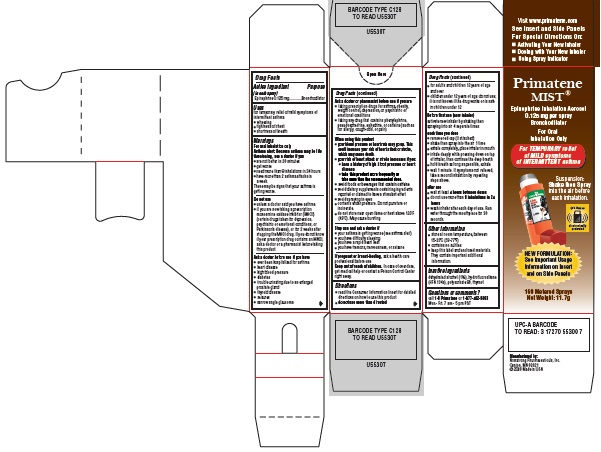
Primatene Mist Epinephrine Inhalation 125 ug Aerosol — NDC 17270-5530-0 (Billing 17270-5530-00)
This is a package of Primatene Mist Epinephrine Inhalation 125 ug Aerosol from Armstrong Pharmaceuticals, Inc., marketed since Dec 2018 and currently FDA-listed. It is this product's only package size.
NDC database record
One package, one record: these facts belong to NDC 17270-5530-0 alone.
- Record
- FDA NDC Directory package listing · Human OTC drug
- Code segments
- 17270 labeler · 5530 product · 0 package
- Package marketed since
- Dec 14, 2018
- Sample package
- No — commercial package
- Listing certified through
- Dec 31, 2027
- Barcode (UPC-A, from the NDC)
- 3 1727055300 7
- FDA record last changed
- Jul 24, 2026
Identity & classification
Regulatory identifiers FDA, NLM and CMS codes for this package
- RxCUI (RxNorm): 2109083
Where does this data come from?
- FDA openFDA NDC Directory · synced Oct 1, 2026
- FDA label on DailyMed · label index refreshed Oct 6, 2026
- RxNorm (NLM RxNav) · catalog refreshed Oct 1, 2026
- Medi-Span GPI (licensed)
- First Databank (licensed) · refreshed Oct 1, 2026
RxNorm drug class
This medicine belongs to the alpha-Adrenergic Agonist class.
Where does this data come from?
- RxClass (NLM) · catalog refreshed Oct 1, 2026
Clinical
- Primatene Mist is an over-the-counter inhaler — you don't need a prescription to buy it. But you do need a doctor to have told you that you actually have asthma before you use it....
- Who is Primatene Mist for, and do I need a prescription?
- If it's a new inhaler, you'll need to prime it first — shake it and spray it into the air four times. For each dose, shake the inhaler, spray it into the air once, then breathe out...
- Because epinephrine is a stimulant, it's common to notice a faster heartbeat, some shakiness or jitteriness, nervousness, or trouble sleeping after using it. These are expected. Bu...
Patient education
Supplement & herbal interactions
Where does this data come from?
- MedlinePlus (NLM) · refreshed Oct 1, 2026
- FDA label on DailyMed · label index refreshed Oct 6, 2026
Ask a licensed pharmacist directly — free, answered by our team.
Pricing
A drug doesn't have one price. Each row is a different public payment system, and none is what you'd pay at the counter — that depends on your insurance. The ⓘ on each row explains what it measures.
| Price system | Per each | Per package |
|---|---|---|
| Retail pharmacies payNADAC · weekly | Not in the retail survey — common for institutional, discontinued, or low-volume packs. | |
| Medicaid paysCMS SDUD · 12 mo | No recent Medicaid claims on file for this NDC — rare and low-volume NDCs are suppressed in the public data. | |
| Medicare drug plans payPart D · quarterly | No Part D plan price is available for this NDC in our data. | |
Where does this data come from?
- CMS NADAC weekly file
- CMS ASP pricing files · refreshed Sep 20, 2026
- CMS Medicaid State Drug Utilization Data · refreshed Oct 7, 2026
- CMS Part D plan pricing files · refreshed Sep 24, 2026
- VA National Acquisition Center price file
Packaging — all sizes for this product
| Package NDC | Description | Marketing start | Marketing end | Status |
|---|---|---|---|---|
| 17270-5530-00 You're viewing this Main listing | 1 INHALER in 1 CARTON / 160 AEROSOL in 1 INHALER | 2018-12-14 | — | Active |
Therapeutic equivalents
| Product | Labeler | Pack | NADAC/unit | TE | Status | Price vs. this |
|---|---|---|---|---|---|---|
| Primatene Mist 125 ug 17270-5512-00 | Armstrong | 1 inhaler | — | — | FDA listed | — |
| Primatene Mist 125 ugthis 17270-5530-00 | Armstrong | 1 inhaler | — | — | FDA listed | — |
Where does this data come from?
- FDA openFDA NDC Directory · synced Oct 1, 2026
- FDA Orange Book · refreshed Oct 3, 2026
- CMS NADAC weekly file
Availability & generic status
We did not find an FDA-approved generic match for this exact strength, form and route. Patent/protection dates below may affect future generic timing.
Why the date isn’t exact: Generic timing can change because patents may be challenged, settled, licensed, added, removed, or worked around with a narrower label — and FDA approval does not always mean a pharmacy can get the generic today.
🛈 What do these terms mean?
- Patent
- Legal protection listed in the Orange Book that may delay generic approval or launch. Issued by the U.S. Patent & Trademark Office.
- Substance patent
- Covers the active drug molecule itself — the hardest to design around. A generic generally can’t launch until it expires.
- Formulation (product) patent
- Covers a specific formulation or dosage form. A generic can sometimes work around it with a different formulation.
- Method-of-use patent
- A patent covering one specific approved use of the drug — not necessarily the whole molecule. A generic can sometimes launch with a “skinny label” that carves out the protected use and keeps the others.
- Skinny label
- A generic label that omits a still-patented use when the FDA allows it — letting a generic reach the market for the unprotected uses.
- Exclusivity
- FDA-granted marketing protection, separate from patents — e.g. 5-yr new chemical entity, 7-yr orphan drug, or a +6-month pediatric extension.
- Paragraph IV
- A generic applicant’s formal challenge to a listed patent. It can potentially lead to earlier generic entry, but often involves litigation or a settlement.
- RLD / RS
- Reference Listed Drug — the brand product the FDA uses as the reference for generic applications. Reference Standard — the product the FDA expects generics to compare against in bioequivalence testing.
- TE / AB rating
- FDA therapeutic-equivalence rating. An AB rating generally means the FDA considers a generic therapeutically equivalent to — and substitutable for — the brand.
- LOE (loss of exclusivity)
- The latest patent or exclusivity currently listed — the loss-of-exclusivity / latest-listed-protection date shown on this page. Paragraph-IV challenges and settlements can move the real date earlier; FDA approval and a manufacturer’s decision to market can move it later.
Built from the FDA Orange Book. The bars above are scaled to each protection’s expiry; the red LOE marker is the last one to lapse.
| Patent | Type | Use code | Expires |
|---|---|---|---|
| US 8367734 ↗ | Drug product | — | Jan 26, 2026 |
Is there a generic version of this drug?
The FDA approved a generic — why can’t I get it at my pharmacy yet?
Why do different websites show different generic release dates?
What does “FDA listed” mean?
What does a patent or protection date mean here?
What does “current Orange Book estimate” mean?
Can a generic come out before the last patent expires?
Can a generic come out after the listed dates?
What is the difference between patents and exclusivity?
Why are there multiple patent dates?
Where does this data come from?
- FDA Orange Book · refreshed Oct 3, 2026
Inactive Ingredients / Excipients
Inactive ingredients, also called excipients, are components of the drug product other than the active ingredient. They may include fillers, dyes, coatings, preservatives, flavors, or other formulation ingredients.
🧪 Avoiding an ingredient? See Epinephrine Oral Inhalation inactive ingredients by manufacturer: every current product's list side by side, so you can ask your pharmacy for the version that does not list it.
💡 Tap an ingredient (hover on desktop) to see what it is and why it’s used.
-
UNII 3K9958V90M
A liquid solvent derived from fermentation or chemical synthesis. In medicines, alcohol dissolves active ingredients, helps preserve the product, and improves how the body absorbs certain drugs.
-
UNII DH9E53K1Y8
A synthetic fluorinated hydrocarbon used primarily as a propellant or aerosol dispersant in pressurized inhaler formulations to help deliver medication to the lungs.
-
UNII 6OZP39ZG8H
Polysorbate 80 is a synthetic emulsifier derived from sorbitol and oleic acid. It helps mix oil and water-based ingredients together in medications and improves how the product disperses in the body.
-
UNII 3J50XA376E
Thymol is a natural compound derived from thyme and other plants. It acts as a preservative and flavoring agent in medicines, helping prevent microbial growth and add taste.
4 inactive ingredients listed in the exact product block matched to this NDC.
Label-section wording can be broader than the structured product block and may mention additional formulation ingredients.
Where does this data come from?
ingredient classCode="IACT" elements from the exact product block matched by this NDC. Label-section narrative from DailyMed / the openFDA label index is shown separately when available.- FDA label on DailyMed · label index refreshed Oct 6, 2026
- FDA openFDA NDC Directory · synced Oct 1, 2026
Inactive ingredient FAQ
Are inactive ingredients the same for every manufacturer?
Why might an inactive ingredient be missing?
Can inactive ingredients matter?
Manufacturer & labeler
More NDCs from Armstrong Pharmaceuticals, Inc. labeler code 17270
Where does this data come from?
- FDA openFDA NDC Directory · synced Oct 1, 2026
- Drugs@FDA
FDA label — Drug Facts FDA SPL
🎯 Indications and Usage ▾
Uses for temporary relief of mild symptoms of intermittent asthma ■ wheezing ■ tightness of chest ■ shortness of breath
⏱️ Dosage and Administration ▾
Directions ■ read the Consumer Information Insert for detailed directions on how to use this product ■ do not use more than directed ■ for adults and children 12 years of age and over ■ children under 12 years of age: do not use; it is not known if the drug works or is safe in children under 12 Before first use (new inhaler) activate new inhaler by shaking then spraying into air 4 separate times each time you dose ■ remove red cap (if attached) ■ shake then spray into the air 1 time ■ exhale completely, place inhaler in mouth ■ inhale deeply while pressing down on top of inhaler, then continue the deep breath ■ hold breath as long as possible, exhale ■ wait 1 minute.
If symptoms not relieved, take a second inhalation by repeating steps above. after use ■ wait at least 4 hours between doses ■ do not use more than 8 inhalations in 24 hours ■ wash inhaler after each day of use. Run water through the mouthpiece for 30 seconds.
⚠️ Warnings ▾
Warnings For oral inhalation only Asthma alert: Because asthma may be life threatening, see a doctor if you ■ are not better in 20 minutes ■ get worse ■ need more than 8 inhalations in 24 hours ■ have more than 2 asthma attacks in a week These may be signs that your asthma is getting worse. Do not use ■ unless a doctor said you have asthma ■ if you are now taking a prescription monoamine oxidase inhibitor (MAOI) (certain drugs taken for depression, psychiatric or emotional conditions, or Parkinson’s disease), or for 2 weeks after stopping the MAOI drug.
If you do not know if your prescription drug contains an MAOI, ask a doctor or a pharmacist before taking this product. Ask a doctor before use if you have ■ ever been hospitalized for asthma ■ heart disease ■ high blood pressure ■ diabetes ■ trouble urinating due to an enlarged prostate gland ■ thyroid disease ■ seizures ■ narrow angle glaucoma Ask a doctor or pharmacist before use if you are ■ taking prescription drugs for asthma, obesity, weight control, depression, or psychiatric or emotional conditions ■ taking any drug that contains phenylephrine, pseudoephedrine, ephedrine, or caffeine (such as for allergy, cough-cold, or pain) When using this product ■ your blood pressure or heart rate may go up.
This could increase your risk of heart attack or stroke, which may cause death. ■ your risk of heart attack or stroke increases if you: ■ have a history of high blood pressure or heart disease ■ take this product more frequently or take more than the recommended dose. ■ avoid foods or beverages that contain caffeine ■ avoid dietary supplements containing ingredients reported or claimed to have a stimulant effect ■ avoid spraying in eyes ■ contents under pressure. Do not puncture or incinerate. ■ do not store near open flame or heat above 120°F (49°C).
May cause bursting. Stop use and ask a doctor if ■ your asthma is getting worse (see asthma alert) ■ you have difficulty sleeping ■ you have a rapid heart beat ■ you have tremors, nervousness, or seizure If pregnant or breast-feeding , ask a health care professional before use Keep out of reach of children. In case of overdose, get medical help or contact a Poison Control Center right away.
📦 Storage and Handling ▾
Other information ■ store at room temperature, between 15-25°C (59-77°F) ■ contains no sulfites ■ keep this label and enclosed materials. They contain important additional information.
🧪 Active Ingredient ▾
Active ingredient (in each spray) Epinephrine 0.125 mg
🧪 Inactive Ingredients ▾
Inactive ingredients dehydrated alcohol (1%), hydrofluoroalkane (HFA 134a), polysorbate 80, thymol
🎯 Purpose ▾
Purpose Bronchodilator
📄 Do Not Use ▾
Do not use ■ unless a doctor said you have asthma ■ if you are now taking a prescription monoamine oxidase inhibitor (MAOI) (certain drugs taken for depression, psychiatric or emotional conditions, or Parkinson’s disease), or for 2 weeks after stopping the MAOI drug. If you do not know if your prescription drug contains an MAOI, ask a doctor or a pharmacist before taking this product.
📄 Ask a Doctor Before Use If ▾
Ask a doctor before use if you have ■ ever been hospitalized for asthma ■ heart disease ■ high blood pressure ■ diabetes ■ trouble urinating due to an enlarged prostate gland ■ thyroid disease ■ seizures ■ narrow angle glaucoma
📄 Ask a Doctor or Pharmacist Before Use If ▾
Ask a doctor or pharmacist before use if you are ■ taking prescription drugs for asthma, obesity, weight control, depression, or psychiatric or emotional conditions ■ taking any drug that contains phenylephrine, pseudoephedrine, ephedrine, or caffeine (such as for allergy, cough-cold, or pain)
📄 When Using This Product ▾
When using this product ■ your blood pressure or heart rate may go up. This could increase your risk of heart attack or stroke, which may cause death. ■ your risk of heart attack or stroke increases if you: ■ have a history of high blood pressure or heart disease ■ take this product more frequently or take more than the recommended dose. ■ avoid foods or beverages that contain caffeine ■ avoid dietary supplements containing ingredients reported or claimed to have a stimulant effect ■ avoid spraying in eyes ■ contents under pressure.
Do not puncture or incinerate. ■ do not store near open flame or heat above 120°F (49°C). May cause bursting.
📄 Stop Use and Ask a Doctor If ▾
Stop use and ask a doctor if ■ your asthma is getting worse (see asthma alert) ■ you have difficulty sleeping ■ you have a rapid heart beat ■ you have tremors, nervousness, or seizure
🤰 If Pregnant or Breast-Feeding ▾
If pregnant or breast-feeding , ask a health care professional before use
📄 Keep Out of Reach of Children ▾
Keep out of reach of children. In case of overdose, get medical help or contact a Poison Control Center right away.
📄 Questions or Comments ▾
Questions or comments? call 1-8 Primatene or 1-877-462-8363 Mon.- Fri. 7 am - 5 pm PST
📄 Package Label / Principal Display Panel ▾
Primatene MIST® Carton Principal Display Panel Text: Primatene MIST® Epinephrine Inhalation Aerosol 0.125 mg per spray Bronchodilator For Oral Inhalation Only For TEMPORARY relief of MILD symptoms of INTERMITTENT asthma Suspension: Shake then Spray into the air before each inhalation. This item is electronically protected NEW FORMULATION: See Important Usage Information on Insert and on Side Panels 160 Metered Sprays Net Weight: 11.7g carton
Primatene MIST® Carton Principal Display Panel Text: Primatene MIST® Epinephrine Inhalation Aerosol 0.125 mg per spray Bronchodilator For Oral Inhalation Only For TEMPORARY relief of MILD symptoms of INTERMITTENT asthma Suspension: Shake then Spray into the air before each inhalation. This item is electronically protected NEW FORMULATION: See Important Usage Information on Insert and on Side Panels 160 Metered Sprays Net Weight: 11.7g carton2
About this NDC listing & data coverage
What data is (and isn’t) available for this NDC — tap to expand
| NDC identity (package / product / labeler codes) | ✓ Available |
| Labeler | ✓ Available |
| Product & package description | ✓ Available |
| Marketing category & status | ✓ Available |
| Active ingredient / dosage form / route | ✓ Available |
| FDA label (SPL via DailyMed) | ✓ Available |
| Package photos | ✓ Available |
| Inactive ingredients (structured) | ✓ Available |
| NADAC pharmacy acquisition price (CMS) | — Not published for this NDC CMS publishes NADAC only for NDCs reported in its retail-pharmacy survey. |
| Orange Book / therapeutic-equivalence data | ✓ Available |
| HCPCS J-code billing crosswalk | — Not published for this NDC Most self-administered / retail products have no J-code — that is normal. |
| Medicaid utilization (CMS SDUD) | — Not published for this NDC CMS reports utilization only for NDCs with Medicaid claims above its privacy threshold. |