
Clobetasol Propionate Cream USP, 0.05% .5 mg/g Cream, 30 g — NDC 21922-016-05 (Billing 21922-0016-05)
This is a package of 30 g of Clobetasol Propionate Cream USP, 0.05% .5 mg/g Cream from Encube Ethicals, Inc., marketed since Oct 2020 and currently FDA-listed; retail pharmacies pay about $0.1668 per g (NADAC).
Identity & classification
Regulatory identifiers FDA, NLM and CMS codes for this package
Drug-database identifiers Medi-Span GPI and First Databank GCN / HICL / AHFS classification
- GSN (GCN sequence number): 007634
- GCN: 32140
- GPI-14 (Medi-Span): 90550025103705
- HICL (First Databank): 003327
- AHFS class code: 84:06.08.00
- RxCUI (RxNorm): 861495
Where does this data come from?
- FDA openFDA NDC Directory · synced Oct 1, 2026
- FDA label on DailyMed · label index refreshed Oct 1, 2026
- RxNorm (NLM RxNav) · catalog refreshed Oct 1, 2026
- Medi-Span GPI (licensed)
- First Databank (licensed) · refreshed Oct 1, 2026
RxNorm drug class
This medicine belongs to the Corticosteroid class.
Where does this data come from?
- RxClass (NLM) · catalog refreshed Oct 1, 2026
Clinical
- It calms inflamed, itchy skin and scalp conditions, including plaque psoriasis. The exact use depends on your product, such as shampoo for scalp psoriasis or spray for plaque psori...
- Usually only a short time, often 2 weeks and up to 4 weeks for some products. Stop when your skin is under control. If you see no improvement in 2 weeks, check back with your presc...
- Generally no. Most clobetasol skin products should not be used on the face, armpits or groin. Keep it out of your eyes and mouth, and follow your product's directions.
- Mild burning, stinging, itching or dryness where you apply it. Call your doctor if your skin thins, breaks out, looks infected or gets worse. Also call for signs of steroid effects...
Patient education
Supplement & herbal interactions
Where does this data come from?
- MedlinePlus (NLM) · refreshed Oct 1, 2026
- FDA label on DailyMed · label index refreshed Oct 1, 2026
Ask a licensed pharmacist directly — free, answered by our team.
Pricing
A drug doesn't have one price. Each row is a different public payment system, and none is what you'd pay at the counter — that depends on your insurance. The ⓘ on each row explains what it measures.
| Price system | Per g | Per package |
|---|---|---|
| Retail pharmacies payNADAC · weekly | $0.167 | $5.00 / 30 g |
| Medicaid paysCMS SDUD · 12 mo | $0.4986 | $14.96 / 30 g |
| Medicare drug plans payPart D · quarterly | No Part D plan price is available for this NDC in our data. | |
Where does this data come from?
- CMS NADAC weekly file · file of Sep 30, 2026
- CMS ASP pricing files · refreshed Sep 20, 2026
- CMS Medicaid State Drug Utilization Data · through Q1 2026
- CMS Part D plan pricing files · refreshed Sep 24, 2026
- VA National Acquisition Center price file
Packaging — all sizes for this product
| Package NDC | Description | Per unit | Per pack | Marketing start | Marketing end | Status |
|---|---|---|---|---|---|---|
| 21922-0016-04 21922-016-04 | 15 g in 1 TUBE | $0.1930 / g | $2.90 | 2020-10-01 | — | Active |
| 21922-0016-05 You're viewing this | 30 g in 1 TUBE | $0.1668 / g | $5.00 | 2020-10-01 | — | Active |
| 21922-0016-06 21922-016-06 | 45 g in 1 TUBE | $0.1216 / g | $5.47 | 2020-10-01 | — | Active |
| 21922-0016-07 21922-016-07 Main listing | 60 g in 1 TUBE | $0.1404 / g | $8.42 | 2020-10-01 | — | Active |
You're viewing one of 4 pack sizes for this product.
Per g, this pack runs about 37% above the cheapest pack (45 g, $0.1216 vs $0.1668 NADAC).
This pack accounts for about 26% of this product's recent Medicaid fills; the largest share goes to the 60 g pack. See all packs ↓
Pack size FAQ
What quantity is in this package?
How does this package differ from NDC 21922-0016-04?
What NDC number is used to bill for this package of Clobetasol Propionate Cream USP, 0.05% .5 mg/g Cream?
Prices are the latest CMS NADAC pharmacy acquisition cost per NDC; per-pack figures are per-unit × pack quantity, shown only when the pack is denominated in the same measure NADAC prices.
Therapeutic equivalents
| Product | Labeler | Pack | NADAC/unit | TE | Status | Price vs. this |
|---|---|---|---|---|---|---|
| Clobetasol Propionate Cream USP, 0.05% Clobetasol Propionate Cream USP, 0.05% .5 mg/gthis 21922-0016-05 | Encube | 30 g | $0.167 | AB1 | Availability likely | — |
| Clobetasol Propionate .5 mg/g 69238-1532-03 | Amneal | 1 tube | $0.167 | AB1 | Availability likely | — |
| Clobetasol Propionate .5 mg/g 00168-0163-15 | E. | 15 g | $0.193 | AB1 | Availability likely | +16% |
| Clobetasol Propionate .5 mg/g 13668-0569-01 | Torrent | 15 g | $0.193 | AB1 | Availability likely | +16% |
| Clobetasol Propionate .5 mg/g 51672-1258-01 | Sun | 1 tube | $0.193 | AB1 | Availability likely | +16% |
| Clobetasol Propionate .5 mg/g 62332-0547-15 | Alembic | 1 tube | $0.193 | AB1 | Availability likely | +16% |
| Clobetasol Propionate .5 mg/g 68180-0956-01 | Lupin | 1 tube | $0.193 | AB1 | Availability likely | +16% |
| Clobetasol Propionate .5 mg/g 70700-0109-15 | Xiromed, | 1 tube | $0.193 | AB1 | Availability likely | +16% |
| Clobetasol Propionate Cream USP, 0.05% Clobetasol Propionate Cream USP, 0.05% .5 mg/g 72603-0323-01 | Northstar | 15 g | $0.193 | AB1 | Availability likely | +16% |
| Clobetasol Propionate .5 mg/g 68462-0529-17 | Glenmark | 1 tube | $0.224 | — | FDA listed | +34% |
| Clobetasol Propionate .5 mg/g 42291-0076-15 | AvKARE | 1 tube | — | AB1 | FDA listed | — |
| Clobetasol Propionate .5 mg/g 46708-0547-15 | Alembic | 1 tube | — | AB1 | FDA listed | — |
| Clobetasol Propionate .5 mg/g 50090-0549-00 | A-S | 1 tube | — | AB1 | FDA listed | — |
| Clobetasol Propionate .5 mg/g 50090-5079-00 | A-S | 1 tube | — | AB1 | FDA listed | — |
| Clobetasol Propionate Cream USP, 0.05% Clobetasol Propionate Cream USP, 0.05% .5 mg/g 50090-5979-00 | A-S | 30 g | — | AB1 | FDA listed | — |
| Clobetasol Propionate .5 mg/g 50090-6717-00 | A-S | 1 tube | — | AB1 | FDA listed | — |
| Clobetasol Propionate Cream USP, 0.05% Clobetasol Propionate Cream USP, 0.05% .5 mg/g 50090-7392-00 | A-S | 15 g | — | AB1 | FDA listed | — |
| Clobetasol Propionate .5 mg/g 63629-2329-01 | Bryant | 60 g | — | AB1 | FDA listed | — |
| Clobetasol Propionate .5 mg/g 63629-2330-01 | Bryant | 1 tube | — | AB1 | FDA listed | — |
| Clobetasol Propionate .5 mg/g 63629-2331-01 | Bryant | 1 tube | — | AB1 | FDA listed | — |
| Clobetasol Propionate .5 mg/g 63629-2332-01 | Bryant | 1 tube | — | AB1 | FDA listed | — |
| Clobetasol Propionate Cream 0.05% Clobetasol Propionate Cream 0.05% .5 mg/g 68788-4001-06 | Preferred | 60 g | — | AB1 | FDA listed | — |
| Clobetasol Propionate Cream USP, 0.05% Clobetasol Propionate Cream USP, 0.05% .5 mg/g 70518-4374-00 | REMEDYREPACK | 30 g | — | AB1 | FDA listed | — |
| Clobetasol Propionate Cream USP, 0.05% Clobetasol Propionate Cream USP, 0.05% .5 mg/g 71335-2821-01 | Bryant | 60 g | — | AB1 | FDA listed | — |
| Clobetasol Propionate .5 mg/g 72162-1961-02 | Bryant | 1 tube | — | AB1 | FDA listed | — |
| Clobetasol Propionate Cream USP, 0.05% Clobetasol Propionate Cream USP, 0.05% .5 mg/g 72162-2300-02 | Bryant | 15 g | — | AB1 | FDA listed | — |
| Clobetasol Propionate .5 mg/g 72189-0262-30 | DIRECT | 30 g | — | AB1 | FDA listed | — |
| Clobetasol Propionate .5 mg/g 82804-0083-30 | Proficient | 30 g | — | AB1 | FDA listed | — |
| Clobetasol Propionate Cream, 0.05% Clobetasol Propionate Cream, 0.05% .5 mg/g 82804-0133-30 | Proficient | 30 g | — | AB1 | FDA listed | — |
Where does this data come from?
- FDA openFDA NDC Directory · synced Oct 1, 2026
- FDA Orange Book · refreshed Sep 3, 2026
- CMS NADAC weekly file · file of Sep 30, 2026
Availability & generic status
This product is an FDA-approved generic. Other versions of the same drug are listed under Therapeutic equivalents, least expensive first.
Where does this data come from?
- FDA Orange Book · refreshed Sep 3, 2026
Inactive Ingredients / Excipients
Inactive ingredients, also called excipients, are components of the drug product other than the active ingredient. They may include fillers, dyes, coatings, preservatives, flavors, or other formulation ingredients.
Where does this data come from?
IACT rows and label-wide narrative are kept separate; availability and product-level specificity depend on the submitted label.- FDA label on DailyMed · label index refreshed Oct 1, 2026
- FDA openFDA NDC Directory · synced Oct 1, 2026
Inactive ingredient FAQ
Are inactive ingredients the same for every manufacturer?
Why might an inactive ingredient be missing?
Can inactive ingredients matter?
Manufacturer & labeler
Where does this data come from?
- FDA openFDA NDC Directory · synced Oct 1, 2026
- Drugs@FDA
Full prescribing information FDA SPL
🎯 Indications and Usage ▾
INDICATIONS AND USAGE: Clobetasol propionate cream USP, 0.05% is super-high potency corticosteroid formulation indicated for the relief of the inflammatory and pruritic manifestations of corticosteroid-responsive dermatoses. Treatment beyond 2 consecutive weeks is not recommended, and the total dosage should not exceed 50 g /week because of the potential for the drug to suppress the hypothalamic-pituitary- adrenal (HPA) axis. Use in pediatric patients under 12 years of age is not recommended.
As with other highly active corticosteroids, therapy should be discontinued when control has been achieved. If no improvement is seen within 2 weeks, reassessment of the diagnosis may be necessary.
⏱️ Dosage and Administration ▾
DOSAGE AND ADMINISTRATION: Apply a thin layer of clobetasol propionate cream to the affected skin areas twice daily and rub in gently and completely (See INDICATIONS AND USAGE). Clobetasol propionate cream is super- high potency topical corticosteroids; therefore, treatment should be limited to 2 consecutive weeks and amounts greater than 50 g/week should not be used . As with other highly active corticosteroids, therapy should be discontinued when control has been achieved.
If no improvement is seen within 2 weeks, reassessment of diagnosis may be necessary. Clobetasol propionate cream should not be used with occlusive dressings. Geriatric Use: In studies where geriatric patients (65 years of age or older, see PRECAUTIONS) have been treated with clobetasol propionate cream, safety did not differ from that in younger patients; therefore, no dosage adjustment is recommended.
⛔ Contraindications ▾
CONTRAINDICATIONS: Clobetasol propionate cream USP, 0.05% is contraindicated in those patients with a history of hypersensitivity to any of the components of the preparations.
🤒 Adverse Reactions ▾
ADVERSE REACTIONS: In controlled clinical trials, the most frequent adverse reactions reported for clobetasol propionate cream were burning and stinging sensation in 1% of treated patients. Less frequent adverse reactions were itching, skin atrophy, and cracking and fissuring of the skin. Cushing's syndrome has been reported in infants and adults as a result of prolonged use of topical clobetasol propionate formulations.
The following additional local adverse reactions have been reported with topical corticosteroids, and they may occur more frequently with the use of occlusive dressings and higher potency corticosteroids. These reactions are listed in an approximately decreasing order of occurrence: dryness, acneiform eruptions, hypopigmentation, perioral dermatitis, allergic contact dermatitis, secondary infection, irritation, striae, and miliaria. To report SUSPECTED ADVERSE REACTIONS, contact Encube Ethicals Private Limited at 1-833-285-4151 or FDA at 1-800-FDA-1088 or www.fda.gov/medwatch.
🤰 Pregnancy ▾
Pregnancy: Teratogenic Effects: Pregnancy Category C corticosteroids have been shown to be teratogenic in laboratory animals when administered systemically at relatively low dosage levels. Some corticosteroids have been shown to be teratogenic after dermal application to laboratory animals. Clobetasol propionate has not been tested for teratogenicity when applied topically; however, it is absorbed percutaneously, and when administered subcutaneously it was a significant teratogen in both the rabbit and mouse.
Clobetasol propionate has greater teratogenic potential than steroids that are less potent. Teratogenicity studies in mice using the subcutaneous route resulted in fetotoxicity at the highest dose tested (1 mg/kg) and teratogenicity at all dose levels tested down to 0.03 mg/kg. These doses are approximately 1.4 and 0.04 times, respectively, the human topical dose of clobetasol propionate cream.
Abnormalities seen included cleft palate and skeletal abnormalities. In rabbits, clobetasol propionate was teratogenic at doses of 3 and 10 mcg/kg. These doses are approximately 0.02 and 0.05 times, respectively, the human topical dose of clobetasol propionate cream.
Abnormalities seen included cleft palate, cranioschisis, and other skeletal abnormalities. There are no adequate and well-controlled studies of the teratogenic potential of clobetasol propionate in pregnant women. Clobetasol propionate cream should be used during pregnancy only if the potential benefit justifies the potential risk to the fetus.
🧒 Pediatric Use ▾
Pediatric Use: Safety and effectiveness of clobetasol propionate cream in pediatric patients have not been established. Use in pediatric patients under 12 years of age is not recommended. Because of a higher ratio of skin surface area to body mass, pediatric patients are at a greater risk than adults of HPA axis suppression and Cushing's syndrome when they are treated with topical corticosteroids.
They are therefore also at greater risk of adrenal insufficiency during or after withdrawal of treatment. Adverse effects including striae have been reported with inappropriate use of topical corticosteroids in infants and children. HPA axis suppression, Cushing's syndrome, linear growth retardation, delayed weight gain, and intracranial hypertension have been reported in children receiving topical corticosteroids.
Manifestations of adrenal suppression in children include low plasma cortisol levels and an absence of response to ACTH stimulation. Manifestations of intracranial hypertension include bulging fontanelles, headaches, and bilateral papilledema.
🧓 Geriatric Use ▾
Geriatric Use: A limited number of patients at or above 65 years of age have been treated with clobetasol propionate cream (n = 231) in US and non-US clinical trials. While the number of patients is too small to permit separate analysis of efficacy and safety, the adverse reactions reported in this population were similar to those reported by younger patients. Based on available data, no adjustment of dosage of clobetasol propionate cream in geriatric patients is warranted.
🆘 Overdosage ▾
OVERDOSAGE: Topically applied clobetasol propionate cream can be absorbed in sufficient amounts to produce systemic effects (see PRECAUTIONS).
🧬 Clinical Pharmacology ▾
CLINICAL PHARMACOLOGY: Like other topical corticosteroids, clobetasol propionate has anti-inflammatory, antipruritic, and vasoconstrictive properties. The mechanism of the anti-inflammatory activity of the topical steroids, in general, is unclear. However, corticosteroids are thought to act by the induction of phospholipase A 2 inhibitory proteins, collectively called lipocortins.
It is postulated that these proteins control the biosynthesis of potent mediators of inflammation such as prostaglandins and leukotrienes by inhibiting the release of their common precursor, arachidonic acid. Arachidonic acid is released from membrane phospholipids by phospholipase A 2 . Pharmacokinetics: The extent of percutaneous absorption of topical corticosteroids is determined by many factors, including the vehicle and the integrity of the epidermal barrier.
Occlusive dressings with hydrocortisone for up to 24 hours has not been demonstrated to increase penetration; however, occlusion of hydrocortisone for 96 hours markedly enhances penetration. Topical corticosteroids can be absorbed from normal intact skin. Inflammation and/or other disease processes in the skin may increase percutaneous absorption.
Studies performed with clobetasol propionate cream indicate that it is in the super-high range of potency as compared with other topical corticosteroids.
📦 How Supplied / Storage and Handling ▾
HOW SUPPLIED: Clobetasol Propionate Cream USP, 0.05% is supplied in 15 g tube (NDC 21922-016-04) 30 g tube (NDC 21922-016-05) 45 g tube (NDC 21922-016-06) 60 g tube (NDC 21922-016-07) Store cream between 15° and 30°C (59°-86°F). Clobetasol propionate cream should not refrigerated. Made in Italy, formulated in India.
Manufactured by: Encube Ethicals Pvt. Ltd. Plot No.
C-1, Madkaim Industrial Estate, Madkaim, Post: Mardol, Ponda, Goa - 403 404, India. OR Manufacture by: Encube Ethicals Pvt. Ltd.
Plot No. 113, Smart Industrial Park, Pithampur, District: Dhar – 454 774, Madhya Pradesh, India. Distributed by: Encube Ethicals, Inc.
200 Meredith Drive, Suite 202 Durham, NC 27713 USA Rev: 12/23
📋 Description ▾
DESCRIPTION: Clobetasol Propionate Cream USP contains the active compound clobetasol propionate, a synthetic corticosteroid, for topical dermatologic use. Clobetasol, an analog of prednisolone, has a high degree of glucocorticoid activity and a slight degree of mineralocorticoid activity. Chemically, clobetasol propionate is (11β, 16β)-21-chloro-9-fluoro-11-hydroxy-16-methyl-17-(1-oxopropoxy)-pregna-1,4-diene-3,20-dione, and it has the following structural formula: Clobetasol propionate has the molecular formula C 25 H 32 ClFO 5 and a molecular weight of 467.
It is a white to cream-colored crystalline powder insoluble in water. Clobetasol propionate cream USP, 0.05% contains clobetasol propionate 0.5 mg/g in a cream base of propylene glycol, mono- and di-glycerides, cetostearyl alcohol, stearoyl macrogolglycerides, white wax, chlorocresol, sodium citrate, anhydrous citric acid, and purified water. structure.jpg
💬 Information for Patients ▾
Information for Patients: Patients using topical corticosteroids should receive the following information and instructions: 1. This medication is to be used as directed by the physician. It is for external use only.
Avoid contact with the eyes. 2. This medication should not be used for any disorder other than that for which it was prescribed.
3. The treated skin area should not be bandaged, otherwise covered, or wrapped so as to be occlusive unless directed by the physician. 4.
Patients should report any signs of local adverse reactions to the physician.
⚠️ Precautions ▾
PRECAUTIONS General: Clobetasol propionate cream USP, 0.05% should not be used in the treatment of rosacea or perioral dermatitis, and should not be used on the face, groin, or axillae. Systemic absorption of topical corticosteroids can produce reversible HPA axis suppression with the potential for glucocorticosteroid insufficiency after withdrawal from treatment. Manifestations of Cushing's syndrome, hyperglycemia, and glucosuria can also be produced in some patients by systemic absorption of topical corticosteroids while on therapy.
Patients applying a topical steroid to a large surface area or to areas under occlusion should be evaluated periodically for evidence of HPA axis suppression. This may be done by using the ACTH stimulation, A.M. plasma cortisol, and urinary free cortisol tests. Patients receiving super-potent corticosteroids should not be treated for more than 2 weeks at a time, and only small areas should be treated at any one time due to the increased risk of HPA suppression.
Clobetasol propionate cream produced HPA axis suppression when used at doses as low as 2 g/day for 1 week in patients with eczema. If HPA axis suppression is noted, an attempt should be made to withdraw the drug, to reduce the frequency of application, or to substitute a less potent corticosteroid. Recovery of HPA axis function is generally prompt upon discontinuation of topical corticosteroids.
Infrequently, signs and symptoms of glucocorticosteroid insufficiency may occur that require supplemental systemic corticosteroids. For information on systemic supplementation, see prescribing information for those products. Pediatric patients may be more susceptible to systemic toxicity from equivalent doses due to their larger skin surface to body mass ratios (see PRECAUTIONS: Pediatric Use).
If irritation develops, clobetasol propionate cream should be discontinued and appropriate therapy instituted. Allergic contact dermatitis with corticosteroids is usually diagnosed by observing a failure to heal rather than noting a clinical exacerbation as with most topical products not containing corticosteroids. Such an observation should be corroborated with appropriate diagnostic patch testing.
If concomitant skin infections are present or develop, an appropriate antifungal or antibacterial agent should be used. If a favorable response does not occur promptly, use of clobetasol propionate cream should be discontinued until the infection has been adequately controlled. Information for Patients: Patients using topical corticosteroids should receive the following information and instructions: 1.
This medication is to be used as directed by the physician. It is for external use only. Avoid contact with the eyes.
2. This medication should not be used for any disorder other than that for which it was prescribed. 3.
The treated skin area should not be bandaged, otherwise covered, or wrapped so as to be occlusive unless directed by the physician. 4. Patients should report any signs of local adverse reactions to the physician.
Laboratory Tests: The following tests may be helpful in evaluating patients for HPA axis suppression: ACTH stimulation test A.M. plasma cortisol test Urinary free cortisol test Carcinogenesis, Mutagenesis, Impairment of Fertility: Long-term animal studies have not been performed to evaluate the carcinogenic potential of clobetasol propionate. Studies in the rat following subcutaneous administration at dosage levels up to 50 mcg/kg/day revealed that the females exhibited an increase in the number of resorbed embryos and a decrease in the number of living fetuses at the highest dose.
Clobetasol propionate was nonmutagenic in 3 different test systems: the Ames test, the Saccharomyces cerevisiae gene conversion assay, and the E. coli B WP2 fluctuation test. Pregnancy: Teratogenic Effects: Pregnancy Category C corticosteroids have been shown to be teratogenic in laboratory animals when administered systemically at relatively low dosage levels.… [Excerpted — this section continues on DailyMed.]
🍼 Nursing Mothers ▾
Nursing Mothers: Systemically administered corticosteroids appear in human milk and could suppress growth, interfere with endogenous corticosteroid production, or cause other untoward effects. It is not known whether topical administration of corticosteroids could result in sufficient systemic absorption to produce detectable quantities in human milk. Because many drugs are excreted in human milk, caution should be exercised when clobetasol propionate cream is administered to a nursing woman.
📄 Carcinogenesis, Mutagenesis, Impairment of Fertility ▾
Carcinogenesis, Mutagenesis, Impairment of Fertility: Long-term animal studies have not been performed to evaluate the carcinogenic potential of clobetasol propionate. Studies in the rat following subcutaneous administration at dosage levels up to 50 mcg/kg/day revealed that the females exhibited an increase in the number of resorbed embryos and a decrease in the number of living fetuses at the highest dose. Clobetasol propionate was nonmutagenic in 3 different test systems: the Ames test, the Saccharomyces cerevisiae gene conversion assay, and the E. coli B WP2 fluctuation test.
📄 Package Label / Principal Display Panel ▾
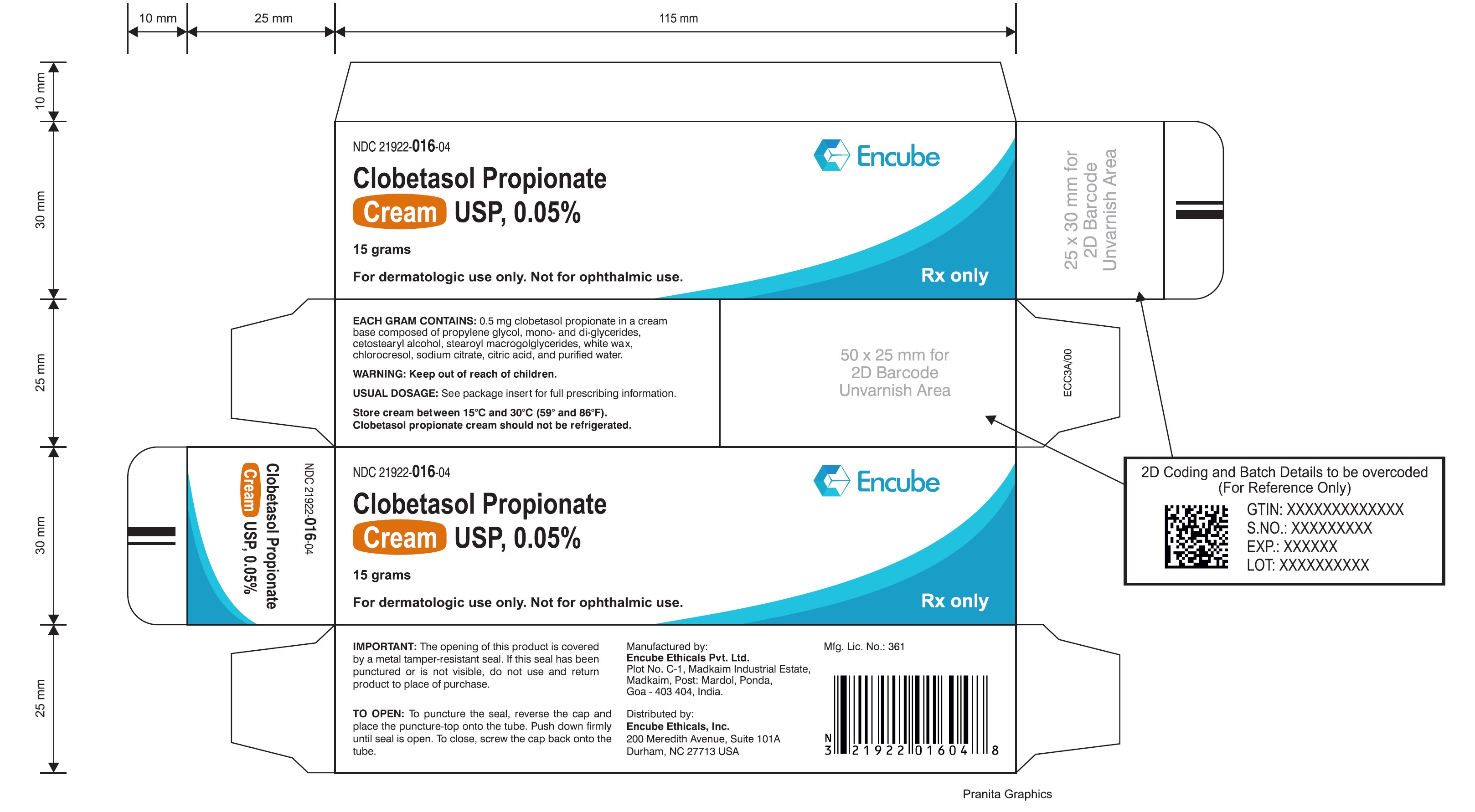
PACKAGE LABEL.PRINCIPAL DISPLAY PANEL PRINCIPAL DISPLAY PANEL-Carton NDC 21922-016-04 Clobetasol Propionate Cream USP, 0.05% For dermatologic use only. Not for ophthalmic use. Rx only 15 grams Manufactured by: Encube Ethicals Pvt.
Ltd. Plot No. C-1, Madkaim Industrial Estate, Madkaim, Post: Mardol, Ponda, Goa - 403 404, India.
Distributed by: Encube Ethicals, Inc. 200 Meredith Drive, Suite 202, Durham, NC 27713, USA NDC 21922-016-05 Clobetasol Propionate Cream USP, 0.05% For dermatologic use only. Not for ophthalmic use.
Rx only 30 grams Manufactured by: Encube Ethicals Pvt. Ltd. Plot No.
C-1, Madkaim Industrial Estate, Madkaim, Post: Mardol, Ponda, Goa - 403 404, India. Distributed by: Encube Ethicals, Inc. 200 Meredith Drive, Suite 202, Durham, NC 27713, USA NDC 21922-016-06 Clobetasol Propionate Cream USP, 0.05% For dermatologic use only.
Not for ophthalmic use. Rx only 45 grams Manufactured by: Encube Ethicals Pvt. Ltd.
Plot No. C-1, Madkaim Industrial Estate, Madkaim, Post: Mardol, Ponda, Goa - 403 404, India. Distributed by: Encube Ethicals, Inc.
200 Meredith Drive, Suite 202, Durham, NC 27713, USA NDC 21922-016-07 Clobetasol Propionate Cream USP, 0.05% For dermatologic use only. Not for ophthalmic use. Rx only 60 grams Manufactured by: Encube Ethicals Pvt.
Ltd. Plot No. C-1, Madkaim Industrial Estate, Madkaim, Post: Mardol, Ponda, Goa - 403 404, India.
Distributed by: Encube Ethicals, Inc. 200 Meredith Drive, Suite 202, Durham, NC 27713, USA NDC 21922-016-04 Clobetasol Propionate Cream USP, 0.05% For dermatologic use only. Not for ophthalmic use.
Rx only 15 grams Manufacture by: Encube Ethicals Pvt. Ltd. Plot No.
113, Smart Industrial Park, Pithampur, District: Dhar – 454 774, Madhya Pradesh, India. Distributed by: Encube Ethicals, Inc. 200 Meredith Drive, Suite 202, Durham, NC 27713, USA NDC 21922-016-05 Clobetasol Propionate Cream USP, 0.05% For dermatologic use only.
Not for ophthalmic use. Rx only 30 grams Manufacture by: Encube Ethicals Pvt. Ltd.
Plot No. 113, Smart Industrial Park, Pithampur, District: Dhar – 454 774, Madhya Pradesh, India. Distributed by: Encube Ethicals, Inc.
200 Meredith Drive, Suite 202, Durham, NC 27713, USA NDC 21922-016-06 Clobetasol Propionate Cream USP, 0.05% For dermatologic use only. Not for ophthalmic use. Rx only 45 grams Manufacture by: Encube Ethicals Pvt.
Ltd. Plot No. 113, Smart Industrial Park, Pithampur, District: Dhar – 454 774, Madhya Pradesh, India.
Distributed by: Encube Ethicals, Inc. 200 Meredith Drive, Suite 202, Durham, NC 27713, USA NDC 21922-016-07 Clobetasol Propionate Cream USP, 0.05% For dermatologic use only. Not for ophthalmic use.
Rx only 60 grams Manufacture by: Encube Ethicals Pvt. Ltd. Plot No.
113, Smart Industrial Park, Pithampur, District: Dhar – 454 774, Madhya Pradesh, India. Distributed by: Encube Ethicals, Inc. 200 Meredith Drive, Suite 202, Durham, NC 27713, USA clobetasol-carton-15-g clobetasol-carton-30-g clobetasol-carton-45-g clobetasol-carton-60-g 15 g c 30 g c 45 g c 60 g c