
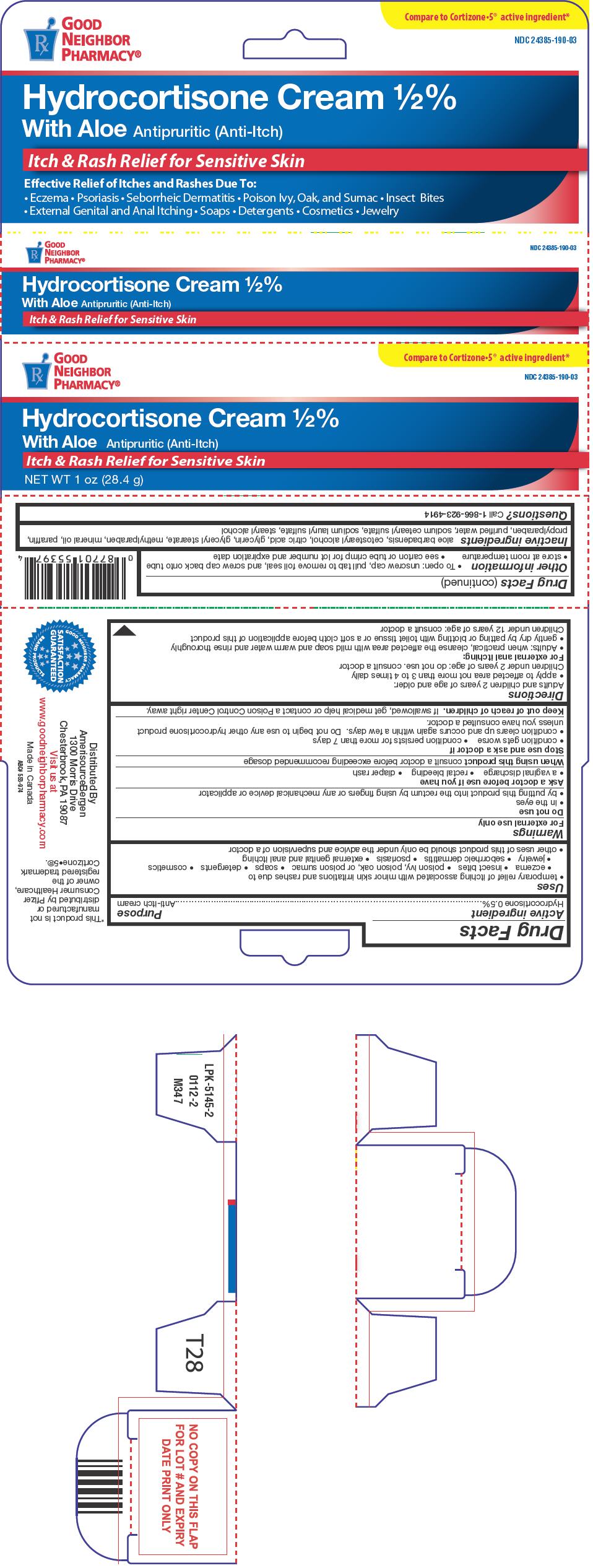
Good Neighbor Pharmacy Hydrocortisone With Aloe for Sensitive Skin .5 g/100g Cream, 1 tube — NDC 24385-190-03 (Billing 24385-0190-03)
This is a package of 1 tube of Good Neighbor Pharmacy Hydrocortisone With Aloe for Sensitive Skin .5 g/100g Cream from AmerisourceBergen, marketed since Sep 2001 and currently FDA-listed, this package's marketing is listed to end Jul 2027; retail pharmacies pay about $0.0505 per g (NADAC). It is this product's only package size.
Identity & classification
Regulatory identifiers FDA, NLM and CMS codes for this package
Drug-database identifiers Medi-Span GPI and First Databank GCN / HICL / AHFS classification
- GSN (GCN sequence number): 007524
- GCN: 30842
- HICL (First Databank): 002863
- AHFS class code: 52:08.08.00
- RxCUI (RxNorm): 198707
Where does this data come from?
- FDA openFDA NDC Directory · synced Oct 1, 2026
- FDA label on DailyMed · label index refreshed Oct 1, 2026
- RxNorm (NLM RxNav) · catalog refreshed Oct 1, 2026
- Medi-Span GPI (licensed)
- First Databank (licensed) · refreshed Oct 1, 2026
RxNorm drug class
This medicine belongs to the Corticosteroid class.
Where does this data come from?
- RxClass (NLM) · catalog refreshed Oct 1, 2026
Clinical
Hydrocortisone topical is used to treat redness, swelling, itching, and discomfort of various skin conditions. Hydrocortisone is in a class of medications called corticosteroids. It works by activating natural substances in the skin to reduce swelling, redness, and itching.
Read the full MedlinePlus article ↗- It depends on the product. Tablets and oral granules are used for adrenal insufficiency, among other conditions. Injections are used for severe allergic states and skin diseases. R...
- Don't stop it suddenly if you take it for adrenal insufficiency. Stopping abruptly can cause adrenal crisis, which can be fatal. Talk to your prescriber before making any changes.
- Common ones are fluid retention, higher blood pressure, changes in blood sugar, mood changes, bigger appetite and weight gain. Call your doctor for signs of infection, vision chang...
- Grapefruit juice and some antifungals and antibiotics can raise hydrocortisone levels. Some seizure medicines and rifampicin can lower them. Tell me about any diabetes medicines, w...
Patient education
Supplement & herbal interactions
Some supplements/herbs that may interact with Hydrocortisone — tap one for details:
Hydrocortisone may be associated with lower levels of 8 nutrients — worth a chat with your pharmacist, not a cause for alarm.
Where does this data come from?
- MedlinePlus (NLM) · refreshed Oct 1, 2026
- FDA label on DailyMed · label index refreshed Oct 1, 2026
Ask a licensed pharmacist directly — free, answered by our team.
Pricing
A drug doesn't have one price. Each row is a different public payment system, and none is what you'd pay at the counter — that depends on your insurance. The ⓘ on each row explains what it measures.
| Price system | Per g | Per package |
|---|---|---|
| Retail pharmacies payNADAC · weekly | $0.051 | $1.43 / 28.4 g |
| Medicaid paysCMS SDUD · 12 mo | $0.3125 | $8.88 / 28.4 g |
| Medicare drug plans payPart D · quarterly | No Part D plan price is available for this NDC in our data. | |
Where does this data come from?
- CMS NADAC weekly file · file of Sep 30, 2026
- CMS ASP pricing files · refreshed Sep 20, 2026
- CMS Medicaid State Drug Utilization Data · through Q1 2026
- CMS Part D plan pricing files · refreshed Sep 24, 2026
- VA National Acquisition Center price file
Packaging — all sizes for this product
| Package NDC | Description | Marketing start | Marketing end | Status |
|---|---|---|---|---|
| 24385-0190-03 You're viewing this Main listing | 1 TUBE in 1 CARTON / 28.4 g in 1 TUBE | 2001-09-13 | Jul 31, 2027 | Active |
Therapeutic equivalents
| Product | Labeler | Pack | NADAC/unit | TE | Status | Price vs. this |
|---|---|---|---|---|---|---|
| Good Neighbor Pharmacy Hydrocortisone With Aloe for Sensitive Skin .5 g/100gthis 24385-0190-03 | AmerisourceBergen | 1 tube | $0.051 | — | Availability likely | — |
| Hydrocortisone .5 g/100g 51672-2010-02 | Sun | 1 tube | $0.113 | — | Availability likely | +123% |
| AVON HeXashield Anti Itch Cream with Healing Aloe 5 mg/g 43136-0103-01 | Tai | 1 tube | — | — | FDA listed | — |
| HeXashield Anti Itch Cream with Healing Aloe 5 mg/g 43136-0203-01 | Tai | 1 tube | — | — | FDA listed | — |
| Hydrocortisone .5 g/100g 63187-0575-01 | Proficient | 1 tube | — | — | FDA listed | — |
| Anti-Itch Regular Strength 5 mg/g 69842-0192-57 | CVS | 1 tube | — | — | FDA listed | — |
| Anti-Itch Feminine Care 5 mg/g 80489-0103-01 | OL | 1 tube | — | — | FDA listed | — |
Where does this data come from?
- FDA openFDA NDC Directory · synced Oct 1, 2026
- FDA Orange Book · refreshed Sep 3, 2026
- CMS NADAC weekly file · file of Sep 30, 2026
Availability & generic status
FDA-approved generic versions are listed, and recent pricing/market data suggests they may be available — see Therapeutic equivalents.
Where does this data come from?
- FDA Orange Book · refreshed Sep 3, 2026
Inactive Ingredients / Excipients
Inactive ingredients, also called excipients, are components of the drug product other than the active ingredient. They may include fillers, dyes, coatings, preservatives, flavors, or other formulation ingredients.
💡 Tap an ingredient (hover on desktop) to see what it is and why it’s used.
-
UNII 2DMT128M1S
A waxy solid derived from plant or animal sources. It acts as an emulsifier to blend oil and water components, and also thickens the medicine to give it the right texture and consistency.
-
UNII 2968PHW8QP
A weak organic acid derived from citrus fruits or made through fermentation. It works as a buffer to control pH, a preservative to extend shelf life, and a flavoring agent in medications.
-
UNII PDC6A3C0OX
Glycerin is a clear, thick liquid derived from plant oils or fats. It acts as a humectant to retain moisture, a sweetener, and a solvent in medications.
-
UNII 230OU9XXE4
A waxy substance made from glycerin and stearic acid that acts as an emulsifier to blend oily and watery ingredients together. It also helps thicken and stabilize the medicine's texture.
-
UNII A2I8C7HI9T
Methylparaben is a preservative derived from benzoic acid that prevents growth of bacteria, fungi, and mold in medicines. It extends the product's shelf life and maintains safety during storage.
-
UNII T5L8T28FGP
Mineral oil is a clear, odorless liquid derived from crude oil. It acts as a lubricant and emollient in medications, helping pills slide smoothly during manufacturing and aiding moisture retention in topical products.
-
UNII I9O0E3H2ZE
Paraffin is a waxy, petroleum-derived substance used as a coating, lubricant, and hardening agent in tablets and capsules. It helps protect the medicine from moisture and gives pills a smooth finish.
-
UNII Z8IX2SC1OH
Propylparaben is a chemical preservative used to prevent bacterial and fungal growth in medicines and personal care products. It helps extend shelf life and maintain product safety during storage.
-
UNII 7ZBS06BH4B
A synthetic surfactant derived from coconut or palm oil. It helps other ingredients blend evenly throughout the medicine and improves how the product spreads or dissolves, acting as an emulsifier and detergent.
-
UNII 368GB5141J
A detergent and foaming agent derived from coconut or palm oil. In medications, it helps break down and mix oil and water-based ingredients, aids in tablet disintegration, and improves how the drug dissolves and spreads in the mouth or digestive system.
-
UNII 2KR89I4H1Y
Stearyl alcohol is a waxy, fatty substance derived from natural oils or made synthetically. It acts as an emulsifier and thickener in medicines, helping mix ingredients together and give the product the right texture.
-
UNII 059QF0KO0R
Water is a liquid solvent that dissolves and mixes ingredients together in liquid medicines, syrups, and injections. It helps distribute the active drug evenly throughout the product.
12 inactive ingredients listed in the exact product block matched to this NDC.
Label-section wording can be broader than the structured product block and may mention additional formulation ingredients.
Where does this data come from?
ingredient classCode="IACT" elements from the exact product block matched by this NDC. Label-section narrative from DailyMed / the openFDA label index is shown separately when available.- FDA label on DailyMed · label index refreshed Oct 1, 2026
- FDA openFDA NDC Directory · synced Oct 1, 2026
Inactive ingredient FAQ
Are inactive ingredients the same for every manufacturer?
Why might an inactive ingredient be missing?
Can inactive ingredients matter?
Manufacturer & labeler
Where does this data come from?
- FDA openFDA NDC Directory · synced Oct 1, 2026
- Drugs@FDA
FDA label — Drug Facts FDA SPL
🎯 Indications and Usage ▾
Uses temporary relief of itching associated with minor skin irritations and rashes due to eczema insect bites poison ivy, poison oak, or poison sumac soaps detergents cosmetics jewelry seborrheic dermatitis psoriasis external genital and anal itching other uses of this product should be only under the advice and supervision of a doctor
⏱️ Dosage and Administration ▾
Directions Adults and children 2 years of age and older: apply to affected area not more than 3 to 4 times daily Children under 2 years of age: do not use. consult a doctor For external anal itching Adults: when practical, cleanse the affected area with mild soap and warm water and rinse thoroughly gently dry by patting or blotting with toilet tissue or a soft cloth before application of this product Children under 12 years of age: consult a doctor
⚠️ Warnings ▾
Warnings For external use only Do not use in the eyes by putting this product into the rectum by using fingers or any mechanical device or applicator Ask a doctor before use if you have a vaginal discharge rectal bleeding diaper rash When using this product consult a doctor before exceeding recommended dosage Stop use and ask a doctor if condition gets worse condition persists for more than 7 days condition clears up and occurs again within a few days. Do not begin to use any other hydrocortisone product unless you have consulted a doctor.
Keep out of reach of children. If swallowed, get medical help or contact a Poison Control Center right away.
📦 Storage and Handling ▾
Other information To open: unscrew cap, pull tab to remove foil seal, and screw cap back onto tube store at room temperature see carton or tube crimp for lot number and expiration date
🧪 Active Ingredient ▾
Active ingredient Hydrocortisone 0.5%
🧪 Inactive Ingredients ▾
Inactive ingredients aloe barbadensis, cetostearyl alcohol, citric acid, glycerin, glyceryl stearate, methylparaben, mineral oil, paraffin, propylparaben, purified water, sodium cetearyl sulfate, sodium lauryl sulfate, stearyl alcohol
🎯 Purpose ▾
Purpose Anti-itch cream
📄 Do Not Use ▾
For external use only Do not use in the eyes by putting this product into the rectum by using fingers or any mechanical device or applicator
📄 Ask a Doctor Before Use If ▾
Ask a doctor before use if you have a vaginal discharge rectal bleeding diaper rash
📄 When Using This Product ▾
When using this product consult a doctor before exceeding recommended dosage
📄 Stop Use and Ask a Doctor If ▾
Stop use and ask a doctor if condition gets worse condition persists for more than 7 days condition clears up and occurs again within a few days. Do not begin to use any other hydrocortisone product unless you have consulted a doctor.
📄 Keep Out of Reach of Children ▾
Keep out of reach of children. If swallowed, get medical help or contact a Poison Control Center right away.
📄 Questions or Comments ▾
Questions? Call 1-866-923-4914
📄 Package Label / Principal Display Panel ▾
PRINCIPAL DISPLAY PANEL - 28.4 g Tube Carton Compare to Cortizone•5 ® active ingredient* Rx GOOD NEIGHBOR PHARMACY ® NDC 24385-190-03 Hydrocortisone Cream ½% With Aloe Antipruritic (Anti-Itch) Itch & Rash Relief for Sensitive Skin NET WT 1 oz (28.4 g) PRINCIPAL DISPLAY PANEL - 28.4 g Tube Carton