
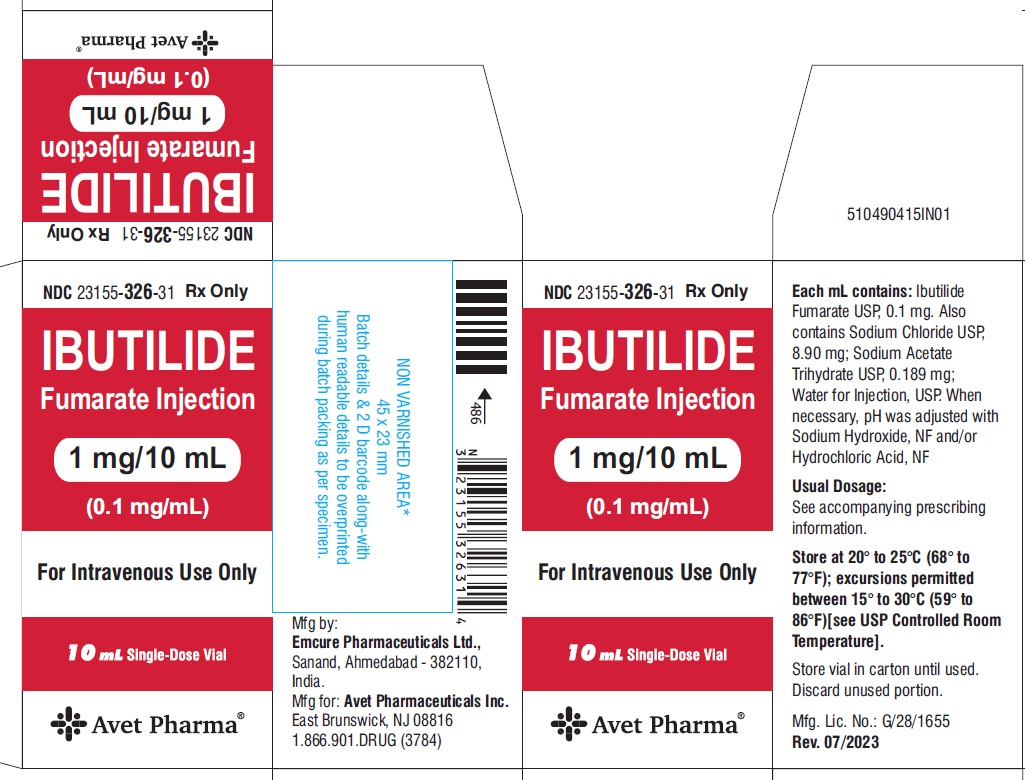
Ibutilide Fumarate 1 mg/10mL Injection, Solution — NDC 23155-326-31 (Billing 23155-0326-31)
This is a package of Ibutilide Fumarate 1 mg/10mL Injection, Solution from Heritage Pharmaceuticals Inc. d/b/a Avet Pharmaceuticals Inc., marketed since Apr 2024 and currently FDA-listed. It is this product's only package size.
NDC database record
One package, one record: these facts belong to NDC 23155-326-31 alone.
- Record
- FDA NDC Directory package listing · Human prescription drug
- Code segments
- 23155 labeler · 326 product · 31 package
- Package marketed since
- Apr 1, 2024
- Sample package
- No — commercial package
- Listing certified through
- Dec 31, 2026
- Barcode (UPC)
- 0323155326314
- FDA record last changed
- Jul 24, 2026
Identity & classification
Regulatory identifiers FDA, NLM and CMS codes for this package
Drug-database identifiers Medi-Span GPI and First Databank GCN / HICL / AHFS classification
- GSN (GCN sequence number): 026014
- GCN: 27100
- HICL (First Databank): 010956
- AHFS class code: 24:04.04.20
- RxCUI (RxNorm): 979120
Where does this data come from?
- FDA openFDA NDC Directory · synced Oct 1, 2026
- FDA label on DailyMed · label index refreshed Oct 5, 2026
- RxNorm (NLM RxNav) · catalog refreshed Oct 1, 2026
- Medi-Span GPI (licensed)
- First Databank (licensed) · refreshed Oct 1, 2026
RxNorm drug class
This medicine belongs to the Antiarrhythmic class.
Where does this data come from?
- RxClass (NLM) · catalog refreshed Oct 1, 2026
Clinical
Patient education
Supplement & herbal interactions
Where does this data come from?
- MedlinePlus (NLM) · refreshed Oct 1, 2026
- FDA label on DailyMed · label index refreshed Oct 5, 2026
Ask a licensed pharmacist directly — free, answered by our team.
Pricing
A drug doesn't have one price. Each row is a different public payment system, and none is what you'd pay at the counter — that depends on your insurance. The ⓘ on each row explains what it measures.
| Price system | Per mL | Per package |
|---|---|---|
| Retail pharmacies payNADAC · weekly | Not in the retail survey — common for institutional, discontinued, or low-volume packs. | |
| Medicaid paysCMS SDUD · 12 mo | No recent Medicaid claims on file for this NDC — rare and low-volume NDCs are suppressed in the public data. | |
| Medicare drug plans payPart D · quarterly | No Part D plan price is available for this NDC in our data. | |
| Medicare Part B allowsASP · J1742 | No ASP payment limit on file for J1742 this quarter. | |
Where does this data come from?
- CMS NADAC weekly file
- CMS ASP pricing files · refreshed Sep 20, 2026
- CMS Medicaid State Drug Utilization Data · refreshed Oct 5, 2026
- CMS Part D plan pricing files · refreshed Sep 24, 2026
- VA National Acquisition Center price file
Billing & reimbursement
Where does this data come from?
- CMS ASP NDC-HCPCS crosswalk · refreshed Sep 22, 2026
- DMEPDAC NDC-HCPCS crosswalk
- openFDA NSDE billing units · refreshed Sep 7, 2026
Packaging — all sizes for this product
| Package NDC | Description | Marketing start | Marketing end | Status |
|---|---|---|---|---|
| 23155-0326-31 You're viewing this Main listing | 1 VIAL, GLASS in 1 CARTON / 10 mL in 1 VIAL, GLASS | 2024-04-01 | — | Active |
Therapeutic equivalents
| Product | Labeler | Pack | NADAC/unit | TE | Status | Price vs. this |
|---|---|---|---|---|---|---|
| Corvert .1 mg/mL 00009-3794-22 | Pharmacia | 1 vial | — | AP | FDA listed | — |
| Ibutilide Fumarate 1 mg/10mLthis 23155-0326-31 | Heritage | 1 vial | — | AP | FDA listed | — |
Where does this data come from?
- FDA openFDA NDC Directory · synced Oct 1, 2026
- FDA Orange Book · refreshed Oct 3, 2026
- CMS NADAC weekly file
Availability & generic status
This product is an FDA-approved generic. Other versions of the same drug are listed under Therapeutic equivalents, least expensive first.
Where does this data come from?
- FDA Orange Book · refreshed Oct 3, 2026
Inactive Ingredients / Excipients
Inactive ingredients, also called excipients, are components of the drug product other than the active ingredient. They may include fillers, dyes, coatings, preservatives, flavors, or other formulation ingredients.
💡 Tap an ingredient (hover on desktop) to see what it is and why it’s used.
-
UNII QTT17582CB
A strong acid used to adjust and maintain the proper pH level in liquid medicines, ensuring stability and preventing breakdown of active ingredients.
-
UNII 4550K0SC9B
Sodium acetate is a salt derived from acetic acid. It acts as a buffer to help maintain the medicine's pH stability and may serve as a preservative or solubilizer in liquid formulations.
-
UNII 451W47IQ8X
Sodium chloride is common table salt. It's used in medicines as a buffer to maintain proper pH, as a filler to add bulk, or to adjust the osmotic balance in liquid formulations.
-
UNII 55X04QC32I
A strong alkaline chemical used to adjust and maintain the pH balance of liquid medicines. It helps keep the medicine stable and ensures it stays effective during storage.
-
UNII 059QF0KO0R
Water is a liquid solvent that dissolves and mixes ingredients together in liquid medicines, syrups, and injections. It helps distribute the active drug evenly throughout the product.
5 inactive ingredients listed in the exact product block matched to this NDC.
Where does this data come from?
ingredient classCode="IACT" elements from the exact product block matched by this NDC. Label-section narrative from DailyMed / the openFDA label index is shown separately when available.- FDA label on DailyMed · label index refreshed Oct 5, 2026
- FDA openFDA NDC Directory · synced Oct 1, 2026
Inactive ingredient FAQ
Are inactive ingredients the same for every manufacturer?
Why might an inactive ingredient be missing?
Can inactive ingredients matter?
Manufacturer & labeler
More NDCs from Heritage Pharmaceuticals Inc. d/b/a Avet Pharmac... labeler code 23155
- Diphenhydramine Hydrochloride 50 mg/mL Injection NDC 23155-264-41
- acetazolamide 125 mg Tablet NDC 23155-287-01
- acetazolamide 250 mg Tablet NDC 23155-288-01
- Amikacin Sulfate 250 mg/mL Injection, Solution NDC 23155-290-41
- Prochlorperazine Edisylate 5 mg/mL Injection NDC 23155-294-41
- Acetazolamide 500 mg/5mL Injection, Powder, Lyophilized, For Solution NDC 23155-313-31
- propofol 10 mg/mL Injection, Emulsion NDC 23155-345-41
- Melphalan hydrochloride Kit NDC 23155-355-41
- Amantadine Hydrochloride 100 mg Capsule NDC 23155-362-01
- Furosemide 10 mg/mL Injection, Solution NDC 23155-473-41
- Verapamil Hydrochloride 120 mg Tablet NDC 23155-486-01
- Desmopressin Acetate .1 mg Tablet NDC 23155-489-01
Where does this data come from?
- FDA openFDA NDC Directory · synced Oct 1, 2026
- Drugs@FDA
Full prescribing information FDA SPL
🎯 Indications and Usage ▾
INDICATIONS AND USAGE Ibutilide fumarate injection is indicated for the rapid conversion of atrial fibrillation or atrial flutter of recent onset to sinus rhythm. Patients with atrial arrhythmias of longer duration are less likely to respond to ibutilide fumarate. The effectiveness of ibutilide has not been determined in patients with arrhythmias of more than 90 days in duration.
LIFE-THREATENING ARRHYTHMIAS—APPROPRIATE TREATMENT ENVIRONMENT Ibutilide fumarate can cause potentially fatal arrhythmias, particularly sustained polymorphic ventricular tachycardia, usually in association with QT prolongation (torsades de pointes), but sometimes without documented QT prolongation. In registration studies, these arrhythmias, which require cardioversion, occurred in 1.7% of treated patients during, or within a number of hours of, use of Ibutilide fumarate. These arrhythmias can be reversed if treated promptly (see WARNINGS, Proarrhythmia ).
It is essential that Ibutilide fumarate be administered in a setting of continuous ECG monitoring and by personnel trained in identification and treatment of acute ventricular arrhythmias, particularly polymorphic ventricular tachycardia. Patients with atrial fibrillation of more than 2 to 3 days’ duration must be adequately anticoagulated, generally for at least 2 weeks. CHOICE OF PATIENTS Patients with chronic atrial fibrillation have a strong tendency to revert after conversion to sinus rhythm (see CLINICAL STUDIES ) and treatments to maintain sinus rhythm carry risks.
Patients to be treated with Ibutilide fumarate , therefore, should be carefully selected such that the expected benefits of maintaining sinus rhythm outweigh the immediate risks of Ibutilide fumarate , and the risks of maintenance therapy, and are likely to offer an advantage compared with alternative management.
⏱️ Dosage and Administration ▾
DOSAGE AND ADMINISTRATION The recommended dose based on controlled trials (see CLINICAL STUDIES ) is outlined in the Table below. Ibutilide infusion should be stopped as soon as the presenting arrhythmia is terminated or in the event of sustained or nonsustained ventricular tachycardia, or marked prolongation of QT or QTc. Recommended Dose of Ibutilide Fumarate Injection Patient Weight Initial Infusion (over 10 minutes) Second Infusion 60 kg (132 lb) or more One vial (1 mg ibutilide fumarate) If the arrhythmia does not terminate within 10 minutes after the end of the initial infusion, a second 10-minute infusion of equal strength may be administered 10 minutes after completion of the first infusion.
Less than 60 kg (132 lb) 0.1 mL/kg (0.01 mg/kg ibutilide fumarate) In a trial comparing ibutilide and sotalol (see CLINICAL STUDIES ), 2 mg ibutilide fumarate administered as a single infusion to patients weighing more than 60 kg was also effective in terminating atrial fibrillation or atrial flutter. In the post-cardiac surgery study (see CLINICAL STUDIES ), one or two intravenous infusions of 0.5 mg (0.005 mg/kg per dose for patients weighing less than 60 kg) was effective in terminating atrial fibrillation or atrial flutter.
Patients should be observed with continuous ECG monitoring for at least 4 hours following infusion or until QTc has returned to baseline. Longer monitoring is required if any arrhythmic activity is noted. Skilled personnel and proper equipment (see WARNINGS, Proarrhythmia ), such as a cardioverter/defibrillator, and medication for treatment of sustained ventricular tachycardia, including polymorphic ventricular tachycardia, must be available during administration of ibutilide fumarate and subsequent monitoring of the patient.
Dilution Ibutilide fumarate injection may be administered undiluted or diluted in 50 mL of diluent. Ibutilide fumarate may be added to 0.9% Sodium Chloride Injection or 5% Dextrose Injection before infusion. The contents of one 10 mL vial (0.1 mg/mL) may be added to a 50 mL infusion bag to form an admixture of approximately 0.017 mg/mL ibutilide fumarate.
Parenteral drug products should be inspected visually for particulate matter and discoloration prior to administration whenever solution and container permit. Compatibility and Stability The following diluents are compatible with ibutilide fumarate injection (0.1 mg/mL): 5% Dextrose Injection 0.9% Sodium Chloride Injection The following intravenous solution containers are compatible with admixtures of ibutilide fumarate injection (0.1 mg/mL): polyvinyl chloride plastic bags polyolefin bags Admixtures of the product, with approved diluents, are chemically and physically stable for 24 hours at room temperature (15° to 30° C or 59° to 86° F) and for 48 hours at refrigerated temperatures (2° to 8°C or 36° to 46°F).
Strict adherence to the use of aseptic technique during the preparation of the admixture is recommended in order to maintain sterility.
⛔ Contraindications ▾
CONTRAINDICATIONS Ibutilide fumarate injection is contraindicated in patients who have previously demonstrated hypersensitivity to ibutilide fumarate or any of the other product components.
⚠️ Warnings ▾
WARNINGS Proarrhythmia Like other antiarrhythmic agents, ibutilide fumarate injection can induce or worsen ventricular arrhythmias in some patients. This may have potentially fatal consequences. Torsades de pointes, a polymorphic ventricular tachycardia that develops in the setting of a prolonged QT interval, may occur because of the effect ibutilide fumarate has on cardiac repolarization, but ibutilide fumarate can also cause polymorphic VT in the absence of excessive prolongation of the QT interval.
In general, with drugs that prolong the QT interval, the risk of torsades de pointes is thought to increase progressively as the QT interval is prolonged and may be worsened with bradycardia, a varying heart rate, and hypokalemia. In clinical trials conducted in patients with atrial fibrillation and atrial flutter, those with QTc intervals greater than 440 msec were not usually allowed to participate, and serum potassium had to be above 4 mEq/L. Although change in QTc was dose dependent for ibutilide, there was no clear relationship between risk of serious proarrhythmia and dose in clinical studies, possibly due to the small number of events.
In clinical trials of intravenous ibutilide, patients with a history of congestive heart failure (CHF) or low left ventricular ejection fraction appeared to have a higher incidence of sustained polymorphic ventricular tachycardia (VT), than those without such underlying conditions; for sustained polymorphic VT the rate was 5.4% in patients with a history of CHF and 0.8% without it. There was also a suggestion that women had a higher risk of proarrhythmia, but the sex difference was not observed in all studies and was most prominent for nonsustained ventricular tachycardia.
The incidence of sustained ventricular arrhythmias was similar in male (1.8%) and female (1.5%) patients, possibly due to the small number of events. Ibutilide fumarate is not recommended in patients who have previously demonstrated polymorphic ventricular tachycardia (eg, torsades de pointes). During registration trials, 1.7% of patients with atrial flutter or atrial fibrillation treated with Ibutilide fumarate developed sustained polymorphic ventricular tachycardia requiring cardioversion.
In these clinical trials, many initial episodes of polymorphic ventricular tachycardia occurred after the infusion of ibutilide fumarate was stopped but generally not more than 40 minutes after the start of the first infusion. There were, however, instances of recurrent polymorphic VT that occurred about 3 hours after the initial infusion. In two cases, the VT degenerated into ventricular fibrillation, requiring immediate defibrillation.
Other cases were managed with cardiac pacing and magnesium sulfate infusions. Nonsustained polymorphic ventricular tachycardia occurred in 2.7% of patients and nonsustained monomorphic ventricular tachycardias occurred in 4.9% of the patients (see ADVERSE REACTIONS ). Proarrhythmic events must be anticipated.
Skilled personnel and proper equipment, including cardiac monitoring equipment, intracardiac pacing facilities, a cardioverter/defibrillator, and medication for treatment of sustained ventricular tachycardia, including polymorphic ventricular tachycardia, must be available during and after administration of ibutilide fumarate. Before treatment with ibutilide fumarate, hypokalemia and hypomagnesemia should be corrected to reduce the potential for proarrhythmia. Patients should be observed with continuous ECG monitoring for at least 4 hours following infusion or until QTc has returned to baseline.
Longer monitoring is required if any arrhythmic activity is noted. Management of polymorphic ventricular tachycardia includes discontinuation of ibutilide, correction of electrolyte abnormalities, especially potassium and magnesium, and overdrive cardiac pacing, electrical cardioversion, or defibrillation. Pharmacologic therapies include magnesium sulfate infusions.
Treatment with antiarrhythmics should ge… [Excerpted — this section continues on DailyMed.]
🤒 Adverse Reactions ▾
ADVERSE REACTIONS Ibutilide fumarate injection was generally well tolerated in clinical trials. Of the 586 patients with atrial fibrillation or atrial flutter who received ibutilide fumarate in phase II/III studies, 149 (25%) reported medical events related to the cardiovascular system, including sustained polymorphic ventricular tachycardia (1.7%) and nonsustained polymorphic ventricular tachycardia (2.7%). Other clinically important adverse events with an uncertain relationship to ibutilide fumarate include the following (0.2% represents one patient): sustained monomorphic ventricular tachycardia (0.2%), nonsustained monomorphic ventricular tachycardia (4.9%), AV block (1.5%), bundle branch block (1.9%), ventricular extrasystoles (5.1%), supraventricular extrasystoles (0.9%), hypotension/postural hypotension (2%), bradycardia/sinus bradycardia (1.2%), nodal arrhythmia (0.7%), congestive heart failure (0.5%), tachycardia/sinus tachycardia/supraventricular tachycardia (2.7%), idioventricular rhythm (0.2%), syncope (0.3%), and renal failure (0.3%).
The incidence of these events, except for syncope, was greater in the group treated with ibutilide fumarate than in the placebo group. Another adverse reaction that may be associated with the administration of ibutilide fumarate was nausea, which occurred with a frequency greater than 1% more in ibutilide-treated patients than those treated with placebo. The medical events reported for more than 1% of the placebo- and ibutilide-treated patients are shown in the following Table.
Treatment-Emergent Medical Events With Frequency of More Than 1% and Higher Than That of Placebo Event Placebo N=127 All Ibutilide N=586 Patients Patients n % n % CARDIOVASCULAR Ventricular extrasystoles 1 0.8 30
5.1Nonsustained monomorphic VT 1 0.8 29
4.9 Nonsustained polymorphic VT — — 16
2.7Hypotension 2 1.6 12
2.0 Bundle branch block — — 11
1.9 Sustained polymorphic VT — — 10
1.7AV block 1 0.8 9
1.5 Hypertension — — 7
1.2 QT segment prolonged — — 7
1.2Bradycardia 1 0.8 7
1.2Palpitation 1 0.8 6
1.0Tachycardia 1 0.8 16
2.7GASTROINTESTINAL Nausea 1 0.8 11
1.9CENTRAL NERVOUS SYSTEM Headache 4 3.1 21
3.6In the post-cardiac surgery study (see CLINICAL STUDIES ), similar types of medical events were reported. In the 1 mg ibutilide fumarate treatment group (N=70), 2 patients (2.9%) developed sustained polymorphic ventricular tachycardia and 2 other patients (2.9%) developed nonsustained polymorphic ventricular tachycardia. Polymorphic ventricular tachycardia was not reported in the 73 patients in the 0.5 mg dose group or in the 75 patients in the 0.25 mg dose group.
🔄 Drug Interactions ▾
Drug Interactions No specific pharmacokinetic or other formal drug interaction studies were conducted. Digoxin Supraventricular arrhythmias may mask the cardiotoxicity associated with excessive digoxin levels. Therefore, it is advisable to be particularly cautious in patients whose plasma digoxin levels are above or suspected to be above the usual therapeutic range.
Co-administration of digoxin did not have effects on either the safety or efficacy of ibutilide in the clinical trials. Calcium channel blocking agents Co-administration of calcium channel blockers did not have any effect on either the safety or efficacy of ibutilide in the clinical trials. Beta-adrenergic blocking agents Co-administration of beta-adrenergic blocking agents did not have any effect on either the safety or efficacy of ibutilide in the clinical trials.
🔄 Drug / Laboratory Test Interactions ▾
Laboratory Test Interactions None known.
🤰 Pregnancy ▾
Pregnancy Ibutilide administered orally was teratogenic (abnormalities included adactyly, interventricular septal defects, and scoliosis) and embryocidal in reproduction studies in rats. On a mg/m 2 basis, corrected for the 3% oral bioavailability, the “no adverse effect dose” (5 mg/kg/day given orally) was approximately the same as the maximum recommended human dose (MRHD); the teratogenic dose (20 mg/kg/day given orally) was about four times the MRHD on a mg/m 2 basis, or 16 times the MRHD on a mg/kg basis. Ibutilide fumarate should not be administered to a pregnant woman unless clinical benefit outweighs potential risk to the fetus.
🧒 Pediatric Use ▾
Pediatric Use Clinical trials with ibutilide fumarate in patients with atrial fibrillation and atrial flutter did not include anyone under the age of 18. Safety and effectiveness of ibutilide in pediatric patients has not been established.
🧓 Geriatric Use ▾
Geriatric Use Clinical studies of ibutilide fumarate (involving 586 patients) did not include sufficient numbers of subjects less than age 65 (45%) to determine whether they respond differently from older subjects. Other reported clinical experience has not identified differences in responses between the elderly and younger patients. In general, dose selection for an elderly patient should be cautious, usually starting at the low end of the dosing range, reflecting the greater frequency of decreased hepatic, renal, or cardiac function, and of concomitant disease or other drug therapy.
🆘 Overdosage ▾
OVERDOSAGE Acute Experience in Animals Acute overdose in animals results in CNS toxicity; notably, CNS depression, rapid gasping breathing, and convulsions. The intravenous median lethal dose in the rat was more than 50 mg/kg which is, on a mg/m 2 basis, at least 250 times the maximum recommended human dose. Human Experience In the registration trials with ibutilide fumarate injection, four patients were unintentionally overdosed.
The largest dose was 3.4 mg administered over 15 minutes. One patient (0.025 mg/kg) developed increased ventricular ectopy and monomorphic ventricular tachycardia, another patient (0.032 mg/kg) developed AV block—3rd degree and nonsustained polymorphic VT, and two patients (0.038 and 0.020 mg/kg) had no medical event reports. Based on known pharmacology, the clinical effects of an overdosage with ibutilide could exaggerate the expected prolongation of repolarization seen at usual clinical doses.
Medical events (eg, proarrhythmia, AV block) that occur after the overdosage should be treated with measures appropriate for that condition.
🧬 Clinical Pharmacology ▾
CLINICAL PHARMACOLOGY Mechanism of Action Ibutilide fumarate injection prolongs action potential duration in isolated adult cardiac myocytes and increases both atrial and ventricular refractoriness in vivo , ie, class III electrophysiologic effects. Voltage clamp studies indicate that ibutilide fumarate, at nanomolar concentrations, delays repolarization by activation of a slow, inward current (predominantly sodium), rather than by blocking outward potassium currents, which is the mechanism by which most other class III antiarrhythmics act.
These effects lead to prolongation of atrial and ventricular action potential duration and refractoriness, the predominant electrophysiologic properties of ibutilide fumarate in humans that are thought to be the basis for its antiarrhythmic effect. Electrophysiologic Effects Ibutilide fumarate produces mild slowing of the sinus rate and atrioventricular conduction. Ibutilide fumarate produces no clinically significant effect on QRS duration at intravenous doses up to 0.03 mg/kg administered over a 10-minute period.
Although there is no established relationship between plasma concentration and antiarrhythmic effect, ibutilide fumarate produces dose-related prolongation of the QT interval, which is thought to be associated with its antiarrhythmic activity. (see WARNINGS for relationship between QTc prolongation and torsades de pointes-type arrhythmias.) In a study in healthy volunteers, intravenous infusions of ibutilide fumarate resulted in prolongation of the QT interval that was directly correlated with ibutilide plasma concentration during and after 10-minute and 8-hour infusions.
A steep ibutilide concentration/response (QT prolongation) relationship was shown. The maximum effect was a function of both the dose of ibutilide fumarate and the infusion rate. Hemodynamic Effects A study of hemodynamic function in patients with ejection fractions both above and below 35% showed no clinically significant effects on cardiac output, mean pulmonary arterial pressure, or pulmonary capillary wedge pressure at doses of ibutilide fumarate up to 0.03 mg/kg.
Pharmacokinetics After intravenous infusion, ibutilide plasma concentrations rapidly decrease in a multiexponential fashion. The pharmacokinetics of ibutilide are highly variable among subjects. Ibutilide has a high systemic plasma clearance that approximates liver blood flow (about 29 mL/min/kg), a large steady-state volume of distribution (about 11 L/kg) in healthy volunteers, and minimal (about 40%) protein binding.
Ibutilide is also cleared rapidly and highly distributed in patients being treated for atrial flutter or atrial fibrillation. The elimination half-life averages about 6 hours (range from 2 to 12 hours). The pharmacokinetics of ibutilide are linear with respect to the dose of ibutilide fumarate over the dose range of 0.01 mg/kg to 0.10 mg/kg.
The enantiomers of ibutilide fumarate have pharmacokinetic properties similar to each other and to ibutilide fumarate. The pharmacokinetics of ibutilide fumarate injection in patients with atrial flutter or atrial fibrillation are similar regardless of the type of arrhythmia, patient age, sex, or the concomitant use of digoxin, calcium channel blockers, or beta blockers. Metabolism and elimination In healthy male volunteers, about 82% of a 0.01 mg/kg dose of [ 14 C] ibutilide fumarate was excreted in the urine (about 7% of the dose as unchanged ibutilide) and the remainder (about 19%) was recovered in the feces.
Eight metabolites of ibutilide were detected in metabolic profiling of urine. These metabolites are thought to be formed primarily by ω-oxidation followed by sequential β-oxidation of the heptyl side chain of ibutilide. Of the eight metabolites, only the ω-hydroxy metabolite possesses class III electrophysiologic properties similar to that of ibutilide in an in vitro isolated rabbit myocardium model.
The plasma concentrations of this active metabolite, however, are less than 10% of that o… [Excerpted — this section continues on DailyMed.]
📦 How Supplied / Storage and Handling ▾
HOW SUPPLIED Ibutilide Fumarate Injection is supplied as an acetate-buffered isotonic solution at a concentration of 0.1 mg/mL that has been adjusted to approximately pH 4.6 in 10 mL clear glass, single-dose, flip-off vials. Single-dose 10 mL vial, 1 mg /10 mL (0.1 mg/mL) NDC 23155-326-31 Store at 20° to 25°C (68° to 77°F); excursions permitted between 15° to 30°C (59° to 86°F) [see USP Controlled Room Temperature]. Store vial in carton until used.
Manufactured by: Emcure Pharmaceuticals Ltd., Sanand, Ahmedabad - 382110, India. Manufactured for: Avet Pharmaceuticals Inc. East Brunswick, NJ 08816 1.866.901.DRUG (3784) Revised: 03/2024 logo
📋 Description ▾
DESCRIPTION Ibutilide Fumarate Injection is an antiarrhythmic drug with predominantly class III (cardiac action potential prolongation) properties according to the Vaughan Williams Classification. Each milliliter of Ibutilide Fumarate Injection contains 0.1 mg of ibutilide fumarate, USP (equivalent to 0.087 mg ibutilide free base), 0.189 mg sodium acetate trihydrate, USP, 8.90 mg sodium chloride, USP, hydrochloric acid NF and/or sodium hydroxide NF to adjust pH to approximately 4.6, and Water for Injection, USP. Ibutilide Fumarate Injection is an isotonic, clear, colorless, sterile aqueous solution.
Ibutilide fumarate has one chiral center, and exists as a racemate of the (+) and (−) enantiomers. The chemical name for ibutilide fumarate is Methanesulfonamide, N-{4-{4-(ethylheptylamino)-1-hydroxybutyl} phenyl}, (+) (−), (E)-2-butenedioate (1:0.5) (hemifumarate salt) Its molecular formula is C 22 H 38 N 2 O 5 S, and its molecular weight is 442.62. Ibutilide fumarate is a white to off-white powder with an aqueous solubility of over 100 mg/mL at pH 7 or lower.
The structural formula is represented below: structure
⚠️ Precautions ▾
PRECAUTIONS General Antiarrhythmics Class Ia antiarrhythmic drugs (Vaughan Williams Classification), such as disopyramide, quinidine, and procainamide, and other class III drugs, such as amiodarone and sotalol, should not be given concomitantly with ibutilide fumarate injection or within 4 hours postinfusion because of their potential to prolong refractoriness. In the clinical trials, class I or other class III antiarrhythmic agents were withheld for at least 5 half-lives prior to ibutilide infusion and for 4 hours after dosing, but thereafter were allowed at the physician’s discretion.
Other drugs that prolong the QT interval The potential for proarrhythmia may increase with the administration of ibutilide fumarate injection to patients who are being treated with drugs that prolong the QT interval, such as phenothiazines, tricyclic antidepressants, tetracyclic antidepressants, and certain antihistamine drugs (H 1 receptor antagonists). Heart block Of the nine (1.5%) ibutilide-treated patients with reports of reversible heart block, five had first degree, three had second degree, and one had complete heart block.
Laboratory Test Interactions None known. Drug Interactions No specific pharmacokinetic or other formal drug interaction studies were conducted. Digoxin Supraventricular arrhythmias may mask the cardiotoxicity associated with excessive digoxin levels.
Therefore, it is advisable to be particularly cautious in patients whose plasma digoxin levels are above or suspected to be above the usual therapeutic range. Co-administration of digoxin did not have effects on either the safety or efficacy of ibutilide in the clinical trials. Calcium channel blocking agents Co-administration of calcium channel blockers did not have any effect on either the safety or efficacy of ibutilide in the clinical trials.
Beta-adrenergic blocking agents Co-administration of beta-adrenergic blocking agents did not have any effect on either the safety or efficacy of ibutilide in the clinical trials. Carcinogenesis, Mutagenesis, Impairment of Fertility No animal studies have been conducted to determine the carcinogenic potential of ibutilide fumarate; however, it was not genotoxic in a battery of assays, (Ames assay, mammalian cell forward gene mutation assay, unscheduled DNA synthesis assay, and mouse micronucleus assay). Similarly, no drug-related effects on fertility or mating were noted in a reproductive study in rats in which ibutilide was administered orally to both sexes up to doses of 20 mg/kg/day.
On a mg/m 2 basis, corrected for 3% bioavailability, the highest dose tested was approximately four times the maximum recommended human dose (MRHD). Pregnancy Ibutilide administered orally was teratogenic (abnormalities included adactyly, interventricular septal defects, and scoliosis) and embryocidal in reproduction studies in rats. On a mg/m 2 basis, corrected for the 3% oral bioavailability, the “no adverse effect dose” (5 mg/kg/day given orally) was approximately the same as the maximum recommended human dose (MRHD); the teratogenic dose (20 mg/kg/day given orally) was about four times the MRHD on a mg/m 2 basis, or 16 times the MRHD on a mg/kg basis.
Ibutilide fumarate should not be administered to a pregnant woman unless clinical benefit outweighs potential risk to the fetus. Nursing Mothers The excretion of ibutilide into breast milk has not been studied; accordingly, breastfeeding should be discouraged during therapy with ibutilide fumarate. Pediatric Use Clinical trials with ibutilide fumarate in patients with atrial fibrillation and atrial flutter did not include anyone under the age of 18.
Safety and effectiveness of ibutilide in pediatric patients has not been established. Geriatric Use Clinical studies of ibutilide fumarate (involving 586 patients) did not include sufficient numbers of subjects less than age 65 (45%) to determine whether they respond differently from older subjects. Other reported clinical experience has not identified… [Excerpted — this section continues on DailyMed.]
🍼 Nursing Mothers ▾
Nursing Mothers The excretion of ibutilide into breast milk has not been studied; accordingly, breastfeeding should be discouraged during therapy with ibutilide fumarate.
📄 Carcinogenesis, Mutagenesis, Impairment of Fertility ▾
Carcinogenesis, Mutagenesis, Impairment of Fertility No animal studies have been conducted to determine the carcinogenic potential of ibutilide fumarate; however, it was not genotoxic in a battery of assays, (Ames assay, mammalian cell forward gene mutation assay, unscheduled DNA synthesis assay, and mouse micronucleus assay). Similarly, no drug-related effects on fertility or mating were noted in a reproductive study in rats in which ibutilide was administered orally to both sexes up to doses of 20 mg/kg/day. On a mg/m 2 basis, corrected for 3% bioavailability, the highest dose tested was approximately four times the maximum recommended human dose (MRHD).
📄 Package Label / Principal Display Panel ▾
Principal display panel- Label NDC 23155-326-31 Rx Only Ibutilide Fumarate Injection 1 mg/10 mL (0.1 mg/mL) For I.V Use Only 10 mL Single-Dose Vial NDC 23155-326-31 Rx Only Ibutilide Fumarate Injection 1 mg/10 mL (0.1 mg/mL) For Intravenous Use Only 10 mL Single-Dose Vial vial carton
Reported adverse events (FAERS)
Top reported reactions
Reporter sex
Serious outcomes
Where does this data come from?
About this NDC listing & data coverage
What data is (and isn’t) available for this NDC — tap to expand
| NDC identity (package / product / labeler codes) | ✓ Available |
| Labeler | ✓ Available |
| Product & package description | ✓ Available |
| Marketing category & status | ✓ Available |
| Active ingredient / dosage form / route | ✓ Available |
| FDA label (SPL via DailyMed) | ✓ Available |
| Package photos | ✓ Available |
| Inactive ingredients (structured) | ✓ Available |
| NADAC pharmacy acquisition price (CMS) | — Not published for this NDC CMS publishes NADAC only for NDCs reported in its retail-pharmacy survey. |
| Orange Book / therapeutic-equivalence data | ✓ Available |
| HCPCS J-code billing crosswalk | ✓ Available |
| Medicaid utilization (CMS SDUD) | — Not published for this NDC CMS reports utilization only for NDCs with Medicaid claims above its privacy threshold. |