
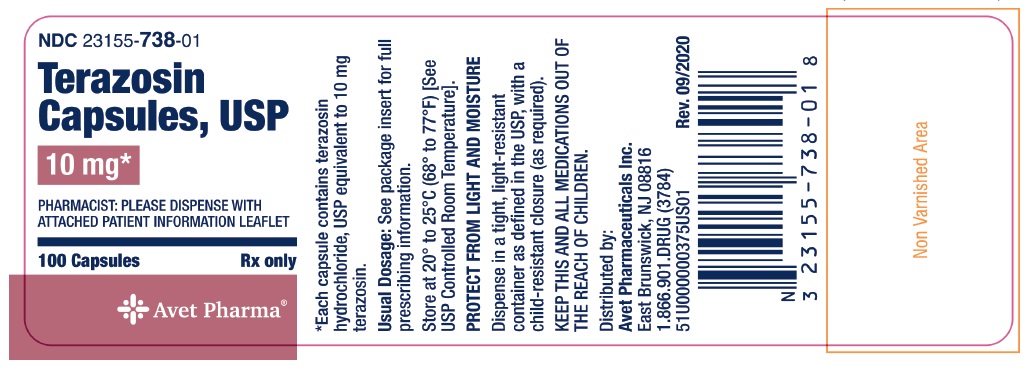
terazosin 10 mg Capsule, 100-count — NDC 23155-738-01 (Billing 23155-0738-01)
This is a package of 100 capsules of terazosin 10 mg Capsule from Heritage Pharmaceuticals Inc. d/b/a Avet Pharmaceuticals Inc., marketed since Apr 2021 and currently FDA-listed; retail pharmacies pay about $0.1305 per capsule (NADAC). It is the main listing for this product, which comes in 2 package sizes.
NDC database record
One package, one record: these facts belong to NDC 23155-738-01 alone.
- Record
- FDA NDC Directory package listing · Human prescription drug
- Code segments
- 23155 labeler · 738 product · 01 package
- Package marketed since
- Apr 30, 2021
- Sample package
- No — commercial package
- Listing certified through
- Dec 31, 2026
- Billing quantity
- 100 EA per package
- Barcode (UPC)
- 0323155737011, 0323155735017, 0323155738018, 0323155736014
- Medicaid fills, this package
- 355 prescriptions in the last four reported quarters
- FDA record last changed
- Jul 24, 2026
Identity & classification
Regulatory identifiers FDA, NLM and CMS codes for this package
Drug-database identifiers Medi-Span GPI and First Databank GCN / HICL / AHFS classification
- GSN (GCN sequence number): 022652
- GCN: 47127
- GPI-14 (Medi-Span): 36202040100120
- HICL (First Databank): 000094
- AHFS class code: 24:16.00.00
- RxCUI (RxNorm): 260376
Where does this data come from?
- FDA openFDA NDC Directory · synced Oct 8, 2026
- FDA label on DailyMed · label index refreshed Oct 8, 2026
- RxNorm (NLM RxNav) · catalog refreshed Oct 1, 2026
- Medi-Span GPI (licensed)
- First Databank (licensed) · refreshed Oct 8, 2026
RxNorm drug class
This medicine belongs to the alpha-Adrenergic Blocker class.
Where does this data come from?
- RxClass (NLM) · catalog refreshed Oct 1, 2026
Clinical
Terazosin is used to: treat benign prostatic hyperplasia (BPH; enlarged prostate that can cause difficulty urinating, painful urination or increased urinary frequency or urgency). treat high blood pressure. Terazosin is in a class of medications called alpha-blockers. It relieves the symptoms of BPH by relaxing the muscles of the bladder and prostate. It lowers blood pressure by relaxing the blood vessels so that blood can flow more easily through the body. High blood pressure is a common condition, and when not treated it can cause damage to the brain, heart, blood vessels, kidneys and oth...
Read the full MedlinePlus article ↗- It treats symptoms of an enlarged prostate (BPH) and high blood pressure. Your prescriber will tell you which one you are taking it for.
- The first dose can drop your blood pressure and cause dizziness or fainting. Taking it at bedtime lowers the chance of an injury. Avoid driving or hazardous tasks for 12 hours afte...
- Why do I take the first dose at bedtime?
- Do not just jump back to your usual dose. After more than a few days off, the label says to restart with the starting regimen. Call your prescriber or me for guidance.
Patient education
Supplement & herbal interactions
Some supplements/herbs that may interact with Terazosin — tap one for details:
Terazosin may be associated with lower levels of 1 nutrient — worth a chat with your pharmacist, not a cause for alarm.
Where does this data come from?
- MedlinePlus (NLM) · refreshed Oct 8, 2026
- FDA label on DailyMed · label index refreshed Oct 8, 2026
Ask a licensed pharmacist directly — free, answered by our team.
Pricing
A drug doesn't have one price. Each row is a different public payment system, and none is what you'd pay at the counter — that depends on your insurance. The ⓘ on each row explains what it measures.
| Price system | Per ea | Per package |
|---|---|---|
| Retail pharmacies payNADAC · weekly | $0.131 | $13.05 / 100 capsules |
| Medicaid paysCMS SDUD · 12 mo | $0.3635 | $36.35 / 100 capsules |
| Medicare drug plans payPart D · Q2 2026 | $0.2378 | $23.78 / 100 capsules |
Where does this data come from?
- CMS NADAC weekly file · file of Oct 7, 2026
- CMS ASP pricing files · refreshed Sep 20, 2026
- CMS Medicaid State Drug Utilization Data · through Q1 2026
- CMS Part D plan pricing files · refreshed Sep 24, 2026
- VA National Acquisition Center price file
Packaging — all sizes for this product
| Package NDC | Description | Per unit | Per pack | Marketing start | Marketing end | Status |
|---|---|---|---|---|---|---|
| 23155-0738-01 You're viewing this Main listing | 100 CAPSULE in 1 BOTTLE | $0.1305 / ea | $13.05 | 2021-04-30 | — | Active |
| 23155-0738-10 23155-738-10 | 1000 CAPSULE in 1 BOTTLE | $0.1305 / ea | $130.49 | 2021-04-30 | — | Active |
You're viewing the smallest of 2 pack sizes for this product.
This pack has the lowest per-ea cost of the 2 priced pack sizes ($0.1305 NADAC).
In Medicaid, this is the most-dispensed pack of this product — about 100% of fills over the last four reported quarters. See all packs ↓
Pack size FAQ
What quantity is in this package?
How does this package differ from NDC 23155-0738-10?
What NDC number is used to bill for this package of terazosin 10 mg Capsule?
Prices are the latest CMS NADAC pharmacy acquisition cost per NDC; per-pack figures are per-unit × pack quantity, shown only when the pack is denominated in the same measure NADAC prices.
Therapeutic equivalents
| Product | Labeler | Pack | NADAC/unit | TE | Status | Price vs. this |
|---|---|---|---|---|---|---|
| terazosin 10 mgthis 23155-0738-01 | Heritage | 100 capsules | $0.130 | AB | Availability likely | — |
| Terazosin 10 mg 27241-0291-01 | Ajanta | 100 capsules | $0.130 | AB | Availability likely | — |
| Terazosin 10 mg 50268-0767-15 | AvPAK | 50 capsules | $0.130 | AB | Availability likely | — |
| Terazosin 10 mg 59746-0386-06 | Jubilant | 100 capsules | $0.130 | AB | Availability likely | — |
| Terazosin 10 mg 62135-0461-90 | Chartwell | 90 capsules | $0.130 | AB | Availability likely | — |
| Terazosin 10 mg 69452-0333-20 | Bionpharma | 100 capsules | $0.130 | AB | Availability likely | — |
| Terazosin 10 mg 42291-0823-10 | AvKARE | 1000 capsules | — | AB | FDA listed | — |
| Terazosin 10 mg 50090-2371-00 | A-S | 30 capsules | — | AB | Discontinued | — |
| Terazosin 10 mg 63187-0620-30 | Proficient | 30 capsules | — | AB | FDA listed | — |
| Terazosin 10 mg 63629-2439-01 | Bryant | 100 capsules | — | AB | FDA listed | — |
| Terazosin 10 mg 63629-5237-01 | Bryant | 30 capsules | — | AB | FDA listed | — |
| Terazosin Hydrochloride 10 mg 69292-0204-01 | Amici | 100 capsules | — | AB | FDA listed | — |
| Terazosin 10 mg 71335-3123-01 | Bryant | 30 capsules | — | AB | FDA listed | — |
| terazosin 10 mg 71335-9607-01 | Bryant | 30 capsules | — | AB | FDA listed | — |
| Terazosin Hydrochloride 10 mg 71610-0594-60 | Aphena | 90 capsules | — | AB | FDA listed | — |
| Terazosin 10 mg 71610-0780-60 | Aphena | 90 capsules | — | AB | FDA listed | — |
| Terazosin 10 mg 72162-1702-00 | Bryant | 1000 capsules | — | AB | FDA listed | — |
Where does this data come from?
- FDA openFDA NDC Directory · synced Oct 8, 2026
- FDA Orange Book · refreshed Oct 3, 2026
- CMS NADAC weekly file · file of Oct 7, 2026
Availability & generic status
This product is an FDA-approved generic. Other versions of the same drug are listed under Therapeutic equivalents, least expensive first.
Where does this data come from?
- FDA Orange Book · refreshed Oct 3, 2026
What it looks like
Where does this data come from?
- FDA label on DailyMed · label index refreshed Oct 8, 2026
Inactive Ingredients / Excipients
Inactive ingredients, also called excipients, are components of the drug product other than the active ingredient. They may include fillers, dyes, coatings, preservatives, flavors, or other formulation ingredients.
🧪 Avoiding an ingredient? See Terazosin inactive ingredients by manufacturer: every current product's list side by side, so you can ask your pharmacy for the version that does not list it.
💡 Tap an ingredient (hover on desktop) to see what it is and why it’s used.
-
UNII 2S7830E561
Crospovidone is a synthetic polymer derived from povidone. It acts as a disintegrant, helping the tablet or capsule break apart quickly in the stomach so the active ingredient can be absorbed.
-
UNII CQ3XH3DET6
D&C Yellow No. 10 Aluminum Lake is a yellow colorant made by combining a dye with aluminum salts. It's used in medicines to add color for product identification and visual appeal.
-
UNII H3R47K3TBD
FD&C Blue No. 1 is a synthetic blue dye approved for use in foods and medicines. It serves as a colorant to give the medication its distinctive appearance and help with product identification.
-
UNII J9EQA3S2JM
FD&C Blue No. 1 Aluminum Lake is a blue colorant made by combining FD&C Blue No. 1 dye with aluminum salts. It is used to color tablets, capsules, and other medicines for easy identification and appearance.
-
UNII 4AQJ3LG584
A synthetic blue dye combined with aluminum to create a stable colorant. It's used in medicines and supplements to add blue color or create specific shades for product identification and appearance.
-
UNII WZB9127XOA
A synthetic red dye used to color medications and make them easier to identify. It serves as a colorant in tablets, capsules, and liquid formulations.
-
UNII XM0M87F357
A dark iron oxide compound that gives medicines their black or dark color. It's used as a colorant in tablets and capsules to help identify the product and make it visually distinctive.
-
UNII 2G86QN327L
Gelatin is a protein derived from animal collagen, commonly used in medicines as a gelling agent and capsule material. It helps create soft or hard capsule shells that hold and release medication, and can also thicken liquid formulations.
-
UNII EWQ57Q8I5X
Lactose monohydrate is a natural sugar derived from milk. It serves as a filler and binder in tablets and capsules, helping create the proper size, texture, and consistency of the medicine.
-
UNII 70097M6I30
Magnesium stearate is a salt made from magnesium and stearic acid, a fatty substance. It's used in tablets and capsules as a lubricant and glidant to help ingredients flow smoothly during manufacturing and prevent sticking.
-
UNII 6DC9Q167V3
Propylene glycol is a clear liquid derived from petroleum or vegetable sources. It acts as a solvent, humectant, and preservative in medicines, helping dissolve active ingredients and maintain product stability.
-
UNII 46N107B71O
Shellac is a natural resin secreted by the lac beetle. It's used as a coating on tablets and capsules to control how quickly the medicine dissolves and to improve appearance and stability.
-
UNII O8232NY3SJ
A plant-based carbohydrate derived from corn kernels. It acts as a filler to add bulk, a binder to hold ingredients together, and a disintegrant to help the tablet break apart in your stomach for absorption.
-
UNII 7SEV7J4R1U
A powder made from a naturally occurring mineral. In medicines, talc works as a glidant and anti-caking agent, helping tablets and capsules flow smoothly during manufacturing and preventing clumping.
-
UNII 15FIX9V2JP
Titanium dioxide is a bright white mineral powder commonly used as a colorant and opacifying agent. It makes pills and tablets white or lighter in color and helps make coatings non-transparent.
15 inactive ingredients listed in the exact product block matched to this NDC.
Where does this data come from?
ingredient classCode="IACT" elements from the exact product block matched by this NDC. Label-section narrative from DailyMed / the openFDA label index is shown separately when available.- FDA label on DailyMed · label index refreshed Oct 8, 2026
- FDA openFDA NDC Directory · synced Oct 8, 2026
Inactive ingredient FAQ
Are inactive ingredients the same for every manufacturer?
Why might an inactive ingredient be missing?
Can inactive ingredients matter?
Manufacturer & labeler
More NDCs from Heritage Pharmaceuticals Inc. d/b/a Avet Pharmac... labeler code 23155
- Labetalol Hydrochloride 200 mg Tablet NDC 23155-724-01
- Labetalol Hydrochloride 300 mg Tablet NDC 23155-725-01
- Labetalol Hydrochloride 400 mg Tablet NDC 23155-726-01
- terazosin 1 mg Capsule NDC 23155-735-01
- terazosin 2 mg Capsule NDC 23155-736-01
- terazosin 5 mg Capsule NDC 23155-737-01
- Theophylline 300 mg Tablet, Extended Release NDC 23155-741-01
- Theophylline 450 mg Tablet, Extended Release NDC 23155-742-01
- Rasagiline mesylate .5 mg Tablet NDC 23155-746-03
- Rasagiline mesylate 1 mg Tablet NDC 23155-747-03
- pentamidine isethionate 300 mg/300mg Injection, Powder, Lyophilized, For Solution NDC 23155-748-41
- Benazepril Hydrochloride 5 mg Tablet NDC 23155-749-01
Where does this data come from?
- FDA openFDA NDC Directory · synced Oct 8, 2026
- Drugs@FDA
Full prescribing information FDA SPL
🎯 Indications and Usage ▾
INDICATIONS AND USAGE Terazosin capsules are indicated for the treatment of symptomatic benign prostatic hyperplasia (BPH). There is a rapid response, with approximately 70% of patients experiencing an increase in urinary flow and improvement in symptoms of BPH when treated with terazosin. The long term effects of terazosin on the incidence of surgery, acute urinary obstruction or other complications of BPH are yet to be determined.
Terazosin capsules are also indicated for the treatment of hypertension. They can be used alone or in combination with other antihypertensive agents such as diuretics or beta-adrenergic blocking agents.
⏱️ Dosage and Administration ▾
DOSAGE AND ADMINISTRATION If terazosin capsules administration is discontinued for several days, therapy should be reinstituted using the initial dosing regimen. Benign Prostatic Hyperplasia Initial Dose 1 mg at bedtime is the starting dose for all patients, and this dose should not be exceeded as an initial dose. Patients should be closely followed during initial administration in order to minimize the risk of severe hypotensive response.
Subsequent Doses The dose should be increased in a stepwise fashion to 2 mg, 5 mg, or 10 mg once daily to achieve the desired improvement of symptoms and/or flow rates. Doses of 10 mg once daily are generally required for the clinical response. Therefore, treatment with 10 mg for a minimum of 4 to 6 weeks may be required to assess whether a beneficial response has been achieved.
Some patients may not achieve a clinical response despite appropriate titration. Although some additional patients responded at a 20 mg daily dose, there was an insufficient number of patients studied to draw definitive conclusions about this dose. There are insufficient data to support the use of higher doses for those patients who show inadequate or no response to 20 mg daily.
If terazosin administration is discontinued for several days or longer, therapy should be reinstituted using the initial dosing regimen. Use With Other Drugs Caution should be observed when terazosin capsules are administered concomitantly with other antihypertensive agents, especially the calcium channel blocker verapamil, to avoid the possibility of developing significant hypotension. When using terazosin and other antihypertensive agents concomitantly, dosage reduction and retitration of either agent may be necessary (see PRECAUTIONS ).
Hypotension has been reported when terazosin capsules have been used with phosphodiesterase-5 (PDE-5) inhibitors. Hypertension The dose of terazosin capsules and the dose interval (12 or 24 hours) should be adjusted according to the patient's individual blood pressure response. The following is a guide to its administration: Initial Dose 1 mg at bedtime is the starting dose for all patients, and this dose should not be exceeded.
This initial dosing regimen should be strictly observed to minimize the potential for severe hypotensive effects. Subsequent Doses The dose may be slowly increased to achieve the desired blood pressure response. The usual recommended dose range is 1 mg to 5 mg administered once a day; however, some patients may benefit from doses as high as 20 mg per day.
Doses over 20 mg do not appear to provide further blood pressure effect and doses over 40 mg have not been studied. Blood pressure should be monitored at the end of the dosing interval to be sure control is maintained throughout the interval. It may also be helpful to measure blood pressure 2 to 3 hours after dosing to see if the maximum and minimum responses are similar, and to evaluate symptoms such as dizziness or palpitations which can result from excessive hypotensive response.
If response is substantially diminished at 24 hours an increased dose or use of a twice daily regimen can be considered. If terazosin administration is discontinued for several days or longer, therapy should be reinstituted using the initial dosing regimen. In clinical trials, except for the initial dose, the dose was given in the morning.
Use with other drugs (see above).
⛔ Contraindications ▾
CONTRAINDICATIONS Terazosin capsules are contraindicated in patients known to be hypersensitive to terazosin hydrochloride.
⚠️ Warnings ▾
WARNINGS Syncope and "First-dose" Effect Terazosin capsules, like other alpha-adrenergic blocking agents, can cause marked lowering of blood pressure, especially postural hypotension, and syncope in association with the first dose or first few days of therapy. A similar effect can be anticipated if therapy is interrupted for several days and then restarted. Syncope has also been reported with other alpha-adrenergic blocking agents in association with rapid dosage increases or the introduction of another antihypertensive drug.
Syncope is believed to be due to an excessive postural hypotensive effect, although occasionally the syncopal episode has been preceded by a bout of severe supraventricular tachycardia with heart rates of 120 to 160 beats per minute. Additionally, the possibility of the contribution of hemodilution to the symptoms of postural hypotension should be considered. To decrease the likelihood of syncope or excessive hypotension, treatment should always be initiated with a 1 mg dose of terazosin, given at bedtime.
The 2 mg, 5 mg and 10 mg capsules are not indicated as initial therapy. Dosage should then be increased slowly, according to recommendations in the DOSAGE AND ADMINISTRATION section and additional antihypertensive agents should be added with caution. The patient should be cautioned to avoid situations, such as driving or hazardous tasks, where injury could result should syncope occur during initiation of therapy.
In early investigational studies, where increasing single doses up to 7.5 mg were given at 3 day intervals, tolerance to the first dose phenomenon did not necessarily develop and the "first dose" effect could be observed at all doses. Syncopal episodes occurred in 3 of the 14 subjects given terazosin at doses of 2.5, 5 and 7.5 mg, which are higher than the recommended initial dose; in addition, severe orthostatic hypotension (blood pressure falling to 50/0 mmHg) was seen in two others and dizziness, tachycardia, and lightheadedness occurred in most subjects.
These adverse effects all occurred within 90 minutes of dosing. In three placebo-controlled BPH studies 1, 2, and 3 (see CLINICAL PHARMACOLOGY ), the incidence of postural hypotension in the terazosin treated patients was 5.1%, 5.2%, and 3.7% respectively. In multiple dose clinical trials involving nearly 2000 hypertensive patients treated with terazosin, syncope was reported in about 1% of patients.
Syncope was not necessarily associated only with the first dose. If syncope occurs, the patient should be placed in a recumbent position and treated supportively as necessary. There is evidence that the orthostatic effect of terazosin is greater, even in chronic use, shortly after dosing.
The risk of the events is greatest during the initial seven days of treatment, but continues at all time intervals. Priapism Rarely, (probably less than once in every several thousand patients), terazosin and other α 1 – antagonists have been associated with priapism (painful penile erection, sustained for hours and unrelieved by sexual intercourse or masturbation). Two or three dozen cases have been reported.
Because this condition can lead to permanent impotence if not promptly treated, patients must be advised about the seriousness of the condition (see PRECAUTIONS, Information for Patients ).
🤒 Adverse Reactions ▾
ADVERSE REACTIONS Benign Prostatic Hyperplasia The incidence of treatment-emergent adverse events has been ascertained from clinical trials conducted worldwide. All adverse events reported during these trials were recorded as adverse reactions. The incidence rates presented below are based on combined data from six placebo-controlled trials involving once-a-day administration of terazosin at doses ranging from 1 to 20 mg.
Table 1 summarizes those adverse events reported for patients in these trials when the incidence rate in the terazosin group was at least 1% and was greater than that for the placebo group, or where the reaction is of clinical interest. Asthenia, postural hypotension, dizziness, somnolence, nasal congestion/rhinitis, and impotence were the only events that were significantly (p ≤ 0.05) more common in patients receiving terazosin than in patients receiving placebo. The incidence of urinary tract infection was significantly lower in the patients receiving terazosin than in patients receiving placebo.
An analysis of the incidence rate of hypotensive adverse events (see PRECAUTIONS ) adjusted for the length of drug treatment has shown that the risk of the events is greatest during the initial seven days of treatment, but continues at all time intervals. Additional adverse events have been reported, but these are, in general, not distinguishable from symptoms that might have occurred in the absence of exposure to terazosin. The safety profile of patients treated in the long-term open-label study was similar to that observed in the controlled studies.
The adverse events were usually transient and mild or moderate in intensity, but sometimes were serious enough to interrupt treatment. In the placebo-controlled clinical trials, the rates of premature termination due to adverse events were not statistically different between the placebo and terazosin groups. The adverse events that were bothersome, as judged by their being reported as reasons for discontinuation of therapy by at least 0.5% of the terazosin group and being reported more often than in the placebo group, are shown in Table 2.
Hypertension The prevalence of adverse reactions has been ascertained from clinical trials conducted primarily in the United States. All adverse experiences (events) reported during these trials were recorded as adverse reactions. The prevalence rates presented below are based on combined data from fourteen placebo-controlled trials involving once-a-day administration of terazosin, as monotherapy or in combination with other antihypertensive agents, at doses ranging from 1 to 40 mg.
Table 3 summarizes those adverse experiences reported for patients in these trials where the prevalence rate in the terazosin group was at least 5%, where the prevalence rate for the terazosin group was at least 2% and was greater than the prevalence rate for the placebo group, or where the reaction is of particular interest. Asthenia, blurred vision, dizziness, nasal congestion, nausea, peripheral edema, palpitations and somnolence were the only symptoms that were significantly (p < 0.05) more common in patients receiving terazosin than in patients receiving placebo.
Similar adverse reaction rates were observed in placebo-controlled monotherapy trials. Additional adverse reactions have been reported, but these are, in general, not distinguishable from symptoms that might have occurred in the absence of exposure to terazosin. The following additional adverse reactions were reported by at least 1% of 1987 patients who received terazosin in controlled or open, short- or long-term clinical trials or have been reported during marketing experience: Body as a Whole Chest pain, facial edema, fever, abdominal pain, neck pain, shoulder pain Cardiovascular System Arrhythmia, vasodilation Digestive System Constipation, diarrhea, dry mouth, dyspepsia, flatulence, vomiting Metabolic/Nutritional Disorders Gout Musculoskeletal System Arthralgia, arthritis, joint disord… [Excerpted — this section continues on DailyMed.]
🔄 Drug Interactions ▾
Drug Interactions In controlled trials, terazosin has been added to diuretics, and several beta-adrenergic blockers; no unexpected interactions were observed. Terazosin has also been used in patients on a variety of concomitant therapies; while these were not formal interaction studies, no interactions were observed. Terazosin has been used concomitantly in at least 50 patients on the following drugs or drug classes: 1) analgesic/anti-inflammatory (e.g., acetaminophen, aspirin, codeine, ibuprofen, indomethacin); 2) antibiotics (e.g., erythromycin, trimethoprim and sulfamethoxazole); 3) anticholinergic/sympathomimetics (e.g., phenylephrine hydrochloride, phenylpropanolamine hydrochloride, pseudoephedrine hydrochloride); 4) antigout (e.g., allopurinol); 5) antihistamines (e.g., chlorpheniramine); 6) cardiovascular agents (e.g., atenolol, hydrochlorothiazide, methyclothiazide, propranolol); 7) corticosteroids; 8) gastrointestinal agents (e.g., antacids); 9) hypoglycemics; 10) sedatives and tranquilizers (e.g., diazepam).
🤰 Pregnancy ▾
Pregnancy Teratogenic Effects: Pregnancy category C Terazosin was not teratogenic in either rats or rabbits when administered at oral doses up to 280 and 60 times, respectively, the maximum recommended human dose. Fetal resorptions occurred in rats dosed with 480 mg/kg/day, approximately 280 times the maximum recommended human dose. Increased fetal resorptions, decreased fetal weight and an increased number of supernumerary ribs were observed in offspring of rabbits dosed with 60 times the maximum recommended human dose.
These findings (in both species) were most likely secondary to maternal toxicity. There are no adequate and well-controlled studies in pregnant women and the safety of terazosin in pregnancy has not been established. Terazosin is not recommended during pregnancy unless the potential benefit justifies the potential risk to the mother and fetus.
🧒 Pediatric Use ▾
Pediatric Use Safety and effectiveness in children have not been determined.
🆘 Overdosage ▾
OVERDOSAGE Should overdosage of terazosin lead to hypotension, support of the cardiovascular system is of first importance. Restoration of blood pressure and normalization of heart rate may be accomplished by keeping the patient in the supine position. If this measure is inadequate, shock should first be treated with volume expanders.
If necessary, vasopressors should then be used and renal function should be monitored and supported as needed. Laboratory data indicate that terazosin is 90 to 94% protein bound; therefore, dialysis may not be of benefit.
🧬 Clinical Pharmacology ▾
CLINICAL PHARMACOLOGY Pharmacodynamics A. Benign Prostatic Hyperplasia (BPH) The symptoms associated with BPH are related to bladder outlet obstruction, which is comprised of two underlying components: a static component and a dynamic component. The static component is a consequence of an increase in prostate size.
Over time, the prostate will continue to enlarge. However, clinical studies have demonstrated that the size of the prostate does not correlate with the severity of BPH symptoms or the degree of urinary obstruction. The dynamic component is a function of an increase in smooth muscle tone in the prostate and bladder neck, leading to constriction of the bladder outlet.
Smooth muscle tone is mediated by sympathetic nervous stimulation of alpha-1 adrenoceptors, which are abundant in the prostate, prostatic capsule and bladder neck. The reduction in symptoms and improvement in urine flow rates following administration of terazosin is related to relaxation of smooth muscle produced by blockade of alpha-1 adrenoceptors in the bladder neck and prostate. Because there are relatively few alpha-1 adrenoceptors in the bladder body, terazosin is able to reduce the bladder outlet obstruction without affecting bladder contractility.
Terazosin has been studied in 1222 men with symptomatic BPH. In three placebo-controlled studies, symptom evaluation and uroflowmetric measurements were performed approximately 24 hours following dosing. Symptoms were quantified using the Boyarsky Index.
The questionnaire evaluated both obstructive (hesitancy, intermittency, terminal dribbling, impairment of size and force of stream, sensation of incomplete bladder emptying) and irritative (nocturia, daytime frequency, urgency, dysuria) symptoms by rating each of the 9 symptoms from 0 to 3, for a total score of 27 points. Results from these studies indicated that terazosin statistically significantly improved symptoms and peak urine flow rates over placebo as follows: In all three studies, both symptom scores and peak urine flow rates showed statistically significant improvement from baseline in patients treated with terazosin from week 2 (or the first clinic visit) and throughout the study duration.
Analysis of the effect of terazosin on individual urinary symptoms demonstrated that compared to placebo, terazosin significantly improved the symptoms of hesitancy, intermittency, impairment in size and force of urinary stream, sensation of incomplete emptying, terminal dribbling, daytime frequency and nocturia. Global assessments of overall urinary function and symptoms were also performed by investigators who were blinded to patient treatment assignment. In Studies 1 and 3, patients treated with terazosin had a significantly (p ≤ 0.001) greater overall improvement compared to placebo treated patients.
In a short term study (Study 1), patients were randomized to either 2, 5 or 10 mg of terazosin or placebo. Patients randomized to the 10 mg group achieved a statistically significant response in both symptoms and peak flow rate compared to placebo (Figure 1). In a long-term, open-label, non-placebo controlled clinical trial, 181 men were followed for 2 years and 58 of these men were followed for 30 months.
The effect of terazosin on urinary symptom scores and peak flow rates was maintained throughout the study duration (Figures 2 and 3): In this long-term trial, both symptom scores and peak urinary flow rates showed statistically significant improvement suggesting a relaxation of smooth muscle cells. Although blockade of alpha-1 adrenoceptors also lowers blood pressure in hypertensive patients with increased peripheral vascular resistance, terazosin treatment of normotensive men with BPH did not result in a clinically significant blood pressure lowering effect: B.
Hypertension In animals, terazosin causes a decrease in blood pressure by decreasing total peripheral vascular resistance. The vasodilatory hypotensive action of terazosin appears to be produced m… [Excerpted — this section continues on DailyMed.]
📦 How Supplied / Storage and Handling ▾
HOW SUPPLIED Terazosin Capsules, USP 1 mg, are available as size 3 white opaque cap and body hard gelatin capsules, imprinted with "735" on the cap and "1 mg" on the body in black ink, packaged in bottles of 100 and 1000 capsules, NDC # 23155-735-01 and NDC # 23155-735-10. Terazosin Capsules, USP 2 mg, are available as size 3 yellow opaque cap and white opaque body hard gelatin capsules, imprinted with "736" on the cap and "2 mg" on the body in black ink, packaged in bottles of 100 and 1000 capsules, NDC # 23155-736-01 and NDC # 23155-736-10.
Terazosin Capsules, USP 5 mg, are available as size 3 swedish orange opaque cap and white opaque body hard gelatin capsules, imprinted with "737" on the cap and "5 mg" on the body in black ink, packaged in bottles of 100 and 1000 capsules, NDC # 23155-737-01 and NDC # 23155-737-10. Terazosin Capsules, USP 10 mg, are available as size 3 aqua blue opaque cap and white opaque body hard gelatin capsules, imprinted with "738" on the cap and "10 mg" on the body in black, packaged in bottles of 100 and 1000 capsules, NDC # 23155-738-01 and NDC # 23155-738-10.
PHARMACIST: Dispense in a tight, light-resistant container as defined in the USP, with a child-resistant closure (as required). Store at 20° to 25°C (68° to 77°F) [See USP Controlled Room Temperature]. PROTECT FROM LIGHT AND MOISTURE Distributed by: Avet Pharmaceuticals Inc.
East Brunswick, NJ 08816 1.866.901.DRUG (3784) Revised: 08/2021 Image
📋 Description ▾
DESCRIPTION Terazosin hydrochloride, USP an alpha-1-selective adrenoceptor blocking agent, is a quinazoline derivative. The chemical name for terazosin hydrochloride, USP is (RS)-Piperazine, 1-(4-Amino-6,7-dimethoxy-2-quinazolinyl)-4-[(tetra-hydro-2-furanyl)carbonyl]-, monohydrochloride, dihydrate. It has the following structural formula: Terazosin hydrochloride, USP is a white, crystalline substance, freely soluble in water and isotonic saline.
Each capsule for oral administration, contains terazosin hydrochloride, USP equivalent to 1 mg, 2 mg, 5 mg or 10 mg terazosin. In addition, each capsule contains the following inactive ingredients: crospovidone, lactose monohydrate, magnesium stearate, talc and corn starch. The capsule shells and imprinting inks contain: titanium dioxide, gelatin, shellac glaze, black iron oxide, n-butyl alcohol, propylene glycol, FD&C Blue #2 aluminum lake, FD&C Red #40 aluminum lake, D&C Yellow #10 aluminum lake and FD&C Blue #1.
The 2 mg capsule shell also contains D&C Red #33. FDA approved dissolution test specifications differ from USP. Image
💬 Medication Guide ▾
PATIENT INFORMATION ABOUT TERAZOSIN CAPSULES, USP (ter ay'zoe sin) Rx only When used to treat HYPERTENSION or BENIGN PROSTATIC HYPERPLASIA (BPH) Please read this leaflet before you start taking terazosin capsules. Also, read it each time you get a new prescription. This is a summary and should NOT take the place of a full discussion with your doctor who has additional information about terazosin capsules.
You and your doctor should discuss terazosin capsules and your condition before you start taking it and at your regular check-ups. Terazosin capsules are used to treat high blood pressure (hypertension). Terazosin capsules are also used to treat benign prostatic hyperplasia (BPH) in men.
This leaflet describes terazosin capsules as a treatment for hypertension or BPH. What is hypertension (high blood pressure)? Blood pressure is the tension of the blood within the blood vessels.
If blood is pumped too forcefully, or if the blood vessels are too narrow, the pressure of the blood against the walls of the vessels rises. If high blood pressure is not treated, over time, the increased pressure can damage blood vessels or it can cause the heart to work too hard and may decrease the flow of blood to the heart, brain, and kidneys. As a result, these organs may become damaged and not function correctly.
If high blood pressure is controlled, this damage is less likely to happen. Treatment options for hypertension Non-drug treatments are sometimes effective in controlling mild hypertension. The most important lifestyle changes to lower blood pressure are to lose weight, reduce salt, fat, and alcohol in the diet, quit smoking, and exercise regularly.
However, many hypertensive patients require one or more ongoing medications to control their blood pressure. There are different kinds of medications used to treat hypertension. Your doctor has prescribed terazosin capsules for you.
What Terazosin Capsules do to treat hypertension Terazosin capsules work by relaxing blood vessels so that blood passes through them more easily. This helps to lower blood pressure. What is BPH?
The prostate is a gland located below the bladder of men. It surrounds the urethra (you-REETH-rah), which is a tube that drains urine from the bladder. BPH is an enlargement of the prostate gland.
The symptoms of BPH, however, can be caused by an increase in the tightness of muscles in the prostate. If the muscles inside the prostate tighten, they can squeeze the urethra and slow the flow of urine. This can lead to symptoms such as: a weak or interrupted stream when urinating a feeling that you can not empty your bladder completely a feeling of delay when you start to urinate a need to urinate often, especially at night, or a feeling that you must urinate right away Treatment options for BPH There are three main treatment options for BPH: Program of monitoring or "Watchful Waiting".
Some men have an enlarged prostate gland, but no symptoms, or symptoms that are not bothersome. If this applies, you and your doctor may decide on a program of monitoring including regular checkups, instead of medication or surgery. Medication.
There are different kinds of medication used to treat BPH. Your doctor has prescribed terazosin capsules for you. See "What Terazosin Capsules do to treat BPH" below.
Surgery. Some patients may need surgery. Your doctor can describe several different surgical procedures to treat BPH.
Which procedure is best depends on your symptoms and medical condition. What Terazosin Capsules do to treat BPH Terazosin capsules relax the tightness of a certain type of muscle in the prostate and at the opening of the bladder. This may increase the rate of urine flow and/or decrease the symptoms you are having.
Terazosin capsules help to relieve the symptoms of BPH. It does NOT change the size of the prostate, which may continue to grow. However, a larger prostate does not necessarily cause more or worse symptoms.
If terazosin capsules are helping you, you should notice… [Excerpted — this section continues on DailyMed.]
⚠️ Precautions ▾
PRECAUTIONS General Prostatic Cancer Carcinoma of the prostate and BPH cause many of the same symptoms. These two diseases frequently co-exist. Therefore, patients thought to have BPH should be examined prior to starting terazosin therapy to rule out the presence of carcinoma of the prostate.
Intraoperative Floppy Iris Syndrome (IFIS) Intraoperative Floppy Iris Syndrome (IFIS) has been observed during cataract surgery in some patients on/or previously treated with alpha-1 blockers. This variant of small pupil syndrome is characterized by the combination of a flaccid iris that billows in response to intraoperative irrigation currents, progressive intraoperative miosis despite preoperative dilation with standard mydriatic drugs, and potential prolapse of the iris toward the phacoemulsification incisions. The patient's ophthalmologist should be prepared for possible modifications to their surgical technique, such as the utilization of iris hooks, iris dilator rings, or viscoelastic substances.
There does not appear to be a benefit of stopping alpha-1 blocker therapy prior to cataract surgery. Orthostatic Hypotension While syncope is the most severe orthostatic effect of terazosin (see WARNINGS ), other symptoms of lowered blood pressure, such as dizziness, lightheadedness and palpitations, were more common and occurred in some 28% of patients in clinical trials of hypertension. In BPH clinical trials, 21% of the patients experienced one or more of the following: dizziness, hypotension, postural hypotension, syncope, and vertigo.
Patients with occupations in which such events represent potential problems should be treated with particular caution. Information for Patients (see Patient Package Insert) Patients should be made aware of the possibility of syncopal and orthostatic symptoms, especially at the initiation of therapy, and to avoid driving or hazardous tasks for 12 hours after the first dose, after a dosage increase and after interruption of therapy when treatment is resumed. They should be cautioned to avoid situations where injury could result should syncope occur during initiation of terazosin therapy.
They should also be advised of the need to sit or lie down when symptoms of lowered blood pressure occur, although these symptoms are not always orthostatic, and to be careful when rising from a sitting or lying position. If dizziness, lightheadedness, or palpitations are bothersome they should be reported to the physician, so that dose adjustment can be considered. Patients should also be told that drowsiness or somnolence can occur with terazosin, requiring caution in people who must drive or operate heavy machinery.
Patients should be advised about the possibility of priapism as a result of treatment with terazosin and other similar medications. Patients should know that this reaction to terazosin is extremely rare, but that if it is not brought to immediate medical attention, it can lead to permanent erectile dysfunction (impotence). Laboratory Tests Small but statistically significant decreases in hematocrit, hemoglobin, white blood cells, total protein and albumin were observed in controlled clinical trials.
These laboratory findings suggested the possibility of hemodilution. Treatment with terazosin for up to 24 months had no significant effect on prostate specific antigen (PSA) levels. Drug Interactions In controlled trials, terazosin has been added to diuretics, and several beta-adrenergic blockers; no unexpected interactions were observed.
Terazosin has also been used in patients on a variety of concomitant therapies; while these were not formal interaction studies, no interactions were observed. Terazosin has been used concomitantly in at least 50 patients on the following drugs or drug classes: 1) analgesic/anti-inflammatory (e.g., acetaminophen, aspirin, codeine, ibuprofen, indomethacin); 2) antibiotics (e.g., erythromycin, trimethoprim and sulfamethoxazole); 3) anticholinergic/sympathomimetics (e.g., phenyleph… [Excerpted — this section continues on DailyMed.]
🍼 Nursing Mothers ▾
Nursing Mothers It is not known whether terazosin is excreted in breast milk. Because many drugs are excreted in breast milk, caution should be exercised when terazosin is administered to a nursing woman.
🧬 Pharmacokinetics ▾
Pharmacokinetics Terazosin hydrochloride administered as terazosin capsules is essentially completely absorbed in man. Administration of capsules immediately after meals had a minimal effect on the extent of absorption. The time to reach peak plasma concentration however, was delayed by about 40 minutes.
Terazosin has been shown to undergo minimal hepatic first-pass metabolism and nearly all of the circulating dose is in the form of parent drug. The plasma levels peak about one hour after dosing, and then decline with a half-life of approximately 12 hours. In a study that evaluated the effect of age on terazosin pharmacokinetics, the mean plasma half-lives were 14 and 11.4 hours for the age group ≥ 70 years and the age group of 20 to 39 years, respectively.
After oral administration the plasma clearance was decreased by 31.7% in patients 70 years of age or older compared to that in patients 20 to 39 years of age. The drug is 90 to 94% bound to plasma proteins and binding is constant over the clinically observed concentration range. Approximately 10% of an orally administered dose is excreted as parent drug in the urine and approximately 20% is excreted in the feces.
The remainder is eliminated as metabolites. Impaired renal function had no significant effect on the elimination of terazosin, and dosage adjustment of terazosin to compensate for the drug removal during hemodialysis (approximately 10%) does not appear to be necessary. Overall, approximately 40% of the administered dose is excreted in the urine and approximately 60% in the feces.
The disposition of the compound in animals is qualitatively similar to that in man.
🧬 Pharmacodynamics ▾
Pharmacodynamics A. Benign Prostatic Hyperplasia (BPH) The symptoms associated with BPH are related to bladder outlet obstruction, which is comprised of two underlying components: a static component and a dynamic component. The static component is a consequence of an increase in prostate size.
Over time, the prostate will continue to enlarge. However, clinical studies have demonstrated that the size of the prostate does not correlate with the severity of BPH symptoms or the degree of urinary obstruction. The dynamic component is a function of an increase in smooth muscle tone in the prostate and bladder neck, leading to constriction of the bladder outlet.
Smooth muscle tone is mediated by sympathetic nervous stimulation of alpha-1 adrenoceptors, which are abundant in the prostate, prostatic capsule and bladder neck. The reduction in symptoms and improvement in urine flow rates following administration of terazosin is related to relaxation of smooth muscle produced by blockade of alpha-1 adrenoceptors in the bladder neck and prostate. Because there are relatively few alpha-1 adrenoceptors in the bladder body, terazosin is able to reduce the bladder outlet obstruction without affecting bladder contractility.
Terazosin has been studied in 1222 men with symptomatic BPH. In three placebo-controlled studies, symptom evaluation and uroflowmetric measurements were performed approximately 24 hours following dosing. Symptoms were quantified using the Boyarsky Index.
The questionnaire evaluated both obstructive (hesitancy, intermittency, terminal dribbling, impairment of size and force of stream, sensation of incomplete bladder emptying) and irritative (nocturia, daytime frequency, urgency, dysuria) symptoms by rating each of the 9 symptoms from 0 to 3, for a total score of 27 points. Results from these studies indicated that terazosin statistically significantly improved symptoms and peak urine flow rates over placebo as follows: In all three studies, both symptom scores and peak urine flow rates showed statistically significant improvement from baseline in patients treated with terazosin from week 2 (or the first clinic visit) and throughout the study duration.
Analysis of the effect of terazosin on individual urinary symptoms demonstrated that compared to placebo, terazosin significantly improved the symptoms of hesitancy, intermittency, impairment in size and force of urinary stream, sensation of incomplete emptying, terminal dribbling, daytime frequency and nocturia. Global assessments of overall urinary function and symptoms were also performed by investigators who were blinded to patient treatment assignment. In Studies 1 and 3, patients treated with terazosin had a significantly (p ≤ 0.001) greater overall improvement compared to placebo treated patients.
In a short term study (Study 1), patients were randomized to either 2, 5 or 10 mg of terazosin or placebo. Patients randomized to the 10 mg group achieved a statistically significant response in both symptoms and peak flow rate compared to placebo (Figure 1). In a long-term, open-label, non-placebo controlled clinical trial, 181 men were followed for 2 years and 58 of these men were followed for 30 months.
The effect of terazosin on urinary symptom scores and peak flow rates was maintained throughout the study duration (Figures 2 and 3): In this long-term trial, both symptom scores and peak urinary flow rates showed statistically significant improvement suggesting a relaxation of smooth muscle cells. Although blockade of alpha-1 adrenoceptors also lowers blood pressure in hypertensive patients with increased peripheral vascular resistance, terazosin treatment of normotensive men with BPH did not result in a clinically significant blood pressure lowering effect: B.
Hypertension In animals, terazosin causes a decrease in blood pressure by decreasing total peripheral vascular resistance. The vasodilatory hypotensive action of terazosin appears to be produced mainly by blockade of a… [Excerpted — this section continues on DailyMed.]
📄 Package Label / Principal Display Panel ▾
PACKAGE LABEL.PRINCIPAL DISPLAY PANEL - 1mg NDC 23155- 735 -01 Terazosin Capsules, USP 1 mg* PHARMACIST: PLEASE DISPENSE WITH ATTACHED PATIENT INFORMATION LEAFLET 100 Capsules Rx only 1 mg
PACKAGE LABEL.PRINCIPAL DISPLAY PANEL - 2 mg NDC 23155- 736 -01 Terazosin Capsules, USP 2 mg* PHARMACIST: PLEASE DISPENSE WITH ATTACHED PATIENT INFORMATION LEAFLET 100 Capsules Rx only 2 mg
PACKAGE LABEL.PRINCIPAL DISPLAY PANEL - 5 mg NDC 23155- 737 -01 Terazosin Capsules, USP 5 mg* PHARMACIST: PLEASE DISPENSE WITH ATTACHED PATIENT INFORMATION LEAFLET 100 Capsules Rx only 5 mg
PACKAGE LABEL.PRINCIPAL DISPLAY PANEL - 10 mg NDC 23155- 738 -01 Terazosin Capsules, USP 10 mg* PHARMACIST: PLEASE DISPENSE WITH ATTACHED PATIENT INFORMATION LEAFLET 100 Capsules Rx only 10 mg