
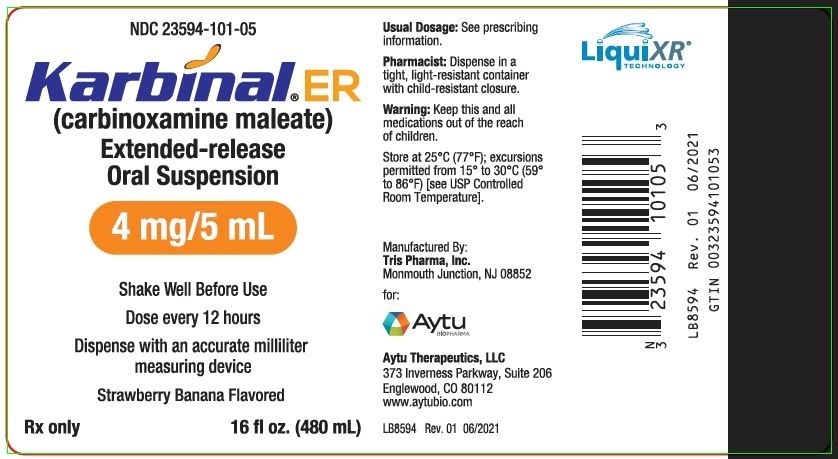
Karbinal ER Carbinoxamine Maleate 4 mg/5mL Suspension, Extended Release — NDC 23594-101-01 (Billing 23594-0101-01)
This is a package of Karbinal ER Carbinoxamine Maleate 4 mg/5mL Suspension, Extended Release from Aytu Therapeutics, LLC, marketed since Jan 2014 and currently FDA-listed.
Identity & classification
Regulatory identifiers FDA, NLM and CMS codes for this package
Drug-database identifiers Medi-Span GPI and First Databank GCN / HICL / AHFS classification
- GSN (GCN sequence number): 070822
- GCN: 34474
- GPI-14 (Medi-Span): 4120001015G120
- HICL (First Databank): 004483
- AHFS class code: 04:04.00.00
- RxCUI (RxNorm): 1374770
Where does this data come from?
- FDA openFDA NDC Directory · synced Oct 1, 2026
- FDA label on DailyMed · label index refreshed Oct 1, 2026
- RxNorm (NLM RxNav) · catalog refreshed Oct 1, 2026
- Medi-Span GPI (licensed)
- First Databank (licensed) · refreshed Oct 1, 2026
RxNorm drug class
This medicine belongs to the Histamine-1 Receptor Antagonist class.
Where does this data come from?
- RxClass (NLM) · catalog refreshed Oct 1, 2026
Clinical
- It relieves symptoms of allergies, such as allergic rhinitis, allergic eye irritation, hives, and dermatographism. It can also be added after a severe allergic reaction is controll...
- Yes, drowsiness is one of its most common effects, along with dizziness. Don't drive or operate machinery until you know how it affects you. Avoid alcohol and other sedating medici...
- Tablets and oral solution such as Carbzah and RyVent are taken on an empty stomach with water. Karbinal and the generic extended-release suspension are taken every 12 hours, and yo...
- Never to a child under 2, because deaths have been reported. For children 2 and older, your prescriber sets the dose carefully. Younger children may become excited rather than slee...
Patient education
Supplement & herbal interactions
Some supplements/herbs that may interact with Carbinoxamine Maleate — tap one for details:
Where does this data come from?
- MedlinePlus (NLM) · refreshed Oct 1, 2026
- FDA label on DailyMed · label index refreshed Oct 1, 2026
Ask a licensed pharmacist directly — free, answered by our team.
Pricing
A drug doesn't have one price. Each row is a different public payment system, and none is what you'd pay at the counter — that depends on your insurance. The ⓘ on each row explains what it measures.
| Price system | Per mL | Per package |
|---|---|---|
| Retail pharmacies payNADAC · weekly | Not in the retail survey — common for institutional, discontinued, or low-volume packs. | |
| Medicaid paysCMS SDUD · 12 mo | No recent Medicaid claims on file for this NDC — rare and low-volume NDCs are suppressed in the public data. | |
| Medicare drug plans payPart D · quarterly | No Part D plan price is available for this NDC in our data. | |
Where does this data come from?
- CMS NADAC weekly file
- CMS ASP pricing files · refreshed Sep 20, 2026
- CMS Medicaid State Drug Utilization Data · refreshed Oct 3, 2026
- CMS Part D plan pricing files · refreshed Sep 24, 2026
- VA National Acquisition Center price file
Packaging — all sizes for this product
| Package NDC | Description | Per unit | Per pack | Marketing start | Marketing end | Status |
|---|---|---|---|---|---|---|
| 23594-0101-01 You're viewing this | 2 BOTTLE, PLASTIC in 1 CARTON / 30 mL in 1 BOTTLE, PLASTIC Sample | — | — | 2014-01-03 | — | Active |
| 23594-0101-05 23594-101-05 Main listing | 480 mL in 1 BOTTLE, PLASTIC | $1.19 / mL | $572.24 | 2014-01-03 | — | Active |
This pack shows little to no recent Medicaid volume — the 480 ml pack carries most fills. See all packs ↓
Pack size FAQ
What quantity is in this package?
What NDC number is used to bill for this package of Karbinal ER Carbinoxamine Maleate 4 mg/5mL Suspension, Extended Release?
Prices are the latest CMS NADAC pharmacy acquisition cost per NDC; per-pack figures are per-unit × pack quantity, shown only when the pack is denominated in the same measure NADAC prices.
Therapeutic equivalents
| Product | Labeler | Pack | NADAC/unit | TE | Status | Price vs. this |
|---|---|---|---|---|---|---|
| Carbinoxamine Maleate Extended-Release Oral Suspension 4 mg/5mL 62542-0101-05 | Neos | 480 ml | $1.047 | — | Availability likely | — |
| Karbinal ER 4 mg/5mLthis 23594-0101-01 | Aytu | 2 bottles | — | — | FDA listed | — |
Where does this data come from?
- FDA openFDA NDC Directory · synced Oct 1, 2026
- FDA Orange Book · refreshed Oct 3, 2026
- CMS NADAC weekly file
Availability & generic status
We did not find an FDA-approved generic match for this exact strength, form and route. Patent/protection dates below may affect future generic timing.
Why the date isn’t exact: Generic timing can change because patents may be challenged, settled, licensed, added, removed, or worked around with a narrower label — and FDA approval does not always mean a pharmacy can get the generic today.
🛈 What do these terms mean?
- Patent
- Legal protection listed in the Orange Book that may delay generic approval or launch. Issued by the U.S. Patent & Trademark Office.
- Substance patent
- Covers the active drug molecule itself — the hardest to design around. A generic generally can’t launch until it expires.
- Formulation (product) patent
- Covers a specific formulation or dosage form. A generic can sometimes work around it with a different formulation.
- Method-of-use patent
- A patent covering one specific approved use of the drug — not necessarily the whole molecule. A generic can sometimes launch with a “skinny label” that carves out the protected use and keeps the others.
- Skinny label
- A generic label that omits a still-patented use when the FDA allows it — letting a generic reach the market for the unprotected uses.
- Exclusivity
- FDA-granted marketing protection, separate from patents — e.g. 5-yr new chemical entity, 7-yr orphan drug, or a +6-month pediatric extension.
- Paragraph IV
- A generic applicant’s formal challenge to a listed patent. It can potentially lead to earlier generic entry, but often involves litigation or a settlement.
- RLD / RS
- Reference Listed Drug — the brand product the FDA uses as the reference for generic applications. Reference Standard — the product the FDA expects generics to compare against in bioequivalence testing.
- TE / AB rating
- FDA therapeutic-equivalence rating. An AB rating generally means the FDA considers a generic therapeutically equivalent to — and substitutable for — the brand.
- LOE (loss of exclusivity)
- The latest patent or exclusivity currently listed — the loss-of-exclusivity / latest-listed-protection date shown on this page. Paragraph-IV challenges and settlements can move the real date earlier; FDA approval and a manufacturer’s decision to market can move it later.
Built from the FDA Orange Book. The bars above are scaled to each protection’s expiry; the red LOE marker is the last one to lapse.
| Patent | Type | Use code | Expires |
|---|---|---|---|
| US 9522191 ↗ | Drug product | — | Jun 15, 2027 |
| US 8062667 ↗ | Drug product | — | Mar 29, 2029 |
Is there a generic version of KARBINAL ER 4 MG/5 ML SUSP?
The FDA approved a generic — why can’t I get it at my pharmacy yet?
Why do different websites show different generic release dates?
What does “FDA listed” mean?
What does a patent or protection date mean here?
What does “current Orange Book estimate” mean?
Can a generic come out before the last patent expires?
Can a generic come out after the listed dates?
What is the difference between patents and exclusivity?
Why are there multiple patent dates?
Where does this data come from?
- FDA Orange Book · refreshed Oct 3, 2026
What it looks like
Where does this data come from?
- FDA label on DailyMed · label index refreshed Oct 1, 2026
Inactive Ingredients / Excipients
Inactive ingredients, also called excipients, are components of the drug product other than the active ingredient. They may include fillers, dyes, coatings, preservatives, flavors, or other formulation ingredients.
Where does this data come from?
IACT rows and label-wide narrative are kept separate; availability and product-level specificity depend on the submitted label.- FDA label on DailyMed · label index refreshed Oct 1, 2026
- FDA openFDA NDC Directory · synced Oct 1, 2026
Inactive ingredient FAQ
Are inactive ingredients the same for every manufacturer?
Why might an inactive ingredient be missing?
Can inactive ingredients matter?
Manufacturer & labeler
Where does this data come from?
- FDA openFDA NDC Directory · synced Oct 1, 2026
- Drugs@FDA
Full prescribing information FDA SPL
🎯 Indications and Usage ▾
1 INDICATIONS AND USAGE Karbinal ER is indicated for adults and pediatric patients 2 years of age and older for the symptomatic treatment of: Seasonal and perennial allergic rhinitis Vasomotor rhinitis Allergic conjunctivitis due to inhalant allergens and foods Mild, uncomplicated allergic skin manifestations of urticaria and angioedema Dermatographism As therapy for anaphylactic reactions adjunctive to epinephrine and other standard measures after the acute manifestations have been controlled Amelioration of the severity of allergic reactions to blood or plasma Karbinal ER is indicated for adults and pediatric patients 2 years of age and older for the symptomatic treatment of: Seasonal and perennial allergic rhinitis ( 1 ) Vasomotor rhinitis ( 1 ) Allergic conjunctivitis due to inhalant allergens and foods ( 1 ) Mild, uncomplicated allergic skin manifestations of urticaria and angioedema ( 1 ) Dermatographism ( 1 ) As therapy for anaphylactic reactions adjunctive to epinephrine and other standard measures after the acute manifestations have been controlled ( 1 ) Amelioration of the severity of allergic reactions to blood or plasma ( 1 )
⏱️ Dosage and Administration ▾
2 DOSAGE AND ADMINISTRATION Adults and Adolescents 12 years of age and older ( 2 .3): 7.5 mL to 20 mL (6 mg to 16 mg) orally every 12 hours Pediatric patients 2 years to 11 years of age (approximately 0.2 mg/kg/day to 0.4 mg/kg/day) ( 2 .4): 2 years to 3 years – 3.75 mL to 5 mL (3 mg to 4 mg) orally every 12 hours 4 years to 5 years – 3.75 mL to 10 mL (3 mg to 8 mg) orally every 12 hours 6 years to 11 years – 7.5 mL to 15 mL (6 mg to 12 mg) orally every 12 hours
2.1General Administration Instructions The dosage of Karbinal ER should be individualized based on the severity of the condition and the response of the patient. Start with lower doses and increase as needed and tolerated. Administer Karbinal ER by the oral route only.
Measure Karbinal ER with an accurate milliliter measuring device. A household teaspoon is not an accurate measuring device and could lead to overdosage. A pharmacist can provide an appropriate measuring device and can provide instructions for measuring correct dose.
Shake Karbinal ER well before use.
2.2Recommended Dosage for Adults and Adolescents 12 years of age and older: Administer 7.5 mL to 20 mL (6 mg to 16 mg) orally every 12 hours
2.3Recommended Dosage for Pediatric Patients 2 years to 11 years of age (approximately 0.2 mg/kg/day to 0.4 mg/kg/day) 2 years to 3 years: Administer 3.75 mL to 5 mL (3 mg to 4 mg) orally every 12 hours administered orally 4 years to 5 years: Administer 3.75 mL to 10 mL (3 mg to 8 mg) orally every 12 hours administered orally 6 years to 11 years: Administer 7.5 mL to 15 mL (6 mg to 12 mg) orally every 12 hours administered orally
2.1General Administration Instructions The dosage of Karbinal ER should be individualized based on the severity of the condition and the response of the patient. Start with lower doses and increase as needed and tolerated. Administer Karbinal ER by the oral route only.
Measure Karbinal ER with an accurate milliliter measuring device. A household teaspoon is not an accurate measuring device and could lead to overdosage. A pharmacist can provide an appropriate measuring device and can provide instructions for measuring correct dose.
Shake Karbinal ER well before use.
2.2Recommended Dosage for Adults and Adolescents 12 years of age and older: Administer 7.5 mL to 20 mL (6 mg to 16 mg) orally every 12 hours
2.3Recommended Dosage for Pediatric Patients 2 years to 11 years of age (approximately 0.2 mg/kg/day to 0.4 mg/kg/day) 2 years to 3 years: Administer 3.75 mL to 5 mL (3 mg to 4 mg) orally every 12 hours administered orally 4 years to 5 years: Administer 3.75 mL to 10 mL (3 mg to 8 mg) orally every 12 hours administered orally 6 years to 11 years: Administer 7.5 mL to 15 mL (6 mg to 12 mg) orally every 12 hours administered orally
💊 Dosage Forms and Strengths ▾
3 DOSAGE FORMS AND STRENGTHS Extended-release oral suspension: 4 mg carbinoxamine maleate per 5 mL as a light beige to tan viscous suspension with strawberry-banana flavor. Extended-release oral suspension: 4 mg carbinoxamine maleate per 5 mL ( 3 )
⛔ Contraindications ▾
4 CONTRAINDICATIONS Karbinal ER is contraindicated in: children younger than 2 years of age because deaths have been reported in this age group (see Warnings and Precautions (5.1)] patients who are hypersensitive to carbinoxamine maleate or any of the inactive ingredients in Karbinal ER [see Warnings and Precautions (5.1)] patients who are taking monoamine oxidase inhibitors (MAOI) [see Drug Interactions(7)]. Children younger than 2 years of age ( 4 ) Patients with known hypersensitivity to the drug or any of the inactive ingredients ( 4 ) Monoamine oxidase inhibitors (MAOI) ( 4 )
⚠️ Warnings and Cautions ▾
5 WARNINGS AND PRECAUTIONS Activities requiring mental alertness: Avoid engaging in hazardous tasks requiring complete mental alertness such as driving or operating machinery. ( 5.2 ) Anticholinergic actions: Use with caution in patients with increased intraocular pressure, narrow angle glaucoma, hyperthyroidism, cardiovascular disease, hypertension, stenosing peptic ulcer, symptomatic prostatic hypertrophy, bladder neck obstruction, pyloroduodenal obstruction. ( 5.3 ) Contains sodium metabisulfite, a sulfite that may cause anaphylaxis including life-threatening or less severe asthmatic episodes in susceptible individuals.
( 5.4 )
5.1Pediatric Mortality Deaths have been reported in children less than 2 years of age who were taking carbinoxamine-containing drug products; therefore, Karbinal ER is contraindicated in children younger than 2 years of age.
5.2Somnolence and Impaired Mental Alertness Karbinal ER may produce marked drowsiness and impair the mental or physical abilities required for the performance of potentially hazardous tasks such as driving a car or operating machinery. Advise patients to avoid engaging in hazardous tasks requiring mental alertness and motor coordination after ingestion of Karbinal ER. Avoid concurrent use of Karbinal ER with alcohol or other central nervous system depressants because additional impairment of central nervous system performance may occur.
5.3Concomitant Medical Conditions Karbinal ER has anticholinergic (atropine-like) properties and, therefore, should be used with caution in patients with: increased intraocular pressure, narrow angle glaucoma, hyperthyroidism, cardiovascular disease, hypertension, stenosing peptic ulcer, symptomatic prostatic hypertrophy, bladder neck obstruction, or pyloroduodenal obstruction.
5.4Allergic Reactions due to Sulfites, including Anaphylaxis Karbinal ER contains sodium metabisulfite, a sulfite that may cause allergic-type reactions, including anaphylaxis and life-threatening or less severe asthmatic episodes, in susceptible individuals. The overall prevalence of sulfite sensitivity in the general population is unknown and probably low. Sulfite sensitivity is seen more frequently in asthmatic than in nonasthmatic individuals.
🤒 Adverse Reactions ▾
6 ADVERSE REACTIONS The following clinically significant adverse reactions are descrived elsewhere in the labeling: Somnolense and Impaired Mental Alertness [see Warnings and Precautions (5.2) ]. Allergic Reactions due to Sulfites, including Anaphylaxis [see Warnings and Precautions (5.4)]. The most frequent adverse reactions include: sedation, sleepiness, dizziness, disturbed coordination, epigastric distress, and thickening of bronchial secretions.
In clinical use, younger children and older adults may be particularly sensitive to adverse reactions [see Pediatric Use (8.4) and Geriatric Use (8.5) ]. The following adverse reactions, listed by body system, have been identified in case reports and during the use of carbinoxamine in observational studies. Because these reactions are reported voluntarily from a population of uncertain size, it is not always possible to reliably estimate their frequency or establish a causal relationship to drug exposure.
Body as a Whole : Urticaria, drug rash, anaphylactic shock, photosensitivity, excessive perspiration, chills, dryness of mouth, nose and throat. Cardiovascular : Hypotension, headache, palpitations, tachycardia, extrasystoles. Central Nervous System : Fatigue, confusion, restlessness, excitation, nervousness, tremor, irritability, insomnia, euphoria, paresthesia, blurred vision, diplopia, vertigo, tinnitus, acute labyrinthitis, hysteria, neuritis, convulsions.
Gastrointestinal : Anorexia, nausea, vomiting, diarrhea, constipation. Hematologic : Hemolytic anemia, thrombocytopenia, agranulocytosis. Laboratory : Increase in uric acid levels.
Respiratory : Tightness of chest and wheezing, nasal stuffiness. Urogenital : Urinary frequency, difficult urination, urinary retention, early menses. Most common adverse reactions are: sedation, sleepiness, dizziness, disturbed coordination, epigastric distress, and thickening of bronchial secretions.
( 6 ) To report SUSPECTED ADVERSE REACTIONS, contact Cerecor, Inc., at 1-866-416-9637 or FDA at 1-800-FDA-1088 or www.fda.gov/medwatch.
🔄 Drug Interactions ▾
7 DRUG INTERACTIONS Do not use of Karbinal ER in patients who are taking monoamine oxidase inhibitors (MAOIs), which prolong and intensify the anticholinergic (drying) effects of antihistamines. Avoid use of Karbinal ER with alcohol and other CNS depressants (hypnotics, sedatives, tranquilizers, etc.) due to additive effects. Monoamine oxidase inhibitors (MAOIs): Prolong and intensify the anticholinergic (drying) effects.
( 4 and 7 ) Alcohol and CNS depressants (hypnotics, sedatives, tranquilizers, etc.): Avoid concomitant use due to additive adverse effects. ( 7 )
👥 Use in Specific Populations ▾
8 USE IN SPECIFIC POPULATIONS Lactation: Advise not to breastfeed. ( 8.2 ) Contraindicated in children younger than 2 years of age. ( 4 and 8.4 ) May cause sedation or excitation in young children. ( 8.4 ) May cause dizziness, sedation, and hypotension in elderly patients. Start elderly patients on lower doses and observe closely for confusion and over-sedation. ( 8.5 )
8.1Pregnancy Risk Summary Published data over decades of use of antihistamines, including carbinoxamine, have not identified a drug-associated risk of major birth defects, miscarriage or adverse maternal or fetal out comes. However, published dat a specifically evaluating the risk of carbinoxamine were not found. Animal reproductive studies have not been conducted with carbinoxamine maleate.
The estimated background risk of major birth defects and miscarriage for the indicated population is unknown. All pregnancies have a background risk of birth defect, loss, or other adverse outcomes. In the U.S. general population, the estimated background risks of major birth defects and miscarriage in clinically recognized pregnancies is 2% to 4% and 15% to 20%, respectively.
8.2Lactation Risk Summary Based on the physical properties of carbinoxamine, it is likely that carbinoxamine is present in breastmilk. There are published reports of drowsiness and irritability in infants exposed to antihistamines via breastmilk. There are post-marketing reports of deaths in children under 2 years of age exposed to carbinoxamine by oral administration.
There are no available data on the effects on milk production. It is not recommended to breastfeed during treatment wit h Karbinal ER [see Warnings and Precautions (5.1)] and use in Specific Populations (8.4)].
8.4Pediatric Use Karbinal ER is contraindicated in pediatric patients younger than 2 years of age because deaths have been reported in this patient population who were taking carbinoxamine-containing drug products [see Contraindications (4) and Warnings and Precautions (5.1)] . The safety and effectiveness of Karbinal ER in pediatric patients aged 2 years and older have been established and is based on demonstration of bioequivalence to the immediate-release reference product [see Clinical Pharmacology (12.3)] . Carbinoxamine may diminish mental alertness or produce sedation in children.
Paradoxical reactions with excitation are more likely in younger children.
8.5Geriatric Use Karbinal ER may cause dizziness, hypotension, confusion, or over-sedation in the elderly. Start elderly patients on lower doses and observe closely.
🤰 Pregnancy ▾
8.1Pregnancy Risk Summary Published data over decades of use of antihistamines, including carbinoxamine, have not identified a drug-associated risk of major birth defects, miscarriage or adverse maternal or fetal out comes. However, published dat a specifically evaluating the risk of carbinoxamine were not found. Animal reproductive studies have not been conducted with carbinoxamine maleate.
The estimated background risk of major birth defects and miscarriage for the indicated population is unknown. All pregnancies have a background risk of birth defect, loss, or other adverse outcomes. In the U.S. general population, the estimated background risks of major birth defects and miscarriage in clinically recognized pregnancies is 2% to 4% and 15% to 20%, respectively.
🧒 Pediatric Use ▾
8.4Pediatric Use Karbinal ER is contraindicated in pediatric patients younger than 2 years of age because deaths have been reported in this patient population who were taking carbinoxamine-containing drug products [see Contraindications (4) and Warnings and Precautions (5.1)] . The safety and effectiveness of Karbinal ER in pediatric patients aged 2 years and older have been established and is based on demonstration of bioequivalence to the immediate-release reference product [see Clinical Pharmacology (12.3)] . Carbinoxamine may diminish mental alertness or produce sedation in children.
Paradoxical reactions with excitation are more likely in younger children.
🧓 Geriatric Use ▾
8.5Geriatric Use Karbinal ER may cause dizziness, hypotension, confusion, or over-sedation in the elderly. Start elderly patients on lower doses and observe closely.
🆘 Overdosage ▾
10. OVERDOSAGE Overdosage with carbinoxamine may cause central nervous system depression or stimulation, hallucinations, convulsions, and death. Atropine-like signs and symptoms – dry mouth; fixed, dilated pupils; flushing; and gastrointestinal symptoms may also occur.
The treatment of overdosage consists of discontinuation of Karbinal ER and institution of symptomatic and supportive therapy. Vital signs (including respiration, pulse, blood pressure, and temperature) and EKG should be monitored. Induction of vomiting is not recommended.
Activated charcoal should be given and gastric lavage should be considered after ingestion of a potentially life-threatening amount of drug. In the presence of severe anticholinergic effects, physostigmine may be useful. Vasopressors may be used to treat hypotension.
🧬 Clinical Pharmacology ▾
12. CLINICAL PHARMACOLOGY
12.1Mechanism of Action Carbinoxamine is an H 1 receptor antagonist (antihistamine) that exhibits anticholinergic (drying) and sedative properties. Antihistamines compete with histamine for receptor sites on effector cells.
12.3Pharmacokinetics Karbinal ER after single-dose administration of 16 mg was bioequivalent to the reference carbinoxamine immediate-release oral solution after the administration of two doses of 8 mg six hours apart under fasting conditions. The carbinoxamine mean (SD) peak plasma concentration (C max ) was 28.7 (5.3) ng/mL at 6.7 hours after Karbinal ER administration. The plasma half-life of carbinoxamine was 17.0 hours.
There was no effect of food on the pharmacokinetic parameters. Karbinal ER after multiple-dose administration of 16 mg every 12 hours for 8 days was bioequivalent to the reference carbinoxamine immediate-release oral solution after multiple-dose administration of 8 mg every 6 hours. The mean (SD) steady-state C max was 72.9 (24.4) ng/mL at 5.6 hours after Karbinal ER administration.
Carbinoxamine mean (SD) minimum plasma concentration at steady-state was 51.8 (20.3) ng/mL.
🧬 Mechanism of Action ▾
12.1Mechanism of Action Carbinoxamine is an H 1 receptor antagonist (antihistamine) that exhibits anticholinergic (drying) and sedative properties. Antihistamines compete with histamine for receptor sites on effector cells.
📦 How Supplied / Storage and Handling ▾
16. HOW SUPPLIED/STORAGE AND HANDLING Karbinal ER extended-release oral suspension contains 4 mg carbinoxamine maleate per 5 mL. It is a light beige to tan viscous suspension with strawberry-banana flavor and is supplied as follows: NDC 23594-101-05 Bottles of 16 fl oz (480 mL) Store at 25ºC (77ºF); excursions permitted from 15ºC to 30ºC (59ºF to 86ºF). [See USP Controlled Room Temperature].
Dispense in tight, light-resistant container with child-resistant closure.
📋 Description ▾
11. DESCRIPTION Each 5 mL of Karbinal ER extended-release oral suspension contains 4 mg of carbinoxamine maleate (equivalent to 2.86 mg of carbinoxamine) complex with sodium polystyrene sulfonate. Karbinal ER extended-release oral suspension contains the following inactive ingredients: citric acid anhydrous, strawberry-banana flavor, glycerin, high fructose corn syrup, methylparaben, modified food starch, polysorbate 80, polyvinyl acetate, povidone, propylparaben, purified water, sodium metabisulfite, sodium polystyrene sulfonate, sucrose, triacetin, and xanthan gum.
The chemical name of carbinoxamine maleate is 2-[(4-chlorophenyl)-2-pyridinylmethoxy]- N, N -dimethylethanamine (Z)-2-butenedioate (1:1), which has the following structure: Chemical Structure Chemical Structure
🧬 Pharmacokinetics ▾
12.3Pharmacokinetics Karbinal ER after single-dose administration of 16 mg was bioequivalent to the reference carbinoxamine immediate-release oral solution after the administration of two doses of 8 mg six hours apart under fasting conditions. The carbinoxamine mean (SD) peak plasma concentration (C max ) was 28.7 (5.3) ng/mL at 6.7 hours after Karbinal ER administration. The plasma half-life of carbinoxamine was 17.0 hours.
There was no effect of food on the pharmacokinetic parameters. Karbinal ER after multiple-dose administration of 16 mg every 12 hours for 8 days was bioequivalent to the reference carbinoxamine immediate-release oral solution after multiple-dose administration of 8 mg every 6 hours. The mean (SD) steady-state C max was 72.9 (24.4) ng/mL at 5.6 hours after Karbinal ER administration.
Carbinoxamine mean (SD) minimum plasma concentration at steady-state was 51.8 (20.3) ng/mL.
🔬 Clinical Studies ▾
14. CLINICAL STUDIES The effectiveness and safety of Karbinal ER is based on demonstration of bioequivalence to the immediate-release reference product [see Pharmacokinetics (12.3) ].
🧪 Nonclinical Toxicology ▾
13. NONCLINICAL TOXICOLOGY 13.1. Carcinogenesis, Mutagenesis, Impairment of Fertility No long-term studies in animals have been performed to determine the possible effects of carbinoxamine on carcinogenesis, mutagenesis, and fertility.
📄 Carcinogenesis, Mutagenesis, Impairment of Fertility ▾
13.1. Carcinogenesis, Mutagenesis, Impairment of Fertility No long-term studies in animals have been performed to determine the possible effects of carbinoxamine on carcinogenesis, mutagenesis, and fertility.
📄 Recent Major Changes ▾
Dosage Forms and Strengths ( 3 ) 03/2026
📄 Package Label / Principal Display Panel ▾
PRINCIPAL DISPLAY PANEL - 480 mL Bottle Label NDC 23594-101-05 Karbinal ™ ER (carbinoxamine maleate) Extended-release Oral Suspension 4 mg/5 ml Shake Well Before Use Dose every 12 hours Dispense with an accurate milliliter measuring device Strawberry Banana Flavored Rx only 16 fl oz. (480 mL) karbinal-16oz Manufactured by: Tris Pharma, Inc. Monmouth Junction, NJ 08852 Distributed by: Aytu Therapeutics, LLC 7900 E.
Union Ave, Suite 920 Denver, CO 80237 www.aytubio.com LB8594 Rev 02 03/2026 Aytu BioPharma logo
Medicaid utilization by pack size
Medicare Part D spend CMS · PART D · 2026 (Q1)
About this NDC listing & data coverage
What data is (and isn’t) available for this NDC — tap to expand
| NDC identity (package / product / labeler codes) | ✓ Available |
| Labeler | ✓ Available |
| Product & package description | ✓ Available |
| Marketing category & status | ✓ Available |
| Active ingredient / dosage form / route | ✓ Available |
| FDA label (SPL via DailyMed) | ✓ Available |
| Package photos | ✓ Available |
| Inactive ingredients (structured) | — Not published for this NDC The labeler did not submit a structured excipient list, or no SPL is available. |
| NADAC pharmacy acquisition price (CMS) | — Not published for this NDC CMS publishes NADAC only for NDCs reported in its retail-pharmacy survey. |
| Orange Book / therapeutic-equivalence data | ✓ Available |
| HCPCS J-code billing crosswalk | — Not published for this NDC Most self-administered / retail products have no J-code — that is normal. |
| Medicaid utilization (CMS SDUD) | — Not published for this NDC CMS reports utilization only for NDCs with Medicaid claims above its privacy threshold. |