
Sodium Tetradecyl Sulfate 30 mg/mL Injection, Solution — NDC 24201-201-05 (Billing 24201-0201-05)
This is a package of Sodium Tetradecyl Sulfate 30 mg/mL Injection, Solution from Hikma Pharmaceuticals USA Inc., marketed since Dec 2019 and currently FDA-listed. It is this product's only package size.
NDC database record
One package, one record: these facts belong to NDC 24201-201-05 alone.
- Record
- FDA NDC Directory package listing · Human prescription drug
- Code segments
- 24201 labeler · 201 product · 05 package
- Package marketed since
- Dec 9, 2019
- Sample package
- No — commercial package
- Listing certified through
- Dec 31, 2026
- Barcode (UPC-A, from the NDC)
- 3 2420120105 0
- FDA record last changed
- Jul 24, 2026
Identity & classification
Regulatory identifiers FDA, NLM and CMS codes for this package
Drug-database identifiers Medi-Span GPI and First Databank GCN / HICL / AHFS classification
- GSN (GCN sequence number): 024180
- GCN: 37574
- GPI-14 (Medi-Span): 99650010002010
- HICL (First Databank): 003851
- AHFS class code: 24:12.00.00
- RxCUI (RxNorm): 204491
Where does this data come from?
- FDA openFDA NDC Directory · synced Oct 1, 2026
- FDA label on DailyMed · label index refreshed Oct 5, 2026
- RxNorm (NLM RxNav) · catalog refreshed Oct 1, 2026
- Medi-Span GPI (licensed)
- First Databank (licensed) · refreshed Oct 1, 2026
RxNorm drug class
This medicine belongs to the Sclerosing agents for local injection class.
Where does this data come from?
- RxClass (NLM) · catalog refreshed Oct 1, 2026
Clinical
Patient education
Supplement & herbal interactions
Where does this data come from?
- MedlinePlus (NLM) · refreshed Oct 1, 2026
- FDA label on DailyMed · label index refreshed Oct 5, 2026
Ask a licensed pharmacist directly — free, answered by our team.
Pricing
A drug doesn't have one price. Each row is a different public payment system, and none is what you'd pay at the counter — that depends on your insurance. The ⓘ on each row explains what it measures.
| Price system | Per mL | Per package |
|---|---|---|
| Retail pharmacies payNADAC · weekly | Not in the retail survey — common for institutional, discontinued, or low-volume packs. | |
| Medicaid paysCMS SDUD · 12 mo | No recent Medicaid claims on file for this NDC — rare and low-volume NDCs are suppressed in the public data. | |
| Medicare drug plans payPart D · quarterly | No Part D plan price is available for this NDC in our data. | |
Where does this data come from?
- CMS NADAC weekly file
- CMS ASP pricing files · refreshed Sep 20, 2026
- CMS Medicaid State Drug Utilization Data · refreshed Oct 5, 2026
- CMS Part D plan pricing files · refreshed Sep 24, 2026
- VA National Acquisition Center price file
Packaging — all sizes for this product
| Package NDC | Description | Marketing start | Marketing end | Status |
|---|---|---|---|---|
| 24201-0201-05 You're viewing this Main listing | 5 VIAL, GLASS in 1 CARTON / 2 mL in 1 VIAL, GLASS | 2019-12-09 | — | Active |
Therapeutic equivalents
| Product | Labeler | Pack | NADAC/unit | TE | Status | Price vs. this |
|---|---|---|---|---|---|---|
| Sodium Tetradecyl Sulfate 30 mg/mLthis 24201-0201-05 | Hikma | 5 vials | — | AP | FDA listed | — |
| Sotradecol 30 mg/mL 67457-0163-02 | Mylan | 5 vials | — | — | FDA listed | — |
Where does this data come from?
- FDA openFDA NDC Directory · synced Oct 1, 2026
- FDA Orange Book · refreshed Oct 3, 2026
- CMS NADAC weekly file
Availability & generic status
This product is an FDA-approved generic. Other versions of the same drug are listed under Therapeutic equivalents, least expensive first.
Where does this data come from?
- FDA Orange Book · refreshed Oct 3, 2026
Inactive Ingredients / Excipients
Inactive ingredients, also called excipients, are components of the drug product other than the active ingredient. They may include fillers, dyes, coatings, preservatives, flavors, or other formulation ingredients.
💡 Tap an ingredient (hover on desktop) to see what it is and why it’s used.
-
0.02 mL / 1 mL
UNII LKG8494WBH
Benzyl alcohol is a clear liquid used as a preservative and solvent in medicines. It helps prevent bacterial and fungal growth and dissolves other ingredients to create uniform liquid formulations.
-
9 mg / 1 mL
UNII 22ADO53M6F
A mineral salt derived from phosphoric acid, used as a buffer to maintain the pH balance of the medication and help stabilize the active ingredients.
-
UNII 059QF0KO0R
Water is a liquid solvent that dissolves and mixes ingredients together in liquid medicines, syrups, and injections. It helps distribute the active drug evenly throughout the product.
3 inactive ingredients listed in the exact product block matched to this NDC.
Where does this data come from?
ingredient classCode="IACT" elements from the exact product block matched by this NDC. Label-section narrative from DailyMed / the openFDA label index is shown separately when available.- FDA label on DailyMed · label index refreshed Oct 5, 2026
- FDA openFDA NDC Directory · synced Oct 1, 2026
Inactive ingredient FAQ
Are inactive ingredients the same for every manufacturer?
Why might an inactive ingredient be missing?
Can inactive ingredients matter?
Manufacturer & labeler
More NDCs from Hikma Pharmaceuticals USA Inc. labeler code 24201
- Levothyroxine Sodium 100 ug/mL Injection, Solution NDC 24201-002-01
- Pentobarbital Sodium 50 mg/mL Injection, Solution NDC 24201-010-20
- Acetaminophen 10 mg/mL Injection, Solution NDC 24201-100-24
- Valrubicin Intravesical Solution 40 mg/mL Solution, Concentrate NDC 24201-101-04
- Acetaminophen 10 mg/mL Injection, Solution NDC 24201-110-24
- Medroxyprogesterone Acetate Injectable Suspension 150 mg/mL Injection, Suspension NDC 24201-150-01
- Icatibant 30 mg/3mL Injection, Solution NDC 24201-207-01
- Calcitonin Salmon 200 [USP'U]/mL Injection, Solution NDC 24201-400-02
- Dihydroergotamine Mesylate 4 mg/mL Spray NDC 24201-463-01
Where does this data come from?
- FDA openFDA NDC Directory · synced Oct 1, 2026
- Drugs@FDA
Full prescribing information FDA SPL
🎯 Indications and Usage ▾
INDICATIONS AND USAGE Sodium tetradecyl sulfate injection is indicated in the treatment of small uncomplicated varicose veins of the lower extremities that show simple dilation with competent valves. The benefit- to-risk ratio should be considered in selected patients who are great surgical risks.
⏱️ Dosage and Administration ▾
DOSAGE AND ADMINISTRATION Parenteral drug products should be inspected visually for particulate matter and discoloration prior to administration. Do not use if precipitated or discolored. Sodium tetradecyl sulfate injection is for intravenous use only.
The strength of solution required depends on the size and degree of varicosity. In general, the 1% solution will be found most useful with the 3% solution preferred for larger varicosities. The dosage should be kept small, using 0.5 mL to 2 mL (preferably 1 mL maximum) for each injection, and the maximum single treatment should not exceed 10 mL.
⛔ Contraindications ▾
CONTRAINDICATIONS Sodium tetradecyl sulfate injection is contraindicated in previous hypersensitivity reactions to the drug; in acute superficial thrombophlebitis; valvular or deep vein incompetence; huge superficial veins with wide open communications to deeper veins; phlebitis migrans; acute cellulitis; allergic conditions; acute infections; varicosities caused by abdominal and pelvic tumors unless the tumor has been removed; bedridden patients; such uncontrolled systemic diseases as diabetes, toxic hyperthyroidism, tuberculosis, asthma, neoplasm, sepsis, blood dyscrasias and acute respiratory or skin diseases.
⚠️ Warnings ▾
WARNINGS Sodium tetradecyl sulfate injection should only be administered by a healthcare professional experienced in venous anatomy and the diagnosis and treatment of conditions affecting the venous system and familiar with proper injection technique. Severe adverse local effects, including tissue necrosis, may occur following extravasation; therefore, extreme care in intravenous needle placement and using the minimal effective volume at each injection site are important. Emergency resuscitation equipment should be immediately available.
Allergic reactions, including fatal anaphylaxis, have been reported. As a precaution against anaphylactic shock, it is recommended that 0.5 mL of sodium tetradecyl sulfate injection be injected into a varicosity, followed by observation of the patient for several hours before administration of a second or larger dose. The possibility of an anaphylactic reaction should be kept in mind, and the physician should be prepared to treat it appropriately.
Because of the danger of thrombosis extension into the deep venous system, thorough preinjection evaluation for valvular competency should be carried out and slow injections with a small amount (not over 2 mL) of the preparation should be injected into the varicosity. Deep venous patency must be determined by noninvasive testing such as duplex ultrasound. Venous sclerotherapy should not be undertaken if tests such as Trendelenberg and Perthes, and angiography show significant valvular or deep venous incompetence.
The development of deep vein thrombosis and pulmonary embolism have been reported following sclerotherapy treatment of superficial varicosities. Patients should have post-treatment follow-up of sufficient duration to assess for the development of deep vein thrombosis. Embolism may occur as long as four weeks after injection of sodium tetradecyl sulfate.
Adequate post-treatment compression may decrease the incidence of deep vein thrombosis. Arterial Embolism Stroke, transient ischemic attack, myocardial infarction, and impaired cardiac function have been reported in close temporal relationship with STS administration. These events may be caused by air embolism when using the product foamed with room air (high nitrogen concentration) or thromboembolism.
The safety and efficacy of STS foamed with room air has not been established and its use should be avoided.
🤒 Adverse Reactions ▾
ADVERSE REACTIONS Local reactions consisting of pain, urticaria or ulceration may occur at the site of injection. A permanent discoloration may remain along the path of the sclerosed vein segment. Sloughing and necrosis of tissue may occur following extravasation of the drug.
(See WARNINGS section.) Allergic reactions such as hives, asthma, hay fever and anaphylactic shock have been reported. Mild systemic reactions that have been reported include headache, nausea and vomiting. (See WARNINGS section.) At least six deaths have been reported with the use of sodium tetradecyl sulfate injection.
Four cases of anaphylactic shock leading to death have been reported in patients who received sodium tetradecyl sulfate injection. One of these four patients reported a history of asthma, a contraindication to the administration of sodium tetradecyl sulfate injection. (See WARNINGS section.) One death has been reported in a patient who received sodium tetradecyl sulfate injection and who had been receiving an antiovulatory agent.
Another death (fatal pulmonary embolism) has been reported in a 36-year-old female treated with sodium tetradecyl acetate and who was not taking oral contraceptives. Cerebrovascular accident, myocardial infarction To report SUSPECTED ADVERSE REACTIONS, contact Hikma Pharmaceuticals USA Inc. at 1-877-845-0689 or FDA at 1-800 FDA-1088 or www.fda.gov/medwatch.
🔄 Drug Interactions ▾
DRUG INTERACTIONS No well-controlled studies have been performed on patients taking antiovulatory agents. The physician must use judgment and evaluate any patient taking antiovulatory drugs prior to initiating treatment with sodium tetradecyl sulfate injection. (See ADVERSE REACTIONS section.) Heparin should not be included in the same syringe as sodium tetradecyl sulfate injection, since the two are incompatible.
🤰 Pregnancy ▾
PREGNANCY Teratogenic Effects Animal reproduction studies have not been conducted with sodium tetradecyl sulfate injection. It is also not known whether sodium tetradecyl sulfate injection can cause fetal harm when administered to a pregnant woman or can affect reproduction capacity. sodium tetradecyl sulfate injection should be given to a pregnant woman only if clearly needed and the benefits outweigh the risks.
🧒 Pediatric Use ▾
PEDIATRIC USE Safety and effectiveness in pediatric patients have not been established.
🧬 Clinical Pharmacology ▾
CLINICAL PHARMACOLOGY Sodium tetradecyl sulfate injection is a sclerosing agent. Intravenous injection causes intima inflammation and thrombus formation. This usually occludes the injected vein. Subsequent formation of fibrous tissue results in partial or complete vein obliteration that may or may not be permanent.
📦 How Supplied / Storage and Handling ▾
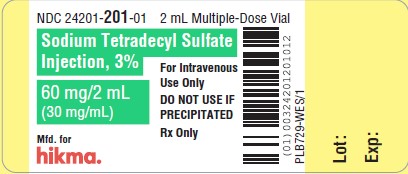
HOW SUPPLIED Sodium tetradecyl sulfate injection, 3%, 60 mg/2 mL (30 mg/mL) is a sterile nonpyrogenic solution for intravenous use. NDC 24201-201-05 Carton containing 5 x 2 mL multiple-dose vials.
📦 Storage and Handling ▾
STORAGE Store at 20° to 25°C (68° to 77°F). [See USP Controlled Room Temperature.]
📋 Description ▾
DESCRIPTION Sodium tetradecyl sulfate is an anionic surfactant which occurs as a white, waxy solid. The structural formula is as follows: C 14 H 29 NaSO 4 7-Ethyl-2-methyl-4-hendecanol sulfate sodium salt MW 316.44 Sodium tetradecyl sulfate injection is a sterile nonpyrogenic solution for intravenous use as a sclerosing agent. 3% 60 mg/2 mL (30 mg/mL): Each mL contains sodium tetradecyl sulfate 30 mg, benzyl alcohol 0.02 mL and dibasic sodium phosphate, anhydrous 9 mg in Water for Injection. pH 7.9; monobasic sodium phosphate and/or sodium hydroxide added, if needed, for pH adjustment.
Sodium Tetradecyl Sulfate Structural Formula
⚠️ Precautions ▾
PRECAUTIONS GENERAL Extreme caution must be exercised in the presence of underlying arterial disease such as marked peripheral arteriosclerosis or thromboangiitis obliterans (Buerger’s Disease).
🍼 Nursing Mothers ▾
NURSING MOTHERS It is not known whether this drug is excreted in human milk. Because many drugs are excreted in human milk, caution should be exercised when sodium tetradecyl sulfate injection is administered to a nursing woman.
📄 Carcinogenesis, Mutagenesis, Impairment of Fertility ▾
CARCINOGENESIS, MUTAGENESIS, IMPAIRMENT OF FERTILITY When tested in the L5178YTK +/- mouse lymphoma assay, sodium tetradecyl sulfate did not induce a dose-related increase in the frequency of thymidine kinase-deficient mutants and, therefore, was judged to be nonmutagenic in this system. However, no long-term animal carcinogenicity studies with sodium tetradecyl sulfate have been performed.
📄 Package Label / Principal Display Panel ▾
PRINCIPAL DISPLAY PANEL - 30 mg/mL Carton Label NDC 24201- 201 -01 2 mL Multiple-Dose Vial Sodium Tetradecyl Sulfate 3% Injection 60 mg/2 mL (30 mg/mL) FOR IV USE ONLY DO NOT USE IF PRECIPITATED Rx Only NDC 24201- 201 -05 5 x 2 mL Multiple-Dose Vial Sodium Tetradecyl Sulfate 3% Injection 60 mg/2 mL (30 mg/mL) FOR IV USE ONLY DO NOT USE IF PRECIPITATED Rx Only unit Label carton
Reported adverse events (FAERS)
Top reported reactions
Age at onset
Reporter sex
Serious outcomes
Where does this data come from?
About this NDC listing & data coverage
What data is (and isn’t) available for this NDC — tap to expand
| NDC identity (package / product / labeler codes) | ✓ Available |
| Labeler | ✓ Available |
| Product & package description | ✓ Available |
| Marketing category & status | ✓ Available |
| Active ingredient / dosage form / route | ✓ Available |
| FDA label (SPL via DailyMed) | ✓ Available |
| Package photos | ✓ Available |
| Inactive ingredients (structured) | ✓ Available |
| NADAC pharmacy acquisition price (CMS) | — Not published for this NDC CMS publishes NADAC only for NDCs reported in its retail-pharmacy survey. |
| Orange Book / therapeutic-equivalence data | ✓ Available |
| HCPCS J-code billing crosswalk | — Not published for this NDC Most self-administered / retail products have no J-code — that is normal. |
| Medicaid utilization (CMS SDUD) | — Not published for this NDC CMS reports utilization only for NDCs with Medicaid claims above its privacy threshold. |