
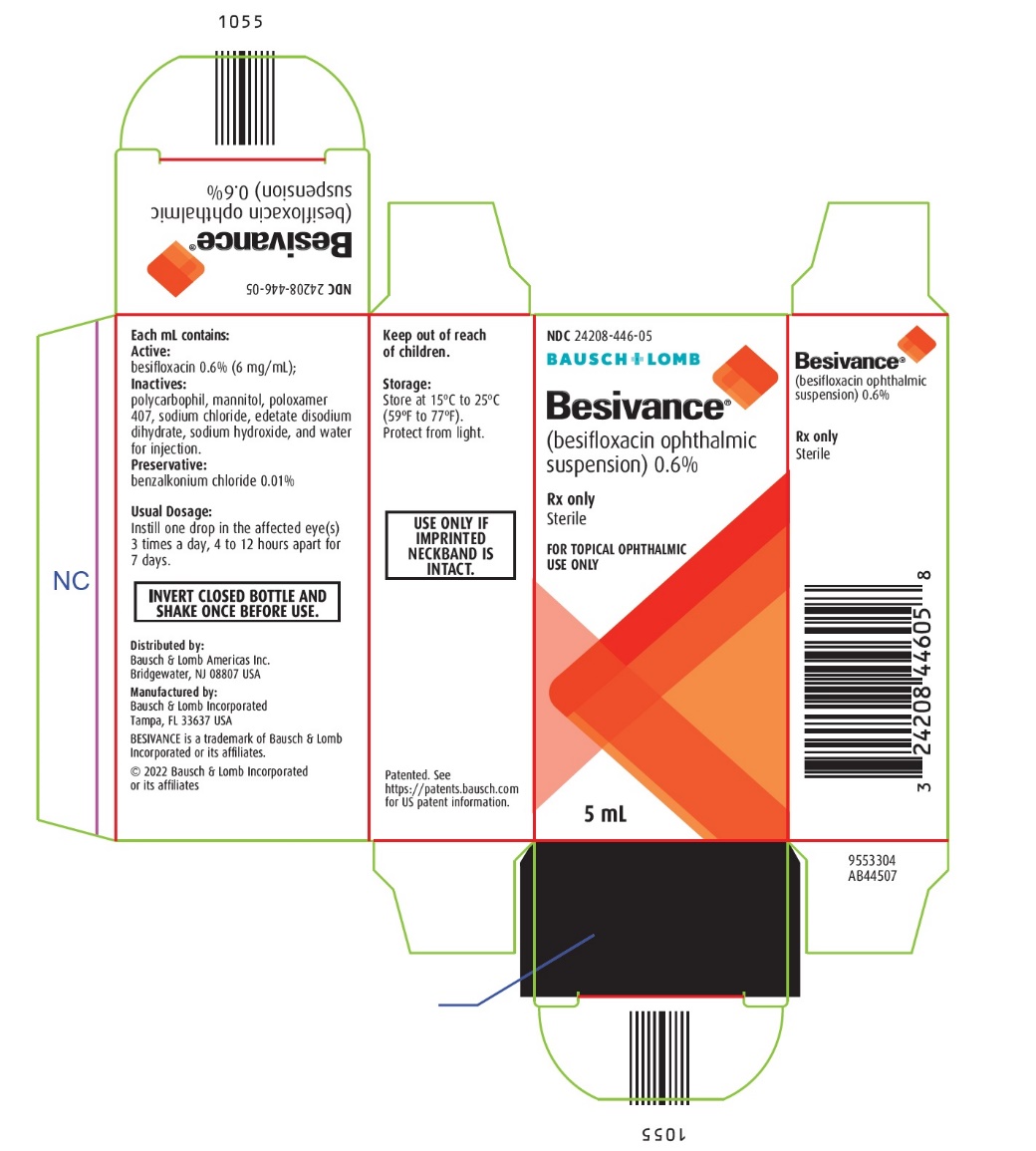
Besivance Besifloxacin 6 mg/mL Suspension — NDC 24208-446-05 (Billing 24208-0446-05)
This is a package of Besivance Besifloxacin 6 mg/mL Suspension from Bausch & Lomb Incorporated, marketed since May 2009 and currently FDA-listed; retail pharmacies pay about $44.09 per mL (NADAC). It is the main listing for this product, which comes in 2 package sizes.
NDC database record
One package, one record: these facts belong to NDC 24208-446-05 alone.
- Record
- FDA NDC Directory package listing · Human prescription drug
- Code segments
- 24208 labeler · 446 product · 05 package
- Package marketed since
- May 28, 2009
- Sample package
- No — commercial package
- Listing certified through
- Dec 31, 2026
- Barcode (UPC)
- 0324208446058
- Medicaid fills, this package
- 289 prescriptions in the last four reported quarters
- FDA record last changed
- Jul 24, 2026
Identity & classification
Regulatory identifiers FDA, NLM and CMS codes for this package
Drug-database identifiers Medi-Span GPI and First Databank GCN / HICL / AHFS classification
- GSN (GCN sequence number): 065230
- GCN: 24317
- GPI-14 (Medi-Span): 86101007101820
- HICL (First Databank): 036350
- AHFS class code: 52:04.04.00
- RxCUI (RxNorm): 850305
Where does this data come from?
- FDA openFDA NDC Directory · synced Oct 1, 2026
- FDA label on DailyMed · label index refreshed Oct 6, 2026
- RxNorm (NLM RxNav) · catalog refreshed Oct 1, 2026
- Medi-Span GPI (licensed)
- First Databank (licensed) · refreshed Oct 1, 2026
RxNorm drug class
This medicine belongs to the Quinolone Antimicrobial class.
Where does this data come from?
- RxClass (NLM) · catalog refreshed Oct 1, 2026
Clinical
Besifloxacin ophthalmic is used to treat bacterial conjunctivitis (pinkeye; infection of the membrane that covers the outside of the eyeballs and the inside of the eyelids). Besifloxacin is in a class of medications called fluoroquinolones. It works by killing the bacteria that cause infection.
Read the full MedlinePlus article ↗- It treats bacterial conjunctivitis, which is pink eye caused by bacteria. It will not help with pink eye caused by other things. Your prescriber decides if it fits your situation.
- Turn the closed bottle upside down and shake it once. Then put one drop in the affected eye(s) three times a day, spaced 4 to 12 hours apart, for 7 days. Follow your prescriber's d...
- Most are mild and in the eye. You might notice redness, blurry vision, pain, irritation or itching. Some people get a headache. Call your doctor if things get worse instead of bett...
- No. Do not wear contact lenses if you have signs of bacterial conjunctivitis or while you are using these drops. Ask your doctor when you can go back to them.
Patient education
Supplement & herbal interactions
Where does this data come from?
- MedlinePlus (NLM) · refreshed Oct 1, 2026
- FDA label on DailyMed · label index refreshed Oct 6, 2026
Ask a licensed pharmacist directly — free, answered by our team.
Pricing
A drug doesn't have one price. Each row is a different public payment system, and none is what you'd pay at the counter — that depends on your insurance. The ⓘ on each row explains what it measures.
| Price system | Per mL | Per package |
|---|---|---|
| Retail pharmacies payNADAC · weekly | $44.090 | $220.45 / 5 ml |
| Medicaid paysCMS SDUD · 12 mo | $44.68 | $223.38 / 5 ml |
| Medicare drug plans payPart D · Q2 2026 | $45.27 | $226.36 / 5 ml |
Where does this data come from?
- CMS NADAC weekly file · file of Sep 30, 2026
- CMS ASP pricing files · refreshed Sep 20, 2026
- CMS Medicaid State Drug Utilization Data · through Q1 2026
- CMS Part D plan pricing files · refreshed Sep 24, 2026
- VA National Acquisition Center price file
Packaging — all sizes for this product
| Package NDC | Description | Per unit | Per pack | Marketing start | Marketing end | Status |
|---|---|---|---|---|---|---|
| 24208-0446-02 24208-446-02 | 1 BOTTLE, DROPPER in 1 CARTON / 2 mL in 1 BOTTLE, DROPPER | — | — | 2009-05-28 | — | Active |
| 24208-0446-05 You're viewing this Main listing | 1 BOTTLE, DROPPER in 1 CARTON / 5 mL in 1 BOTTLE, DROPPER | $44.09 / mL | $220.45 | 2009-05-28 | — | Active |
In Medicaid, this is the most-dispensed pack of this product — about 100% of fills over the last four reported quarters. See all packs ↓
Pack size FAQ
What quantity is in this package?
What NDC number is used to bill for this package of Besivance Besifloxacin 6 mg/mL Suspension?
Prices are the latest CMS NADAC pharmacy acquisition cost per NDC; per-pack figures are per-unit × pack quantity, shown only when the pack is denominated in the same measure NADAC prices.
Therapeutic equivalents
| Product | Labeler | Pack | NADAC/unit | TE | Status | Price vs. this |
|---|---|---|---|---|---|---|
| Besivance 6 mg/mLthis 24208-0446-05 | Bausch | 1 bottle | $44.090 | — | Availability likely | — |
| Besivance 6 mg/mL 82260-0466-05 | Bausch | 1 bottle | — | — | FDA listed | — |
| Besivance 6 mg/mL 85766-0257-05 | Sportpharm | 1 bottle | — | — | FDA listed | — |
| Besivance 6 mg/mL 85766-0260-05 | Sportpharm | 1 bottle | — | — | FDA listed | — |
Where does this data come from?
- FDA openFDA NDC Directory · synced Oct 1, 2026
- FDA Orange Book · refreshed Oct 3, 2026
- CMS NADAC weekly file · file of Sep 30, 2026
Availability & generic status
We did not find an FDA-approved generic match for this exact strength, form and route. Patent/protection dates below may affect future generic timing.
Why the date isn’t exact: Generic timing can change because patents may be challenged, settled, licensed, added, removed, or worked around with a narrower label — and FDA approval does not always mean a pharmacy can get the generic today.
🛈 What do these terms mean?
- Patent
- Legal protection listed in the Orange Book that may delay generic approval or launch. Issued by the U.S. Patent & Trademark Office.
- Substance patent
- Covers the active drug molecule itself — the hardest to design around. A generic generally can’t launch until it expires.
- Formulation (product) patent
- Covers a specific formulation or dosage form. A generic can sometimes work around it with a different formulation.
- Method-of-use patent
- A patent covering one specific approved use of the drug — not necessarily the whole molecule. A generic can sometimes launch with a “skinny label” that carves out the protected use and keeps the others.
- Skinny label
- A generic label that omits a still-patented use when the FDA allows it — letting a generic reach the market for the unprotected uses.
- Exclusivity
- FDA-granted marketing protection, separate from patents — e.g. 5-yr new chemical entity, 7-yr orphan drug, or a +6-month pediatric extension.
- Paragraph IV
- A generic applicant’s formal challenge to a listed patent. It can potentially lead to earlier generic entry, but often involves litigation or a settlement.
- RLD / RS
- Reference Listed Drug — the brand product the FDA uses as the reference for generic applications. Reference Standard — the product the FDA expects generics to compare against in bioequivalence testing.
- TE / AB rating
- FDA therapeutic-equivalence rating. An AB rating generally means the FDA considers a generic therapeutically equivalent to — and substitutable for — the brand.
- LOE (loss of exclusivity)
- The latest patent or exclusivity currently listed — the loss-of-exclusivity / latest-listed-protection date shown on this page. Paragraph-IV challenges and settlements can move the real date earlier; FDA approval and a manufacturer’s decision to market can move it later.
Built from the FDA Orange Book. The bars above are scaled to each protection’s expiry; the red LOE marker is the last one to lapse.
| Patent | Type | Use code | Expires |
|---|---|---|---|
| US 8937062 ↗ | Method of use | U-80 | Nov 13, 2029 |
| US 8415342 ↗ | Method of use | U-80 | Nov 7, 2030 |
| US 8604020 ↗ | Drug product | — | Mar 12, 2030 |
| US 8481526 ↗ | Drug substance | — | Jan 9, 2031 |
Is there a generic version of BESIVANCE 0.6% SUSP?
The FDA approved a generic — why can’t I get it at my pharmacy yet?
Why do different websites show different generic release dates?
What does “FDA listed” mean?
What does a patent or protection date mean here?
What does “current Orange Book estimate” mean?
Can a generic come out before the last patent expires?
Can a generic come out after the listed dates?
What is the difference between patents and exclusivity?
Why are there multiple patent dates?
Where does this data come from?
- FDA Orange Book · refreshed Oct 3, 2026
Inactive Ingredients / Excipients
Inactive ingredients, also called excipients, are components of the drug product other than the active ingredient. They may include fillers, dyes, coatings, preservatives, flavors, or other formulation ingredients.
🧪 Avoiding an ingredient? See Besifloxacin Ophthalmic inactive ingredients by manufacturer: every current product's list side by side, so you can ask your pharmacy for the version that does not list it.
💡 Tap an ingredient (hover on desktop) to see what it is and why it’s used.
-
UNII F5UM2KM3W7
Benzalkonium chloride is a chemical compound that works as a preservative and antimicrobial agent in medications. It prevents bacterial and fungal growth in liquid formulations to keep the product safe during storage and use.
-
UNII 7FLD91C86K
Edetate disodium is a chemical compound that binds and removes certain metal ions. In medicines, it acts as a preservative and stabilizer by preventing metals like calcium from interfering with the product's shelf life and consistency.
-
UNII 3OWL53L36A
A natural sugar alcohol derived from seaweed or synthesized in the lab. It's used as a filler to add bulk, a sweetener in sugar-free formulas, and a disintegrant to help tablets break apart in the stomach.
-
UNII TUF2IVW3M2
Poloxamer 407 is a synthetic polymer made from ethylene oxide and propylene oxide. In medicines, it acts as a thickener, emulsifier, and solubilizer to help mix ingredients and create the right texture.
-
UNII W25LM17A4W
Polycarbophil is a synthetic polymer that absorbs water and swells. It's used as a binder to hold tablet ingredients together and as a disintegrant to help the tablet break apart in the digestive system.
-
UNII 451W47IQ8X
Sodium chloride is common table salt. It's used in medicines as a buffer to maintain proper pH, as a filler to add bulk, or to adjust the osmotic balance in liquid formulations.
-
UNII 55X04QC32I
A strong alkaline chemical used to adjust and maintain the pH balance of liquid medicines. It helps keep the medicine stable and ensures it stays effective during storage.
-
UNII 059QF0KO0R
Water is a liquid solvent that dissolves and mixes ingredients together in liquid medicines, syrups, and injections. It helps distribute the active drug evenly throughout the product.
8 inactive ingredients listed in the exact product block matched to this NDC.
Where does this data come from?
ingredient classCode="IACT" elements from the exact product block matched by this NDC. Label-section narrative from DailyMed / the openFDA label index is shown separately when available.- FDA label on DailyMed · label index refreshed Oct 6, 2026
- FDA openFDA NDC Directory · synced Oct 1, 2026
Inactive ingredient FAQ
Are inactive ingredients the same for every manufacturer?
Why might an inactive ingredient be missing?
Can inactive ingredients matter?
Manufacturer & labeler
More NDCs from Bausch & Lomb Incorporated labeler code 24208
- Brimonidine Tartrate 2 mg/mL Solution/ Drops NDC 24208-411-05
- Retisert Fluocinolone Acetonide .59 mg Implant NDC 24208-416-01
- Opcon-A Naphazoline hydrochloride and Pheniramine maleate .2675 mg/mL; 3.15 mg/mL Solution/ Drops NDC 24208-430-03
- Opcon-A Naphazoline hydrochloride and Pheniramine maleate .2675 mg/mL; 3.15 mg/mL Solution/ Drops NDC 24208-431-15
- Ofloxacin 3 mg/mL Solution/ Drops NDC 24208-434-05
- Lotemax loteprednol etabonate 5 mg/g Ointment NDC 24208-443-01
- Advanced Eye Relief/ Redness Maximum Relief Naphazoline Hydrochloride and Hypromellose 5 mg/mL; .3 mg/mL Solution/ Drops NDC 24208-450-15
- Advanced Eye Relief Dry Eye Rejuvenation glycerin propylene glycol 3 mg/mL; 10 mg/mL Solution/ Drops NDC 24208-454-30
- Diclofenac Sodium 1 mg/mL Solution/ Drops NDC 24208-457-05
- Latanoprost 50 ug/mL Solution/ Drops NDC 24208-463-25
- BRINZOLAMIDE 10 mg/mL Suspension/ Drops NDC 24208-464-10
- Dorzolamide HCl 20 mg/mL Solution/ Drops NDC 24208-485-10
Where does this data come from?
- FDA openFDA NDC Directory · synced Oct 1, 2026
- Drugs@FDA
Full prescribing information FDA SPL
🎯 Indications and Usage ▾
1 INDICATIONS AND USAGE BESIVANCE ® (besifloxacin ophthalmic suspension) 0.6% is indicated for the treatment of bacterial conjunctivitis caused by susceptible isolates of the following bacteria: Aerococcus viridans* CDC coryneform group G Corynebacterium pseudodiphtheriticum* Corynebacterium striatum* Haemophilus influenzae Moraxella catarrhalis* Moraxella lacunata* Pseudomonas aeruginosa* Staphylococcus aureus Staphylococcus epidermidis Staphylococcus hominis* Staphylococcus lugdunensis* Staphylococcus warneri* Streptococcus mitis group Streptococcus oralis Streptococcus pneumoniae Streptococcus salivarius* *Efficacy for this organism was studied in fewer than 10 infections.
BESIVANCE ® (besifloxacin ophthalmic suspension) 0.6% is a quinolone antimicrobial indicated for the treatment of bacterial conjunctivitis caused by susceptible isolates of the following bacteria: Aerococcus viridans *, CDC coryneform group G, Corynebacterium pseudodiphtheriticum*, Corynebacterium striatum*, Haemophilus influenzae, Moraxella catarrhalis*, Moraxella lacunata*, Pseudomonas aeruginosa*, Staphylococcus aureus, Staphylococcus epidermidis, Staphylococcus hominis*, Staphylococcus lugdunensis*, Staphylococcus warneri*, Streptococcus mitis group , Streptococcus oralis, Streptococcus pneumoniae, Streptococcus salivarius* *Efficacy for this organism was studied in fewer than 10 infections.
( 1 )
⏱️ Dosage and Administration ▾
2 DOSAGE AND ADMINISTRATION Invert closed bottle and shake once before use. Instill one drop in the affected eye(s) 3 times a day, 4 to 12 hours apart for 7 days. Instill one drop in the affected eye(s) 3 times a day, 4 to 12 hours apart for 7 days. ( 2 )
💊 Dosage Forms and Strengths ▾
3 DOSAGE FORMS AND STRENGTHS Ophthalmic suspension containing 6 mg/mL (0.6%) of besifloxacin. Ophthalmic suspension: besifloxacin 6 mg/mL (0.6%) ( 3 )
⛔ Contraindications ▾
4 CONTRAINDICATIONS None. None. ( 4 )
⚠️ Warnings and Cautions ▾
5 WARNINGS AND PRECAUTIONS Not for Injection into the Eye ( Error! Hyperlink reference not valid. ) Growth of Resistant Organisms with Prolonged Use ( Error! Hyperlink reference not valid. ) Avoidance of Contact Lenses: Patients should not wear contact lenses if they have signs or symptoms of bacterial conjunctivitis or during the course of therapy with BESIVANCE. ( 5.3 )
5.1 Not for Injection into the Eye
5.2Growth of Resistant Organisms with Prolonged Use As with other anti-infectives, prolonged use of BESIVANCE (besifloxacin ophthalmic suspension) 0.6% may result in overgrowth of non-susceptible organisms, including fungi. If super-infection occurs, discontinue use and institute alternative therapy. Whenever clinical judgment dictates, the patient should be examined with the aid of magnification, such as slit-lamp biomicroscopy, and, where appropriate, fluorescein staining.
5.3Avoidance of Contact Lenses Patients should not wear contact lenses if they have signs or symptoms of bacterial conjunctivitis or during the course of therapy with BESIVANCE.
🤒 Adverse Reactions ▾
6 ADVERSE REACTIONS Because clinical trials are conducted under widely varying conditions, adverse reaction rates observed in the clinical trials of a drug cannot be directly compared to rates in the clinical trials of another drug and may not reflect the rates observed in clinical practice. The data described below reflect exposure to BESIVANCE in approximately 1,000 patients between 1 and 98 years old with clinical signs and symptoms of bacterial conjunctivitis. The most frequently reported ocular adverse reaction was conjunctival redness, reported in approximately 2% of patients.
Other adverse reactions reported in patients receiving BESIVANCE occurring in approximately 1-2% of patients included: blurred vision, eye pain, eye irritation, eye pruritus and headache. The most common adverse reaction reported in 2% of patients treated with BESIVANCE was conjunctival redness. ( 6 ) To report SUSPECTED ADVERSE REACTIONS, contact Bausch & Lomb Incorporated at 1-800-553-5340 or FDA at 1-800-FDA-1088 or www.fda.gov/medwatch .
👥 Use in Specific Populations ▾
8 USE IN SPECIFIC POPULATIONS
8.1Pregnancy Risk Summary There are no available human data for the use of BESIVANCE during pregnancy to inform any drug-associated risks; however, systemic exposure to besifloxacin from ocular administration is low [see Clinical Pharmacology (12.3) ]. Oral administration of besifloxacin to pregnant rats during organogenesis or during the prenatal and postnatal period did not produce adverse embryofetal or offspring effects at clinically relevant systemic exposures [see Data]. Data Animal Data In an embryofetal development study in rats, the administration of besifloxacin at oral doses up to 1,000 mg/kg/day during organogenesis was not associated with visceral or skeletal malformations in rat fetuses, although this dose was associated with maternal toxicity (reduced body weight gain and food consumption) and maternal mortality.
Increased post-implantation loss, decreased fetal body weights, and decreased fetal ossification were also observed. At this dose, the mean C max in the rat dams was approximately 20 mcg/mL, approximately 46,500 times the mean plasma concentrations measured in humans at the recommended human ophthalmic dose (RHOD). The No Observed Adverse Effect Level (NOAEL) for this embryofetal development study was 100 mg/kg/day (C max , 5 mcg/mL, approximately 11,600 times the mean plasma concentrations measured in humans at the RHOD).
In a prenatal and postnatal development study in rats, the NOAELs for both fetal/neonate and maternal toxicity were 100 mg/kg/day. At 1,000 mg/kg/day, pups weighed significantly less than controls and had a reduced neonatal survival rate. Attainment of developmental landmarks and sexual maturation was delayed, although surviving pups from this dose group that were reared to maturity did not demonstrate deficits in behavior, including activity, learning and memory, and their reproductive capacity appeared normal.
8.2Lactation Risk Summary There are no data on the presence of BESIVANCE in human milk, the effects on the breastfed infant, or the effects on milk production. However, systemic exposure to besifloxacin following topical ocular administration is low [see Clinical Pharmacology (12.3) ] , and it is not known whether measurable levels of besifloxacin would be present in maternal milk following topical ocular administration. The developmental and health benefits of breastfeeding should be considered, along with the mother’s clinical need for BESIVANCE, and any potential adverse effects on the breastfed infant from BESIVANCE.
8.4Pediatric Use The safety and effectiveness of BESIVANCE in infants below one year of age have not been established. The efficacy of BESIVANCE in treating bacterial conjunctivitis in pediatric patients one year or older has been demonstrated in controlled clinical trials [see Clinical Studies (14)]. There is no evidence that the ophthalmic administration of quinolones has any effect on weight-bearing joints, even though systemic administration of some quinolones has been shown to cause arthropathy in immature animals.
8.5Geriatric Use No overall differences in safety and effectiveness have been observed between elderly and younger patients.
🤰 Pregnancy ▾
8.1Pregnancy Risk Summary There are no available human data for the use of BESIVANCE during pregnancy to inform any drug-associated risks; however, systemic exposure to besifloxacin from ocular administration is low [see Clinical Pharmacology (12.3) ]. Oral administration of besifloxacin to pregnant rats during organogenesis or during the prenatal and postnatal period did not produce adverse embryofetal or offspring effects at clinically relevant systemic exposures [see Data]. Data Animal Data In an embryofetal development study in rats, the administration of besifloxacin at oral doses up to 1,000 mg/kg/day during organogenesis was not associated with visceral or skeletal malformations in rat fetuses, although this dose was associated with maternal toxicity (reduced body weight gain and food consumption) and maternal mortality.
Increased post-implantation loss, decreased fetal body weights, and decreased fetal ossification were also observed. At this dose, the mean C max in the rat dams was approximately 20 mcg/mL, approximately 46,500 times the mean plasma concentrations measured in humans at the recommended human ophthalmic dose (RHOD). The No Observed Adverse Effect Level (NOAEL) for this embryofetal development study was 100 mg/kg/day (C max , 5 mcg/mL, approximately 11,600 times the mean plasma concentrations measured in humans at the RHOD).
In a prenatal and postnatal development study in rats, the NOAELs for both fetal/neonate and maternal toxicity were 100 mg/kg/day. At 1,000 mg/kg/day, pups weighed significantly less than controls and had a reduced neonatal survival rate. Attainment of developmental landmarks and sexual maturation was delayed, although surviving pups from this dose group that were reared to maturity did not demonstrate deficits in behavior, including activity, learning and memory, and their reproductive capacity appeared normal.
🧒 Pediatric Use ▾
8.4Pediatric Use The safety and effectiveness of BESIVANCE in infants below one year of age have not been established. The efficacy of BESIVANCE in treating bacterial conjunctivitis in pediatric patients one year or older has been demonstrated in controlled clinical trials [see Clinical Studies (14)]. There is no evidence that the ophthalmic administration of quinolones has any effect on weight-bearing joints, even though systemic administration of some quinolones has been shown to cause arthropathy in immature animals.
🧓 Geriatric Use ▾
8.5Geriatric Use No overall differences in safety and effectiveness have been observed between elderly and younger patients.
🧬 Clinical Pharmacology ▾
12 CLINICAL PHARMACOLOGY
12.1Mechanism of Action Besifloxacin is a fluoroquinolone antibacterial [see Microbiology (12.4) ] .
12.3Pharmacokinetics Plasma concentrations of besifloxacin were measured in adult patients with suspected bacterial conjunctivitis who received BESIVANCE bilaterally three times a day (16 doses total). Following the first and last dose, the maximum plasma besifloxacin concentration in each patient was less than 1.3 ng/mL. The mean besifloxacin C max was 0.37 ng/mL on Day 1 and 0.43 ng/mL on Day 6.
The average elimination half-life of besifloxacin in plasma following multiple dosing was estimated to be 7 hours.
12.4Microbiology Besifloxacin is an 8-chloro fluoroquinolone with an N-1 cyclopropyl group. The compound has activity against Gram-positive and Gram-negative bacteria due to the inhibition of both bacterial DNA gyrase and topoisomerase IV. DNA gyrase is an essential enzyme required for replication, transcription and repair of bacterial DNA.
Topoisomerase IV is an essential enzyme required for partitioning of the chromosomal DNA during bacterial cell division. Besifloxacin is bactericidal with minimum bactericidal concentrations (MBCs) generally within one dilution of the minimum inhibitory concentrations (MICs). The mechanism of action of fluoroquinolones, including besifloxacin, is different from that of aminoglycoside, macrolide, and β -lactam antibiotics.
Therefore, besifloxacin may be active against pathogens that are resistant to these antibiotics and these antibiotics may be active against pathogens that are resistant to besifloxacin. In vitro studies demonstrated cross-resistance between besifloxacin and some fluoroquinolones. In vitro resistance to besifloxacin develops via multiple-step mutations and occurs at a general frequency of <3.3 x 10 -10 for Staphylococcus aureus and <7 x 10 -10 for Streptococcus pneumoniae .
Besifloxacin has been shown to be active against most isolates of the following bacteria both in vitro and in conjunctival infections treated in clinical trials [see Indications and Usage (1) ]: Aerococcus viridans* CDC coryneform group G Corynebacterium pseudodiphtheriticum* Corynebacterium striatum* Haemophilus influenzae Moraxella catarrhalis* Moraxella lacunata* Pseudomonas aeruginosa* Staphylococcus aureus Staphylococcus epidermidis Staphylococcus hominis* Staphylococcus lugdunensis* Staphylococcus warneri* Streptococcus mitis group Streptococcus oralis Streptococcus pneumoniae Streptococcus salivarius* *Efficacy for this organism was studied in fewer than 10 infections.
🧬 Mechanism of Action ▾
12.1Mechanism of Action Besifloxacin is a fluoroquinolone antibacterial [see Microbiology (12.4) ] .
📦 How Supplied / Storage and Handling ▾
16 HOW SUPPLIED/STORAGE AND HANDLING BESIVANCE ® (besifloxacin ophthalmic suspension) 0.6% is supplied as a sterile ophthalmic suspension in a white low density polyethylene (LDPE) bottle with a controlled dropper tip and beige polypropylene cap. Tamper evidence is provided with a shrink band around the cap and neck area of the package. NDC 24208-446-05 5 mL in 7.5 mL bottle Storage: Store at 15°C to 25°C (59°F to 77°F). Protect from light.
📋 Description ▾
11 DESCRIPTION BESIVANCE ® (besifloxacin ophthalmic suspension) 0.6% is a sterile ophthalmic suspension of besifloxacin formulated with DuraSite ® † (polycarbophil, edetate disodium dihydrate, sodium chloride, sodium hydroxide, and water for injection). Each mL of BESIVANCE contains 6.63 mg besifloxacin hydrochloride equivalent to 6 mg besifloxacin base. It is an 8-chloro fluoroquinolone anti-infective for topical ophthalmic use.
C 19 H 21 ClFN 3 O 3 •HCl Molecular Weight 430.30 Chemical Name: (+)-7-[(3R)-3-aminohexahydro-1H-azepin-1-yl]-8-chloro-1-cyclopropyl-6-fluoro-4-oxo-1,4-dihydroquinoline-3-carboxylic acid hydrochloride. Besifloxacin hydrochloride is a white to pale yellowish-white powder. Each mL contains: Active: besifloxacin 0.6% (6 mg/mL); Inactives: polycarbophil, mannitol, poloxamer 407, sodium chloride, edetate disodium dihydrate, sodium hydroxide, and water for injection.
Preservative: benzalkonium chloride 0.01% BESIVANCE is an isotonic suspension with an osmolality of approximately 290 mOsm/kg. Besifloxacin hydrochloride structural formula
💬 Information for Patients ▾
17 PATIENT COUNSELING INFORMATION Handling the Container Advise patients to avoid contaminating the applicator tip with material from the eye, fingers or other source. Use with Contact Lenses Advise patients not to wear contact lenses if they have signs or symptoms of bacterial conjunctivitis or during the course of therapy with BESIVANCE. Dosing Instructions Patients should be instructed to invert closed bottle (upside down) and shake once before each use.
Distributed by: Bausch & Lomb Americas Inc. Bridgewater, NJ 08807 USA Manufactured by: Bausch & Lomb Incorporated Tampa, FL 33637 USA Patented. See https://patents.bausch.com for US patent information.
BESIVANCE is a trademark of Bausch & Lomb Incorporated or its affiliates. © 2022 Bausch & Lomb Incorporated or its affiliates † DuraSite is a trademark of Sun Pharma Global FZE. 9142709 (folded) 9142609 (flat)
🧬 Pharmacokinetics ▾
12.3Pharmacokinetics Plasma concentrations of besifloxacin were measured in adult patients with suspected bacterial conjunctivitis who received BESIVANCE bilaterally three times a day (16 doses total). Following the first and last dose, the maximum plasma besifloxacin concentration in each patient was less than 1.3 ng/mL. The mean besifloxacin C max was 0.37 ng/mL on Day 1 and 0.43 ng/mL on Day 6.
The average elimination half-life of besifloxacin in plasma following multiple dosing was estimated to be 7 hours.
🔬 Clinical Studies ▾
14 CLINICAL STUDIES In a randomized, double-masked, vehicle-controlled, multicenter clinical trial, in which patients 1-98 years of age were dosed 3 times a day for 5 days, BESIVANCE was superior to its vehicle in patients with bacterial conjunctivitis. Clinical resolution was achieved in 45% (90/198) for the BESIVANCE-treated group versus 33% (63/191) for the vehicle-treated group (difference 12%, 95% CI 3% - 22%). Microbiological outcomes demonstrated a statistically significant eradication rate for causative pathogens of 91% (181/198) for the BESIVANCE-treated group versus 60% (114/191) for the vehicle-treated group (difference 31%, 95% CI 23% - 40%).
Microbiologic eradication does not always correlate with clinical outcome in anti-infective trials.
🧪 Nonclinical Toxicology ▾
13 NONCLINICAL TOXICOLOGY
13.1Carcinogenesis, Mutagenesis, Impairment of Fertility Long-term studies in animals to determine the carcinogenic potential of besifloxacin have not been performed. No in vitro mutagenic activity of besifloxacin was observed in an Ames test (up to 3.33 mcg/plate) on bacterial tester strains Salmonella typhimurium TA98, TA100, TA1535, TA1537 and Escherichia coli WP2uvrA. However, it was mutagenic in S. typhimurium strain TA102 and E. coli strain WP2 (pKM101).
Positive responses in these strains have been observed with other quinolones and are likely related to topoisomerase inhibition. Besifloxacin induced chromosomal aberrations in CHO cells in vitro and it was positive in an in vivo mouse micronucleus assay at oral doses ≥1,500 mg/kg. Besifloxacin did not induce unscheduled DNA synthesis in hepatocytes cultured from rats given the test compound up to 2,000 mg/kg by the oral route.
In a fertility and early embryonic development study in rats, besifloxacin did not impair the fertility of male or female rats at oral doses of up to 500 mg/kg/day. This dose is approximately 26,500 times higher than the mean plasma concentration measured in humans at the recommended human ophthalmic dose.
📄 Carcinogenesis, Mutagenesis, Impairment of Fertility ▾
13.1Carcinogenesis, Mutagenesis, Impairment of Fertility Long-term studies in animals to determine the carcinogenic potential of besifloxacin have not been performed. No in vitro mutagenic activity of besifloxacin was observed in an Ames test (up to 3.33 mcg/plate) on bacterial tester strains Salmonella typhimurium TA98, TA100, TA1535, TA1537 and Escherichia coli WP2uvrA. However, it was mutagenic in S. typhimurium strain TA102 and E. coli strain WP2 (pKM101).
Positive responses in these strains have been observed with other quinolones and are likely related to topoisomerase inhibition. Besifloxacin induced chromosomal aberrations in CHO cells in vitro and it was positive in an in vivo mouse micronucleus assay at oral doses ≥1,500 mg/kg. Besifloxacin did not induce unscheduled DNA synthesis in hepatocytes cultured from rats given the test compound up to 2,000 mg/kg by the oral route.
In a fertility and early embryonic development study in rats, besifloxacin did not impair the fertility of male or female rats at oral doses of up to 500 mg/kg/day. This dose is approximately 26,500 times higher than the mean plasma concentration measured in humans at the recommended human ophthalmic dose.
📄 Package Label / Principal Display Panel ▾
PACKAGE/LABEL PRINCIPAL DISPLAY PANEL NDC 24208-446-05 BAUSCH + LOMB Besivance ® (besifloxacin ophthalmic Suspension) 0.6% Rx only Sterile FOR TOPICAL OPHTHALMIC USE ONLY 5 mL 9553305 AB44507 carton