
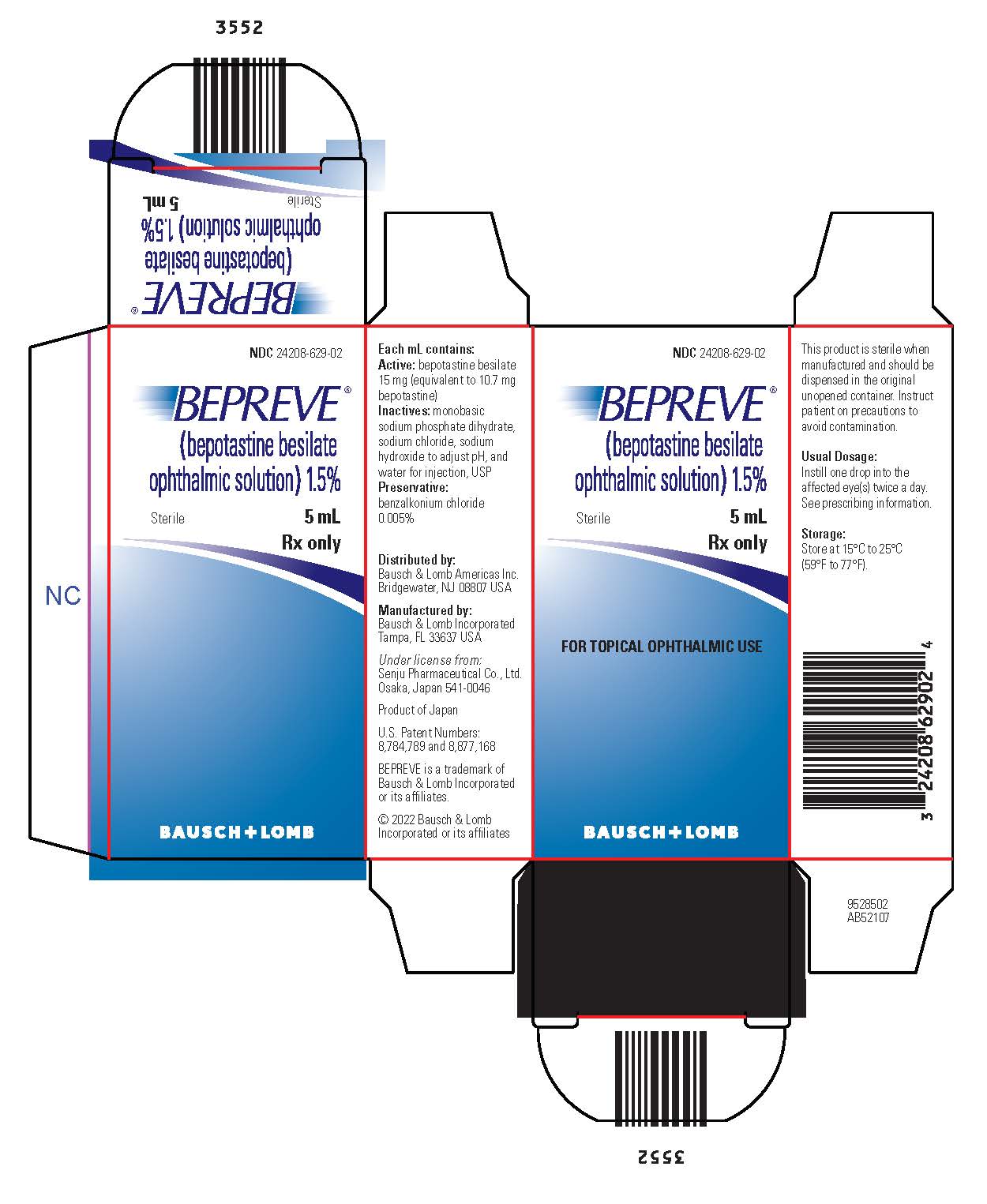
Bepreve bepotastine besilate 15 mg/mL Solution/ Drops — NDC 24208-629-02 (Billing 24208-0629-02)
This is a package of Bepreve bepotastine besilate 15 mg/mL Solution/ Drops from Bausch & Lomb Incorporated, marketed since Sep 2009 and currently FDA-listed; retail pharmacies pay about $55.94 per mL (NADAC). It is the main listing for this product, which comes in 3 package sizes.
Identity & classification
Regulatory identifiers FDA, NLM and CMS codes for this package
Drug-database identifiers Medi-Span GPI and First Databank GCN / HICL / AHFS classification
- GSN (GCN sequence number): 065598
- GCN: 27606
- GPI-14 (Medi-Span): 86802008102020
- HICL (First Databank): 036608
- AHFS class code: 04:92.00.00
- RxCUI (RxNorm): 863038
Where does this data come from?
- FDA openFDA NDC Directory · synced Oct 1, 2026
- FDA label on DailyMed · label index refreshed Oct 1, 2026
- RxNorm (NLM RxNav) · catalog refreshed Oct 1, 2026
- Medi-Span GPI (licensed)
- First Databank (licensed) · refreshed Oct 1, 2026
RxNorm drug class
This medicine belongs to the Histamine-1 Receptor Antagonist class.
Where does this data come from?
- RxClass (NLM) · catalog refreshed Oct 1, 2026
Clinical
- It treats itching of the eyes caused by allergic conjunctivitis. It is an antihistamine, so it blocks the histamine that causes the itch.
- You put one drop in each affected eye, usually twice a day. Take your contact lenses out first. Follow your prescriber's directions and the label on your bottle.
- Take your lenses out before putting the drops in. The preservative benzalkonium chloride can be absorbed by soft lenses. You can put them back in after 10 minutes. These drops shou...
- The most common one is a mild taste in your mouth after the drop. Some people have eye irritation, headache or cold-like symptoms. These are generally mild.
Patient education
Supplement & herbal interactions
Where does this data come from?
- MedlinePlus (NLM) · refreshed Oct 1, 2026
- FDA label on DailyMed · label index refreshed Oct 1, 2026
Ask a licensed pharmacist directly — free, answered by our team.
Pricing
A drug doesn't have one price. Each row is a different public payment system, and none is what you'd pay at the counter — that depends on your insurance. The ⓘ on each row explains what it measures.
| Price system | Per mL | Per package |
|---|---|---|
| Retail pharmacies payNADAC · weekly | $55.936 | $279.68 / 5 ml |
| Medicaid paysCMS SDUD · 12 mo | $57.15 | $285.73 / 5 ml |
| Medicare drug plans payPart D · Q2 2026 | $59.16 | $295.79 / 5 ml |
Where does this data come from?
- CMS NADAC weekly file · file of Sep 30, 2026
- CMS ASP pricing files · refreshed Sep 20, 2026
- CMS Medicaid State Drug Utilization Data · through Q1 2026
- CMS Part D plan pricing files · refreshed Sep 24, 2026
- VA National Acquisition Center price file
Packaging — all sizes for this product
| Package NDC | Description | Per unit | Per pack | Marketing start | Marketing end | Status |
|---|---|---|---|---|---|---|
| 24208-0629-01 24208-629-01 | 1 BOTTLE, DROPPER in 1 CARTON / 10 mL in 1 BOTTLE, DROPPER | $53.81 / mL | $538.11 | 2009-09-08 | — | Active |
| 24208-0629-02 You're viewing this Main listing | 1 BOTTLE, DROPPER in 1 CARTON / 5 mL in 1 BOTTLE, DROPPER | $55.94 / mL | $279.68 | 2009-09-08 | — | Active |
| 24208-0629-03 24208-629-03 | 1 BOTTLE, DROPPER in 1 CARTON / 1 mL in 1 BOTTLE, DROPPER | — | — | 2009-09-08 | — | Active |
Per mL, this pack runs about 4% above the cheapest pack (NDC 24208-0629-01, $53.81 vs $55.94 NADAC).
In Medicaid, this is the most-dispensed pack of this product — about 82% of fills over the last four reported quarters. See all packs ↓
Pack size FAQ
What quantity is in this package?
What NDC number is used to bill for this package of Bepreve bepotastine besilate 15 mg/mL Solution/ Drops?
Prices are the latest CMS NADAC pharmacy acquisition cost per NDC; per-pack figures are per-unit × pack quantity, shown only when the pack is denominated in the same measure NADAC prices.
Therapeutic equivalents
| Product | Labeler | Pack | NADAC/unit | TE | Status | Price vs. this |
|---|---|---|---|---|---|---|
| Bepotastine Besilate 15 mg/mL 70069-0712-01 | Somerset | 1 bottle | $8.286 | AT | Availability likely | save 85% |
| Bepotastine Besilate 15 mg/mL 00378-7055-35 | Mylan | 1 bottle | $10.487 | AT | Availability likely | save 81% |
| Bepotastine Besilate 15 mg/mL 24208-0630-05 | Bausch | 1 bottle | $10.487 | AT | Availability likely | save 81% |
| Bepotastine Besilate Ophthalmic Solution 1.5% 15 mg/mL 62332-0598-05 | Alembic | 1 bottle | $10.487 | AT | Availability likely | save 81% |
| Bepotastine Besilate 15 mg/mL 70069-0711-01 | Somerset | 1 bottle | $10.487 | AT | Availability likely | save 81% |
| Bepotastine Besilate 15 mg/mL 82260-0630-05 | Bausch | 1 bottle | $10.487 | AT | Availability likely | save 81% |
| Bepreve 15 mg/mLthis 24208-0629-02 | Bausch | 1 bottle | $55.936 | AT | Availability likely | — |
| Bepotastine Besilate Ophthalmic Solution 1.5% 15 mg/mL 46708-0598-05 | Alembic | 1 bottle | — | AT | FDA listed | — |
Where does this data come from?
- FDA openFDA NDC Directory · synced Oct 1, 2026
- FDA Orange Book · refreshed Sep 3, 2026
- CMS NADAC weekly file · file of Sep 30, 2026
Availability & generic status
FDA-approved generic versions are listed, and recent pricing/market data suggests they may be available — see Therapeutic equivalents.
Where does this data come from?
- FDA Orange Book · refreshed Sep 3, 2026
Inactive Ingredients / Excipients
Inactive ingredients, also called excipients, are components of the drug product other than the active ingredient. They may include fillers, dyes, coatings, preservatives, flavors, or other formulation ingredients.
Where does this data come from?
IACT rows and label-wide narrative are kept separate; availability and product-level specificity depend on the submitted label.- FDA label on DailyMed · label index refreshed Oct 1, 2026
- FDA openFDA NDC Directory · synced Oct 1, 2026
Inactive ingredient FAQ
Are inactive ingredients the same for every manufacturer?
Why might an inactive ingredient be missing?
Can inactive ingredients matter?
Manufacturer & labeler
Where does this data come from?
- FDA openFDA NDC Directory · synced Oct 1, 2026
- Drugs@FDA
Full prescribing information FDA SPL
🎯 Indications and Usage ▾
1 INDICATIONS AND USAGE BEPREVE ® (bepotastine besilate ophthalmic solution) 1.5% is a histamine H 1 receptor antagonist indicated for the treatment of itching associated with signs and symptoms of allergic conjunctivitis. BEPREVE is a histamine H1 receptor antagonist indicated for the treatment of itching associated with allergic conjunctivitis. ( 1 )
⏱️ Dosage and Administration ▾
2 DOSAGE AND ADMINISTRATION Instill one drop of BEPREVE into the affected eye(s) twice a day. Remove contact lenses prior to instillation of BEPREVE. • Instill one drop into the affected eye(s) twice a day. ( 2 ) • Remove contact lenses prior to instillation of BEPREVE. ( 2 )
💊 Dosage Forms and Strengths ▾
3 DOSAGE FORMS AND STRENGTHS Ophthalmic solution containing bepotastine besilate 15 mg/mL (1.5%). Ophthalmic solution containing bepotastine besilate, 15 mg/mL (1.5%). ( 3 )
⛔ Contraindications ▾
4 CONTRAINDICATIONS BEPREVE is contraindicated in patients with a history of hypersensitivity reactions to bepotastine or any of the other ingredients [see Adverse Reactions ( 6.2 )] . Hypersensitivity to any component of this product. ( 4 )
⚠️ Warnings and Cautions ▾
5 WARNINGS AND PRECAUTIONS • Contamination of Solution: Do not touch the dropper tip to any surface. Keep bottle tightly closed when not in use. ( 5.1 ) • Contact Lens Wear: BEPREVE should not be used to treat contact lens-related irritation. ( 5.2 )
5.1Contamination of Tip and Solution To minimize contaminating the dropper tip and solution, advise the patient not to touch the eyelids or surrounding areas with the dropper tip of the bottle and to keep the bottle tightly closed when not in use.
5.2Contact Lens Wear BEPREVE should not be used to treat contact lens-related irritation. BEPREVE should not be instilled while wearing contact lenses. Patient should remove contact lenses prior to instillation of BEPREVE, because benzalkonium chloride may be absorbed by soft contact lenses. Lenses may be reinserted after 10 minutes following administration of BEPREVE.
5.1Contamination of Tip and Solution To minimize contaminating the dropper tip and solution, advise the patient not to touch the eyelids or surrounding areas with the dropper tip of the bottle and to keep the bottle tightly closed when not in use.
5.2Contact Lens Wear BEPREVE should not be used to treat contact lens-related irritation. BEPREVE should not be instilled while wearing contact lenses. Patient should remove contact lenses prior to instillation of BEPREVE, because benzalkonium chloride may be absorbed by soft contact lenses. Lenses may be reinserted after 10 minutes following administration of BEPREVE.
🤒 Adverse Reactions ▾
6 ADVERSE REACTIONS The most common adverse reaction occurring in approximately 25% of patients was a mild taste following instillation. Other adverse reactions which occurred in 2-5% of subjects were eye irritation, headache, and nasopharyngitis. ( 6.1 ) To report SUSPECTED ADVERSE REACTIONS, contact Bausch & Lomb Incorporated at 1-800-553-5340 or FDA at 1-800-FDA-1088 or www.fda.gov/medwatch.
6.1Clinical Trials Experience Because clinical trials are conducted under widely varying conditions, adverse reaction rates observed in the clinical trials of a drug cannot be directly compared to rates in the clinical trials of another drug and may not reflect the rates observed in clinical practice. The most common reported adverse reaction occurring in approximately 25% of subjects was a mild taste following instillation. Other adverse reactions occurring in 2-5% of subjects were eye irritation, headache, and nasopharyngitis.
6.2Post-Marketing Experience Hypersensitivity reactions have been reported rarely during the post-marketing use of BEPREVE. Because these reactions are reported voluntarily from a population of unknown size, it is not always possible to reliably estimate their frequency or establish a causal relationship to drug exposure. The hypersensitivity reactions may include itching, body rash, and swelling of lips, tongue and/or throat.
6.1Clinical Trials Experience Because clinical trials are conducted under widely varying conditions, adverse reaction rates observed in the clinical trials of a drug cannot be directly compared to rates in the clinical trials of another drug and may not reflect the rates observed in clinical practice. The most common reported adverse reaction occurring in approximately 25% of subjects was a mild taste following instillation. Other adverse reactions occurring in 2-5% of subjects were eye irritation, headache, and nasopharyngitis.
6.2Post-Marketing Experience Hypersensitivity reactions have been reported rarely during the post-marketing use of BEPREVE. Because these reactions are reported voluntarily from a population of unknown size, it is not always possible to reliably estimate their frequency or establish a causal relationship to drug exposure. The hypersensitivity reactions may include itching, body rash, and swelling of lips, tongue and/or throat.
👥 Use in Specific Populations ▾
8 USE IN SPECIFIC POPULATIONS
8.1Pregnancy Risk Summary There are no available human data for the use of BEPREVE during pregnancy to inform any drug-associated risks. Oral administration of bepotastine besilate to pregnant rats or rabbits during organogenesis or during the pre/postnatal period did not produce adverse embryofetal or offspring effects at clinically relevant systemic exposures. Maternal toxicity was observed in the rabbits at the lowest dose administered, 20 mg/kg/day (215 times the maximum recommended human ophthalmic dose, RHOD, on a mg/m 2 basis) [see Data ] .
The background risk of major birth defects and miscarriage for the indicated population is unknown. However, the background risk in the U.S. general population of major birth defects is 2 to 4%, and of miscarriage is 15 to 20%, of clinically recognized pregnancies. Data Animal Data In embryofetal development studies, oral administration of bepotastine besilate to pregnant rabbits throughout organogenesis did not produce teratogenic effects at maternal doses up to 500 mg/kg/day (approximately 5,400 times the maximum RHOD, on a mg/m 2 basis).
A maternal no observed adverse effect level (NOAEL) was not identified in this study due to spontaneous abortion observed at the lowest dose tested, 20 mg/kg/day (approximately 215 times higher than the maximum RHOD, on a mg/m 2 basis). Oral administration of bepotastine besilate to pregnant rats throughout organogenesis produced skeletal anomalies at 1,000 mg/kg/day (5,400 times higher than the maximum RHOD, on a mg/m 2 basis), a dose that also produced maternal toxicity and lethality. No teratogenic effects were observed in rats at maternal doses up to 200 mg/kg/day (corresponding to an estimated blood plasma concentration 3,300 times higher than that anticipated in humans at the maximum RHOD).
A maternal NOAEL was observed at 10 mg/kg/day (54 times higher than the maximum RHOD, on a mg/m 2 basis). Following a single 3 mg/kg oral dose in rats (16 times higher than the maximum RHOD, on a mg/m 2 basis), the concentration of radio-labeled bepotastine besilate was similar in fetal liver and maternal blood plasma. The concentration in other fetal tissues was one-third to one-tenth the concentration in maternal blood plasma.
In a pre/postnatal development study, oral administration of bepotastine besilate to rats during the perinatal and lactation periods produced an increase in stillbirths and decreased growth and development in offspring at a maternal dose of 1,000 mg/kg/day (5,400 times higher than the maximum RHOD, on a mg/m 2 basis). There were no observed adverse effects on offspring of rats treated with 100 mg/kg/day (540 times higher than the maximum RHOD, on a mg/m 2 basis). Effects on parturition and maternal lethality were observed at 100 mg/kg/day and 1,000 mg/kg/day, respectively.
A maternal NOAEL was observed at 10 mg/kg/day (54 times higher than the maximum RHOD, on a mg/m 2 basis).
8.2Lactation Risk Summary There are no data on the presence of BEPREVE in human milk, the effects on the breastfed infant or the effects on milk production. The developmental and health benefits of breastfeeding should be considered, along with the mother’s clinical need for BEPREVE, and any potential adverse effects on the breastfed infant from BEPREVE. Animal Data Following a single 3 mg/kg oral dose (16 times the maximum RHOD, on a mg/m2 basis) of radio-labeled bepotastine besilate to nursing rats 11 days after delivery, the maximum concentration of radioactivity in milk was 0.40 mcg-eq/mL 1 hour after administration; at 48 hours after administration, the radioactivity concentration was below detection limits.
The milk radioactivity concentration was higher than the maternal blood plasma radioactivity concentration at each time of measurement. It is not known whether bepotastine besilate would be present in maternal milk following topical ocular administration.
8.4Pediatric Use Safety and efficacy of BEPREVE (bepotastine b… [Excerpted — this section continues on DailyMed.]
🤰 Pregnancy ▾
8.1Pregnancy Risk Summary There are no available human data for the use of BEPREVE during pregnancy to inform any drug-associated risks. Oral administration of bepotastine besilate to pregnant rats or rabbits during organogenesis or during the pre/postnatal period did not produce adverse embryofetal or offspring effects at clinically relevant systemic exposures. Maternal toxicity was observed in the rabbits at the lowest dose administered, 20 mg/kg/day (215 times the maximum recommended human ophthalmic dose, RHOD, on a mg/m 2 basis) [see Data ] .
The background risk of major birth defects and miscarriage for the indicated population is unknown. However, the background risk in the U.S. general population of major birth defects is 2 to 4%, and of miscarriage is 15 to 20%, of clinically recognized pregnancies. Data Animal Data In embryofetal development studies, oral administration of bepotastine besilate to pregnant rabbits throughout organogenesis did not produce teratogenic effects at maternal doses up to 500 mg/kg/day (approximately 5,400 times the maximum RHOD, on a mg/m 2 basis).
A maternal no observed adverse effect level (NOAEL) was not identified in this study due to spontaneous abortion observed at the lowest dose tested, 20 mg/kg/day (approximately 215 times higher than the maximum RHOD, on a mg/m 2 basis). Oral administration of bepotastine besilate to pregnant rats throughout organogenesis produced skeletal anomalies at 1,000 mg/kg/day (5,400 times higher than the maximum RHOD, on a mg/m 2 basis), a dose that also produced maternal toxicity and lethality. No teratogenic effects were observed in rats at maternal doses up to 200 mg/kg/day (corresponding to an estimated blood plasma concentration 3,300 times higher than that anticipated in humans at the maximum RHOD).
A maternal NOAEL was observed at 10 mg/kg/day (54 times higher than the maximum RHOD, on a mg/m 2 basis). Following a single 3 mg/kg oral dose in rats (16 times higher than the maximum RHOD, on a mg/m 2 basis), the concentration of radio-labeled bepotastine besilate was similar in fetal liver and maternal blood plasma. The concentration in other fetal tissues was one-third to one-tenth the concentration in maternal blood plasma.
In a pre/postnatal development study, oral administration of bepotastine besilate to rats during the perinatal and lactation periods produced an increase in stillbirths and decreased growth and development in offspring at a maternal dose of 1,000 mg/kg/day (5,400 times higher than the maximum RHOD, on a mg/m 2 basis). There were no observed adverse effects on offspring of rats treated with 100 mg/kg/day (540 times higher than the maximum RHOD, on a mg/m 2 basis). Effects on parturition and maternal lethality were observed at 100 mg/kg/day and 1,000 mg/kg/day, respectively.
A maternal NOAEL was observed at 10 mg/kg/day (54 times higher than the maximum RHOD, on a mg/m 2 basis).
🧒 Pediatric Use ▾
8.4Pediatric Use Safety and efficacy of BEPREVE (bepotastine besilate ophthalmic solution) 1.5% have not been established in pediatric patients under 2 years of age. Efficacy in pediatric patients under 10 years of age was extrapolated from clinical trials conducted in pediatric patients greater than 10 years of age and from adults.
🧓 Geriatric Use ▾
8.5Geriatric Use No overall differences in safety or effectiveness have been observed between elderly and younger patients.
🧬 Clinical Pharmacology ▾
12 CLINICAL PHARMACOLOGY
12.1Mechanism of Action Bepotastine is a topically active, direct H1-receptor antagonist and an inhibitor of the release of histamine from mast cells.
12.3Pharmacokinetics Absorption: The extent of systemic exposure to bepotastine following topical ophthalmic administration of bepotastine besilate 1% and 1.5% ophthalmic solutions was evaluated in 12 healthy adults. Following one drop of 1% or 1.5% bepotastine besilate ophthalmic solution to both eyes four times daily (QID) for 7 days, bepotastine plasma concentrations peaked at approximately 1 to 2 hours post-instillation. Maximum plasma concentrations for the 1% and 1.5% strengths were 5.1 ± 2.5 ng/mL and 7.3 ± 1.9 ng/mL, respectively.
Plasma concentrations at 24 hours post-instillation were below the quantifiable limit (2 ng/mL) in 11/12 subjects in the two dose groups. Distribution: The extent of protein binding of bepotastine is approximately 55% and independent of bepotastine concentration. Metabolism: In vitro metabolism studies with human liver microsomes demonstrated that bepotastine is minimally metabolized by CYP450 isozymes.
In vitro studies demonstrated that bepotastine besilate does not inhibit the metabolism of various cytochrome P450 substrates via inhibition of CYP3A4, CYP2C9, and CYP2C19. The effect of bepotastine besilate on the metabolism of substrates of CYP1A2, CYP2C8, and CYP2D6 was not studied. Bepotastine besilate has a low potential for drug interaction via inhibition of CYP3A4, CYP2C9, and CYP2C19.
Excretion: The main route of elimination of bepotastine besilate is urinary excretion (with approximately 75-90% excreted unchanged in urine).
🧬 Mechanism of Action ▾
12.1Mechanism of Action Bepotastine is a topically active, direct H1-receptor antagonist and an inhibitor of the release of histamine from mast cells.
📦 How Supplied / Storage and Handling ▾
16 HOW SUPPLIED/STORAGE AND HANDLING BEPREVE (bepotastine besilate ophthalmic solution) 1.5% is supplied in a white low density polyethylene bottle with a sterile linear low density polyethylene controlled dropper tip and a white polypropylene cap in the following sizes: NDC 24208-629-02 5 mL Bottle NDC 24208-629-01 10 mL Bottle Storage: Store at 15°C to 25°C (59°F to 77°F).
📋 Description ▾
11 DESCRIPTION BEPREVE (bepotastine besilate ophthalmic solution) 1.5% is a sterile, topically administered drug for ophthalmic use. Each mL of BEPREVE contains 15 mg bepotastine besilate. Bepotastine besilate is designated chemically as (+) -4-[[(S)-p-chloro-alpha -2-pyridylbenzyl]oxy]-1-piperidine butyric acid monobenzenesulfonate.
The chemical structure for bepotastine besilate is: Bepotastine besilate is a white to pale yellowish-white crystalline powder. The molecular weight of bepotastine besilate is 547.06 daltons. BEPREVE ophthalmic solution is supplied as a sterile, aqueous 1.5% solution, with an approximate pH of 6.8.
The osmolality of BEPREVE (bepotastine besilate ophthalmic solution) 1.5% is approximately 295 mOsm/kg. Each mL of BEPREVE (bepotastine besilate ophthalmic solution) 1.5% contains: • Active: bepotastine besilate 15 mg (equivalent to 10.7 mg bepotastine) • Inactives: monobasic sodium phosphate dihydrate, sodium chloride, sodium hydroxide to adjust pH, and water for injection, USP • Preservative: benzalkonium chloride 0.005% Chemical Structure
💬 Information for Patients ▾
17 PATIENT COUNSELING INFORMATION • Sterility of Dropper Tip Advise patients not to touch the dropper tip to any surface, as this may contaminate the solution and to keep the bottle tightly closed when not in use. Distributed by: Bausch & Lomb Americas Inc. Bridgewater, NJ 08807 USA Manufactured by: Bausch & Lomb Incorporated Tampa, FL 33637 USA Under license from: Senju Pharmaceutical Co., Ltd.
Osaka, Japan 541-0046 U.S. Patent Numbers: 8,784,789 and 8,877,168 BEPREVE is a trademark of Bausch & Lomb Incorporated or its affiliates. © 2022 Bausch & Lomb Incorporated or its affiliates 9291104 (folded) 9291004 (flat)
🧬 Pharmacokinetics ▾
12.3Pharmacokinetics Absorption: The extent of systemic exposure to bepotastine following topical ophthalmic administration of bepotastine besilate 1% and 1.5% ophthalmic solutions was evaluated in 12 healthy adults. Following one drop of 1% or 1.5% bepotastine besilate ophthalmic solution to both eyes four times daily (QID) for 7 days, bepotastine plasma concentrations peaked at approximately 1 to 2 hours post-instillation. Maximum plasma concentrations for the 1% and 1.5% strengths were 5.1 ± 2.5 ng/mL and 7.3 ± 1.9 ng/mL, respectively.
Plasma concentrations at 24 hours post-instillation were below the quantifiable limit (2 ng/mL) in 11/12 subjects in the two dose groups. Distribution: The extent of protein binding of bepotastine is approximately 55% and independent of bepotastine concentration. Metabolism: In vitro metabolism studies with human liver microsomes demonstrated that bepotastine is minimally metabolized by CYP450 isozymes.
In vitro studies demonstrated that bepotastine besilate does not inhibit the metabolism of various cytochrome P450 substrates via inhibition of CYP3A4, CYP2C9, and CYP2C19. The effect of bepotastine besilate on the metabolism of substrates of CYP1A2, CYP2C8, and CYP2D6 was not studied. Bepotastine besilate has a low potential for drug interaction via inhibition of CYP3A4, CYP2C9, and CYP2C19.
Excretion: The main route of elimination of bepotastine besilate is urinary excretion (with approximately 75-90% excreted unchanged in urine).
🔬 Clinical Studies ▾
14 CLINICAL STUDIES Clinical efficacy was evaluated in two conjunctival allergen challenge (CAC) studies (237 patients). BEPREVE (bepotastine besilate ophthalmic solution) 1.5% was more effective than its vehicle for relieving ocular itching induced by an ocular allergen challenge, both at a CAC 15 minutes post-dosing and a CAC 8 hours post-dosing of BEPREVE. The safety of BEPREVE was evaluated in a randomized clinical study of 861 subjects over a period of 6 weeks.
🧪 Nonclinical Toxicology ▾
13 NONCLINICAL TOXICOLOGY
13.1Carcinogenesis, Mutagenesis, Impairment of Fertility Carcinogenesis Long-term dietary studies in mice and rats were conducted to evaluate the carcinogenic potential of bepotastine besilate. Bepotastine besilate did not significantly induce neoplasms in mice receiving a nominal dose of up to 200 mg/kg/day for 21 months, or in rats receiving a nominal dose of up to 97 mg/kg/day for 24 months. These dose levels correspond to systemic exposures approximately 350 and 200 times higher than that achieved at the RHOD, respectively.
The no observable adverse effect level for bepotastine besilate based on nominal dose levels in carcinogenicity tests were 18.7 to 19.9 mg/kg/day in mice and 9.6 to 9.8 mg/kg/day in rats (corresponding to systemic exposures approximately 60 and 20 times higher than that anticipated in humans at RHOD, respectively). Mutagenesis There was no evidence of genotoxicity in the Ames test (mutagenicity), in CHO cells (chromosome aberration), in mouse hepatocytes (unscheduled DNA synthesis), or in the mouse micronucleus test.
Impairment of Fertility Oral administration of bepotastine to male and female rats at doses up to 1,000 mg/kg/day (5,400 times higher than the maximum RHOD, on a mg/m 2 basis) resulted in reduction in fertility index and surviving fetuses. Oral administration of bepotastine besilate produced no observed adverse effects on fertility or reproduction in rats at oral doses up to 200 mg/kg/day (corresponding to an estimated blood plasma concentration 3,300 times higher than that anticipated in humans at the RHOD).
📄 Carcinogenesis, Mutagenesis, Impairment of Fertility ▾
13.1Carcinogenesis, Mutagenesis, Impairment of Fertility Carcinogenesis Long-term dietary studies in mice and rats were conducted to evaluate the carcinogenic potential of bepotastine besilate. Bepotastine besilate did not significantly induce neoplasms in mice receiving a nominal dose of up to 200 mg/kg/day for 21 months, or in rats receiving a nominal dose of up to 97 mg/kg/day for 24 months. These dose levels correspond to systemic exposures approximately 350 and 200 times higher than that achieved at the RHOD, respectively.
The no observable adverse effect level for bepotastine besilate based on nominal dose levels in carcinogenicity tests were 18.7 to 19.9 mg/kg/day in mice and 9.6 to 9.8 mg/kg/day in rats (corresponding to systemic exposures approximately 60 and 20 times higher than that anticipated in humans at RHOD, respectively). Mutagenesis There was no evidence of genotoxicity in the Ames test (mutagenicity), in CHO cells (chromosome aberration), in mouse hepatocytes (unscheduled DNA synthesis), or in the mouse micronucleus test.
Impairment of Fertility Oral administration of bepotastine to male and female rats at doses up to 1,000 mg/kg/day (5,400 times higher than the maximum RHOD, on a mg/m 2 basis) resulted in reduction in fertility index and surviving fetuses. Oral administration of bepotastine besilate produced no observed adverse effects on fertility or reproduction in rats at oral doses up to 200 mg/kg/day (corresponding to an estimated blood plasma concentration 3,300 times higher than that anticipated in humans at the RHOD).
📄 Package Label / Principal Display Panel ▾
PACKAGE/LABEL PRINCIPAL DISPLAY PANEL NDC 24208-629-02 BEPREVE ® (bepotastine besilate ophthalmic solution) 1.5% Sterile 5 mL Rx only FOR TOPICAL OPHTHALMIC USE BAUSCH + LOMB 9528502 AB52107 5ML CARTON