
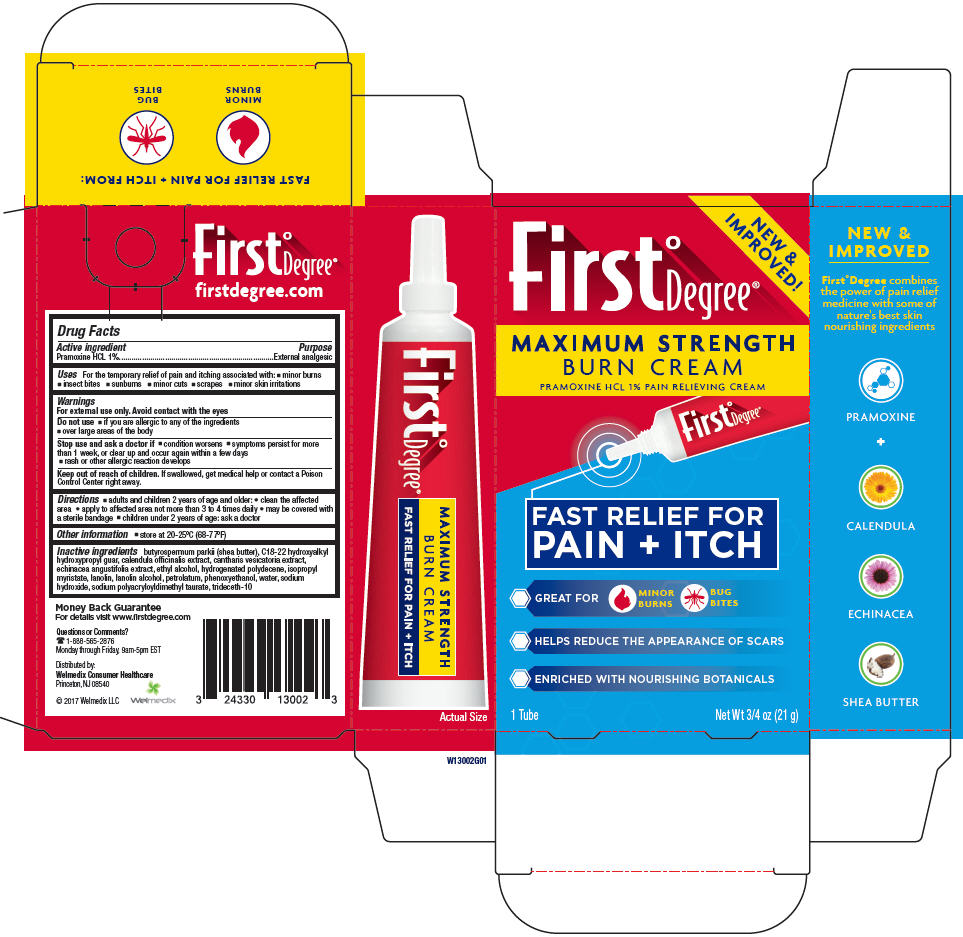
First Degree Maximum Strength Burn Pramoxine Hydrochloride 10 mg/g Cream — NDC 24330-130-02 (Billing 24330-0130-02)
This is a package of First Degree Maximum Strength Burn Pramoxine Hydrochloride 10 mg/g Cream from Welmedix LLC, marketed since Mar 2017 and currently FDA-listed. It is this product's only package size.
NDC database record
One package, one record: these facts belong to NDC 24330-130-02 alone.
- Record
- FDA NDC Directory package listing · Human OTC drug
- Code segments
- 24330 labeler · 130 product · 02 package
- Package marketed since
- Mar 9, 2017
- Sample package
- No — commercial package
- Listing certified through
- Dec 31, 2026
- Barcode (UPC-A, from the NDC)
- 3 2433013002 3
- FDA record last changed
- Jul 24, 2026
Identity & classification
Regulatory identifiers FDA, NLM and CMS codes for this package
- RxCUI (RxNorm): 1052684
Where does this data come from?
- FDA openFDA NDC Directory · synced Oct 1, 2026
- FDA label on DailyMed · label index refreshed Oct 3, 2026
- RxNorm (NLM RxNav) · catalog refreshed Oct 1, 2026
- Medi-Span GPI (licensed)
- First Databank (licensed) · refreshed Oct 1, 2026
RxNorm drug class
This medicine belongs to the Local anesthetics class.
Where does this data come from?
- RxClass (NLM) · catalog refreshed Oct 1, 2026
Clinical
Pramoxine is used to temporarily relieve pain and itching from insect bites; poison ivy, poison oak, or poison sumac; minor cuts, scrapes, or burns; minor skin irritation or rashes; or dry, itchy skin. Pramoxine also may be used to treat soreness, burning, itching, and pain from hemorrhoids (''piles'') and other minor rectal irritations or itching. Pramoxine is in a class of medications called topical anesthetics. It works by stopping nerves from sending pain signals.
Read the full MedlinePlus article ↗- It gives short-term relief from pain and itching from minor problems like sunburn, minor burns, insect bites, and poison ivy rashes. Some products are made for specific uses, like...
- That depends on the product. Many say not more than 3 to 4 times daily, and some allow up to 5 times daily. Check your label and follow it closely.
- No. It is for external use only. If it gets in your eyes, rinse thoroughly with water.
- Can I use it inside the vagina or near my eyes?
Patient education
Supplement & herbal interactions
Where does this data come from?
- MedlinePlus (NLM) · refreshed Oct 1, 2026
- FDA label on DailyMed · label index refreshed Oct 3, 2026
Ask a licensed pharmacist directly — free, answered by our team.
Pricing
A drug doesn't have one price. Each row is a different public payment system, and none is what you'd pay at the counter — that depends on your insurance. The ⓘ on each row explains what it measures.
| Price system | Per g | Per package |
|---|---|---|
| Retail pharmacies payNADAC · weekly | Not in the retail survey — common for institutional, discontinued, or low-volume packs. | |
| Medicaid paysCMS SDUD · 12 mo | No recent Medicaid claims on file for this NDC — rare and low-volume NDCs are suppressed in the public data. | |
| Medicare drug plans payPart D · quarterly | No Part D plan price is available for this NDC in our data. | |
Where does this data come from?
- CMS NADAC weekly file
- CMS ASP pricing files · refreshed Sep 20, 2026
- CMS Medicaid State Drug Utilization Data · refreshed Oct 4, 2026
- CMS Part D plan pricing files · refreshed Sep 24, 2026
- VA National Acquisition Center price file
Packaging — all sizes for this product
| Package NDC | Description | Marketing start | Marketing end | Status |
|---|---|---|---|---|
| 24330-0130-02 You're viewing this Main listing | 1 TUBE in 1 BOX / 21 g in 1 TUBE | 2017-03-09 | — | Active |
Therapeutic equivalents
| Product | Labeler | Pack | NADAC/unit | TE | Status | Price vs. this |
|---|---|---|---|---|---|---|
| First Degree Maximum Strength Burn 10 mg/gthis 24330-0130-02 | Welmedix | 1 tube | — | — | FDA listed | — |
| CeraVe Developed with Dermatologists Itch Relief Moisturizing 10 mg/g 49967-0512-01 | L'Oreal | 340 g | — | — | FDA listed | — |
| Pramoxine Itch relief 1 g/100g 51316-0141-12 | CVS | 340 g | — | — | FDA listed | — |
| CeraVe Developed with Dermatologists Itch Relief Moisturizing 10 mg/g 82046-0620-01 | L'Oreal | 340 g | — | — | FDA listed | — |
| Numbing cream 1 g/100g 85284-0008-01 | BLOOMWELL | 50 g | — | — | Discontinued | — |
| VAGISIL Anti-Itch Medicated Wipes Maximum Strength 10 mg/g 11509-5035-01 | Combe | 12 packets | — | — | FDA listed | — |
| VAGISIL Anti-Itch Medicated Wipes Maximum Strength 10 mg/g 11509-5058-01 | Combe | 20 packets | — | — | FDA listed | — |
Where does this data come from?
- FDA openFDA NDC Directory · synced Oct 1, 2026
- FDA Orange Book · refreshed Oct 3, 2026
- CMS NADAC weekly file
Availability & generic status
We did not find an FDA-approved generic match for this exact strength, form and route.
Where does this data come from?
- FDA Orange Book · refreshed Oct 3, 2026
What it looks like
Where does this data come from?
- FDA label on DailyMed · label index refreshed Oct 3, 2026
Inactive Ingredients / Excipients
Inactive ingredients, also called excipients, are components of the drug product other than the active ingredient. They may include fillers, dyes, coatings, preservatives, flavors, or other formulation ingredients.
💡 Tap an ingredient (hover on desktop) to see what it is and why it’s used.
-
UNII 3K9958V90M
A liquid solvent derived from fermentation or chemical synthesis. In medicines, alcohol dissolves active ingredients, helps preserve the product, and improves how the body absorbs certain drugs.
-
UNII 18E7415PXQ
A plant extract from calendula flowers used in topical formulations. It functions as a soothing botanical ingredient and may help support the product's skin-conditioning properties.
-
UNII VB06AV5US8
Echinacea angustifolia is a plant extract used as a natural flavoring or coloring agent in some medicines. It may also help preserve the product's stability or serve as a filler ingredient.
-
UNII E89I1637KE
Guar gum is a natural thickener made from guar bean seeds. It's used in medicines as a binder and thickening agent to hold ingredients together and create the right texture and consistency.
-
UNII U333RI6EB7
Hydrogenated polydecene type I is a synthetic oil derived from plant-based polymers. It acts as a lubricant and glidant to help powder ingredients flow smoothly during tablet or capsule manufacturing.
-
UNII 0RE8K4LNJS
Isopropyl myristate is an oily liquid made from coconut or palm oil. It's used in medicines as an emollient and penetration enhancer to help the medicine absorb through skin or improve spreadability in topical products.
-
UNII 7EV65EAW6H
Lanolin is a waxy substance derived from sheep's wool. It's used in medicines as an emollient and skin-conditioning agent to soften formulations and improve spreadability in topical products like creams and ointments.
-
UNII 884C3FA9HE
Lanolin alcohol is a waxy substance derived from sheep's wool. It functions as an emollient and emulsifier in medicines, helping blend oil and water-based ingredients while softening the product's texture.
-
UNII 3Q034RO3BT
Lytta vesicatoria is a beetle species whose dried body has historically been used in traditional medicine. In pharmaceutical formulations, it may serve as an active natural ingredient source rather than a typical inactive excipient, though its exact role depends on the specific product formulation.
-
UNII 4T6H12BN9U
Petrolatum is a purified mineral oil-based jelly derived from petroleum. In medicines, it acts as an emollient, lubricant, and moisture barrier to soften skin, reduce friction, and help prevent water loss from formulations.
-
UNII HIE492ZZ3T
Phenoxyethanol is a synthetic preservative and antimicrobial agent used to prevent bacterial and fungal growth in medicines and cosmetic products, extending shelf life and maintaining product safety.
-
UNII K49155WL9Y
Shea butter is a fat extracted from shea tree nuts. It's used in medicines as an emollient and lubricant to soften the product, improve texture, and help ingredients blend smoothly together.
-
UNII 55X04QC32I
A strong alkaline chemical used to adjust and maintain the pH balance of liquid medicines. It helps keep the medicine stable and ensures it stays effective during storage.
-
UNII Y7LJA74T0N
A salt derived from the amino acid taurine. It serves as a buffer and pH regulator in medications, helping maintain stability and prevent degradation of active ingredients.
-
UNII G624N6MSBA
A synthetic surfactant derived from coconut oil. It helps dissolve and distribute other ingredients evenly throughout the medicine, acting as an emulsifier and solubilizer in liquid formulations.
-
UNII 059QF0KO0R
Water is a liquid solvent that dissolves and mixes ingredients together in liquid medicines, syrups, and injections. It helps distribute the active drug evenly throughout the product.
16 inactive ingredients listed in the exact product block matched to this NDC.
Label-section wording can be broader than the structured product block and may mention additional formulation ingredients.
Where does this data come from?
ingredient classCode="IACT" elements from the exact product block matched by this NDC. Label-section narrative from DailyMed / the openFDA label index is shown separately when available.- FDA label on DailyMed · label index refreshed Oct 3, 2026
- FDA openFDA NDC Directory · synced Oct 1, 2026
Inactive ingredient FAQ
Are inactive ingredients the same for every manufacturer?
Why might an inactive ingredient be missing?
Can inactive ingredients matter?
Manufacturer & labeler
More NDCs from Welmedix LLC labeler code 24330
- First Degree Calendula Officinalis, Echinacea Angustifolia, Cantharis Vesicatoria 1 [hp_Q]/.1g; 1 [hp_Q]/.1g; 3 [hp_X]/.1g Tincture NDC 24330-110-14
- SunBurnt Advanced After-Sun Calendula Officinalis, Echinacea Angustifolia, Cantharis Vesicatoria 1 [hp_Q]/.1g; 1 [hp_Q]/.1g; 3 [hp_X]/.1g Gel NDC 24330-210-03
- SunBurnt PLUS Pain Relief Lidocaine Hydrochloride 1 g/100g Gel NDC 24330-240-01
- Welmedix HomeCare PRO Extra Strength Rapid Rash Relief Petrolatum, Zinc Oxide 49 g/100g; 15 g/100g Cream NDC 24330-410-07
- Welmedix HomeCare PRO Fragile Skin Protectant Petrolatum 42 g/100g Ointment NDC 24330-412-03
- Welmedix HomeCare PRO Fragile Skin Protectant Petrolatum 42 g/100g Ointment NDC 24330-413-12
- Welmedix HomeCare PRO Rapid Relief Rash Cream Petrolatum, Zinc Oxide 49 g/100g; 15 g/100g Cream NDC 24330-414-12
Where does this data come from?
- FDA openFDA NDC Directory · synced Oct 1, 2026
- Drugs@FDA
FDA label — Drug Facts FDA SPL
🎯 Indications and Usage ▾
Uses For the temporary relief of pain and itching associated with: minor burns insect bites sunburns minor cuts scrapes minor skin irritations
⏱️ Dosage and Administration ▾
Directions adults and children 2 years of age and older: clean the affected area apply to affected area not more than 3 to 4 times daily may be covered with a sterile bandage children under 2 years of age: ask a doctor
⚠️ Warnings ▾
Warnings For external use only. Avoid contact with the eyes Do not use if you are allergic to any of the ingredients over large areas of the body Stop use and ask a doctor if condition worsens symptoms persist for more than 1 week, or clear up and occur again within a few days rash or other allergic reaction develops Keep out of reach of children. If swallowed, get medical help or contact a Poison Control Center right away.
📦 Storage and Handling ▾
Other information store at 20-25°C (68-77°F)
🧪 Active Ingredient ▾
Active ingredient Pramoxine HCL 1%
🧪 Inactive Ingredients ▾
Inactive ingredients butyrospermum parkii (shea butter), C18-22 hydroxyalkyl hydroxypropyl guar, calendula officinalis extract, cantharis vesicatoria extract, echinacea angustifolia extract, ethyl alcohol, hydrogenated polydecene, isopropyl myristate, lanolin, lanolin alcohol, petrolatum, phenoxyethanol, water, sodium hydroxide, sodium polyacryloyldimethyl taurate, trideceth-10
🎯 Purpose ▾
Purpose External analgesic
📄 Do Not Use ▾
Do not use if you are allergic to any of the ingredients over large areas of the body
📄 Stop Use and Ask a Doctor If ▾
Stop use and ask a doctor if condition worsens symptoms persist for more than 1 week, or clear up and occur again within a few days rash or other allergic reaction develops
📄 Keep Out of Reach of Children ▾
Keep out of reach of children. If swallowed, get medical help or contact a Poison Control Center right away.
📄 Questions or Comments ▾
Questions or Comments? 1-888-565-2876 Monday through Friday, 9am-5pm EST
📄 Package Label / Principal Display Panel ▾
PRINCIPAL DISPLAY PANEL - 21 g Tube Box NEW & IMPROVED! First° Degree ® MAXIMUM STRENGTH BURN CREAM PRAMOXINE HCL 1% PAIN RELIEVING CREAM FAST RELIEF FOR PAIN + ITCH GREAT FOR MINOR BURNS BUG BITES HELPS REDUCE THE APPEARANCE OF SCARS ENRICHED WITH NOURISHING BOTANICALS 1 Tube Net Wt 3/4 oz (21 g) Principal Display Panel - 21 g Tube Box
About this NDC listing & data coverage
What data is (and isn’t) available for this NDC — tap to expand
| NDC identity (package / product / labeler codes) | ✓ Available |
| Labeler | ✓ Available |
| Product & package description | ✓ Available |
| Marketing category & status | ✓ Available |
| Active ingredient / dosage form / route | ✓ Available |
| FDA label (SPL via DailyMed) | ✓ Available |
| Package photos | ✓ Available |
| Inactive ingredients (structured) | ✓ Available |
| NADAC pharmacy acquisition price (CMS) | — Not published for this NDC CMS publishes NADAC only for NDCs reported in its retail-pharmacy survey. |
| Orange Book / therapeutic-equivalence data | — Not published for this NDC Applies only to products approved under an NDA/ANDA; many listings are out of scope. |
| HCPCS J-code billing crosswalk | — Not published for this NDC Most self-administered / retail products have no J-code — that is normal. |
| Medicaid utilization (CMS SDUD) | — Not published for this NDC CMS reports utilization only for NDCs with Medicaid claims above its privacy threshold. |