
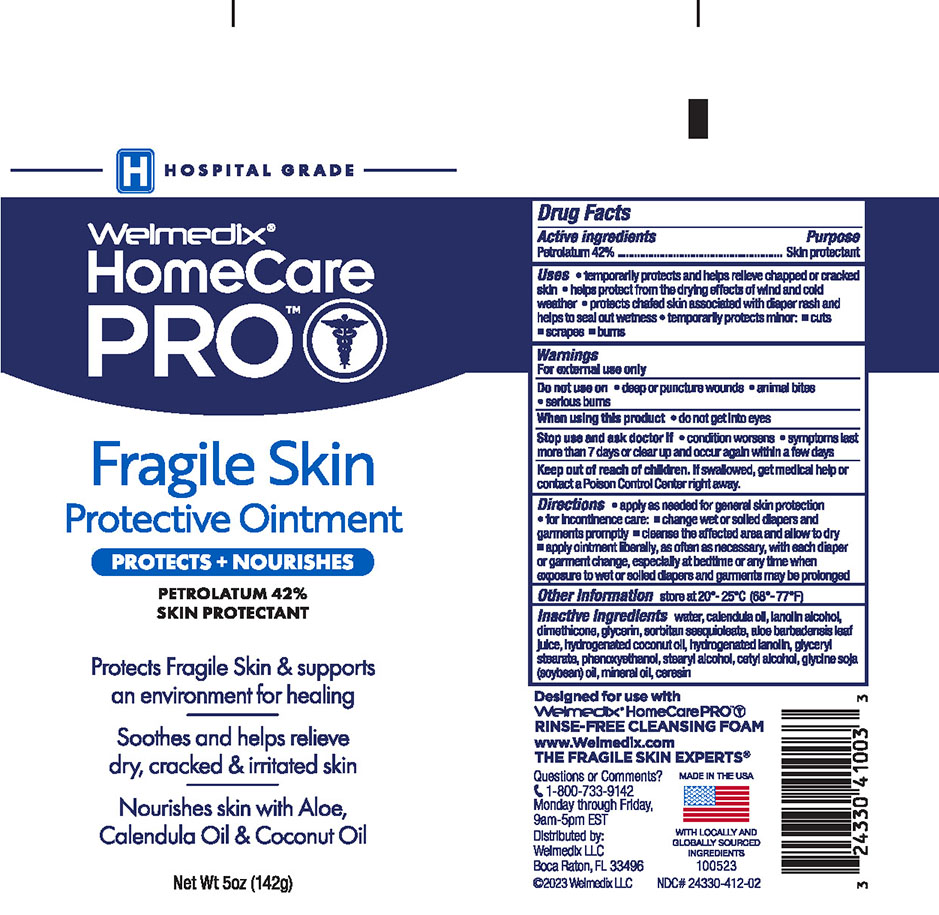
Welmedix HomeCare PRO Fragile Skin Protectant Petrolatum 42 g/100g Ointment, 142 g
🆔 Identity & classification
Where does this data come from?
🏭 Manufacturer & labeler
Where does this data come from?
🩺 Clinical
Welmedix HomeCare PRO Fragile Skin Protectant is a topical ointment containing petrolatum, an over-the-counter skin care product marketed under FDA's OTC monograph rules. Petrolatum is commonly used as an occlusive moisturizer and skin protectant, functioning to help seal moisture into the skin and protect against minor irritation. This ointment form is typically applied directly to affected skin areas and is often used for dry, sensitive, or fragile skin.
Patient education
Supplement & herbal interactions
Some supplements/herbs that may interact with Petrolatum — tap one for details:
Where does this data come from?
Ask a licensed pharmacist directly — free, answered by our team.
🧪 Inactive Ingredients / Excipients
Inactive ingredients, also called excipients, are components of the drug product other than the active ingredient. They may include fillers, dyes, coatings, preservatives, flavors, or other formulation ingredients.
💡 Tap an ingredient (hover on desktop) to see what it is and why it’s used.
-
UNII ZY81Z83H0X
Aloe vera leaf is a plant extract derived from the aloe plant. It is used in medicines as a natural moisturizer and skin-soothing agent in topical formulations.
-
UNII P0M7O4Y7YD
A plant extract from calendula flowers, traditionally used in formulations. It typically serves as a botanical ingredient that may provide color, fragrance, or skin-conditioning properties to topical products.
-
UNII Q1LS2UJO3A
Ceresin is a purified mineral wax derived from ozocerite. It functions as a binding agent, thickener, and coating material in medicines to help hold ingredients together and provide texture or protective coating.
-
UNII 936JST6JCN
Cetyl alcohol is a waxy, fatty substance derived from plant or animal sources. It acts as an emulsifier and thickener in medicines, helping blend oil and water components and giving products a smooth, creamy texture.
-
UNII 92RU3N3Y1O
Dimethicone is a silicone-based oil that acts as an anti-foaming agent and lubricant in medicines. It reduces gas bubbles in liquid formulations and helps coat and protect the stomach lining when ingested.
-
UNII PDC6A3C0OX
Glycerin is a clear, thick liquid derived from plant oils or fats. It acts as a humectant to retain moisture, a sweetener, and a solvent in medications.
-
UNII 230OU9XXE4
A waxy substance made from glycerin and stearic acid that acts as an emulsifier to blend oily and watery ingredients together. It also helps thicken and stabilize the medicine's texture.
-
UNII JY81OXM1OM
A plant-based oil from coconut that has been chemically treated to solidify it. It acts as a binder and filler to help hold tablet ingredients together and give the pill its shape and firmness.
-
UNII 7EV65EAW6H
Lanolin is a waxy substance derived from sheep's wool. It's used in medicines as an emollient and skin-conditioning agent to soften formulations and improve spreadability in topical products like creams and ointments.
-
UNII 884C3FA9HE
Lanolin alcohol is a waxy substance derived from sheep's wool. It functions as an emollient and emulsifier in medicines, helping blend oil and water-based ingredients while softening the product's texture.
-
UNII T5L8T28FGP
Mineral oil is a clear, odorless liquid derived from crude oil. It acts as a lubricant and emollient in medications, helping pills slide smoothly during manufacturing and aiding moisture retention in topical products.
-
UNII HIE492ZZ3T
Phenoxyethanol is a synthetic preservative and antimicrobial agent used to prevent bacterial and fungal growth in medicines and cosmetic products, extending shelf life and maintaining product safety.
-
UNII 0W8RRI5W5A
A fatty acid derivative used as an emulsifier and surfactant in medications. It helps blend oily and water-based ingredients together to create a stable, uniform product.
-
UNII PL360EPO9J
Soy sterol is a plant-derived fat extracted from soybeans. It's used as an emulsifier and stabilizer to help keep oil and water mixed together and maintain the medicine's texture and consistency.
-
UNII 2KR89I4H1Y
Stearyl alcohol is a waxy, fatty substance derived from natural oils or made synthetically. It acts as an emulsifier and thickener in medicines, helping mix ingredients together and give the product the right texture.
-
UNII 059QF0KO0R
Water is a liquid solvent that dissolves and mixes ingredients together in liquid medicines, syrups, and injections. It helps distribute the active drug evenly throughout the product.
16 inactive ingredients listed in the exact product block matched to this NDC.
Label-section wording can be broader than the structured product block and may mention additional formulation ingredients.
Where does this data come from?
ingredient classCode="IACT" elements from the exact product block matched by this NDC. Label-section narrative from DailyMed / the openFDA label index is shown separately when available.Inactive ingredient FAQ
Are inactive ingredients the same for every manufacturer?
Why might an inactive ingredient be missing?
Can inactive ingredients matter?
💲 Pricing
A drug doesn't have one price. Each row is a different public payment system, and none is what you'd pay at the counter — that depends on your insurance. The ⓘ on each row explains what it measures.
| Price system | Per g | Per package |
|---|---|---|
| Retail pharmacies payNADAC · weekly | Not in the retail survey — common for institutional, discontinued, or low-volume packs. | |
| Medicaid paysCMS SDUD · 12 mo | No recent Medicaid claims on file for this NDC — rare and low-volume NDCs are suppressed in the public data. | |
| Medicare drug plans payPart D · quarterly | No Part D plan price is available for this NDC in our data. | |
Where does this data come from?
🔁 Therapeutic equivalents
| Product | Labeler | Pack | NADAC/unit | TE | Status | Price vs. this |
|---|---|---|---|---|---|---|
| Rugby Petrolatum Hydrating Skin Protectant 420 mg/g 00536-1143-97 | Rugby | 100 g | $0.050 | — | Availability likely | — |
| Welmedix HomeCare PRO Fragile Skin Protectant 42 g/100gthis 24330-0412-03 | Welmedix | 142 g | — | — | FDA listed | — |
| Welmedix HomeCare PRO Fragile Skin Protectant 42 g/100g 24330-0413-12 | Welmedix | 340 g | — | — | FDA listed | — |
| Hydrophor 42 g/100g 71399-5101-01 | Akron | 454 g | — | — | FDA listed | — |
Where does this data come from?
⏳ Availability & generic status
We did not find an FDA-approved generic match for this exact strength, form and route.
Where does this data come from?
🔬 Reported adverse events (FAERS)
Top reported reactions
Age at onset
Reporter sex
Serious outcomes
Where does this data come from?
📦 Packaging — all sizes for this product
| Package NDC | Description | Marketing start | Status |
|---|---|---|---|
| 24330-0412-03 You're viewing this | 142 g in 1 TUBE (24330-412-03) | 2013-04-01 | Active |
🧭 About this NDC listing & data coverage
What data is (and isn’t) available for this NDC — tap to expand
| NDC identity (package / product / labeler codes) | ✓ Available |
| Labeler | ✓ Available |
| Product & package description | ✓ Available |
| Marketing category & status | ✓ Available |
| Active ingredient / dosage form / route | ✓ Available |
| FDA label (SPL via DailyMed) | ✓ Available |
| Package photos | ✓ Available |
| Inactive ingredients (structured) | ✓ Available |
| NADAC pharmacy acquisition price (CMS) | — Not published for this NDC CMS publishes NADAC only for NDCs reported in its retail-pharmacy survey. |
| Orange Book / therapeutic-equivalence data | — Not published for this NDC Applies only to products approved under an NDA/ANDA; many listings are out of scope. |
| HCPCS J-code billing crosswalk | — Not published for this NDC Most self-administered / retail products have no J-code — that is normal. |
| Medicaid utilization (CMS SDUD) | — Not published for this NDC CMS reports utilization only for NDCs with Medicaid claims above its privacy threshold. |
Questions about this listing
Is this NDC FDA-approved?
Why is there no price listed?
Is the NDC printed on the package the same as the 11-digit billing NDC?
What do the three segments of this NDC mean?
Is this package still being marketed?
Who lists this product with the FDA?
Do I need a prescription for this product?
Where does this data come from?
📄 FDA label — Drug Facts FDA SPL
🎯 Indications and Usage ▾
Uses • temporarily protects and helps relieve chapped or cracked skin • helps protect from the drying effects of wind and cold weather • helps treat and prevent diaper rash • protects chafed skin associated with diaper rash and helps protect from wetness • temporarily protects: • minor cuts • scrapes • burns
⏱️ Dosage and Administration ▾
Directions: For general skin protection: apply as needed. For incontinence care: change wet and soiled diapers and garments promptly. • Cleanse the affected area and allow to dry. • Apply ointment liberally, as often as necessary, especially at bedtime or any time when exposure to wet, moist or soiled garments may be prolonged.
⚠️ Warnings ▾
Warnings For external use only
🧪 Active Ingredient ▾
Active ingredients Petrolatum 42%
🧪 Inactive Ingredients ▾
Inactive ingredients water, calendula oil, lanolin alcohol, dimethicone, glycerin, sorbitan sesquioleatem, aloe barbadensis leaf juice, hydrogenated coconut oil, hydrogenated lanolin, glyceryl stearate, phenoxyethanol, stearyl alcohol, cetyl alcohol, glycine soja (soybean) oil, mineral oil, ceresin
🎯 Purpose ▾
Purpose Skin Protectant