
Silodosin 8 mg Capsule, 30-count — NDC 27241-145-01 (Billing 27241-0145-01)
This is a package of 30 capsules of Silodosin 8 mg Capsule from Ajanta Pharma USA Inc., marketed since Dec 2018 and currently FDA-listed; retail pharmacies pay about $0.3187 per capsule (NADAC). It is the main listing for this product, which comes in 2 package sizes.
Other active recalls for Silodosin (different manufacturers) — 1 · tap to view
Identity & classification
Regulatory identifiers FDA, NLM and CMS codes for this package
Drug-database identifiers Medi-Span GPI and First Databank GCN / HICL / AHFS classification
- GSN (GCN sequence number): 064847
- GCN: 16858
- GPI-14 (Medi-Span): 56852060000140
- HICL (First Databank): 036119
- AHFS class code: 12:16.04.12
- RxCUI (RxNorm): 809477
Where does this data come from?
- FDA openFDA NDC Directory · synced Oct 1, 2026
- FDA label on DailyMed · label index refreshed Oct 1, 2026
- RxNorm (NLM RxNav) · catalog refreshed Oct 1, 2026
- Medi-Span GPI (licensed)
- First Databank (licensed) · refreshed Oct 1, 2026
RxNorm drug class
This medicine belongs to the alpha-Adrenergic Blocker class.
Where does this data come from?
- RxClass (NLM) · catalog refreshed Oct 1, 2026
Clinical
- It treats the symptoms of an enlarged prostate (BPH), such as poor urine flow. It relaxes muscle in the prostate and bladder area. It is not a blood pressure medicine.
- Take one capsule once a day with a meal. If swallowing is hard, you can sprinkle the powder from an opened capsule on a spoonful of applesauce, swallow it right away, and follow wi...
- The most common is retrograde ejaculation, where semen goes backward, which goes away after stopping. Dizziness, diarrhea, headache and a stuffy nose can also happen. Stand up slow...
- Call if you faint, feel very dizzy, have swelling of the tongue or throat, a serious rash, or yellowing of your skin or eyes. Get help right away for an erection that will not go a...
Patient education
Supplement & herbal interactions
Some supplements/herbs that may interact with Silodosin — tap one for details:
Where does this data come from?
- MedlinePlus (NLM) · refreshed Oct 1, 2026
- FDA label on DailyMed · label index refreshed Oct 1, 2026
Ask a licensed pharmacist directly — free, answered by our team.
Pricing
A drug doesn't have one price. Each row is a different public payment system, and none is what you'd pay at the counter — that depends on your insurance. The ⓘ on each row explains what it measures.
| Price system | Per ea | Per package |
|---|---|---|
| Retail pharmacies payNADAC · weekly | $0.319 | $9.56 / 30 capsules |
| Medicaid paysCMS SDUD · 12 mo | $0.6926 | $20.78 / 30 capsules |
| Medicare drug plans payPart D · Q2 2026 | $0.7600 | $22.80 / 30 capsules |
Where does this data come from?
- CMS NADAC weekly file · file of Sep 30, 2026
- CMS ASP pricing files · refreshed Sep 20, 2026
- CMS Medicaid State Drug Utilization Data · through Q4 2025
- CMS Part D plan pricing files · refreshed Sep 24, 2026
- VA National Acquisition Center price file
Packaging — all sizes for this product
| Package NDC | Description | Per unit | Per pack | Marketing start | Marketing end | Status |
|---|---|---|---|---|---|---|
| 27241-0145-01 You're viewing this Main listing | 30 CAPSULE in 1 BOTTLE | $0.3187 / ea | $9.56 | 2018-12-03 | — | Active |
| 27241-0145-03 27241-145-03 | 90 CAPSULE in 1 BOTTLE | $0.3187 / ea | $28.68 | 2018-12-03 | — | Active |
You're viewing the smallest of 2 pack sizes for this product.
This pack has the lowest per-ea cost of the 2 priced pack sizes ($0.3187 NADAC).
In Medicaid, this is the most-dispensed pack of this product — about 56% of fills over the last four reported quarters. See all packs ↓
Pack size FAQ
What quantity is in this package?
How does this package differ from NDC 27241-0145-03?
What NDC number is used to bill for this package of Silodosin 8 mg Capsule?
Prices are the latest CMS NADAC pharmacy acquisition cost per NDC; per-pack figures are per-unit × pack quantity, shown only when the pack is denominated in the same measure NADAC prices.
Therapeutic equivalents
| Product | Labeler | Pack | NADAC/unit | TE | Status | Price vs. this |
|---|---|---|---|---|---|---|
| Silodosin 8 mgthis 27241-0145-01 | Ajanta | 30 capsules | $0.319 | AB | Availability likely | — |
| Silodosin 8 mg 31722-0636-30 | Camber | 30 capsules | $0.319 | AB | Availability likely | — |
| Silodosin 8 mg 33342-0385-07 | Macleods | 30 capsules | $0.319 | AB | Availability likely | — |
| Silodosin 8 mg 59651-0096-30 | Aurobindo | 30 capsules | $0.319 | AB | Availability likely | — |
| Silodosin 8 mg 69238-1420-03 | Amneal | 30 capsules | $0.319 | AB | Availability likely | — |
| Silodosin 8 mg 72205-0010-30 | Novadoz | 30 capsules | $0.319 | AB | Availability likely | — |
| Silodosin 8 mg 42291-0778-90 | AvKARE | 90 capsules | — | AB | FDA listed | — |
| Silodosin 8 mg 46708-0406-30 | Alembic | 30 capsules | — | — | FDA listed | — |
| Silodosin 8 mg 60219-1420-03 | Amneal | 30 capsules | — | AB | FDA listed | — |
| Silodosin 8 mg 62332-0406-30 | Alembic | 30 capsules | — | — | FDA listed | — |
| Silodosin 8 mg 68180-0741-02 | Lupin | 500 capsules | — | AB | FDA listed | — |
| Silodosin 8 mg 71335-3128-01 | Bryant | 30 capsules | — | AB | FDA listed | — |
| Silodosin 8 mg 72162-2447-03 | Bryant | 30 capsules | — | AB | FDA listed | — |
| Silodosin 8 mg 72789-0090-30 | PD-Rx | 30 capsules | — | AB | FDA listed | — |
| Silodosin 8 mg 82619-0114-01 | Creekwood | 30 capsules | — | AB | FDA listed | — |
Where does this data come from?
- FDA openFDA NDC Directory · synced Oct 1, 2026
- FDA Orange Book · refreshed Sep 3, 2026
- CMS NADAC weekly file · file of Sep 30, 2026
Availability & generic status
This product is an FDA-approved generic. Other versions of the same drug are listed under Therapeutic equivalents, least expensive first.
Where does this data come from?
- FDA Orange Book · refreshed Sep 3, 2026
What it looks like
Where does this data come from?
- FDA label on DailyMed · label index refreshed Oct 1, 2026
Inactive Ingredients / Excipients
Inactive ingredients, also called excipients, are components of the drug product other than the active ingredient. They may include fillers, dyes, coatings, preservatives, flavors, or other formulation ingredients.
Where does this data come from?
IACT rows and label-wide narrative are kept separate; availability and product-level specificity depend on the submitted label.- FDA label on DailyMed · label index refreshed Oct 1, 2026
- FDA openFDA NDC Directory · synced Oct 1, 2026
Inactive ingredient FAQ
Are inactive ingredients the same for every manufacturer?
Why might an inactive ingredient be missing?
Can inactive ingredients matter?
Manufacturer & labeler
Where does this data come from?
- FDA openFDA NDC Directory · synced Oct 1, 2026
- Drugs@FDA
Full prescribing information FDA SPL
🎯 Indications and Usage ▾
1 INDICATIONS AND USAGE Silodosin capsules, a selective alpha-1 adrenergic receptor antagonist, is indicated for the treatment of the signs and symptoms of benign prostatic hyperplasia (BPH) [see Clinical Studies ( 14 )]. Silodosin capsules are not indicated for the treatment of hypertension. Silodosin capsules, an alpha-1 adrenergic receptor antagonist, is indicated for the treatment of the signs and symptoms of benign prostatic hyperplasia (BPH).
Silodosin is not indicated for the treatment of hypertension. ( 1 )
⏱️ Dosage and Administration ▾
2 DOSAGE AND ADMINISTRATION 8 mg capsules taken orally once daily with a meal. ( 2.1 ) 4 mg capsules taken orally once daily with a meal for those with moderate renal impairment [Creatinine Clearance (CCr) 30 mL/min -50 mL/min]. (2.2 )
2.1Dosing Information The recommended dose is 8 mg orally once daily with a meal. Patients who have difficulty swallowing pills and capsules may carefully open the silodosin capsule and sprinkle the powder inside on a tablespoonful of applesauce. The applesauce should be swallowed immediately (within 5 minutes) without chewing and followed with an 8 oz glass of cool water to ensure complete swallowing of the powder.
The applesauce used should not be hot, and it should be soft enough to be swallowed without chewing. Any powder/applesauce mixture should be used immediately (within 5 minutes) and not stored for future use. Subdividing the contents of a silodosin capsule is not recommended [see Clinical Pharmacology ( 12.3 )].
2.2Dosage Adjustment in Special Populations Renal impairment: Silodosin capsules are contraindicated in patients with severe renal impairment (CCr less than 30 mL/min). In patients with moderate renal impairment (CCr 30 mL/min -50 mL/min), the dose should be reduced to 4 mg once daily taken with a meal. No dosage adjustment is needed in patients with mild renal impairment (CCr 50 mL/min - 80 mL/min) [see Contraindications ( 4 ), Warnings and Precautions ( 5.2 ), Use in Specific Populations ( 8.6 ), and Clinical Pharmacology ( 12.3 )].
Hepatic impairment: Silodosin capsules has not been studied in patients with severe hepatic impairment (Child-Pugh score greater than or equal to 10) and is therefore contraindicated in these patients. No dosage adjustment is needed in patients with mild or moderate hepatic impairment [see Contraindications ( 4 ), Warnings and Precautions ( 5.3 ), Use in Specific Populations ( 8.7 ), and Clinical Pharmacology ( 12.3 )].
💊 Dosage Forms and Strengths ▾
3 DOSAGE FORMS AND STRENGTHS The 8 mg capsules are blue/white, opaque, hard #1 gelatin capsules imprinted with “ap” logo on the cap and “SLN 8” on the body in black ink containing white to off-white colored powder. The 4 mg capsules are white, opaque, hard #3 gelatin capsules imprinted with “ap” logo on the cap and “SLN 4” on the body in black ink containing white to off-white colored powder. Capsules: 8 mg and 4 mg. ( 3 )
⛔ Contraindications ▾
4 CONTRAINDICATIONS Severe renal impairment (CCr less than 30 mL/min) Severe hepatic impairment (Child-Pugh score greater than or equal to 10) Concomitant administration with strong Cytochrome P450 3A4 (CYP3A4) inhibitors (e.g., ketoconazole, clarithromycin, itraconazole, ritonavir) [see Drug Interactions ( 7.1 )] Patients with a history of hypersensitivity to silodosin or any of the ingredients of silodosin capsules [see Adverse Reactions ( 6.2 ) and Description ( 11 )] Patients with severe renal impairment [Creatinine Clearance (CCr less than 30 mL/min)].
( 4 ) Patients with severe hepatic impairment (Child-Pugh score greater than 10). ( 4 ) Concomitant administration with strong Cytochrome P450 3A4 (CYP3A4) inhibitors (e.g., ketoconazole, clarithromycin, itraconazole, ritonavir). ( 4 ) Patients with a history of hypersensitivity to silodosin or any of the ingredients of silodosin capsules.
( 4 )
⚠️ Warnings and Cautions ▾
5 WARNINGS AND PRECAUTIONS Postural hypotension, with or without symptoms (e.g., dizziness), may develop when beginning silodosin capsules treatment. ( 5.1 ) In patients with moderate renal impairment, silodosin capsules dose should be reduced to 4 mg once daily. ( 5.2 ) Silodosin capsules should not be used in combination with other alpha-blockers.
( 5.5 ) Examine patients thought to have BPH prior to starting therapy with silodosin capsules to rule out the presence of carcinoma of the prostate. ( 5.6 ) Inform patients planning cataract surgery to notify their ophthalmologist that they are taking silodosin capsules because of the possibility of Intraoperative Floppy Iris Syndrome (IFIS). ( 5.7 )
5.1Orthostatic Effects Postural hypotension, with or without symptoms (e.g., dizziness) may develop when beginning silodosin capsules treatment. As with other alpha-blockers, there is potential for syncope. Patients should be cautioned about driving, operating machinery, or performing hazardous tasks when initiating therapy [see Adverse Reactions ( 6 ), Use in Specific Populations ( 8.5 ), Clinical Pharmacology ( 12.2 ), and Patient Counseling Information ( 17 )].
5.2Renal Impairment In a clinical pharmacology study, plasma concentrations (AUC and C max ) of silodosin were approximately three times higher in subjects with moderate renal impairment compared with subjects with normal renal function, while half-lives of silodosin doubled in duration. The dose of silodosin capsules should be reduced to 4 mg in patients with moderate renal impairment. Exercise caution and monitor such patients for adverse events [see Use in Specific Populations ( 8.6 ) and Clinical Pharmacology ( 12.3 )].
Silodosin capsules are contraindicated in patients with severe renal impairment [see Contraindications ( 4 )].
5.3Hepatic Impairment Silodosin capsules have not been tested in patients with severe hepatic impairment, and therefore, should not be prescribed to such patients [see Contraindications ( 4 ), Use in Specific Populations ( 8.7 ) and Clinical Pharmacology ( 12.3 )].
5.4Pharmacokinetic Drug-Drug Interactions In a drug interaction study, co-administration of a single 8 mg dose of silodosin capsules with 400 mg ketoconazole, a strong CYP3A4 inhibitor, caused a 3.8-fold increase in maximum plasma silodosin concentrations and 3.2-fold increase in silodosin exposure (i.e., AUC). Concomitant use of ketoconazole or other strong CYP3A4 inhibitors (e.g., itraconazole, clarithromycin, ritonavir) is therefore contraindicated [see Drug Interactions ( 7.1 )].
5.5Pharmacodynamic Drug-Drug Interactions The pharmacodynamic interactions between silodosin and other alpha-blockers have not been determined. However, interactions may be expected, and silodosin capsules should not be used in combination with other alpha-blockers [see Drug Interactions ( 7.3 )]. A specific pharmacodynamic interaction study between silodosin and antihypertensive agents has not been performed.
However, patients in the Phase 3 clinical studies taking concomitant antihypertensive medications with silodosin capsules did not experience a significant increase in the incidence of syncope, dizziness, or orthostasis. Nevertheless, exercise caution during concomitant use with antihypertensives and monitor patients for possible adverse events [see Adverse Reactions ( 6.1 ) and Drug Interactions ( 7.6 )]. Caution is also advised when alpha-adrenergic blocking agents including silodosin capsules are coadministered with PDE5 inhibitors.
Alpha-adrenergic blockers and PDE5 inhibitors are both vasodilators that can lower blood pressure. Concomitant use of these two drug classes can potentially cause symptomatic hypotension [see Drug Interactions ( 7.5 )].
5.6Carcinoma of the Prostate Carcinoma of the prostate and BPH cause many of the same symptoms. These two diseases frequently co-exist. Therefore, patients thought to have BPH should be examined prior to starting therapy with silodosin capsules to… [Excerpted — this section continues on DailyMed.]
🤒 Adverse Reactions ▾
6 ADVERSE REACTIONS Most common adverse reactions (incidence greater than 2%) are retrograde ejaculation, dizziness, diarrhea, orthostatic hypotension, headache, nasopharyngitis, and nasal congestion. ( 6 ) To report SUSPECTED ADVERSE REACTIONS, contact Ajanta Pharma USA, Inc., at 1-855-664-7744 or FDA at 1-800-FDA-1088 or www.fda.gov/medwatch .
6.1Clinical Trials Experience Because clinical trials are conducted under widely varying conditions, adverse reaction rates observed in the clinical trials of a drug cannot be directly compared to rates in the clinical trials of another drug and may not reflect the rates observed in clinical practice. In U.S. clinical trials, 897 patients with BPH were exposed to 8 mg silodosin capsules daily. This includes 486 patients exposed for 6 months and 168 patients exposed for 1 year.
The population was 44 to 87 years of age, and predominantly Caucasian. Of these patients, 42.8% were 65 years of age or older and 10.7% were 75 years of age or older. In double-blind, placebo controlled, 12-week clinical trials, 466 patients were administered silodosin capsules and 457 patients were administered placebo.
At least one treatment-emergent adverse reaction was reported by 55.2% of silodosin capsules treated patients (36.8% for placebo treated). The majority (72.1%) of adverse reactions for the silodosin capsules treated patients (59.8% for placebo treated) were qualified by the investigator as mild. A total of 6.4% of silodosin capsules treated patients (2.2% for placebo treated) discontinued therapy due to an adverse reaction (treatment-emergent), the most common reaction being retrograde ejaculation (2.8%) for silodosin capsules treated patients.
Retrograde ejaculation is reversible upon discontinuation of treatment. Adverse Reactions observed in at least 2% of patients: The incidence of treatment-emergent adverse reactions listed in the following table were derived from two 12-week, multicenter, double-blind, placebo-controlled clinical studies of silodosin capsules 8 mg daily in BPH patients. Adverse reactions that occurred in at least 2% of patients treated with silodosin capsules and more frequently than with placebo are shown in Table 1.
Table 1 Adverse Reactions Occurring in greater than or equal to 2% of Patients in 12-week, Placebo-Controlled Clinical Trials Adverse Reactions Silodosin Capsules N = 466 n (%) Placebo N = 457 n (%) Retrograde Ejaculation 131 (28.1) 4 (0.9) Dizziness 15 (3.2) 5 (1.1) Diarrhea 12 (2.6) 6 (1.3) Orthostatic Hypotension 12 (2.6) 7 (1.5) Headache 11 (2.4) 4 (0.9) Nasopharyngitis 11 (2.4) 10 (2.2) Nasal Congestion 10 (2.1) 1 (0.2) In the two 12-week, placebo-controlled clinical trials, the following adverse events were reported by between 1% and 2% of patients receiving silodosin capsules and occurred more frequently than with placebo: insomnia, PSA increased, sinusitis, abdominal pain, asthenia, and rhinorrhea.
One case of syncope in a patient taking prazosin concomitantly and one case of priapism were reported in the silodosin capsules treatment group. In a 9-month open-label safety study of silodosin capsules, one case of Intraoperative Floppy Iris Syndrome (IFIS) was reported.
6.2Postmarketing Experience The following adverse reactions have been identified during post approval use of silodosin. Because these reactions are reported voluntarily from a population of uncertain size, it is not always possible to reliably estimate their frequency or establish a causal relationship to drug exposure: Skin and subcutaneous tissue disorders: toxic skin eruption, purpura, skin rash, pruritus, and urticaria Hepatobiliary disorders: jaundice, impaired hepatic function associated with increased transaminase values Immune system disorders: allergic-type reactions, not limited to skin reactions including swollen tongue and pharyngeal edema resulting in serious outcomes
🔄 Drug Interactions ▾
7 DRUG INTERACTIONS Strong P-glycoprotein inhibitors (e.g., cyclosporine): Co-administration may increase plasma silodosin concentration. Concomitant use is not recommended. ( 7.2 ) Alpha-blockers: Interactions involving concomitant use have not been determined.
However, interactions are expected and concomitant use is not recommended. ( 7.3 ) Concomitant use of PDE5 inhibitors with alpha-blockers including silodosin can potentially cause symptomatic hypotension. ( 5.5 , 7.5 )
7.1Moderate and Strong CYP3A4 Inhibitors In a clinical metabolic inhibition study, a 3.8-fold increase in silodosin maximum plasma concentrations and 3.2-fold increase in silodosin exposure were observed with concurrent administration of a strong CYP3A4 inhibitor, 400 mg ketoconazole. Use of strong CYP3A4 inhibitors such as itraconazole or ritonavir may cause plasma concentrations of silodosin to increase. Concomitant administration of strong CYP3A4 inhibitors and silodosin capsules are contraindicated [see Contraindications ( 4 ), Warnings and Precautions ( 5.4 ) and Clinical Pharmacology ( 12.3 )].
The effect of moderate CYP3A4 inhibitors on the pharmacokinetics of silodosin has not been evaluated. Concomitant administration with moderate CYP3A4 inhibitors (e.g., diltiazem, erythromycin, verapamil) may increase concentration of silodosin. Exercise caution and monitor patients for adverse events when co-administering silodosin capsules with moderate CYP3A4 inhibitors.
7.2Strong P-glycoprotein (P-gp) Inhibitors In vitro studies indicated that silodosin is a P-gp substrate. Ketoconazole, a CYP3A4 inhibitor that also inhibits P-gp, caused significant increase in exposure to silodosin. Inhibition of P-gp may lead to increased silodosin concentration. Silodosin capsules are therefore not recommended in patients taking strong P-gp inhibitors such as cyclosporine [see Clinical Pharmacology ( 12.3 )].
7.3Alpha-Blockers The pharmacodynamic interactions between silodosin and other alpha-blockers have not been determined. However, interactions may be expected, and silodosin capsules should not be used in combination with other alpha-blockers [see Warnings and Precautions ( 5.5 )].
7.4Digoxin The effect of co-administration of silodosin capsules and digoxin 0.25 mg/day for 7 days was evaluated in a clinical trial in 16 healthy males, aged 18 to 45 years. Concomitant administration of silodosin capsules and digoxin did not significantly alter the steady state pharmacokinetics of digoxin. No dose adjustment is required.
7.5PDE5 Inhibitors Co-administration of silodosin capsules with a single dose of 100 mg sildenafil or 20 mg tadalafil was evaluated in a placebo-controlled clinical study that included 24 healthy male subjects, 45 to 78 years of age. Orthostatic vital signs were monitored in the 12-hour period following concomitant dosing. During this period, the total number of positive orthostatic test results was greater in the group receiving silodosin capsules plus a PDE5 inhibitor compared with silodosin capsules alone.
No events of symptomatic orthostasis or dizziness were reported in subjects receiving silodosin capsules with a PDE5 inhibitor.
7.6Other Concomitant Drug Therapy Antihypertensives The pharmacodynamic interactions between silodosin and antihypertensives have not been rigorously investigated in a clinical study. However, approximately one-third of the patients in clinical studies used concomitant antihypertensive medications with silodosin capsules. The incidence of dizziness and orthostatic hypotension in these patients was higher than in the general silodosin population (4.6% versus 3.8% and 3.4% versus 3.2%, respectively).
Exercise caution during concomitant use with antihypertensives and monitor patients for possible adverse events [see Warnings and Precautions ( 5.5 )]. Metabolic Interactions In vitro data indicate that silodosin does not have the potential to inhibit or induce cytochrome P450 enzyme systems.
7.7Food Interactions The ef… [Excerpted — this section continues on DailyMed.]
👥 Use in Specific Populations ▾
8 USE IN SPECIFIC POPULATIONS Renal impairment: Dose adjustment in moderate disease. ( 2.2 ) Contraindicated in severe renal disease. ( 4 ) Hepatic impairment: Contraindicated in severe disease. ( 4 )
8.1Pregnancy Risk Summary Silodosin capsules are not indicated for use in females.
8.2Lactation Silodosin capsules are not indicated for use in females.
8.3Females and Males of Reproductive Potential Infertility Males Possible effects on male fertility could be observed based on findings in rats at exposures that were at least two times higher than at the MRHD (based on AUC). These findings may be reversible, and the clinical relevance is unknown [see Nonclinical Toxicology ( 13.1 )] .
8.4Pediatric Use Silodosin capsules are not indicated for use in pediatric patients. Safety and effectiveness in pediatric patients have not been established.
8.5Geriatric Use In double-blind, placebo-controlled, 12-week clinical studies of silodosin capsules, 259 (55.6%) were under 65 years of age, 207 (44.4%) patients were 65 years of age and over, while 60 (12.9%) patients were 75 years of age and over. Orthostatic hypotension was reported in 2.3% of silodosin capsule patients less than 65 years of age (1.2% for placebo), 2.9% of silodosin capsule patients greater than or equal to 65 years of age (1.9% for placebo), and 5.0% of patients greater than or equal to 75 years of age (0% for placebo).
There were otherwise no significant differences in safety or effectiveness between older and younger patients [see Clinical Pharmacology ( 12.3 )].
8.6Renal Impairment The effect of renal impairment on silodosin pharmacokinetics was evaluated in a single dose study of six male patients with moderate renal impairment and seven male subjects with normal renal function. Plasma concentrations of silodosin were approximately three times higher in subjects with moderate renal impairment compared with subjects with normal renal function. Silodosin capsules should be reduced to 4 mg per day in patients with moderate renal impairment.
Exercise caution and monitor patients for adverse events. Silodosin capsules have not been studied in patients with severe renal impairment. Silodosin capsules are contraindicated in patients with severe renal impairment [see Contraindications ( 4 ), Warnings and Precautions ( 5.2 ) and Clinical Pharmacology ( 12.3 )].
8.7Hepatic Impairment In a study comparing nine male patients with moderate hepatic impairment (Child-Pugh scores 7 to 9), to nine healthy male subjects, the single dose pharmacokinetics of silodosin were not significantly altered in patients with hepatic impairment. No dosing adjustment is required in patients with mild or moderate hepatic impairment. Silodosin capsules have not been studied in patients with severe hepatic impairment.
Silodosin capsules are contraindicated in patients with severe hepatic impairment [see Contraindications ( 4 ), Warnings and Precautions ( 5.3 ) and Clinical Pharmacology ( 12.3 )].
🤰 Pregnancy ▾
8.1Pregnancy Risk Summary Silodosin capsules are not indicated for use in females.
🧒 Pediatric Use ▾
8.4Pediatric Use Silodosin capsules are not indicated for use in pediatric patients. Safety and effectiveness in pediatric patients have not been established.
🧓 Geriatric Use ▾
8.5Geriatric Use In double-blind, placebo-controlled, 12-week clinical studies of silodosin capsules, 259 (55.6%) were under 65 years of age, 207 (44.4%) patients were 65 years of age and over, while 60 (12.9%) patients were 75 years of age and over. Orthostatic hypotension was reported in 2.3% of silodosin capsule patients less than 65 years of age (1.2% for placebo), 2.9% of silodosin capsule patients greater than or equal to 65 years of age (1.9% for placebo), and 5.0% of patients greater than or equal to 75 years of age (0% for placebo).
There were otherwise no significant differences in safety or effectiveness between older and younger patients [see Clinical Pharmacology ( 12.3 )].
🆘 Overdosage ▾
10 OVERDOSAGE Silodosin capsules was evaluated at doses of up to 48 mg/day in healthy male subjects. The dose-limiting adverse event was postural hypotension. Should overdose of silodosin capsules lead to hypotension, support of the cardiovascular system is of first importance.
Restoration of blood pressure and normalization of heart rate may be accomplished by maintaining the patient in the supine position. If this measure is inadequate, administration of intravenous fluid should be considered. If necessary, vasopressors could be used, and renal function should be monitored and supported as needed.
Dialysis is unlikely to be of significant benefit since silodosin is highly (97%) protein bound.
🧬 Clinical Pharmacology ▾
12 CLINICAL PHARMACOLOGY
12.1Mechanism of Action Silodosin is a selective antagonist of post-synaptic alpha-1 adrenoreceptors, which are located in the human prostate, bladder base, bladder neck, prostatic capsule, and prostatic urethra. Blockade of these alpha-1 adrenoreceptors can cause smooth muscle in these tissues to relax, resulting in an improvement in urine flow and a reduction in BPH symptoms. An in vitro study examining binding affinity of silodosin to the three subtypes of the alpha-1 adrenoreceptors (alpha-1A, alpha-1B, and alpha-1D) was conducted.
The results of the study demonstrated that silodosin binds with high affinity to the alpha-1A subtype.
12.2Pharmacodynamics Orthostatic Effects A test for postural hypotension was conducted 2 to 6 hours after the first dose in the two 12-week, double-blind, placebo-controlled clinical studies. After the patient had been at rest in a supine position for 5 minutes, the patient was asked to stand. Blood pressure and heart rate were assessed at 1 minute and 3 minutes after standing.
A positive result was defined as a greater than 30 mmHg decrease in systolic blood pressure, or a greater than 20 mmHg decrease in diastolic blood pressure, or a greater than 20 bpm increase in heart rate [see Warnings and Precautions ( 5.1 )]. Table 2 Summary of Orthostatic Test Results in 12-week, Placebo-Controlled Clinical Trials Time of Measurement Test Result Silodosin Capsules N=466 n (%) Placebo N=457 n (%) 1 Minute After Standing Negative 459 (98.7) 454 (99.6) Positive 6 (1.3) 2 (0.4) 3 Minutes After Standing Negative 456 (98.1) 454 (99.6) Positive 9 (1.9) 2 (0.4) Cardiac Electrophysiology The effect of silodosin capsules on QT interval was evaluated in a double-blind, randomized, active- (moxifloxacin) and placebo-controlled, parallel-group study in 189 healthy male subjects aged 18 to 45 years.
Subjects received either silodosin capsules 8 mg, silodosin capsules 24 mg, or placebo once daily for five days, or a single dose of moxifloxacin 400 mg on Day 5 only. The 24 mg dose of silodosin capsules was selected to achieve blood levels of silodosin that may be seen in a “worst-case” scenario exposure (i.e., in the setting of concomitant renal disease or use of strong CYP3A4 inhibitors) [see Contraindications ( 4 ), Warnings and Precautions ( 5.3 ) and Clinical Pharmacology ( 12.3 )]. QT interval was measured during a 24-hour period following dosing on Day 5 (at silodosin steady state).
Silodosin capsules was not associated with an increase in individual corrected (QTcI) QT interval at any time during steady state measurement, while moxifloxacin, the active control, was associated with a maximum 9.59 msec increase in QTcI. There has been no signal of Torsade de Pointes in the post-marketing experience with silodosin outside the United States.
12.3Pharmacokinetics The pharmacokinetics of silodosin have been evaluated in adult male subjects with doses ranging from 0.1 mg to 24 mg per day. The pharmacokinetics of silodosin are linear throughout this dosage range. Absorption The pharmacokinetic characteristics of silodosin 8 mg once daily were determined in a multi-dose, open-label, 7-day pharmacokinetic study completed in 19 healthy, target-aged (greater than or equal to 45 years of age) male subjects.
Table 3 presents the steady state pharmacokinetics of this study. Table 3 Mean (±SD) Steady State Pharmacokinetic Parameters in Healthy Males Following Silodosin 8 mg Once Daily with Food C max (ng/mL) t max (hours) t 1/2 (hours) AUC ss (ng.hr/mL) 61.6 ± 27.54 2.6 ± 0.90 13.3 ± 8.07 373.4 ± 164.94 C max = maximum concentration, t max = time to reach C max , t 1/2 = elimination half-life, AUC ss = steady state area under the concentration-time curve Figure 1 Mean (±SD) Silodosin Steady State Plasma Concentration-Time Profile in Healthy Target-Aged Subjects Following Silodosin 8 mg Once Daily with Food The absolute bioavailability is approximately 32%.
Food Effect The maximum effect of food (i.… [Excerpted — this section continues on DailyMed.]
🧬 Mechanism of Action ▾
12.1Mechanism of Action Silodosin is a selective antagonist of post-synaptic alpha-1 adrenoreceptors, which are located in the human prostate, bladder base, bladder neck, prostatic capsule, and prostatic urethra. Blockade of these alpha-1 adrenoreceptors can cause smooth muscle in these tissues to relax, resulting in an improvement in urine flow and a reduction in BPH symptoms. An in vitro study examining binding affinity of silodosin to the three subtypes of the alpha-1 adrenoreceptors (alpha-1A, alpha-1B, and alpha-1D) was conducted.
The results of the study demonstrated that silodosin binds with high affinity to the alpha-1A subtype.
📦 How Supplied / Storage and Handling ▾
16 HOW SUPPLIED/STORAGE AND HANDLING Blue / White opaque, hard gelatin 8 mg capsules . Cap is imprinted with “ap” in black ink. Body is imprinted with “SLN 8” in black ink.
8 mg capsules are supplied in unit of use HDPE bottles of: 30 capsules (NDC 27241-145-01) 90 capsules (NDC 27241-145-03) Bottles of 30 and 90 capsules are supplied with child-resistant closures. White, opaque, hard gelatin 4 mg capsules . Cap is imprinted with “ap” in black ink.
Body is imprinted with “SLN 4” in black ink. 4 mg capsules are supplied in unit of use HDPE bottles of: 30 capsules (NDC 27241-144-01) Bottles of 30 capsules are supplied with child-resistant closures. Storage Store at 20°C to 25°C (68°F to 77°F); excursions permitted to 15°C to 30°C (59°F to 86°F) [see USP Controlled Room Temperature].
Protect from light and moisture. Keep out of reach of children.
📋 Description ▾
11 DESCRIPTION Silodosin capsules, a selective antagonist of alpha-1 adrenoreceptors. The chemical name of silodosin is 1-(3-Hydroxypropyl)-5-[(2R)-2-({2-[2 (2,2,2-trifluoroethoxy) phenoxy]ethyl}amino)propyl]-2,3-dihydro-1 H -indole-7-carboxamide and the molecular formula is C 25 H 32 F 3 N 3 O 4 with a molecular weight of 495.53. The structural formula of silodosin is: Silodosin is a white to pale yellowish white powder that melts at approximately 105 to 109°C.
It is freely soluble in acetic acid and in absolute alcohol, and insoluble in water. Each silodosin 8 mg capsule for oral administration contains 8 mg silodosin, and the following inactive ingredients: mannitol, pregelatinized starch, sodium lauryl sulfate and sodium stearyl fumarate. The size #1 hard gelatin capsules contain FD & C Blue 1, FD & C Red 3, FD & C Red 40, gelatin and titanium dioxide.
The capsules are printed with edible ink containing shellac, dehydrated alcohol, isopropyl alcohol, butyl alcohol, propylene glycol, strong ammonia solution, black iron oxide and potassium hydroxide. Each silodosin 4 mg capsule for oral administration contains 4 mg silodosin, and the following inactive ingredients: mannitol, pregelatinized starch, sodium lauryl sulfate and sodium stearyl fumarate. The size #3 hard gelatin capsules contain gelatin and titanium dioxide.
The capsules are printed with edible ink containing shellac, dehydrated alcohol, isopropyl alcohol, butyl alcohol, propylene glycol, strong ammonia solution, black iron oxide and potassium hydroxide. structure
💬 Information for Patients ▾
17 PATIENT COUNSELING INFORMATION Advise patients to take silodosin capsules once daily with a meal [see Dosage and Administration ( 2.1 )]. Advise patients about the possible occurrence of symptoms related to postural hypotension (such as dizziness), and should be cautioned about driving, operating machinery, or performing hazardous tasks until they know how silodosin capsules will affect them. This is especially important for those with low blood pressure or who are taking antihypertensive medications [see Warnings and Precautions ( 5.1 )].
Counsel patients on that the most common side effect seen with silodosin capsules are an orgasm with reduced or no semen. This side effect does not pose a safety concern and is reversible with discontinuation of the product [see Adverse Reactions ( 6.1 )]. Counsel patients to tell their ophthalmologist about the use of silodosin capsules before cataract surgery or other procedures involving the eyes, even if the patient is no longer taking silodosin capsules [see Warnings and Precautions ( 5.7 )].
Product of India Manufactured by: Ajanta Pharma Limited, India Marketed by: Ajanta Pharma USA Inc. Bridgewater, NJ 08807. Revised: 11/2025
🧬 Pharmacokinetics ▾
12.3Pharmacokinetics The pharmacokinetics of silodosin have been evaluated in adult male subjects with doses ranging from 0.1 mg to 24 mg per day. The pharmacokinetics of silodosin are linear throughout this dosage range. Absorption The pharmacokinetic characteristics of silodosin 8 mg once daily were determined in a multi-dose, open-label, 7-day pharmacokinetic study completed in 19 healthy, target-aged (greater than or equal to 45 years of age) male subjects.
Table 3 presents the steady state pharmacokinetics of this study. Table 3 Mean (±SD) Steady State Pharmacokinetic Parameters in Healthy Males Following Silodosin 8 mg Once Daily with Food C max (ng/mL) t max (hours) t 1/2 (hours) AUC ss (ng.hr/mL) 61.6 ± 27.54 2.6 ± 0.90 13.3 ± 8.07 373.4 ± 164.94 C max = maximum concentration, t max = time to reach C max , t 1/2 = elimination half-life, AUC ss = steady state area under the concentration-time curve Figure 1 Mean (±SD) Silodosin Steady State Plasma Concentration-Time Profile in Healthy Target-Aged Subjects Following Silodosin 8 mg Once Daily with Food The absolute bioavailability is approximately 32%.
Food Effect The maximum effect of food (i.e., co-administration with a high fat, high calorie meal) on the PK of silodosin was not evaluated. The effect of a moderate fat, moderate calorie meal was variable and decreased silodosin C max by approximately 18% - 43% and AUC by 4% - 49% across three different studies. In a single-center, open-label, single-dose, randomized, two-period crossover study in twenty healthy male subjects age 21 to 43 years under fed conditions, a study was conducted to evaluate the relative bioavailability of the contents of an 8 mg capsule (size #1) of silodosin sprinkled on applesauce compared to the product administered as an intact capsule.
Based on AUC 0-24 and C max , silodosin administered by sprinkling the contents of a silodosin capsule onto a tablespoonful of applesauce was found to be bioequivalent to administering the capsule whole. Distribution Silodosin has an apparent volume of distribution of
49.5L and is approximately 97% protein bound. Elimination Metabolism Silodosin undergoes extensive metabolism through glucuronidation, alcohol and aldehyde dehydrogenase, and cytochrome P450 3A4 (CYP3A4) pathways. The main metabolite of silodosin is a glucuronide conjugate (KMD-3213G) that is formed via direct conjugation of silodosin by UDP-glucuronosyltransferase 2B7 (UGT2B7).
Co-administration with inhibitors of UGT2B7 (e.g., probenecid, valproic acid, fluconazole) may potentially increase exposure to silodosin. KMD-3213G, which has been shown in vitro to be active, has an extended half-life (approximately 24 hours) and reaches plasma exposure (AUC) approximately four times greater than that of silodosin. The second major metabolite (KMD-3293) is formed via alcohol and aldehyde dehydrogenases and reaches plasma exposures similar to that of silodosin.
KMD-3293 is not expected to contribute significantly to the overall pharmacologic activity of silodosin. Excretion Following oral administration of 14 C-labeled silodosin, the recovery of radioactivity after 10 days was approximately 33.5% in urine and 54.9% in feces. After intravenous administration, the plasma clearance of silodosin was approximately 10 L/hour.
Special Populations Race No clinical studies specifically investigating the effects of race have been performed. Geriatric In a study comparing 12 geriatric males (mean age 69 years) and 9 young males (mean age 24 years), the exposure (AUC) and elimination half-life of silodosin were approximately 15% and 20%, respectively, greater in geriatric than young subjects. No difference in the C max of silodosin was observed [see Use in Specific Populations ( 8.5 )].
Pediatric Silodosin capsules has not been evaluated in patients less than 18 years of age. Renal Impairment In a study with six subjects with moderate renal impairment, the total silodosin (bound and unbound) AUC, C max , and elimi… [Excerpted — this section continues on DailyMed.]
🧬 Pharmacodynamics ▾
12.2Pharmacodynamics Orthostatic Effects A test for postural hypotension was conducted 2 to 6 hours after the first dose in the two 12-week, double-blind, placebo-controlled clinical studies. After the patient had been at rest in a supine position for 5 minutes, the patient was asked to stand. Blood pressure and heart rate were assessed at 1 minute and 3 minutes after standing.
A positive result was defined as a greater than 30 mmHg decrease in systolic blood pressure, or a greater than 20 mmHg decrease in diastolic blood pressure, or a greater than 20 bpm increase in heart rate [see Warnings and Precautions ( 5.1 )]. Table 2 Summary of Orthostatic Test Results in 12-week, Placebo-Controlled Clinical Trials Time of Measurement Test Result Silodosin Capsules N=466 n (%) Placebo N=457 n (%) 1 Minute After Standing Negative 459 (98.7) 454 (99.6) Positive 6 (1.3) 2 (0.4) 3 Minutes After Standing Negative 456 (98.1) 454 (99.6) Positive 9 (1.9) 2 (0.4) Cardiac Electrophysiology The effect of silodosin capsules on QT interval was evaluated in a double-blind, randomized, active- (moxifloxacin) and placebo-controlled, parallel-group study in 189 healthy male subjects aged 18 to 45 years.
Subjects received either silodosin capsules 8 mg, silodosin capsules 24 mg, or placebo once daily for five days, or a single dose of moxifloxacin 400 mg on Day 5 only. The 24 mg dose of silodosin capsules was selected to achieve blood levels of silodosin that may be seen in a “worst-case” scenario exposure (i.e., in the setting of concomitant renal disease or use of strong CYP3A4 inhibitors) [see Contraindications ( 4 ), Warnings and Precautions ( 5.3 ) and Clinical Pharmacology ( 12.3 )]. QT interval was measured during a 24-hour period following dosing on Day 5 (at silodosin steady state).
Silodosin capsules was not associated with an increase in individual corrected (QTcI) QT interval at any time during steady state measurement, while moxifloxacin, the active control, was associated with a maximum 9.59 msec increase in QTcI. There has been no signal of Torsade de Pointes in the post-marketing experience with silodosin outside the United States.
🔬 Clinical Studies ▾
14 CLINICAL STUDIES
14.1Benign Prostatic Hyperplasia Two 12-week, randomized, double-blind, placebo-controlled, multicenter studies were conducted with 8 mg daily of silodosin. In these two studies, 923 patients [mean age 64.6 years; Caucasian (89.3%), Hispanic (4.9%), Black (3.9%), Asian (1.2%), Other (0.8%)] were randomized and 466 patients received silodosin capsules 8 mg daily. The two studies were identical in design except for the inclusion of pharmacokinetic sampling in Study 1.
The primary efficacy assessment was the International Prostate Symptom Score (IPSS) which evaluated irritative (frequency, urgency, and nocturia), and obstructive (hesitancy, incomplete emptying, intermittency, and weak stream) symptoms. Maximum urine flow rate (Q max ) was a secondary efficacy measure. Mean changes from baseline to last assessment (Week 12) in total IPSS score were statistically significantly greater for groups treated with silodosin capsules than those treated with placebo in both studies (Table 4 and Figures 2 and 3).
Table 4 Mean Change (SD) from Baseline to Week 12 in International Prostate Symptom Score in Two Randomized, Controlled, Double-Blind Studies Total Symptom Score Study 1 Study 2 Silodosin Capsules 8 mg (n = 233) Placebo (n = 228) p-value Silodosin Capsules 8 mg (n = 233) Placebo (n = 229) p-value Baseline 21.5 (5.38) 21.4 (4.91) 21.2 (4.88) 21.2 (4.92) Week 12 / LOCF Change from Baseline -6.5 (6.73) -3.6 (5.85) < 0.0001 -6.3 (6.54) -3.4 (5.83) < 0.0001 LOCF – Last observation carried forward for those not completing 12 weeks of treatment.
Figure 2 Mean Change from Baseline in IPSS Total Score by Treatment Group and Visit in Study 1 B – Baseline determination taken Day 1 of the study before the initial dose. Subsequent values are observed cases except for LOCF values. LOCF – Last observation carried forward for those not completing 12 weeks of treatment.
Figure 3 Mean Change from Baseline in IPSS Total Score by Treatment Group and Visit in Study 2 B – Baseline determination taken Day 1 of the study before the initial dose. Subsequent values are observed cases except for LOCF values. LOCF – Last observation carried forward for those not completing 12 weeks of treatment.
Mean IPSS total score for silodosin capsules once daily groups showed a decrease starting at the first scheduled observation and remained decreased through the 12 weeks of treatment in both studies. Silodosin capsules produced statistically significant increases in maximum urinary flow rates from baseline to last assessment (Week 12) versus placebo in both studies (Table 5 and Figures 4 and 5). Mean peak flow rate increased starting at the first scheduled observation at Day 1 and remained greater than the baseline flow rate through the 12 weeks of treatment for both studies.
Table 5 Mean Change (SD) from Baseline in Maximum Urinary Flow Rate (mL/sec) in Two Randomized, Controlled, Double-Blind Studies Mean Maximum Flow Rate (mL/sec) Study 1 Study 2 Silodosin Capsules 8 mg (n = 233) Placebo (n = 228) p-value Silodosin Capsules 8 mg (n = 233) Placebo (n = 229) p-value Baseline 9.0 (2.60) 9.0 (2.85) 8.4 (2.48) 8.7 (2.67) Week 12 / LOCF Change from Baseline 2.2 (4.31) 1.2 (3.81) 0.0060 2.9 (4.53) 1.9 (4.82) 0.0431 LOCF – Last observation carried forward for those not completing 12 weeks of treatment.
Figure 4 Mean Change from Baseline in Q max (mL/sec) by Treatment Group and Visit in Study 1 B – Baseline determination taken Day 1 of the study before the initial dose. Subsequent values are observed cases except for LOCF values. LOCF – Last observation carried forward for those not completing 12 weeks of treatment.
Note – The first Q max assessments at Day 1 were taken 2-6 hours after patients received the first dose of double-blind medication. Note – Measurements at each visit were scheduled 2-6 hours after dosing (approximate peak plasma silodosin concentration). Figure 5 Mean Change from Baseline in Q max (mL/sec) by Treatment Group and Visit in Stud… [Excerpted — this section continues on DailyMed.]
🧪 Nonclinical Toxicology ▾
13 NONCLINICAL TOXICOLOGY
13.1Carcinogenesis, Mutagenesis, and Impairment of Fertility In a 2-year oral carcinogenicity study in rats administered doses up to 150 mg/kg/day [about 8 times the exposure at the MRHD based on AUC of silodosin], an increase in thyroid follicular cell tumor incidence was seen in male rats receiving doses of 150 mg/kg/day. Silodosin induced stimulation of thyroid stimulating hormone (TSH) secretion in the male rat as a result of increased metabolism and decreased circulating levels of thyroxine (T4). These changes are believed to produce specific morphological and functional changes in the rat thyroid including hypertrophy, hyperplasia, and neoplasia.
Silodosin did not alter TSH or T4 levels in clinical trials and no effects based on thyroid examinations were noted. The relevance to human risk of these thyroid tumors in rats is not known. In a 2-year oral carcinogenicity study in mice administered doses up to 100 mg/kg/day in males (about 9 times the exposure at the MRHD based on AUC of silodosin) and 400 mg/kg/day in females (about 72 times the exposure at the MRHD based on AUC), there were no significant tumor findings in male mice.
Female mice treated for 2 years with doses of 150 mg/kg/day (about 29 times the exposure at the MRHD based on AUC) or greater had statistically significant increases in the incidence of mammary gland adenoacanthomas and adenocarcinomas. The increased incidence of mammary gland neoplasms in female mice was considered secondary to silodosin-induced hyperprolactinemia measured in the treated mice. Elevated prolactin levels were not observed in clinical trials.
The relevance to human risk of prolactin-mediated endocrine tumors in mice is not known. Rats and mice do not produce glucuronidated silodosin, which is present in human serum at approximately four times the level of circulating silodosin and which has similar pharmacological activity to silodosin. Silodosin produced no evidence of mutagenic or genotoxic potential in the in vitro Ames assay, mouse lymphoma assay, unscheduled DNA synthesis assay and the in vivo mouse micronucleus assay.
A weakly positive response was obtained in two in vitro Chinese Hamster Lung (CHL) tests for chromosomal aberration assays at high, cytotoxic concentrations. Treatment of male rats with silodosin for 15 days resulted in decreased fertility at the high dose of 20 mg/kg/day (about 2 times the exposure at the MRHD based on AUC) which was reversible following a two-week recovery period. No effect was observed at 6 mg/kg/day.
The clinical relevance of this finding is not known. In a fertility study in female rats, the high dose of 20 mg/kg/day (about 1 to 4 times the exposure at the MRHD based on AUC) resulted in estrus cycle changes, but no effect on fertility. No effect on the estrus cycle was observed at 6 mg/kg/day.
In a male rat fertility study, sperm viability and count were significantly lower after administration of 600 mg/kg/day (about 65 times the exposure at the MRHD based on AUC) for one month. Histopathological examination of infertile males revealed changes in the testes and epididymides at 200 mg/kg/day (about 30 times the exposure at the MRHD based on AUC).
📄 Carcinogenesis, Mutagenesis, Impairment of Fertility ▾
13.1Carcinogenesis, Mutagenesis, and Impairment of Fertility In a 2-year oral carcinogenicity study in rats administered doses up to 150 mg/kg/day [about 8 times the exposure at the MRHD based on AUC of silodosin], an increase in thyroid follicular cell tumor incidence was seen in male rats receiving doses of 150 mg/kg/day. Silodosin induced stimulation of thyroid stimulating hormone (TSH) secretion in the male rat as a result of increased metabolism and decreased circulating levels of thyroxine (T4). These changes are believed to produce specific morphological and functional changes in the rat thyroid including hypertrophy, hyperplasia, and neoplasia.
Silodosin did not alter TSH or T4 levels in clinical trials and no effects based on thyroid examinations were noted. The relevance to human risk of these thyroid tumors in rats is not known. In a 2-year oral carcinogenicity study in mice administered doses up to 100 mg/kg/day in males (about 9 times the exposure at the MRHD based on AUC of silodosin) and 400 mg/kg/day in females (about 72 times the exposure at the MRHD based on AUC), there were no significant tumor findings in male mice.
Female mice treated for 2 years with doses of 150 mg/kg/day (about 29 times the exposure at the MRHD based on AUC) or greater had statistically significant increases in the incidence of mammary gland adenoacanthomas and adenocarcinomas. The increased incidence of mammary gland neoplasms in female mice was considered secondary to silodosin-induced hyperprolactinemia measured in the treated mice. Elevated prolactin levels were not observed in clinical trials.
The relevance to human risk of prolactin-mediated endocrine tumors in mice is not known. Rats and mice do not produce glucuronidated silodosin, which is present in human serum at approximately four times the level of circulating silodosin and which has similar pharmacological activity to silodosin. Silodosin produced no evidence of mutagenic or genotoxic potential in the in vitro Ames assay, mouse lymphoma assay, unscheduled DNA synthesis assay and the in vivo mouse micronucleus assay.
A weakly positive response was obtained in two in vitro Chinese Hamster Lung (CHL) tests for chromosomal aberration assays at high, cytotoxic concentrations. Treatment of male rats with silodosin for 15 days resulted in decreased fertility at the high dose of 20 mg/kg/day (about 2 times the exposure at the MRHD based on AUC) which was reversible following a two-week recovery period. No effect was observed at 6 mg/kg/day.
The clinical relevance of this finding is not known. In a fertility study in female rats, the high dose of 20 mg/kg/day (about 1 to 4 times the exposure at the MRHD based on AUC) resulted in estrus cycle changes, but no effect on fertility. No effect on the estrus cycle was observed at 6 mg/kg/day.
In a male rat fertility study, sperm viability and count were significantly lower after administration of 600 mg/kg/day (about 65 times the exposure at the MRHD based on AUC) for one month. Histopathological examination of infertile males revealed changes in the testes and epididymides at 200 mg/kg/day (about 30 times the exposure at the MRHD based on AUC).
📄 Package Label / Principal Display Panel ▾
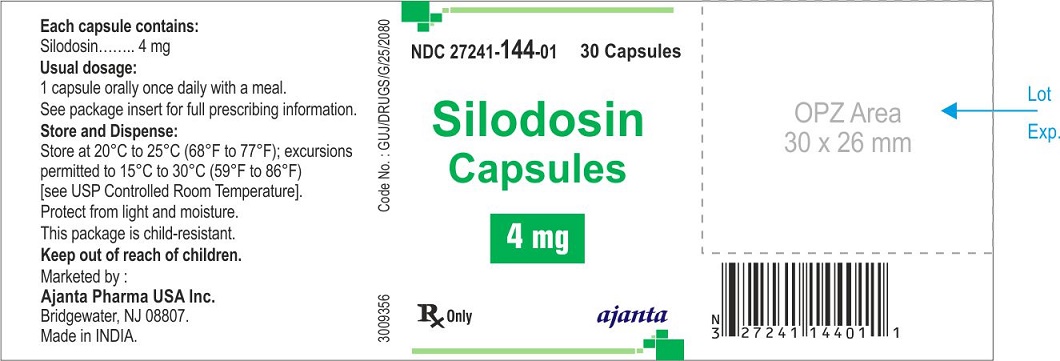
PACKAGE LABEL.PRINCIPAL DISPLAY PANEL NDC 27241-144-01 30 Capsules Silodosin Capsules 4 mg Rx Only ajanta NDC 27241-145-01 30 Capsules Silodosin Capsules 8 mg Rx Only ajanta NDC 27241-145-03 90 Capsules Silodosin Capsules 8 mg Rx Only ajanta 4mg-30 8mg-30 8mg-90