
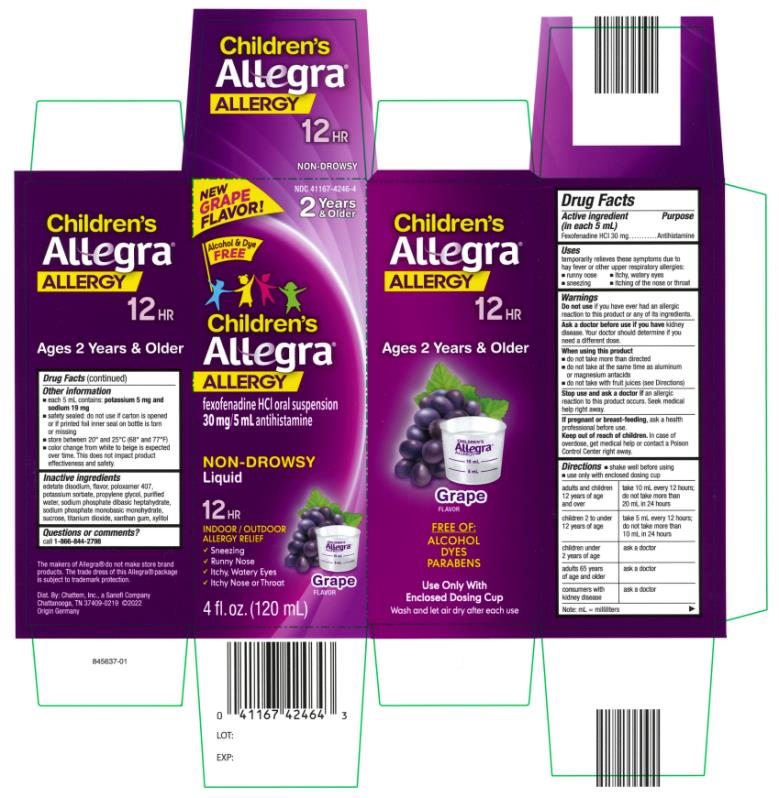
Childrens Allegra Allergy Fexofenadine Hydrochloride 30 mg/5mL Suspension — NDC 41167-4246-4 (Billing 41167-4246-04)
This is a package of Childrens Allegra Allergy Fexofenadine Hydrochloride 30 mg/5mL Suspension from Chattem, Inc., marketed since Mar 2011 and currently FDA-listed.
NDC database record
One package, one record: these facts belong to NDC 41167-4246-4 alone.
- Record
- FDA NDC Directory package listing · Human OTC drug
- Code segments
- 41167 labeler · 4246 product · 4 package
- Package marketed since
- Mar 1, 2023
- Sample package
- No — commercial package
- Listing certified through
- Dec 31, 2027
- Barcode (UPC-A, from the NDC)
- 3 4116742464 4
- FDA record last changed
- Jul 24, 2026
Identity & classification
Regulatory identifiers FDA, NLM and CMS codes for this package
Drug-database identifiers Medi-Span GPI and First Databank GCN / HICL / AHFS classification
- GSN (GCN sequence number): 061995
- GCN: 97779
- HICL (First Databank): 011595
- AHFS class code: 04:08.00.00
- RxCUI (RxNorm): 997491
Where does this data come from?
- FDA openFDA NDC Directory · synced Oct 8, 2026
- FDA label on DailyMed · label index refreshed Oct 8, 2026
- RxNorm (NLM RxNav) · catalog refreshed Oct 8, 2026
- Medi-Span GPI (licensed)
- First Databank (licensed) · refreshed Oct 8, 2026
RxNorm drug class
This medicine belongs to the Histamine-1 Receptor Antagonist class.
Where does this data come from?
- RxClass (NLM) · catalog refreshed Oct 8, 2026
Clinical
- It relieves hay fever and other upper respiratory allergy symptoms like runny nose, sneezing, and itchy, watery eyes. Some products, like Allegra Hives 24hr, are for hives and the...
- No. The label says not to take it with fruit juices, so use water instead. Also avoid taking it at the same time as aluminum or magnesium antacids.
- Can I take fexofenadine with fruit juice?
- Yes, check with your doctor first. The label says your doctor should decide whether you need a different dose. The same goes for adults 65 and older.
Patient education
Supplement & herbal interactions
Where does this data come from?
- MedlinePlus (NLM) · refreshed Oct 8, 2026
- FDA label on DailyMed · label index refreshed Oct 8, 2026
Ask a licensed pharmacist directly — free, answered by our team.
Pricing
A drug doesn't have one price. Each row is a different public payment system, and none is what you'd pay at the counter — that depends on your insurance. The ⓘ on each row explains what it measures.
| Price system | Per mL | Per package |
|---|---|---|
| Retail pharmacies payNADAC · weekly | Not in the retail survey — common for institutional, discontinued, or low-volume packs. | |
| Medicaid paysCMS SDUD · 12 mo | No recent Medicaid claims on file for this NDC — rare and low-volume NDCs are suppressed in the public data. | |
| Medicare drug plans payPart D · quarterly | No Part D plan price is available for this NDC in our data. | |
Where does this data come from?
- CMS NADAC weekly file
- CMS ASP pricing files · refreshed Sep 20, 2026
- CMS Medicaid State Drug Utilization Data · refreshed Oct 9, 2026
- CMS Part D plan pricing files · refreshed Sep 24, 2026
- VA National Acquisition Center price file
Packaging — all sizes for this product
| Package NDC | Description | Marketing start | Marketing end | Status |
|---|---|---|---|---|
| 41167-4246-02 41167-4246-2 Main listing | 1 BOTTLE in 1 CARTON / 240 mL in 1 BOTTLE | 2023-03-01 | — | Active |
| 41167-4246-04 You're viewing this | 1 BOTTLE in 1 CARTON / 120 mL in 1 BOTTLE | 2011-03-03 | — | Active |
Pack size FAQ
What quantity is in this package?
What NDC number is used to bill for this package of Childrens Allegra Allergy Fexofenadine Hydrochloride 30 mg/5mL Suspension?
Therapeutic equivalents
| Product | Labeler | Pack | NADAC/unit | TE | Status | Price vs. this |
|---|---|---|---|---|---|---|
| Childrens Allergy 30 mg/5mL 61269-0527-94 | H2-Pharma, | 1 bottle | $0.119 | — | Availability likely | — |
| Childrens Fexofenadine Hydrochloride Allergy 30 mg/5mL 00363-2141-01 | Walgreens | 1 bottle | — | — | FDA listed | — |
| Children Allergy 30 mg/5mL 00363-2600-04 | Walgreens | 1 bottle | — | — | FDA listed | — |
| Dye Free Wal Fex childrens allergy 30 mg/5mL 00363-9230-04 | Walgreens | 1 bottle | — | — | FDA listed | — |
| Childrens Allergy 30 mg/5mL 37808-0623-04 | H | 1 bottle | — | — | FDA listed | — |
| Children Allergy 30 mg/5mL 37808-0654-04 | H | 1 bottle | — | — | FDA listed | — |
| Childrens Allegra Hives 30 mg/5mL 41167-4227-01 | Chattem, | 1 bottle | — | — | FDA listed | — |
| Childrens Allegra Allergy 30 mg/5mL 41167-4244-01 | Chattem, | 1 bottle | — | — | FDA listed | — |
| Childrens Allegra Allergy 30 mg/5mLthis 41167-4246-04 | Chattem, | 1 bottle | — | — | FDA listed | — |
| Childrens Allergy 30 mg/5mL 49035-0208-04 | EQUATE | 1 bottle | — | — | FDA listed | — |
| Childrens Allergy 30 mg/5mL 51316-0260-04 | CVS | 1 bottle | — | — | FDA listed | — |
| Childrens Fexofenadine Hydrochloride Allergy 30 mg/5mL 51672-2141-01 | Sun | 1 bottle | — | — | FDA listed | — |
| Childrens Allergy 30 mg/5mL 55319-0923-04 | Family | 1 bottle | — | — | FDA listed | — |
| Childrens Allergy 30 mg/5mL 55319-0957-04 | Family | 1 bottle | — | — | Discontinued | — |
| Fexofenadine Hydrochloride 30 mg/5mL 58602-0426-20 | Aurohealth | 1 bottle | — | — | FDA listed | — |
| Childrens Allergy 30 mg/5mL 79903-0249-04 | WALMART | 1 bottle | — | — | FDA listed | — |
| Childrens Fexofenadine Hydrochloride Allergy 30 mg/5mL 79903-0306-04 | Wal-Mart | 1 bottle | — | — | FDA listed | — |
Where does this data come from?
- FDA openFDA NDC Directory · synced Oct 8, 2026
- FDA Orange Book · refreshed Oct 3, 2026
- CMS NADAC weekly file
Availability & generic status
FDA-approved generic versions are listed, and recent pricing/market data suggests they may be available — see Therapeutic equivalents.
Why the date isn’t exact: Generic timing can change because patents may be challenged, settled, licensed, added, removed, or worked around with a narrower label — and FDA approval does not always mean a pharmacy can get the generic today.
🛈 What do these terms mean?
- Patent
- Legal protection listed in the Orange Book that may delay generic approval or launch. Issued by the U.S. Patent & Trademark Office.
- Substance patent
- Covers the active drug molecule itself — the hardest to design around. A generic generally can’t launch until it expires.
- Formulation (product) patent
- Covers a specific formulation or dosage form. A generic can sometimes work around it with a different formulation.
- Method-of-use patent
- A patent covering one specific approved use of the drug — not necessarily the whole molecule. A generic can sometimes launch with a “skinny label” that carves out the protected use and keeps the others.
- Skinny label
- A generic label that omits a still-patented use when the FDA allows it — letting a generic reach the market for the unprotected uses.
- Exclusivity
- FDA-granted marketing protection, separate from patents — e.g. 5-yr new chemical entity, 7-yr orphan drug, or a +6-month pediatric extension.
- Paragraph IV
- A generic applicant’s formal challenge to a listed patent. It can potentially lead to earlier generic entry, but often involves litigation or a settlement.
- RLD / RS
- Reference Listed Drug — the brand product the FDA uses as the reference for generic applications. Reference Standard — the product the FDA expects generics to compare against in bioequivalence testing.
- TE / AB rating
- FDA therapeutic-equivalence rating. An AB rating generally means the FDA considers a generic therapeutically equivalent to — and substitutable for — the brand.
- LOE (loss of exclusivity)
- The latest patent or exclusivity currently listed — the loss-of-exclusivity / latest-listed-protection date shown on this page. Paragraph-IV challenges and settlements can move the real date earlier; FDA approval and a manufacturer’s decision to market can move it later.
Built from the FDA Orange Book. The bars above are scaled to each protection’s expiry; the red LOE marker is the last one to lapse.
| Patent | Type | Use code | Expires |
|---|---|---|---|
| US 8933097 ↗ | Drug product | — | Aug 2, 2030 |
| US 8933097 ↗ | Drug product | — | Aug 2, 2030 |
Is there a generic version of CHLD ALLEGRA ALLERGY 30 MG/5?
The FDA approved a generic — why can’t I get it at my pharmacy yet?
Why do different websites show different generic release dates?
What does “FDA listed” mean?
What does a patent or protection date mean here?
What does “current Orange Book estimate” mean?
Can a generic come out before the last patent expires?
Can a generic come out after the listed dates?
What is the difference between patents and exclusivity?
Why are there multiple patent dates?
Where does this data come from?
- FDA Orange Book · refreshed Oct 3, 2026
What it looks like
Where does this data come from?
- FDA label on DailyMed · label index refreshed Oct 8, 2026
Inactive Ingredients / Excipients
Inactive ingredients, also called excipients, are components of the drug product other than the active ingredient. They may include fillers, dyes, coatings, preservatives, flavors, or other formulation ingredients.
🧪 Avoiding an ingredient? See Fexofenadine inactive ingredients by manufacturer: every current product's list side by side, so you can ask your pharmacy for the version that does not list it.
💡 Tap an ingredient (hover on desktop) to see what it is and why it’s used.
-
UNII 7FLD91C86K
Edetate disodium is a chemical compound that binds and removes certain metal ions. In medicines, it acts as a preservative and stabilizer by preventing metals like calcium from interfering with the product's shelf life and consistency.
-
UNII TUF2IVW3M2
Poloxamer 407 is a synthetic polymer made from ethylene oxide and propylene oxide. In medicines, it acts as a thickener, emulsifier, and solubilizer to help mix ingredients and create the right texture.
-
UNII 1VPU26JZZ4
Potassium sorbate is a salt derived from sorbic acid, a naturally occurring preservative. It prevents growth of mold, yeast, and some bacteria, extending the medicine's shelf life.
-
UNII 6DC9Q167V3
Propylene glycol is a clear liquid derived from petroleum or vegetable sources. It acts as a solvent, humectant, and preservative in medicines, helping dissolve active ingredients and maintain product stability.
-
UNII 70WT22SF4B
A mineral salt that acts as a buffer to maintain the pH balance of the medication. It helps stabilize the drug's potency and prevents unwanted chemical changes during storage.
-
UNII 593YOG76RN
A salt made from sodium and phosphate that helps regulate acidity and maintain proper pH balance in the medicine. It also acts as a buffer to keep the product stable.
-
UNII C151H8M554
A natural sugar derived from sugar cane or sugar beets. It's used as a sweetener, filler, and binder to improve taste, add bulk, and help hold tablet or capsule ingredients together.
-
UNII 15FIX9V2JP
Titanium dioxide is a bright white mineral powder commonly used as a colorant and opacifying agent. It makes pills and tablets white or lighter in color and helps make coatings non-transparent.
-
UNII 059QF0KO0R
Water is a liquid solvent that dissolves and mixes ingredients together in liquid medicines, syrups, and injections. It helps distribute the active drug evenly throughout the product.
-
UNII TTV12P4NEE
Xanthan gum is a thickening and stabilizing ingredient made from fermented corn or other sugars. It's added to medicines to improve texture, prevent separation of liquids and solids, and help the product stay consistent.
-
UNII VCQ006KQ1E
Xylitol is a naturally occurring sugar alcohol derived from plants. It's used in medicines as a sweetener, bulking agent, and to improve taste, especially in liquid formulations and chewable tablets.
11 inactive ingredients listed in the exact product block matched to this NDC.
Label-section wording can be broader than the structured product block and may mention additional formulation ingredients.
Where does this data come from?
ingredient classCode="IACT" elements from the exact product block matched by this NDC. Label-section narrative from DailyMed / the openFDA label index is shown separately when available.- FDA label on DailyMed · label index refreshed Oct 8, 2026
- FDA openFDA NDC Directory · synced Oct 8, 2026
Inactive ingredient FAQ
Are inactive ingredients the same for every manufacturer?
Why might an inactive ingredient be missing?
Can inactive ingredients matter?
Manufacturer & labeler
More NDCs from Chattem, Inc. labeler code 41167
- Allegra Allergy fexofenadine hydrochloride 180 mg Tablet, Film Coated NDC 41167-4124-0
- Allegra Hives 24hr Fexofenadine Hydrochloride 180 mg Tablet, Film Coated NDC 41167-4126-3
- Allegra Allergy fexofenadine hydrochloride 60 mg Tablet, Film Coated NDC 41167-4131-2
- Childrens Allegra Hives fexofenadine HCl 30 mg/5mL Suspension NDC 41167-4227-1
- Childrens Allegra Allergy Fexofenadine Hydrochloride 30 mg Tablet, Orally Disintegrating NDC 41167-4232-1
- Childrens Allegra Allergy Fexofenadine Hydrochloride 30 mg/5mL Suspension NDC 41167-4244-1
- Allegra-D Allergy and Congestion fexofenadine hydrochloride and pseudoephedrine 60 mg; 120 mg Tablet, Film Coated, Extended Release NDC 41167-4310-2
- Allegra-D Allergy and Congestion fexofenadine hydrochloride and pseudoephedrine 180 mg; 240 mg Tablet, Film Coated, Extended Release NDC 41167-4320-5
- Nasacort Allergy 24HR Triamcinolone Acetonide 55 ug Spray, Metered NDC 41167-5800-1
- Xyzal levocetirizine dihydrochloride 5 mg Tablet, Film Coated NDC 41167-5803-9
- Xyzal levocetirizine dihydrochloride .5 mg/mL Solution NDC 41167-5804-5
- Selsun Blue Itchy Dry Scalp PYRITHIONE ZINC .01 g/mL Shampoo NDC 41167-6020-3
Where does this data come from?
- FDA openFDA NDC Directory · synced Oct 8, 2026
- Drugs@FDA
FDA label — Drug Facts FDA SPL
🎯 Indications and Usage ▾
Uses temporarily relieves these symptoms due to hay fever or other upper respiratory allergies: runny nose sneezing itchy, water eyes itching of the nose or throat
⏱️ Dosage and Administration ▾
Directions shake well before using use only with enclosed dosing cup adults and children 12 years of age and over take 10 mL every 12 hours; do not take more than 20 mL in 24 hours children 2 to under 12 years of age take 5 mL every 12 hours; do not take more than 10 mL in 24 hours children under 2 years of age ask a doctor adults 65 years of age and older ask a doctor consumers with kidney disease ask a doctor Note: mL = milliliters
⚠️ Warnings ▾
Warnings Do not use if you have ever had an allergic reaction to this product or any of its ingredients. Ask a doctor before use if you have kidney disease. Your doctor should determine if you need a different dose.
When using this product do not take more than directed do not take at the same time as aluminum or magnesium antacids do not take with fruit juices (see Directions) Stop use and ask a doctor if an allergic reaction to this product occurs. Seek medical help right away. If pregnant or breast-feeding, ask a health professional before use.
Keep out of reach of children. In case of overdose, get medical help or contact a Poison Control Center right away.
🧪 Active Ingredient ▾
Active ingredient (in each 5 mL ) Fexofenadine HCI 30 mg
🧪 Inactive Ingredients ▾
Inactive ingredients edetate disodium, flavor, poloxamer 407, potassium sorbate, propylene glycol, purified water, sodium phosphate dibasic heptahydrate, sodium phosphate monobasic monohydrate, sucrose, titanium dioxide, xanthan gum, xylitol
🎯 Purpose ▾
Purpose Antihistamine
📄 Do Not Use ▾
Do not use if you have ever had an allergic reaction to this product or any of its ingredients.
📄 Ask a Doctor Before Use If ▾
Ask a doctor before use if you have kidney disease. Your doctor should determine if you need a different dose.
📄 When Using This Product ▾
When using this product do not take more than directed do not take at the same time as aluminum or magnesium antacids do not take with fruit juices (see Directions)
📄 Stop Use and Ask a Doctor If ▾
Stop use and ask a doctor if an allergic reaction to this product occurs. Seek medical help right away.
🤰 If Pregnant or Breast-Feeding ▾
If pregnant or breast-feeding, ask a health professional before use.
📄 Keep Out of Reach of Children ▾
Keep out of reach of children. In case of overdose, get medical help or contact a Poison Control Center right away.
📄 Questions or Comments ▾
Questions or comments? call toll-free 1-800- 844 - 2798
📄 Package Label / Principal Display Panel ▾
PRINCIPAL DISPLAY PANEL NDC 41167-4244-4 Children’s Allegra® ALLERGY fexofenadine HCI oral suspension 12 HR 30 mg/5 ml antihistamine NDC 41167-4244-4 Children’s Allegra® ALLERGY fexofenadine HCI oral suspension 12 HR 30 mg/5 ml antihistamine
PRINCIPAL DISPLAY PANEL NDC 41167-4246-4 Children’s Allegra® ALLERGY fexofenadine HCI oral suspension 12 HR 30 mg/5 ml antihistamine NDC 41167-4246-4 Children’s Allegra® ALLERGY fexofenadine HCI oral suspension 12 HR 30 mg/5 ml antihistamine
Reported adverse events (FAERS)
Top reported reactions
Age at onset
Reporter sex
Serious outcomes
Where does this data come from?
About this NDC listing & data coverage
What data is (and isn’t) available for this NDC — tap to expand
| NDC identity (package / product / labeler codes) | ✓ Available |
| Labeler | ✓ Available |
| Product & package description | ✓ Available |
| Marketing category & status | ✓ Available |
| Active ingredient / dosage form / route | ✓ Available |
| FDA label (SPL via DailyMed) | ✓ Available |
| Package photos | ✓ Available |
| Inactive ingredients (structured) | ✓ Available |
| NADAC pharmacy acquisition price (CMS) | — Not published for this NDC CMS publishes NADAC only for NDCs reported in its retail-pharmacy survey. |
| Orange Book / therapeutic-equivalence data | ✓ Available |
| HCPCS J-code billing crosswalk | — Not published for this NDC Most self-administered / retail products have no J-code — that is normal. |
| Medicaid utilization (CMS SDUD) | — Not published for this NDC CMS reports utilization only for NDCs with Medicaid claims above its privacy threshold. |