
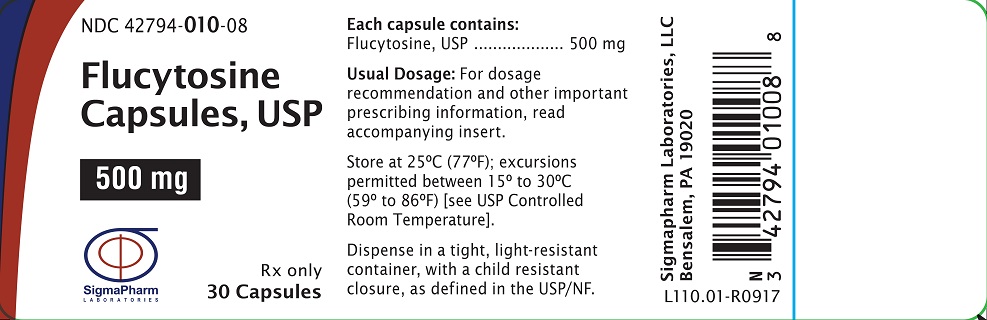
Flucytosine 500 mg Capsule, 30-count — NDC 42794-010-08 (Billing 42794-0010-08)
This is a package of 30 capsules of Flucytosine 500 mg Capsule from Sigmapharm Laboratories, LLC, marketed since Jun 2018 and currently FDA-listed. It is this product's only package size.
NDC database record
One package, one record: these facts belong to NDC 42794-010-08 alone.
- Record
- FDA NDC Directory package listing · Human prescription drug
- Code segments
- 42794 labeler · 010 product · 08 package
- Package marketed since
- Jun 1, 2018
- Sample package
- No — commercial package
- Listing certified through
- Dec 31, 2026
- Billing quantity
- 30 EA per package
- Barcode (UPC)
- 0342794010088, 0342794009082
- FDA record last changed
- Jul 24, 2026
Identity & classification
Regulatory identifiers FDA, NLM and CMS codes for this package
Drug-database identifiers Medi-Span GPI and First Databank GCN / HICL / AHFS classification
- GSN (GCN sequence number): 009543
- GCN: 42561
- GPI-14 (Medi-Span): 11000020000110
- HICL (First Databank): 004131
- AHFS class code: 08:14.32.00
- RxCUI (RxNorm): 197702
Where does this data come from?
- FDA openFDA NDC Directory · synced Oct 8, 2026
- FDA label on DailyMed · label index refreshed Oct 6, 2026
- RxNorm (NLM RxNav) · catalog refreshed Oct 1, 2026
- Medi-Span GPI (licensed)
- First Databank (licensed) · refreshed Oct 8, 2026
RxNorm drug class
This medicine belongs to the Nucleoside Analog Antifungal class.
Where does this data come from?
- RxClass (NLM) · catalog refreshed Oct 1, 2026
Clinical
- That's a great question. Flucytosine can work alone against some fungi, but the problem is that the fungus can develop resistance to it pretty quickly when it's used by itself. Pai...
- Why do I have to take flucytosine with another antifungal? Can't it work on its own?
- Yes — and this is one of the most practical tips for taking this medication. Instead of swallowing all your capsules at once, try taking a few at a time over about 15 minutes. Spre...
- The capsules are making me feel sick to my stomach. Is there anything I can do?
Patient education
Supplement & herbal interactions
Some supplements/herbs that may interact with Flucytosine — tap one for details:
Where does this data come from?
- MedlinePlus (NLM) · refreshed Oct 1, 2026
- FDA label on DailyMed · label index refreshed Oct 6, 2026
Ask a licensed pharmacist directly — free, answered by our team.
Pricing
A drug doesn't have one price. Each row is a different public payment system, and none is what you'd pay at the counter — that depends on your insurance. The ⓘ on each row explains what it measures.
| Price system | Per each | Per package |
|---|---|---|
| Retail pharmacies payNADAC · weekly | Not in the retail survey — common for institutional, discontinued, or low-volume packs. | |
| Medicaid paysCMS SDUD · 12 mo | No recent Medicaid claims on file for this NDC — rare and low-volume NDCs are suppressed in the public data. | |
| Medicare drug plans payPart D · Q2 2026 | $31.31 | $939.35 / 30 capsules |
Where does this data come from?
- CMS NADAC weekly file
- CMS ASP pricing files · refreshed Sep 20, 2026
- CMS Medicaid State Drug Utilization Data · refreshed Oct 8, 2026
- CMS Part D plan pricing files · refreshed Sep 24, 2026
- VA National Acquisition Center price file
Packaging — all sizes for this product
| Package NDC | Description | Marketing start | Marketing end | Status |
|---|---|---|---|---|
| 42794-0010-08 You're viewing this Main listing | 30 CAPSULE in 1 BOTTLE | 2018-06-01 | — | Active |
Therapeutic equivalents
| Product | Labeler | Pack | NADAC/unit | TE | Status | Price vs. this |
|---|---|---|---|---|---|---|
| Ancobon 500 mg 00187-3555-10 | Bausch | 100 capsules | — | AB | FDA listed | — |
| Flucytosine 500 mg 00904-6835-07 | Major | 30 capsules | — | AB | FDA listed | — |
| Flucytosine 500 mg 23155-0861-01 | Heritage | 100 capsules | — | AB | FDA listed | — |
| Flucytosine 500 mg 40032-0770-01 | Novel | 100 capsules | — | AB | FDA listed | — |
| Flucytosine 500 mg 42385-0984-01 | Laurus | 100 capsules | — | AB | FDA listed | — |
| Flucytosine 500 mgthis 42794-0010-08 | Sigmapharm | 30 capsules | — | AB | FDA listed | — |
| Flucytosine 500 mg 43386-0770-01 | Lupin | 100 capsules | — | AB | FDA listed | — |
| Flucytosine 500 mg 50268-0332-12 | AvPAK | 20 capsules | — | AB | FDA listed | — |
| Flucytosine 500 mg 59651-0332-01 | Aurobindo | 100 capsules | — | — | FDA listed | — |
| Flucytosine 500 mg 60687-0610-21 | American | 30 capsules | — | AB | FDA listed | — |
Where does this data come from?
- FDA openFDA NDC Directory · synced Oct 8, 2026
- FDA Orange Book · refreshed Oct 3, 2026
- CMS NADAC weekly file
Availability & generic status
This product is an FDA-approved generic. Other versions of the same drug are listed under Therapeutic equivalents, least expensive first.
Where does this data come from?
- FDA Orange Book · refreshed Oct 3, 2026
What it looks like
Where does this data come from?
- FDA label on DailyMed · label index refreshed Oct 6, 2026
Inactive Ingredients / Excipients
Inactive ingredients, also called excipients, are components of the drug product other than the active ingredient. They may include fillers, dyes, coatings, preservatives, flavors, or other formulation ingredients.
🧪 Avoiding an ingredient? See Flucytosine inactive ingredients by manufacturer: every current product's list side by side, so you can ask your pharmacy for the version that does not list it.
💡 Tap an ingredient (hover on desktop) to see what it is and why it’s used.
-
UNII 05JZI7B19X
A plant-based thickener made from cellulose that holds water and creates texture. It works as a binder and thickening agent to give the medicine its proper consistency and help ingredients blend together.
-
UNII EX438O2MRT
Ferric oxide yellow is a naturally occurring iron compound used as a colorant in medications. It gives tablets, capsules, and other forms a yellow or golden hue for identification and appearance.
-
UNII XM0M87F357
A dark iron oxide compound that gives medicines their black or dark color. It's used as a colorant in tablets and capsules to help identify the product and make it visually distinctive.
-
UNII 2G86QN327L
Gelatin is a protein derived from animal collagen, commonly used in medicines as a gelling agent and capsule material. It helps create soft or hard capsule shells that hold and release medication, and can also thicken liquid formulations.
-
UNII EWQ57Q8I5X
Lactose monohydrate is a natural sugar derived from milk. It serves as a filler and binder in tablets and capsules, helping create the proper size, texture, and consistency of the medicine.
-
UNII 368GB5141J
A detergent and foaming agent derived from coconut or palm oil. In medications, it helps break down and mix oil and water-based ingredients, aids in tablet disintegration, and improves how the drug dissolves and spreads in the mouth or digestive system.
-
UNII O8232NY3SJ
A plant-based carbohydrate derived from corn kernels. It acts as a filler to add bulk, a binder to hold ingredients together, and a disintegrant to help the tablet break apart in your stomach for absorption.
-
UNII 7SEV7J4R1U
A powder made from a naturally occurring mineral. In medicines, talc works as a glidant and anti-caking agent, helping tablets and capsules flow smoothly during manufacturing and preventing clumping.
-
UNII 15FIX9V2JP
Titanium dioxide is a bright white mineral powder commonly used as a colorant and opacifying agent. It makes pills and tablets white or lighter in color and helps make coatings non-transparent.
9 inactive ingredients listed in the exact product block matched to this NDC.
Where does this data come from?
ingredient classCode="IACT" elements from the exact product block matched by this NDC. Label-section narrative from DailyMed / the openFDA label index is shown separately when available.- FDA label on DailyMed · label index refreshed Oct 6, 2026
- FDA openFDA NDC Directory · synced Oct 8, 2026
Inactive ingredient FAQ
Are inactive ingredients the same for every manufacturer?
Why might an inactive ingredient be missing?
Can inactive ingredients matter?
Manufacturer & labeler
More NDCs from Sigmapharm Laboratories, LLC labeler code 42794
- Adefovir Dipivoxil 10 mg Tablet NDC 42794-003-08
- Protriptyline Hydrochloride 5 mg Tablet, Film Coated NDC 42794-004-02
- Amiloride Hydrochloride 5 mg Tablet NDC 42794-005-02
- Protriptyline Hydrochloride 10 mg Tablet, Film Coated NDC 42794-007-02
- Flucytosine 250 mg Capsule NDC 42794-009-08
- Griseofulvin 500 mg Tablet NDC 42794-012-08
- Ultramicrosize Griseofulvin 125 mg Tablet NDC 42794-013-08
- Ultramicrosize Griseofulvin 250 mg Tablet NDC 42794-014-08
- Asenapine 5 mg Tablet NDC 42794-016-08
- Asenapine 10 mg Tablet NDC 42794-017-08
- Liothyronine Sodium 5 ug Tablet NDC 42794-018-02
Where does this data come from?
- FDA openFDA NDC Directory · synced Oct 8, 2026
- Drugs@FDA
Full prescribing information FDA SPL
🚨 Boxed Warning ▾
WARNING Use with extreme caution in patients with impaired renal function. Close monitoring of hematologic, renal and hepatic status of all patients is essential. These instructions should be thoroughly reviewed before administration of Flucytosine Capsules, USP.
🎯 Indications and Usage ▾
INDICATIONS AND USAGE Flucytosine Capsules, USP are indicated only in the treatment of serious infections caused by susceptible strains of Candida and/or Cryptococcus . Candida: Septicemia, endocarditis and urinary system infections have been effectively treated with flucytosine. Limited trials in pulmonary infections justify the use of flucytosine.
Cryptococcus: Meningitis and pulmonary infections have been treated effectively. Studies in septicemias and urinary tract infections are limited, but good responses have been reported. Flucytosine Capsules, USP should be used in combination with amphotericin B for the treatment of systemic candidiasis and cryptococcosis because of the emergence of resistance to Flucytosine Capsules, USP (see MICROBIOLOGY ).
⏱️ Dosage and Administration ▾
DOSAGE AND ADMINISTRATION The usual dosage of Flucytosine Capsules, USP is 50 to 150 mg/kg/day administered in divided doses at 6-hour intervals. Nausea or vomiting may be reduced or avoided if the capsules are given a few at a time over a 15-minute period. If the BUN or the serum creatinine is elevated, or if there are other signs of renal impairment, the initial dose should be at the lower level (see WARNINGS ).
Flucytosine Capsules, USP should be used in combination with amphotericin B for the treatment of systemic candidiasis and cryptococcosis because of the emergence of resistance to Flucytosine Capsules, USP (see MICROBIOLOGY ).
⛔ Contraindications ▾
CONTRAINDICATIONS Flucytosine Capsules, USP should not be used in patients with a known hypersensitivity to the drug.
⚠️ Warnings ▾
WARNINGS Flucytosine Capsules, USP must be given with extreme caution to patients with impaired renal function. Since flucytosine is excreted primarily by the kidneys, renal impairment may lead to accumulation of the drug. Flucytosine serum concentrations should be monitored to determine the adequacy of renal excretion in such patients.
Dosage adjustments should be made in patients with renal insufficiency to prevent progressive accumulation of active drug. Flucytosine Capsules, USP must be given with extreme caution to patients with bone marrow depression. Patients may be more prone to depression of bone marrow function if they: 1) have a hematologic disease, 2) are being treated with radiation or drugs which depress bone marrow, or 3) have a history of treatment with such drugs or radiation.
Bone marrow toxicity can be irreversible and may lead to death in immunosuppressed patients. Frequent monitoring of hepatic function and of the hematopoietic system is indicated during therapy.
🤒 Adverse Reactions ▾
ADVERSE REACTIONS The adverse reactions which have occurred during treatment with Flucytosine Capsules, USP are grouped according to organ system affected. Cardiovascular: Cardiac arrest, myocardial toxicity, ventricular dysfunction. Respiratory: Respiratory arrest, chest pain, dyspnea.
Dermatologic: Rash, pruritus, urticaria, photosensitivity. Gastrointestinal: Nausea, emesis, abdominal pain, diarrhea, anorexia, dry mouth, duodenal ulcer, gastrointestinal hemorrhage, acute hepatic injury including hepatic necrosis with possible fatal outcome in debilitated patients, hepatic dysfunction, jaundice, ulcerative colitis, enterocolitis, bilirubin elevation, increased hepatic enzymes. Genitourinary: Azotemia, creatinine and BUN elevation, crystalluria, renal failure.
Hematologic: Anemia, agranulocytosis, aplastic anemia, eosinophilia, leukopenia, pancytopenia, thrombocytopenia, and fatal cases of bone marrow aplasia. Neurologic: Ataxia, hearing loss, headache, paresthesia, parkinsonism, peripheral neuropathy, pyrexia, vertigo, sedation, convulsions. Psychiatric: Confusion, hallucinations, psychosis.
Miscellaneous: Fatigue, hypoglycemia, hypokalemia, weakness, allergic reactions, Lyell’s syndrome. To report SUSPECTED ADVERSE REACTIONS , contact Sigmapharm Laboratories, LLC, Pharmacovigilance at 1-855-332-0731 or FDA at 1-800-FDA-1088 or www.fda.gov/medwatch.
🤰 Pregnancy ▾
Pregnancy Teratogenic Effects Flucytosine was shown to be teratogenic (vertebral fusions) in the rat at doses of 40 mg/kg/day (298 mg/M 2 /day or 0.051 times the human dose) administered on days 7 to 13 of gestation. At higher doses (700 mg/kg/day; 5208 mg/M 2 /day or 0.89 times the human dose administered on days 9 to 12 of gestation), cleft lip and palate and micrognathia were reported. Flucytosine was not teratogenic in rabbits up to a dose of 100 mg/kg/day (1423 mg/M 2 /day or 0.243 times the human dose) administered on days 6 to 18 of gestation.
In mice, 400 mg/kg/day of flucytosine (1380 mg/M 2 /day or 0.236 times the human dose) administered on days 7 to 13 of gestation was associated with a low incidence of cleft palate that was not statistically significant. Studies in pregnant rats have shown that flucytosine injected intraperitoneally crosses the placental barrier. There are no adequate and well-controlled studies in pregnant women.
Flucytosine Capsules, USP should be used during pregnancy only if the potential benefit justifies the potential risk to the fetus. Nursing Mothers It is not known whether this drug is excreted in human milk. Because many drugs are excreted in human milk and because of the potential for serious adverse reactions in nursing infants from Flucytosine Capsules, USP, a decision should be made whether to discontinue nursing or to discontinue the drug, taking into account the importance of the drug to the mother.
Pediatric Use The efficacy and safety of Flucytosine Capsules, USP have not been systematically studied in pediatric patients. A small number of neonates have been treated with 25 to 200 mg/kg/day of flucytosine, with and without the addition of amphotericin B, for systemic candidiasis. No unexpected adverse reactions were reported in these patients.
It should be noted, however, that hypokalemia and acidemia were reported in one patient who received flucytosine in combination with amphotericin B, and anemia was observed in a second patient who received flucytosine alone. Transient thrombocytopenia was noted in two additional patients, one of whom also received amphotericin B.
🆘 Overdosage ▾
OVERDOSAGE There is no experience with intentional overdosage. It is reasonable to expect that overdosage may produce pronounced manifestations of the known clinical adverse reactions. Prolonged serum concentrations in excess of 100 mcg/mL may be associated with an increased incidence of toxicity, especially gastrointestinal (diarrhea, nausea, vomiting), hematologic (leukopenia, thrombocytopenia) and hepatic (hepatitis).
In the management of overdosage, prompt gastric lavage or the use of an emetic is recommended. Adequate fluid intake should be maintained, by the intravenous route if necessary, since flucytosine is excreted unchanged via the renal tract. The hematologic parameters should be monitored frequently; liver and kidney function should be carefully monitored.
Should any abnormalities appear in any of these parameters, appropriate therapeutic measures should be instituted. Since hemodialysis has been shown to rapidly reduce serum concentrations in anuric patients, this method may be considered in the management of overdosage.
🧬 Clinical Pharmacology ▾
CLINICAL PHARMACOLOGY Flucytosine is rapidly and virtually completely absorbed following oral administration. Flucytosine Capsules, USP are not metabolized significantly when given orally to man. Bioavailability estimated by comparing the area under the curve of serum concentrations after oral and intravenous administration showed 78% to 89% absorption of the oral dose.
Peak serum concentrations of 30 to 40 mcg/mL were reached within 2 hours of administration of a 2 g oral dose to normal subjects. Other studies revealed mean serum concentrations of approximately 70 to 80 mcg/mL 1 to 2 hours after a dose in patients with normal renal function receiving a 6-week regimen of flucytosine (150 mg/kg/day given in divided doses every 6 hours) in combination with amphotericin B. The half-life in the majority of healthy subjects ranged between 2.4 and 4.8 hours.
Flucytosine is excreted via the kidneys by means of glomerular filtration without significant tubular reabsorption. More than 90% of the total radioactivity after oral administration was recovered in the urine as intact drug. Flucytosine is deaminated (probably by gut bacteria) to 5-fluorouracil.
The area under the curve (AUC) ratio of 5-fluorouracil to flucytosine is 4%. Approximately 1% of the dose is present in the urine as the α-fluoro-β-ureido-propionic acid metabolite. A small portion of the dose is excreted in the feces.
The half-life of flucytosine is prolonged in patients with renal insufficiency; the average half-life in nephrectomized or anuric patients was 85 hours (range: 29.9 to 250 hours). A linear correlation was found between the elimination rate constant of flucytosine and creatinine clearance. In vitro studies have shown that 2.9% to 4% of flucytosine is protein-bound over the range of therapeutic concentrations found in the blood.
Flucytosine readily penetrates the blood-brain barrier, achieving clinically significant concentrations in cerebrospinal fluid. Pharmacokinetics in Pediatric Patients Limited data are available regarding the pharmacokinetics of Flucytosine Capsules, USP administered to neonatal patients being treated for systemic candidiasis. After five days of continuous therapy, median peak levels in infants were 19.6 mcg/mL, 27.7 mcg/mL, and 83.9 mcg/mL at doses of 25 mg/kg (N=3), 50 mg/kg (N=4), and 100 mg/kg (N=3), respectively.
Mean time to peak serum levels was of 2.5 ± 1.3 hours, similar to that observed in adult patients. A good deal of interindividual variability was noted, which did not correlate with gestational age. Some patients had serum levels > 100 mcg/mL, suggesting a need for drug level monitoring during therapy.
In another study, serum concentrations were determined during flucytosine therapy in two patients (total assays performed =10). Median serum flucytosine concentrations at steady state were calculated to be 57 ± 10 mcg/mL (doses of 50 to 125 mg/kg/day, normalized to 25 mg/kg per dose for comparison). In three infants receiving flucytosine 25 mg/kg/day (four divided doses), a median flucytosine half-life of 7.4 hours was observed, approximately double that seen in adult patients.
The concentration of flucytosine in the cerebrospinal fluid of one infant was 43 mcg/mL 3 hours after a 25 mg oral dose, and ranged from 20 to 67 mg/L in another neonate receiving oral doses of 120 to 150 mg/kg/day.
📦 How Supplied / Storage and Handling ▾
HOW SUPPLIED Flucytosine Capsules, USP are supplied as capsules containing 250 mg and 500 mg of flucytosine. Flucytosine Capsules, USP 250 mg have an opaque green cap and opaque white body and are imprinted Σ9 on cap and body. Bottles of 30 capsules (NDC 42794-009-08) Flucytosine Capsules, USP 500 mg have an opaque grey cap and opaque yellow body and are imprinted Σ10 on cap and body.
Bottles of 30 capsules (NDC 42794-010-08) Store at 25°C (77°F); excursions permitted between 15° - 30°C (59° - 86°F) [see USP Controlled Room Temperature]. KEEP OUT OF REACH OF CHILDREN Sigmapharm Laboratories, LLC Bensalem, PA 19020 OS010A-03 REV.0219
📋 Description ▾
DESCRIPTION Flucytosine Capsules, USP are an antifungal agent available as 250 mg and 500 mg capsules for oral administration. In addition to the active ingredient of flucytosine, each capsule contains corn starch, lactose monohydrate and talc. The 250 mg capsule shell contains FD&C Yellow No.
6, FD&C Green No. 3, D&C Yellow No. 10, titanium dioxide, sodium lauryl sulfate and gelatin.
The 500 mg capsule shell contains iron oxide yellow, iron oxide black, titanium dioxide, carboxymethylcellulose, sodium lauryl sulfate and gelatin. The imprinting ink used for 250 mg and 500 mg capsules contains black iron oxide. Chemically, flucytosine is 5-fluorocytosine, a fluorinated pyrimidine which is related to fluorouracil and floxuridine.
It is a white to off-white crystalline powder with a molecular weight of 129.09 and the following structural formula: chemical structure
⚠️ Precautions ▾
PRECAUTIONS General Before therapy with Flucytosine Capsules, USP is instituted, electrolytes (because of hypokalemia) and the hematologic and renal status of the patient should be determined (see WARNINGS ). Close monitoring of the patient during therapy is essential. Laboratory Tests Since renal impairment can cause progressive accumulation of the drug, blood concentrations and kidney function should be monitored during therapy.
Hematologic status (leucocyte and thrombocyte count) and liver function (alkaline phosphatase, SGOT and SGPT) should be determined at frequent intervals during treatment as indicated. Drug Interactions Cytosine arabinoside, a cytostatic agent, has been reported to inactivate the antifungal activity of Flucytosine Capsules, USP by competitive inhibition. Drugs which impair glomerular filtration may prolong the biological half-life of flucytosine.
Drug/Laboratory Test Interactions Measurement of serum creatinine levels should be determined by the Jaffe reaction, since Flucytosine Capsules, USP do not interfere with the determination of creatinine values by this method. Most automated equipment for measurement of creatinine makes use of the Jaffe reaction. Carcinogenesis, Mutagenesis, Impairment of Fertility Flucytosine has not undergone adequate animal testing to evaluate carcinogenic potential.
The mutagenic potential of flucytosine was evaluated in Ames-type studies with five different mutants of S. typhimurium and no mutagenicity was detected in the presence or absence of activating enzymes. Flucytosine was nonmutagenic in three different repair assay systems (i.e., rec, uvr and pol). There have been no adequate trials in animals on the effects of flucytosine on fertility or reproductive performance.
The fertility and reproductive performance of the offspring (F1 generation) of mice treated with 100 mg/kg/day (345 mg/M 2 /day or 0.059 times the human dose), 200 mg/kg/day (690 mg/M 2 /day or 0.118 times the human dose) or 400 mg/kg/day (1380 mg/M 2 /day or 0.236 times the human dose) of flucytosine on days 7 to 13 of gestation was studied; the in utero treatment had no adverse effect on the fertility or reproductive performance of the offspring.
📄 Package Label / Principal Display Panel ▾
Flucytosine 250 mg Container Label - 30 Count Sigmapharm Laboratories, LLC NDC 42794- 009 -08 Flucytosine Capsules, USP 250 mg 30 Capsules Rx only 250-30
Flucytosine 500 mg Container Label - 30 count Sigmapharm Laboratories, LLC NDC 42794- 010 -08 Flucytosine Capsules, USP 500 mg 30 Capsules Rx Only 500-30
Medicare Part D spend CMS · PART D · 2026 (Q1)
About this NDC listing & data coverage
What data is (and isn’t) available for this NDC — tap to expand
| NDC identity (package / product / labeler codes) | ✓ Available |
| Labeler | ✓ Available |
| Product & package description | ✓ Available |
| Marketing category & status | ✓ Available |
| Active ingredient / dosage form / route | ✓ Available |
| FDA label (SPL via DailyMed) | ✓ Available |
| Package photos | ✓ Available |
| Inactive ingredients (structured) | ✓ Available |
| NADAC pharmacy acquisition price (CMS) | — Not published for this NDC CMS publishes NADAC only for NDCs reported in its retail-pharmacy survey. |
| Orange Book / therapeutic-equivalence data | ✓ Available |
| HCPCS J-code billing crosswalk | — Not published for this NDC Most self-administered / retail products have no J-code — that is normal. |
| Medicaid utilization (CMS SDUD) | — Not published for this NDC CMS reports utilization only for NDCs with Medicaid claims above its privacy threshold. |