
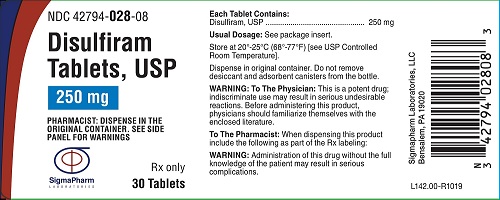
Disulfiram 250 mg Tablet, 30-count — NDC 42794-028-08 (Billing 42794-0028-08)
This is a package of 30 tablets of Disulfiram 250 mg Tablet from Sigmapharm Laboratories, LLC, marketed since Nov 2021 and currently FDA-listed; retail pharmacies pay about $1.82 per tablet (NADAC). It is this product's only package size.
NDC database record
One package, one record: these facts belong to NDC 42794-028-08 alone.
- Record
- FDA NDC Directory package listing · Human prescription drug
- Code segments
- 42794 labeler · 028 product · 08 package
- Package marketed since
- Nov 1, 2021
- Sample package
- No — commercial package
- Listing certified through
- Dec 31, 2026
- Billing quantity
- 30 EA per package
- Barcode (UPC)
- 0342794028083
- Medicaid fills, this package
- 232 prescriptions in the last four reported quarters
- FDA record last changed
- Jul 24, 2026
Identity & classification
Regulatory identifiers FDA, NLM and CMS codes for this package
Drug-database identifiers Medi-Span GPI and First Databank GCN / HICL / AHFS classification
- GSN (GCN sequence number): 001192
- GCN: 02881
- GPI-14 (Medi-Span): 62802040000325
- HICL (First Databank): 000529
- AHFS class code: 91:02.00.00
- RxCUI (RxNorm): 197623
Where does this data come from?
- FDA openFDA NDC Directory · synced Oct 8, 2026
- FDA label on DailyMed · label index refreshed Oct 8, 2026
- RxNorm (NLM RxNav) · catalog refreshed Oct 1, 2026
- Medi-Span GPI (licensed)
- First Databank (licensed) · refreshed Oct 8, 2026
RxNorm drug class
This medicine belongs to the Aldehyde Dehydrogenase Inhibitor class.
Where does this data come from?
- RxClass (NLM) · catalog refreshed Oct 1, 2026
Clinical
- It's an aid for selected people with chronic alcohol use who want to stay sober. It works best alongside counseling and support. It isn't a cure, and on its own it's unlikely to ch...
- Even a small amount can cause flushing, a pounding headache, nausea, heavy vomiting, chest pain, a fast heartbeat and confusion. Severe reactions can be dangerous, including heart...
- What happens if I drink while taking it?
- For up to 14 days after your last dose. Also watch for hidden alcohol in sauces, vinegars, cough syrups, tonics, aftershave and back rubs.
Patient education
Supplement & herbal interactions
Some supplements/herbs that may interact with Disulfiram — tap one for details:
Disulfiram may be associated with lower levels of 1 nutrient — worth a chat with your pharmacist, not a cause for alarm.
Where does this data come from?
- MedlinePlus (NLM) · refreshed Oct 8, 2026
- FDA label on DailyMed · label index refreshed Oct 8, 2026
Ask a licensed pharmacist directly — free, answered by our team.
Pricing
A drug doesn't have one price. Each row is a different public payment system, and none is what you'd pay at the counter — that depends on your insurance. The ⓘ on each row explains what it measures.
| Price system | Per ea | Per package |
|---|---|---|
| Retail pharmacies payNADAC · weekly | $1.823 | $54.70 / 30 tablets |
| Medicaid paysCMS SDUD · 12 mo | $2.04 | $61.30 / 30 tablets |
| Medicare drug plans payPart D · Q2 2026 | $2.25 | $67.46 / 30 tablets |
Where does this data come from?
- CMS NADAC weekly file · file of Oct 7, 2026
- CMS ASP pricing files · refreshed Sep 20, 2026
- CMS Medicaid State Drug Utilization Data · through Q1 2026
- CMS Part D plan pricing files · refreshed Sep 24, 2026
- VA National Acquisition Center price file
Packaging — all sizes for this product
| Package NDC | Description | Marketing start | Marketing end | Status |
|---|---|---|---|---|
| 42794-0028-08 You're viewing this Main listing | 30 TABLET in 1 BOTTLE | 2021-11-01 | — | Active |
Therapeutic equivalents
| Product | Labeler | Pack | NADAC/unit | TE | Status | Price vs. this |
|---|---|---|---|---|---|---|
| Disulfiram 250 mgthis 42794-0028-08 | Sigmapharm | 30 tablets | $1.823 | AB | Availability likely | — |
| Disulfiram 250 mg 47781-0607-30 | Alvogen | 30 tablets | $1.823 | AB | Availability likely | — |
| Disulfiram 250 mg 62135-0431-30 | Chartwell | 30 tablets | $1.823 | AB | Availability likely | — |
| Disulfiram 250 mg 60429-0196-01 | Golden | 100 tablets | — | AB | FDA listed | — |
| Disulfiram 250 mg 63629-5466-01 | Bryant | 90 tablets | — | AB | FDA listed | — |
Where does this data come from?
- FDA openFDA NDC Directory · synced Oct 8, 2026
- FDA Orange Book · refreshed Oct 3, 2026
- CMS NADAC weekly file · file of Oct 7, 2026
Availability & generic status
This product is an FDA-approved generic. Other versions of the same drug are listed under Therapeutic equivalents, least expensive first.
Where does this data come from?
- FDA Orange Book · refreshed Oct 3, 2026
Inactive Ingredients / Excipients
Inactive ingredients, also called excipients, are components of the drug product other than the active ingredient. They may include fillers, dyes, coatings, preservatives, flavors, or other formulation ingredients.
🧪 Avoiding an ingredient? See Disulfiram inactive ingredients by manufacturer: every current product's list side by side, so you can ask your pharmacy for the version that does not list it.
💡 Tap an ingredient (hover on desktop) to see what it is and why it’s used.
-
UNII OP1R32D61U
Microcrystalline cellulose is a purified form of cellulose, a natural fiber from plant sources. It acts as a binder and filler in tablets and capsules, helping hold ingredients together and give the medicine its shape and size.
-
UNII 2S7830E561
Crospovidone is a synthetic polymer derived from povidone. It acts as a disintegrant, helping the tablet or capsule break apart quickly in the stomach so the active ingredient can be absorbed.
-
UNII EWQ57Q8I5X
Lactose monohydrate is a natural sugar derived from milk. It serves as a filler and binder in tablets and capsules, helping create the proper size, texture, and consistency of the medicine.
-
UNII 70097M6I30
Magnesium stearate is a salt made from magnesium and stearic acid, a fatty substance. It's used in tablets and capsules as a lubricant and glidant to help ingredients flow smoothly during manufacturing and prevent sticking.
-
UNII FZ989GH94E
Povidone is a synthetic polymer made from a plastic-like material. It acts as a binder to hold tablet ingredients together and as a disintegrant to help the tablet break apart in your stomach so the medicine can be absorbed.
-
UNII ETJ7Z6XBU4
Silicon dioxide is a naturally occurring mineral used as a glidant and anti-caking agent. It helps powder ingredients flow smoothly and prevents clumping during manufacturing and storage.
6 inactive ingredients listed in the exact product block matched to this NDC.
Where does this data come from?
ingredient classCode="IACT" elements from the exact product block matched by this NDC. Label-section narrative from DailyMed / the openFDA label index is shown separately when available.- FDA label on DailyMed · label index refreshed Oct 8, 2026
- FDA openFDA NDC Directory · synced Oct 8, 2026
Inactive ingredient FAQ
Are inactive ingredients the same for every manufacturer?
Why might an inactive ingredient be missing?
Can inactive ingredients matter?
Manufacturer & labeler
More NDCs from Sigmapharm Laboratories, LLC labeler code 42794
- Ultramicrosize Griseofulvin 250 mg Tablet NDC 42794-014-08
- Asenapine 5 mg Tablet NDC 42794-016-08
- Asenapine 10 mg Tablet NDC 42794-017-08
- Liothyronine Sodium 5 ug Tablet NDC 42794-018-02
- Liothyronine Sodium 25 ug Tablet NDC 42794-019-02
- Liothyronine Sodium 50 ug Tablet NDC 42794-020-02
- Disulfiram 500 mg Tablet NDC 42794-029-08
- Dofetilide 125 ug Capsule NDC 42794-044-10
- Dofetilide 250 ug Capsule NDC 42794-045-10
- Dofetilide 500 ug Capsule NDC 42794-046-10
- Ambrisentan 5 mg Tablet, Film Coated NDC 42794-051-08
- Ambrisentan 10 mg Tablet, Film Coated NDC 42794-052-08
Where does this data come from?
- FDA openFDA NDC Directory · synced Oct 8, 2026
- Drugs@FDA
Full prescribing information FDA SPL
🚨 Boxed Warning ▾
WARNING: Disulfiram should never be administered to a patient when he is in a state of alcohol intoxication, or without his full knowledge. The physician should instruct relatives accordingly.
Disulfiram should never be administered to a patient when he is in a state of alcohol intoxication, or without his full knowledge. The physician should instruct relatives accordingly.
🎯 Indications and Usage ▾
INDICATIONS AND USAGE: Disulfiram is an aid in the management of selected chronic alcohol patients who want to remain in a state of enforced sobriety so that supportive and psychotherapeutic treatment may be applied to best advantage. Disulfiram is not a cure for alcoholism. When used alone, without proper motivation and supportive therapy, it is unlikely that it will have any substantive effect on the drinking pattern of the chronic alcoholic.
⏱️ Dosage and Administration ▾
DOSAGE AND ADMINISTRATION: Disulfiram should never be administered until the patient has abstained from alcohol for at least 12 hours. Initial Dosage Schedule: In the first phase of treatment, a maximum of 500 mg daily is given in a single dose for one to two weeks. Although usually taken in the morning, disulfiram may be taken on retiring by patients who experience a sedative effect.
Alternatively, to minimize, or eliminate, the sedative effect, dosage may be adjusted downward. Maintenance Regimen: The average maintenance dose is 250 mg daily (range, 125 to 500 mg), it should not exceed 500 mg daily. Note: Occasionally patients, while seemingly on adequate maintenance doses of disulfiram, report that they are able to drink alcoholic beverages with impunity and without any symptomatology.
All appearances to the contrary, such patients must be presumed to be disposing of their tablets in some manner without actually taking them. Until such patients have been observed reliably taking their daily disulfiram tablets (preferably crushed and well mixed with liquid), it cannot be concluded that disulfiram is ineffective. Duration of Therapy: The daily, uninterrupted administration of disulfiram must be continued until the patient is fully recovered socially and a basis for permanent self-control is established.
Depending on the individual patient, maintenance therapy may be required for months or even years. Trial with Alcohol: During early experience with disulfiram, it was thought advisable for each patient to have at least one supervised alcohol-drug reaction. More recently, the test reaction has been largely abandoned.
Furthermore, such a test reaction should never be administered to a patient over 50 years of age. A clear, detailed and convincing description of the reaction is felt to be sufficient in most cases. However, where a test reaction is deemed necessary, the suggested procedure is as follows: After the first one to two weeks’ therapy with 500 mg daily, a drink of 15 mL (1/2 oz) of 100 proof whiskey, or equivalent, is taken slowly.
This test dose of alcoholic beverage may be repeated once only, so that the total dose does not exceed 30 mL (1 oz) of whiskey. Once a reaction develops, no more alcohol should be consumed. Such tests should be carried out only when the patient is hospitalized, or comparable supervision and facilities, including oxygen, are available.
Management of Disulfiram-Alcohol Reaction: In severe reactions, whether caused by an excessive test dose or by the patient’s unsupervised ingestion of alcohol, supportive measures to restore blood pressure and treat shock should be instituted. Other recommendations include: oxygen, carbogen (95% oxygen and 5% carbon dioxide), vitamin C intravenously in massive doses (1 g) and ephedrine sulfate. Antihistamines have also been used intravenously.
Potassium levels should be monitored, particularly in patients on digitalis, since hypokalemia has been reported.
⛔ Contraindications ▾
CONTRAINDICATIONS: Patients who are receiving or have recently received metronidazole, paraldehyde, alcohol, or alcohol-containing preparations, e.g., cough syrups, tonics and the like, should not be given disulfiram. Disulfiram is contraindicated in the presence of severe myocardial disease or coronary occlusion, psychoses, and hypersensitivity to disulfiram or to other thiuram derivatives used in pesticides and rubber vulcanization.
⚠️ Warnings ▾
WARNINGS: Disulfiram should never be administered to a patient when he is in a state of alcohol intoxication, or without his full knowledge. The physician should instruct relatives accordingly. The patient must be fully informed of the disulfiram-alcohol reaction.
He must be strongly cautioned against surreptitious drinking while taking the drug, and he must be fully aware of the possible consequences. He should be warned to avoid alcohol in disguised forms, i.e., in sauces, vinegars, cough mixtures, and even in aftershave lotions and back rubs. He should also be warned that reactions may occur with alcohol up to 14 days after ingesting disulfiram.
The Disulfiram-Alcohol Reaction: Disulfiram plus alcohol, even small amounts, produce flushing, throbbing in head and neck, throbbing headache, respiratory difficulty, nausea, copious vomiting, sweating, thirst, chest pain, palpitation, dyspnea, hyperventilation, tachycardia, hypotension, syncope, marked uneasiness, weakness, vertigo, blurred vision, and confusion. In severe reactions there may be respiratory depression, cardiovascular collapse, arrhythmias, myocardial infarction, acute congestive heart failure, unconsciousness, convulsions, and death.
The intensity of the reaction varies with each individual, but is generally proportional to the amounts of disulfiram and alcohol ingested. Mild reactions may occur in the sensitive individual when the blood alcohol concentration is increased to as little as 5 to 10 mg per 100 mL. Symptoms are fully developed at 50 mg per 100 mL, and unconsciousness usually results when the blood alcohol level reaches 125 to 150 mg.
The duration of the reaction varies from 30 to 60 minutes, to several hours in the more severe cases, or as long as there is alcohol in the blood. Concomitant Conditions: Because of the possibility of an accidental disulfiram-alcohol reaction, disulfiram should be used with extreme caution in patients with any of the following conditions: diabetes mellitus, hypothyroidism, epilepsy, cerebral damage, chronic and acute nephritis, hepatic cirrhosis or insufficiency.
🤒 Adverse Reactions ▾
ADVERSE REACTIONS: (See CONTRAINDICATIONS , WARNINGS AND PRECAUTIONS .) OPTIC NEURITIS, PERIPHERAL NEURITIS, POLYNEURITIS, AND PERIPHERAL NEUROPATHY MAY OCCUR FOLLOWING ADMINISTRATION OF DISULFIRAM. Multiple cases of hepatitis, including both cholestatic and fulminant hepatitis, as well as hepatic failure resulting in transplantation or death, have been reported with administration of disulfiram. Occasional skin eruptions are, as a rule, readily controlled by concomitant administration of an antihistaminic drug.
In a small number of patients, a transient mild drowsiness, fatigability, impotence, headache, acneform eruptions, allergic dermatitis, or a metallic or garlic-like aftertaste may be experienced during the first two weeks of therapy. These complaints usually disappear spontaneously with the continuation of therapy, or with reduced dosage. Psychotic reactions have been noted, attributable in most cases to high dosage, combined toxicity (with metronidazole or isoniazid), or to the unmasking of underlying psychoses in patients stressed by the withdrawal of alcohol.
To report SUSPECTED ADVERSE REACTIONS , contact Sigmapharm Laboratories, LLC, Pharmacovigilance at 1-855-332-0731 or FDA at 1-800-FDA-1088 or www.fda.gov/medwatch.
🔄 Drug Interactions ▾
Drug Interactions: Disulfiram appears to decrease the rate at which certain drugs are metabolized and therefore may increase the blood levels and the possibility of clinical toxicity of drugs given concomitantly. DISULFIRAM SHOULD BE USED WITH CAUTION IN THOSE PATIENTS RECEIVING PHENYTOIN AND ITS CONGENERS, SINCE THE CONCOMITANT ADMINISTRATION OF THESE TWO DRUGS CAN LEAD TO PHENYTOIN INTOXICATION. PRIOR TO ADMINISTERING DISULFIRAM TO A PATIENT ON PHENYTOIN THERAPY, A BASELINE PHENYTOIN SERUM LEVEL SHOULD BE OBTAINED.
SUBSEQUENT TO INITIATION OF DISULFIRAM THERAPY, SERUM LEVELS OF PHENYTOIN SHOULD BE DETERMINED ON DIFFERENT DAYS FOR EVIDENCE OF AN INCREASE OR FOR A CONTINUING RISE IN LEVELS. INCREASED PHENYTOIN LEVELS SHOULD BE TREATED WITH APPROPRIATE DOSAGE ADJUSTMENT. It may be necessary to adjust the dosage of oral anticoagulants upon beginning or stopping disulfiram, since disulfiram may prolong prothrombin time.
Patients taking isoniazid when disulfiram is given should be observed for the appearance of unsteady gait or marked changes in mental status, the disulfiram should be discontinued if such signs appear. In rats, simultaneous ingestion of disulfiram and nitrite in the diet for 78 weeks has been reported to cause tumors, and it has been suggested that disulfiram may react with nitrites in the rat stomach to form a nitrosamine, which is tumorigenic. Disulfiram alone in the rat’s diet did not lead to such tumors.
The relevance of this finding to humans is not known at this time.
🤰 Pregnancy ▾
Usage in Pregnancy: The safe use of this drug in pregnancy has not been established. Therefore, disulfiram should be used during pregnancy only when, in the judgment of the physician, the probable benefits outweigh the possible risks.
🧒 Pediatric Use ▾
Pediatric Use: Safety and effectiveness in pediatric patients have not been established.
🧓 Geriatric Use ▾
Geriatric Use: A determination has not been made whether controlled clinical studies of disulfiram included sufficient numbers of subjects aged 65 and over to define a difference in response from younger subjects. Other reported clinical experience has not identified differences in responses between the elderly and younger patients. In general, dose selection for an elderly patient should be cautious, usually starting at the low end of the dosing range, reflecting the greater frequency of decreased hepatic, renal or cardiac function, and of concomitant disease or other drug therapy.
🆘 Overdosage ▾
OVERDOSAGE: No specific information is available on the treatment of overdosage with disulfiram. It is recommended that the physician contact the local Poison Control Center.
🧬 Clinical Pharmacology ▾
CLINICAL PHARMACOLOGY: Disulfiram produces a sensitivity to alcohol which results in a highly unpleasant reaction when the patient under treatment ingests even small amounts of alcohol. Disulfiram blocks the oxidation of alcohol at the acetaldehyde stage. During alcohol metabolism following disulfiram intake, the concentration of acetaldehyde occurring in the blood may be 5 to 10 times higher than that found during metabolism of the same amount of alcohol alone.
Accumulation of acetaldehyde in the blood produces a complex of highly unpleasant symptoms referred to hereinafter as the disulfiram-alcohol reaction. This reaction, which is proportional to the dosage of both disulfiram and alcohol, will persist as long as alcohol is being metabolized. Disulfiram does not appear to influence the rate of alcohol elimination from the body.
Disulfiram is absorbed slowly from the gastrointestinal tract and is eliminated slowly from the body. One (or even two) weeks after a patient has taken his last dose of disulfiram, ingestion of alcohol may produce unpleasant symptoms. Prolonged administration of disulfiram does not produce tolerance; the longer a patient remains on therapy, the more exquisitely sensitive he becomes to alcohol.
📋 Description ▾
DESCRIPTION: Disulfiram is an alcohol antagonist drug.
⚠️ Precautions ▾
PRECAUTIONS: Patients with a history of rubber contact dermatitis should be evaluated for hypersensitivity to thiuram derivatives before receiving disulfiram (see CONTRAINDICATIONS) . It is suggested that every patient under treatment carry an Identification Card stating that he is receiving disulfiram and describing the symptoms most likely to occur as a result of the disulfiram-alcohol reaction. In addition, this card should indicate the physician or institution to be contacted in an emergency.
(Cards may be obtained from Sigmapharm Laboratories, LLC. upon request.) Alcoholism may accompany or be followed by dependence on narcotics or sedatives. Barbiturates and disulfiram have been administered concurrently without untoward effects; the possibility of initiating a new abuse should be considered. Hepatic toxicity including hepatic failure resulting in transplantation or death have been reported.
Severe and sometimes fatal hepatitis associated with disulfiram therapy may develop even after many months of therapy. Hepatic toxicity has occurred in patients with or without prior history of abnormal liver function. Patients should be advised to immediately notify their physician of any early symptoms of hepatitis, such as fatigue, weakness, malaise, anorexia, nausea, vomiting, jaundice, or dark urine.
Baseline and follow-up liver function tests (10-14 days) are suggested to detect any hepatic dysfunction that may result with disulfiram therapy. In addition, a complete blood count and serum chemistries, including liver function tests, should be monitored. Patients taking disulfiram tablets should not be exposed to ethylene dibromide or its vapors.
This precaution is based on preliminary results of animal research currently in progress that suggest a toxic interaction between inhaled ethylene dibromide and ingested disulfiram resulting in a higher incidence of tumors and mortality in rats. A correlation between this finding and humans, however, has not been demonstrated. Drug Interactions: Disulfiram appears to decrease the rate at which certain drugs are metabolized and therefore may increase the blood levels and the possibility of clinical toxicity of drugs given concomitantly.
DISULFIRAM SHOULD BE USED WITH CAUTION IN THOSE PATIENTS RECEIVING PHENYTOIN AND ITS CONGENERS, SINCE THE CONCOMITANT ADMINISTRATION OF THESE TWO DRUGS CAN LEAD TO PHENYTOIN INTOXICATION. PRIOR TO ADMINISTERING DISULFIRAM TO A PATIENT ON PHENYTOIN THERAPY, A BASELINE PHENYTOIN SERUM LEVEL SHOULD BE OBTAINED. SUBSEQUENT TO INITIATION OF DISULFIRAM THERAPY, SERUM LEVELS OF PHENYTOIN SHOULD BE DETERMINED ON DIFFERENT DAYS FOR EVIDENCE OF AN INCREASE OR FOR A CONTINUING RISE IN LEVELS.
INCREASED PHENYTOIN LEVELS SHOULD BE TREATED WITH APPROPRIATE DOSAGE ADJUSTMENT. It may be necessary to adjust the dosage of oral anticoagulants upon beginning or stopping disulfiram, since disulfiram may prolong prothrombin time. Patients taking isoniazid when disulfiram is given should be observed for the appearance of unsteady gait or marked changes in mental status, the disulfiram should be discontinued if such signs appear.
In rats, simultaneous ingestion of disulfiram and nitrite in the diet for 78 weeks has been reported to cause tumors, and it has been suggested that disulfiram may react with nitrites in the rat stomach to form a nitrosamine, which is tumorigenic. Disulfiram alone in the rat’s diet did not lead to such tumors. The relevance of this finding to humans is not known at this time.
Usage in Pregnancy: The safe use of this drug in pregnancy has not been established. Therefore, disulfiram should be used during pregnancy only when, in the judgment of the physician, the probable benefits outweigh the possible risks. Pediatric Use: Safety and effectiveness in pediatric patients have not been established.
Nursing Mothers: It is not known whether this drug is excreted in human milk. Since many drugs are so excreted, disulfiram should not be given to nursing mothers.… [Excerpted — this section continues on DailyMed.]
🍼 Nursing Mothers ▾
Nursing Mothers: It is not known whether this drug is excreted in human milk. Since many drugs are so excreted, disulfiram should not be given to nursing mothers.
📄 Package Label / Principal Display Panel ▾
Disulfiram 250 mg Container Label NDC 42794-028-08 Disulfiram Tablets, USP 250 mg PHARMACIST: DISPENSE IN THE ORIGINAL CONTAINER. SEE SIDE PANEL FOR WARNINGS. Rx Only 30 Tablets image description
Disulfiram 500 mg Container Label NDC 42794-029-08 Disulfiram Tablets, USP 500 mg PHARMACIST: DISPENSE IN THE ORIGINAL CONTAINER. SEE SIDE PANEL FOR WARNINGS. Rx Only 30 Tablets image description