
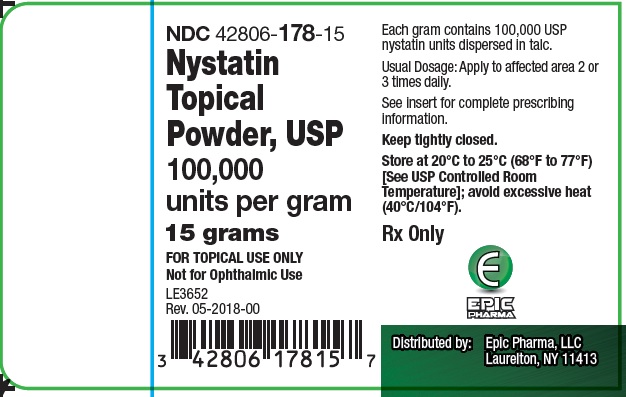
Nystatin Topical Powder 100000 U/g Powder, 30 g
🆔 Identity & classification
Where does this data come from?
🏷️ RxNorm drug class
This medicine belongs to the Polyene Antifungal class.
Where does this data come from?
🏭 Manufacturer & labeler
Where does this data come from?
🩺 Clinical
- Nystatin treats yeast infections caused by Candida. Depending on the form you're given, it can clear up a yeast infection in your mouth (thrush), on your skin, or in your gastroint...
- Shake it well, then swish it around your entire mouth — hold it there as long as you comfortably can before swallowing. If you're giving it to an infant, use the dropper to place h...
- How do I use the oral suspension correctly?
- Nystatin is generally very well tolerated. The most common complaints with the topical forms are minor — things like burning, itching, or redness right where you apply it. These ar...
Patient education
Supplement & herbal interactions
Where does this data come from?
Ask a licensed pharmacist directly — free, answered by our team.
💊 What it looks like
Where does this data come from?
🧪 Inactive Ingredients / Excipients
Inactive ingredients, also called excipients, are components of the drug product other than the active ingredient. They may include fillers, dyes, coatings, preservatives, flavors, or other formulation ingredients.
💡 Tap an ingredient (hover on desktop) to see what it is and why it’s used.
-
UNII 7SEV7J4R1U
A powder made from a naturally occurring mineral. In medicines, talc works as a glidant and anti-caking agent, helping tablets and capsules flow smoothly during manufacturing and preventing clumping.
1 inactive ingredient listed in the exact product block matched to this NDC.
Where does this data come from?
ingredient classCode="IACT" elements from the exact product block matched by this NDC. Label-section narrative from DailyMed / the openFDA label index is shown separately when available.Inactive ingredient FAQ
Are inactive ingredients the same for every manufacturer?
Why might an inactive ingredient be missing?
Can inactive ingredients matter?
💲 Pricing
A drug doesn't have one price. Each row is a different public payment system, and none is what you'd pay at the counter — that depends on your insurance. The ⓘ on each row explains what it measures.
| Price system | Per g | Per package |
|---|---|---|
| Retail pharmacies payNADAC · weekly | $0.268 | $8.05 / 30 g |
| Medicaid paysCMS SDUD · 12 mo | No recent Medicaid claims on file for this NDC — rare and low-volume NDCs are suppressed in the public data. | |
| Medicare drug plans payPart D · Q2 2026 | $0.3744 | $11.23 / 30 g |
Where does this data come from?
🔁 Therapeutic equivalents
| Product | Labeler | Pack | NADAC/unit | TE | Status | Price vs. this |
|---|---|---|---|---|---|---|
| Nystop 100000 [USP'U]/g 00574-2008-02 | Padagis | 60 g | $0.259 | AT | Availability likely | save 4% |
| Nystatin Topical Powder 100000 U/gthis 42806-0178-30 | Epic | 30 g | $0.268 | AT | FDA listed | — |
| Nystatin 100000 [USP'U]/g 75907-0060-30 | Dr. | 30 g | $0.312 | AT | Availability likely | +16% |
| Nyamyc 100000 [USP'U]/g 00832-0465-15 | Upsher-Smith | 1 bottle | $0.437 | AT | Availability likely | +63% |
| Klayesta 100000 U/g 42806-0186-15 | Epic | 15 g | $0.437 | AT | Availability likely | +63% |
| Nystatin 100000 [USP'U]/g 68382-0370-01 | Zydus | 15 g | $0.437 | AT | Availability likely | +63% |
| Nystatin 100000 [USP'U]/g 69315-0306-15 | Leading | 15 g | $0.437 | AT | Availability likely | +63% |
| Nystatin 100000 [USP'U]/g 72603-0491-01 | Northstar | 15 g | $0.437 | AT | Availability likely | +63% |
| Nystatin Topical Powder 100000 U/g 42806-0185-15 | Epic | 15 g | — | AT | FDA listed | — |
| Nystop 100000 [USP'U]/g 63629-8696-01 | Bryant | 15 g | — | AT | FDA listed | — |
| Nystop 100000 [USP'U]/g 63629-8697-01 | Bryant | 30 g | — | AT | FDA listed | — |
| Nystop 100000 [USP'U]/g 63629-8698-01 | Bryant | 60 g | — | AT | FDA listed | — |
| Nystatin 100000 [USP'U]/g 70771-1585-01 | Zydus | 15 g | — | AT | FDA listed | — |
| Nystop 100000 [USP'U]/g 71335-2845-01 | Bryant | 15 g | — | AT | FDA listed | — |
| Nystop 100000 [USP'U]/g 71335-2869-01 | Bryant | 30 g | — | AT | FDA listed | — |
| Nystop 100000 [USP'U]/g 72162-1124-02 | Bryant | 15 g | — | AT | FDA listed | — |
Where does this data come from?
⏳ Availability & generic status
This product is an FDA-approved generic. Other versions of the same drug are listed under Therapeutic equivalents, least expensive first.
Where does this data come from?
🔬 Reported adverse events (FAERS)
Top reported reactions
Age at onset
Reporter sex
Serious outcomes
Where does this data come from?
📦 Packaging — all sizes for this product
| Package NDC | Description | Per unit | Per pack | Marketing start | Status |
|---|---|---|---|---|---|
| 42806-0178-15 | 15 g in 1 BOTTLE (42806-178-15) | $0.3072 / g | $4.61 | 2018-05-02 | Active |
| 42806-0178-30 You're viewing this | 30 g in 1 BOTTLE (42806-178-30) | $0.2683 / g | $8.05 | 2018-05-02 | Active |
| 42806-0178-60 | 60 g in 1 BOTTLE (42806-178-60) | $0.2254 / g | $13.53 | 2018-05-02 | Active |
You're viewing one of 3 pack sizes for this product.
Per g, this pack runs about 19% above the cheapest pack (60 g, $0.2254 vs $0.2683 NADAC).
Pack size FAQ
What quantity is in NDC 42806-0178-30?
What is the difference between NDC 42806-0178-30 and NDC 42806-0178-15?
What NDC number is used to bill for this package of Nystatin Topical Powder 100000 U/g Powder?
Prices are the latest CMS NADAC pharmacy acquisition cost per NDC; per-pack figures are per-unit × pack quantity, shown only when the pack is denominated in the same measure NADAC prices.
📄 Full prescribing information FDA SPL
🎯 Indications and Usage ▾
INDICATIONS AND USAGE Nystatin topical powder is indicated in the treatment of cutaneous or mucocutaneous mycotic infections caused by Candida albicans and other susceptible Candida species. Nystatin topical powder is not indicated for systemic, oral, intravaginal or ophthalmic use.
⏱️ Dosage and Administration ▾
DOSAGE AND ADMINISTRATION Very moist lesions are best treated with the topical dusting powder. Adults and Pediatric Patients (Neonates and Older) Apply to candidal lesions two or three times daily until healing is complete. For fungal infection of the feet caused by Candida species, the powder should be dusted on the feet, as well as, in all foot wear.
⛔ Contraindications ▾
CONTRAINDICATIONS Nystatin topical powder is contraindicated in patients with a history of hypersensitivity to any of its components.
🤒 Adverse Reactions ▾
ADVERSE REACTIONS The frequency of adverse events reported in patients using nystatin topical powder is less than 0.1%. The more common events that were reported include allergic reactions, burning, itching, rash, eczema, and pain on application. (See PRECAUTIONS, General .)
🤰 Pregnancy ▾
Pregnancy Teratogenic Effects Category C Animal reproduction studies have not been conducted with any nystatin topical preparation. It also is not known whether these preparations can cause fetal harm when used by a pregnant woman or can affect reproductive capacity. Nystatin topical powder should be prescribed for a pregnant woman only if the potential benefit to the mother outweighs the potential risk to the fetus.
🧒 Pediatric Use ▾
Pediatric Use Safety and effectiveness have been established in the pediatric population from birth to 16 years. (See DOSAGE AND ADMINISTRATION ).
🧓 Geriatric Use ▾
Geriatric Use Clinical studies with nystatin topical powder did not include sufficient numbers of subjects aged 65 years and older to determine whether they respond differently than younger subjects. Other reported clinical experience has not identified differences in responses between elderly and younger patients, but greater sensitivity of some older individuals cannot be ruled out.
🧬 Clinical Pharmacology ▾
CLINICAL PHARMACOLOGY Pharmacokinetics Nystatin is not absorbed from intact skin or mucous membrane. Microbiology Nystatin is an antibiotic which is both fungistatic and fungicidal in vitro against a wide variety of yeasts and yeast-like fungi, including Candida albicans, C. parapsilosis, C. tropicalis, C. guilliermondi, C. pseudotropicalis, C. krusei, Torulopsis glabrata, Tricophyton rubrum, T. mentagrophytes. Nystatin acts by binding to sterols in the cell membrane of susceptible species resulting in a change in membrane permeability and the subsequent leakage of intracellular components.
On repeated subculturing with increasing levels of nystatin, Candida albicans does not develop resistance to nystatin. Generally, resistance to nystatin does not develop during therapy. However, other species of Candida (C, tropicalis, C. guilliermondi, C. krusei, and C. stellatoides) become quite resistant on treatment with nystatin and simultaneously become cross resistant to amphotericin as well.
This resistance is lost when the antibiotic is removed. Nystatin exhibits no appreciable activity against bacteria, protozoa, or viruses.
📦 How Supplied / Storage and Handling ▾
HOW SUPPLIED Nystatin topical powder, USP is supplied as 100,000 units nystatin per gram in plastic squeeze bottles. 15 g (NDC 42806-178-15) 30 g (NDC 42806-178-30) 60 g (NDC 42806-178-60)
📦 Storage and Handling ▾
STORAGE Store at 20°C to 25°C (68°F to 77°F)[see USP Controlled Room Temperature]; avoid excessive heat (40°C/104°F). Keep tightly closed. Distributed by: Epic Pharma, LLC Laurelton, NY 11413 Rev. 05-2018-00 MF178REV05/2018 OE2722
📋 Description ▾
DESCRIPTION Nystatin is a polyene antifungal antibiotic obtained from Streptomyces noursei. The molecular formula for Nystatin is C 47 H 75 NO 17 . The molecular weight of Nystatin is 926.09. Structural formula: Nystatin topical powder is for dermatologic use. Nystatin topical powder contains 100,000 USP nystatin units per gram dispersed in talc. nystatin-topical-powder-structural-formula
💬 Information for Patients ▾
Information for Patients Patients using this medication should receive the following information and instructions: 1. The patient should be instructed to use this medication as directed (including the replacement of missed doses). This medication is not for any disorder other than that for which it is prescribed.
2. Even if symptomatic relief occurs within the first few days of treatment, the patient should be advised not to interrupt or discontinue therapy until the prescribed course of treatment is completed. 3.
If symptoms of irritation develop, the patient should be advised to notify the physician promptly.