Therapeutic class — broad (HIC1)Ear/Eye/Nose/Rectum/Topical/Vagina/Other
HIC2 codeQ5
Therapeutic class — intermediate (HIC2)Agents Acting Principally On The Skin
HIC3 codeQ5F
Therapeutic class — specific (HIC3)Topical Antifungals
AHFS code08:14.28.00
AHFS classPolyene Antifungals
FDB label nameKLAYESTA 100,000 UNIT/GM POWD
FDB brand nameKlayesta
Legend statusF — Federal legend — prescription drug or device
TE code (Orange Book)AT · RLD · RS
Why two NDCs?
The FDA registers this code as 42806-186-15 — a 5-3-2 layout, and that's what's printed on the package and shown on DailyMed. For insurance claims, every NDC is standardized to a uniform 11-digit 5-4-2 format by adding a zero to the product segment → 42806-0186-15. Same drug, same package — only the format differs.
Where does this data come from?
Identifiers from the FDA openFDA NDC Directory and Structured Product Labeling; RxCUI from RxNorm (NLM); GPI from Medi-Span; GCN / HIC / AHFS / legend from First Databank.
🏷️RxNorm drug class
This medicine belongs to the Polyene Antifungal class.
Pharmacologic classPolyene Antifungal
Drug family (ATC)Antibiotics, Antibiotics, Antibiotics
Where does this data come from?
Therapeutic classes from RxNorm RxClass (U.S. National Library of Medicine) — Established Pharmacologic Class (FDA), ATC drug family (WHO) and mechanism of action, matched by this product’s RxCUI.
The labeler markets the product; the application holder owns the FDA approval. They’re often the same company but can differ (e.g. a repackager or an authorized generic). A mailing address / phone appears here when the manufacturer includes it in the product’s FDA label (not all do).
Where does this data come from?
Labeler, application holder and registered establishment from the FDA openFDA NDC Directory and Drugs@FDA; address/contact from the product’s FDA label.
🩺 Clinical
Label name KLAYESTA 100,000 UNIT/GM POWDIngredient Nystatin
📖 What it is MedlinePlus · NLM
Topical nystatin is used to treat fungal infections of the skin. Nystatin is in a class of antifungal medications called polyenes. It works by stopping the growth of fungi that cause infection.
Nystatin treats yeast infections caused by Candida. Depending on the form you're given, it can clear up a yeast infection in your mouth (thrush), on your skin, or in your gastroint...
Shake it well, then swish it around your entire mouth — hold it there as long as you comfortably can before swallowing. If you're giving it to an infant, use the dropper to place h...
How do I use the oral suspension correctly?
Nystatin is generally very well tolerated. The most common complaints with the topical forms are minor — things like burning, itching, or redness right where you apply it. These ar...
Plain-language summary from MedlinePlus (U.S. National Library of Medicine); supplement & herbal interactions and nutrient depletion data from the Natural Medicines database; our full guide is HelloPharmacist editorial content.
💬 Questions about Nystatin Topical Powder?
Ask a licensed pharmacist directly — free, answered by our team.
One label can cover several strengths, so colors may be combined — always confirm a loose pill against the dispensed prescription label or a pharmacist.
Where does this data come from?
Physical description (imprint, shape, color, scoring, coating) from this product’s FDA Structured Product Labeling (SPL), mirrored from DailyMed / openFDA.
🧪 Inactive Ingredients / Excipients
Inactive ingredients, also called excipients, are components of the drug product
other than the active ingredient. They may include fillers, dyes, coatings, preservatives, flavors,
or other formulation ingredients.
💡 Tap an ingredient (hover on desktop) to see what it is and why it’s used.
UNII 24H4NWX5CO
Kaolin is a naturally occurring clay mineral. It's used in tablets and capsules as a filler and absorbent to add bulk, improve texture, and help bind ingredients together.
UNII 70097M6I30
Magnesium stearate is a salt made from magnesium and stearic acid, a fatty substance. It's used in tablets and capsules as a lubricant and glidant to help ingredients flow smoothly during manufacturing and prevent sticking.
2 inactive ingredients listed in the exact product block matched to this NDC.
Where does this data come from?
Data sourced from official FDA Structured Product Labeling (SPL) via DailyMed — ingredient classCode="IACT" elements from the exact product block matched by this NDC. Label-section narrative from DailyMed / the openFDA label index is shown separately when available.
Inactive ingredient FAQ
Are inactive ingredients the same for every manufacturer?
No. Inactive ingredients can differ by manufacturer, dosage form, strength, and package / product version.
Why might an inactive ingredient be missing?
Some SPLs do not provide a complete structured inactive-ingredient list, and older or unusual labels may only include the information in narrative text.
Can inactive ingredients matter?
Yes. They can matter for allergies, intolerances, dyes, gluten / lactose concerns, preservatives, and formulation differences — but confirm with a pharmacist or the manufacturer when it’s clinically important.
💲 Pricing
A drug doesn't have one price. Each row is a different public payment system, and none is what you'd pay at the counter — that depends on your insurance. The ⓘ on each row explains what it measures.
Price system
Per g
Per package
Retail pharmacies payNADAC · weekly
$0.437
$6.55 / 15 g
Medicaid paysCMS SDUD · 12 mo
$0.6216
$9.32 / 15 g
Medicare drug plans payPart D · quarterly
No Part D plan price is available for this NDC in our data.
NADAC price history (per g) — tap or hover for the price & month
▼ Down 8% over the last 9 months.
Where does this data come from?
NADAC (National Average Drug Acquisition Cost) is the CMS weekly pharmacy-acquisition-cost survey — what pharmacies pay. ASP (Average Sales Price) is the CMS Medicare Part B drug-payment file, published quarterly. Medicaid pays is computed by us from CMS State Drug Utilization Data (total reimbursed ÷ units, trailing 12 months) — gross of rebates and inclusive of dispensing fees, so it reflects what Medicaid paid, not an acquisition cost. Medicare drug plans pay is the median negotiated point-of-sale unit cost across plans listing this NDC in the CMS quarterly Prescription Drug Plan pricing files, before rebates. The VA pays is the federal contract price (FSS, and the statutory Big 4 ceiling where listed) from the VA National Acquisition Center pharmaceutical price file. All are free public government data; each measures a different payer, so the figures are not directly comparable.
About this product: this is a generic version of the medicine. FDA equivalence ratings are shown when available, and other versions are listed above, least expensive first.
Where does this data come from?
Equivalents are other NDCs of the same ingredient, form and route from the openFDA NDC Directory, ranked least-expensive-first by NADAC. Therapeutic-equivalence (AB) ratings come from the FDA Orange Book; biologics use the FDA Purple Book for biosimilar & interchangeable status.
⏳ Availability & generic status
🏛️
2023
On the market since
Apr 2023
📍
2026
Currently FDA-listed
3 years listed
🔓
·
Generic on the market
this product is a generic
✅This is a generic drug
This product is an FDA-approved generic. Other versions of the same drug are listed under Therapeutic equivalents, least expensive first.
Where does this data come from?
Patents and exclusivity from the FDA Orange Book (small-molecule drugs), refreshed from public FDA data. Generic launch timing is an estimate, not a guarantee.
🗺️ Medicaid utilization & spend
📍 This exact package only: Medicaid data is reported per full 11-digit NDC — labeler, product and pack size — so every number here is for 42806-0186-15, not the drug overall. Other pack sizes report separately.
💊 Pharmacy benefit only: These are Medicaid outpatient pharmacy claims, billed by NDC. They exclude the medical benefit — clinic- or hospital-administered drugs billed under HCPCS J-codes — so drugs used mostly that way (e.g. Avastin, Lucentis, Keytruda) can look low or missing here. That’s expected, not an error.
📅 Q1 2025 – Q1 2026 · 5 quarters of data
ⓘ The newest quarter is usually incomplete when first published; states restate recent quarters in later CMS releases, so the latest figures typically revise upward. State coverage-policy changes can also shift quarter-to-quarter totals.
Prescriptions last 4 qtrs
24.1K
Units reimbursed last 4 qtrs
470.9K
Gross reimbursed last 4 qtrs
$292.7K
Avg / prescription
$12.13
Avg / unit
$0.6216
Latest quarter Q1 2026
5.1KRx
Medicaid pays / g
$0.6216
gross reimbursed
vs
NADAC / g
$0.4365
acquisition cost
=
Spread
+$0.1851
+42% vs cost
What Medicaid paid per g (before rebates; includes the pharmacy’s dispensing fee) compared with NADAC — the average price pharmacies pay to buy the drug. A positive spread means Medicaid reimbursed more than the purchase price, before manufacturer rebates.
Fee-for-service vs managed care ⓘ
28% FFS72% MCO
Fee-for-service · 6,680 Rx Managed care · 17,458 Rx
State Medicaid map
Units reimbursed · per 100k residents
13.4639
gray = no data reported ⓘ
Colors are per 100,000 residents, so big states don’t automatically dominate. Tap or hover a state for its actual totals.
Tap or hover a state
…for its Medicaid breakdown
Prescriptions—
Units—
Reimbursed—
🏆 Top states by units · per 100k residents
1New Jersey639 /100k
2Indiana553 /100k
3Ohio475 /100k
4Pennsylvania386 /100k
5Louisiana341 /100k
6Michigan316 /100k
7New York289 /100k
8Maryland259 /100k
National units — by quarter
💵 About the dollar figures: “reimbursed” is what Medicaid paid pharmacies before confidential manufacturer rebates, so the program’s real net cost is lower than these numbers. Fee-for-service and managed-care claims are combined unless split above. Source: CMS State Drug Utilization Data; per-100k rates use 2023 Census population estimates.
💊 Medicaid utilization by pack size
Medicaid (SDUD) totals over the four most recent reported quarters for every package size of this drug — handy when a specific package (e.g. a starter/titration pack) carries little or no Medicaid volume on its own.
Drug total (last 4 qtrs): 81,511 Rx · 3,670,350 units · $1,507,831 gross reimbursed
Tap a pack size to open its page. Source: CMS State Drug Utilization Data, last 4 quarters.
📊 Medicare Part D spend CMS · PART D · 2026 (Q1)
Medicare Part D (outpatient prescription) spending for Klayesta — the program that covers self-administered drugs. 1 manufacturer.
⚠️ Drug-level data: CMS publishes Part D spending by drug, not by NDC — these figures combine every manufacturer, strength and package size sold under the name Klayesta. That’s a different level of aggregation than the Medicaid card above, which is specific to this exact 11-digit NDC (pack size included), so the two aren’t directly comparable.
Period
Total Part D spend
$1.6M
Claims incl. refills
71.5K
Beneficiaries
57.9K
Spend / beneficiary
$27.54
Spend / claim
$22.32
Trend by period
💵 About the dollar figures: spending is what Part D plans paid before confidential manufacturer rebates, so the program’s real net cost is lower. A blank patient count means fewer than 11 people — CMS hides counts that small to protect privacy. Source: CMS Medicare Quarterly Part D Spending by Drug (data.cms.gov), updated quarterly.
🔬 Reported adverse events (FAERS)
Read carefully: FAERS reports are voluntary and unverified. Counts are not incidence, do not establish causation, are subject to reporting bias, and cannot be used to compare one drug to another. Shown for signal context only. Reports for Nystatin Topical Powder — the ingredient across all brands.
Top reported reactions
Fall3
Loss Of Consciousness3
Pneumonia3
Pyrexia3
Asthenia2
Cardiac Failure2
Confusional State2
Age at onset
Adult2
Elderly4
Reporter sex
Male · 28%
Female · 72%
Serious outcomes
Hospitalization12
Death1
Reports over time (by year) — tap or hover for the count & year
Most recent year is provisional (FAERS lags ~3 months).
Where does this data come from?
Adverse-event reports from the FDA Adverse Event Reporting System (FAERS) via openFDA. FAERS reports are voluntary and unverified — counts are not incidence and don’t establish causation.
You're viewing the smallest of 3 pack sizes for this product.
Per g, this pack runs about 69% above the cheapest pack (60 g, $0.2587 vs $0.4365 NADAC).
This pack accounts for about 30% of this product's recent Medicaid fills; most go to the 60 g pack. See all packs ↓
Pack size FAQ
What quantity is in NDC 42806-0186-15?
NDC 42806-0186-15 contains 15 g — 15 g in 1 bottle.
What is the difference between NDC 42806-0186-15 and NDC 42806-0186-30?
Both are KLAYESTA Nystatin Topical Powder 100000 U/g Powder — the drug itself is identical. NDC 42806-0186-15 is the 15 g package, while NDC 42806-0186-30 is the 30 g package. Per-g NADAC also differs: $0.4365 here vs $0.3119 for the 30 g pack.
What NDC number is used to bill for this package of KLAYESTA Nystatin Topical Powder 100000 U/g Powder?
Bill NDC 42806-0186-15 — the 11-digit billing format is 42806018615. Pharmacy and medical claims use the 11-digit form; the FDA label may print a shorter form of the same code.
Prices are the latest CMS NADAC pharmacy acquisition cost per NDC; per-pack figures are per-unit × pack quantity, shown only when the pack is denominated in the same measure NADAC prices.
📄 Full prescribing information FDA SPL
The complete FDA label for this product — the official prescribing information, verbatim, section by section. Jump with a chip, search within the label, or expand everything.
INDICATIONS AND USAGE KLAYESTA is indicated in the treatment of cutaneous or mucocutaneous mycotic infections caused by Candida albicans and other susceptible Candida species. KLAYESTA is not indicated for systemic, oral, intravaginal or ophthalmic use.
⏱️Dosage and Administration59 words▾
DOSAGE AND ADMINISTRATION Very moist lesions are best treated with the topical dusting powder. Adults and Pediatric Patients (Neonates and Older) Apply to candidal lesions two or three times daily until healing is complete. For fungal infection of the feet caused by Candida species, the powder should be dusted on the feet, as well as, in all foot wear.
⛔Contraindications16 words▾
CONTRAINDICATIONS KLAYESTA is contraindicated in patients with a history of hypersensitivity to any of its components.
🤒Adverse Reactions38 words▾
ADVERSE REACTIONS The frequency of adverse events reported in patients using KLAYESTA is less than 0.1%. The more common events that were reported include allergic reactions, burning, itching, rash, eczema, and pain on application. (See PRECAUTIONS, General .)
🤰Pregnancy61 words▾
Pregnancy Teratogenic Effects Animal reproduction studies have not been conducted with any KLAYESTA topical preparation. It also is not known whether these preparations can cause fetal harm when used by a pregnant woman or can affect reproductive capacity. KLAYESTA should be prescribed for a pregnant woman only if the potential benefit to the mother outweighs the potential risk to the fetus.
🧒Pediatric Use22 words▾
Pediatric Use Safety and effectiveness have been established in the pediatric population from birth to 16 years. (See DOSAGE AND ADMINISTRATION ).
🧓Geriatric Use53 words▾
Geriatric Use Clinical studies with KLAYESTA did not include sufficient numbers of subjects aged 65 years and older to determine whether they respond differently than younger subjects. Other reported clinical experience has not identified differences in responses between elderly and younger patients, but greater sensitivity of some older individuals cannot be ruled out.
🧬Clinical Pharmacology155 words▾
CLINICAL PHARMACOLOGY Pharmacokinetics KLAYESTA is not absorbed from intact skin or mucous membrane. Microbiology Nystatin is an antibiotic which is both fungistatic and fungicidal in vitro against a wide variety of yeasts and yeast-like fungi, including Candida albicans, C. parapsilosis, C. tropicalis, C. guilliermondi, C. pseudotropicalis, C. krusei, Torulopsis glabrata, Tricophyton rubrum, T. mentagrophytes. Nystatin acts by binding to sterols in the cell membrane of susceptible species resulting in a change in membrane permeability and the subsequent leakage of intracellular components.
On repeated subculturing with increasing levels of nystatin, Candida albicans does not develop resistance to nystatin. Generally, resistance to nystatin does not develop during therapy. However, other species of Candida (C, tropicalis, C. guilliermondi, C. krusei, and C. stellatoides) become quite resistant on treatment with nystatin and simultaneously become cross resistant to amphotericin as well.
This resistance is lost when the antibiotic is removed. Nystatin exhibits no appreciable activity against bacteria, protozoa, or viruses.
📦How Supplied / Storage and Handling38 words▾
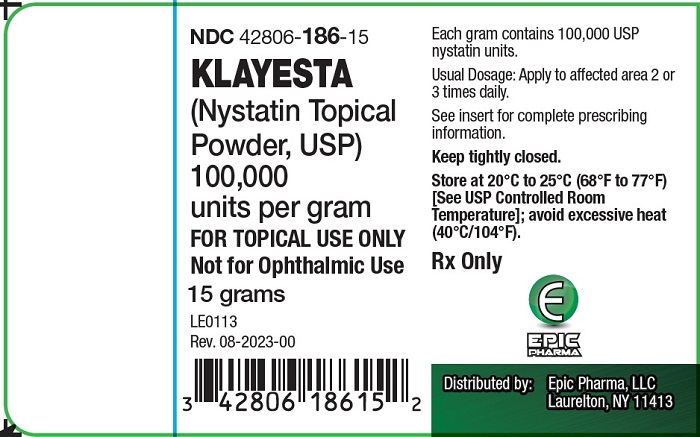
HOW SUPPLIED KLAYESTA (nystatin topical powder, USP) is off-white to light yellow powder, and is supplied as 100,000 units nystatin per gram in plastic squeeze bottles. 15 g (NDC 42806-186-15) 30 g (NDC 42806-186-30) 60 g (NDC 42806-186-60)
📦Storage and Handling33 words▾
STORAGE Store at 20°C to 25°C (68°F to 77°F) [see USP Controlled Room Temperature]; avoid excessive heat (40°C/104°F). Keep tightly closed. Distributed by: Epic Pharma, LLC Laurelton, NY 11413 Rev. 06-2025-00 MF186REV06/25 OS0017
📋Description54 words▾
DESCRIPTION Nystatin is a polyene antifungal antibiotic obtained from Streptomyces noursei. The molecular formula for Nystatin is C 47 H 75 NO 17 . The molecular weight of Nystatin is 926.09. Structural formula: KLAYESTA is for dermatologic use. KLAYESTA contains 100,000 USP nystatin units per gram. Inactive ingredients: magnesium stearate and light kaolin. structural-formula.jpg
💬Information for Patients95 words▾
Information for Patients Patients using this medication should receive the following information and instructions: 1. The patient should be instructed to use this medication as directed (including the replacement of missed doses). This medication is not for any disorder other than that for which it is prescribed.
2. Even if symptomatic relief occurs within the first few days of treatment, the patient should be advised not to interrupt or discontinue therapy until the prescribed course of treatment is completed. 3.
If symptoms of irritation develop, the patient should be advised to notify the physician promptly.
No label section mentions that — try another word, or open the full label on DailyMed below.
Glossary — plain-language definitions of medical terms used in this label:
contraindicated: Should not be used in that situation, because the risk is considered too high.
in vitro: In a laboratory dish or test tube rather than in a living person or animal; results may not carry over to people.
Adverse Reactions: Unwanted or harmful effects that people experienced while taking a medicine, listed on its official label.
animal reproduction studies: Tests in pregnant animals used to check whether a medicine might harm a developing baby.
Clinical Pharmacology: The label section explaining how a medicine works in the body and how the body processes it.
Clinical Studies: The label section summarizing the research trials used to show that a medicine works and is acceptably safe.
Contraindications: A list of situations or health conditions in which a medicine should not be used because the chance of harm is too high.
Dosage and Administration: The label section explaining how much of a medicine to use and how to take or give it.
fetal harm: Injury or damage to a developing baby while it is growing inside the womb.
fungal infection: An infection caused by a fungus, such as a yeast or mold, rather than by bacteria or a virus.
hypersensitivity: An overreaction of the body's defense system to a substance, causing symptoms such as rash, swelling, or trouble breathing.
Indications and Usage: The label section stating which medical conditions the FDA has officially approved the medicine to treat, prevent, or manage.
mucocutaneous: Involving both the skin and the moist linings of the body, such as the mouth, eyes, or nose.
NDC: A unique number that identifies a specific medicine, its maker, strength, and package size.
Pharmacokinetics: The study of how the body takes in a medicine, spreads it around, breaks it down, and removes it over time.
teratogenic: Able to cause physical birth defects in a developing baby when a medicine is taken during pregnancy.
topical: Applied onto the skin, eyes, or another body surface to work mainly where it is placed.
Source: FDA Structured Product Labeling, mirrored from DailyMed / openFDA.
Prefer the government’s original formatting? View this label on DailyMed ↗
For educational and professional reference only — not medical advice. Pricing reflects published
NADAC and CMS ASP (free public data) and may differ from your acquisition cost; always verify before billing or dispensing.