
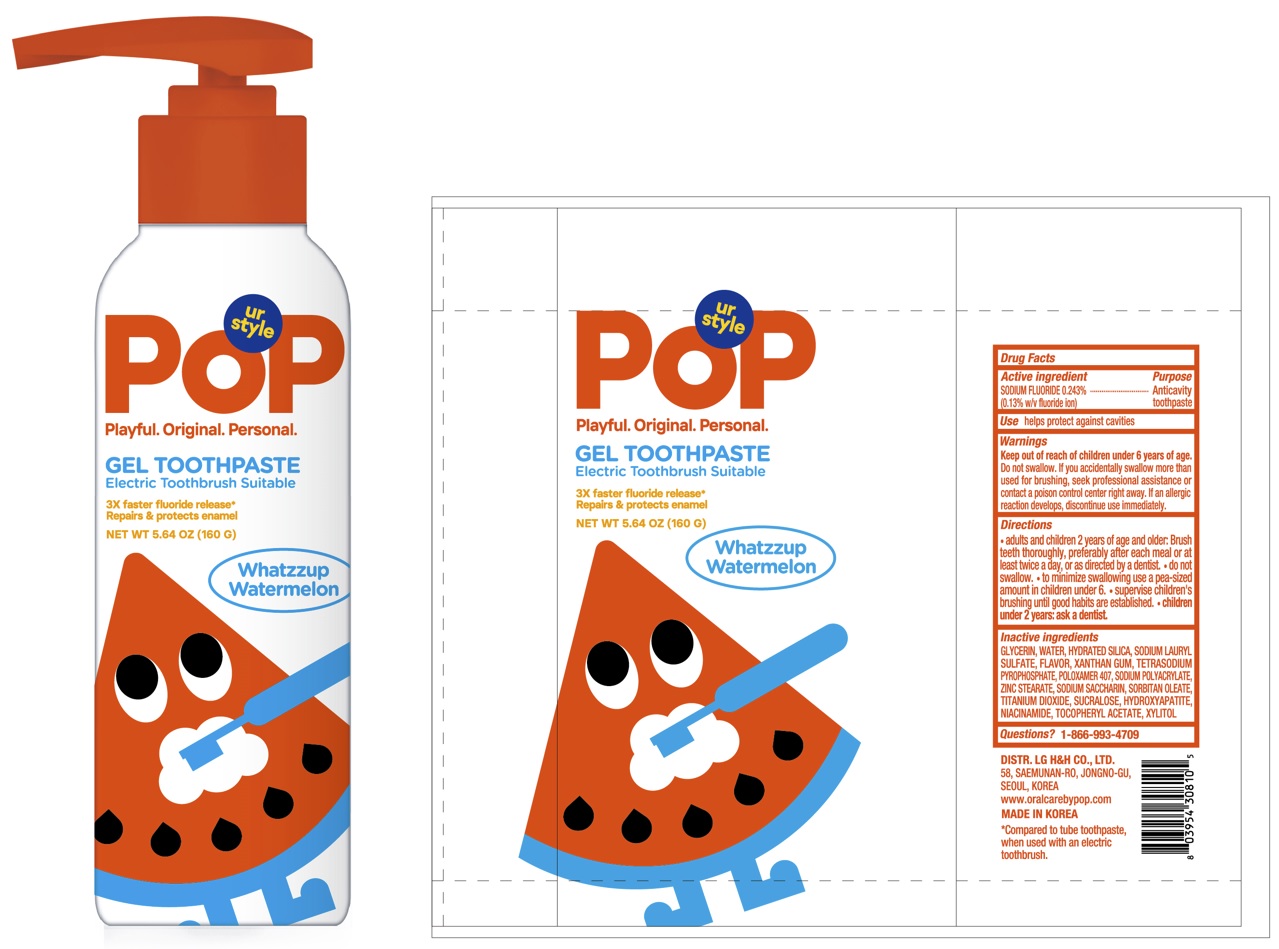
POP Gel Whatzzup Watermelon Sodium Fluoride 1.3 mg/g Paste, Dentifrice
🆔 Identity & classification
Where does this data come from?
🏷️ RxNorm drug class
This medicine belongs to the Caries prophylactic agents class.
Where does this data come from?
🏭 Manufacturer & labeler
Where does this data come from?
🩺 Clinical
Fluoride is used to prevent tooth decay. It is taken up by teeth and helps to strengthen teeth, resist acid, and block the cavity-forming action of bacteria. Fluoride usually is prescribed for children and adults whose homes have water that is not fluoridated (already has fluoride added). This medication is sometimes prescribed for other uses; ask your doctor or pharmacist for more information.
Read the full MedlinePlus article ↗POP Gel Whatzzup Watermelon is an over-the-counter toothpaste containing sodium fluoride as its active ingredient. This product is formulated as a fluoride dentifrice for topical application to teeth during brushing. Sodium fluoride is commonly included in toothpastes and other oral care products to help strengthen tooth enamel and reduce cavity formation. This is an OTC monograph drug, meaning it is marketed under established FDA regulations for fluoride dentifrices rather than through an individual product application.
Patient education
Supplement & herbal interactions
Where does this data come from?
Ask a licensed pharmacist directly — free, answered by our team.
💊 What it looks like
Where does this data come from?
🧪 Inactive Ingredients / Excipients
Inactive ingredients, also called excipients, are components of the drug product other than the active ingredient. They may include fillers, dyes, coatings, preservatives, flavors, or other formulation ingredients.
💡 Tap an ingredient (hover on desktop) to see what it is and why it’s used.
-
UNII WR1WPI7EW8
A synthetic form of vitamin E used as an antioxidant. It prevents oils and fats in the medicine from breaking down and becoming rancid, helping keep the product stable during storage.
-
UNII PDC6A3C0OX
Glycerin is a clear, thick liquid derived from plant oils or fats. It acts as a humectant to retain moisture, a sweetener, and a solvent in medications.
-
UNII Y6O7T4G8P9
Hydrated silica is a fine powder form of silicon dioxide with absorbed water. It works as an anti-caking agent and absorbent in medicines, helping powders stay free-flowing and preventing clumping.
-
UNII 25X51I8RD4
Niacinamide is a form of vitamin B3, a water-soluble nutrient. In medicines, it may be added as a nutritional supplement or to support skin health, though its primary role here is as an active ingredient rather than a traditional inactive filler.
-
UNII TUF2IVW3M2
Poloxamer 407 is a synthetic polymer made from ethylene oxide and propylene oxide. In medicines, it acts as a thickener, emulsifier, and solubilizer to help mix ingredients and create the right texture.
-
UNII SB8ZUX40TY
Saccharin sodium is an artificial sweetener made from saccharin salt. It's added to medicines to improve taste, especially in liquid formulations for children or bitter drugs.
-
UNII 368GB5141J
A detergent and foaming agent derived from coconut or palm oil. In medications, it helps break down and mix oil and water-based ingredients, aids in tablet disintegration, and improves how the drug dissolves and spreads in the mouth or digestive system.
-
UNII 285CYO341L
Sodium polyacrylate is a synthetic polymer that absorbs and holds water. In medicines, it acts as a disintegrant, helping tablets break apart quickly in the stomach, and as a binder, holding tablet ingredients together.
-
UNII O352864B8Z
A sodium salt compound used in medicines as a buffering agent to maintain pH stability and as a chelating agent to prevent unwanted chemical reactions during storage and mixing.
-
UNII 06XEA2VD56
Sorbitan oleate is an emulsifier derived from sorbitol and oleic acid. It helps mix oil and water-based ingredients together and keeps them from separating in the medicine.
-
UNII 96K6UQ3ZD4
Sucralose is a synthetic sweetener made from sugar. It's added to medicines to improve taste without adding calories, helping make bitter or unpleasant-tasting drugs easier to take.
-
UNII 15FIX9V2JP
Titanium dioxide is a bright white mineral powder commonly used as a colorant and opacifying agent. It makes pills and tablets white or lighter in color and helps make coatings non-transparent.
-
UNII 91D9GV0Z28
A mineral salt made from calcium and phosphate. It acts as a filler to add bulk to the tablet or capsule, and helps bind ingredients together so the medicine holds its shape.
-
UNII 059QF0KO0R
Water is a liquid solvent that dissolves and mixes ingredients together in liquid medicines, syrups, and injections. It helps distribute the active drug evenly throughout the product.
-
UNII TTV12P4NEE
Xanthan gum is a thickening and stabilizing ingredient made from fermented corn or other sugars. It's added to medicines to improve texture, prevent separation of liquids and solids, and help the product stay consistent.
-
UNII VCQ006KQ1E
Xylitol is a naturally occurring sugar alcohol derived from plants. It's used in medicines as a sweetener, bulking agent, and to improve taste, especially in liquid formulations and chewable tablets.
-
UNII H92E6QA4FV
Zinc stearate is a fine white powder made from zinc and stearic acid. It works as a lubricant and glidant to help the tablet or capsule move smoothly through manufacturing equipment and prevents sticking.
17 inactive ingredients listed in the exact product block matched to this NDC.
Label-section wording can be broader than the structured product block and may mention additional formulation ingredients.
Where does this data come from?
ingredient classCode="IACT" elements from the exact product block matched by this NDC. Label-section narrative from DailyMed / the openFDA label index is shown separately when available.Inactive ingredient FAQ
Are inactive ingredients the same for every manufacturer?
Why might an inactive ingredient be missing?
Can inactive ingredients matter?
💲 Pricing
A drug doesn't have one price. Each row is a different public payment system, and none is what you'd pay at the counter — that depends on your insurance. The ⓘ on each row explains what it measures.
| Price system | Per g | Per package |
|---|---|---|
| Retail pharmacies payNADAC · weekly | Not in the retail survey — common for institutional, discontinued, or low-volume packs. | |
| Medicaid paysCMS SDUD · 12 mo | No recent Medicaid claims on file for this NDC — rare and low-volume NDCs are suppressed in the public data. | |
| Medicare drug plans payPart D · quarterly | No Part D plan price is available for this NDC in our data. | |
Where does this data come from?
🔁 Therapeutic equivalents
Where does this data come from?
⏳ Availability & generic status
We did not find an FDA-approved generic match for this exact strength, form and route.
Where does this data come from?
📦 Packaging — all sizes for this product
| Package NDC | Description | Marketing start | Status |
|---|---|---|---|
| 43136-0522-60 You're viewing this | 1 TUBE in 1 CARTON (43136-522-60) / 160 g in 1 TUBE | 2023-09-18 | Active |
🧭 About this NDC listing & data coverage
What data is (and isn’t) available for this NDC — tap to expand
| NDC identity (package / product / labeler codes) | ✓ Available |
| Labeler | ✓ Available |
| Product & package description | ✓ Available |
| Marketing category & status | ✓ Available |
| Active ingredient / dosage form / route | ✓ Available |
| FDA label (SPL via DailyMed) | ✓ Available |
| Package photos | ✓ Available |
| Inactive ingredients (structured) | ✓ Available |
| NADAC pharmacy acquisition price (CMS) | — Not published for this NDC CMS publishes NADAC only for NDCs reported in its retail-pharmacy survey. |
| Orange Book / therapeutic-equivalence data | — Not published for this NDC Applies only to products approved under an NDA/ANDA; many listings are out of scope. |
| HCPCS J-code billing crosswalk | — Not published for this NDC Most self-administered / retail products have no J-code — that is normal. |
| Medicaid utilization (CMS SDUD) | — Not published for this NDC CMS reports utilization only for NDCs with Medicaid claims above its privacy threshold. |
Questions about this listing
Is this NDC FDA-approved?
Why is there no price listed?
Is the NDC printed on the package the same as the 11-digit billing NDC?
What do the three segments of this NDC mean?
Is this package still being marketed?
Who lists this product with the FDA?
Do I need a prescription for this product?
Where does this data come from?
📄 FDA label — Drug Facts FDA SPL
🎯 Indications and Usage ▾
Use helps protect against cavities
⏱️ Dosage and Administration ▾
Directions adults and children 2 years of age and and older: Brush teeth thoroughly, preferably after each meal or at least twice a day, or as directed by a dentist. do not swallow. to minimize swallowing use a pea-sized amount in children under 6. supervise children's brushing until good habits are established. children under 2 years: ask a dentist.
⚠️ Warnings ▾
Warnings Warnings Keep out of reach of children. Keep out of reach of children under 6 years of age. Do not swallow. If you accidentally swallow more than used for brushing, seek professional assistance or contact a poison control center right away. If an allergic reaction develops, discontinue use immediately.
🧪 Active Ingredient ▾
Active Ingredient SODIUM FLUORIDE 0.243% (0.13% w/v fluoride ion)
🧪 Inactive Ingredients ▾
Inactive Ingredients GLYCERIN, WATER, HYDRATED SILICA, SODIUM LAURYL SULFATE, FLAVOR, XANTHAN GUM, TETRASODIUM PYROPHOSPHATE, POLOXAMER 407, SODIUM POLYACRYLATE, ZINC STEARATE, SODIUM SACCHARIN, SORBITAN OLEATE, TITANIUM DIOXIDE, SUCRALOSE, HYDROXYAPATITE, NIACINAMIDE, TOCOPHERYL ACETATE, XYLITOL
🎯 Purpose ▾
Purpose Anticavity toopaste