
AlbuRx ALBUMIN (HUMAN) 12.5 g/50mL Solution — NDC 44206-251-10 (Billing 44206-0251-10)
This is a package of AlbuRx ALBUMIN (HUMAN) 12.5 g/50mL Solution from CSL Behring AG, marketed since Jan 2009 and currently FDA-listed. It is the main listing for this product, which comes in 2 package sizes.
NDC database record
One package, one record: these facts belong to NDC 44206-251-10 alone.
- Record
- FDA NDC Directory package listing · Plasma derivative
- Code segments
- 44206 labeler · 251 product · 10 package
- Package marketed since
- Jan 6, 2009
- Sample package
- No — commercial package
- Listing certified through
- Dec 31, 2026
- Barcode (UPC-A, from the NDC)
- 3 4420625110 2
- Medicaid fills, this package
- 3,418 prescriptions in the last four reported quarters
- FDA record last changed
- Oct 8, 2026
Identity & classification
Regulatory identifiers FDA, NLM and CMS codes for this package
Drug-database identifiers Medi-Span GPI and First Databank GCN / HICL / AHFS classification
- GSN (GCN sequence number): 006331
- GCN: 25060
- GPI-14 (Medi-Span): 85400010002015
- HICL (First Databank): 002728
- AHFS class code: 16:00.00.00
Where does this data come from?
- FDA openFDA NDC Directory · synced Oct 8, 2026
- FDA label on DailyMed · label index refreshed Oct 8, 2026
- RxNorm (NLM RxNav) · catalog refreshed Oct 1, 2026
- Medi-Span GPI (licensed)
- First Databank (licensed) · refreshed Oct 8, 2026
Clinical
Patient education
Supplement & herbal interactions
Where does this data come from?
- MedlinePlus (NLM) · refreshed Oct 8, 2026
- FDA label on DailyMed · label index refreshed Oct 8, 2026
Ask a licensed pharmacist directly — free, answered by our team.
Pricing
A drug doesn't have one price. Each row is a different public payment system, and none is what you'd pay at the counter — that depends on your insurance. The ⓘ on each row explains what it measures.
| Price system | Per mL | Per package |
|---|---|---|
| Retail pharmacies payNADAC · weekly | Not in the retail survey — common for institutional, discontinued, or low-volume packs. | |
| Medicaid paysCMS SDUD · 12 mo | $0.7991 | $79.91 / 100 ml |
| Medicare drug plans payPart D · quarterly | No Part D plan price is available for this NDC in our data. | |
Where does this data come from?
- CMS NADAC weekly file
- CMS ASP pricing files · refreshed Sep 20, 2026
- CMS Medicaid State Drug Utilization Data · through Q1 2026
- CMS Part D plan pricing files · refreshed Sep 24, 2026
- VA National Acquisition Center price file
Packaging — all sizes for this product
| Package NDC | Description | Marketing start | Marketing end | Status |
|---|---|---|---|---|
| 44206-0251-05 44206-251-05 | 1 VIAL, GLASS in 1 CARTON / 50 mL in 1 VIAL, GLASS | 2009-01-06 | — | Active |
| 44206-0251-10 You're viewing this Main listing | 1 VIAL, GLASS in 1 CARTON / 100 mL in 1 VIAL, GLASS | 2009-01-06 | — | Active |
In Medicaid, this is the most-dispensed pack of this product — about 68% of fills over the last four reported quarters. See all packs ↓
Pack size FAQ
What quantity is in this package?
What NDC number is used to bill for this package of AlbuRx ALBUMIN (HUMAN) 12.5 g/50mL Solution?
Therapeutic equivalents
| Product | Labeler | Pack | NADAC/unit | TE | Status | Price vs. this |
|---|---|---|---|---|---|---|
| AlbuRx 12.5 g/50mLthis 44206-0251-10 | CSL | 1 vial | — | — | FDA listed | — |
| Kedbumin 12.5 g/50mL 76179-0025-02 | Kedrion | 1 vial | — | — | FDA listed | — |
| Albutein 12.5 g/50mL 68516-5216-00 | GRIFOLS | 100 ml | — | — | FDA listed | — |
Where does this data come from?
- FDA openFDA NDC Directory · synced Oct 8, 2026
- FDA Purple Book · refreshed Oct 5, 2026
- CMS NADAC weekly file
Availability & biosimilar status
Biologics have no small-molecule generics; biosimilar competition is tracked in the FDA Purple Book.
Where does this data come from?
- FDA Purple Book · refreshed Oct 5, 2026
Inactive Ingredients / Excipients
Inactive ingredients, also called excipients, are components of the drug product other than the active ingredient. They may include fillers, dyes, coatings, preservatives, flavors, or other formulation ingredients.
💡 Tap an ingredient (hover on desktop) to see what it is and why it’s used.
-
UNII 3EN9H0M2FX
A salt form of an amino acid derivative used as a solubilizer and stabilizer in liquid and injectable formulations. It helps keep active ingredients dissolved and protected from degradation during storage.
-
UNII 660YQ98I10
Potassium chloride is a mineral salt used in medicines as a buffer and to help maintain the proper pH balance and stability of the formulation during storage and use.
-
UNII 9XTM81VK2B
Sodium caprylate is a salt derived from caprylic acid, a naturally occurring fatty acid. In medicines, it acts as a preservative and antimicrobial agent to help prevent contamination and extend shelf life.
-
UNII 451W47IQ8X
Sodium chloride is common table salt. It's used in medicines as a buffer to maintain proper pH, as a filler to add bulk, or to adjust the osmotic balance in liquid formulations.
4 inactive ingredients listed in the exact product block matched to this NDC.
Where does this data come from?
ingredient classCode="IACT" elements from the exact product block matched by this NDC. Label-section narrative from DailyMed / the openFDA label index is shown separately when available.- FDA label on DailyMed · label index refreshed Oct 8, 2026
- FDA openFDA NDC Directory · synced Oct 8, 2026
Inactive ingredient FAQ
Are inactive ingredients the same for every manufacturer?
Why might an inactive ingredient be missing?
Can inactive ingredients matter?
Manufacturer & labeler
More NDCs from CSL Behring AG labeler code 44206
- Rhophylac HUMAN RHO(D) IMMUNE GLOBULIN 1500 [iU]/2mL Solution NDC 44206-300-01
- ALBURX ALBUMIN (HUMAN) 12.5 g/250mL Solution NDC 44206-310-25
- Privigen Human Immunoglobulin G 5 g/50mL Liquid NDC 44206-436-05
- Privigen Human Immunoglobulin G 10 g/100mL Liquid NDC 44206-437-10
- Privigen Human Immunoglobulin G 20 g/200mL Liquid NDC 44206-438-20
- Privigen Human Immunoglobulin G 40 g/400mL Liquid NDC 44206-439-40
Where does this data come from?
- FDA openFDA NDC Directory · synced Oct 8, 2026
- Drugs@FDA
Full FDA label FDA SPL
🎯 Indications and Usage ▾
3. INDICATIONS AND USAGE
3.1General Principles 17 3.1.1 Volume Deficit Since the oncotic pressure of AlbuRx ® 25, Albumin (Human) 25% solution is about four times higher than that of normal human serum, it will expand the plasma volume if interstitial water is available for an inflow through the capillary walls. However, many patients suffering from an acute volume deficit also have some degree of interstitial dehydration. In the absence of hyperhydration, the treatment of an acute volume deficit with AlbuRx ® 25 should therefore include isotonic electrolyte solutions with an albumin:electrolyte ratio of 1:3 or 1:4.
By contrast, chronic volume deficits have usually been at least partially compensated for by the renal retention of sodium and water with some degree of tissue edema, and in these circumstances a trial with AlbuRx ® 25 only is indicated. In any case, an anemia of clinically relevant magnitude requires specific treatment, and the metabolic needs of the patient with respect to fluid and electrolytes must be cared for. 3.1.2 Oncotic Deficit The common causes of hypoproteinemia are protein-calorie malnutrition, defective absorption in gastro-intestinal disorders, faulty albumin synthesis in chronic hepatic failure, increased protein catabolism postoperatively or with sepsis, and abnormal renal losses of albumin with chronic kidney disease.
In all these settings, the circulating albumin mass is initially maintained by a gradual transfer of extravascular albumin to the circulation, and hypoproteinemia ensues only when this compensatory potential has been exhausted. This implies that manifest hypoproteinemia is usually accompanied by a hidden extravascular albumin deficit of equal magnitude as the measurable intravascular deficit, which must be allowed for if AlbuRx ® 25, Albumin (Human) 25% solution is infused because of the capillary permeability of that protein.
The primary sequel of the oncotic deficit resulting from hypoproteinemia is a loss of plasma and a gain of interstitial volume with increased lymphatic flow. As a secondary response, the kidney retains sodium and water which distribute themselves on both sides of the capillary walls and the plasma volume may be returned almost to normal when the interstitial hydrostatic pressure increases sufficiently to compensate for the decrease of the serum oncotic pressure. This chain of events is accelerated by the infusion of crystalloid fluids.
The plasma volume is maintained at the price of interstitial edema. 2 There is some evidence that a serum oncotic pressure near 20 mmHg – equaling a total serum protein (TSP) concentration of 5.2 g/100 mL – represents a threshold, below which the risk of complications increases. 17 The target organs of hypoproteinemia include the skin, the lungs, and the intestine.
10 Cutaneous edema lowers the oxygen tension of wounds and may thus impair the healing process. 5 An oncotic deficit favors the development of interstitial pulmonary edema 4 and the intestinal accumulation of fluids, which may progress to a paralytic ileus. 9 Relief of the basic pathology is the definitive mode of therapy for the restoration of the plasma protein content, but this process takes time to become effective, and the rapid correction of a critical oncotic deficit by the administration of AlbuRx ® 25, Albumin (Human) 25% solution – possibly in conjunction with a diuretic – may therefore be indicated, particularly in high-risk patients who have undergone abdominal, cardio-vascular, thoracic, or urologic surgery or who have acute bacteremia.
In notably catabolic patients, attempts to raise the TSP level above 6 g/100 mL usually prove futile, even with massive doses of Albumin (Human). 17 It is emphasized that whereas AlbuRx ® 25, Albumin (Human) 25% solution may be necessary to prevent or treat the aforementioned acute complications of hypoproteinemia, it is not indicated for treatment of the chronic condition itself.
3.2Specific Indications 17 3.2.1 Acute ci… [Excerpted — this section continues on DailyMed.]
⏱️ Dosage and Administration ▾
8. DOSAGE AND ADMINISTRATION AlbuRx ® 25, Albumin (Human) 25% solution must be administered intravenously. The venipuncture site should not be infected or traumatized, and should be prepared with standard aseptic technique.
The solution is compatible with whole blood or packed red cells as well as the usual electrolyte and carbohydrate solutions intended for intravenous use. By contrast, it should not be mixed with protein hydrolysates, amino acid mixtures, or solutions containing alcohol. It is ready for use as contained in the bottle and may be given without regard to the blood group of the recipient.
The dosage of AlbuRx ® 25, Albumin (Human) 25% solution is based on the principles outlined in the section on indications but should always be adapted to the individual situation. The quantities required may be underestimated because of hidden extravascular deficits, and the effect of AlbuRx ® 25 infusion on the serum protein level should therefore be checked by laboratory analysis.
8.1Volume Deficit The appropriate AlbuRx ® 25, Albumin (Human) 25% solution dose for the treatment of a volume deficit should be estimated from the recipient's hemodynamic response 7 , supplemented with the established safeguards against a circulatory overload. In the absence of active hemorrhage, the total dose should at any rate not exceed the normal circulating albumin mass, i.e. 2 g per kg body weight.
8.2Oncotic Deficit The appropriate AlbuRx ® 25, Albumin (Human) 25% solution dose in grams of protein for the correction of an oncotic deficit can, as an average, be estimated from the difference between the desired and the actual TSP level x plasma volume (~40 mL/kg) × 2, the latter factor allowing for the hidden extravascular deficit. The individual effect is, however, variable and should be checked by measuring the post-infusion TSP level. 10,17
8.3Hemolytic Disease of the Newborn The appropriate AlbuRx ® 25, Albumin (Human) 25% solution dose for the binding of free serum bilirubin in severely hemolytic infants is 1 g/kg body weight, to be given about one hour prior to the exchange transfusion, and caution is recommended in hypervolemic infants. Parenteral drug products should be inspected visually for particulate matter and discoloration prior to administration, whenever solution and container permit.
⛔ Contraindications ▾
4. CONTRAINDICATIONS The only specific contraindication to the use of AlbuRx ® 25, Albumin (Human) 25% solution is a history of an incompatibility reaction to Albumin (Human) in the individual recipient (see ADVERSE REACTIONS ).
⚠️ Warnings ▾
5. WARNINGS AlbuRx ® 25, Albumin (Human) 25% solution is made from human plasma. Products made from human plasma may contain infectious agents, such as viruses, that can cause disease.
The risk that such products will transmit an infectious agent has been extremely reduced by screening plasma donors for prior exposure to certain viruses, by testing for the presence of certain current virus infections, and by inactivating and/or removing certain viruses through alcohol fractionation and through heat treatment of the product in the final container for 10 hours at 60°C. Despite these measures, such products can still potentially transmit disease. A theoretical risk for transmission of Creutzfeldt-Jakob Disease (CJD) is considered extremely remote.
No cases of transmission of viral diseases or CJD have ever been identified for Albumin (Human). There is also the possibility that unknown infectious agents may be present in such products. All infections thought by a physician possibly to have been transmitted by this product should be reported by the physician or other healthcare provider to CSL Behring at 1-800-504-5434.
The physician should discuss the risks and benefits of this product with the patient. Turbid solutions must not be used. Do not begin administration more than 4 hours after introduction of the administration set.
Partially used bottles must be discarded. There exists a risk of potentially fatal hemolysis and acute renal failure from the inappropriate use of sterile water for injection as a diluent for AlbuRx ® 25, Albumin (Human) 25% solution. Acceptable diluents include 0.9% sodium chloride or 5% dextrose in water.
🤒 Adverse Reactions ▾
7. ADVERSE REACTIONS Since AlbuRx ® 25, Albumin (Human) 25% solution is sterile when coming from the manufacturer, bacterial contamination with the risk of post-infusion septicemia can only occur if the container has been damaged or following puncture of the rubber cap (see WARNINGS ). Though very rare, non-septic incompatibility reactions including nausea, chills, fever, urticaria, headache and hypotension following the administration of albumin-containing preparations have been recorded.
8,11,12,17 A favorable response was observed to the intravenous administration of 50 to 100 mg of prednisolone. 12
🤰 Pregnancy ▾
Pregnancy Category C Animal reproduction studies have not been conducted with AlbuRx ® 25, Albumin (Human) 25% solution. It is also not known whether AlbuRx ® 25 can cause fetal harm when administered to a pregnant woman or can affect reproduction capacity. AlbuRx ® 25 should be given to a pregnant woman only if clearly needed.
There is, however, no evidence for any contraindication to the use of AlbuRx ® 25 specifically associated with reproduction, pregnancy or the fetus. Use an intravenous infusion set suitable for the infusion of blood and blood products.
🧬 Clinical Pharmacology ▾
2. CLINICAL PHARMACOLOGY 13,17
2.1AlbuRx ® 25, Albumin (Human) 25% solution should not be used as an intravenous nutrient because of the slow breakdown and relatively unfavorable composition of the albumin molecule with respect to its content of essential amino acids. Oral provision of proteins or an intravenous regimen providing adequate calories and a suitable amino acid mixture are the methods of choice for the treatment of protein malnutrition as such, though they do not permit the rapid correction of hypoproteinemia.
2.2The binding properties of albumin may provide an indication for its use in severe hemolytic disease of the newborn, where it may lower the plasma concentration of free bilirubin pending an exchange transfusion. This effect is possibly also relevant in certain cases of acute liver failure with rapidly increasing levels of serum bilirubin, particularly in the presence of severe hypoproteinemia.
2.3The colloid osmotic or oncotic properties of albumin at this moment constitute the predominant reason for its clinical use. The rationale for this is the Starling concept of the capillary balance of hydrostatic and oncotic pressure gradients across the capillary walls as the determinant of the fluid – i.e. volume – distribution between the intravascular and the interstitial compartment. 16 The two main indications for the use of AlbuRx ® 25, Albumin (Human) 25% solution are therefore a plasma or blood volume deficit and the oncotic deficit resulting from hypoproteinemia.
The 25% concentration is oncotically equivalent to approximately five times its volume of normal human plasma. The effective colloid osmotic pressure of the serum proteins depends very largely on the relatively small and numerous albumin molecules, which therefore play a decisive role in the maintenance of the circulating plasma volume.
📦 How Supplied / Storage and Handling ▾
9. HOW SUPPLIED AlbuRx ® 25, Albumin (Human) 25% solution is supplied in 50 mL (NDC 44206-251-05) and 100 mL (NDC 44206-251-10) vials, with complete directions for use.
📦 Storage and Handling ▾
10. STORAGE AlbuRx ® 25, Albumin (Human) 25% solution should be stored at a temperature not exceeding 30°C (86°F). It should not be used after the expiration date printed on the label.
📋 Description ▾
1. DESCRIPTION AlbuRx ® 25, Albumin (Human) 25% solution is a sterile aqueous solution for intravenous administration containing the albumin component of human blood. This product is prepared from the plasma of US donors.
The product has been produced by alcohol fractionation and has been heated for 10 hours at 60°C for inactivation of infectious agents. The results of virus validation studies have shown that the manufacturing process, particularly alcohol fractionation, eliminates enveloped and non-enveloped viruses. Additionally, heat treatment at 60°C for a period of 10 hours efficiently inactivates viruses.
The solution contains 130-160 milliequivalents of sodium per liter (mEq/L) and the potassium content is not over 2 mEq/L. The aluminum content does not exceed 200 µg/L. The solution is stabilized with 0.08 millimole of sodium acetyltryptophanate plus 0.08 millimole of sodium caprylate per gram of albumin.
The solution contains no preservative.
⚠️ Precautions ▾
6. PRECAUTIONS Adequate precautions should be taken against circulatory overload and may include pulmonary auscultation or X-ray as well as monitoring the central venous or pulmonary artery wedge pressure. Special caution is indicated in patients with stabilized chronic anemia, congestive heart failure and renal insufficiency.
Pregnancy Category C Animal reproduction studies have not been conducted with AlbuRx ® 25, Albumin (Human) 25% solution. It is also not known whether AlbuRx ® 25 can cause fetal harm when administered to a pregnant woman or can affect reproduction capacity. AlbuRx ® 25 should be given to a pregnant woman only if clearly needed.
There is, however, no evidence for any contraindication to the use of AlbuRx ® 25 specifically associated with reproduction, pregnancy or the fetus. Use an intravenous infusion set suitable for the infusion of blood and blood products.
📚 References ▾
REFERENCES Birke G, Liljedahl SO, Plantin LO, Reizenstein P. Acta Chir. Scand .
1968;134:27. Cervera AL, Moss G. J.
Trauma . 1974;14:506. Clowes GH Jr, Vucinic M, Weidner MG.
Ann. Surg . 1966;163:866.
Gaar KA Jr, Taylor AE, Owens LJ, Guyton AC. Amer. J.
Physiol . 1967;213:79. Heughan C, Niinikoski J, Hunt TK.
Surg. Gynec. Obstet .
1972;135:257. Hoye RC, Paulson DF, Ketcham AS. Surg.
Gynec. Obstet . 1970;131:943.
Kinney JM, Egdahl RH, Zuidema GD. Manual of Preoperative and Postoperative Care, American College of Surgeons . Philadelphia: W.
B. Saunders Co; 1971. Lowenstein E.
In: Sgouris JT, René A, ed. Proceedings of the Workshop on Albumin, February 12–13 . Bethesda, Maryland 20014: DHEW Publication NIH 76-925, NHLI; , p.
302, 1975. Moss G. Surg.
Forum . 1967;18:333. Pappova E, Bachmeier W, Crevoisier JL, Kollar J, Kollar M, Tobler P, Zahler HW, Zaugg D, Lundsgaard-Hansen P.
Vox Sang . 1977;33:307. Ring J, Messmer K.
Lancet . 1977;1:466. Ring J, Seifert J, Lob G, Coulin K, Brendel W.
Klin. Wschr . 1974;52:595.
Sgouris JT, René A, ed. Proceedings of the Workshop on Albumin, February 12–13 . Bethesda, Maryland 20014: DHEW Publication NIH 76-925, NHLI; 1975.
Skillman JJ, Parikh BM, Tanenbaum BJ. Amer. J.
Surg . 1970;119:440. Skillman JJ, Tanenbaum BJ.
Current Topics in Surgical Research . New York: Academic Press; 1970;2:523. Starling EH.
J. Physiol . 1896;19:312-326.
Tullis JL. JAMA . 1977;237:355,460.
📄 Package Label / Principal Display Panel ▾
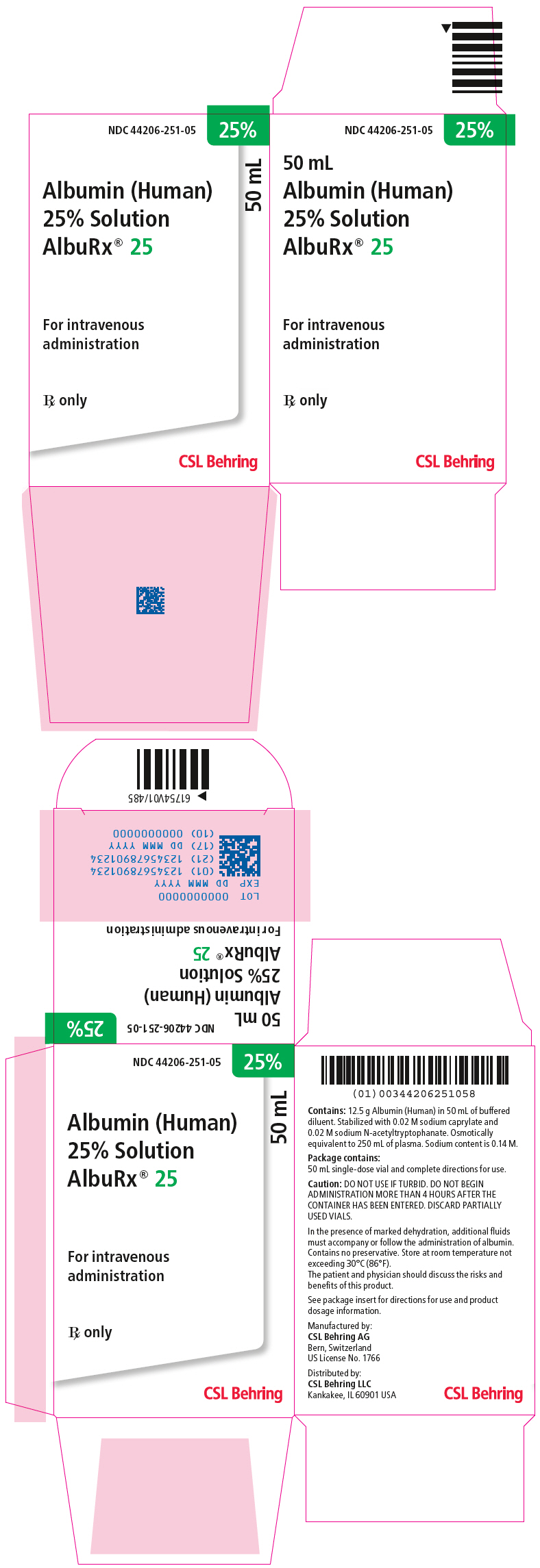
Package Label - Principal Display Panel - 50 mL NDC 44206-251-05 25% AlbuRx ® 25 Albumin (Human) 25% Solution 50 mL For intravenous administration Rx only CSL Behring Front Package
Package Label - Principal Display Panel - 100 mL NDC 44206-251-10 25% AlbuRx ® 25 Albumin (Human) 25% Solution 100 mL For intravenous administration Rx only CSL Behring Front Package
Medicaid utilization & spend
Medicaid utilization by pack size
Medicare Part D spend CMS · PART D · 2025 (Q1-Q4)
Reported adverse events (FAERS)
Top reported reactions
Age at onset
Reporter sex
Serious outcomes
Where does this data come from?
About this NDC listing & data coverage
What data is (and isn’t) available for this NDC — tap to expand
| NDC identity (package / product / labeler codes) | ✓ Available |
| Labeler | ✓ Available |
| Product & package description | ✓ Available |
| Marketing category & status | ✓ Available |
| Active ingredient / dosage form / route | ✓ Available |
| FDA label (SPL via DailyMed) | ✓ Available |
| Package photos | ✓ Available |
| Inactive ingredients (structured) | ✓ Available |
| NADAC pharmacy acquisition price (CMS) | — Not published for this NDC CMS publishes NADAC only for NDCs reported in its retail-pharmacy survey. |
| Orange Book / therapeutic-equivalence data | — Not published for this NDC Applies only to products approved under an NDA/ANDA; many listings are out of scope. |
| HCPCS J-code billing crosswalk | — Not published for this NDC Most self-administered / retail products have no J-code — that is normal. |
| Medicaid utilization (CMS SDUD) | ✓ Available |