
TECHNETIUM TC 99M SESTAMIBI 1 mg/mL Injection, Powder, For Solution — NDC 45548-141-30 (Billing 45548-0141-30)
This is a package of TECHNETIUM TC 99M SESTAMIBI 1 mg/mL Injection, Powder, For Solution from Jubilant Draximage (USA) Inc., marketed since Jul 2009 and currently FDA-listed.
NDC database record
One package, one record: these facts belong to NDC 45548-141-30 alone.
- Record
- FDA NDC Directory package listing · Human prescription drug
- Code segments
- 45548 labeler · 141 product · 30 package
- Package marketed since
- Jul 1, 2009
- Sample package
- No — commercial package
- Listing certified through
- Dec 31, 2026
- Barcode (UPC-A, from the NDC)
- 3 4554814130 4
- FDA record last changed
- Jul 24, 2026
Identity & classification
Regulatory identifiers FDA, NLM and CMS codes for this package
Drug-database identifiers Medi-Span GPI and First Databank GCN / HICL / AHFS classification
- GSN (GCN sequence number): 066782
- GCN: 29167
- HICL (First Databank): 037226
- AHFS class code: 36:68.00.00
Where does this data come from?
- FDA openFDA NDC Directory · synced Oct 1, 2026
- FDA label on DailyMed · label index refreshed Oct 6, 2026
- RxNorm (NLM RxNav) · catalog refreshed Oct 1, 2026
- Medi-Span GPI (licensed)
- First Databank (licensed) · refreshed Oct 1, 2026
Clinical
Patient education
Supplement & herbal interactions
Where does this data come from?
- MedlinePlus (NLM) · refreshed Oct 1, 2026
- FDA label on DailyMed · label index refreshed Oct 6, 2026
Ask a licensed pharmacist directly — free, answered by our team.
Pricing
A drug doesn't have one price. Each row is a different public payment system, and none is what you'd pay at the counter — that depends on your insurance. The ⓘ on each row explains what it measures.
| Price system | Per mL | Per package |
|---|---|---|
| Retail pharmacies payNADAC · weekly | Not in the retail survey — common for institutional, discontinued, or low-volume packs. | |
| Medicaid paysCMS SDUD · 12 mo | No recent Medicaid claims on file for this NDC — rare and low-volume NDCs are suppressed in the public data. | |
| Medicare drug plans payPart D · quarterly | No Part D plan price is available for this NDC in our data. | |
Where does this data come from?
- CMS NADAC weekly file
- CMS ASP pricing files · refreshed Sep 20, 2026
- CMS Medicaid State Drug Utilization Data · refreshed Oct 6, 2026
- CMS Part D plan pricing files · refreshed Sep 24, 2026
- VA National Acquisition Center price file
Packaging — all sizes for this product
| Package NDC | Description | Marketing start | Marketing end | Status |
|---|---|---|---|---|
| 45548-0141-05 45548-141-05 Main listing | 5 VIAL in 1 KIT / 10 mL in 1 VIAL | 2009-07-01 | — | Active |
| 45548-0141-10 45548-141-10 | 10 VIAL in 1 KIT / 10 mL in 1 VIAL | 2009-07-01 | — | Active |
| 45548-0141-30 You're viewing this | 30 VIAL in 1 KIT / 10 mL in 1 VIAL | 2009-07-01 | — | Active |
Pack size FAQ
What quantity is in this package?
What NDC number is used to bill for this package of TECHNETIUM TC 99M SESTAMIBI 1 mg/mL Injection, Powder, For Solution?
Therapeutic equivalents
| Product | Labeler | Pack | NADAC/unit | TE | Status | Price vs. this |
|---|---|---|---|---|---|---|
| Technetium Tc 99M Sestamibi 1 mg/mLthis 45548-0141-30 | Jubilant | 30 vials | — | AP | FDA listed | — |
Where does this data come from?
- FDA openFDA NDC Directory · synced Oct 1, 2026
- FDA Orange Book · refreshed Oct 3, 2026
- CMS NADAC weekly file
Availability & generic status
This product is an FDA-approved generic. Other versions of the same drug are listed under Therapeutic equivalents, least expensive first.
Where does this data come from?
- FDA Orange Book · refreshed Oct 3, 2026
Inactive Ingredients / Excipients
Inactive ingredients, also called excipients, are components of the drug product other than the active ingredient. They may include fillers, dyes, coatings, preservatives, flavors, or other formulation ingredients.
💡 Tap an ingredient (hover on desktop) to see what it is and why it’s used.
-
1 mg / 1 mL
UNII ZT934N0X4W
A naturally occurring amino acid salt used as a reducing agent and antioxidant in medications. It helps prevent ingredient breakdown and may improve product stability during storage.
-
20 mg / 1 mL
UNII 3OWL53L36A
A natural sugar alcohol derived from seaweed or synthesized in the lab. It's used as a filler to add bulk, a sweetener in sugar-free formulas, and a disintegrant to help tablets break apart in the stomach.
-
0.075 mg / 1 mL
UNII 1BQV3749L5
Stannous chloride is a tin-based chemical compound used as a reducing agent and antioxidant in pharmaceuticals. It helps prevent oxidation of active ingredients and stabilizes certain formulations, particularly in products requiring preservation of potency.
-
2.6 mg / 1 mL
UNII B22547B95K
A salt derived from citric acid that helps maintain the proper acid-base balance in the medicine. It's used as a buffer to keep the product stable and at the right pH level.
4 inactive ingredients listed in the exact product block matched to this NDC.
Where does this data come from?
ingredient classCode="IACT" elements from the exact product block matched by this NDC. Label-section narrative from DailyMed / the openFDA label index is shown separately when available.- FDA label on DailyMed · label index refreshed Oct 6, 2026
- FDA openFDA NDC Directory · synced Oct 1, 2026
Inactive ingredient FAQ
Are inactive ingredients the same for every manufacturer?
Why might an inactive ingredient be missing?
Can inactive ingredients matter?
Manufacturer & labeler
Where does this data come from?
- FDA openFDA NDC Directory · synced Oct 1, 2026
- Drugs@FDA
Full prescribing information FDA SPL
🎯 Indications and Usage ▾
1 INDICATIONS AND USAGE Myocardial Imaging: Kit for the preparation of Technetium Tc 99m Sestamibi Injection is a myocardial perfusion agent that is indicated for detecting coronary artery disease by localizing myocardial ischemia (reversible defects) and infarction (non-reversible defects), in evaluating myocardial function and developing information for use in patient management decisions. Technetium Tc 99m Sestamibi evaluation of myocardial ischemia can be accomplished with rest and cardiovascular stress techniques (e.g., exercise or pharmacologic stress in accordance with the pharmacologic stress agents labeling).
It is usually not possible to determine the age of a myocardial infarction or to differentiate a recent myocardial infarction from ischemia. Breast Imaging: Kit for the preparation of Technetium Tc 99m Sestamibi Injection is indicated for planar imaging as a second line diagnostic drug after mammography to assist in the evaluation of breast lesions in patients with an abnormal mammogram or a palpable breast mass. Kit for the preparation of Technetium Tc 99m Sestamibi Injection is not indicated for breast cancer screening, to confirm the presence or absence of malignancy, and it is not an alternative to biopsy.
Technetium Tc 99m Sestamibi, is a myocardial perfusion agent indicated for: detecting coronary artery disease by localizing myocardial ischemia (reversible defects) and infarction (non-reversible defects) ( 1 ) evaluating myocardial function and developing information for use in patient management decisions ( 1 )
⏱️ Dosage and Administration ▾
2 DOSAGE AND ADMINISTRATION For Myocardial Imaging: The suggested dose range for I.V. administration of Technetium Tc 99m Sestamibi in a single dose to be employed in the average patient (70 kg) is 370 to 1110 MBq (10 to 30 mCi). For Breast Imaging: The recommended dose range for I.V. administration of Technetium Tc 99m Sestamibi is a single dose of 740 to 1110 MBq (20 to 30 mCi). For Myocardial Imaging: The suggested dose range for I.V. administration of Technetium Tc 99m Sestamibi in a single dose to be employed in the average patient (70 kg) is 370 to 1110 MBq (10 to 30 mCi) ( 2 ).
For Breast Imaging: The recommended dose range for I.V. administration of Technetium Tc 99m Sestamibi is a single dose of 740 to 1110 MBq (20 to 30 mCi) ( 2 ).
2.1Image Acquisition Breast Imaging: It is recommended that images are obtained with a table overlay to separate breast tissue from the myocardium and liver, and to exclude potential activity that may be present in the opposite breast. For lateral images, position the patient prone with the isolateral arm comfortably above the head, shoulders flat against the table, head turned to the side and relaxed, with the breast imaged pendent through an overlay cutout. The breast should not be compressed on the overlay.
For anterior images, position the patient supine with both arms behind the head. For either lateral or anterior images, shield the chest and abdominal organs, or remove them from the field of view. For complete study, sets of images should be obtained five minutes after the injection, and in the following sequence: Beginning five minutes after the injection of Technetium Tc 99m Sestamibi: ten-minute lateral image of breast with abnormality ten-minute lateral image of contralateral breast ten-minute anterior image of both breasts
2.2Radiation Dosimetry The radiation doses to organs and tissues of an average patient (70 kg) per 1110 MBq (30 mCi) of Technetium Tc 99m Sestamibi injected intravenously are shown in Table 1. Table 1. Radiation Absorbed Doses from Tc 99m Sestamibi Estimated Radiation Absorbed Dose REST STRESS 2.0 hour void 4.8 hour void 2.0 hour void 4.8 hour void Organ rads/30 mCi mGy/1110 MBq rads/30 mCi mGy/1110 MBq rads/30 mCi mGy/1110 MBq rads/30 mCi mGy/1110 MBq Breasts 0.2 2.0 0.2 1.9 0.2 2.0 0.2
1.8Gallbladder Wall 2.0 20.0 2.0 20.0 2.8 28.9 2.8
27.8Small Intestine 3.0 30.0 3.0 30.0 2.4 24.4 2.4
24.4Upper Large Intestine Wall 5.4 55.5 5.4 55.5 4.5 44.4 4.5
44.4Lower Large Intestine Wall 3.9 40.0 4.2 41.1 3.3 32.2 3.3
32.2Stomach Wall 0.6 6.1 0.6 5.8 0.6 5.3 0.5
5.2Heart Wall 0.5 5.1 0.5 4.9 0.5 5.6 0.5
5.3Kidneys 2.0 20.0 2.0 20.0 1.7 16.7 1.7
16.7Liver 0.6 5.8 0.6 5.7 0.4 4.2 0.4
4.1Lungs 0.3 2.8 0.3 2.7 0.3 2.6 0.2
2.4Bone Surfaces 0.7 6.8 0.7 6.4 0.6 6.2 0.6
6.0Thyroid 0.7 7.0 0.7 2.4 0.3 2.7 0.2
2.4Ovaries 1.5 15.5 1.6 15.5 1.2 12.2 1.3
13.3Testes 0.3 3.4 0.4 3.9 0.3 3.1 0.3
3.4Red Marrow 0.5 5.1 0.5 5.0 0.5 4.6 0.5
4.4Urinary Bladder Wall 2.0 20.0 4.2 41.1 1.5 15.5 3.0
30.0Total Body 0.5 4.8 0.5 4.8 0.4 4.2 0.4
4.2Radiation dosimetry calculations performed by Radiation Internal Dose Information Center, Oak Ridge Institute for Science and Education, PO Box 117, Oak Ridge, TN 37831-0117.
2.3Instructions for Preparation Preparation of the Technetium Tc 99m Sestamibi from the Kit for the Preparation of Technetium Tc 99m Sestamibi is done by the following aseptic procedure: General Procedure: a. Prior to adding the Sodium Pertechnetate Tc 99m Injection to the vial, inspect the vial carefully for the presence of damage, particularly cracks, and do not use the vial if found. Tear off a radiation symbol and attach it to the neck of the vial. b.
Waterproof gloves should be worn during the preparation procedure. Remove the plastic disc from the vial and swab the top of the vial closure with alcohol to sanitize the surface. Boiling Water Bath Procedure: c.
Place the vial in a suitable radiation shield with a fitted radiation cap. d. With a sterile shiel… [Excerpted — this section continues on DailyMed.]
💊 Dosage Forms and Strengths ▾
3 DOSAGE FORMS AND STRENGTHS Kit for the Preparation of Technetium Tc 99m Sestamibi Injection is supplied as a lyophilized sterile and non-pyrogenic mixture in a 10 mL vial. Kit for the Preparation of Technetium Tc 99m Sestamibi Injection is supplied as a lyophilized sterile and non-pyrogenic mixture in a 10 mL vial in kits of five (5) (NDC # 45548-141-05), ten (10) (NDC # 45548-141-10) and thirty (30) (NDC # 45548-141-30) ( 3 ).
⛔ Contraindications ▾
4 CONTRAINDICATIONS None known. None known ( 4 ).
⚠️ Warnings and Cautions ▾
5 WARNINGS AND PRECAUTIONS Pharmacologic induction of cardiovascular stress may be associated with serious adverse events such as myocardial infarction, arrhythmia, hypotension, bronchoconstriction and cerebrovascular events ( 5.1 ). Technetium Tc 99m Sestamibi has been rarely associated with acute severe allergic and anaphylactic events of angioedema and generalized urticaria. In some patients the allergic symptoms developed on the second injection during Technetium Tc 99m Sestamibi imaging ( 5.1 ).
Caution should be exercised and emergency equipment should be available when administering Technetium Tc 99m Sestamibi ( 5.1 ). Before administering Technetium Tc 99m Sestamibi patients should be asked about the possibility of allergic reactions to either drug ( 5.1 ). The contents of the vial are intended only for use in the preparation of Technetium Tc 99m Sestamibi and are not to be administered directly to the patient without first undergoing the preparative procedure ( 5.2 ).
5.1Warnings In studying patients in whom cardiac disease is known or suspected, care should be taken to assure continuous monitoring and treatment in accordance with safe, accepted clinical procedure. Infrequently, death has occurred 4 to 24 hours after Tc 99m Sestamibi use and is usually associated with exercise stress testing [ see General Precautions ( 5.2 ) ]. Pharmacologic induction of cardiovascular stress may be associated with serious adverse events such as myocardial infarction, arrhythmia, hypotension, bronchoconstriction and cerebrovascular events.
Caution should be used when pharmacologic stress is selected as an alternative to exercise; it should be used when indicated and in accordance with the pharmacologic stress agent's labeling. Technetium Tc 99m Sestamibi has been rarely associated with acute severe allergic and anaphylactic events of angioedema and generalized urticaria. In some patients the allergic symptoms developed on the second injection during Tc 99m Sestamibi imaging.
Patients who receive Technetium Tc 99m Sestamibi for either myocardial or breast imaging are receiving the same drug. Caution should be exercised and emergency equipment should be available when administering Technetium Tc 99m Sestamibi. Also, before administering Technetium Tc 99m Sestamibi Injection, patients should be asked about the possibility of allergic reactions to the drug.
5.2General Precautions The contents of the vial are intended only for use in the preparation of Technetium Tc 99m Sestamibi and are not to be administered directly to the patient without first undergoing the preparative procedure. Radioactive drugs must be handled with care and appropriate safety measures should be used to minimize radiation exposure to clinical personnel. Also, care should be taken to minimize radiation exposure to the patients consistent with proper patient management.
Contents of the kit before preparation are not radioactive. However, after the Sodium Pertechnetate Tc 99m Injection is added, adequate shielding of the final preparation must be maintained. The components of the kit are sterile and non-pyrogenic.
It is essential to follow directions carefully and to adhere to strict aseptic procedures during preparation. Technetium Tc 99m labeling reactions depend on maintaining the stannous ion in the reduced state. Hence, Sodium Pertechnetate Tc 99m Injection containing oxidants should not be used.
Technetium Tc 99m Sestamibi should not be used more than six hours after preparation. Radiopharmaceuticals should be used only by physicians who are qualified by training and experience in the safe use and handling of radionuclides and whose experience and training have been approved by the appropriate government agency authorized to license the use of radionuclides. Stress testing should be performed only under the supervision of a qualified physician and in a laboratory equipped with appropriate resuscitation and support apparatus.
The most frequent exercise stress te… [Excerpted — this section continues on DailyMed.]
⚠️ Warnings ▾
5.1Warnings In studying patients in whom cardiac disease is known or suspected, care should be taken to assure continuous monitoring and treatment in accordance with safe, accepted clinical procedure. Infrequently, death has occurred 4 to 24 hours after Tc 99m Sestamibi use and is usually associated with exercise stress testing [ see General Precautions ( 5.2 ) ]. Pharmacologic induction of cardiovascular stress may be associated with serious adverse events such as myocardial infarction, arrhythmia, hypotension, bronchoconstriction and cerebrovascular events.
Caution should be used when pharmacologic stress is selected as an alternative to exercise; it should be used when indicated and in accordance with the pharmacologic stress agent's labeling. Technetium Tc 99m Sestamibi has been rarely associated with acute severe allergic and anaphylactic events of angioedema and generalized urticaria. In some patients the allergic symptoms developed on the second injection during Tc 99m Sestamibi imaging.
Patients who receive Technetium Tc 99m Sestamibi for either myocardial or breast imaging are receiving the same drug. Caution should be exercised and emergency equipment should be available when administering Technetium Tc 99m Sestamibi. Also, before administering Technetium Tc 99m Sestamibi Injection, patients should be asked about the possibility of allergic reactions to the drug.
🤒 Adverse Reactions ▾
6 ADVERSE REACTIONS Adverse events were evaluated in 3741 adults who were evaluated in clinical studies. Of these patients, 3068 (77% men, 22% women, and 0.7 % of the patients' genders were not recorded) were in cardiac clinical trials and 673 (100% women) in breast imaging trials. Cases of angina, chest pain, and death have occurred [ see Warning and Precautions ( 5.1 ) ].
Adverse events reported at a rate of 0.5% or greater after receiving Technetium Tc 99m Sestamibi administration are shown in the following table: Table 2. Selected Adverse Events Reported in > 0.5 % of Patients Who Received Technetium Tc 99m Sestamibi in Either Breast or Cardiac Clinical Studies* Body System Breast Studies Cardiac Studies Women n = 673 Women n = 685 Men n = 2361 Total n = 3046 Body as a Whole 21 (3.1 %) 6 (0.9 %) 17 (0.7 %) 23 (0.8 %) Headache 11 (1.6 %) 2 (0.3 %) 4 (0.2 %) 6 (0.2 %) Cardiovascular 9 (1.3 %) 24 (3.5 %) 75 (3.2 %) 99 (3.3 %) Chest Pain/Angina 0 (0 %) 18 (2.6 %) 46 (1.9 %) 64 (2.1 %) ST Segment Changes 0 (0 %) 11 (1.6 %) 29 (1.2 %) 40 (1.3 %) Digestive System 8 (1.2 %) 4 (0.6 %) 9 (0.4 %) 13 (0.4 %) Nausea 4 (0.6 %) 1 (0.1 %) 2 (0.1 %) 3 (0.1 %) Special Senses 132 (19.6 %) 62 (9.1 %) 160 (6.8 %) 222 (7.3 %) Taste Perversion 129 (19.2 %) 60 (8.8 %) 157 (6.6 %) 217 (7.1 %) Parosmia 8 (1.2 %) 6 (0.9 %) 10 (0.4 %) 16 (0.5 %) * Excludes the 22 patients whose gender was not recorded.
In the clinical studies for breast imaging, breast pain was reported in 12 (1.7 %) of the patients. In 11 of these patients the pain appears to be associated with biopsy/surgical procedures. The following adverse reactions have been reported in ≤ 0.5% of patients: signs and symptoms consistent with seizure occurring shortly after administration of the agent; transient arthritis; angioedema, arrhythmia, dizziness, syncope, abdominal pain, vomiting, and severe hypersensitivity characterized by dyspnea, hypotension, bradycardia, asthenia, and vomiting within two hours after a second injection of Technetium Tc 99m Sestamibi.
A few cases of flushing, edema, injection site inflammation, dry mouth, fever, pruritis, rash, urticaria and fatigue have also been attributed to administration of the agent. The following adverse reactions have been reported in ≤ 0.5 % of patients: signs and symptoms consistent with seizure occurring shortly after administration of the agent; transient arthritis; angioedema, arrhythmia, dizziness, syncope, abdominal pain, vomiting, and severe hypersensitivity characterized by dyspnea, hypotension, bradycardia, asthenia, and vomiting within two hours after a second injection of Technetium Tc 99m Sestamibi.
A few cases of flushing, edema, injection site inflammation, dry mouth, fever, pruritis, rash, urticaria and fatigue have also been attributed to administration of the agent ( 6 ). To report SUSPECTED ADVERSE REACTIONS, contact Jubilant DraxImage Inc. at 1-888-633-5343or FDA at 1-800-FDA-1088 or www.fda.gov/medwatch .
🔄 Drug Interactions ▾
7 DRUG INTERACTIONS Specific drug-drug interactions have not been studied. Specific drug-drug interactions have not been studied ( 7 ).
👥 Use in Specific Populations ▾
8 USE IN SPECIFIC POPULATIONS In one study of 46 subjects who received Technetium Tc 99m Sestamibi administration, the radioactivity in both children and adolescents exhibited blood PK profiles similar to those previously reported in adults ( 8.4 ). Lactation: Interruption of breastfeeding after exposure to Technetium Tc 99m Sestamibi is not necessary, however, a lactating woman should be advised to consider restricting close contact with her breast fed infant to a maximum of 5 hours in the 24 hour period after Technetium Tc 99m Sestamibi administration in order to minimize radiation exposure ( 8.2 )
8.1Pregnancy Risk Summary Limited available data with Technetium Tc 99m Sestamibi use in pregnant women have not identified a drug-associated risk of major birth defects, miscarriage, or adverse maternal or fetal outcomes. Animal reproduction and teratogenicity studies have not been conducted with Technetium Tc 99m Sestamibi. However, all radiopharmaceuticals have the potential to cause fetal harm depending on the fetal stage of development and the magnitude of the radiation dose.
If considering Technetium Tc 99m Sestamibi administration to a pregnant woman, inform the patient about the potential for adverse pregancy outcomes based on the radiation dose from Technetium Tc 99m Sestamibi and the gestational timing of exposure. All pregnancies have a background risk of birth defects, loss, or other adverse outcomes. In the U.S. general population, the estimated background risk of major birth defects and miscarriage in clinically recognized pregancies is 2 % to 4 % and 15 % to 20 %, respectively.
8.2Lactation Risk Summary Limited data in the scientific literature on the presence of Technetium Tc 99m Sestamibi in human milk, demonstrate that between 0.01 % and 0.03 % of maternal injected activity of technetium Tc 99m Sestamibi was excreted in human milk. Technetium Tc 99m Sestamibi accumulates in the lactating breast [see Clinical Considerations]. There are limited data in the scientific literature on effects of Technetium Tc 99m Sestamibi on the breastfed infant or on milk production.
The developmental and health benefits of breastfeeding should be considered along with the mother's clinical need for Technetium Tc 99m Sestamibi and any potential adverse effects on the breastfed infant from Technetium Tc 99m Sestamibi or from the underlying maternal condition. Clinical Considerations Interruption of breastfeeding after exposure of Technetium Tc 99m Sestamibi is not necessary because Technetium Tc 99m Sestamibi excretion in breast milk is low. However, a lactating woman may restrict close contact with her breast fed infant to a maximum of 5 hours in the 24 hour period after Technetium Tc 99m Sestamibi administration in order to minimize radiation exposure.
8.4Pediatric Use Safety and effectiveness in the pediatric population have not been established. No evidence of diagnostic efficacy or clinical utility of Technetium Tc 99m Sestamibi scan was found in clinical studies of children and adolescents with Kawasaki disease. A prospective study of 445 pediatric patients with Kawasaki disease was designed to determine the predictive value of Technetium Tc 99m Sestamibi rest and stress myocardial perfusion imaging to define a pediatric population with Kawasaki disease that was at risk of developing cardiac events.
Cardiac events were defined as cardiac death, MI, hospitalization due to cardiac etiology, heart failure, CABG or coronary angioplasty. The standard of truth was defined as cardiac events occurring 6 months following the administration of Technetium Tc 99m Sestamibi. Only three cardiac events were observed at six months in this study.
In all three cases, the scan was negative. No clinically meaningful measurements of sensitivity, specificity or other diagnostic performance parameters could be demonstrated in this study. A ten year retrospective case history study of pediatric Kawasaki disease patients who completed Technetium Tc 9… [Excerpted — this section continues on DailyMed.]
🤰 Pregnancy ▾
8.1Pregnancy Risk Summary Limited available data with Technetium Tc 99m Sestamibi use in pregnant women have not identified a drug-associated risk of major birth defects, miscarriage, or adverse maternal or fetal outcomes. Animal reproduction and teratogenicity studies have not been conducted with Technetium Tc 99m Sestamibi. However, all radiopharmaceuticals have the potential to cause fetal harm depending on the fetal stage of development and the magnitude of the radiation dose.
If considering Technetium Tc 99m Sestamibi administration to a pregnant woman, inform the patient about the potential for adverse pregancy outcomes based on the radiation dose from Technetium Tc 99m Sestamibi and the gestational timing of exposure. All pregnancies have a background risk of birth defects, loss, or other adverse outcomes. In the U.S. general population, the estimated background risk of major birth defects and miscarriage in clinically recognized pregancies is 2 % to 4 % and 15 % to 20 %, respectively.
🧒 Pediatric Use ▾
8.4Pediatric Use Safety and effectiveness in the pediatric population have not been established. No evidence of diagnostic efficacy or clinical utility of Technetium Tc 99m Sestamibi scan was found in clinical studies of children and adolescents with Kawasaki disease. A prospective study of 445 pediatric patients with Kawasaki disease was designed to determine the predictive value of Technetium Tc 99m Sestamibi rest and stress myocardial perfusion imaging to define a pediatric population with Kawasaki disease that was at risk of developing cardiac events.
Cardiac events were defined as cardiac death, MI, hospitalization due to cardiac etiology, heart failure, CABG or coronary angioplasty. The standard of truth was defined as cardiac events occurring 6 months following the administration of Technetium Tc 99m Sestamibi. Only three cardiac events were observed at six months in this study.
In all three cases, the scan was negative. No clinically meaningful measurements of sensitivity, specificity or other diagnostic performance parameters could be demonstrated in this study. A ten year retrospective case history study of pediatric Kawasaki disease patients who completed Technetium Tc 99m Sestamibi myocardial perfusion imaging and who had coronary angiography within three months of the Technetium Tc 99m Sestamibi scan was designed to measure sensitivity and specificity of Technetium Tc 99m Sestamibi scan.
Out of 72 patients who had both evaluable Technetium Tc 99m Sestamibi scans and evaluable angiographic images, only one patient had both an abnormal angiogram and an abnormal Technetium Tc 99m Sestamibi scan. No clinically meaningful measurements of sensitivity, specificity or other diagnostic performance parameters could be demonstrated in this study. In a clinical pharmacology study, 46 pediatric patients with Kawasaki disease received Technetium Tc 99m Sestamibi administration at the following doses: 0.1 to 0.2 mCi/kg for rest, 0.3 mCi/kg for stress in one day studies; 0.2 mCi/kg for rest and 0.2 mCi/kg for stress in two day studies.
The radioactivity both in younger children and in adolescents exhibited PK profiles similar to those previously reported in adults [ see Clinical Pharmacology ( 12.3 )] . The radiation absorbed doses in adolescents, both at rest and stress, were similar to those observed in adults [ see Dosage and Administration ( 2.2 )] . When comparing weight-adjusted radioactivity (up to 0.3 mCi/kg) doses administered to adolescents and younger children to the recommended dose administered to adults (up to 30 mCi), the radiation absorbed doses in both adolescents and younger children were similar to those in adults.
Adverse events were evaluated in 609 pediatric patients from the three clinical studies described above. The frequency and the type of the adverse events were similar to the ones observed in the studies of Technetium Tc 99m Sestamibi in adults. Two of the 609 had a serious adverse event: one patient received a Technetium Tc 99m Sestamibi overdose but remained asymptomatic, and one patient had an asthma exacerbation following administration.
🧓 Geriatric Use ▾
8.5Geriatric Use Of 3068 patients in clinical studies of Technetium Tc 99m Sestamibi for myocardial imaging, 693 patients were 65 or older and 121 were 75 or older. Of 673 patients in clinical studies of Technetium Tc 99m Sestamibi for breast imaging, 138 patients were 65 or older and 30 were 75 or older. Based on the evaluation of the frequency of adverse events and review of vital signs data, no overall differences in safety were observed between these subjects and younger subjects.
Although reported clinical experience has not identified differences in response between elderly and younger patients, greater sensitivity of some older individuals cannot be ruled out.
🆘 Overdosage ▾
10 OVERDOSAGE The clinical consequences of overdosing with Technetium Tc 99m Sestamibi are not known.
🧬 Clinical Pharmacology ▾
12 CLINICAL PHARMACOLOGY
12.1Mechanism of Action Technetium Tc 99m Sestamibi is a cationic Tc 99m complex which has been found to accumulate in viable myocardial tissue in a manner analogous to that of thallous chloride TI-201. Scintigraphic images obtained in humans after the intravenous administration of the drug have been comparable to those obtained with thallous chloride TI-201 in normal and abnormal myocardial tissue. Animal studies have shown that myocardial uptake is not blocked when the sodium pump mechanism is inhibited.
Although studies of subcellular fractionation and electron micrographic analysis of heart cell aggregates suggest that Tc 99m Sestamibi cellular retention occurs specifically within the mitochondria as a result of electrostatic interactions, the clinical relevance of these findings has not been determined. The mechanism of Tc 99m Sestamibi localization in various types of breast tissue (e.g., benign, inflammatory, malignant, fibrous) has not been established.
12.3Pharmacokinetics Pulmonary activity is negligible even immediately after injection. Blood clearance studies indicate that the fast clearing component clears with a t 1/2 of 4.3 minutes at rest, and clears with a t 1/2 of 1.6 minutes under exercise conditions. At five minutes post injection about 8 % of the injected dose remains in circulation.
There is less than 1% protein binding of Technetium Tc 99m Sestamibi in plasma. The myocardial biological half-life is approximately six hours after a rest or exercise injection. The biological half-life for the liver is approximately 30 minutes after a rest or exercise injection.
The effective half-life of clearance (which includes both the biological half-life and radionuclide decay) for the heart is approximately 3 hours, and for the liver is approximately 30 minutes, after a rest or exercise injection. The ideal imaging time reflects the best compromise between heart count rate and surrounding organ uptake. Myocardial uptake which is coronary flow dependent is 1.2 % of the injected dose at rest and 1.5 % of the injected dose at exercise.
Table 6 illustrates the biological clearance as well as effective clearance (which includes biological clearance and radionuclide decay) of Tc 99m Sestamibi from the heart and liver. [Organ concentrations expressed as percentage of injected dose; data based on an average of 5 subjects at rest and 5 subjects during exercise.] Table 6. Biological and Effective Clearance Time REST Heart Liver Biological Effective Biological Effective 5 min. 1.2 1.2 19.6 19.4 30 min.
1.11.0 12.2 11.5 1 hour 1.0 0.9 5.6 5.0 2 hours 1.0 0.8 2.2 1.7 4 hours 0.8 0.5 0.7
0.4Time STRESS Heart Liver Biological Effective Biological Effective 5 min. 1.5 1.5 5.9 5.8 30 min. 1.4 1.3 4.5 4.2 1 hour 1.4 1.2 2.4 2.1 2 hours 1.2 1.0 0.9 0.7 4 hours 1.0 0.6 0.3
0.2A study in a dog myocardial ischemia model reported that Technetium Tc 99m Sestamibi undergoes myocardial distribution (redistribution), although more slowly and less completely than thallous chloride TI-201. A study in a dog myocardial infarction model reported that the drug showed no redistribution of any consequence. Definitive human studies to demonstrate possible redistribution have not been reported.
In patients with documented myocardial infarction, imaging revealed the infarct up to four hours post dose. Metabolism The agent is excreted without any evidence of metabolism. Elimination The major pathway for clearance of Tc 99m Sestamibi is the hepatobiliary system.
Activity from the gall bladder appears in the intestines within one hour of injection. Twenty-seven percent of the injected dose is excreted in the urine, and approximately thirty-three percent of the injected dose is cleared through the feces in 48 hours.
🧬 Mechanism of Action ▾
12.1Mechanism of Action Technetium Tc 99m Sestamibi is a cationic Tc 99m complex which has been found to accumulate in viable myocardial tissue in a manner analogous to that of thallous chloride TI-201. Scintigraphic images obtained in humans after the intravenous administration of the drug have been comparable to those obtained with thallous chloride TI-201 in normal and abnormal myocardial tissue. Animal studies have shown that myocardial uptake is not blocked when the sodium pump mechanism is inhibited.
Although studies of subcellular fractionation and electron micrographic analysis of heart cell aggregates suggest that Tc 99m Sestamibi cellular retention occurs specifically within the mitochondria as a result of electrostatic interactions, the clinical relevance of these findings has not been determined. The mechanism of Tc 99m Sestamibi localization in various types of breast tissue (e.g., benign, inflammatory, malignant, fibrous) has not been established.
📦 How Supplied / Storage and Handling ▾
16 HOW SUPPLIED/STORAGE AND HANDLING Kit for the Preparation of Technetium Tc 99m Sestamibi Injection is supplied as a 10 mL vial in kits of five (5) (NDC # 45548-141-05), ten (10) (NDC # 45548-141-10) and thirty (30) (NDC # 45548-141-30), sterile and non pyrogenic. The patient dose should be measured by a suitable radioactivity calibration system immediately prior to patient administration. Radiochemical purity should be checked prior to patient administration.
Parenteral drug products should be inspected visually for particulate matter and discoloration prior to administration whenever solution and container permit. Prior to lyophilization the pH is between 5.6 and 5.8. The contents of the vial are lyophilized and stored under nitrogen.
Store at 15 °C to 25 °C (59 °F to 77 °F) before and after reconstitution. Kit for Preparation of Technetium Tc 99m Sestamibi Injection contains no preservatives. Included in each kit of five (5) vials, ten (10) vials and thirty (30) vials, is a package insert and a sufficient number of vial shield labels and radiation warning labels.
This reagent kit is approved for distribution to persons licensed by the U.S. Nuclear Regulatory Commission to use by product material identified in 10 CFR 35.200 or under an equivalent license issued by an Agreement State.
📋 Description ▾
11 DESCRIPTION Each 10 mL vial contains a sterile, non-pyrogenic, lyophilized mixture of: Tetrakis (2-methoxy isobutyl isonitrile) Copper (I) tetrafluoroborate - 1 mg Sodium Citrate Dihydrate - 2.6 mg L-Cysteine Hydrochloride Monohydrate - 1 mg Mannitol - 20 mg Stannous Chloride, Dihydrate, minimum (SnCl 2 2H 2 O) - 0.025 mg Stannous Chloride, Dihydrate (SnCl 2 2H 2 O) - 0.075 mg Tin Chloride (stannous and stannic) Dihydrate, maximum (as SnCl 2 2H 2 O) - 0.086 mg Prior to lyophilization the pH is 5.6 to 5.8. The contents of the vial are lyophilized and stored under nitrogen.
This drug is administered by intravenous injection for diagnostic use after reconstitution with sterile, non-pyrogenic, oxidant-free Sodium Pertechnetate Tc 99m Injection. The pH of the reconstituted product is 5.5 (5.0-6.0). No bacteriostatic preservative is present.
The precise structure of the technetium complex is Tc 99m[MIBI] 6 + where MIBI is 2-methoxyisobutylisonitrile.
11.1Physical Characteristics Technetium Tc 99m decays by isomeric transition with a physical half-life of 6.02 hours. 1 Photons that are useful for detection and imaging studies are listed below in Table 3. Table 3. Principal Radiation Emission Date Radiation Mean %/ Disintegration Mean Energy (KeV) Gamma-2 89.07 140.5 1 Kocher, David, C., Radioactive Decay Data Tables, DOE/TIC-11026, 108(1981).
11.2External Radiation The specific gamma ray constant for Tc 99m is 5.4 microcoulombs/kg-MBq-hr (0.78 R/mCi-hr) at 1 cm. The first half value layer is 0.017 cm of Pb. A range of values for the relative attenuation of the radiation emitted by this radionuclide that results from interposition of various thicknesses of Pb is shown in Table 4.
To facilitate control of the radiation exposure from Megabequerel (millicurie) amounts of this radionuclide, the use of a 0.25 cm thickness of Pb will attenuate the radiation emitted by a factor of 1,000. Table 4. Radiation Attenuation by Lead Shielding Shield Thickness (Pb) cm Coefficient of Attenuation 0.017 0.5 0.08 10 -1 0.16 10 -2 0.25 10 -3 0.33 10 -4 To correct for physical decay of this radionuclide, the fractions that remain at selected intervals after the time of calibration are shown in Table 5.
Table 5. Physical Decay Chart; Tc 99m Half Life:
6.02Hours Hours Fraction Remaining Hours Fraction Remaining 0 Calibration Time 1.000 7 0.447 1 0.891 8 0.398 2 0.794 9 0.355 3 0.708 10 0.316 4 0.631 11 0.282 5 0.562 12 0.251 6 0.501
💬 Information for Patients ▾
17 PATIENT COUNSELING INFORMATION Kit for the Preparation of Technetium Tc 99m Sestamibi Injection contains the same active ingredient as CARDIOLITE ® and MIRALUMA ® which are different names for the same drug (Kit for the Preparation of Technetium Tc 99m Sestamibi Injection). Patients should be advised to inform their health care provider if they had an allergic reaction to either drug or if they had an imaging study with either drug. Lactation: Interruption of breastfeeding after exposure to Technetium Tc 99m Sestamibi is not necessary, however, a lactating woman should be advised to consider restricting close contact with her breast fed infant to a maximum of 5 hours in the 24 hour period after Technetium Tc 99m Sestamibi administration in order to minimize radiation exposure [see Use in Specific Populations ( 8.2 )] .
CARDIOLITE ® , MIRALUMA ® and Recon-o-Stat are trademarks of Lantheus Medical Imaging, Inc. Manufactured for: Jubilant DraxImage Inc. Kirkland, Quebec, Canada H9H 4J4 For Ordering Tel: Toll Free 888-633-5343 All Other Business: 888-633-5343 Made in Canada
🍼 Nursing Mothers ▾
8.2Lactation Risk Summary Limited data in the scientific literature on the presence of Technetium Tc 99m Sestamibi in human milk, demonstrate that between 0.01 % and 0.03 % of maternal injected activity of technetium Tc 99m Sestamibi was excreted in human milk. Technetium Tc 99m Sestamibi accumulates in the lactating breast [see Clinical Considerations]. There are limited data in the scientific literature on effects of Technetium Tc 99m Sestamibi on the breastfed infant or on milk production.
The developmental and health benefits of breastfeeding should be considered along with the mother's clinical need for Technetium Tc 99m Sestamibi and any potential adverse effects on the breastfed infant from Technetium Tc 99m Sestamibi or from the underlying maternal condition. Clinical Considerations Interruption of breastfeeding after exposure of Technetium Tc 99m Sestamibi is not necessary because Technetium Tc 99m Sestamibi excretion in breast milk is low. However, a lactating woman may restrict close contact with her breast fed infant to a maximum of 5 hours in the 24 hour period after Technetium Tc 99m Sestamibi administration in order to minimize radiation exposure.
🧬 Pharmacokinetics ▾
12.3Pharmacokinetics Pulmonary activity is negligible even immediately after injection. Blood clearance studies indicate that the fast clearing component clears with a t 1/2 of 4.3 minutes at rest, and clears with a t 1/2 of 1.6 minutes under exercise conditions. At five minutes post injection about 8 % of the injected dose remains in circulation.
There is less than 1% protein binding of Technetium Tc 99m Sestamibi in plasma. The myocardial biological half-life is approximately six hours after a rest or exercise injection. The biological half-life for the liver is approximately 30 minutes after a rest or exercise injection.
The effective half-life of clearance (which includes both the biological half-life and radionuclide decay) for the heart is approximately 3 hours, and for the liver is approximately 30 minutes, after a rest or exercise injection. The ideal imaging time reflects the best compromise between heart count rate and surrounding organ uptake. Myocardial uptake which is coronary flow dependent is 1.2 % of the injected dose at rest and 1.5 % of the injected dose at exercise.
Table 6 illustrates the biological clearance as well as effective clearance (which includes biological clearance and radionuclide decay) of Tc 99m Sestamibi from the heart and liver. [Organ concentrations expressed as percentage of injected dose; data based on an average of 5 subjects at rest and 5 subjects during exercise.] Table 6. Biological and Effective Clearance Time REST Heart Liver Biological Effective Biological Effective 5 min. 1.2 1.2 19.6 19.4 30 min.
1.11.0 12.2 11.5 1 hour 1.0 0.9 5.6 5.0 2 hours 1.0 0.8 2.2 1.7 4 hours 0.8 0.5 0.7
0.4Time STRESS Heart Liver Biological Effective Biological Effective 5 min. 1.5 1.5 5.9 5.8 30 min. 1.4 1.3 4.5 4.2 1 hour 1.4 1.2 2.4 2.1 2 hours 1.2 1.0 0.9 0.7 4 hours 1.0 0.6 0.3
0.2A study in a dog myocardial ischemia model reported that Technetium Tc 99m Sestamibi undergoes myocardial distribution (redistribution), although more slowly and less completely than thallous chloride TI-201. A study in a dog myocardial infarction model reported that the drug showed no redistribution of any consequence. Definitive human studies to demonstrate possible redistribution have not been reported.
In patients with documented myocardial infarction, imaging revealed the infarct up to four hours post dose. Metabolism The agent is excreted without any evidence of metabolism. Elimination The major pathway for clearance of Tc 99m Sestamibi is the hepatobiliary system.
Activity from the gall bladder appears in the intestines within one hour of injection. Twenty-seven percent of the injected dose is excreted in the urine, and approximately thirty-three percent of the injected dose is cleared through the feces in 48 hours.
🔬 Clinical Studies ▾
14 CLINICAL STUDIES Clinical Trials: Myocardial Imaging: In a trial of rest and stress Tc 99m Sestamibi imaging, the relationship of normal or abnormal perfusion scans and long term cardiac events was evaluated in 521 patients (511 men, 10 women) with stable chest pain. There were 73.9 % Caucasians, 25.9 % Blacks and 0.2 % Asians. The mean age was 59.6 years (range: 29 to 84 years).
All patients had a baseline rest and exercise Tc 99m Sestamibi scan and were followed for 13.2 ± 4.9 months (range: 1 to 24 months). Images were correlated with the occurrence of a cardiac event (cardiac death or non-fatal myocardial infarction). In this trial as summarized in Table 7 , 24/521 (4.6 %) had a cardiac event.
Table 7. Cardiac Events Baseline Scan (a) Proportion of patients with events by scan results (a) Proportion of scan result in patients with events; N=24 (a) Proportion of event-free patients by scan result (a) Normal 1/206 (0.5 %) 1/24 (4.2 %) 205/206 (99.5 %) Abnormal 23/315 (7.3 %) (b) 23/24 (95.8 %) (b) 292/315 (92.7 %) (b) (a) Note: Similar findings were found in two studies with patients who had pharmacologic stress Tc 99m Sestamibi imaging. (b) p<0.01 Although patients with normal images had a lower cardiac event rate than those with abnormal images, in all patients with abnormal images it was not possible to predict which patient would be likely to have further cardiac events; i.e., such individuals were not distinguishable from other patients with abnormal images.
The findings were not evaluated for defect location, disease duration, specific vessel involvement or intervening management. In earlier trials, using a template consisting of the anterior wall, inferior-posterior wall and isolated apex, localization in the anterior or inferior-posterior wall in patients with suspected angina or coronary artery disease was shown. Disease localization isolated to the apex has not been established.
In adults, Tc 99m Sestamibi has not been studied or evaluated in cardiac disorders other than coronary artery disease. Breast Imaging: Technetium Tc 99m Sestamibi was evaluated in two multicenter, clinical trials of a total of 673 woman patients. Overall the mean age was 52 (range 23 to 87 years).
The racial and ethnic representation was 70% Caucasian, 15 % African-American, 14 % Hispanic and 1% Asian. Both clinical studies evaluated women who were referred for further evaluation for either: 1) a mammographically detected (with varying degrees of malignant likelihood) but not palpable breast lesion (study A, n=387, mean age = 54 years), or 2) a palpable breast lesion (study B, n=286, mean age = 50 years). In both studies all patients were scheduled for biopsy.
Technetium Tc 99m Sestamibi (20 to 30 mCi) was injected intravenously in a vein that was contralateral to the breast lesion in question. Planar imaging was completed with a high resolution collimator with a 10 % window centered at 140 keV, and 128 x 128 matrix. An initial marker image, that was not used in the data analysis, was obtained using a cobalt Co57 point source as a marker of a palpable mass.
Images were obtained 5 minutes after injection as follows: lateral image of the affected breast for 10 minutes, lateral image of the contralateral breast for 10 minutes, and an anterior image of both breasts for 10 minutes. For the lateral image the patients were positioned in a prone position. For the anterior image, the patients were supine.
The Technetium Tc 99m Sestamibi scintigraphic images were read in a randomized method by two groups of three blinded readers. Technetium Tc 99m Sestamibi uptake was scored as: normal (no uptake), equivocal, low, moderate, or high uptake. The results of Technetium Tc 99m Sestamibi images and mammography were analyzed in comparison to histopathologic findings of malignant or non-malignant disease.
As shown in Table 8 for the 483 evaluable patients, the sensitivity and specificity of any degree of Technetium Tc 99m Sestamibi uptake appear to vary w… [Excerpted — this section continues on DailyMed.]
🧪 Nonclinical Toxicology ▾
13 NONCLINICAL TOXICOLOGY
13.1Carcinogenesis, Mutagenesis, Impairment of Fertility In comparison with most other diagnostic technetium labeled radiopharmaceuticals, the radiation dose to the ovaries (1.5 rads/30 mCi at rest, 1.2 rads/30 mCi at exercise) is high. Minimal exposure (ALARA) is necessary in women of childbearing capability [ see Dosage and Administration ( 2.2 )] . The active intermediate, Cu(MIBI) 4 BF 4 , was evaluated for genotoxic potential in a battery of five tests.
No genotoxic activity was observed in the Ames, CHO/HPRT and sister chromatid exchange tests (all in vitro ). At cytotoxic concentrations(> 20 mcg/mL), an increase in cells with chromosome aberrations was observed in the in vitro human lymphocyte assay. Cu(MIBI) 4 BF 4 did not show genotoxic effects in the in vivo mouse micronucleus test at a dose which caused systemic and bone marrow toxicity (9 mg/kg, > 600 x maximal human dose).
📄 Carcinogenesis, Mutagenesis, Impairment of Fertility ▾
13.1Carcinogenesis, Mutagenesis, Impairment of Fertility In comparison with most other diagnostic technetium labeled radiopharmaceuticals, the radiation dose to the ovaries (1.5 rads/30 mCi at rest, 1.2 rads/30 mCi at exercise) is high. Minimal exposure (ALARA) is necessary in women of childbearing capability [ see Dosage and Administration ( 2.2 )] . The active intermediate, Cu(MIBI) 4 BF 4 , was evaluated for genotoxic potential in a battery of five tests.
No genotoxic activity was observed in the Ames, CHO/HPRT and sister chromatid exchange tests (all in vitro ). At cytotoxic concentrations(> 20 mcg/mL), an increase in cells with chromosome aberrations was observed in the in vitro human lymphocyte assay. Cu(MIBI) 4 BF 4 did not show genotoxic effects in the in vivo mouse micronucleus test at a dose which caused systemic and bone marrow toxicity (9 mg/kg, > 600 x maximal human dose).
📄 Package Label / Principal Display Panel ▾
PRINCIPAL DISPLAY PANEL - Vial Label Kit for the preparation of Technetium Tc 99m Sestamibi Injection Contains 1mg of Tetrakis(2-methoxyisobutylisonitrile) copper(I) Tetrafluoroborate Diagnostic Agent for Intravenous Use After Labeling with Additive-Free Technetium Tc 99m Store at 15 °C to 25 °C (59 °F to 77 °F) See package insert for full prescribing information. Made in Canada Manufactured for: Jubilant DraxImage Inc. KIRKLAND, QC H9H 4J4 CANADA 412020 Lot: Exp: Rx only Principal Display Panel - Vial Label
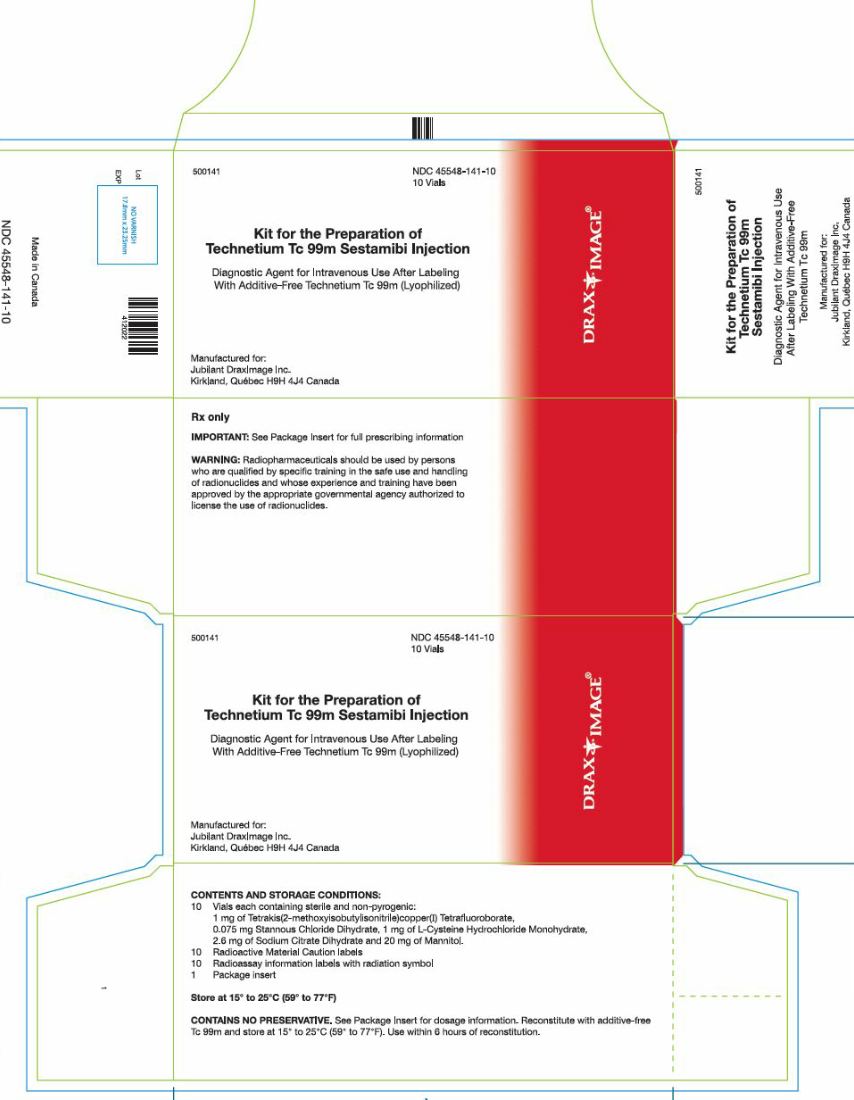
PRINCIPAL DISPLAY PANEL - 10 Vials Carton Label Kit for the Preparation of Technetium Tc 99m Sestamibi Injection Diagnostic Agent for Intravenous Use After Labeling With Additive-Free Technetium Tc 99m (Lyophilized) 500141 NDC 45548-141-10 10 Vials Manufactured for: Jubilant DraxImage Inc. Kirkland, Quebec H9H 4J4 Canada Made in Canada NDC45548-141-10 Lot..... Exp.......
Rx only IMPORTANT: See Package Insert for full prescribing Information. WARNING: Radiopharmaceuticals should be used by persons who are qualified by specific training in the safe use and handling of radionuclides and whose experience and training have been approved by the appropriate governmental agency authorized to license the use of radionuclides. CONTENTS AND STORAGE CONDITIONS: 10 Vials each containing sterile and non-pyrogenic: 1mg of Tetrakis(2-methoxyisobutylisonitrile)copper (I) Tetrafluoroborate, 0.075mg of Stannous Chloride Dihydrate, 1mg of L-Cysteine Hydrochloride Monohydrate, 2.6mg of Sodium Citrate Dihydrate and 20mg of Mannitol.
10 Radioactive Material Caution labels 10 Radioassay information labels with radiation symbol 1 Package Insert Store at 15 °C to 25°C (59 °F to 77°F) CONTAINS NO PRESERVATIVE. See Package Insert for dosage information. Reconstitute with additive-free Tc 99m and store at 15° to 25°C (59° to 77°F).
Use within 6 hours of reconstitution. Principal Display Panel - 10 Vial Carton Label
PRINCIPAL DISPLAY PANEL - Caution Label For Radioactive Material CAUTION RADIOACTIVE MATERIAL Prior to adding the radioisotope to the vial tear off a radiation symbol and attach it to the neck of the vial. 216521 Principal Display Panel - Caution Label Radioactive Material
PRINCIPAL DISPLAY PANEL - RADIOASSAY INFORMATION LABEL CAUTION RADIOACTIVE MATERIAL Rx Only Technetium Tc 99m Sestamibi Injection Contents Sodium Pertechnetate Tc 99m Injection Tetrakis (2-methoxyisobutylisonitrile) copper(I) tetrafluoroborate - 1mg Stannous Chloride Dihydrate - 0.075mg L-Cysteine Hydrochloride Monohydrate - 1mg Sodium Citrate Dihydrate - 2.6mg Mannitol - 20mg Store at 15 o to 25 o C (59 o to 77 o F). Use within 6 hours of reconstitution. 216511 MBq (mCi) Tc 99m/mL Volume.................mL Time/Date.................
Expiration Time......... Lot No...................... Technetium Tc 99m Sestamibi Injection 216511 Principal Display Panel - RADIOASSAY INFORMATION LABEL
About this NDC listing & data coverage
Kit / multi-component package
This NDC identifies a kit — a package containing more than one component. Structured data (pricing, ingredients, equivalents) is often reported per component rather than for the kit NDC itself, which can make this page look thinner than the components' own pages.
What data is (and isn’t) available for this NDC — tap to expand
| NDC identity (package / product / labeler codes) | ✓ Available |
| Labeler | ✓ Available |
| Product & package description | ✓ Available |
| Marketing category & status | ✓ Available |
| Active ingredient / dosage form / route | ✓ Available |
| FDA label (SPL via DailyMed) | ✓ Available |
| Package photos | ✓ Available |
| Inactive ingredients (structured) | ✓ Available |
| NADAC pharmacy acquisition price (CMS) | — Not published for this NDC CMS publishes NADAC only for NDCs reported in its retail-pharmacy survey. |
| Orange Book / therapeutic-equivalence data | ✓ Available |
| HCPCS J-code billing crosswalk | — Not published for this NDC Most self-administered / retail products have no J-code — that is normal. |
| Medicaid utilization (CMS SDUD) | — Not published for this NDC CMS reports utilization only for NDCs with Medicaid claims above its privacy threshold. |