
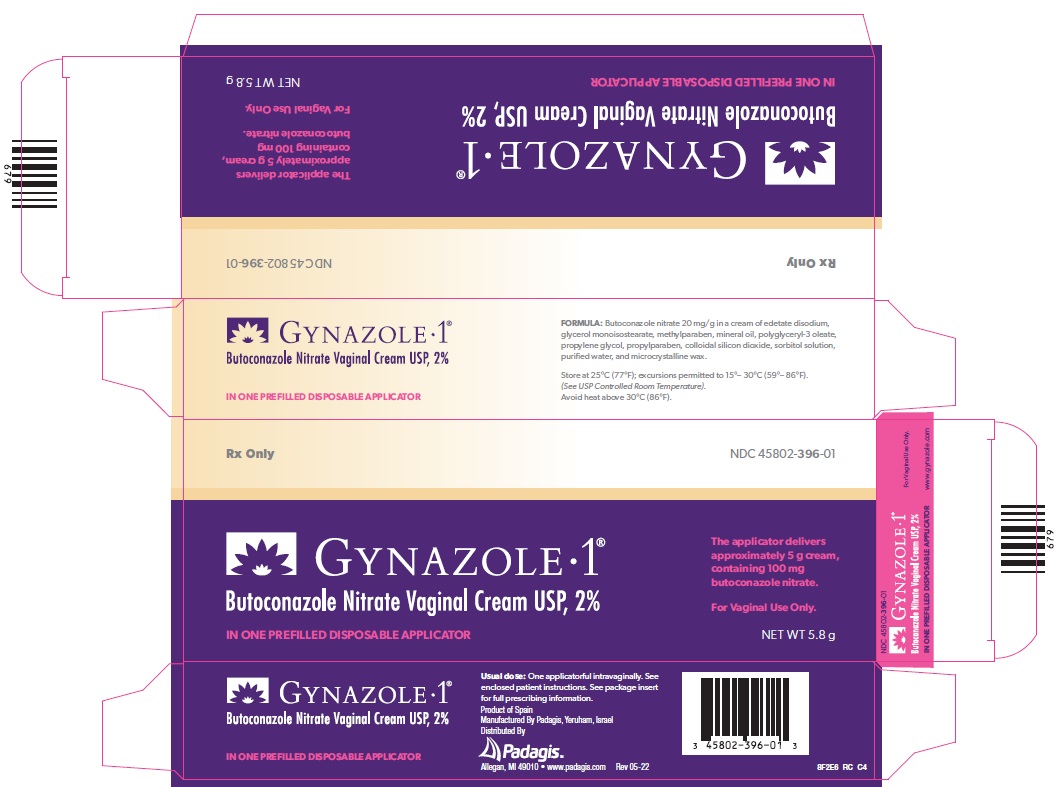
gynazole 1 butoconazole nitrate 100 mg/5g Cream, 1 tube — NDC 45802-396-01 (Billing 45802-0396-01)
This is a package of 1 tube of gynazole 1 butoconazole nitrate 100 mg/5g Cream from Padagis Israel Pharmaceuticals Ltd, marketed since Apr 2015 and currently FDA-listed; retail pharmacies pay about $23.30 per g (NADAC). It is the main listing for this product, which comes in 2 package sizes.
NDC database record
One package, one record: these facts belong to NDC 45802-396-01 alone.
- Record
- FDA NDC Directory package listing · Human prescription drug
- Code segments
- 45802 labeler · 396 product · 01 package
- Package marketed since
- Apr 29, 2015
- Sample package
- No — commercial package
- Listing certified through
- Dec 31, 2026
- Barcode (UPC-A, from the NDC)
- 3 4580239601 3
- Medicaid fills, this package
- 1,031 prescriptions in the last four reported quarters
- FDA record last changed
- Jul 24, 2026
Identity & classification
Regulatory identifiers FDA, NLM and CMS codes for this package
Drug-database identifiers Medi-Span GPI and First Databank GCN / HICL / AHFS classification
- GSN (GCN sequence number): 022144
- GCN: 28821
- GPI-14 (Medi-Span): 55104015123720
- HICL (First Databank): 003032
- AHFS class code: 84:04.08.08
- RxCUI (RxNorm): 890785
Where does this data come from?
- FDA openFDA NDC Directory · synced Oct 8, 2026
- FDA label on DailyMed · label index refreshed Oct 8, 2026
- RxNorm (NLM RxNav) · catalog refreshed Oct 1, 2026
- Medi-Span GPI (licensed)
- First Databank (licensed) · refreshed Oct 8, 2026
RxNorm drug class
This medicine belongs to the Azole Antifungal class.
Where does this data come from?
- RxClass (NLM) · catalog refreshed Oct 1, 2026
Clinical
Butoconazole is used to treat yeast infections of the vagina. This medication is sometimes prescribed for other uses; ask your doctor or pharmacist for more information.
Read the full MedlinePlus article ↗Patient education
Supplement & herbal interactions
Where does this data come from?
- MedlinePlus (NLM) · refreshed Oct 8, 2026
- FDA label on DailyMed · label index refreshed Oct 8, 2026
Ask a licensed pharmacist directly — free, answered by our team.
Pricing
A drug doesn't have one price. Each row is a different public payment system, and none is what you'd pay at the counter — that depends on your insurance. The ⓘ on each row explains what it measures.
| Price system | Per g | Per package |
|---|---|---|
| Retail pharmacies payNADAC · weekly | $23.304 | $135.16 / 5.8 g |
| Medicaid paysCMS SDUD · 12 mo | $21.31 | $123.60 / 5.8 g |
| Medicare drug plans payPart D · Q2 2026 | $21.43 | $124.27 / 5.8 g |
Where does this data come from?
- CMS NADAC weekly file · file of Oct 7, 2026
- CMS ASP pricing files · refreshed Sep 20, 2026
- CMS Medicaid State Drug Utilization Data · through Q1 2026
- CMS Part D plan pricing files · refreshed Sep 24, 2026
- VA National Acquisition Center price file
Packaging — all sizes for this product
| Package NDC | Description | Per unit | Per pack | Marketing start | Marketing end | Status |
|---|---|---|---|---|---|---|
| 45802-0396-01 You're viewing this Main listing | 1 TUBE, WITH APPLICATOR in 1 CARTON / 5.8 g in 1 TUBE, WITH APPLICATOR | $23.30 / g | $135.16 | 2015-04-29 | — | Active |
| 45802-0396-02 45802-396-02 | 1 TUBE, WITH APPLICATOR in 1 CARTON / 5.8 g in 1 TUBE, WITH APPLICATOR Sample | — | — | 2015-04-29 | — | Active |
In Medicaid, this is the most-dispensed pack of this product — about 100% of fills over the last four reported quarters. See all packs ↓
Pack size FAQ
What quantity is in this package?
How does this package differ from NDC 45802-0396-02?
What NDC number is used to bill for this package of gynazole 1 butoconazole nitrate 100 mg/5g Cream?
Prices are the latest CMS NADAC pharmacy acquisition cost per NDC; per-pack figures are per-unit × pack quantity, shown only when the pack is denominated in the same measure NADAC prices.
Therapeutic equivalents
| Product | Labeler | Pack | NADAC/unit | TE | Status | Price vs. this |
|---|---|---|---|---|---|---|
| gynazole 1 100 mg/5gthis 45802-0396-01 | Padagis | 1 tube | $23.304 | — | Availability likely | — |
Where does this data come from?
- FDA openFDA NDC Directory · synced Oct 8, 2026
- FDA Orange Book · refreshed Oct 3, 2026
- CMS NADAC weekly file · file of Oct 7, 2026
Availability & generic status
This product is an FDA-approved generic. Other versions of the same drug are listed under Therapeutic equivalents, least expensive first.
Where does this data come from?
- FDA Orange Book · refreshed Oct 3, 2026
What it looks like
Where does this data come from?
- FDA label on DailyMed · label index refreshed Oct 8, 2026
Inactive Ingredients / Excipients
Inactive ingredients, also called excipients, are components of the drug product other than the active ingredient. They may include fillers, dyes, coatings, preservatives, flavors, or other formulation ingredients.
💡 Tap an ingredient (hover on desktop) to see what it is and why it’s used.
-
UNII 7FLD91C86K
Edetate disodium is a chemical compound that binds and removes certain metal ions. In medicines, it acts as a preservative and stabilizer by preventing metals like calcium from interfering with the product's shelf life and consistency.
-
UNII HYE7O27HAO
Glyceryl isostearate is a fatty substance derived from vegetable oils or animal fats. In medicines, it acts as an emulsifier to blend water and oil components together, and helps form a smooth texture in creams, ointments, and other topical products.
-
UNII A2I8C7HI9T
Methylparaben is a preservative derived from benzoic acid that prevents growth of bacteria, fungi, and mold in medicines. It extends the product's shelf life and maintains safety during storage.
-
UNII XOF597Q3KY
A refined form of wax made from petroleum, microcrystalline wax is used in medicines as a coating agent, binder, and hardening ingredient. It helps give tablets and capsules their shape and protective outer layer.
-
UNII T5L8T28FGP
Mineral oil is a clear, odorless liquid derived from crude oil. It acts as a lubricant and emollient in medications, helping pills slide smoothly during manufacturing and aiding moisture retention in topical products.
-
UNII XRQ165498B
A plant-derived emulsifier made from glycerin and oleic acid. It helps mix oil and water-based ingredients together in the formulation and improves product texture and stability.
-
UNII 6DC9Q167V3
Propylene glycol is a clear liquid derived from petroleum or vegetable sources. It acts as a solvent, humectant, and preservative in medicines, helping dissolve active ingredients and maintain product stability.
-
UNII Z8IX2SC1OH
Propylparaben is a chemical preservative used to prevent bacterial and fungal growth in medicines and personal care products. It helps extend shelf life and maintain product safety during storage.
-
UNII ETJ7Z6XBU4
Silicon dioxide is a naturally occurring mineral used as a glidant and anti-caking agent. It helps powder ingredients flow smoothly and prevents clumping during manufacturing and storage.
-
UNII 506T60A25R
Sorbitol is a natural sugar alcohol derived from glucose. It serves as a sweetener, humectant, and bulking agent in medications to improve taste and help maintain moisture in the product.
-
UNII 059QF0KO0R
Water is a liquid solvent that dissolves and mixes ingredients together in liquid medicines, syrups, and injections. It helps distribute the active drug evenly throughout the product.
11 inactive ingredients listed in the exact product block matched to this NDC.
Where does this data come from?
ingredient classCode="IACT" elements from the exact product block matched by this NDC. Label-section narrative from DailyMed / the openFDA label index is shown separately when available.- FDA label on DailyMed · label index refreshed Oct 8, 2026
- FDA openFDA NDC Directory · synced Oct 8, 2026
Inactive ingredient FAQ
Are inactive ingredients the same for every manufacturer?
Why might an inactive ingredient be missing?
Can inactive ingredients matter?
Manufacturer & labeler
More NDCs from Padagis Israel Pharmaceuticals Ltd labeler code 45802
- diphenhydramine hcl and zinc acetate Diphenhydramine Hydrochloride, 2 g/100g; .1 g/100g Cream NDC 45802-358-03
- testosterone 40.5 mg/2.5g Gel NDC 45802-366-65
- Imiquimod 12.5 mg/.25g Cream NDC 45802-368-53
- Betamethasone Dipropionate .5 mg/g Cream NDC 45802-376-32
- Clindamycin Phosphate and Benzoyl Peroxide 10 mg/g; 37.5 mg/g Gel NDC 45802-383-01
- Tacrolimus .3 mg/g Ointment NDC 45802-390-00
- Ciclopirox Olamine 7.7 mg/100mL Suspension NDC 45802-400-46
- Ciclopirox 1 g/100mL Shampoo NDC 45802-401-09
- Alogliptin and Pioglitazone 25 mg; 30 mg Tablet, Film Coated NDC 45802-402-65
- oxymetazoline hcl oxymetazoline hydrochloride .05 g/100mL Spray NDC 45802-410-59
- Ammonium Lactate 12 g/100g Lotion NDC 45802-419-26
- Desonide .5 mg/g Ointment NDC 45802-423-35
Where does this data come from?
- FDA openFDA NDC Directory · synced Oct 8, 2026
- Drugs@FDA
Full prescribing information FDA SPL
🎯 Indications and Usage ▾
INDICATIONS AND USAGE GYNAZOLE • 1 ® Butoconazole Nitrate Vaginal Cream USP, 2% is indicated for the local treatment of vulvovaginal candidiasis (infections caused by Candida ). The diagnosis should be confirmed by KOH smears and/or cultures (see CLINICAL STUDIES ). Note: GYNAZOLE • 1 ® Butoconazole Nitrate Vaginal Cream USP, 2% is safe and effective in non-pregnant women; however, the safety and effectiveness of this product in pregnant women has not been established (see PRECAUTIONS - Pregnancy ).
⏱️ Dosage and Administration ▾
DOSAGE AND ADMINISTRATION The recommended dose of GYNAZOLE • 1 ® Butoconazole Nitrate Vaginal Cream USP, 2% is one applicatorful of cream (approximately 5 grams of the cream) intravaginally. This amount of cream contains approximately 100 mg of butoconazole nitrate.
⛔ Contraindications ▾
CONTRAINDICATIONS GYNAZOLE • 1 ® Butoconazole Nitrate Vaginal Cream USP, 2% is contraindicated in patients with a history of hypersensitivity to any of the components of the product.
⚠️ Warnings ▾
WARNINGS This cream contains mineral oil. Mineral oil may weaken latex or rubber products such as condoms or vaginal contraceptive diaphragms; therefore, use of such products within 72 hours following treatment with GYNAZOLE•1 ® Butoconazole Nitrate Vaginal Cream USP, 2% is not recommended. Recurrent vaginal yeast infections, especially those that are difficult to eradicate, can be an early sign of infection with the human immunodeficiency virus (HIV) in women who are considered at risk for HIV infection.
🤒 Adverse Reactions ▾
ADVERSE REACTIONS Of the 314 patients treated with GYNAZOLE • 1 ® Butoconazole Nitrate Vaginal Cream USP, 2% for 1 day in controlled clinical trials, 18 patients (5.7%) reported complaints such as vulvar/vaginal burning, itching, soreness and swelling, pelvic or abdominal pain or cramping, or a combination of two or more of these symptoms. In 3 patients (1%) these complaints were considered treatment-related. Five of the 18 patients reporting adverse events discontinued the study because of them.
🤰 Pregnancy ▾
Pregnancy:
🧒 Pediatric Use ▾
Pediatric Use - Safety and effectiveness in children have not been established.
🧬 Clinical Pharmacology ▾
CLINICAL PHARMACOLOGY Following vaginal administration of butoconazole nitrate vaginal cream, 2% to 3 women, 1.7% (range 1.3-2.2%) of the dose was absorbed on average. Peak plasma levels (13.6-18.6 ng radioequivalents/mL of plasma) of the drug and its metabolites are attained between 12 and 24 hours after vaginal administration. Microbiology - The exact mechanism of the antifungal action of butoconazole nitrate is unknown; however, it is presumed to function as other imidazole derivatives via inhibition of steroid synthesis.
Imidazoles generally inhibit the conversion of lanosterol to ergosterol, resulting in a change in fungal cell membrane lipid composition. This structural change alters cell permeability and, ultimately, results in the osmotic disruption or growth inhibition of the fungal cell. Butoconazole nitrate is an imidazole derivative that has fungicidal activity in vitro against Candida spp. and has been demonstrated to be clinically effective against vaginal infections due to Candida albicans .
Candida albicans has been identified as the predominant species responsible for vulvovaginal candidiasis.
📦 How Supplied / Storage and Handling ▾
HOW SUPPLIED GYNAZOLE•1 ® Butoconazole Nitrate Vaginal Cream USP, 2% is available in cartons containing one single-dose prefilled disposable applicator (NDC 45802- 396 -01). Store at 25°C (77°F); excursions permitted to 15°-30°C (59°-86°F) [see USP Controlled Room Temperature]. Avoid heat above 30°C (86°F).
📋 Description ▾
DESCRIPTION GYNAZOLE • 1 ® Butoconazole Nitrate Vaginal Cream USP, 2% contains butoconazole nitrate 2%, an imidazole derivative with antifungal activity. Its chemical name is (±)-1-[4-(p-chlorophenyl)-2- [(2,6-dichlorophenyl) thio]butyl] imidazole mononitrate, and it has the following chemical structure: Butoconazole nitrate is a white to off-white crystalline powder with a molecular weight of 474.79. It is sparingly soluble in methanol; slightly soluble in chloroform, methylene chloride, acetone, and ethanol; very slightly soluble in ethyl acetate; and practically insoluble in water.
It melts at about 159°C with decomposition. GYNAZOLE • 1 ® Butoconazole Nitrate Vaginal Cream USP, 2% contains 2% butoconazole nitrate in a cream of edetate disodium, glyceryl monoisostearate, methylparaben, mineral oil, polyglyceryl-3 oleate, propylene glycol, propylparaben, colloidal silicon dioxide, sorbitol solution, purified water, and microcrystalline wax. Chemical Structure.jpg
⚠️ Precautions ▾
PRECAUTIONS General - If clinical symptoms persist, tests should be repeated to rule out other pathogens, to confirm the original diagnosis, and to rule out other conditions that may predispose a patient to recurrent vaginal fungal infections. Carcinogenesis, Mutagenesis, Impairment of Fertility - Carcinogenesis - Long term studies in animals have not been performed to evaluate the carcinogenic potential of this drug. Mutagenicity - Butoconazole nitrate was not mutagenic when tested in the Ames bacterial test, yeast, chromosomal aberration assay in CHO cells, CHO/HGPRT point mutation assay, mouse micronucleus, and rat dominant lethal assays.
Impairment of Fertility - No impairment of fertility was seen in rabbits or rats administered butoconazole nitrate in oral doses up to 30 mg/kg/day (5 times the human dose based on mg/m 2 ) or 100 mg/kg/day (10 times the human dose based on mg/m 2 ), respectively. Pregnancy: Pregnancy Category C - In pregnant rats administered 6 mg/kg/day of butoconazole nitrate intravaginally during the period of organogenesis, there was an increase in resorption rate and decrease in litter size; however, no teratogenicity was noted.
This dose represents a 130- to 353-fold margin of safety based on serum levels achieved in rats following intravaginal administration compared to the serum levels achieved in humans following intravaginal administration of the recommended therapeutic dose of butoconazole nitrate. Butoconazole nitrate has no apparent adverse effect when administered orally to pregnant rats throughout organogenesis at dose levels up to 50 mg/kg/day (5 times the human dose based on mg/m 2 ). Daily oral doses of 100, 300 or 750 mg/kg/day (10, 30 or 75 times the human dose based on mg/m 2 respectively) resulted in fetal malformations (abdominal wall defects, cleft palate), but maternal stress was also evident at these higher dose levels.
There were, however, no adverse effects on litters of rabbits who received butoconazole nitrate orally, even at maternally stressful dose levels (e.g., 150 mg/kg, 24 times the human dose based on mg/m 2 ). Butoconazole nitrate, like other azole antifungal agents, causes dystocia in rats when treatment is extended through parturition. However, this effect was not apparent in rabbits treated with as much as 100 mg/kg/day orally (16 times the human dose based on mg/m 2 ).
There are, however, no adequate and well-controlled studies in pregnant women. GYNAZOLE • 1 ® Butoconazole Nitrate Vaginal Cream USP, 2% should be used during pregnancy only if the potential benefit justifies the potential risk to the fetus. Nursing Mothers - It is not known whether this drug is excreted in human milk.
Because many drugs are excreted in human milk, caution should be exercised when butoconazole nitrate is administered to a nursing woman. Pediatric Use - Safety and effectiveness in children have not been established.
🍼 Nursing Mothers ▾
Nursing Mothers - It is not known whether this drug is excreted in human milk. Because many drugs are excreted in human milk, caution should be exercised when butoconazole nitrate is administered to a nursing woman.
🔬 Clinical Studies ▾
CLINICAL STUDIES Vulvovaginal Candidiasis : Two studies were conducted that compared 2% butoconazole nitrate cream with clotrimazole tablets. There were 322 enrolled patients, 161 received 2.0% butoconazole vaginal cream and 161 patients inserted the 500-mg clotrimazole vaginal tablet. At the second follow-up visit (30 days post-therapy), 118 patients in the butoconazole group and 116 in the clotrimazole group were evaluable for efficacy analysis, respectively.
All of these patients had infection caused by Candida albicans . The efficacy of the study drugs was assessed by evaluating clinical, mycologic and therapeutic cure rates, which are summarized in Table 1. The therapeutic cure was defined as complete resolution of signs and symptoms of vaginal candidiasis (clinical cure) along with a negative KOH examination and negative culture for Candida spp.
(microbiologic eradication) at the long term follow-up (30 days). The therapeutic cure rate was 67% in the butoconazole group and 61% in the clotrimazole group. Table 1.jpg
📄 Carcinogenesis, Mutagenesis, Impairment of Fertility ▾
Carcinogenesis, Mutagenesis, Impairment of Fertility - Carcinogenesis - Long term studies in animals have not been performed to evaluate the carcinogenic potential of this drug. Mutagenicity - Butoconazole nitrate was not mutagenic when tested in the Ames bacterial test, yeast, chromosomal aberration assay in CHO cells, CHO/HGPRT point mutation assay, mouse micronucleus, and rat dominant lethal assays. Impairment of Fertility - No impairment of fertility was seen in rabbits or rats administered butoconazole nitrate in oral doses up to 30 mg/kg/day (5 times the human dose based on mg/m 2 ) or 100 mg/kg/day (10 times the human dose based on mg/m 2 ), respectively.
📄 Patient Package Insert ▾
Patient Package Insert GYNAZOLE•1 ® Butoconazole Nitrate Vaginal Cream USP, 2% IN ONE PREFILLED DISPOSABLE APPLICATOR Using the GYNAZOLE•1 ® Butoconazole Nitrate Vaginal Cream USP, 2% Prefilled Disposable Applicator 3 Easy Steps: Step 1: Preparing the Applicator Peel back the protective foil and remove the prefilled applicator. Applicator is designed to be used with tip in place. Do not remove tip; do not use applicator if tip has been removed.
Do not warm applicator before using. While holding the applicator firmly, pull the ring back to fully extend the plunger ( see Figures 1 and 2 ). Step 2: Inserting the Applicator Gently insert the applicator into the vagina as far as it will comfortably go ( see Figures 3A and 3B ).
Step 3: Applying the Cream Push the plunger to release the cream ( see Figures 4A, 4B and 4C ). Remove the empty applicator from the vagina and throw it away. Important Instructions • One prefilled applicator of GYNAZOLE • 1 ® Butoconazole Nitrate Vaginal Cream USP, 2% should be administered. • This cream contains mineral oil.
Mineral oil may weaken latex or rubber products such as condoms or vaginal contraceptive diaphragms; therefore, use of such products within 72 hours following treatment with GYNAZOLE • 1 ® Butoconazole Nitrate Vaginal Cream USP, 2% is not recommended. • There are no adequate and well-controlled studies in pregnant women. GYNAZOLE • 1 ® Butoconazole Nitrate Vaginal Cream USP, 2% should be used during pregnancy only under the supervision of a physician. Call your doctor for medical advice about side effects.
You may report side effects to FDA at 1-800-FDA-1088. Manufactured By Padagis Yeruham, Israel Distributed By Padagis TM Allegan, MI 49010 • www.padagis.com Rev 05-22 8F200 RC J2 Figure 1 and 2.jpg Figure 3A Figure 3B.jpg Figure 4A Figure 4B Figure 4C.jpg
📄 Package Label / Principal Display Panel ▾
PACKAGE/LABEL PRINCIPAL DISPLAY PANEL Rx Only NDC 45802- 396 -01 GYNAZOLE•1 ® Butoconazole Nitrate Vaginal Cream USP, 2% The applicator delivers approximately 5 g cream, containing 100 mg butoconazole nitrate. IN ONE PREFILLED DISPOSABLE APPLICATOR For Vaginal Use Only. NET WT 5.8 g The following image is a placeholder representing the product identifier that is either affixed or imprinted on the drug package label during the packaging operation. carton serialization