
Home › NDC Lookup › Ingredients › Loratadine › 46122-0539-52
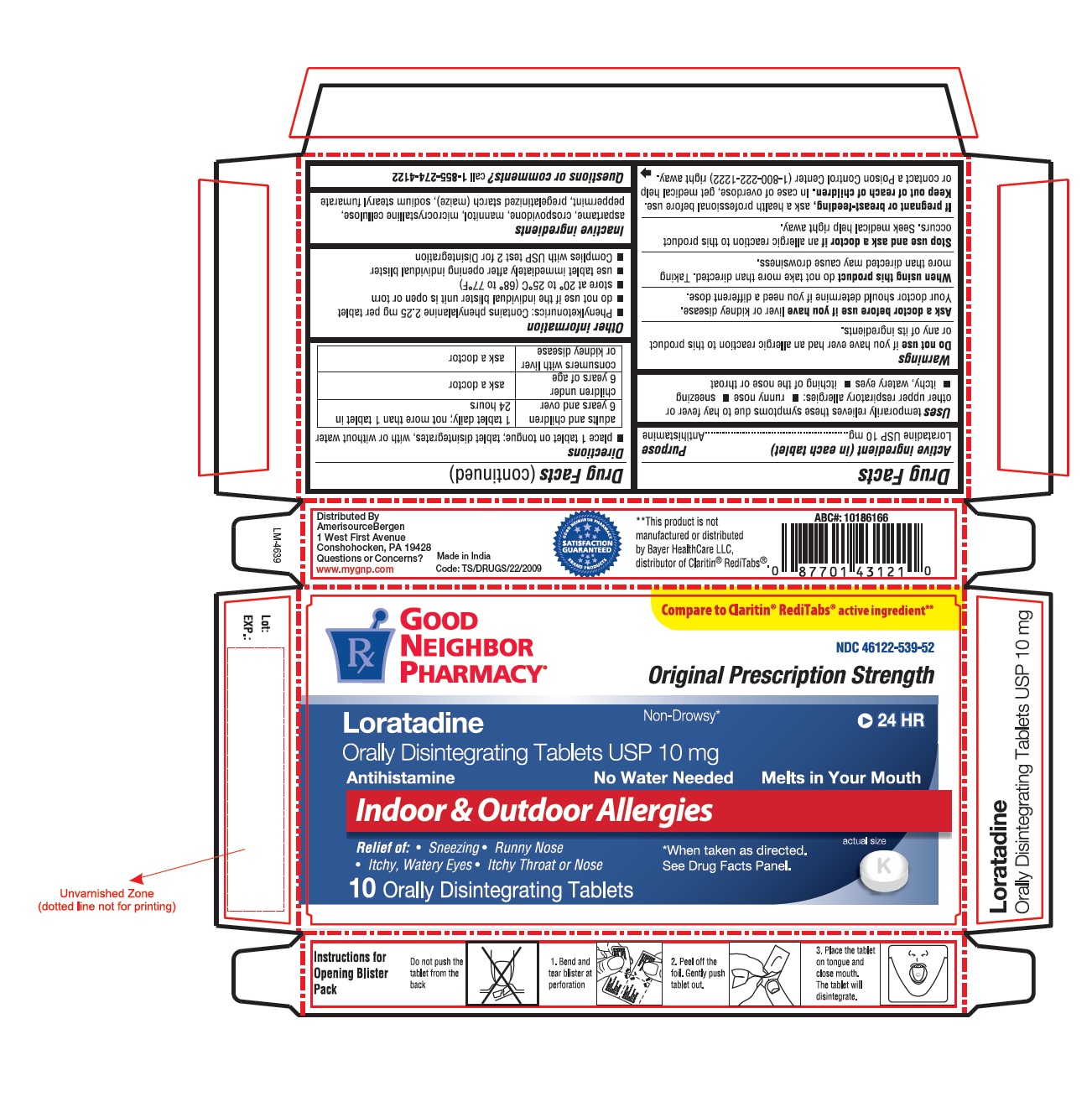
Loratadine ODT 10 mg Tablet, Orally Disintegrating, 10-count — NDC 46122-0539-52 package photo

Loratadine ODT 10 mg Tablet, Orally Disintegrating, 10-count

by Amerisource Bergen · 1 BLISTER PACK in 1 CARTON (46122-539-52) / 10 TABLET, ORALLY DISINTEGRATING in 1 BLISTER PACK
NDC 46122-0539-52
🏷️ FDA NDC (as labeled) 46122-539-52 billing pads the product segment with a zero
This package
Contains10-count Cost per ea$0.5274 NADAC Per package$5.27 / 10 tablets Pack sizes2 compare ↓
Also priced by: Medicaid pays $0.5756/unit — full pricing hub ↓
Also comes in: 10 tablets 46122-0539-65
OTC Generic On market Non-controlled
🗂️ Data synced Jul 24, 2026 · sources: openFDA · FDA label (DailyMed) · FDA Orange & Purple Book · First Databank · CMS NADAC, ASP, Medicare & Medicaid · RxNorm
📋 All sources & update times →

🆔 Identity & classification

FDA NDC (as labeled) 46122-539-52
Product NDC 46122-539
11-digit billing NDC 46122053952
NCPDP billing unit EA — each (per item)
RxCUI 311373
UNII 7AJO3BO7QN
Application # ANDA208477
SPL Set ID d2524455-b6c4-442b-b139-666a555c5298
DEA schedule Non-controlled
Marketing category ANDA
Marketing status On market
FDA listing status Listed (active directory)
Marketing start 2018-07-09
Route ORAL
Dosage form TABLET, ORALLY DISINTEGRATING
Substance LORATADINE
GPI-14 41550030007220
GPI class GNP Loratadine
GCN Seq No 030476
GCN 60521
HICL code 007605
Ingredient (HICL) Loratadine
HIC1 code Z
Therapeutic class — broad (HIC1) Body As A Whole
HIC2 code Z2
Therapeutic class — intermediate (HIC2) Antihistamines, Antiserotonins, Immunosuppressants
HIC3 code Z2Q
Therapeutic class — specific (HIC3) Antihistamines - 2Nd Generation
AHFS code 04:08.00.00
AHFS class Second Generation Antihistamines
FDB label name LORATADINE 10 MG ODT
FDB brand name Loratadine
Legend status O — Over-the-counter (OTC) drug or device
Why two NDCs? The FDA registers this code as 46122-539-52 — a 5-3-2 layout, and that's what's printed on the package and shown on DailyMed. For insurance claims, every NDC is standardized to a uniform 11-digit 5-4-2 format by adding a zero to the product segment → 46122-0539-52. Same drug, same package — only the format differs.
Where does this data come from?
Identifiers from the FDA openFDA NDC Directory and Structured Product Labeling; RxCUI from RxNorm (NLM); GPI from Medi-Span; GCN / HIC / AHFS / legend from First Databank.

🏷️ RxNorm drug class

This medicine belongs to the Other antihistamines for systemic use class.

Drug family (ATC) Other antihistamines for systemic use
Where does this data come from?
Therapeutic classes from RxNorm RxClass (U.S. National Library of Medicine) — Established Pharmacologic Class (FDA), ATC drug family (WHO) and mechanism of action, matched by this product’s RxCUI.

🏭 Manufacturer & labeler

LabelerAmerisource Bergen
Application holderAUROBINDO PHARMA LTD
FDA applicationANDA208477 (ANDA)
Labeler code46122
First marketedJul 2018
Product typeHuman Otc Drug
Portfolio206 products on file
The labeler markets the product; the application holder owns the FDA approval. They’re often the same company but can differ (e.g. a repackager or an authorized generic). A mailing address / phone appears here when the manufacturer includes it in the product’s FDA label (not all do).
Where does this data come from?
Labeler, application holder and registered establishment from the FDA openFDA NDC Directory and Drugs@FDA; address/contact from the product’s FDA label.

🩺 Clinical

Label name LORATADINE 10 MG ODT Ingredient Loratadine
📖 What it is MedlinePlus · NLM

Loratadine is used to treat allergy symptoms: sneezing runny nose itching of the nose or throat red, itchy, or watery eyes Loratadine is in a class of medications called antihistamines. It works by blocking the action of histamine, a substance in the body that causes allergic symptoms.

Read the full MedlinePlus article ↗
📗 Our plain-language guide HelloPharmacist
  • Loratadine is an antihistamine that temporarily relieves common allergy symptoms — things like a runny nose, sneezing, itchy or watery eyes, and an itchy nose or throat. It works f...
  • When taken as directed, loratadine is considered non-drowsy for most people. However, if you take more than the recommended daily amount, drowsiness can happen. So stick to the dos...
  • It depends on the age. Children 6 and older can take standard adult doses of most forms. Children 2 to under 6 can use the oral solution or chewable tablets, but at a lower amount....
  • You should check with your doctor before taking loratadine if you have liver or kidney disease. Your doctor may need to adjust your dose. It's not necessarily off-limits, but it's...
📖 Read our full Loratadine guide →
Where does this data come from?
Plain-language summary from MedlinePlus (U.S. National Library of Medicine); supplement & herbal interactions and nutrient depletion data from the Natural Medicines database; our full guide is HelloPharmacist editorial content.

💊 What it looks like

Color White
ShapeRound
ImprintK;9
Size8 mm
ScoringNot scored
FlavorPeppermint
One label can cover several strengths, so colors may be combined — always confirm a loose pill against the dispensed prescription label or a pharmacist.
Where does this data come from?
Physical description (imprint, shape, color, scoring, coating) from this product’s FDA Structured Product Labeling (SPL), mirrored from DailyMed / openFDA.

🧪 Inactive Ingredients / Excipients

Inactive ingredients, also called excipients, are components of the drug product other than the active ingredient. They may include fillers, dyes, coatings, preservatives, flavors, or other formulation ingredients.

💡 Tap an ingredient (hover on desktop) to see what it is and why it’s used.

  • UNII Z0H242BBR1
    Aspartame is an artificial sweetener made from amino acids. It's added to medicines to improve taste, making bitter or unpleasant-tasting drugs easier to take.
  • UNII 68401960MK
    Crospovidone is a synthetic polymer made from polyvinylpyrrolidone. It acts as a disintegrant, helping tablets break apart quickly in the stomach so the medicine dissolves and absorbs into the body.
  • UNII 3OWL53L36A
    A natural sugar alcohol derived from seaweed or synthesized in the lab. It's used as a filler to add bulk, a sweetener in sugar-free formulas, and a disintegrant to help tablets break apart in the stomach.
  • UNII OP1R32D61U
    Microcrystalline cellulose is a purified form of cellulose, a natural fiber from plant sources. It acts as a binder and filler in tablets and capsules, helping hold ingredients together and give the medicine its shape and size.
  • UNII V95R5KMY2B
    Peppermint is a flavoring agent derived from the peppermint plant. It's added to medicines to improve taste and mask bitter or unpleasant flavors, making them easier to take.
  • UNII 7CV7WJK4UI
    Sodium stearyl fumarate is a synthetic compound made from stearyl alcohol and fumaric acid. It acts as a lubricant and glidant in tablets and capsules, helping ingredients flow smoothly during manufacturing and preventing sticking.
  • UNII O8232NY3SJ
    A plant-based carbohydrate derived from corn kernels. It acts as a filler to add bulk, a binder to hold ingredients together, and a disintegrant to help the tablet break apart in your stomach for absorption.

7 inactive ingredients listed in the exact product block matched to this NDC.

The official label also statesaspartame, crospovidone, mannitol, microcrystalline cellulose,  peppermint, pregelatinized starch (maize), sodium stearyl fumarate

Label-section wording can be broader than the structured product block and may mention additional formulation ingredients.

Where does this data come from?
Data sourced from official FDA Structured Product Labeling (SPL) via DailyMed — ingredient classCode="IACT" elements from the exact product block matched by this NDC. Label-section narrative from DailyMed / the openFDA label index is shown separately when available.

Inactive ingredient FAQ

Are inactive ingredients the same for every manufacturer?
No. Inactive ingredients can differ by manufacturer, dosage form, strength, and package / product version.
Why might an inactive ingredient be missing?
Some SPLs do not provide a complete structured inactive-ingredient list, and older or unusual labels may only include the information in narrative text.
Can inactive ingredients matter?
Yes. They can matter for allergies, intolerances, dyes, gluten / lactose concerns, preservatives, and formulation differences — but confirm with a pharmacist or the manufacturer when it’s clinically important.

💲 Pricing

A drug doesn't have one price. Each row is a different public payment system, and none is what you'd pay at the counter — that depends on your insurance. The ⓘ on each row explains what it measures.

Price systemPer eaPer package
Retail pharmacies payNADAC · weekly $0.527 $5.27 / 10 tablets
Medicaid paysCMS SDUD · 12 mo $0.5756 $5.76 / 10 tablets
Medicare drug plans payPart D · quarterly No Part D plan price is available for this NDC in our data.
NADAC price history (per ea) — tap or hover for the price & month
May 2022 Jan 2024 Apr 2026 Sep 2026 $0.597 $0.349
▲ Up 51% over the last 15 months.
Where does this data come from?
NADAC (National Average Drug Acquisition Cost) is the CMS weekly pharmacy-acquisition-cost survey — what pharmacies pay. ASP (Average Sales Price) is the CMS Medicare Part B drug-payment file, published quarterly. Medicaid pays is computed by us from CMS State Drug Utilization Data (total reimbursed ÷ units, trailing 12 months) — gross of rebates and inclusive of dispensing fees, so it reflects what Medicaid paid, not an acquisition cost. Medicare drug plans pay is the median negotiated point-of-sale unit cost across plans listing this NDC in the CMS quarterly Prescription Drug Plan pricing files, before rebates. The VA pays is the federal contract price (FSS, and the statutory Big 4 ceiling where listed) from the VA National Acquisition Center pharmaceutical price file. All are free public government data; each measures a different payer, so the figures are not directly comparable.

🔁 Therapeutic equivalents

ProductLabelerPackNADAC/unitTEStatusPrice vs. this
Loratadine ODT 10 mg 00536-1367-07 Rugby 10 tablets $0.527 — Availability likely —
Loratadine ODT 10 mgthis 46122-0539-52 Amerisource 10 tablets $0.527 — Availability likely —
Loratadine 10 mg 72888-0029-09 Advagen 10 tablets $0.527 — Availability likely —
good sense allergy relief 10 mg 00113-1191-65 L. 1 tablet — — FDA listed —
good sense allergy relief 10 mg 00113-9755-65 L. 1 tablet — — FDA listed —
Childrens Loratadine Odt 10 mg 00363-4020-84 WALGREEN 10 tablets — — FDA listed —
Loratadine ODT 10 mg 00363-9937-84 WALGREEN 10 tablets — — FDA listed —
Claritin Reditabs 10 mg 11523-4329-01 Bayer 10 tablets — — FDA listed —
Claritin Reditabs 10 mg 11523-7157-02 Bayer 10 tablets — — FDA listed —
loratadine 10 mg 11822-0558-00 Rite 1 tablet — — FDA listed —
loratadine 10 mg 11822-0919-00 Rite 1 tablet — — Discontinued —
Loratadine ODT 10 mg 21130-0221-84 Better 10 tablets — — FDA listed —
signature care allergy relief 10 mg 21130-0301-65 Safeway 1 tablet — — Discontinued —
signature care allergy relief 10 mg 21130-0452-65 Safeway 1 tablet — — FDA listed —
allergy relief 10 mg 30142-0446-65 Kroger 1 tablet — — FDA listed —
Topcare Allergy Relief 10 mg 36800-0853-65 Topco 1 tablet — — FDA listed —
non drowsy allergy relief 10 mg 41250-0890-65 Meijer 1 tablet — — FDA listed —
careone allergy relief 10 mg 41520-0510-65 American 1 tablet — — FDA listed —
Loratadine 10 mg 43598-0707-30 Dr. 10 tablets — — FDA listed —
Loratadine 10 mg 43598-0758-10 Dr. 10 tablets — — FDA listed —
Loratadine ODT 10 mg 49035-0806-03 Wal-Mart 10 tablets — — FDA listed —
Loratadine 10 mg 51316-0503-01 CVS 10 tablets — — FDA listed —
Allergy Relief 10 mg 51316-0931-46 CVS 1 tablet — — FDA listed —
Allergy Relief 10 mg 51660-0527-31 Ohm 1 tablet — — FDA listed —
Loratadine ODT 10 mg 53943-0035-03 DISCOUNT 10 tablets — — FDA listed —
dg health allergy relief 10 mg 55910-0594-46 Dolgencorp, 1 tablet — — FDA listed —
dg health allergy relief 10 mg 55910-0970-46 Dolgencorp, 1 tablet — — FDA listed —
Allervarx 10 mg 57483-0950-10 Innovus 10 tablets — — FDA listed —
Loratadine ODT 10 mg 58602-0744-83 Aurohealth 10 tablets — — FDA listed —
Loratadine ODT 10 mg 58602-0821-83 Aurohealth 10 tablets — — FDA listed —
Loratadine ODT 10 mg 58602-0830-83 Aurohealth 10 tablets — — FDA listed —
Loratadine ODT 10 mg 58602-0881-15 Aurohealth 10 tablets — — FDA listed —
Loratadine 10 mg 59556-0917-01 Strides 10 tablets — — FDA listed —
Loratadine ODT 10 mg 60000-0950-83 Ahold 10 tablets — — FDA listed —
Loratadine ODT 10 mg 68016-0088-10 Chain 10 tablets — — FDA listed —
Alavert Allergy 10 mg 69536-0190-60 Foundation 1 tablet — — FDA listed —
Alavert Allergy 10 mg 69536-0195-20 Foundation 1 tablet — — FDA listed —
Loratadine ODT 10 mg 69842-0085-03 CVS 10 tablets — — FDA listed —
Basic Care Allergy Relief 10 mg 72288-0200-65 Amazon.com 1 tablet — — FDA listed —
Basic Care Allergy Relief 10 mg 72288-0451-65 Amazon.com 1 tablet — — FDA listed —
Loratadine 10 mg 72983-0501-01 Tenshi 10 tablets — — FDA listed —
Loratadine 10 mg 72983-0503-06 Tenshi 1 tablet — — FDA listed —
equate loratadine 10 mg 79903-0381-10 WALMART 1 tablet — — FDA listed —
Alavert Allergy 10 mg 80070-0110-18 Foundation 1 tablet — — FDA listed —
Alavert Allergy 10 mg 80070-0120-60 Foundation 1 tablet — — FDA listed —
Allergy Relief 10 mg 79481-9723-01 Meijer, 1 tablet — — FDA listed —
About this product: this is a generic version of the medicine. FDA equivalence ratings are shown when available, and other versions are listed above, least expensive first.
Where does this data come from?
Equivalents are other NDCs of the same ingredient, form and route from the openFDA NDC Directory, ranked least-expensive-first by NADAC. Therapeutic-equivalence (AB) ratings come from the FDA Orange Book; biologics use the FDA Purple Book for biosimilar & interchangeable status.

⏳ Availability & generic status

🏛️
2018
On the market since
Jul 2018
📍
2026
Currently FDA-listed
8 years listed
🔓
·
Generic on the market
this product is a generic
✅This is a generic drug

This product is an FDA-approved generic. Other versions of the same drug are listed under Therapeutic equivalents, least expensive first.

Where does this data come from?
Patents and exclusivity from the FDA Orange Book (small-molecule drugs), refreshed from public FDA data. Generic launch timing is an estimate, not a guarantee.

🗺️ Medicaid utilization & spend

📍 This exact package only: Medicaid data is reported per full 11-digit NDC — labeler, product and pack size — so every number here is for 46122-0539-52, not the drug overall. Other pack sizes report separately.
💊 Pharmacy benefit only: These are Medicaid outpatient pharmacy claims, billed by NDC. They exclude the medical benefit — clinic- or hospital-administered drugs billed under HCPCS J-codes — so drugs used mostly that way (e.g. Avastin, Lucentis, Keytruda) can look low or missing here. That’s expected, not an error.
📅 Q1 2025 – Q4 2025 · 4 quarters of data
ⓘ The newest quarter is usually incomplete when first published; states restate recent quarters in later CMS releases, so the latest figures typically revise upward. State coverage-policy changes can also shift quarter-to-quarter totals.
Prescriptions last 4 qtrs
479
Units reimbursed last 4 qtrs
13.7K
Gross reimbursed last 4 qtrs
$7.9K
Avg / prescription
$16.44
Avg / unit
$0.5756
Latest quarter Q4 2025
133Rx
Medicaid pays / ea
$0.5756
gross reimbursed
vs
NADAC / ea
$0.5274
acquisition cost
=
Spread
+$0.0482
+9% vs cost
What Medicaid paid per ea (before rebates; includes the pharmacy’s dispensing fee) compared with NADAC — the average price pharmacies pay to buy the drug. A positive spread means Medicaid reimbursed more than the purchase price, before manufacturer rebates.
Fee-for-service vs managed care ⓘ
33% FFS 67% MCO
Fee-for-service · 158 Rx Managed care · 321 Rx
State Medicaid map
Alaska: no data reported AK Maine: no data reported ME Washington: no data reported WA Idaho: no data reported ID Montana: no data reported MT North Dakota: no data reported ND Minnesota: no data reported MN Wisconsin: no data reported WI Michigan: no data reported MI New York: no data reported NY Vermont: no data reported VT New Hampshire: no data reported NH Oregon: no data reported OR Nevada: no data reported NV Wyoming: no data reported WY South Dakota: no data reported SD Iowa: no data reported IA Illinois: no data reported IL Indiana: no data reported IN Ohio: no data reported OH Pennsylvania: 2,020 units · 15.6 per 100k residents PA New Jersey: 1,366 units · 14.7 per 100k residents NJ Massachusetts: no data reported MA California: 4,266 units · 10.9 per 100k residents CA Utah: no data reported UT Colorado: no data reported CO Nebraska: no data reported NE Missouri: no data reported MO Kentucky: 1,095 units · 24.2 per 100k residents KY West Virginia: no data reported WV Virginia: no data reported VA Maryland: 4,590 units · 74.3 per 100k residents MD Connecticut: no data reported CT Rhode Island: no data reported RI Arizona: no data reported AZ New Mexico: no data reported NM Kansas: no data reported KS Arkansas: no data reported AR Tennessee: no data reported TN North Carolina: no data reported NC South Carolina: no data reported SC Delaware: no data reported DE Oklahoma: no data reported OK Louisiana: no data reported LA Mississippi: no data reported MS Alabama: no data reported AL Georgia: 345 units · 3.1 per 100k residents GA D.C.: no data reported DC Hawaii: no data reported HI Texas: no data reported TX Florida: no data reported FL
Units reimbursed · per 100k residents
3.174.3
gray = no data reported ⓘ
Colors are per 100,000 residents, so big states don’t automatically dominate. Tap or hover a state for its actual totals.
Tap or hover a state
…for its Medicaid breakdown
🏆 Top states by units · per 100k residents
1 Maryland 74.3 /100k
2 Kentucky 24.2 /100k
3 Pennsylvania 15.6 /100k
4 New Jersey 14.7 /100k
5 California 10.9 /100k
6 Georgia 3.1 /100k
National units — by quarter
💵 About the dollar figures: “reimbursed” is what Medicaid paid pharmacies before confidential manufacturer rebates, so the program’s real net cost is lower than these numbers. Fee-for-service and managed-care claims are combined unless split above. Source: CMS State Drug Utilization Data; per-100k rates use 2023 Census population estimates.

💊 Medicaid utilization by pack size

Medicaid (SDUD) totals over the four most recent reported quarters for every package size of this drug — handy when a specific package (e.g. a starter/titration pack) carries little or no Medicaid volume on its own.
Drug total (last 4 qtrs): 615 Rx · 18,026 units · $11,063 gross reimbursed
Tap a pack size to open its page. Source: CMS State Drug Utilization Data, last 4 quarters.

🔬 Reported adverse events (FAERS)

Read carefully: FAERS reports are voluntary and unverified. Counts are not incidence, do not establish causation, are subject to reporting bias, and cannot be used to compare one drug to another. Shown for signal context only. Reports for Loratadine ODT (this brand).

Top reported reactions

Fatigue3,295
Nausea2,750
Dyspnoea2,491
Headache2,459
Diarrhoea2,428
Dizziness2,116
Pain2,018

Age at onset

Neonate30
Infant16
Child333
Adolescent338
Adult5,585
Elderly3,093

Reporter sex

48,850 reports
Male · 36%
Female · 64%
Unknown · 0%

Serious outcomes

Hospitalization13,910
Death2,893
Life-threatening1,618
Disabling1,269
Reports over time (by year) — tap or hover for the count & year
2019 2021 2023 2026 4,225 0
Most recent year is provisional (FAERS lags ~3 months).
Where does this data come from?
Adverse-event reports from the FDA Adverse Event Reporting System (FAERS) via openFDA. FAERS reports are voluntary and unverified — counts are not incidence and don’t establish causation.

📦 Packaging — all sizes for this product

Package NDCDescription Per unit Per pack Marketing startStatus
46122-0539-52 You're viewing this 1 BLISTER PACK in 1 CARTON (46122-539-52) / 10 TABLET, ORALLY DISINTEGRATING in 1 BLISTER PACK $0.5274 / ea $5.27 2018-07-09 Active
46122-0539-65 3 BLISTER PACK in 1 CARTON (46122-539-65) / 10 TABLET, ORALLY DISINTEGRATING in 1 BLISTER PACK $0.5274 / ea $15.82 2022-08-10 Active

This pack has the lowest per-ea cost of the 2 priced pack sizes ($0.5274 NADAC).

In Medicaid, this is the most-dispensed pack of this product — about 78% of fills over the last four reported quarters. See all packs ↓

Pack size FAQ

What quantity is in NDC 46122-0539-52?
NDC 46122-0539-52 is a 10-count package — 1 blister pack in 1 carton / 10 tablet, orally disintegrating in 1 blister pack.
What NDC number is used to bill for this package of Loratadine ODT 10 mg Tablet, Orally Disintegrating?
Bill NDC 46122-0539-52 — the 11-digit billing format is 46122053952. Pharmacy and medical claims use the 11-digit form; the FDA label may print a shorter form of the same code.

Prices are the latest CMS NADAC pharmacy acquisition cost per NDC; per-pack figures are per-unit × pack quantity, shown only when the pack is denominated in the same measure NADAC prices.

📄 FDA label — Drug Facts FDA SPL

The complete FDA label for this product — the official Drug Facts labeling, verbatim, section by section. Jump with a chip, search within the label, or expand everything.
🎯 Indications and Usage 26 words ▾

Uses temporarily relieves these symptoms due to hay fever or other upper respiratory allergies: runny nose sneezing itchy, watery eyes itching of the nose or throat

⏱️ Dosage and Administration 48 words ▾

Directions place 1 tablet on tongue; tablet disintegrates, with or without water adults and children 6 years and over 1 tablet daily; not more than 1 tablet in 24 hours children under 6 years of age ask a doctor consumers with liver or kidney disease ask a doctor

⚠️ Warnings 1 words ▾

Warnings

📦 Storage and Handling 43 words ▾

Other information Phenylketonurics: Contains phenylalanine 2.25 mg per tablet do not use if the individual blister unit is open or torn store at 20° to 25°C (68° to 77°F) use tablet immediately after opening individual blister Complies with USP test 2 for Disintegration

🧪 Active Ingredient 9 words ▾

Active ingredient (in each tablet) Loratadine USP 10 mg

🧪 Inactive Ingredients 14 words ▾

Inactive ingredients aspartame, crospovidone, mannitol, microcrystalline cellulose, peppermint, pregelatinized starch (maize), sodium stearyl fumarate

🎯 Purpose 2 words ▾

Purpose Antihistamine

Source: FDA Structured Product Labeling, mirrored from DailyMed / openFDA. Prefer the government’s original formatting? View this label on DailyMed ↗
For educational and professional reference only — not medical advice. Pricing reflects published NADAC and CMS ASP (free public data) and may differ from your acquisition cost; always verify before billing or dispensing.