
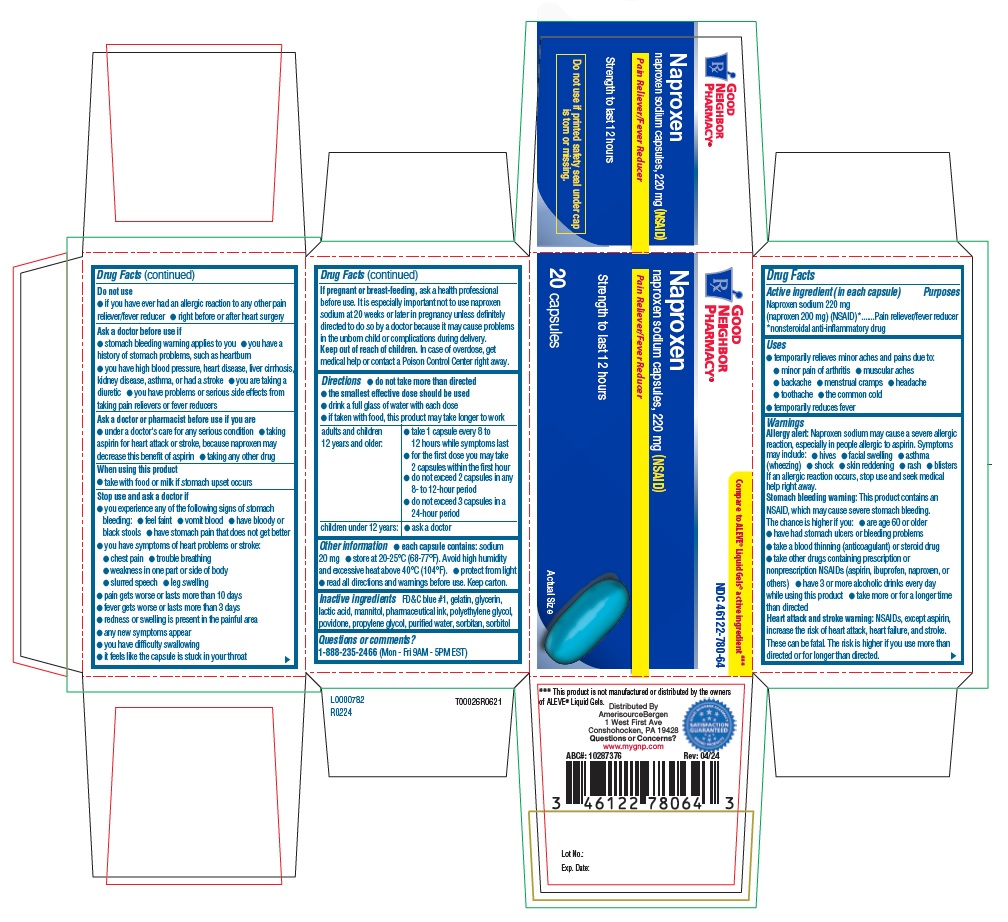
Naproxen Sodium 220 mg Capsule, Liquid Filled, 20-count — NDC 46122-780-64 (Billing 46122-0780-64)
This is a package of 20 capsules of Naproxen Sodium 220 mg Capsule, Liquid Filled from AMERISOURCE BERGEN, marketed since Apr 2024 and currently FDA-listed; retail pharmacies pay about $0.1494 per capsule (NADAC). It is this product's only package size.
NDC database record
One package, one record: these facts belong to NDC 46122-780-64 alone.
- Record
- FDA NDC Directory package listing · Human OTC drug
- Code segments
- 46122 labeler · 780 product · 64 package
- Package marketed since
- Apr 11, 2024
- Sample package
- No — commercial package
- Listing certified through
- Dec 31, 2026
- Billing quantity
- 20 EA per package
- Barcode (UPC-A, from the NDC)
- 3 4612278064 3
- FDA record last changed
- Jul 24, 2026
Other active recalls for Naproxen Sodium (different manufacturers) — 2 · tap to view
Identity & classification
Regulatory identifiers FDA, NLM and CMS codes for this package
Drug-database identifiers Medi-Span GPI and First Databank GCN / HICL / AHFS classification
- GSN (GCN sequence number): 066844
- GCN: 29254
- HICL (First Databank): 003726
- AHFS class code: 28:08.04.04
- RxCUI (RxNorm): 1112231
Where does this data come from?
- FDA openFDA NDC Directory · synced Oct 8, 2026
- FDA label on DailyMed · label index refreshed Oct 8, 2026
- RxNorm (NLM RxNav) · catalog refreshed Oct 8, 2026
- Medi-Span GPI (licensed)
- First Databank (licensed) · refreshed Oct 8, 2026
RxNorm drug class
This medicine belongs to the Nonsteroidal Anti-inflammatory Drug class.
Where does this data come from?
- RxClass (NLM) · catalog refreshed Oct 8, 2026
Clinical
Prescription naproxen is used to relieve pain, tenderness, swelling, and stiffness caused by osteoarthritis (arthritis caused by a breakdown of the lining of the joints), rheumatoid arthritis (arthritis caused by swelling of the lining of the joints), juvenile arthritis (a form of joint disease in children), and ankylosing spondylitis (arthritis that mainly affects the spine). Prescription naproxen tablets, extended-release tablets, and suspension are also used to relieve shoulder pain caused by bursitis (inflammation of a fluid-filled sac in the shoulder joint), tendinitis (inflammation of th...
Read the full MedlinePlus article ↗- It relieves pain, inflammation and fever. Prescription versions treat arthritis, tendonitis, bursitis, acute gout and painful periods. Over-the-counter versions handle minor aches...
- Take it by mouth with a full glass of water. Over-the-counter products are taken every 8 to 12 hours while symptoms last, and you should use the smallest dose that works. For presc...
- Headache, indigestion, heartburn, nausea and swelling are common. Call your doctor if you have black stools, vomit blood, a rash, yellow skin or eyes, or chest pain.
- Usually not. Combining naproxen with other NSAIDs or aspirin raises bleeding risk with little added benefit. Naproxen can also interfere with low-dose aspirin taken for your heart,...
Patient education
Supplement & herbal interactions
Some supplements/herbs that may interact with Naproxen Sodium — tap one for details:
Naproxen Sodium may be associated with lower levels of 1 nutrient — worth a chat with your pharmacist, not a cause for alarm.
Where does this data come from?
- MedlinePlus (NLM) · refreshed Oct 8, 2026
- FDA label on DailyMed · label index refreshed Oct 8, 2026
Ask a licensed pharmacist directly — free, answered by our team.
Pricing
A drug doesn't have one price. Each row is a different public payment system, and none is what you'd pay at the counter — that depends on your insurance. The ⓘ on each row explains what it measures.
| Price system | Per ea | Per package |
|---|---|---|
| Retail pharmacies payNADAC · weekly | $0.149 | $2.99 / 20 capsules |
| Medicaid paysCMS SDUD · 12 mo | No recent Medicaid claims on file for this NDC — rare and low-volume NDCs are suppressed in the public data. | |
| Medicare drug plans payPart D · quarterly | No Part D plan price is available for this NDC in our data. | |
Where does this data come from?
- CMS NADAC weekly file · file of Oct 7, 2026
- CMS ASP pricing files · refreshed Sep 20, 2026
- CMS Medicaid State Drug Utilization Data · refreshed Oct 9, 2026
- CMS Part D plan pricing files · refreshed Sep 24, 2026
- VA National Acquisition Center price file
Packaging — all sizes for this product
| Package NDC | Description | Marketing start | Marketing end | Status |
|---|---|---|---|---|
| 46122-0780-64 You're viewing this Main listing | 1 BOTTLE in 1 CARTON / 20 CAPSULE, LIQUID FILLED in 1 BOTTLE | 2024-04-11 | — | Active |
Therapeutic equivalents
| Product | Labeler | Pack | NADAC/unit | TE | Status | Price vs. this |
|---|---|---|---|---|---|---|
| Naproxen Sodium 220 mgthis 46122-0780-64 | AMERISOURCE | 20 capsules | $0.149 | — | Availability likely | — |
| Naproxen Sodium 220 mg 70677-1148-01 | Strategic | 40 capsules | $0.149 | — | Availability likely | — |
| Naproxen Sodium 220 mg 62011-0369-01 | Strategic | 40 capsules | $0.156 | — | Discontinued | +4% |
| Aleve liquid gels 220 mg 00280-0105-02 | Bayer | 160 capsules | — | — | FDA listed | — |
| Aleve 220 mg 00280-6080-01 | Bayer | 120 capsules | — | — | FDA listed | — |
| Aleve Easy Open Arthritis Cap 220 mg 00280-6091-80 | Bayer | 80 capsules | — | — | FDA listed | — |
| Naproxen Sodium 220 mg 00363-0102-15 | WALGREEN | 40 capsules | — | — | FDA listed | — |
| Naproxen Sodium 220 mg 00363-0177-11 | WALGREEN | 20 capsules | — | — | FDA listed | — |
| Naproxen Sodium 220 mg 00363-0748-08 | Walgreens | 80 capsules | — | — | FDA listed | — |
| Naproxen Sodium 220 mg 11673-0651-78 | TARGET | 80 capsules | — | — | FDA listed | — |
| Naproxen Sodium 220 mg 11673-0748-18 | TARGET | 180 capsules | — | — | FDA listed | — |
| Naproxen Sodium 220 mg 11822-0788-04 | Rite | 40 capsules | — | — | FDA listed | — |
| Naproxen Sodium 220 mg 21130-0748-20 | Safeway, | 20 capsules | — | — | FDA listed | — |
| Naproxen Sodium 220 mg 21130-0948-11 | Albertsons | 20 capsules | — | — | FDA listed | — |
| Naproxen Sodium 220 mg 30142-0285-22 | KROGER | 120 capsules | — | — | FDA listed | — |
| Naproxen Sodium 220 mg 36800-0204-11 | TOP | 20 capsules | — | — | FDA listed | — |
| Naproxen Sodium 220 mg 37808-0049-15 | HEB | 40 capsules | — | — | FDA listed | — |
| Naproxen Sodium 220 mg 41163-0079-15 | SUPERVALU | 40 capsules | — | — | FDA listed | — |
| Naproxen Sodium 220 mg 41250-0225-15 | MEIJER | 40 capsules | — | — | FDA listed | — |
| Naproxen Sodium 220 mg 41520-0748-20 | Care | 20 capsules | — | — | FDA listed | — |
| Naproxen Sodium 220 mg 49035-0382-22 | Wal-Mart | 120 capsules | — | — | FDA listed | — |
| Naproxen Sodium 220 mg 49035-0748-12 | EQUATE | 120 capsules | — | — | FDA listed | — |
| Naproxen Sodium 220 mg 51013-0137-15 | PuraCap | 20 capsules | — | — | FDA listed | — |
| Naproxen Sodium 220 mg 53345-0042-01 | Humanwell | 5000 capsules | — | — | FDA listed | — |
| Naproxen Sodium 220 mg 53943-0179-11 | DISCOUNT | 20 capsules | — | — | FDA listed | — |
| Naproxen Sodium 220 mg 55301-0748-20 | AAFES/Your | 20 capsules | — | — | FDA listed | — |
| Naproxen Sodium 220 mg 55910-0748-20 | Dolgencorp, | 20 capsules | — | — | FDA listed | — |
| All Day Relief 220 mg 56062-0748-40 | Publix | 40 capsules | — | — | FDA listed | — |
| Naproxen Sodium 220 mg 59428-0748-20 | Productos | 20 capsules | — | — | Discontinued | — |
| Naproxen Sodium 220 mg 59428-0784-20 | Productos | 20 capsules | — | — | Discontinued | — |
| Naproxen Sodium 220 mg 59726-0174-20 | P | 20 capsules | — | — | FDA listed | — |
| Naproxen Sodium 220 mg 59726-0751-20 | P | 20 capsules | — | — | FDA listed | — |
| Naproxen Sodium 220 mg 63868-0830-20 | CHAIN | 20 capsules | — | — | FDA listed | — |
| Naproxen Sodium 220 mg 63941-0681-16 | VALU | 50 capsules | — | — | FDA listed | — |
| Naproxen Sodium 220 mg 68016-0056-40 | Premier | 40 capsules | — | — | FDA listed | — |
| Naproxen Sodium 220 mg 69452-0179-22 | Bionpharma | 120 capsules | — | — | FDA listed | — |
| naproxen sodium 220 mg 69452-0259-22 | Bionpharma | 120 capsules | — | — | Discontinued | — |
| naproxen sodium 220 mg 69452-0284-25 | Bionpharma | 180 capsules | — | — | FDA listed | — |
| Naproxen Sodium 220 mg 69842-0748-08 | CVS | 80 capsules | — | — | FDA listed | — |
| Naproxen Sodium 220 mg 72288-0312-25 | Amazon.com | 180 capsules | — | — | FDA listed | — |
| Naproxen Sodium 220 mg 72476-0748-20 | Care | 20 capsules | — | — | FDA listed | — |
Where does this data come from?
- FDA openFDA NDC Directory · synced Oct 8, 2026
- FDA Orange Book · refreshed Oct 9, 2026
- CMS NADAC weekly file · file of Oct 7, 2026
Availability & generic status
FDA-approved generic versions are listed, and recent pricing/market data suggests they may be available — see Therapeutic equivalents.
Why the date isn’t exact: Generic timing can change because patents may be challenged, settled, licensed, added, removed, or worked around with a narrower label — and FDA approval does not always mean a pharmacy can get the generic today.
🛈 What do these terms mean?
- Patent
- Legal protection listed in the Orange Book that may delay generic approval or launch. Issued by the U.S. Patent & Trademark Office.
- Substance patent
- Covers the active drug molecule itself — the hardest to design around. A generic generally can’t launch until it expires.
- Formulation (product) patent
- Covers a specific formulation or dosage form. A generic can sometimes work around it with a different formulation.
- Method-of-use patent
- A patent covering one specific approved use of the drug — not necessarily the whole molecule. A generic can sometimes launch with a “skinny label” that carves out the protected use and keeps the others.
- Skinny label
- A generic label that omits a still-patented use when the FDA allows it — letting a generic reach the market for the unprotected uses.
- Exclusivity
- FDA-granted marketing protection, separate from patents — e.g. 5-yr new chemical entity, 7-yr orphan drug, or a +6-month pediatric extension.
- Paragraph IV
- A generic applicant’s formal challenge to a listed patent. It can potentially lead to earlier generic entry, but often involves litigation or a settlement.
- RLD / RS
- Reference Listed Drug — the brand product the FDA uses as the reference for generic applications. Reference Standard — the product the FDA expects generics to compare against in bioequivalence testing.
- TE / AB rating
- FDA therapeutic-equivalence rating. An AB rating generally means the FDA considers a generic therapeutically equivalent to — and substitutable for — the brand.
- LOE (loss of exclusivity)
- The latest patent or exclusivity currently listed — the loss-of-exclusivity / latest-listed-protection date shown on this page. Paragraph-IV challenges and settlements can move the real date earlier; FDA approval and a manufacturer’s decision to market can move it later.
Built from the FDA Orange Book. The bars above are scaled to each protection’s expiry; the red LOE marker is the last one to lapse.
| Patent | Type | Use code | Expires |
|---|---|---|---|
| US 10028925 ↗ | Method of use | U-1731 | Mar 3, 2026 |
| US 10022344 ↗ | Method of use | U-1731 | Mar 3, 2026 |
| US 10028925 ↗ | Method of use | U-1732 | Mar 3, 2026 |
| US 10022344 ↗ | Method of use | U-1732 | Mar 3, 2026 |
| US 11090280 ↗ | Method of use | U-1731 | Mar 3, 2026 |
| US 11090280 ↗ | Method of use | U-1732 | Mar 3, 2026 |
| US 9693979 ↗ | Drug product | — | Mar 3, 2026 |
| US 9693978 ↗ | Drug product | — | Mar 3, 2026 |
Is there a generic version of GNP NAPROXEN SODIUM 220 MG CAP?
The FDA approved a generic — why can’t I get it at my pharmacy yet?
Why do different websites show different generic release dates?
What does “FDA listed” mean?
What does a patent or protection date mean here?
What does “current Orange Book estimate” mean?
Can a generic come out before the last patent expires?
Can a generic come out after the listed dates?
What is the difference between patents and exclusivity?
Why are there multiple patent dates?
Where does this data come from?
- FDA Orange Book · refreshed Oct 9, 2026
What it looks like
Where does this data come from?
- FDA label on DailyMed · label index refreshed Oct 8, 2026
Inactive Ingredients / Excipients
Inactive ingredients, also called excipients, are components of the drug product other than the active ingredient. They may include fillers, dyes, coatings, preservatives, flavors, or other formulation ingredients.
🧪 Avoiding an ingredient? See Naproxen inactive ingredients by manufacturer: every current product's list side by side, so you can ask your pharmacy for the version that does not list it.
💡 Tap an ingredient (hover on desktop) to see what it is and why it’s used.
-
UNII H3R47K3TBD
FD&C Blue No. 1 is a synthetic blue dye approved for use in foods and medicines. It serves as a colorant to give the medication its distinctive appearance and help with product identification.
-
UNII 2G86QN327L
Gelatin is a protein derived from animal collagen, commonly used in medicines as a gelling agent and capsule material. It helps create soft or hard capsule shells that hold and release medication, and can also thicken liquid formulations.
-
UNII PDC6A3C0OX
Glycerin is a clear, thick liquid derived from plant oils or fats. It acts as a humectant to retain moisture, a sweetener, and a solvent in medications.
-
UNII 33X04XA5AT
Lactic acid is a naturally occurring organic acid derived from milk or plant sources. It lowers and maintains pH in formulations, helps preserve the product, and can enhance ingredient stability and absorption.
-
UNII 3OWL53L36A
A natural sugar alcohol derived from seaweed or synthesized in the lab. It's used as a filler to add bulk, a sweetener in sugar-free formulas, and a disintegrant to help tablets break apart in the stomach.
-
UNII 3WJQ0SDW1A
Polyethylene glycol is a synthetic liquid or solid polymer used in medicines as a solvent, lubricant, and humectant. It helps dissolve active ingredients, reduces friction during manufacturing, and retains moisture in the final product.
-
UNII U725QWY32X
Povidone K30 is a synthetic polymer made from petroleum. It acts as a binder to hold tablet ingredients together and as a disintegrant to help the tablet break apart in the stomach so the medicine can be absorbed.
-
UNII 6DC9Q167V3
Propylene glycol is a clear liquid derived from petroleum or vegetable sources. It acts as a solvent, humectant, and preservative in medicines, helping dissolve active ingredients and maintain product stability.
-
UNII 6O92ICV9RU
A waxy substance derived from sorbitol that helps mix oil and water together in medicines. It's used as an emulsifier to keep ingredients evenly blended and stable.
-
UNII 506T60A25R
Sorbitol is a natural sugar alcohol derived from glucose. It serves as a sweetener, humectant, and bulking agent in medications to improve taste and help maintain moisture in the product.
-
UNII 059QF0KO0R
Water is a liquid solvent that dissolves and mixes ingredients together in liquid medicines, syrups, and injections. It helps distribute the active drug evenly throughout the product.
11 inactive ingredients listed in the exact product block matched to this NDC.
Label-section wording can be broader than the structured product block and may mention additional formulation ingredients.
Where does this data come from?
ingredient classCode="IACT" elements from the exact product block matched by this NDC. Label-section narrative from DailyMed / the openFDA label index is shown separately when available.- FDA label on DailyMed · label index refreshed Oct 8, 2026
- FDA openFDA NDC Directory · synced Oct 8, 2026
Inactive ingredient FAQ
Are inactive ingredients the same for every manufacturer?
Why might an inactive ingredient be missing?
Can inactive ingredients matter?
Manufacturer & labeler
More NDCs from AMERISOURCE BERGEN labeler code 46122
- Motion Sickness Relief Meclizine HCl 25 mg Tablet, Chewable NDC 46122-774-51
- Nighttime Sleep-Aid Diphenhydramine HCl 50 mg Capsule, Liquid Filled NDC 46122-775-64
- GNP Hemorrhoidal Maximum Strength 150 mg/g; 144 mg/g; 10 mg/g; 25 mg/g Cream NDC 46122-776-37
- Hemorrhoidal Cocoa Butter, Phenylephrine HCl 2.39 g; 6.75 mg Suppository NDC 46122-777-65
- Isopropyl alcohol 70 mL/100mL Liquid NDC 46122-778-34
- Fexofenadine Hydrochloride 180 mg Tablet, Film Coated NDC 46122-779-58
- Good Neighbor Sugar Free Adult Tussin DM Cough and Chest Congestion Dextromethorphan HBr, Guaifenesin 20 mg/20mL; 200 mg/20mL Solution NDC 46122-782-29
- Good Neighbor Dye Free Adult Tussin DM Cough and Chest Congestion dextromethorphan hydrobromide and guaifenesin 20 mg/20mL; 200 mg/20mL Solution NDC 46122-783-34
- Good Neighbor Long Acting Cough Adult Tussin Dextromethorphan HBr 30 mg/10mL Liquid NDC 46122-784-29
- Good Neighbor Adult Tussin Mucus and chest congestion Guaifenesin 200 mg/10mL Syrup NDC 46122-785-29
- Good Neighbor Childrens Cough Relief Cherry Flavor DEXTROMETHORPHAN HYDROBROMIDE AND GUAIFENESIN 5 mg/5mL; 100 mg/5mL Liquid NDC 46122-786-29
- good neighbor pharmacy childrens loratadine 5 mg/5mL Solution NDC 46122-787-34
Where does this data come from?
- FDA openFDA NDC Directory · synced Oct 8, 2026
- Drugs@FDA
FDA label — Drug Facts FDA SPL
🎯 Indications and Usage ▾
Uses temporarily relieves minor aches and pains due to: minor pain of arthritis muscular aches backache menstrual cramps headache toothache the common cold temporarily reduces fever
⏱️ Dosage and Administration ▾
Directions do not take more than directed the smallest effective dose should be used drink a full glass of water with each dose if taken with food, this product may take longer to work adults and children 12 years and older: take 1 capsule every 8 to 12 hours while symptoms last for the first dose you may take 2 capsules within the first hour do not exceed 2 capsules in any 8- to 12-hour period do not exceed 3 capsules in a 24-hour period children under 12 years: ask a doctor
⚠️ Warnings ▾
Warnings Allergy Alert: Naproxen sodium may cause a severe allergic reaction, especially in people allergic to aspirin. Symptoms may include: hives facial swelling asthma (wheezing) shock skin reddening rash blisters If an allergic reaction occurs, stop use and seek medical help right away. Stomach bleeding warning: This product contains an NSAID, which may cause severe stomach bleeding.
The chance is higher if you: are age 60 or older have had stomach ulcers or bleeding problems take a blood thinning (anticoagulant) or steroid drug take other drugs containing prescription or nonprescription NSAIDs (aspirin, ibuprofen, naproxen, or others) have 3 or more alcoholic drinks every day while using this product take more or for a longer time than directed Heart attack and stroke warning NSAIDs, except aspirin, increase the risk of heart attack, heart failure, and stroke. These can be fatal. The risk is higher if you use more than directed or for longer than directed.
Do not use if you have ever had an allergic reaction to any other pain reliever/fever reducer right before or after heart surgery Ask a doctor before use if stomach bleeding warning applies to you you have a history of stomach problems, such as heartburn you have high blood pressure, heart disease, liver cirrhosis, kidney disease, asthma, or had a stroke you are taking a diuretic you have problems or serious side effects from taking pain relievers or fever reducers Ask a doctor or pharmacist before use if you are under a doctor's care for any serious condition taking aspirin for heart attack or stroke, because naproxen may decrease this benefit of aspirin taking any other drug When using this product take with food or milk if stomach upset occurs Stop use and ask a doctor if you experience any of the following signs of stomach bleeding: feel faint vomit blood have bloody or black stools have stomach pain that does not get better you have symptoms of heart problems or stroke: chest pain trouble breathing slurred speech weakness in one part or side of body leg swelling pain gets worse or lasts more than 10 days fever gets worse or lasts more than 3 days redness or swelling is present in the painful area any new symptoms appear you have difficulty swallowing it feels like the capsule is stuck in your throat If pregnant or breast-feeding, ask a health professional before use.
It is especially important not to use naproxen sodium at 20 weeks or later in pregnancy unless definitely directed to do so by a doctor because it may cause problems in the unborn child or complications during delivery. Keep out of reach of children. In case of overdose, get medical help or contact a Poison Control Center right away.
📦 Storage and Handling ▾
Other information each capsule contains: sodium 20 mg store at 20-25°C (68-77°F). Avoid high humidity and excessive heat above 40°C (104°F). protect from light read all directions and warnings before use. Keep carton.
🧪 Active Ingredient ▾
Active ingredients (in each capsule) Naproxen sodium 220 mg (naproxen 200 mg) (NSAID)* *nonsteroidal anti-inflammatory drug
🧪 Inactive Ingredients ▾
Inactive ingredients FD&C blue #1, gelatin, glycerin, lactic acid, mannitol, pharmaceutical ink, polyethylene glycol, povidone, propylene glycol, purified water, sorbitan, sorbitol
🎯 Purpose ▾
Purposes Pain reliever/fever reducer
📄 Do Not Use ▾
Do not use if you have ever had an allergic reaction to any other pain reliever/fever reducer right before or after heart surgery
📄 Ask a Doctor Before Use If ▾
Ask a doctor before use if stomach bleeding warning applies to you you have a history of stomach problems, such as heartburn you have high blood pressure, heart disease, liver cirrhosis, kidney disease, asthma, or had a stroke you are taking a diuretic you have problems or serious side effects from taking pain relievers or fever reducers
📄 Ask a Doctor or Pharmacist Before Use If ▾
Ask a doctor or pharmacist before use if you are under a doctor's care for any serious condition taking aspirin for heart attack or stroke, because naproxen may decrease this benefit of aspirin taking any other drug
📄 When Using This Product ▾
When using this product take with food or milk if stomach upset occurs
📄 Stop Use and Ask a Doctor If ▾
Stop use and ask a doctor if you experience any of the following signs of stomach bleeding: feel faint vomit blood have bloody or black stools have stomach pain that does not get better you have symptoms of heart problems or stroke: chest pain trouble breathing slurred speech weakness in one part or side of body leg swelling pain gets worse or lasts more than 10 days fever gets worse or lasts more than 3 days redness or swelling is present in the painful area any new symptoms appear you have difficulty swallowing it feels like the capsule is stuck in your throat
🤰 If Pregnant or Breast-Feeding ▾
If pregnant or breast-feeding, ask a health professional before use. It is especially important not to use naproxen sodium at 20 weeks or later in pregnancy unless definitely directed to do so by a doctor because it may cause problems in the unborn child or complications during delivery.
📄 Keep Out of Reach of Children ▾
Keep out of reach of children. In case of overdose, get medical help or contact a Poison Control Center right away.
📄 Questions or Comments ▾
Questions or comments? 1-888-235-2466 (Mon – Fri 9AM – 5PM EST)
📄 Package Label / Principal Display Panel ▾
PRINCIPAL DISPLAY PANEL - 20's carton GOOD NEIGHBOR PHARMACY Compare to ALEVE® Liquid Gels® active ingredient*** NDC 46122-780-64 Naproxen naproxen sodium capsules, 220 mg (NSAID) Pain Reliever/ Fever Reducer Strength to last 12 hours 20 capsules front.jpg