
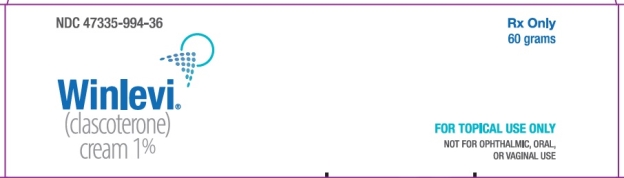
Winlevi Clascoterone 1 g/100g Cream — NDC 47335-994-36 (Billing 47335-0994-36)
This is a package of Winlevi Clascoterone 1 g/100g Cream from Sun Pharmaceutical Industries, Inc., marketed since Oct 2021 and currently FDA-listed; retail pharmacies pay about $10.00 per g (NADAC). It is the main listing for this product, which comes in 2 package sizes.
NDC database record
One package, one record: these facts belong to NDC 47335-994-36 alone.
- Record
- FDA NDC Directory package listing · Human prescription drug
- Code segments
- 47335 labeler · 994 product · 36 package
- Package marketed since
- Oct 4, 2021
- Sample package
- No — commercial package
- Listing certified through
- Dec 31, 2026
- Barcode (UPC)
- 0347335994360
- Medicaid fills, this package
- 32,496 prescriptions in the last four reported quarters
- FDA record last changed
- Jul 24, 2026
Identity & classification
Regulatory identifiers FDA, NLM and CMS codes for this package
Drug-database identifiers Medi-Span GPI and First Databank GCN / HICL / AHFS classification
- GSN (GCN sequence number): 081428
- GCN: 48534
- GPI-14 (Medi-Span): 90050011003720
- HICL (First Databank): 046803
- AHFS class code: 84:06.92.00
- RxCUI (RxNorm): 2474344
Where does this data come from?
- FDA openFDA NDC Directory · synced Oct 8, 2026
- FDA label on DailyMed · label index refreshed Oct 8, 2026
- RxNorm (NLM RxNav) · catalog refreshed Oct 1, 2026
- Medi-Span GPI (licensed)
- First Databank (licensed) · refreshed Oct 8, 2026
RxNorm drug class
This medicine belongs to the Androgen Receptor Inhibitor class.
Where does this data come from?
- RxClass (NLM) · catalog refreshed Oct 1, 2026
Clinical
Patient education
Supplement & herbal interactions
Some supplements/herbs that may interact with Clascoterone — tap one for details:
Where does this data come from?
- MedlinePlus (NLM) · refreshed Oct 8, 2026
- FDA label on DailyMed · label index refreshed Oct 8, 2026
Ask a licensed pharmacist directly — free, answered by our team.
Pricing
A drug doesn't have one price. Each row is a different public payment system, and none is what you'd pay at the counter — that depends on your insurance. The ⓘ on each row explains what it measures.
| Price system | Per g | Per package |
|---|---|---|
| Retail pharmacies payNADAC · weekly | $10.001 | $600.06 / 60 g |
| Medicaid paysCMS SDUD · 12 mo | $9.93 | $595.99 / 60 g |
| Medicare drug plans payPart D · quarterly | No Part D plan price is available for this NDC in our data. | |
Where does this data come from?
- CMS NADAC weekly file · file of Oct 7, 2026
- CMS ASP pricing files · refreshed Sep 20, 2026
- CMS Medicaid State Drug Utilization Data · through Q1 2026
- CMS Part D plan pricing files · refreshed Sep 24, 2026
- VA National Acquisition Center price file
Packaging — all sizes for this product
| Package NDC | Description | Per unit | Per pack | Marketing start | Marketing end | Status |
|---|---|---|---|---|---|---|
| 47335-0994-36 You're viewing this Main listing | 1 TUBE in 1 CARTON / 60 g in 1 TUBE | $10.00 / g | $600.06 | 2021-10-04 | — | Active |
| 47335-0994-94 47335-994-94 | 12 CARTON in 1 CASE / 1 TUBE in 1 CARTON / 2 g in 1 TUBE Sample | — | — | 2021-10-04 | — | Active |
In Medicaid, this is the most-dispensed pack of this product — about 100% of fills over the last four reported quarters. See all packs ↓
Pack size FAQ
What quantity is in this package?
What NDC number is used to bill for this package of Winlevi Clascoterone 1 g/100g Cream?
Prices are the latest CMS NADAC pharmacy acquisition cost per NDC; per-pack figures are per-unit × pack quantity, shown only when the pack is denominated in the same measure NADAC prices.
Therapeutic equivalents
| Product | Labeler | Pack | NADAC/unit | TE | Status | Price vs. this |
|---|---|---|---|---|---|---|
| Winlevi 1 g/100gthis 47335-0994-36 | Sun | 1 tube | $10.001 | — | Availability likely | — |
Where does this data come from?
- FDA openFDA NDC Directory · synced Oct 8, 2026
- FDA Orange Book · refreshed Oct 3, 2026
- CMS NADAC weekly file · file of Oct 7, 2026
Availability & generic status
We did not find an FDA-approved generic match for this exact strength, form and route. Patent/protection dates below may affect future generic timing.
Why the date isn’t exact: Generic timing can change because patents may be challenged, settled, licensed, added, removed, or worked around with a narrower label — and FDA approval does not always mean a pharmacy can get the generic today.
🛈 What do these terms mean?
- Patent
- Legal protection listed in the Orange Book that may delay generic approval or launch. Issued by the U.S. Patent & Trademark Office.
- Substance patent
- Covers the active drug molecule itself — the hardest to design around. A generic generally can’t launch until it expires.
- Formulation (product) patent
- Covers a specific formulation or dosage form. A generic can sometimes work around it with a different formulation.
- Method-of-use patent
- A patent covering one specific approved use of the drug — not necessarily the whole molecule. A generic can sometimes launch with a “skinny label” that carves out the protected use and keeps the others.
- Skinny label
- A generic label that omits a still-patented use when the FDA allows it — letting a generic reach the market for the unprotected uses.
- Exclusivity
- FDA-granted marketing protection, separate from patents — e.g. 5-yr new chemical entity, 7-yr orphan drug, or a +6-month pediatric extension.
- Paragraph IV
- A generic applicant’s formal challenge to a listed patent. It can potentially lead to earlier generic entry, but often involves litigation or a settlement.
- RLD / RS
- Reference Listed Drug — the brand product the FDA uses as the reference for generic applications. Reference Standard — the product the FDA expects generics to compare against in bioequivalence testing.
- TE / AB rating
- FDA therapeutic-equivalence rating. An AB rating generally means the FDA considers a generic therapeutically equivalent to — and substitutable for — the brand.
- LOE (loss of exclusivity)
- The latest patent or exclusivity currently listed — the loss-of-exclusivity / latest-listed-protection date shown on this page. Paragraph-IV challenges and settlements can move the real date earlier; FDA approval and a manufacturer’s decision to market can move it later.
Built from the FDA Orange Book. The bars above are scaled to each protection’s expiry; the red LOE marker is the last one to lapse.
| Patent | Type | Use code | Expires |
|---|---|---|---|
| US 12337002 ↗ | Method of use | U-3280 | Jul 24, 2028 |
| US 11207332 ↗ | Method of use | U-3280 | Nov 20, 2028 |
| US 10159682 ↗ | Method of use | U-2942 | Aug 14, 2028 |
| US 8143240 ↗ | Method of use | U-2942 | Jan 12, 2027 |
| US 9486458 ↗ | Method of use | U-2942 | Jul 24, 2028 |
| US 9433628 ↗ | Drug product | — | Feb 28, 2029 |
| US 11938141 ↗ | Drug product | — | Jul 24, 2028 |
| US 8785427 ↗ | Drug product | — | Jul 25, 2030 |
Is there a generic version of WINLEVI 1% CREAM?
The FDA approved a generic — why can’t I get it at my pharmacy yet?
Why do different websites show different generic release dates?
What does “FDA listed” mean?
What does a patent or protection date mean here?
What does “current Orange Book estimate” mean?
Can a generic come out before the last patent expires?
Can a generic come out after the listed dates?
What is the difference between patents and exclusivity?
Why are there multiple patent dates?
Where does this data come from?
- FDA Orange Book · refreshed Oct 3, 2026
What it looks like
Where does this data come from?
- FDA label on DailyMed · label index refreshed Oct 8, 2026
Inactive Ingredients / Excipients
Inactive ingredients, also called excipients, are components of the drug product other than the active ingredient. They may include fillers, dyes, coatings, preservatives, flavors, or other formulation ingredients.
💡 Tap an ingredient (hover on desktop) to see what it is and why it’s used.
-
UNII H4N855PNZ1
Alpha-tocopherol is a form of vitamin E, a fat-soluble antioxidant derived from natural or synthetic sources. In medicines, it prevents oils and fats from breaking down and becoming rancid, protecting the product's stability and shelf life.
-
UNII 936JST6JCN
Cetyl alcohol is a waxy, fatty substance derived from plant or animal sources. It acts as an emulsifier and thickener in medicines, helping blend oil and water components and giving products a smooth, creamy texture.
-
UNII 7FLD91C86K
Edetate disodium is a chemical compound that binds and removes certain metal ions. In medicines, it acts as a preservative and stabilizer by preventing metals like calcium from interfering with the product's shelf life and consistency.
-
UNII U72Q2I8C85
A mixture of fats derived from coconut oil that acts as an emulsifier and solubilizer. It helps blend oil and water-based ingredients together and improves how the body absorbs certain drugs.
-
UNII T5L8T28FGP
Mineral oil is a clear, odorless liquid derived from crude oil. It acts as a lubricant and emollient in medications, helping pills slide smoothly during manufacturing and aiding moisture retention in topical products.
-
UNII 6OZP39ZG8H
Polysorbate 80 is a synthetic emulsifier derived from sorbitol and oleic acid. It helps mix oil and water-based ingredients together in medications and improves how the product disperses in the body.
-
25 g / 100 g
UNII 6DC9Q167V3
Propylene glycol is a clear liquid derived from petroleum or vegetable sources. It acts as a solvent, humectant, and preservative in medicines, helping dissolve active ingredients and maintain product stability.
-
UNII 059QF0KO0R
Water is a liquid solvent that dissolves and mixes ingredients together in liquid medicines, syrups, and injections. It helps distribute the active drug evenly throughout the product.
8 inactive ingredients listed in the exact product block matched to this NDC.
Where does this data come from?
ingredient classCode="IACT" elements from the exact product block matched by this NDC. Label-section narrative from DailyMed / the openFDA label index is shown separately when available.- FDA label on DailyMed · label index refreshed Oct 8, 2026
- FDA openFDA NDC Directory · synced Oct 8, 2026
Inactive ingredient FAQ
Are inactive ingredients the same for every manufacturer?
Why might an inactive ingredient be missing?
Can inactive ingredients matter?
Manufacturer & labeler
More NDCs from Sun Pharmaceutical Industries, Inc. labeler code 47335
- Alfuzosin Hydrochloride 10 mg Tablet, Extended Release NDC 47335-956-08
- Lacosamide 200 mg Tablet, Film Coated NDC 47335-980-18
- Glatiramer Acetate 20 mg/mL Injection, Solution NDC 47335-990-02
- Glatiramer Acetate 40 mg/mL Injection, Solution NDC 47335-991-02
- MAGNESIUM SULFATE 40 mg/mL Injection, Solution NDC 47335-992-01
- METRONIDAZOLE 500 mg/100mL Injection, Solution NDC 47335-993-01
Where does this data come from?
- FDA openFDA NDC Directory · synced Oct 8, 2026
- Drugs@FDA
Full prescribing information FDA SPL
🎯 Indications and Usage ▾
1 INDICATIONS AND USAGE WINLEVI (clascoterone) cream is an androgen receptor inhibitor indicated for the topical treatment of acne vulgaris in patients 12 years of age and older. WINLEVI (clascoterone) cream is an androgen receptor inhibitor indicated for the topical treatment of acne vulgaris in patients 12 years of age and older. ( 1 )
⏱️ Dosage and Administration ▾
2 DOSAGE AND ADMINISTRATION Cleanse the affected area gently. After the skin is dry, apply a thin uniform layer of WINLEVI cream twice per day, in the morning and the evening, to the affected area. Avoid accidental transfer of WINLEVI cream into eyes, mouth or other mucous membranes.
If contact with mucous membranes occurs, rinse thoroughly with water. WINLEVI cream is for topical use only. WINLEVI cream is not for ophthalmic, oral or vaginal use.
Apply a thin layer (approximately 1 gram) to affected area twice daily (morning and evening). Avoid contact with eyes, mouth, and mucous membranes. ( 2 ) Not for ophthalmic, oral or vaginal use.
( 2 )
💊 Dosage Forms and Strengths ▾
3 DOSAGE FORM AND STRENGTHS Cream 1%. Each gram of WINLEVI cream contains 10 mg of clascoterone in a white to almost white cream. Cream 1%. ( 3 )
⛔ Contraindications ▾
4 CONTRAINDICATIONS None. None ( 4 )
⚠️ Warnings and Cautions ▾
5 WARNINGS AND PRECAUTIONS Local Irritation: Pruritus, burning, skin redness or peeling may be experienced with WINLEVI cream. If these effects occur, discontinue or reduce the frequency of application of WINLEVI cream. ( 5.1 ) Hypothalamic-pituitary-adrenal (HPA) axis suppression may occur during or after treatment with clascoterone.
( 5.2 ) Attempt to withdraw use if HPA axis suppression develops. ( 5.2 ) Pediatric patients may be more susceptible to systemic toxicity. ( 5.2 , 8.4 ) Hyperkalemia: Elevated potassium levels were observed in some subjects during the clinical trials.
( 12.2 )
5.1Local Skin Reactions WINLEVI cream may induce local irritation (erythema/redness, pruritus, scaling/ dryness). Concomitant use with other potentially irritating topical products (medicated or abrasive soaps and cleansers, soaps and cosmetics that have a strong drying effect and products with high concentrations of alcohol, astringents, spices or lime) should be limited. The product should not be applied to cuts, abrasions, eczematous or sunburned skin.
5.2Hypothalamic-pituitary-adrenal (HPA) Axis Suppression Hypothalamic-pituitary-adrenal (HPA) axis suppression was observed and may occur during or after treatment with clascoterone. In the PK trial, all subjects returned to normal HPA axis function at follow-up 4 weeks after stopping treatment [see Clinical Pharmacology (12.2) ]. Conditions which augment systemic absorption include use over large surface areas, prolonged use, and the use of occlusive dressings.
If HPA axis suppression develops, an attempt should be made to withdraw the drug. Pediatric patients may be more susceptible to systemic toxicity.
🤒 Adverse Reactions ▾
6 ADVERSE REACTIONS Most common adverse reactions occurring in 7 to 12% of patients are erythema/reddening, pruritus and scaling/dryness. Additionally, edema, stinging, and burning occurred in >3% of patients and were reported in a similar percentage of subjects treated with vehicle. ( 6.1 ) To report SUSPECTED ADVERSE REACTIONS, contact Sun Pharmaceutical Industries, Inc. 1-800-818-4555 or FDA at 1-800-FDA-1088 or http://www.fda.gov/medwatch.
6.1Clinical Trials Experience Because clinical trials are conducted under widely varying conditions, adverse reaction rates observed in the clinical trials of a drug cannot be directly compared to rates in the clinical trials of another drug and may not reflect the rates observed in practice. In two identical multicenter, randomized, double-blind, vehicle-controlled trials, 1421 subjects 12 years and older with facial acne vulgaris applied WINLEVI cream or vehicle twice daily for 12 weeks. Overall, 62% of the subjects were female, and 38% were male, 91% of the patients were Caucasian, and the mean age was 19.7 years.
Local skin reactions (edema, erythema/redness, pruritus, scaling/dryness, skin atrophy, stinging/burning, striae rubrea, telangiectasia) were observed during the 12-week treatment and occurred in a similar percentage of subjects treated with vehicle. Local skin reactions reported by ≥ 1% of subjects treated with WINLEVI cream are shown in the following table. Table 1.
Incidence of New or Worsening Local Skin Reactions Reported by ≥ 1% of Subjects Treated with WINLEVI Cream After Day 1 in 12-Week Controlled Clinical Trials WINLEVI Cream 1% (N=674 a ) Vehicle Cream (N=656 a ) a The denominators for calculating the percentages were the 674 of 709 subjects treated with WINLEVI cream and 656 of 712 subjects treated with vehicle in these trials who had local skin reaction results reported after Day 1. Edema 24 (3.6%) 23 (3.5%) Erythema/redness 82 (12.2%) 101 (15.4%) Pruritus 52 (7.7%) 54 (8.2%) Scaling/dryness 71 (10.5%) 68 (10.4%) Skin atrophy 11 (1.6%) 17 (2.6%) Stinging/burning 28 (4.2%) 28 (4.3%) Striae rubrae 17 (2.5%) 10 (1.5%) Telangiectasia 8 (1.2%) 12 (1.8%) The following adverse reactions associated with the use of WINLEVI cream were identified in clinical trials and long-term safety studies.
Metabolism: hyperkalemia [see Clinical Pharmacology (12.2) ] Reproductive: polycystic ovaries, amenorrhea.
👥 Use in Specific Populations ▾
8 USE IN SPECIFIC POPULATIONS
8.1Pregnancy Risk Summary There are no available data on WINLEVI cream use in pregnant women to evaluate for a drug-associated risk of major birth defects, miscarriage, or adverse maternal or fetal outcomes. In animal reproduction studies, subcutaneous administration of clascoterone to pregnant rats and rabbits during organogenesis at doses 8 or 39 times the maximum recommended human dose (MRHD), respectively, increased malformations in rats and post-implantation loss and resorptions in rabbits (see Data ). The background risk of major birth defects and miscarriage for the indicated population is unknown.
Adverse outcomes in pregnancy occur regardless of the health of the mother or the use of medications. In the U.S. general population, the estimated background risk of major birth defects and miscarriage in clinically recognized pregnancies is 2% to 4% and 15% to 20%, respectively. Data Animal Data In an embryofetal development study, clascoterone was administered subcutaneously to pregnant rats at doses of 1, 5, or 25 mg/kg/day during the period of organogenesis.
No clascoterone-related maternal toxicity or effects on uterine parameters were noted at doses up to 25 mg/kg/day (336 times the MRHD based on AUC comparison). Clascoterone-related malformations were noted at all dose levels, without a dose relationship. Omphalocele was noted in a single fetus at each dose level.
External and visceral malformations (severe dilation of the lateral and third cerebral ventricles; thin skin, small size, and protruding tongue) were noted in two additional fetuses at 1 mg/kg/day (8 times the MRHD based on AUC comparison). In an embryofetal development study, clascoterone was administered subcutaneously to pregnant rabbits at doses of 0.1, 0.4, or 1.5 mg/kg/day during the period of organogenesis. Post-implantation loss and resorptions were increased at 1.5 mg/kg/day (39 times the MRHD based on AUC comparison).
No developmental toxicity was noted at doses up to 0.4 mg/kg/day (12 times the MRHD based on AUC comparison). No clascoterone-related maternal toxicity or fetal malformations were noted at doses up to 1.5 mg/kg/day (39 times the MRHD based on AUC comparison). In a prenatal and postnatal development study, clascoterone was administered subcutaneously to pregnant rats at doses of 0.5, 2.5, and 12.5 mg/kg/day beginning on gestation day 6 and continuing through lactation day 20.
No significant maternal or developmental toxicity was observed at doses up to 12.5 mg/kg/day (163 times the MRHD based on AUC comparison).
8.2Lactation Risk Summary There are no data regarding the presence of clascoterone or metabolite in human milk, the effects on the breastfed infant or the effects on milk production. The lack of clinical data during lactation precludes a clear determination of the risk of clascoterone to an infant during lactation; therefore, the developmental and health benefits of breastfeeding should be considered along with the mother's clinical need for clascoterone and any potential adverse effects on the breastfed child from clascoterone or from the underlying maternal condition.
8.4Pediatric Use Safety and effectiveness of WINLEVI cream for the topical treatment of acne vulgaris have been established in 641 pediatric patients, aged 12 to 18 years in two identical multicenter, randomized, double-blind, vehicle-controlled, 12-week trials and 2 open-label pharmacokinetic studies [see Clinical Studies (14) ]. Safety and effectiveness of WINLEVI cream for the topical treatment of acne vulgaris has not been established in pediatric patients under 12 years of age. Hypothalamic-pituitary-adrenal (HPA) axis suppression was observed in 2/22 (9%) adolescent subjects.
All subjects returned to normal HPA axis function at follow-up 4 weeks after stopping the treatment [see Clinical Pharmacology (12.2) ]. Children may be more susceptible to systemic toxicity when treated with clascoterone [see Pharmacodynamics (12.2) ]… [Excerpted — this section continues on DailyMed.]
🤰 Pregnancy ▾
8.1Pregnancy Risk Summary There are no available data on WINLEVI cream use in pregnant women to evaluate for a drug-associated risk of major birth defects, miscarriage, or adverse maternal or fetal outcomes. In animal reproduction studies, subcutaneous administration of clascoterone to pregnant rats and rabbits during organogenesis at doses 8 or 39 times the maximum recommended human dose (MRHD), respectively, increased malformations in rats and post-implantation loss and resorptions in rabbits (see Data ). The background risk of major birth defects and miscarriage for the indicated population is unknown.
Adverse outcomes in pregnancy occur regardless of the health of the mother or the use of medications. In the U.S. general population, the estimated background risk of major birth defects and miscarriage in clinically recognized pregnancies is 2% to 4% and 15% to 20%, respectively. Data Animal Data In an embryofetal development study, clascoterone was administered subcutaneously to pregnant rats at doses of 1, 5, or 25 mg/kg/day during the period of organogenesis.
No clascoterone-related maternal toxicity or effects on uterine parameters were noted at doses up to 25 mg/kg/day (336 times the MRHD based on AUC comparison). Clascoterone-related malformations were noted at all dose levels, without a dose relationship. Omphalocele was noted in a single fetus at each dose level.
External and visceral malformations (severe dilation of the lateral and third cerebral ventricles; thin skin, small size, and protruding tongue) were noted in two additional fetuses at 1 mg/kg/day (8 times the MRHD based on AUC comparison). In an embryofetal development study, clascoterone was administered subcutaneously to pregnant rabbits at doses of 0.1, 0.4, or 1.5 mg/kg/day during the period of organogenesis. Post-implantation loss and resorptions were increased at 1.5 mg/kg/day (39 times the MRHD based on AUC comparison).
No developmental toxicity was noted at doses up to 0.4 mg/kg/day (12 times the MRHD based on AUC comparison). No clascoterone-related maternal toxicity or fetal malformations were noted at doses up to 1.5 mg/kg/day (39 times the MRHD based on AUC comparison). In a prenatal and postnatal development study, clascoterone was administered subcutaneously to pregnant rats at doses of 0.5, 2.5, and 12.5 mg/kg/day beginning on gestation day 6 and continuing through lactation day 20.
No significant maternal or developmental toxicity was observed at doses up to 12.5 mg/kg/day (163 times the MRHD based on AUC comparison).
🧒 Pediatric Use ▾
8.4Pediatric Use Safety and effectiveness of WINLEVI cream for the topical treatment of acne vulgaris have been established in 641 pediatric patients, aged 12 to 18 years in two identical multicenter, randomized, double-blind, vehicle-controlled, 12-week trials and 2 open-label pharmacokinetic studies [see Clinical Studies (14) ]. Safety and effectiveness of WINLEVI cream for the topical treatment of acne vulgaris has not been established in pediatric patients under 12 years of age. Hypothalamic-pituitary-adrenal (HPA) axis suppression was observed in 2/22 (9%) adolescent subjects.
All subjects returned to normal HPA axis function at follow-up 4 weeks after stopping the treatment [see Clinical Pharmacology (12.2) ]. Children may be more susceptible to systemic toxicity when treated with clascoterone [see Pharmacodynamics (12.2) ].
🧓 Geriatric Use ▾
8.5Geriatric Use Clinical studies of WINLEVI cream did not include sufficient numbers of subjects aged 65 years of age and over to determine whether they respond differently from younger subjects. Other reported clinical experience has not identified differences in responses between the elderly and younger patients. In general, dose selection for an elderly patient should be cautious, usually starting at the low end of the dosing range, reflecting the greater frequency of decreased hepatic, renal, or cardiac function, and of concomitant disease or other drug therapy.
🧬 Clinical Pharmacology ▾
12 CLINICAL PHARMACOLOGY
12.1Mechanism of Action Clascoterone is an androgen receptor inhibitor. The mechanism of action of WINLEVI cream for the topical treatment of acne vulgaris is unknown.
12.2Pharmacodynamics Hypothalamic-Pituitary-Adrenal (HPA) Axis Suppression HPA axis suppression was evaluated in adult (n=20) and adolescent (n=22) subjects with acne vulgaris following twice daily application of WINLEVI cream for 2 weeks in the pharmacokinetic study described in Section 12.3. HPA axis suppression indicated by 30-minute post-stimulation serum cortisol level of ≤18 mcg/dL was observed in 1/20 (5%) of adult subjects and 2/22 (9%) of adolescent subjects at Day 14. All subjects returned to normal HPA axis function at follow-up 4 weeks after the end of treatment.
Potassium Shifts from normal to elevated potassium levels were observed in 5% of clascoterone-treated subjects and 4% of vehicle-treated subjects. Cardiac Electrophysiology At approximately 2-times the systemic exposure observed with the maximum dose, WINLEVI cream does not prolong the QT interval to any clinically relevant extent.
12.3Pharmacokinetics Absorption Following topical treatment of WINLEVI cream for 2 weeks with a mean dose of approximately 6 grams applied twice daily to adult subjects with moderate to severe acne vulgaris (n=20), systemic concentrations of clascoterone were at steady state by Day 5. On Day 14, the mean ± SD maximum plasma concentration (C max ) was 4.5 ± 2.9 ng/mL, the mean ± SD area under the plasma concentration-time over the dosing interval (AUC ꞇ ) was 37.1 ± 22.3 h*ng/mL and the mean ± SD average plasma concentration (C avg ) was 3.1 ± 1.9 ng/mL.
Distribution Plasma protein binding of clascoterone is 84% to 89% and is independent of concentrations, in vitro. Elimination Metabolism Following topical treatment with WINLEVI cream, the plasma concentrations of cortexolone, a possible primary metabolite of clascoterone, were detectable and generally below or near the lower limit of quantitation (0.5 ng/mL) in subjects ≥12 years of age with acne vulgaris. The in vitro study indicated that incubation of 10 µmol/L clascoterone with human cryopreserved hepatocytes generated cortexolone as the possible primary metabolite and other unidentified metabolites, including conjugated metabolites.
Excretion Excretion of clascoterone has not been fully characterized in humans. Specific Populations Pediatric Patients In adolescent subjects ≥ 12 to <18 years of age (n=22) after 2 weeks of twice daily treatment with mean dose of approximately 6 grams of WINLEVI cream (or mean dose of approximately 4 grams in younger, smaller subjects), steady-state concentrations of clascoterone were achieved by Day 5. Clascoterone systemic exposure in adolescents was similar to those observed in adults.
Drug Interaction Studies Clinical Studies No clinical studies evaluating the drug interaction potential of WINLEVI cream have been conducted. In Vitro Studies CYP Enzymes: Clascoterone inhibited CYP 1A2, 2B6, 2C8, 2C9, 2C19, 2D6, 2E1, or 3A4 with an IC 50 value of >40 µM. Clascoterone up to 30 µM did not induce CYP 1A2, 2B6, or 3A4.
These findings suggest that WINLEVI cream has no clinically meaningful effect on the PK of drugs metabolized by CYP 1A2, 2B6, 2C8, 2C9, 2C19, 2D6, 2E1, or 3A4.
🧬 Mechanism of Action ▾
12.1Mechanism of Action Clascoterone is an androgen receptor inhibitor. The mechanism of action of WINLEVI cream for the topical treatment of acne vulgaris is unknown.
📦 How Supplied / Storage and Handling ▾
16 HOW SUPPLIED/STORAGE AND HANDLING WINLEVI cream 1% is supplied in an epoxy-lined aluminum blind-end tube with a polypropylene cap closure: NDC 47335-994-36 60-gram tube Prior to Dispensing: Store the product in a refrigerator between 36°F and 46°F (2°C and 8°C). Do not freeze. Dispensing Instructions for the Pharmacist: Direct the patient to store the product while in use at room temperature, between 68°F and 77°F (20°C to 25°C).
Do not freeze. Discard the unused product 180 days after the date of dispensing or 1 month after first opening, whichever is sooner.
📦 Storage and Handling ▾
Prior to Dispensing: Store the product in a refrigerator between 36°F and 46°F (2°C and 8°C). Do not freeze.
Dispensing Instructions for the Pharmacist: Direct the patient to store the product while in use at room temperature, between 68°F and 77°F (20°C to 25°C). Do not freeze. Discard the unused product 180 days after the date of dispensing or 1 month after first opening, whichever is sooner.
📋 Description ▾
11 DESCRIPTION WINLEVI (clascoterone) cream contains clascoterone, an androgen receptor inhibitor, in a cream base for topical dermatologic use. WINLEVI cream is a white to almost white cream. Chemically, clascoterone is cortexolone-17α propionate.
Clascoterone is a white to almost white powder, practically insoluble in water. The compound has the empirical formula C 24 H 34 O 5 and molecular weight of 402.5 g/mol. The structural formula is shown below.
Each gram of WINLEVI cream 1% contains 10 mg of clascoterone in a cream base of cetyl alcohol, citric acid monohydrate, edetate disodium, mineral oil, mono- and di-glycerides, polysorbate 80, propylene glycol, purified water, and vitamin E. image description
💬 Information for Patients ▾
17 PATIENT COUNSELING INFORMATION Advise the patient to read the FDA-approved patient labeling (Patient Information). Avoid applying WINLEVI Cream to damaged skin (such as cuts, abrasions), eczematous areas, and sunburned skin. Avoid concomitant use of other potentially irritating topical products (medicated or not).
🧬 Pharmacokinetics ▾
12.3Pharmacokinetics Absorption Following topical treatment of WINLEVI cream for 2 weeks with a mean dose of approximately 6 grams applied twice daily to adult subjects with moderate to severe acne vulgaris (n=20), systemic concentrations of clascoterone were at steady state by Day 5. On Day 14, the mean ± SD maximum plasma concentration (C max ) was 4.5 ± 2.9 ng/mL, the mean ± SD area under the plasma concentration-time over the dosing interval (AUC ꞇ ) was 37.1 ± 22.3 h*ng/mL and the mean ± SD average plasma concentration (C avg ) was 3.1 ± 1.9 ng/mL.
Distribution Plasma protein binding of clascoterone is 84% to 89% and is independent of concentrations, in vitro. Elimination Metabolism Following topical treatment with WINLEVI cream, the plasma concentrations of cortexolone, a possible primary metabolite of clascoterone, were detectable and generally below or near the lower limit of quantitation (0.5 ng/mL) in subjects ≥12 years of age with acne vulgaris. The in vitro study indicated that incubation of 10 µmol/L clascoterone with human cryopreserved hepatocytes generated cortexolone as the possible primary metabolite and other unidentified metabolites, including conjugated metabolites.
Excretion Excretion of clascoterone has not been fully characterized in humans. Specific Populations Pediatric Patients In adolescent subjects ≥ 12 to <18 years of age (n=22) after 2 weeks of twice daily treatment with mean dose of approximately 6 grams of WINLEVI cream (or mean dose of approximately 4 grams in younger, smaller subjects), steady-state concentrations of clascoterone were achieved by Day 5. Clascoterone systemic exposure in adolescents was similar to those observed in adults.
Drug Interaction Studies Clinical Studies No clinical studies evaluating the drug interaction potential of WINLEVI cream have been conducted. In Vitro Studies CYP Enzymes: Clascoterone inhibited CYP 1A2, 2B6, 2C8, 2C9, 2C19, 2D6, 2E1, or 3A4 with an IC 50 value of >40 µM. Clascoterone up to 30 µM did not induce CYP 1A2, 2B6, or 3A4.
These findings suggest that WINLEVI cream has no clinically meaningful effect on the PK of drugs metabolized by CYP 1A2, 2B6, 2C8, 2C9, 2C19, 2D6, 2E1, or 3A4.
🧬 Pharmacodynamics ▾
12.2Pharmacodynamics Hypothalamic-Pituitary-Adrenal (HPA) Axis Suppression HPA axis suppression was evaluated in adult (n=20) and adolescent (n=22) subjects with acne vulgaris following twice daily application of WINLEVI cream for 2 weeks in the pharmacokinetic study described in Section 12.3. HPA axis suppression indicated by 30-minute post-stimulation serum cortisol level of ≤18 mcg/dL was observed in 1/20 (5%) of adult subjects and 2/22 (9%) of adolescent subjects at Day 14. All subjects returned to normal HPA axis function at follow-up 4 weeks after the end of treatment.
Potassium Shifts from normal to elevated potassium levels were observed in 5% of clascoterone-treated subjects and 4% of vehicle-treated subjects. Cardiac Electrophysiology At approximately 2-times the systemic exposure observed with the maximum dose, WINLEVI cream does not prolong the QT interval to any clinically relevant extent.
🔬 Clinical Studies ▾
14 CLINICAL STUDIES The safety and efficacy of WINLEVI cream 1% applied twice daily for 12 weeks for the treatment of acne vulgaris were assessed in two identically-designed, multicenter, randomized, double-blind, vehicle-controlled clinical trials (Trial 1 [NCT02608450] and Trial 2 [NCT02608476]) enrolling 1440 subjects with facial acne vulgaris. The trials enrolled subjects 9 years or older with Investigator's Global Assessment (IGA) of moderate or severe facial acne vulgaris (score of 3 or 4), 30 to 75 inflammatory lesions (papules, pustules and nodules), and 30 to 100 non-inflammatory lesions (open and closed comedones).
A total of 1421 subjects 12 years and older with facial acne vulgaris were enrolled. Of these subjects, 641 (45%) were 12 to 17 years of age, and 780 (55%) were 18 years of age or older. In addition, 62% of the subjects were female, and 91% were Caucasian.
At baseline, subjects had a mean inflammatory lesion count of 42.4 and a mean non-inflammatory lesion count of 61.4. Additionally, approximately 83% of subjects had an IGA score of 3 ("moderate"). Efficacy was assessed at Week 12 by the proportion of subjects in each treatment group with at least a 2-point reduction in IGA compared to baseline and an IGA score of 0 (clear) or 1 (almost clear), absolute change and percent change from baseline in non-inflammatory and inflammatory lesions.
The IGA success rate and mean absolute and percent reduction from baseline in acne lesion counts after 12 weeks of treatment for subjects 12 years of age and older are presented in the following table. Table 2. Clinical Efficacy of WINLEVI Cream 1% in Subjects with Acne Vulgaris at Week 12 Trial 1 Trial 2 WINLEVI Cream 1% N=342 Vehicle Cream N=350 WINLEVI Cream 1% N=367 Vehicle Cream N=362 IGA Success a 18.8% 8.7% 20.9% 6.6% Difference from Vehicle (95% CI) 10.1% (4.1%, 16.0%) 14.3% (8.9%, 19.7%) Non-inflammatory Lesions Mean Absolute Reduction 20.4 13.0 19.5
10.8Difference from Vehicle (95% CI) 7.3 (3.5, 11.1) 8.7 (4.5, 12.4) Mean Percent Reduction 32.6% 21.8% 29.6% 15.7% Difference from Vehicle (95% CI) 10.8% (3.9%, 17.6%) 13.8% (7.5%, 20.1%) Inflammatory Lesions Mean Absolute Reduction 19.3 15.4 20.1
12.6Difference from Vehicle (95% CI) 3.9 (1.3, 6.5) 7.5 (5.2, 9.9) Mean Percent Reduction 44.6% 36.3% 47.1% 29.7% Difference from Vehicle (95% CI) 8.3% (2.2%, 14.4%) 17.5% (11.8%, 23.1%) a Investigator Global Assessment (IGA) success was defined as at least a 2-point reduction in IGA compared to baseline and an IGA score of 0 (clear) or 1 (almost clear).
🧪 Nonclinical Toxicology ▾
13 NONCLINICAL TOXICOLOGY
13.1Carcinogenesis, Mutagenesis, Impairment of Fertility Clascoterone cream (0.1%, 1%, or 5%) was not carcinogenic after daily topical administration in a 2-year carcinogenicity study in rats. An increased incidence of the non-neoplastic finding of atrophy of the skin and subcutis at the application site was reported in males and females treated with 1% and 5% clascoterone cream. Clascoterone was not mutagenic in the Ames reverse mutation assay and was not clastogenic in the in vitro human lymphocyte chromosomal aberration assay.
In rats, clascoterone administered via subcutaneous injection did not induce micronuclei in the bone marrow at 500 or 1000 mg/kg but a slight increase in micronuclei occurred in 2 of 5 rats at 2000 mg/kg. The response was considered equivocal. Overall, the weight of evidence indicates that clascoterone does not represent a genotoxic risk.
In a fertility and early embryonic development study in rats, clascoterone was administered subcutaneously at doses of 0.5, 2.5, or 12.5 mg/kg/day from 2 – 4 weeks before mating through mating. Clascoterone increased pre-implantation loss at 12.5 mg/kg/day (163 times the MRHD based on AUC comparison). Clascoterone had no effects on mating or fertility in rats at doses up to 12.5 mg/kg/day (163 times the MRHD based on AUC comparison).
No effects were noted on development at doses up to 2.5 mg/kg/day (33 times the MRHD based on AUC comparison).
📄 Carcinogenesis, Mutagenesis, Impairment of Fertility ▾
13.1Carcinogenesis, Mutagenesis, Impairment of Fertility Clascoterone cream (0.1%, 1%, or 5%) was not carcinogenic after daily topical administration in a 2-year carcinogenicity study in rats. An increased incidence of the non-neoplastic finding of atrophy of the skin and subcutis at the application site was reported in males and females treated with 1% and 5% clascoterone cream. Clascoterone was not mutagenic in the Ames reverse mutation assay and was not clastogenic in the in vitro human lymphocyte chromosomal aberration assay.
In rats, clascoterone administered via subcutaneous injection did not induce micronuclei in the bone marrow at 500 or 1000 mg/kg but a slight increase in micronuclei occurred in 2 of 5 rats at 2000 mg/kg. The response was considered equivocal. Overall, the weight of evidence indicates that clascoterone does not represent a genotoxic risk.
In a fertility and early embryonic development study in rats, clascoterone was administered subcutaneously at doses of 0.5, 2.5, or 12.5 mg/kg/day from 2 – 4 weeks before mating through mating. Clascoterone increased pre-implantation loss at 12.5 mg/kg/day (163 times the MRHD based on AUC comparison). Clascoterone had no effects on mating or fertility in rats at doses up to 12.5 mg/kg/day (163 times the MRHD based on AUC comparison).
No effects were noted on development at doses up to 2.5 mg/kg/day (33 times the MRHD based on AUC comparison).
📄 Patient Package Insert ▾
Patient Information WINLEVI (Win-levē) (clascoterone) cream Important Information: WINLEVI cream is for use on the skin only (topical). Do not use WINLEVI cream in or on your eyes, mouth, or vagina. What is WINLEVI cream?
WINLEVI cream is a prescription medicine used on the skin (topical) to treat acne vulgaris in people 12 years of age and older. It is not known if WINLEVI cream is safe and effective in children under 12 years of age. Before using WINLEVI cream, tell your healthcare provider about all of your medical conditions, including if you: have skin problems, including eczema, cuts or sunburn are pregnant or plan to become pregnant.
It is not known if WINLEVI cream will harm your unborn baby. are breastfeeding or plan to breastfeed. It is not known if WINLEVI cream passes into your breast milk. Talk to your healthcare provider about the best way to feed your baby during treatment with WINLEVI cream.
Tell your healthcare provider about the medicines you take, including prescription and over-the-counter medicines, vitamins, and herbal supplements. How should I use WINLEVI cream? Use WINLEVI cream exactly as your healthcare provider tells you to use it.
Before applying WINLEVI cream, gently wash and dry the affected skin area. After the skin is dry, apply a thin even layer of WINLEVI cream to the affected areas 2 times each day, in the morning and the evening. Wash your hands after applying WINLEVI cream.
What should I avoid while using WINLEVI cream? Avoid using WINLEVI cream on skin areas with cuts, abrasions, eczema, or on sunburned skin. Avoid getting WINLEVI cream into your eyes, lips, mouth, corners of the nose, or mucous membranes.
If contact with mucous membranes happens, rinse well with water. Avoid using skin products that may dry or irritate your skin such as: medicated or abrasive soaps and cleansers soaps, cleansers, and cosmetics that have strong skin drying effects products that contain high amounts of alcohol astringents, spices, or lime What are the possible side effects of WINLEVI cream? WINLEVI cream can cause serious side effects, including: Local skin reactions.
WINLEVI cream may cause local skin irritation including itching, burning, skin redness or peeling. Symptoms of a disorder where the adrenal gland does not make enough of certain hormones (adrenal insufficiency) during treatment with WINLEVI. Your healthcare provider may stop your treatment with WINLEVI if you develop any adrenal problems.
The most common side effects of WINLEVI cream include reddening, scaling or dryness, and itching of the skin being treated. These are not all of the possible side effects of WINLEVI cream. Call your healthcare provider for medical advice about side effects.
You may report side effects to FDA at 1-800-FDA-1088. You may also report side effects to Sun Pharmaceutical Industries, Inc. by calling 1-800-818-4555. How should I store WINLEVI cream?
Store WINLEVI cream at room temperature between 68°F and 77°F (20°C to 25°C). Do not freeze. Throw away (discard) the unused portion 180 days after the date of dispensing or 1 month after first opening, whichever is sooner.
Keep WINLEVI cream and all medicines out of the reach of children. General Information about the safe and effective use of WINLEVI cream. Medicines are sometimes prescribed for purposes other than those listed in a Patient Information leaflet.
Do not use WINLEVI cream for a condition for which it was not prescribed. Do not give WINLEVI cream to other people, even if they have the same symptoms you have. It may harm them.
You can ask your healthcare provider or pharmacist for information about WINLEVI cream that is written for health professionals. What are the ingredients in WINLEVI cream? Active ingredient: clascoterone Inactive ingredients: cetyl alcohol, citric acid monohydrate, edetate disodium, mineral oil, mono- and di-glycerides, polysorbate 80, propylene glycol, purified water, and vitamin E.
Manufactured in Italy for: Sun Pharmaceutical Industr… [Excerpted — this section continues on DailyMed.]
📄 Package Label / Principal Display Panel ▾
NDC 47335-994-36 Rx Only WINLEVI ® Clascoterone cream 1% For Topical Use Only 60 GM Tube 60 GM Carton