
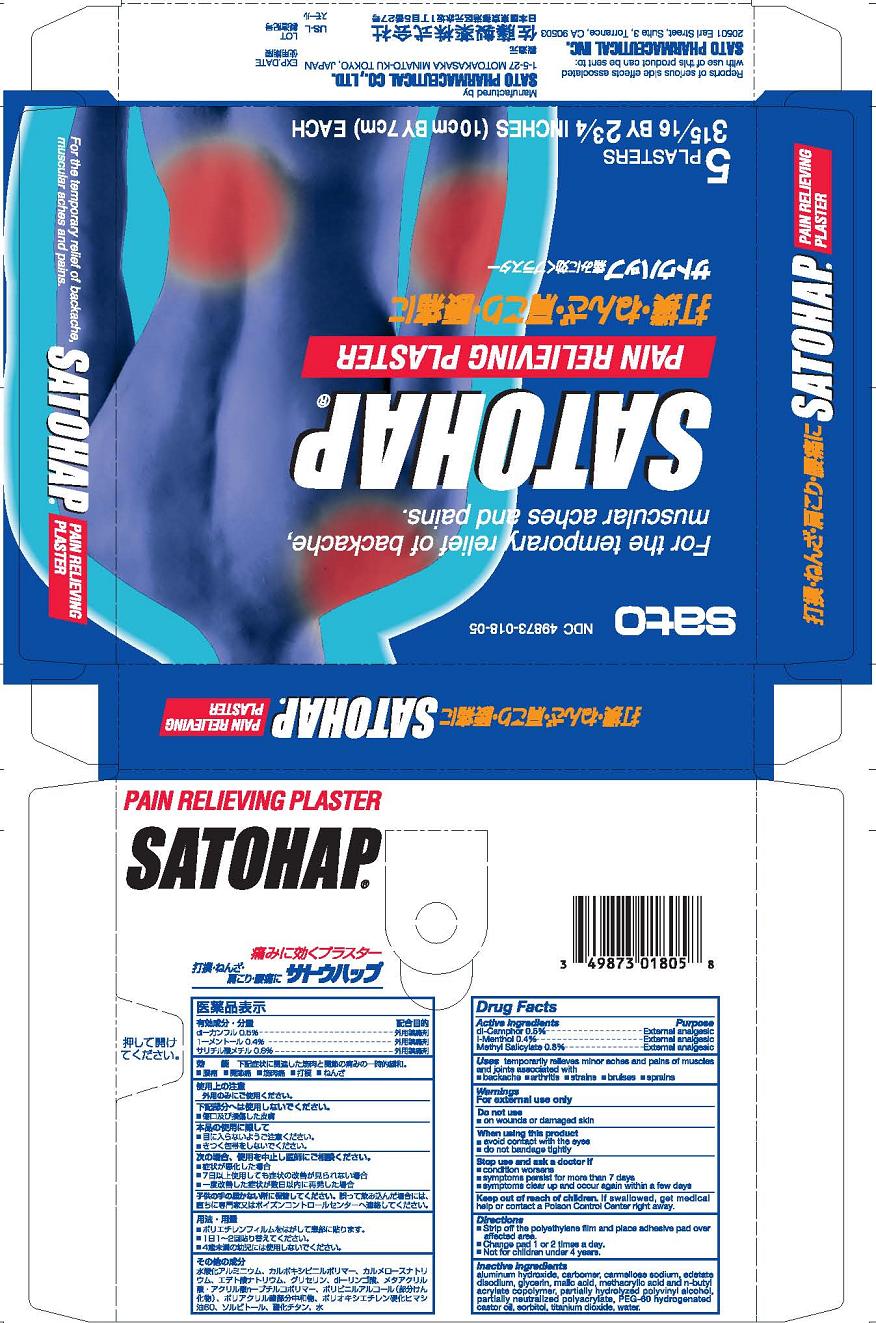
Satohap dl-camphor, l-menthol, methyl salicylate 5 mg; 4 mg; 8 mg Patch, 5 patches — NDC 49873-018-02 (Billing 49873-0018-02)
This is a package of 5 patches of Satohap dl-camphor, l-menthol, methyl salicylate 5 mg; 4 mg; 8 mg Patch from Sato Pharmaceutical Co., Ltd., marketed since Nov 1989 and currently FDA-listed. It is the main listing for this product, which comes in 2 package sizes.
NDC database record
One package, one record: these facts belong to NDC 49873-018-02 alone.
- Record
- FDA NDC Directory package listing · Human OTC drug
- Code segments
- 49873 labeler · 018 product · 02 package
- Package marketed since
- Nov 8, 1989
- Sample package
- No — commercial package
- Listing certified through
- Dec 31, 2027
- Barcode (UPC-A, from the NDC)
- 3 4987301802 7
- FDA record last changed
- Aug 13, 2026
Identity & classification
Regulatory identifiers FDA, NLM and CMS codes for this package
- RxCUI (RxNorm): 2669659
Where does this data come from?
- FDA openFDA NDC Directory · synced Oct 8, 2026
- FDA label on DailyMed · label index refreshed Oct 8, 2026
- RxNorm (NLM RxNav) · catalog refreshed Oct 1, 2026
- Medi-Span GPI (licensed)
- First Databank (licensed) · refreshed Oct 8, 2026
Clinical
Satohap is a topical patch marketed as an over-the-counter monograph product containing camphor, menthol, and methyl salicylate. These three ingredients are commonly combined in external pain-relief products and are typically used to produce a warming or cooling sensation on the skin. Camphor and menthol work as counterirritants, while methyl salicylate functions similarly. The patch delivers these ingredients directly to the area where it is applied.
Patient education
Supplement & herbal interactions
Where does this data come from?
- MedlinePlus (NLM) · refreshed Oct 8, 2026
- FDA label on DailyMed · label index refreshed Oct 8, 2026
Ask a licensed pharmacist directly — free, answered by our team.
Pricing
A drug doesn't have one price. Each row is a different public payment system, and none is what you'd pay at the counter — that depends on your insurance. The ⓘ on each row explains what it measures.
| Price system | Per each | Per package |
|---|---|---|
| Retail pharmacies payNADAC · weekly | Not in the retail survey — common for institutional, discontinued, or low-volume packs. | |
| Medicaid paysCMS SDUD · 12 mo | No recent Medicaid claims on file for this NDC — rare and low-volume NDCs are suppressed in the public data. | |
| Medicare drug plans payPart D · quarterly | No Part D plan price is available for this NDC in our data. | |
Where does this data come from?
- CMS NADAC weekly file
- CMS ASP pricing files · refreshed Sep 20, 2026
- CMS Medicaid State Drug Utilization Data · refreshed Oct 8, 2026
- CMS Part D plan pricing files · refreshed Sep 24, 2026
- VA National Acquisition Center price file
Packaging — all sizes for this product
| Package NDC | Description | Marketing start | Marketing end | Status |
|---|---|---|---|---|
| 49873-0018-02 You're viewing this Main listing | 1 POUCH in 1 CARTON / 5 PATCH in 1 POUCH | 1989-11-08 | — | Active |
| 49873-0018-05 49873-018-05 | 1 POUCH in 1 CARTON / 5 PATCH in 1 POUCH | 1989-11-08 | — | Active |
Pack size FAQ
What quantity is in this package?
How does this package differ from NDC 49873-0018-05?
What NDC number is used to bill for this package of Satohap dl-camphor, l-menthol, methyl salicylate 5 mg; 4 mg; 8 mg Patch?
Therapeutic equivalents
| Product | Labeler | Pack | NADAC/unit | TE | Status | Price vs. this |
|---|---|---|---|---|---|---|
| Satohap 5 mg/1; 4 mg/1; 8 mgthis 49873-0018-02 | Sato | 5 patches | — | — | FDA listed | — |
| Satogesic 5 mg/1; 4 mg/1; 8 mg 49873-0060-01 | Sato | 5 patches | — | — | FDA listed | — |
Where does this data come from?
- FDA openFDA NDC Directory · synced Oct 8, 2026
- FDA Orange Book · refreshed Oct 3, 2026
- CMS NADAC weekly file
Availability & generic status
We did not find an FDA-approved generic match for this exact strength, form and route.
Where does this data come from?
- FDA Orange Book · refreshed Oct 3, 2026
Inactive Ingredients / Excipients
Inactive ingredients, also called excipients, are components of the drug product other than the active ingredient. They may include fillers, dyes, coatings, preservatives, flavors, or other formulation ingredients.
💡 Tap an ingredient (hover on desktop) to see what it is and why it’s used.
-
UNII M4PPW69Y4H
A synthetic polymer made from acrylic acid and sodium acrylate that acts as a binder and thickener. It helps hold tablet ingredients together and controls how quickly the medicine dissolves in the body.
-
UNII 03J11K103C
Algeldrate is an aluminum-based compound that neutralizes stomach acid. It's used in antacid formulations as the active therapeutic ingredient, though classified here as an excipient in combination products where it works alongside other components to relieve heartburn and indigestion.
-
UNII Q984S31CYH
A synthetic polymer made from butyl acrylate and methacrylic acid. It's used as a coating material to control how and where a medicine dissolves in the digestive system, helping ensure the drug is released at the right location.
-
UNII 132584PQMO
A synthetic polymer used as a thickening agent and stabilizer in gels and creams. It helps create the product's texture, keeps ingredients evenly mixed, and improves how the medicine spreads on skin.
-
UNII K679OBS311
Carboxymethylcellulose sodium is a plant-derived thickening agent made from cellulose. In medicines, it acts as a binder to hold ingredients together, a disintegrant to help the tablet break apart, or a thickener in liquids.
-
UNII 7FLD91C86K
Edetate disodium is a chemical compound that binds and removes certain metal ions. In medicines, it acts as a preservative and stabilizer by preventing metals like calcium from interfering with the product's shelf life and consistency.
-
UNII PDC6A3C0OX
Glycerin is a clear, thick liquid derived from plant oils or fats. It acts as a humectant to retain moisture, a sweetener, and a solvent in medications.
-
UNII 817L1N4CKP
Malic acid is a naturally occurring organic acid found in fruits. It works as a buffer and flavor agent to maintain the medicine's pH balance and add tartness to the product.
-
UNII 02NG325BQG
A synthetic oil made by chemically treating castor oil. It acts as a solubilizer and emulsifier to help mix water and oily ingredients together in liquid medicines.
-
UNII 532B59J990
Polyvinyl alcohol is a synthetic polymer made from plant-derived materials. It's used as a binder to hold ingredients together, a film-former in coatings, and a thickener in liquid formulations.
-
UNII 506T60A25R
Sorbitol is a natural sugar alcohol derived from glucose. It serves as a sweetener, humectant, and bulking agent in medications to improve taste and help maintain moisture in the product.
-
UNII 15FIX9V2JP
Titanium dioxide is a bright white mineral powder commonly used as a colorant and opacifying agent. It makes pills and tablets white or lighter in color and helps make coatings non-transparent.
-
UNII 059QF0KO0R
Water is a liquid solvent that dissolves and mixes ingredients together in liquid medicines, syrups, and injections. It helps distribute the active drug evenly throughout the product.
13 inactive ingredients listed in the exact product block matched to this NDC.
Label-section wording can be broader than the structured product block and may mention additional formulation ingredients.
Where does this data come from?
ingredient classCode="IACT" elements from the exact product block matched by this NDC. Label-section narrative from DailyMed / the openFDA label index is shown separately when available.- FDA label on DailyMed · label index refreshed Oct 8, 2026
- FDA openFDA NDC Directory · synced Oct 8, 2026
Inactive ingredient FAQ
Are inactive ingredients the same for every manufacturer?
Why might an inactive ingredient be missing?
Can inactive ingredients matter?
Manufacturer & labeler
More NDCs from Sato Pharmaceutical Co., Ltd. labeler code 49873
- KEEPAN A benzalkonium chloride, lidocaine hydrochloride .1 g/100mL; 1 g/100mL Spray NDC 49873-019-01
- Inon aluminum hydroxide, magnesium carbonate, sodium bicarbonate 400 mg/1.92g; 400 mg/1.92g; 700 mg/1.92g Granule NDC 49873-045-01
- Hi Vetic tolnaftate 1 g/100mL Solution NDC 49873-050-02
- Hi Vetic tolnaftate 1 g/100g Ointment NDC 49873-056-01
- Nazal Naphazoline hydrochloride 50 mg/100mL Liquid NDC 49873-057-01
- Satogesic dl-camphor, l-menthol, methyl salicylate 5 mg; 4 mg; 8 mg Patch NDC 49873-060-01
Where does this data come from?
- FDA openFDA NDC Directory · synced Oct 8, 2026
- Drugs@FDA
FDA label — Drug Facts FDA SPL
🎯 Indications and Usage ▾
Uses temporary relieves minor aches and pains of muscles and joints associated with ■ simple backache ■ arthritis ■ strains ■ bruises ■ sprains
⏱️ Dosage and Administration ▾
Directions ■ Strip off the polyethylene film and place adhesive pad over affected area. ■ Change pad 1 or 2 times a day ■ Not for children under 4 years.
⚠️ Warnings ▾
Warnings For external use only Do not use ■ on wounds or on damaged skin When using this product ■ avoid contact with the eyes ■ do not bandage tightly Stop use and ask a doctor if ■ condition worsens ■ symptoms persist for more than 7 days ■ symptoms clear up and occur again withn a few days Keep out of reach of children . If swallowed, get medical help or contact a Poison Control Center right away.
🧪 Active Ingredient ▾
Active ingredients dl-Camphor 0.5% l-Menthol 0.4% Methyl Salicylate 0.8%
🧪 Inactive Ingredients ▾
Inactive ingredients aluminum hydroxide gel, carbomer, carmellose sodium, edetate disodium, glycerin, malic acid, methacrylic acid and n-butyl acrylate copolymer, partially hydrolyzed polyvinyl alcohol, partially neutralized polyacrylate, PEG 60 hydrogenated castor oil, sorbitol, titanium dioxide, water.
🎯 Purpose ▾
Purpose dl-Camphor External analgesic l-Menthol External analgesic Methyl Salicylate External analgesic
📄 Do Not Use ▾
Do not use ■ on wounds or on damaged skin
📄 When Using This Product ▾
When using this product ■ avoid contact with the eyes ■ do not bandage tightly
📄 Stop Use and Ask a Doctor If ▾
Stop use and ask a doctor if ■ condition worsens ■ symptoms persist for more than 7 days ■ symptoms clear up and occur again withn a few days
📄 Keep Out of Reach of Children ▾
Keep out of reach of children . If swallowed, get medical help or contact a Poison Control Center right away.
📄 Package Label / Principal Display Panel ▾
-05 Carton
-02 Carton
About this NDC listing & data coverage
What data is (and isn’t) available for this NDC — tap to expand
| NDC identity (package / product / labeler codes) | ✓ Available |
| Labeler | ✓ Available |
| Product & package description | ✓ Available |
| Marketing category & status | ✓ Available |
| Active ingredient / dosage form / route | ✓ Available |
| FDA label (SPL via DailyMed) | ✓ Available |
| Package photos | ✓ Available |
| Inactive ingredients (structured) | ✓ Available |
| NADAC pharmacy acquisition price (CMS) | — Not published for this NDC CMS publishes NADAC only for NDCs reported in its retail-pharmacy survey. |
| Orange Book / therapeutic-equivalence data | — Not published for this NDC Applies only to products approved under an NDA/ANDA; many listings are out of scope. |
| HCPCS J-code billing crosswalk | — Not published for this NDC Most self-administered / retail products have no J-code — that is normal. |
| Medicaid utilization (CMS SDUD) | — Not published for this NDC CMS reports utilization only for NDCs with Medicaid claims above its privacy threshold. |