
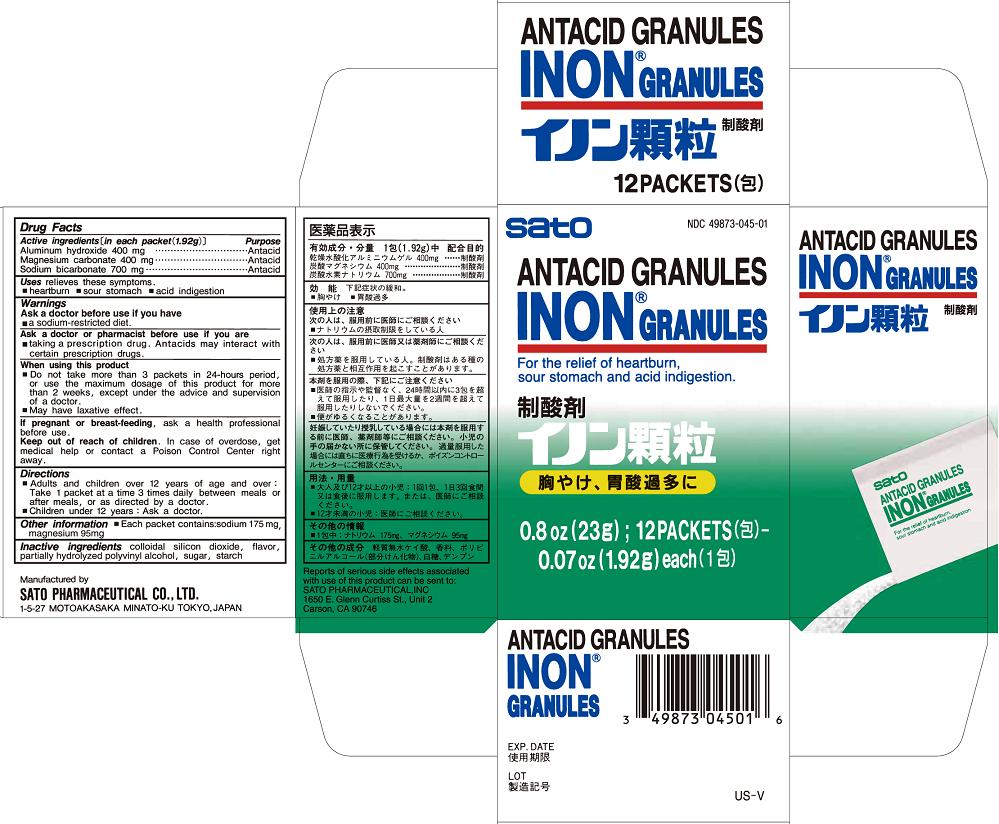
Inon aluminum hydroxide, magnesium carbonate, sodium bicarbonate 400 mg/1.92g; 400 mg/1.92g; 700 mg/1.92g Granule, 12 packets — NDC 49873-045-01 (Billing 49873-0045-01)
This is a package of 12 packets of Inon aluminum hydroxide, magnesium carbonate, sodium bicarbonate 400 mg/1.92g; 400 mg/1.92g; 700 mg/1.92g Granule from Sato Pharmaceutical Co., Ltd., marketed since May 1989 and currently FDA-listed. It is this product's only package size.
NDC database record
One package, one record: these facts belong to NDC 49873-045-01 alone.
- Record
- FDA NDC Directory package listing · Human OTC drug
- Code segments
- 49873 labeler · 045 product · 01 package
- Package marketed since
- May 31, 1989
- Sample package
- No — commercial package
- Listing certified through
- Dec 31, 2026
- Barcode (UPC)
- 0349873045016
- FDA record last changed
- Jul 24, 2026
Identity & classification
Regulatory identifiers FDA, NLM and CMS codes for this package
Where does this data come from?
- FDA openFDA NDC Directory · synced Oct 8, 2026
- FDA label on DailyMed · label index refreshed Oct 8, 2026
- RxNorm (NLM RxNav) · catalog refreshed Oct 1, 2026
- Medi-Span GPI (licensed)
- First Databank (licensed) · refreshed Oct 8, 2026
Clinical
INON is an over-the-counter oral granule product containing three active ingredients commonly used to relieve heartburn and indigestion. Aluminum hydroxide and magnesium carbonate function as antacids that help neutralize stomach acid, while sodium bicarbonate also works as an antacid. This product is marketed under the FDA's OTC monograph rules for antacid combinations and is taken by mouth to manage occasional acid-related discomfort.
Patient education
Supplement & herbal interactions
Where does this data come from?
- MedlinePlus (NLM) · refreshed Oct 8, 2026
- FDA label on DailyMed · label index refreshed Oct 8, 2026
Ask a licensed pharmacist directly — free, answered by our team.
Pricing
A drug doesn't have one price. Each row is a different public payment system, and none is what you'd pay at the counter — that depends on your insurance. The ⓘ on each row explains what it measures.
| Price system | Per g | Per package |
|---|---|---|
| Retail pharmacies payNADAC · weekly | Not in the retail survey — common for institutional, discontinued, or low-volume packs. | |
| Medicaid paysCMS SDUD · 12 mo | No recent Medicaid claims on file for this NDC — rare and low-volume NDCs are suppressed in the public data. | |
| Medicare drug plans payPart D · quarterly | No Part D plan price is available for this NDC in our data. | |
Where does this data come from?
- CMS NADAC weekly file
- CMS ASP pricing files · refreshed Sep 20, 2026
- CMS Medicaid State Drug Utilization Data · refreshed Oct 8, 2026
- CMS Part D plan pricing files · refreshed Sep 24, 2026
- VA National Acquisition Center price file
Packaging — all sizes for this product
| Package NDC | Description | Marketing start | Marketing end | Status |
|---|---|---|---|---|
| 49873-0045-01 You're viewing this Main listing | 12 PACKET in 1 CARTON / 1.92 g in 1 PACKET | 1989-05-31 | — | Active |
Therapeutic equivalents
| Product | Labeler | Pack | NADAC/unit | TE | Status | Price vs. this |
|---|---|---|---|---|---|---|
| Inon 400 mg/1.92g; 400 mg/1.92g; 700 mg/1.92gthis 49873-0045-01 | Sato | 12 packets | — | — | FDA listed | — |
Where does this data come from?
- FDA openFDA NDC Directory · synced Oct 8, 2026
- FDA Orange Book · refreshed Oct 3, 2026
- CMS NADAC weekly file
Availability & generic status
We did not find an FDA-approved generic match for this exact strength, form and route.
Where does this data come from?
- FDA Orange Book · refreshed Oct 3, 2026
What it looks like
Where does this data come from?
- FDA label on DailyMed · label index refreshed Oct 8, 2026
Inactive Ingredients / Excipients
Inactive ingredients, also called excipients, are components of the drug product other than the active ingredient. They may include fillers, dyes, coatings, preservatives, flavors, or other formulation ingredients.
💡 Tap an ingredient (hover on desktop) to see what it is and why it’s used.
-
UNII 532B59J990
Polyvinyl alcohol is a synthetic polymer made from plant-derived materials. It's used as a binder to hold ingredients together, a film-former in coatings, and a thickener in liquid formulations.
-
UNII ETJ7Z6XBU4
Silicon dioxide is a naturally occurring mineral used as a glidant and anti-caking agent. It helps powder ingredients flow smoothly and prevents clumping during manufacturing and storage.
-
UNII 8I089SAH3T
A carbohydrate powder extracted from potatoes. It serves as a filler to add bulk and volume to the tablet or capsule, and as a disintegrant to help the medicine break apart and release its active ingredient in your body.
-
UNII C151H8M554
A natural sugar derived from sugar cane or sugar beets. It's used as a sweetener, filler, and binder to improve taste, add bulk, and help hold tablet or capsule ingredients together.
4 inactive ingredients listed in the exact product block matched to this NDC.
Label-section wording can be broader than the structured product block and may mention additional formulation ingredients.
Where does this data come from?
ingredient classCode="IACT" elements from the exact product block matched by this NDC. Label-section narrative from DailyMed / the openFDA label index is shown separately when available.- FDA label on DailyMed · label index refreshed Oct 8, 2026
- FDA openFDA NDC Directory · synced Oct 8, 2026
Inactive ingredient FAQ
Are inactive ingredients the same for every manufacturer?
Why might an inactive ingredient be missing?
Can inactive ingredients matter?
Manufacturer & labeler
More NDCs from Sato Pharmaceutical Co., Ltd. labeler code 49873
- Satohap dl-camphor, l-menthol, methyl salicylate 5 mg; 4 mg; 8 mg Patch NDC 49873-018-02
- KEEPAN A benzalkonium chloride, lidocaine hydrochloride .1 g/100mL; 1 g/100mL Spray NDC 49873-019-01
- Hi Vetic tolnaftate 1 g/100mL Solution NDC 49873-050-02
- Hi Vetic tolnaftate 1 g/100g Ointment NDC 49873-056-01
- Nazal Naphazoline hydrochloride 50 mg/100mL Liquid NDC 49873-057-01
- Satogesic dl-camphor, l-menthol, methyl salicylate 5 mg; 4 mg; 8 mg Patch NDC 49873-060-01
- Satohap methyl salicylate, dl-camphor, l-menthol 10 g/100mL; 5 g/100mL; 4 g/100mL Lotion NDC 49873-065-01
- Satohap methyl salicylate, dl-camphor, l-menthol 10 g/100mL; 4 g/100mL; 5 g/100mL Spray NDC 49873-068-02
Where does this data come from?
- FDA openFDA NDC Directory · synced Oct 8, 2026
- Drugs@FDA
FDA label — Drug Facts FDA SPL
🎯 Indications and Usage ▾
Uses relieves these symptoms ■ heartburn ■ sour stomach ■ acid indigestion
⏱️ Dosage and Administration ▾
Directions ■ Adults and children 12 years of age and over: Take 1 packet at a time 3 times daily between meals or after meals, or as directed by a doctor ■ Children under 12 years: Ask a doctor
⚠️ Warnings ▾
Warnings If pregnant or breast-feeding , ask a health professional before use. When using this product ■ Do not take more than 3 packets in 24-hours period, or use the maximum dosage of this product for more than 2 weeks, except under the advice and supervision of a doctor ■ May have laxative effect Ask a doctor before use if you have ■ a sodium-restricted diet Ask a doctor or pharmacist before use if you are ■ taking a prescription drug Antacids may interact with certain prescription drugs. Keep out of reach of children.
In case of overdose, get medical help or contact a Poison Control Center right away.
🧪 Active Ingredient ▾
Active ingredients [in each packet (1.92g)] Aluminum hydroxide 400 mg Magnesium carbonate 400 mg Sodium bicarbonate 700 mg
🧪 Inactive Ingredients ▾
Inactive ingredients colloidal silicon dioxide, flavor, partially hydrolyzed polyvinyl alcohol, sugar, starch
🎯 Purpose ▾
Purpose Aluminum hydroxide Antacid Magnesium carbonate Antacid Sodium bicarbonate Antacid
📄 Ask a Doctor Before Use If ▾
Ask a doctor before use if you have ■ a sodium-restricted diet
📄 Ask a Doctor or Pharmacist Before Use If ▾
Ask a doctor or pharmacist before use if you are ■ taking a prescription drug Antacids may interact with certain prescription drugs.
📄 When Using This Product ▾
When using this product ■ Do not take more than 3 packets in 24-hours period, or use the maximum dosage of this product for more than 2 weeks, except under the advice and supervision of a doctor ■ May have laxative effect
🤰 If Pregnant or Breast-Feeding ▾
If pregnant or breast-feeding , ask a health professional before use.
📄 Keep Out of Reach of Children ▾
Keep out of reach of children. In case of overdose, get medical help or contact a Poison Control Center right away.
📄 Other Information ▾
Other information ■ Each packet contains: sodium 175 mg, magnesium 95 mg
📄 Package Label / Principal Display Panel ▾
inongrancart.jpg carton
Reported adverse events (FAERS)
Top reported reactions
Reporter sex
Serious outcomes
Where does this data come from?
About this NDC listing & data coverage
What data is (and isn’t) available for this NDC — tap to expand
| NDC identity (package / product / labeler codes) | ✓ Available |
| Labeler | ✓ Available |
| Product & package description | ✓ Available |
| Marketing category & status | ✓ Available |
| Active ingredient / dosage form / route | ✓ Available |
| FDA label (SPL via DailyMed) | ✓ Available |
| Package photos | ✓ Available |
| Inactive ingredients (structured) | ✓ Available |
| NADAC pharmacy acquisition price (CMS) | — Not published for this NDC CMS publishes NADAC only for NDCs reported in its retail-pharmacy survey. |
| Orange Book / therapeutic-equivalence data | — Not published for this NDC Applies only to products approved under an NDA/ANDA; many listings are out of scope. |
| HCPCS J-code billing crosswalk | — Not published for this NDC Most self-administered / retail products have no J-code — that is normal. |
| Medicaid utilization (CMS SDUD) | — Not published for this NDC CMS reports utilization only for NDCs with Medicaid claims above its privacy threshold. |