
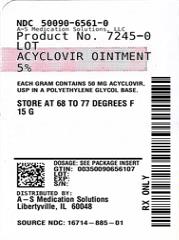
acyclovir 50 mg/g Ointment — NDC 50090-6561-0 (Billing 50090-6561-00)
This is a package of acyclovir 50 mg/g Ointment from A-S Medication Solutions, marketed since Jul 2017 and currently FDA-listed. It is this product's only package size.
NDC database record
One package, one record: these facts belong to NDC 50090-6561-0 alone.
- Record
- FDA NDC Directory package listing · Human prescription drug
- Code segments
- 50090 labeler · 6561 product · 0 package
- Package marketed since
- Jul 18, 2023
- Sample package
- No — commercial package
- Listing certified through
- Dec 31, 2026
- Barcode (UPC-A, from the NDC)
- 3 5009065610 7
- FDA record last changed
- Oct 1, 2026
Identity & classification
Regulatory identifiers FDA, NLM and CMS codes for this package
Drug-database identifiers Medi-Span GPI and First Databank GCN / HICL / AHFS classification
- GSN (GCN sequence number): 007670
- GCN: 31640
- HICL (First Databank): 004183
- AHFS class code: 08:18.32.00
- RxCUI (RxNorm): 197312
Where does this data come from?
- FDA openFDA NDC Directory · synced Oct 1, 2026
- FDA label on DailyMed · label index refreshed Oct 5, 2026
- RxNorm (NLM RxNav) · catalog refreshed Oct 1, 2026
- Medi-Span GPI (licensed)
- First Databank (licensed) · refreshed Oct 1, 2026
RxNorm drug class
This medicine belongs to the Herpesvirus Nucleoside Analog DNA Polymerase Inhibitor class.
Where does this data come from?
- RxClass (NLM) · catalog refreshed Oct 1, 2026
Clinical
Acyclovir cream is used to treat cold sores (fever blisters; blisters that are caused by a virus called herpes simplex) on the face or lips. Acyclovir ointment is used to treat first outbreaks of genital herpes (a herpes virus infection that causes sores to form around the genitals and rectum from time to time) and to treat certain types of sores caused by the herpes simplex virus in people with weak immune systems. Acyclovir is in a class of antiviral medications called synthetic nucleoside analogues. It works by stopping the spread of the herpes virus in the body. Acyclovir does not cure col...
Read the full MedlinePlus article ↗- Acyclovir treats infections caused by herpes-family viruses. Oral forms treat shingles, genital herpes and chickenpox. Creams, ointments, the eye ointment, the buccal tablet and th...
- As early as possible. For cold sores, that means at the first tingling, itching or burning. For genital herpes recurrences, start at the first sign of an outbreak. Early treatment...
- The most common ones are headache, nausea and belly pain. Some people also get vomiting, dizziness or fatigue. These are usually manageable, but tell me if they bother you.
- Call right away for confusion, hallucinations, seizures or unusual drowsiness. Also call if you urinate much less than usual, which can signal kidney trouble. Any allergic reaction...
Patient education
Supplement & herbal interactions
Some supplements/herbs that may interact with Acyclovir — tap one for details:
Where does this data come from?
- MedlinePlus (NLM) · refreshed Oct 1, 2026
- FDA label on DailyMed · label index refreshed Oct 5, 2026
Ask a licensed pharmacist directly — free, answered by our team.
Pricing
A drug doesn't have one price. Each row is a different public payment system, and none is what you'd pay at the counter — that depends on your insurance. The ⓘ on each row explains what it measures.
| Price system | Per g | Per package |
|---|---|---|
| Retail pharmacies payNADAC · weekly | Not in the retail survey — common for institutional, discontinued, or low-volume packs. | |
| Medicaid paysCMS SDUD · 12 mo | No recent Medicaid claims on file for this NDC — rare and low-volume NDCs are suppressed in the public data. | |
| Medicare drug plans payPart D · Q2 2026 | $1.40 | $21.00 / 15 g |
Where does this data come from?
- CMS NADAC weekly file
- CMS ASP pricing files · refreshed Sep 20, 2026
- CMS Medicaid State Drug Utilization Data · refreshed Oct 5, 2026
- CMS Part D plan pricing files · refreshed Sep 24, 2026
- VA National Acquisition Center price file
Packaging — all sizes for this product
| Package NDC | Description | Marketing start | Marketing end | Status |
|---|---|---|---|---|
| 50090-6561-00 You're viewing this Main listing | 1 TUBE in 1 CARTON / 15 g in 1 TUBE | 2023-07-18 | — | Active |
Therapeutic equivalents
| Product | Labeler | Pack | NADAC/unit | TE | Status | Price vs. this |
|---|---|---|---|---|---|---|
| Acyclovir 50 mg/g 00591-1159-30 | ACTAVIS | 1 tube | $0.315 | AB | Availability likely | — |
| acyclovir 50 mg/g 13668-0515-01 | Torrent | 15 g | $0.522 | AB | Availability likely | — |
| acyclovir 50 mg/g 16714-0885-01 | Northstar | 1 tube | $0.522 | AB | Availability likely | — |
| Acyclovir 50 mg/g 51672-1360-01 | Sun | 1 tube | $0.522 | AB | Availability likely | — |
| Acyclovir 50 mg/g 65162-0835-94 | Amneal | 1 tube | $0.522 | AB | Availability likely | — |
| acyclovir 50 mg/g 68462-0746-17 | Glenmark | 1 tube | $0.522 | AB | Availability likely | — |
| Acyclovir 50 mg/g 70700-0107-15 | Xiromed, | 1 tube | $0.522 | AB | Availability likely | — |
| acyclovir 50 mg/g 72578-0082-01 | Viona | 1 tube | $0.522 | AB | Availability likely | — |
| Acyclovir 50 mg/g 33342-0439-15 | Macleods | 1 tube | $0.676 | AB | FDA listed | — |
| Acyclovir 50 mg/g 51672-1361-05 | Sun | 1 tube | $8.992 | AB | Availability likely | — |
| Acyclovir 50 mg/g 62332-0423-05 | Alembic | 1 tube | $8.992 | AB | Availability likely | — |
| Acyclovir 50 mg/g 65162-0836-14 | Amneal | 1 tube | $8.992 | AB | Availability likely | — |
| Acyclovir 50 mg/g 00093-3630-20 | Teva | 1 tube | $8.992 | AB | Availability likely | — |
| Acyclovir 50 mg/g 45802-0044-75 | Padagis | 1 tube | $8.992 | AB | Availability likely | — |
| Zovirax 50 mg/g 00187-0994-45 | Bausch | 1 tube | $38.247 | AB | FDA listed | — |
| Zovirax 50 mg/g 00187-0993-95 | Bausch | 1 tube | — | AB | FDA listed | — |
| Acyclovir 50 mg/g 43547-0499-41 | Solco | 1 tube | — | — | FDA listed | — |
| acyclovir 50 mg/gthis 50090-6561-00 | A-S | 1 tube | — | AB | FDA listed | — |
| Acyclovir 50 mg/g 62332-0248-05 | Alembic | 1 tube | — | AB | FDA listed | — |
| Acyclovir 50 mg/g 63629-2327-01 | Bryant | 30 g | — | AB | FDA listed | — |
| Acyclovir 50 mg/g 63629-2328-01 | Bryant | 15 g | — | AB | FDA listed | — |
| acyclovir 50 mg/g 68071-3909-05 | NuCare | 1 tube | — | AB | FDA listed | — |
| acyclovir 50 mg/g 68788-8247-01 | Preferred | 1 tube | — | AB | FDA listed | — |
| acyclovir 50 mg/g 70771-1371-01 | Zydus | 1 tube | — | AB | FDA listed | — |
| Acyclovir 50 mg/g 72162-1960-02 | Bryant | 15 g | — | AB | FDA listed | — |
| acyclovir 50 mg/g 85766-0115-15 | Sportpharm | 1 tube | — | AB | FDA listed | — |
| Acyclovir 50 mg/g 85957-0036-01 | Aryeh | 2 tubes | — | AB | FDA listed | — |
| Acyclovir 50 mg/g 72162-2327-02 | Bryant | 1 tube | — | AB | FDA listed | — |
| Acyclovir 50 mg/g 70771-1808-02 | Zydus | 1 tube | — | BX | FDA listed | — |
| Acyclovir 50 mg/g 72578-0101-04 | Viona | 1 tube | — | BX | FDA listed | — |
| acyclovir 50 mg/g 68788-4142-01 | c | 15 g | — | AB | FDA listed | — |
| acyclovir 50 mg/g 50090-8074-00 | A-S | 1 tube | — | AB | FDA listed | — |
Where does this data come from?
- FDA openFDA NDC Directory · synced Oct 1, 2026
- FDA Orange Book · refreshed Oct 3, 2026
- CMS NADAC weekly file
Availability & generic status
This product is an FDA-approved generic. Other versions of the same drug are listed under Therapeutic equivalents, least expensive first.
Where does this data come from?
- FDA Orange Book · refreshed Oct 3, 2026
Inactive Ingredients / Excipients
Inactive ingredients, also called excipients, are components of the drug product other than the active ingredient. They may include fillers, dyes, coatings, preservatives, flavors, or other formulation ingredients.
🧪 Avoiding an ingredient? See Acyclovir inactive ingredients by manufacturer: every current product's list side by side, so you can ask your pharmacy for the version that does not list it.
💡 Tap an ingredient (hover on desktop) to see what it is and why it’s used.
-
UNII 3WJQ0SDW1A
Polyethylene glycol is a synthetic liquid or solid polymer used in medicines as a solvent, lubricant, and humectant. It helps dissolve active ingredients, reduces friction during manufacturing, and retains moisture in the final product.
1 inactive ingredient listed in the exact product block matched to this NDC.
Where does this data come from?
ingredient classCode="IACT" elements from the exact product block matched by this NDC. Label-section narrative from DailyMed / the openFDA label index is shown separately when available.- FDA label on DailyMed · label index refreshed Oct 5, 2026
- FDA openFDA NDC Directory · synced Oct 1, 2026
Inactive ingredient FAQ
Are inactive ingredients the same for every manufacturer?
Why might an inactive ingredient be missing?
Can inactive ingredients matter?
Manufacturer & labeler
More NDCs from A-S Medication Solutions labeler code 50090
- Triamcinolone Acetonide 1 mg/g Cream NDC 50090-6547-0
- Mucinex DM Maximum Strength Guaifenesin and Dextromethorphan Hydrobromide 1200 mg; 60 mg Tablet, Extended Release NDC 50090-6549-0
- Glucagon Kit NDC 50090-6550-0
- Phendimetrazine Tartrate 35 mg Tablet NDC 50090-6552-2
- Neutrogena Ultra Sheer Dry Touch Sunscreen Broad Spectrum SPF45 Avobenzone, Homosalate, Octisalate, and Octocrylene 30 mg/mL; 100 mg/mL; 50 mg/mL; 100 mg/mL Lotion NDC 50090-6558-0
- Albuterol Sulfate 2.5 mg/3mL Solution NDC 50090-6560-0
- Ciclopirox 80 mg/mL Solution NDC 50090-6562-0
- aripiprazole 5 mg Tablet NDC 50090-6563-0
- Novolin N Human Insulin 100 [iU]/mL Injection, Suspension NDC 50090-6565-0
- Triamcinolone Acetonide 1 mg/g Cream NDC 50090-6566-0
- Clopidogrel 75 mg Tablet NDC 50090-6567-0
- Clopidogrel 75 mg Tablet NDC 50090-6568-0
Where does this data come from?
- FDA openFDA NDC Directory · synced Oct 1, 2026
- Drugs@FDA
Full prescribing information FDA SPL
🎯 Indications and Usage ▾
INDICATIONS AND USAGE Acyclovir ointment USP 5% is indicated in the management of initial genital herpes and in limited non-life-threatening mucocutaneous Herpes simplex virus infections in immunocompromised patients.
⏱️ Dosage and Administration ▾
DOSAGE AND ADMINISTRATION Apply sufficient quantity to adequately cover all lesions every 3 hours, 6 times per day for 7 days. The dose size per application will vary depending upon the total lesion area but should approximate a one-half inch ribbon of ointment per 4 square inches of surface area. A finger cot or rubber glove should be used when applying acyclovir ointment to prevent autoinoculation of other body sites and transmission of infection to other persons.
Therapy should be initiated as early as possible following onset of signs and symptoms.
⛔ Contraindications ▾
CONTRAINDICATIONS Acyclovir ointment 5% is contraindicated in patients who develop hypersensitivity to the components of the formulation.
⚠️ Warnings ▾
WARNINGS Acyclovir ointment 5% is intended for cutaneous use only and should not be used in the eye.
🤒 Adverse Reactions ▾
ADVERSE REACTIONS In the controlled clinical trials, mild pain (including transient burning and stinging) was reported by about 30% of patients in both the active and placebo arms; treatment was discontinued in 2 of these patients. Local pruritus occurred in 4% of these patients. In all studies, there was no significant difference between the drug and placebo group in the rate or type of reported adverse reactions nor were there any differences in abnormal clinical laboratory findings.
Observed During Clinical Practice Based on clinical practice experience in patients treated with acyclovir ointment in the US, spontaneously reported adverse events are uncommon. Data are insufficient to support an estimate of their incidence or to establish causation. These events may also occur as part of the underlying disease process.
Voluntary reports of adverse events that have been received since market introduction include: General: Edema and/or pain at the application site. Skin: Pruritus, rash.
🔄 Drug Interactions ▾
Drug Interactions Clinical experience has identified no interactions resulting from topical or systemic administration of other drugs concomitantly with acyclovir ointment 5%.
🤰 Pregnancy ▾
Pregnancy Teratogenic Effects: Pregnancy Category B. Acyclovir was not teratogenic in the mouse, rabbit, or rat at exposures greatly in excess of human exposure. There are no adequate and well-controlled studies of systemic acyclovir in pregnant women.
A prospective epidemiologic registry of acyclovir use during pregnancy was established in 1984 and completed in April 1999. There were 749 pregnancies followed in women exposed to systemic acyclovir during the first trimester of pregnancy resulting in 756 outcomes. The occurrence rate of birth defects approximates that found in the general population.
However, the small size of the registry is insufficient to evaluate the risk for less common defects or to permit reliable or definitive conclusions regarding the safety of acyclovir in pregnant women and their developing fetuses. Systemic acyclovir should be used during pregnancy only if the potential benefit justifies the potential risk to the fetus.
🧒 Pediatric Use ▾
Pediatric Use Safety and effectiveness in pediatric patients have not been established.
🧓 Geriatric Use ▾
Geriatric Use Clinical studies of acyclovir ointment did not include sufficient numbers of subjects aged 65 and over to determine whether they respond differently from younger subjects. Other reported clinical experience has not identified differences in responses between the elderly and younger patients. Systemic absorption of acyclovir after topical administration is minimal (see CLINICAL PHARMACOLOGY ).
🆘 Overdosage ▾
OVERDOSAGE Overdosage by topical application of acyclovir ointment 5% is unlikely because of limited transcutaneous absorption (see CLINICAL PHARMACOLOGY ).
🧬 Clinical Pharmacology ▾
CLINICAL PHARMACOLOGY Two clinical pharmacology studies were performed with acyclovir ointment 5% in immunocompromised adults at risk of developing mucocutaneous Herpes simplex virus infections or with localized varicella-zoster infections. These studies were designed to evaluate the dermal tolerance, systemic toxicity, and percutaneous absorption of acyclovir. In 1 of these studies, which included 16 inpatients, the complete ointment or its vehicle were randomly administered in a dose of 1-cm strips (25 mg acyclovir) 4 times a day for 7 days to an intact skin surface area of 4.5 square inches.
No local intolerance, systemic toxicity, or contact dermatitis were observed. In addition, no drug was detected in blood and urine by radioimmunoassay (sensitivity, 0.01 mcg/mL). The other study included 11 patients with localized varicella-zoster infections.
In this uncontrolled study, acyclovir was detected in the blood of 9 patients and in the urine of all patients tested. Acyclovir levels in plasma ranged from <0.01 to 0.28 mcg/mL in 8 patients with normal renal function, and from <0.01 to 0.78 mcg/mL in 1 patient with impaired renal function. Acyclovir excreted in the urine ranged from <0.02% to 9.4% of the daily dose.
Therefore, systemic absorption of acyclovir after topical application is minimal.
📦 How Supplied / Storage and Handling ▾
HOW SUPPLIED Product: 50090-6561 NDC: 50090-6561-0 15 g in a TUBE / 1 in a CARTON
📋 Description ▾
DESCRIPTION Acyclovir is a synthetic nucleoside analogue active against herpes viruses. Acyclovir ointment USP 5% is a formulation for topical administration. Each gram of acyclovir ointment USP 5% contains 50 mg of acyclovir USP in a polyethylene glycol (PEG) base.
Acyclovir USP is a white, crystalline powder with the molecular formula C 8 H 11 N 5 O 3 and a molecular weight of 225.2. The maximum solubility in water at 37°C is 2.5 mg/mL. The pka’s of acyclovir are 2.27 and 9.25.
The chemical name of acyclovir USP is 2-amino-1, 9-dihydro-9- [(2-hydroxyethoxy)methyl]-6 H purin-6-one; it has the following structural formula: acyclovir-structura-formula
⚠️ Precautions ▾
PRECAUTIONS General The recommended dosage, frequency of applications, and length of treatment should not be exceeded (see DOSAGE AND ADMINISTRATION ). There are no data to support the use of acyclovir ointment 5% to prevent transmission of infection to other persons or prevent recurrent infections when applied in the absence of signs and symptoms. Acyclovir ointment 5% should not be used for the prevention of recurrent HSV infections.
Although clinically significant viral resistance associated with the use of acyclovir ointment 5% has not been observed, this possibility exists. Drug Interactions Clinical experience has identified no interactions resulting from topical or systemic administration of other drugs concomitantly with acyclovir ointment 5%. Carcinogenesis, Mutagenesis, Impairment of Fertility Systemic exposure following topical administration of acyclovir is minimal.
Dermal carcinogenicity studies were not conducted. Results from the studies of carcinogenesis, mutagenesis, and fertility are not included in the full prescribing information for acyclovir ointment 5% due to the minimal exposures of acyclovir that result from dermal application. Pregnancy Teratogenic Effects: Pregnancy Category B.
Acyclovir was not teratogenic in the mouse, rabbit, or rat at exposures greatly in excess of human exposure. There are no adequate and well-controlled studies of systemic acyclovir in pregnant women. A prospective epidemiologic registry of acyclovir use during pregnancy was established in 1984 and completed in April 1999.
There were 749 pregnancies followed in women exposed to systemic acyclovir during the first trimester of pregnancy resulting in 756 outcomes. The occurrence rate of birth defects approximates that found in the general population. However, the small size of the registry is insufficient to evaluate the risk for less common defects or to permit reliable or definitive conclusions regarding the safety of acyclovir in pregnant women and their developing fetuses.
Systemic acyclovir should be used during pregnancy only if the potential benefit justifies the potential risk to the fetus. Nursing Mothers It is not known whether topically applied acyclovir is excreted in breast milk. Systemic exposure following topical administration is minimal.
After oral administration of acyclovir, acyclovir concentrations have been documented in breast milk in 2 women and ranged from 0.6 to 4.1 times the corresponding plasma levels. These concentrations would potentially expose the nursing infant to a dose of acyclovir up to 0.3 mg/kg per day. Nursing mothers who have active herpetic lesions near or on the breast should avoid nursing.
Geriatric Use Clinical studies of acyclovir ointment did not include sufficient numbers of subjects aged 65 and over to determine whether they respond differently from younger subjects. Other reported clinical experience has not identified differences in responses between the elderly and younger patients. Systemic absorption of acyclovir after topical administration is minimal (see CLINICAL PHARMACOLOGY ).
Pediatric Use Safety and effectiveness in pediatric patients have not been established.
🍼 Nursing Mothers ▾
Nursing Mothers It is not known whether topically applied acyclovir is excreted in breast milk. Systemic exposure following topical administration is minimal. After oral administration of acyclovir, acyclovir concentrations have been documented in breast milk in 2 women and ranged from 0.6 to 4.1 times the corresponding plasma levels.
These concentrations would potentially expose the nursing infant to a dose of acyclovir up to 0.3 mg/kg per day. Nursing mothers who have active herpetic lesions near or on the breast should avoid nursing.
📄 Carcinogenesis, Mutagenesis, Impairment of Fertility ▾
Carcinogenesis, Mutagenesis, Impairment of Fertility Systemic exposure following topical administration of acyclovir is minimal. Dermal carcinogenicity studies were not conducted. Results from the studies of carcinogenesis, mutagenesis, and fertility are not included in the full prescribing information for acyclovir ointment 5% due to the minimal exposures of acyclovir that result from dermal application.
📄 Package Label / Principal Display Panel ▾
ACYCLOVIR Label Image
Medicare Part D spend CMS · PART D · 2026 (Q1)
About this NDC listing & data coverage
What data is (and isn’t) available for this NDC — tap to expand
| NDC identity (package / product / labeler codes) | ✓ Available |
| Labeler | ✓ Available |
| Product & package description | ✓ Available |
| Marketing category & status | ✓ Available |
| Active ingredient / dosage form / route | ✓ Available |
| FDA label (SPL via DailyMed) | ✓ Available |
| Package photos | ✓ Available |
| Inactive ingredients (structured) | ✓ Available |
| NADAC pharmacy acquisition price (CMS) | — Not published for this NDC CMS publishes NADAC only for NDCs reported in its retail-pharmacy survey. |
| Orange Book / therapeutic-equivalence data | ✓ Available |
| HCPCS J-code billing crosswalk | — Not published for this NDC Most self-administered / retail products have no J-code — that is normal. |
| Medicaid utilization (CMS SDUD) | — Not published for this NDC CMS reports utilization only for NDCs with Medicaid claims above its privacy threshold. |