
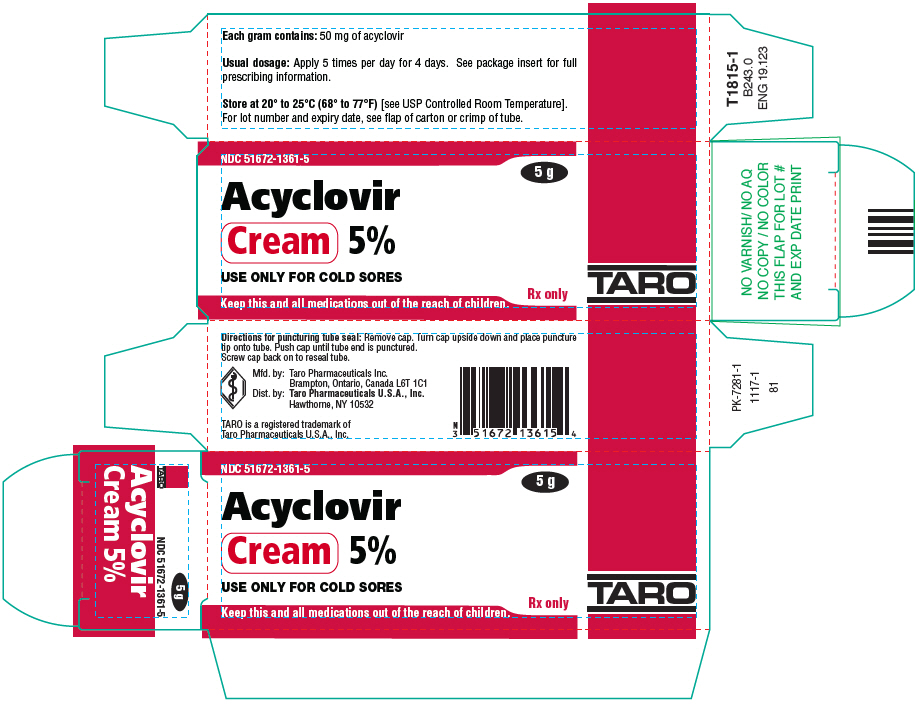
Acyclovir 50 mg/g Cream — NDC 51672-1361-5 (Billing 51672-1361-05)
This is a package of Acyclovir 50 mg/g Cream from Sun Pharmaceutical Industries, Inc., marketed since Jun 2024 and currently FDA-listed; retail pharmacies pay about $8.99 per g (NADAC). It is the main listing for this product, which comes in 2 package sizes.
Identity & classification
Regulatory identifiers FDA, NLM and CMS codes for this package
Drug-database identifiers Medi-Span GPI and First Databank GCN / HICL / AHFS classification
- GSN (GCN sequence number): 018315
- GCN: 62420
- GPI-14 (Medi-Span): 90350010003720
- HICL (First Databank): 004183
- AHFS class code: 08:18.32.00
- RxCUI (RxNorm): 141859
Where does this data come from?
- FDA openFDA NDC Directory · synced Oct 1, 2026
- FDA label on DailyMed · label index refreshed Oct 1, 2026
- RxNorm (NLM RxNav) · catalog refreshed Oct 1, 2026
- Medi-Span GPI (licensed)
- First Databank (licensed) · refreshed Oct 1, 2026
RxNorm drug class
This medicine belongs to the Herpesvirus Nucleoside Analog DNA Polymerase Inhibitor class.
Where does this data come from?
- RxClass (NLM) · catalog refreshed Oct 1, 2026
Clinical
Acyclovir cream is used to treat cold sores (fever blisters; blisters that are caused by a virus called herpes simplex) on the face or lips. Acyclovir ointment is used to treat first outbreaks of genital herpes (a herpes virus infection that causes sores to form around the genitals and rectum from time to time) and to treat certain types of sores caused by the herpes simplex virus in people with weak immune systems. Acyclovir is in a class of antiviral medications called synthetic nucleoside analogues. It works by stopping the spread of the herpes virus in the body. Acyclovir does not cure col...
Read the full MedlinePlus article ↗- Acyclovir treats infections caused by herpes-family viruses. Oral forms treat shingles, genital herpes and chickenpox. Creams, ointments, the eye ointment, the buccal tablet and th...
- As early as possible. For cold sores, that means at the first tingling, itching or burning. For genital herpes recurrences, start at the first sign of an outbreak. Early treatment...
- The most common ones are headache, nausea and belly pain. Some people also get vomiting, dizziness or fatigue. These are usually manageable, but tell me if they bother you.
- Call right away for confusion, hallucinations, seizures or unusual drowsiness. Also call if you urinate much less than usual, which can signal kidney trouble. Any allergic reaction...
Patient education
Supplement & herbal interactions
Some supplements/herbs that may interact with Acyclovir — tap one for details:
Where does this data come from?
- MedlinePlus (NLM) · refreshed Oct 1, 2026
- FDA label on DailyMed · label index refreshed Oct 1, 2026
Ask a licensed pharmacist directly — free, answered by our team.
Pricing
A drug doesn't have one price. Each row is a different public payment system, and none is what you'd pay at the counter — that depends on your insurance. The ⓘ on each row explains what it measures.
| Price system | Per g | Per package |
|---|---|---|
| Retail pharmacies payNADAC · weekly | $8.992 | $44.96 / 5 g |
| Medicaid paysCMS SDUD · 12 mo | $13.03 | $65.15 / 5 g |
| Medicare drug plans payPart D · Q2 2026 | $13.26 | $66.32 / 5 g |
Where does this data come from?
- CMS NADAC weekly file · file of Sep 30, 2026
- CMS ASP pricing files · refreshed Sep 20, 2026
- CMS Medicaid State Drug Utilization Data · through Q1 2026
- CMS Part D plan pricing files · refreshed Sep 24, 2026
- VA National Acquisition Center price file
Packaging — all sizes for this product
| Package NDC | Description | Per unit | Per pack | Marketing start | Marketing end | Status |
|---|---|---|---|---|---|---|
| 51672-1361-05 You're viewing this Main listing | 1 TUBE in 1 CARTON / 5 g in 1 TUBE | $8.99 / g | $44.96 | 2024-06-13 | — | Active |
| 51672-1361-09 51672-1361-9 | 1 TUBE in 1 CARTON / 2 g in 1 TUBE | — | — | 2024-06-13 | — | Active |
In Medicaid, this is the most-dispensed pack of this product — about 100% of fills over the last four reported quarters. See all packs ↓
Pack size FAQ
What quantity is in this package?
What NDC number is used to bill for this package of Acyclovir 50 mg/g Cream?
Prices are the latest CMS NADAC pharmacy acquisition cost per NDC; per-pack figures are per-unit × pack quantity, shown only when the pack is denominated in the same measure NADAC prices.
Therapeutic equivalents
| Product | Labeler | Pack | NADAC/unit | TE | Status | Price vs. this |
|---|---|---|---|---|---|---|
| Acyclovir 50 mg/g 00591-1159-30 | ACTAVIS | 1 tube | $0.315 | AB | Availability likely | save 96% |
| acyclovir 50 mg/g 72578-0082-01 | Viona | 1 tube | $0.522 | AB | Availability likely | save 94% |
| Acyclovir 50 mg/g 70700-0107-15 | Xiromed, | 1 tube | $0.522 | AB | Availability likely | save 94% |
| acyclovir 50 mg/g 68462-0746-17 | Glenmark | 1 tube | $0.522 | AB | Availability likely | save 94% |
| acyclovir 50 mg/g 16714-0885-01 | Northstar | 1 tube | $0.522 | AB | Availability likely | save 94% |
| Acyclovir 50 mg/g 65162-0835-94 | Amneal | 1 tube | $0.522 | AB | Availability likely | save 94% |
| Acyclovir 50 mg/g 51672-1360-01 | Sun | 1 tube | $0.522 | AB | Availability likely | save 94% |
| acyclovir 50 mg/g 13668-0515-01 | Torrent | 15 g | $0.522 | AB | Availability likely | save 94% |
| Acyclovir 50 mg/g 33342-0439-15 | Macleods | 1 tube | $0.676 | AB | FDA listed | save 92% |
| Acyclovir 50 mg/g 00093-3630-20 | Teva | 1 tube | $8.992 | AB | Availability likely | — |
| Acyclovir 50 mg/g 45802-0044-75 | Padagis | 1 tube | $8.992 | AB | Availability likely | — |
| Acyclovir 50 mg/gthis 51672-1361-05 | Sun | 1 tube | $8.992 | AB | Availability likely | — |
| Acyclovir 50 mg/g 62332-0423-05 | Alembic | 1 tube | $8.992 | AB | Availability likely | — |
| Acyclovir 50 mg/g 65162-0836-14 | Amneal | 1 tube | $8.992 | AB | Availability likely | — |
| Zovirax 50 mg/g 00187-0994-45 | Bausch | 1 tube | $38.247 | AB | FDA listed | +325% |
| Acyclovir 50 mg/g 70771-1808-02 | Zydus | 1 tube | — | BX | FDA listed | — |
| Acyclovir 50 mg/g 72162-2327-02 | Bryant | 1 tube | — | AB | FDA listed | — |
| Acyclovir 50 mg/g 72578-0101-04 | Viona | 1 tube | — | BX | FDA listed | — |
| Zovirax 50 mg/g 00187-0993-95 | Bausch | 1 tube | — | AB | FDA listed | — |
| Acyclovir 50 mg/g 43547-0499-41 | Solco | 1 tube | — | — | FDA listed | — |
| acyclovir 50 mg/g 50090-6561-00 | A-S | 1 tube | — | AB | FDA listed | — |
| Acyclovir 50 mg/g 63629-2327-01 | Bryant | 30 g | — | AB | FDA listed | — |
| Acyclovir 50 mg/g 63629-2328-01 | Bryant | 15 g | — | AB | FDA listed | — |
| acyclovir 50 mg/g 70771-1371-01 | Zydus | 1 tube | — | AB | FDA listed | — |
| Acyclovir 50 mg/g 72162-1960-02 | Bryant | 15 g | — | AB | FDA listed | — |
| Acyclovir 50 mg/g 85957-0036-01 | Aryeh | 2 tubes | — | AB | FDA listed | — |
| acyclovir 50 mg/g 85766-0115-15 | Sportpharm | 1 tube | — | AB | FDA listed | — |
| acyclovir 50 mg/g 68071-3909-05 | NuCare | 1 tube | — | AB | FDA listed | — |
| acyclovir 50 mg/g 68788-8247-01 | Preferred | 1 tube | — | AB | FDA listed | — |
| acyclovir 50 mg/g 68788-4142-01 | c | 15 g | — | AB | FDA listed | — |
| acyclovir 50 mg/g 50090-8074-00 | A-S | 1 tube | — | AB | FDA listed | — |
Where does this data come from?
- FDA openFDA NDC Directory · synced Oct 1, 2026
- FDA Orange Book · refreshed Sep 3, 2026
- CMS NADAC weekly file · file of Sep 30, 2026
Availability & generic status
This product is an FDA-approved generic. Other versions of the same drug are listed under Therapeutic equivalents, least expensive first.
Where does this data come from?
- FDA Orange Book · refreshed Sep 3, 2026
Inactive Ingredients / Excipients
Inactive ingredients, also called excipients, are components of the drug product other than the active ingredient. They may include fillers, dyes, coatings, preservatives, flavors, or other formulation ingredients.
💡 Tap an ingredient (hover on desktop) to see what it is and why it’s used.
-
UNII 2DMT128M1S
A waxy solid derived from plant or animal sources. It acts as an emulsifier to blend oil and water components, and also thickens the medicine to give it the right texture and consistency.
-
UNII T5L8T28FGP
Mineral oil is a clear, odorless liquid derived from crude oil. It acts as a lubricant and emollient in medications, helping pills slide smoothly during manufacturing and aiding moisture retention in topical products.
-
UNII 4T6H12BN9U
Petrolatum is a purified mineral oil-based jelly derived from petroleum. In medicines, it acts as an emollient, lubricant, and moisture barrier to soften skin, reduce friction, and help prevent water loss from formulations.
-
UNII TUF2IVW3M2
Poloxamer 407 is a synthetic polymer made from ethylene oxide and propylene oxide. In medicines, it acts as a thickener, emulsifier, and solubilizer to help mix ingredients and create the right texture.
-
UNII 6DC9Q167V3
Propylene glycol is a clear liquid derived from petroleum or vegetable sources. It acts as a solvent, humectant, and preservative in medicines, helping dissolve active ingredients and maintain product stability.
-
UNII 368GB5141J
A detergent and foaming agent derived from coconut or palm oil. In medications, it helps break down and mix oil and water-based ingredients, aids in tablet disintegration, and improves how the drug dissolves and spreads in the mouth or digestive system.
-
UNII 059QF0KO0R
Water is a liquid solvent that dissolves and mixes ingredients together in liquid medicines, syrups, and injections. It helps distribute the active drug evenly throughout the product.
7 inactive ingredients listed in the exact product block matched to this NDC.
Where does this data come from?
ingredient classCode="IACT" elements from the exact product block matched by this NDC. Label-section narrative from DailyMed / the openFDA label index is shown separately when available.- FDA label on DailyMed · label index refreshed Oct 1, 2026
- FDA openFDA NDC Directory · synced Oct 1, 2026
Inactive ingredient FAQ
Are inactive ingredients the same for every manufacturer?
Why might an inactive ingredient be missing?
Can inactive ingredients matter?
Manufacturer & labeler
Where does this data come from?
- FDA openFDA NDC Directory · synced Oct 1, 2026
- Drugs@FDA
Full prescribing information FDA SPL
🎯 Indications and Usage ▾
1 INDICATIONS AND USAGE Acyclovir cream is a herpes simplex virus (HSV) deoxynucleoside analogue DNA polymerase inhibitor indicated for the treatment of recurrent herpes labialis (cold sores) in immunocompetent adults and adolescents 12 years of age and older. Acyclovir cream, 5% is a herpes simplex virus (HSV) deoxynucleoside analogue DNA polymerase inhibitor indicated for the treatment of recurrent herpes labialis (cold sores) in immunocompetent adults and adolescents 12 years of age and older. ( 1 )
⏱️ Dosage and Administration ▾
2 DOSAGE AND ADMINISTRATION Acyclovir cream should be applied 5 times per day for 4 days. Therapy should be initiated as early as possible following the onset of signs or symptoms of herpes labialis, i.e., during the prodrome or when lesions appear. For adolescents 12 years of age and older, the dosage is the same as in adults. Apply 5 times a day for 4 days. ( 2 ) Administer immediately following the onset of cold sore lesions. ( 2 )
💊 Dosage Forms and Strengths ▾
3 DOSAGE FORMS AND STRENGTHS Each gram of acyclovir cream contains 50 mg (equivalent to 5% w/w) of acyclovir. Cream, 50 mg (equivalent to 5% w/w) acyclovir. ( 3 )
⛔ Contraindications ▾
4 CONTRAINDICATIONS Acyclovir cream is contraindicated in patients with known hypersensitivity to acyclovir, valacyclovir, or any component of the formulation. Acyclovir cream is contraindicated in patients with known hypersensitivity to acyclovir, valacyclovir or any component of the formulation. ( 4 )
⚠️ Warnings and Cautions ▾
5 WARNINGS AND PRECAUTIONS Only for topical use of recurrent HSV lesions on the external aspect of lips and the face. Acyclovir cream should not be applied on mucous membranes including in the eye or inside the mouth or nose. ( 5.1 ) There is a potential for irritation and contact sensitization. ( 5.2 )
5.1General Acyclovir cream should only be applied on the affected external aspects of the lips and face in patients with herpes labialis. Because no data are available, application to human mucous membranes is not recommended. Acyclovir cream is intended for cutaneous use only and should not be used in the eye or inside the mouth or nose.
5.2Contact Sensitization Acyclovir cream has a potential for irritation and contact sensitization [see Adverse Reactions (6.1 ]. The effect of acyclovir cream has not been established in immunocompromised patients.
🤒 Adverse Reactions ▾
6 ADVERSE REACTIONS The most common adverse reactions reported were local skin reactions at the application site. ( 6.1 ) Angioedema, anaphylaxis, contact dermatitis and eczema have been reported. ( 6.2 ) To report SUSPECTED ADVERSE REACTIONS, contact Taro Pharmaceuticals U.S.A., Inc. at 1-866-923-4914 or FDA at 1-800-FDA-1088 or www.fda.gov/medwatch.
6.1Clinical Trials Experience Because clinical trials are conducted under widely varying conditions, adverse reaction rates observed in the clinical trials of a drug cannot be directly compared to rates in the clinical trials of another drug, and may not reflect the rates observed in practice. In five double-blind, placebo-controlled trials, 1124 patients were treated with acyclovir cream and 1161 with placebo (vehicle) cream. Local application site reactions were reported by 5% of patients receiving acyclovir cream and 4% of patients receiving placebo.
The most common adverse reactions at the site of topical application were dry lips, desquamation, dryness of skin, cracked lips, burning skin, pruritus, flakiness of skin, and stinging on skin; each adverse reaction occurred in less than 1% of patients receiving acyclovir cream and placebo. Three patients on acyclovir cream and one patient on placebo discontinued treatment due to an adverse event. An additional study, enrolling 22 healthy adults, was conducted to evaluate the dermal tolerance of acyclovir cream compared with vehicle using single occluded and semi-occluded patch testing methodology.
Both acyclovir cream and placebo showed a high and cumulative irritation potential. Another study, enrolling 251 healthy adults, was conducted to evaluate the contact sensitization potential of acyclovir cream using repeat insult patch testing methodology. Of 202 evaluable subjects, possible cutaneous sensitization reactions were observed in the same 4 (2%) subjects with both acyclovir cream and placebo, and these reactions to both acyclovir cream and placebo were confirmed in 3 subjects upon rechallenge.
The sensitizing ingredient(s) has not been identified. The safety profile in patients 12 to 17 years of age was similar to that observed in adults.
6.2Postmarketing Experience In addition to adverse events reported from clinical trials, the following events have been identified during postapproval use of acyclovir cream. Because they are reported voluntarily from a population of unknown size, estimates of frequency cannot be made. These events have been chosen for inclusion due to a combination of their seriousness, frequency of reporting, or potential causal connection to acyclovir cream.
General: Angioedema, anaphylaxis. Skin: Contact dermatitis, eczema.
🔄 Drug Interactions ▾
7 DRUG INTERACTIONS Clinical experience has identified no interactions resulting from topical or systemic administration of other drugs concomitantly with acyclovir cream. Due to minimal systemic absorption of acyclovir cream, systemic drug interactions are unlikely. Clinical experience has identified no interactions resulting from topical or systemic administration of other drugs concomitantly with acyclovir cream.
Due to minimal systemic absorption of acyclovir cream, systemic drug interactions are unlikely. ( 7 )
👥 Use in Specific Populations ▾
8 USE IN SPECIFIC POPULATIONS
8.1Pregnancy Risk Summary Acyclovir is minimally absorbed systemically following topical route of administration, and maternal use is not expected to result in fetal exposure to the acyclovir cream [see Clinical Pharmacology (12.3) ]. Experience with topical acyclovir use in pregnant women over several decades, based on published literature including observational studies, has not identified a drug-associated risk of major birth defects, miscarriage or adverse maternal or fetal outcomes . Animal reproduction studies with systemic exposure of acyclovir have been conducted.
Refer to acyclovir prescribing information for additional details. The estimated background risk of major birth defects and miscarriage for the indicated population is unknown. All pregnancies have a background risk of birth defect, loss, or other adverse outcomes.
In the U.S. general population, the estimated background risk of major birth defects and miscarriage in clinically recognized pregnancies is 2% to 4% and 15% to 20%, respectively.
8.2Lactation Risk Summary Acyclovir is minimally absorbed systemically following topical route of administration, and breastfeeding is not expected to result in exposure of the child to acyclovir cream [see Clinical Pharmacology (12.3) ] . There are no data on the effects of acyclovir cream on the breastfed infant or on milk production. The developmental and health benefits of breastfeeding should be considered along with the mother's clinical need for acyclovir cream and any potential adverse effects on the breastfed child from acyclovir cream or from the underlying maternal condition.
8.4Pediatric Use An open-label, uncontrolled trial with acyclovir cream was conducted in 113 patients aged 12 to 17 years with recurrent herpes labialis. In this trial, therapy was applied using the same dosing regimen as in adults and subjects were followed for adverse events. The safety profile was similar to that observed in adults. Safety and effectiveness in pediatric patients less than 12 years of age have not been established.
8.5Geriatric Use Clinical studies of acyclovir cream did not include sufficient numbers of subjects aged 65 and over to determine whether they respond differently from younger subjects. Other reported clinical experience has not identified differences in responses between the elderly and younger patients. Systemic absorption of acyclovir after topical administration is minimal [see Clinical Pharmacology (12.3) ] .
🤰 Pregnancy ▾
8.1Pregnancy Risk Summary Acyclovir is minimally absorbed systemically following topical route of administration, and maternal use is not expected to result in fetal exposure to the acyclovir cream [see Clinical Pharmacology (12.3) ]. Experience with topical acyclovir use in pregnant women over several decades, based on published literature including observational studies, has not identified a drug-associated risk of major birth defects, miscarriage or adverse maternal or fetal outcomes . Animal reproduction studies with systemic exposure of acyclovir have been conducted.
Refer to acyclovir prescribing information for additional details. The estimated background risk of major birth defects and miscarriage for the indicated population is unknown. All pregnancies have a background risk of birth defect, loss, or other adverse outcomes.
In the U.S. general population, the estimated background risk of major birth defects and miscarriage in clinically recognized pregnancies is 2% to 4% and 15% to 20%, respectively.
🧒 Pediatric Use ▾
8.4Pediatric Use An open-label, uncontrolled trial with acyclovir cream was conducted in 113 patients aged 12 to 17 years with recurrent herpes labialis. In this trial, therapy was applied using the same dosing regimen as in adults and subjects were followed for adverse events. The safety profile was similar to that observed in adults. Safety and effectiveness in pediatric patients less than 12 years of age have not been established.
🧓 Geriatric Use ▾
8.5Geriatric Use Clinical studies of acyclovir cream did not include sufficient numbers of subjects aged 65 and over to determine whether they respond differently from younger subjects. Other reported clinical experience has not identified differences in responses between the elderly and younger patients. Systemic absorption of acyclovir after topical administration is minimal [see Clinical Pharmacology (12.3) ] .
🆘 Overdosage ▾
10 OVERDOSAGE Overdosage by topical application of acyclovir cream is unlikely because of minimal systemic exposure [see Clinical Pharmacology (12.3) ] . There is no information available for overdose.
🧬 Clinical Pharmacology ▾
12 CLINICAL PHARMACOLOGY
12.1Mechanism of Action Acyclovir is an antiviral drug active against α-herpesviruses [see Microbiology (12.4) ] .
12.3Pharmacokinetics A clinical pharmacology study was performed with acyclovir cream in adult volunteers to evaluate the percutaneous absorption of acyclovir. In this study, which included 6 male volunteers, the cream was applied to an area of 710 cm 2 on the backs of the volunteers 5 times daily at intervals of 2 hours for a total of 4 days. The weight of cream applied and urinary excretion of acyclovir were measured daily.
Plasma concentration of acyclovir was assayed 1 hour after the final application. The average daily urinary excretion of acyclovir was approximately 0.04% of the daily applied dose. Plasma acyclovir concentrations were below the limit of detection (0.01 µM) in 5 subjects and barely detectable (0.014 µM) in 1 subject.
Systemic absorption of acyclovir from acyclovir cream is minimal in adults. The systemic absorption of acyclovir following topical application of cream has not been evaluated in patients <18 years of age.
12.4Microbiology Mechanism of Action: Acyclovir is a synthetic purine deoxynucleoside analogue with cell culture and in vivo inhibitory activity against HSV types 1 (HSV-1) and 2 (HSV-2) DNA polymerases. It inhibits HSV-1 and HSV-2 replication in cell culture and in vivo . The inhibitory activity of acyclovir is selective due to its affinity for the enzyme thymidine kinase (TK) encoded by HSV.
This viral enzyme converts acyclovir into acyclovir monophosphate, a deoxynucleotide analogue. The monophosphate is further converted into diphosphate by cellular guanylate kinase and into triphosphate by a number of cellular enzymes. In biochemical assays, acyclovir triphosphate inhibits replication of α-herpes viral DNA.
This inhibition is accomplished in 3 ways: 1) competitive inhibition of viral DNA polymerase, 2) incorporation into and termination of the growing viral DNA chain, and 3) inactivation of the viral DNA polymerase. Antiviral Activity The quantitative relationship between the susceptibility of herpes viruses to antivirals in cell culture and the clinical response to therapy has not been established in humans, and virus sensitivity testing has not been standardized. Sensitivity testing results, expressed as the concentration of drug required to inhibit by 50% the growth of virus in cell culture (EC 50 value), vary greatly depending upon a number of factors.
Using plaque-reduction assays on Vero cells, the EC 50 values of acyclovir against herpes simplex virus isolates range from 0.09 to 59.9 µM (0.02 to 13.5 µg/mL) for HSV-1 and from 0.04 to 44 µM (0.01 to 9.9 µg/mL) for HSV-2. Resistance In Cell Culture Acyclovir-resistant HSV-1 and HSV-2 strains were isolated in cell culture. Acyclovir-resistant HSV resulted from mutations in the viral thymidine kinase (TK; pUL23) and DNA polymerase (POL; pUL30) genes.
Frameshifts were commonly isolated and result in premature truncation of the HSV TK product with consequent decreased susceptibility to acyclovir. Mutations in the viral TK gene may lead to complete loss of TK activity (TK negative), reduced levels of TK activity (TK partial), or alteration in the ability of viral TK to phosphorylate the drug without an equivalent loss in the ability to phosphorylate thymidine (TK altered). In cell culture the following resistance-associated substitutions in TK of HSV-1 and HSV-2 were observed (Table 1).
Table 1: Summary of Acyclovir (ACV) Resistance-associated Amino Acid Substitutions in Cell Culture HSV-1 TK P5A, H7Q, L50V, G56V, G59A, G61A, K62N, T63A, E83K, P84S, D116N, P131S, R163H, A167V, P173L, Q185R, R216S, R220H, T245M, R281stop, T287M, M322K HSV-2 TK L69P, C172R, T288M HSV-1 POL D368A, Y557S, E597D, V621S, L702H, N815S, V817M, G841C HSV-2 POL - In HSV-Infected Patients Clinical HSV-1 and HSV-2 isolates obtained from patients who failed treatment for their α-herpesvirus infections were evaluated for genot… [Excerpted — this section continues on DailyMed.]
🧬 Mechanism of Action ▾
12.1Mechanism of Action Acyclovir is an antiviral drug active against α-herpesviruses [see Microbiology (12.4) ] .
📦 How Supplied / Storage and Handling ▾
16 HOW SUPPLIED/STORAGE AND HANDLING Each gram of acyclovir cream contains 50 mg (equivalent to 5% w/w) of acyclovir in an aqueous cream base. Acyclovir cream is supplied as follows: 2 g tubes (NDC 51672-1361-9). 5 g tubes (NDC 51672-1361-5). Store at 20° to 25°C (68° to 77°F) [see USP Controlled Room Temperature].
📦 Storage and Handling ▾
Store at 20° to 25°C (68° to 77°F) [see USP Controlled Room Temperature].
📋 Description ▾
11 DESCRIPTION Acyclovir, a synthetic deoxynucleoside analogue active against herpes viruses. Acyclovir cream, 5% is a formulation for topical administration. The chemical name of acyclovir is 2-amino-1,9-dihydro-9-[(2-hydroxyethoxy) methyl]-6 H -purin-6-one; it has the following structural formula: Acyclovir is a white to off-white, crystalline powder with the molecular formula C 8 H 11 N 5 O 3 and a molecular weight of 225.
The maximum solubility in water at 37°C is 2.5 mg/mL. The pKa's of acyclovir are 2.27 and 9.25. Each gram of acyclovir cream, 5% contains 50 mg (equivalent to 5% w/w) of acyclovir and the following inactive ingredients: cetostearyl alcohol, mineral oil, poloxamer 407, propylene glycol, sodium lauryl sulfate, water, and white petrolatum.
Chemical Structure
💬 Information for Patients ▾
17 PATIENT COUNSELING INFORMATION Advise the patient to read the FDA-approved patient labeling (Patient Information). General Patients should be informed that acyclovir cream is a prescription topical cream for the treatment of cold sores (recurrent herpes labialis) that occur on the face and lips. Acyclovir cream is not a cure for cold sores.
Patients should be instructed that acyclovir cream is intended for cutaneous use only for herpes labialis of the lips and around the mouth. Patients should be advised that acyclovir cream should not be used in the eye, inside the mouth or nose, or on the genitals. Patients should be instructed to avoid applying other topical products to the affected area while using acyclovir cream.
Do not use if you are allergic to acyclovir cream or any of the ingredients in acyclovir cream. Before you use acyclovir cream, tell your doctor if you are pregnant, planning to become pregnant, or are breast-feeding. Instructions for Use Treatment should be initiated at the earliest sign or symptom of recurrence.
Instruct patients to wash hands prior to application and ensure the face and/or lips are clean and dry. Advise patients to apply acyclovir cream topically 5 times per day for 4 days. Instruct patients to topically apply a quantity of acyclovir cream sufficient to cover the affected area, including the outer margin.
Advise patients to avoid unnecessary rubbing of the affected area to avoid aggravating or transferring the infection. Instruct patients to wash their hands with soap and water after using acyclovir cream. Keep out of reach of children.
Possible Side Effects Common skin-related side effects that occurred when acyclovir cream was applied include application site reactions. Acyclovir cream has the potential for irritation and contact sensitization.
🧬 Pharmacokinetics ▾
12.3Pharmacokinetics A clinical pharmacology study was performed with acyclovir cream in adult volunteers to evaluate the percutaneous absorption of acyclovir. In this study, which included 6 male volunteers, the cream was applied to an area of 710 cm 2 on the backs of the volunteers 5 times daily at intervals of 2 hours for a total of 4 days. The weight of cream applied and urinary excretion of acyclovir were measured daily.
Plasma concentration of acyclovir was assayed 1 hour after the final application. The average daily urinary excretion of acyclovir was approximately 0.04% of the daily applied dose. Plasma acyclovir concentrations were below the limit of detection (0.01 µM) in 5 subjects and barely detectable (0.014 µM) in 1 subject.
Systemic absorption of acyclovir from acyclovir cream is minimal in adults. The systemic absorption of acyclovir following topical application of cream has not been evaluated in patients <18 years of age.
🔬 Clinical Studies ▾
14 CLINICAL STUDIES
14.1Adult Subjects Acyclovir cream was evaluated in two double-blind, randomized, placebo (vehicle)-controlled trials for the treatment of recurrent herpes labialis. The average patient had five episodes of herpes labialis in the previous 12 months. In the first trial, the median age of subjects was 37 years (range 18 to 81 years), 74% were female, and 94% were Caucasian.
In the second trial, median age of subjects was 38 years (range 18 to 87 years), 73% were female, and 94% were Caucasian. Subjects were instructed to initiate treatment within one hour of noticing signs or symptoms and continue treatment for four days, with application of study medication 5 times per day. In both studies, the mean duration of the recurrent herpes labialis episode was approximately one-half day shorter in the subjects treated with acyclovir cream (n = 682) compared with subjects treated with placebo (n = 703) for approximately 4.5 days versus 5 days, respectively.
No significant difference was observed between subjects receiving acyclovir cream or placebo in the prevention of progression of cold sore lesions.
14.2Pediatric Subjects An open-label, uncontrolled trial with acyclovir cream was conducted in 113 patients aged 12 to 17 years with recurrent herpes labialis. In this trial, therapy was applied using the same dosing regimen as in adults and subjects were followed for adverse events. The safety profile was similar to that observed in adults.
🧪 Nonclinical Toxicology ▾
13 NONCLINICAL TOXICOLOGY
13.1Carcinogenesis, Mutagenesis, Impairment of Fertility Systemic exposure following topical administration of acyclovir is minimal. Dermal carcinogenicity studies were not conducted. Results from the studies of carcinogenesis, mutagenesis and fertility are not included in the full prescribing information for acyclovir cream due to the minimal exposures of acyclovir that result from dermal application.
Information on these studies is available in the full prescribing information for acyclovir capsules, tablets, and suspension and acyclovir for injection.
📄 Carcinogenesis, Mutagenesis, Impairment of Fertility ▾
13.1Carcinogenesis, Mutagenesis, Impairment of Fertility Systemic exposure following topical administration of acyclovir is minimal. Dermal carcinogenicity studies were not conducted. Results from the studies of carcinogenesis, mutagenesis and fertility are not included in the full prescribing information for acyclovir cream due to the minimal exposures of acyclovir that result from dermal application.
Information on these studies is available in the full prescribing information for acyclovir capsules, tablets, and suspension and acyclovir for injection.
📄 Patient Package Insert ▾
This Patient Information has been approved by the U.S. Food and Drug Administration. Revised: January 2022 5235679 37 PATIENT INFORMATION Acyclovir (ay sye' kloe vir) Cream Important information: Acyclovir cream is for use on cold sores on the lips and around the mouth only.
Acyclovir cream should not be used in your eyes, mouth, nose, or on your genitals. What is acyclovir cream? Acyclovir cream is a prescription medicine used to treat cold sores (herpes labialis) that are recurring in adults and children 12 years of age and older, and who have normal immune systems.
Acyclovir cream is not a cure for cold sores. It is not known if acyclovir cream is safe and effective in children less than 12 years of age. Do not use acyclovir cream if you are allergic to acyclovir, valacyclovir, or any of the ingredients in acyclovir cream.
See the end of this leaflet for a complete list of ingredients in acyclovir cream. What should I tell my healthcare provider before using acyclovir cream? Before using acyclovir cream, tell your healthcare provider about all of your medical conditions, including if you: become sick very easily (have a weak immune system). are pregnant or plan to become pregnant.
It is not known if acyclovir cream will harm your unborn baby. are breastfeeding or plan to breastfeed. It is not known if acyclovir cream passes into your breast milk. Talk to your healthcare provider about the best way to feed your baby if you use acyclovir cream.
Tell your healthcare provider about all the medicines you take, including prescription and over-the-counter medicines, vitamins, and herbal supplements. How should I use acyclovir cream? Use acyclovir cream exactly as your healthcare provider tells you to use it.
Use acyclovir cream as soon as you have the first symptoms of a cold sore such as itching, redness, burning or tingling, or when the cold sore appears. Wash your hands with soap and water before and after applying acyclovir cream. The affected area should be clean and dry before applying acyclovir cream.
Apply acyclovir cream to the affected area 5 times each day for 4 days, including the outer edge. You should not apply other skin products to the affected area during treatment with acyclovir cream. Avoid unnecessary rubbing of the cold sore because this may cause the cold sore to spread to other areas around your mouth or make your cold sore worse.
What are the possible side effects of acyclovir cream? The most common side effects of acyclovir cream are skin reactions at the treatment site and may include: dry or cracked lips, peeling, flaking or dryness of the skin, a burning or stinging feeling, and itching. These are not all the possible side effects of acyclovir cream.
Call your doctor for medical advice about side effects. You may report side effects to FDA at 1-800-FDA-1088. How should I store acyclovir cream?
Store acyclovir cream at room temperature between 68°F to 77°F (20°C to 25°C). Keep acyclovir cream and all medicines out of the reach of children. General information about the safe and effective use of acyclovir cream Medicines are sometimes prescribed for purposes other than those listed in a Patient Information leaflet.
Do not use acyclovir cream for a condition for which it was not prescribed. Do not give acyclovir cream to other people, even if they have the same symptoms you have. It may harm them.
You can ask your pharmacist or healthcare provider for information about acyclovir cream that is written for health professionals. What are the ingredients in acyclovir cream? Active ingredient: acyclovir Inactive ingredients: cetostearyl alcohol, mineral oil, poloxamer 407, propylene glycol, sodium lauryl sulfate, water, and white petrolatum Mfd. by: Taro Pharmaceuticals Inc., Brampton, Ontario, Canada L6T 1C1 Dist. by: Taro Pharmaceuticals U.S.A., Inc., Hawthorne, NY 10532 For more information, call 1-866-923-4914.
📄 Package Label / Principal Display Panel ▾
PRINCIPAL DISPLAY PANEL - 5 g Tube Carton NDC 51672-1361-5 5 g Acyclovir Cream 5% USE ONLY FOR COLD SORES Rx only Keep this and all medications out of the reach of children. TARO PRINCIPAL DISPLAY PANEL - 5 g Tube Carton