
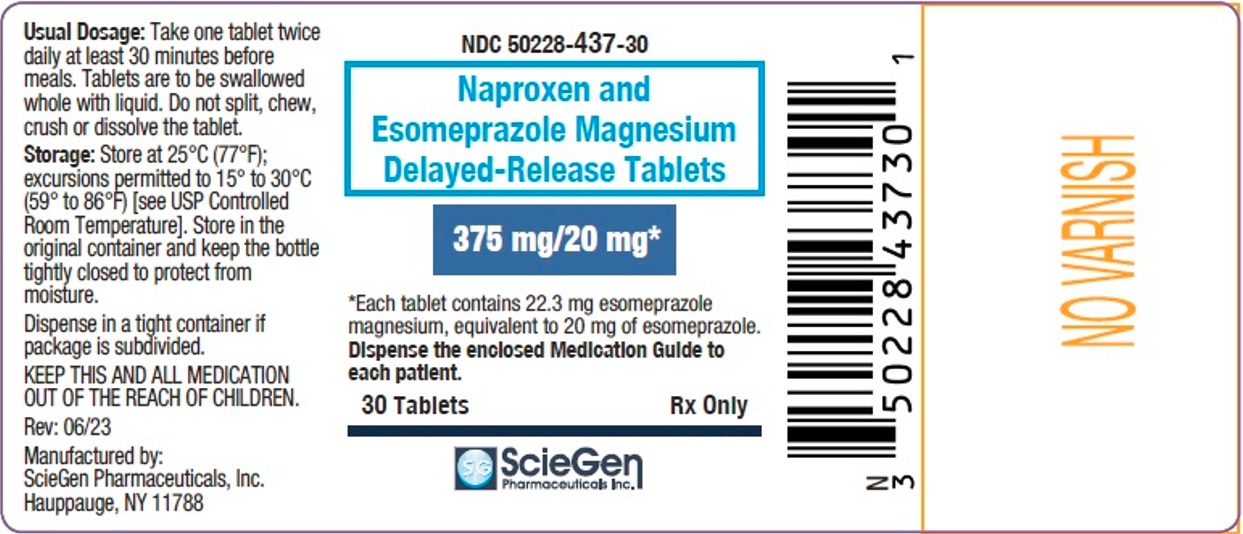
Naproxen and esomeprazole magnesium 375 mg; 20 mg Tablet, Delayed Release, 30-count — NDC 50228-437-30 (Billing 50228-0437-30)
This is a package of 30 tablets of Naproxen and esomeprazole magnesium 375 mg; 20 mg Tablet, Delayed Release from ScieGen Pharmaceuticals, Inc, marketed since Oct 2023 and currently FDA-listed.
NDC database record
One package, one record: these facts belong to NDC 50228-437-30 alone.
- Record
- FDA NDC Directory package listing · Human prescription drug
- Code segments
- 50228 labeler · 437 product · 30 package
- Package marketed since
- Oct 11, 2023
- Sample package
- No — commercial package
- Listing certified through
- Dec 31, 2026
- Barcode (UPC)
- 0350228437103, 0350228438605, 0350228438056, 0350228437301 +2 more
- FDA record last changed
- Oct 1, 2026
Identity & classification
Regulatory identifiers FDA, NLM and CMS codes for this package
Drug-database identifiers Medi-Span GPI and First Databank GCN / HICL / AHFS classification
- GSN (GCN sequence number): 066329
- GCN: 28572
- GPI-14 (Medi-Span): 66109902440620
- HICL (First Databank): 036964
- AHFS class code: 28:08.04.04
- RxCUI (RxNorm): 994005
Where does this data come from?
- FDA openFDA NDC Directory · synced Oct 1, 2026
- FDA label on DailyMed · label index refreshed Oct 6, 2026
- RxNorm (NLM RxNav) · catalog refreshed Oct 1, 2026
- Medi-Span GPI (licensed)
- First Databank (licensed) · refreshed Oct 1, 2026
RxNorm drug class
This medicine belongs to the Proton Pump Inhibitor class.
Where does this data come from?
- RxClass (NLM) · catalog refreshed Oct 1, 2026
Clinical
Patient education
Supplement & herbal interactions
Where does this data come from?
- MedlinePlus (NLM) · refreshed Oct 1, 2026
- FDA label on DailyMed · label index refreshed Oct 6, 2026
Ask a licensed pharmacist directly — free, answered by our team.
Pricing
A drug doesn't have one price. Each row is a different public payment system, and none is what you'd pay at the counter — that depends on your insurance. The ⓘ on each row explains what it measures.
| Price system | Per each | Per package |
|---|---|---|
| Retail pharmacies payNADAC · weekly | Not in the retail survey — common for institutional, discontinued, or low-volume packs. | |
| Medicaid paysCMS SDUD · 12 mo | No recent Medicaid claims on file for this NDC — rare and low-volume NDCs are suppressed in the public data. | |
| Medicare drug plans payPart D · Q2 2026 | $9.48 | $284.49 / 30 tablets |
Where does this data come from?
- CMS NADAC weekly file
- CMS ASP pricing files · refreshed Sep 20, 2026
- CMS Medicaid State Drug Utilization Data · refreshed Oct 6, 2026
- CMS Part D plan pricing files · refreshed Sep 24, 2026
- VA National Acquisition Center price file
Packaging — all sizes for this product
| Package NDC | Description | Per unit | Per pack | Marketing start | Marketing end | Status |
|---|---|---|---|---|---|---|
| 50228-0437-10 50228-437-10 | 1000 TABLET, DELAYED RELEASE in 1 BOTTLE | — | — | 2023-10-11 | — | Active |
| 50228-0437-30 You're viewing this | 30 TABLET, DELAYED RELEASE in 1 BOTTLE | — | — | 2023-10-11 | — | Active |
| 50228-0437-60 50228-437-60 Main listing | 60 TABLET, DELAYED RELEASE in 1 BOTTLE | $2.90 / ea | $173.94 | 2024-03-12 | — | Active |
You're viewing the smallest of 3 pack sizes for this product.
This pack shows little to no recent Medicaid volume — the 60 tablets pack carries most fills. See all packs ↓
Pack size FAQ
What quantity is in this package?
How does this package differ from NDC 50228-0437-60?
What NDC number is used to bill for this package of Naproxen and esomeprazole magnesium 375 mg; 20 mg Tablet, Delayed Release?
Prices are the latest CMS NADAC pharmacy acquisition cost per NDC; per-pack figures are per-unit × pack quantity, shown only when the pack is denominated in the same measure NADAC prices.
Therapeutic equivalents
| Product | Labeler | Pack | NADAC/unit | TE | Status | Price vs. this |
|---|---|---|---|---|---|---|
| Naproxen and esomeprazole magnesium 375 mg/1; 20 mg 27241-0202-60 | Ajanta | 60 tablets | $2.899 | AB | Availability likely | — |
| Naproxen and esomeprazole magnesium 375 mg/1; 20 mg 55111-0289-60 | Dr. | 60 tablets | $2.899 | AB | Availability likely | — |
| Naproxen and esomeprazole magnesium 375 mg/1; 20 mgthis 50228-0437-30 | ScieGen | 30 tablets | — | AB | FDA listed | — |
| Naproxen and esomeprazole magnesium 375 mg/1; 20 mg 68788-8906-03 | Preferred | 30 tablets | — | AB | FDA listed | — |
| Naproxen and esomeprazole magnesium 375 mg/1; 20 mg 76420-0890-01 | Asclemed | 100 tablets | — | AB | FDA listed | — |
| Naproxen and esomeprazole magnesium 375 mg/1; 20 mg 85509-1202-03 | PHOENIX | 30 tablets | — | AB | FDA listed | — |
Where does this data come from?
- FDA openFDA NDC Directory · synced Oct 1, 2026
- FDA Orange Book · refreshed Oct 3, 2026
- CMS NADAC weekly file
Availability & generic status
This product is an FDA-approved generic. Other versions of the same drug are listed under Therapeutic equivalents, least expensive first.
Where does this data come from?
- FDA Orange Book · refreshed Oct 3, 2026
What it looks like
Where does this data come from?
- FDA label on DailyMed · label index refreshed Oct 6, 2026
Inactive Ingredients / Excipients
Inactive ingredients, also called excipients, are components of the drug product other than the active ingredient. They may include fillers, dyes, coatings, preservatives, flavors, or other formulation ingredients.
Where does this data come from?
IACT rows and label-wide narrative are kept separate; availability and product-level specificity depend on the submitted label.- FDA label on DailyMed · label index refreshed Oct 6, 2026
- FDA openFDA NDC Directory · synced Oct 1, 2026
Inactive ingredient FAQ
Are inactive ingredients the same for every manufacturer?
Why might an inactive ingredient be missing?
Can inactive ingredients matter?
Manufacturer & labeler
More NDCs from ScieGen Pharmaceuticals, Inc labeler code 50228
- Droxidopa 300 mg Capsule NDC 50228-431-05
- Naproxen Sodium 275 mg Tablet NDC 50228-432-01
- Naproxen Sodium 550 mg Tablet NDC 50228-433-01
- Naproxen 250 mg Tablet NDC 50228-434-01
- Naproxen 375 mg Tablet NDC 50228-435-01
- Naproxen 500 mg Tablet NDC 50228-436-01
- Naproxen and esomeprazole magnesium 500 mg; 20 mg Tablet, Delayed Release NDC 50228-438-05
- Pirfenidone 267 mg Capsule NDC 50228-441-05
- Pirfenidone 267 mg Tablet NDC 50228-442-10
- Pirfenidone 801 mg Tablet NDC 50228-443-05
- Metformin Hydrochloride 500 mg Tablet, Film Coated, Extended Release NDC 50228-445-01
- Metformin Hydrochloride 1000 mg Tablet, Film Coated, Extended Release NDC 50228-446-05
Where does this data come from?
- FDA openFDA NDC Directory · synced Oct 1, 2026
- Drugs@FDA
Full prescribing information FDA SPL
🚨 Boxed Warning ▾
WARNING: RISK OF SERIOUS CARDIOVASCULAR AND GASTROINTESTINAL EVENTS Cardiovascular Thrombotic Events Non-Steroidal Anti-inflammatory Drugs (NSAIDs), a component of naproxen and esomeprazole magnesium delayed-release tablets, cause an increased risk of serious cardiovascular thrombotic events, including myocardial infarction and stroke, which can be fatal. This risk may occur early in treatment and may increase with duration of use [see Warnings and Precautions (5.1) ] . Naproxen and esomeprazole magnesium delayed-release tablets are contraindicated in the setting of coronary artery bypass graft (CABG) surgery [see Contraindications (4) , and Warnings and Precautions (5.1) ] .
Gastrointestinal Bleeding, Ulceration, and Perforation NSAIDs, a component of naproxen and esomeprazole magnesium delayed-release tablets cause an increased risk of serious gastrointestinal (GI) adverse events including bleeding, ulceration, and perforation of the stomach or intestines, which can be fatal. These events can occur at any time during use and without warning symptoms. Elderly patients and patients with a prior history of peptic ulcer disease and/or GI bleeding are at greater risk for serious GI events [see Warnings and Precautions (5.2) ] .
WARNING: RISK OF SERIOUS CARDIOVASCULAR AND GASTROINTESTINALEVENTS See full prescribing information for complete boxed warning. Nonsteroidal anti-inflammatory drugs (NSAIDs) cause an increased risk of serious cardiovascular thrombotic events, including myocardial infarction and stroke, which can be fatal. This risk may occur early in treatment and may increase with duration of use.
( 5.1 ) Naproxen and esomeprazole magnesium delayed-release tablets are contraindicated in the setting of coronary artery bypass graft (CABG) surgery. ( 4 , 5.1 ) NSAIDs, including naproxen, a component of naproxen and esomeprazole magnesium delayed-release tablets, cause an increased risk of serious gastrointestinal (GI) adverse events including bleeding, ulceration, and perforation of the stomach or intestines, which can be fatal. These events can occur at any time during use and without warning symptoms.
Elderly patients and patients with a prior history of peptic ulcer disease and/or GI bleeding are at greater risk for serious GI events. ( 5.2 )
🎯 Indications and Usage ▾
1 INDICATIONS AND USAGE Naproxen and esomeprazole magnesium delayed-release tablets, a combination of naproxen and esomeprazole magnesium, is indicated in adult and adolescent patients 12 years of age and older weighing at least 38 kg, requiring naproxen for symptomatic relief of arthritis and esomeprazole magnesium to decrease the risk for developing naproxen-associated gastric ulcers. The naproxen component of naproxen and esomeprazole magnesium delayed-release tablets are indicated for relief of signs and symptoms of: osteoarthritis, rheumatoid arthritis and ankylosing spondylitis in adults. juvenile idiopathic arthritis (JIA) in adolescent patients.
The esomeprazole magnesium component of naproxen and esomeprazole magnesium delayed-release tablets are indicated to decrease the risk of developing naproxen-associated gastric ulcers. Limitations of Use: Do not substitute naproxen and esomeprazole magnesium delayed-release tablets with the single-ingredient products of naproxen and esomeprazole magnesium. Naproxen and esomeprazole magnesium delayed-release tablets are not recommended for initial treatment of acute pain because the absorption of naproxen is delayed compared to absorption from other naproxen-containing products.
Controlled studies do not extend beyond 6 months [see Use in Specific Populations (8.4) , Clinical Studies (14) ] . Naproxen and esomeprazole magnesium delayed-release tablets are a combination of naproxen, a non-steroidal anti-inflammatory drug (NSAID), and esomeprazole magnesium, a proton pump inhibitor (PPI) indicated in adult and adolescent patients 12 years of age and older weighing at least 38 kg, requiring naproxen for symptomatic relief of arthritis and esomeprazole magnesium to decrease the risk of developing naproxen-associated gastric ulcers.
The naproxen component of naproxen and esomeprazole magnesium delayed-release tablets is indicated for relief of signs and symptoms of: osteoarthritis, rheumatoid arthritis and ankylosing spondylitis in adults. juvenile idiopathic arthritis (JIA) in adolescent patients. The esomeprazole magnesium component of naproxen and esomeprazole magnesium delayed-release tablets is indicated to decrease the risk of developing naproxen-associated gastric ulcers. ( 1 ) Limitations of Use: Do not substitute naproxen and esomeprazole magnesium delayed-release tablets with the single-ingredient products of naproxen and esomeprazole magnesium.
( 1 ) Naproxen and esomeprazole magnesium delayed-release tablets are not recommended for initial treatment of acute pain because the absorption of naproxen is delayed compared to absorption from other naproxen-containing products. ( 1 ) Controlled studies do not extend beyond 6 months. ( 1 )
⏱️ Dosage and Administration ▾
2 DOSAGE AND ADMINISTRATION Administration Use the lowest naproxen dose for the shortest duration consistent with individual patient treatment goals. ( 2.1 , 5.1 ). If a total daily dose of less than 40 mg esomeprazole is more appropriate, a different treatment should be considered.
( 2.1 ) Swallow naproxen and Esomeprazole magnesium delayed-release tablets whole with liquid at least 30 minutes before meals. ( 2.1 ) Recommended Dosage ( 2.2 ) Adolescents 12 years of age and older weighing 38 kg to less than 50 kg : One naproxen and esomeprazole magnesium delayed-release tablet twice daily of 375 mg naproxen/20 mg of esomeprazole Adults and adolescents 12 years of age and older greater than 50 kg : One naproxen and esomeprazole magnesium delayed-release tablet twice daily of either: 375 mg naproxen/20 mg of esomeprazole; or 500 mg of naproxen/20 mg of esomeprazole Renal or Hepatic Impairment ( 2.3 ) Avoid in moderate/severe renal impairment or severe hepatic impairment.
Consider dose reduction in mild/moderate hepatic impairment.
2.1Important Administration Instructions Use the lowest naproxen dose for the shortest duration consistent with individual patient treatment goals [see Warnings and Precautions (5.1) ] . Carefully consider the potential benefits and risks of naproxen and esomeprazole magnesium delayed-release tablets and other treatment options before deciding to use naproxen and esomeprazole magnesium delayed-release tablets. Naproxen and esomeprazole magnesium delayed-release tablets does not allow for administration of a lower daily dose of esomeprazole magnesium.
If a total daily dose of less than 40 mg esomeprazole is more appropriate, a different treatment should be considered. Swallow naproxen and esomeprazole magnesium delayed-release tablets whole with liquid. Do not split, chew, crush or dissolve the tablet.
Take naproxen and esomeprazole magnesium delayed-release tablets at least 30 minutes before meals. Patients should be instructed that if a dose is missed, it should be taken as soon as possible. However, if the next scheduled dose is due, the patient should not take the missed dose, and should be instructed to take the next dose on time.
Patients should be instructed not to take 2 doses at one time to make up for a missed dose. Antacids may be used while taking naproxen and esomeprazole magnesium delayed-release tablets.
2.2Recommended Dosage The recommended dosage of naproxen and esomeprazole magnesium delayed-release tablets by indication is shown in the table: Indication Patient Population Recommended Dosage Rheumatoid Arthritis, Osteoarthritis, and Ankylosing Spondylitis Adults One naproxen and esomeprazole magnesium delayed-release tablet twice daily of either: 375 mg naproxen/20 mg of esomeprazole; or 500 mg naproxen/20 mg of esomeprazole Juvenile Idiopathic Arthritis in Adolescent Patients 12 Years of Age and Older and Weighing at Least 38 kg Greater than 50 kg 38 kg to less than 50 kg One naproxen and esomeprazole magnesium delayed-release tablet twice daily of: 375 mg naproxen/20 mg of esomeprazole
2.3Use in Renal Impairment or Hepatic Impairment Renal Impairment Naproxen-containing products are not recommended for use in patients with moderate to severe or severe renal impairment (creatinine clearance less than 30 mL/min) [see Warnings and Precautions (5.6) , Use in Specific Populations (8.7) ] . Hepatic Impairment Monitor patients with mild to moderate hepatic impairment closely and consider a possible dose reduction based on the naproxen component of naproxen and esomeprazole magnesium delayed-release tablets.
Naproxen and esomeprazole magnesium delayed-release tablets should be avoided in patients with severe hepatic impairment [see Warnings and Precautions (5.3) , Use in Specific Populations (8.6) ].
💊 Dosage Forms and Strengths ▾
3 DOSAGE FORMS AND STRENGTHS Naproxen and esomeprazole magnesium delayed-release tablets for oral administration are available in the following strengths: 375 mg enteric-coated naproxen and 20 mg immediate-release esomeprazole tablets- Yellow, oval shaped, film coated tablets printed with "437" on one side. 500 mg enteric-coated naproxen and 20 mg immediate-release esomeprazole tablets- Yellow, Oval shaped, film coated tablets printed with "438" on one side. Naproxen and esomeprazole magnesium delayed-release tablets ( 3 ): Naproxen and esomeprazole magnesium delayed-release tablets 375mg/20mg Naproxen and esomeprazole magnesium delayed-release tablets 500mg/20mg
⛔ Contraindications ▾
4 CONTRAINDICATIONS Naproxen and esomeprazole magnesium delayed-release tablets are contraindicated in the following patients: Known hypersensitivity (e.g., anaphylactic reactions and serious skin reactions) to naproxen, esomeprazole magnesium, substituted benzimidazoles, or to any components of the drug product, including omeprazole. Hypersensitivity reactions to esomeprazole may include anaphylaxis, anaphylactic shock, angioedema, bronchospasm, acute tubulointerstitial nephritis, and urticaria [see Warnings and Precautions (5.7 , 5.8 , 5.9 , 5.18 ), Adverse Reactions (6.2) ] .
History of asthma, urticaria, or allergic-type reactions after taking aspirin or other NSAIDs. Severe, sometimes fatal, anaphylactic reactions to NSAIDs have been reported in such patients [see Warnings and Precautions (5.7 , 5.8 )] . In the setting of coronary artery bypass graft (CABG) surgery [see Warnings and Precautions (5.1) ] .
Proton pump inhibitors (PPIs), including esomeprazole magnesium, are contraindicated in patients receiving rilpivirine-containing products [see Drug Interactions (7) ] . Known hypersensitivity to naproxen, esomeprazole magnesium, substituted benzimidazoles, or to any components of the drug product including omeprazole. (4 ) History of asthma, urticaria, or other allergic-type reactions after taking aspirin or other NSAIDs.
( 4 ) In the setting of coronary artery bypass graft (CABG) surgery. ( 4 ) In patients receiving rilpivirine-containing products. ( 4 , 7 )
⚠️ Warnings and Cautions ▾
5 WARNINGS AND PRECAUTIONS Hepatotoxicity : Inform patients of warning signs and symptoms of hepatotoxicity. Discontinue if abnormal liver tests persist or worsen or if clinical signs and symptoms of liver disease develop. ( 5.3 ) Hypertension : Patients taking some antihypertensive medications may have impaired response to these therapies when taking NSAIDs.
Monitor blood pressure. ( 5.4 , 7 ) Heart Failure and Edema : Avoid use of naproxen and esomeprazole magnesium delayed-release tablets in patients with severe heart failure unless benefits are expected to outweigh risk of worsening heart failure. ( 5.5 ) Renal Toxicity : Monitor renal function in patients with renal or hepatic impairment, heart failure, dehydration, or hypovolemia.
Avoid use of naproxen and esomeprazole magnesium delayed-release tablets in patients with advanced renal disease unless benefits are expected to outweigh risk of worsening renal function. ( 5.6 ) Anaphylactic Reactions : Seek emergency help if an anaphylactic reaction occurs. ( 5.7 ) Exacerbation of Asthma Related to Aspirin Sensitivity : Naproxen and esomeprazole magnesium delayed-release tablets are contraindicated in patients with aspirin-sensitive asthma.
Monitor patients with preexisting asthma (without aspirin sensitivity). ( 5.8 ) Serious Skin Reactions : Discontinue naproxen and esomeprazole magnesium delayed-release tablets at first appearance of skin rash or other signs of hypersensitivity. ( 5.9 ) Drug Reaction with Eosinophilia and Systemic Symptoms (DRESS): Discontinue and evaluate clinically ( 5.10 ) Fetal Toxicity : Limit use of NSAIDs, including naproxen and esomeprazole magnesium delayed-release tablets, between about 20 to 30 weeks in pregnancy due to the risk of oligohydramnios/fetal renal dysfunction.
Avoid use of NSAIDs in women at about 30 weeks gestation and later in pregnancy due to the risks of oligohydramnios/fetal renal dysfunction and premature closure of the fetal ductus arteriosus ( 5.11 , 8.1 ) Hematologic Toxicity : Monitor hemoglobin or hematocrit in patients with any signs of symptoms of anemia. ( 5.12 , 7 ) Masking of Inflammation and Fever : Potential for diminished utility of diagnostic signs in detecting infections. ( 5.13 ) Laboratory Monitoring : Obtain CBC and chemistry profile periodically during treatment.
Monitor hemoglobin periodically in patients on long- term treatment who have an initial value of 10 g or less. ( 5.14 ) Active Bleeding : Withdraw treatment in patients who experience active and clinically significant bleeding. ( 5.15 ) Concomitant NSAID Use : Do not use naproxen and esomeprazole magnesium delayed-release tablets with other naproxen -containing products or other non-aspirin NSAIDs.
( 5.16 ) Gastric Malignancy : In adults, symptomatic response to esomeprazole does not preclude the presence of gastric malignancy. Consider additional follow-up and diagnostic testing. ( 5.17 ) Acute Tubulointerstitial Nephritis : Discontinue treatment and evaluate patients.
( 5.18 ) Clostridium difficile -Associated Diarrhea : PPI therapy may be associated with increased risk of Clostridium difficile associated diarrhea. ( 5.19 ) Bone Fracture : Long-term and multiple daily dose PPI therapy may be associated with an increased risk for osteoporosis-related fractures of the hip, wrist or spine. ( 5.20 ) Cutaneous and Systemic Lupus Erythematosus : Mostly cutaneous, new onset or exacerbation of existing disease; discontinue naproxen and esomeprazole magnesium delayed-release tablets and refer to specialist for evaluation.
( 5.21 ) Interaction with Clopidogrel : Avoid concomitant use. ( 5.22 , 7 ) Cyanocobalamin (Vitamin B-12) Deficiency : Daily long-term use (e.g., longer than 3 years) may lead to malabsorption or a deficiency of cyanocobalamin. ( 5.23 ) Hypomagnesemia and Mineral Metabolism : Reported rarely with prolonged treatment with PPIs.
( 5.24 ) Interaction with St. John’s Wort or Rifampin : Avoid concomitant use. ( 5.25 , 7 ) Interactions with Diag… [Excerpted — this section continues on DailyMed.]
🤒 Adverse Reactions ▾
6 ADVERSE REACTIONS The following adverse reactions are discussed in greater detail in other sections of the labeling: Cardiovascular Thrombotic Events [see Warnings and Precautions (5.1) ] GI Bleeding, Ulceration and Perforations [see Warnings and Precautions (5.2) ] Hepatotoxicity [see Warnings and Precautions (5.3) ] Hypertension [see Warnings and Precautions (5.4) ] Heart Failure and Edema [see Warnings and Precautions (5.5) ] Renal Toxicity and Hyperkalemia [see Warnings and Precautions (5.6) ] Anaphylactic Reactions [see Warnings and Precautions (5.7) ] Serious Skin Reactions [see Warnings and Precautions (5.9) ] Drug Reaction with Eosinophilia and Systemic Symptoms (DRESS) [see Warnings and Precautions (5.10) ] Fetal Toxicity [see Warnings and Precautions (5.11) ] Hematologic Toxicity [see Warnings and Precautions (5.12) ] Active Bleeding [see Warnings and Precautions (5.15) ] Acute Tubulointerstitial Nephritis [see Warnings and Precautions (5.18) ] Clostridium difficile- Associated Diarrhea [see Warnings and Precautions (5.19) ] Bone Fracture [see Warnings and Precautions (5.20) ] Cutaneous and Systemic Lupus Erythematosus [see Warnings and Precautions (5.21) ] Cyanocobalamin (Vitamin B-12) Deficiency [see Warnings and Precautions (5.23) ] Hypomagnesemia and Mineral Metabolism [see Warnings and Precautions (5.24) ] Fundic Gland Polyps [see Warnings and Precautions (5.28) ] Most common adverse reactions in clinical trials (>5%) are gastritis and diarrhea.
( 6.1 ) To report SUSPECTED ADVERSE REACTIONS, contact ScieGen Pharmaceuticals Inc. at 1-855-724-3436 or FDA at 1-800-FDA-1088 or www.fda.gov/medwatch .
6.1Clinical Trials Experience Clinical Trials Experience with naproxen and esomeprazole magnesium delayed release tablets Because clinical trials are conducted under widely varying conditions, adverse reaction rates observed in the clinical trials of a drug cannot be directly compared to rates in the clinical trials of another drug and may not reflect the rates observed in practice. The adverse reactions reported below are specific to the clinical trials with naproxen and esomeprazole magnesium delayed-release tablets.
The safety of naproxen and esomeprazole magnesium delayed-release tablets were evaluated in clinical studies involving 2317 patients (aged 27 to 90 years) and ranging from 3 to 12 months. Patients received either 500 mg/20 mg of naproxen and esomeprazole magnesium delayed-release tablets twice daily (n=1157), 500 mg of enteric-coated naproxen twice daily (n=426), or placebo (n=246). The average number of naproxen and esomeprazole magnesium delayed-release tablets doses taken over 12 months was 69 6 ±44.
The table below lists all adverse reactions, regardless of causality, occurring in > 2% of patients receiving naproxen and esomeprazole magnesium delayed-release tablets and higher in the naproxen and esomeprazole magnesium delayed-release tablets group than control from two clinical studies (Study 1 and Study 2). Both of these studies were randomized, multi-center, double-blind, parallel studies. The majority of patients were female (67%), white (86%).
The majority of patients were 50 to 69 years of age (83%). Approximately one quarter were on low-dose aspirin. Table 1: Adverse Reactions reported in > 2% of patients and higher in the naproxen and esomeprazole magnesium delayed-release tablets group than control in Study 1 and Study 2 (endoscopic studies) Preferred term Naproxen and esomeprazole magnesium delayed-release tablets 500 mg/20 mg twice daily (n=428) % EC-Naproxen 500 mg twice daily (n=426) % Gastritis 17 14 Diarrhea 6 5 Upper respiratory tract infection 5 4 Flatulence 4 3 Headache 3 1 Urinary tract infection 2 1 Dysgeusia 2 1 In Study 1 and Study 2, patients taking naproxen and esomeprazole magnesium delayed-release tablets had fewer premature discontinuations due to adverse reactions compared to patients taking enteric-coated naproxen alone (7.9% vs.
12.5% respectively). The most common reas… [Excerpted — this section continues on DailyMed.]
🔄 Drug Interactions ▾
7 DRUG INTERACTIONS See Table 3 and Table 4 for clinically significant drug interactions and interactions with diagnostics with naproxen and esomeprazole magnesium. Table 3: Clinically Significant Drug Interactions with Naproxen and Esomeprazole Magnesium – Affecting Drugs Co-Administered with Naproxen and Esomeprazole magnesium delayed-release tablets and Interactions with Diagnostics Clinical Impact: Naproxen • Naproxen and anticoagulants such as warfarin have a synergistic effect on bleeding. The concomitant use of naproxen and anticoagulants have increased the risk of serious bleeding compared to the use of either drug alone • Serotonin release by platelets plays an important role in hemostasis.
Case-control and cohort epidemiological studies showed that concomitant use of drugs that interfere with serotonin reuptake and an NSAID may potentiate the risk of bleeding more than an NSAID alone. Esomeprazole Magnesium • Increased INR and prothrombin time in patients treated with PPIs, including esomeprazole, and warfarin concomitantly. Increases in INR and prothrombin time may lead to abnormal bleeding and even death. • Concomitant use of esomeprazole 40 mg resulted in reduced plasma Intervention: Monitor patients with concomitant use of naproxen and esomeprazole magnesium delayed-release tablets with anticoagulants (e.g., warfarin), antiplatelet agents (e.g., aspirin), selective serotonin reuptake inhibitors (SSRIs), and serotonin norepinephrine reuptake inhibitors (SNRIs) for signs of bleeding [see Warnings and Precautions (5.14) ].
Clopidogrel: Avoid concomitant use of clopidogrel with naproxen and esomeprazole magnesium delayed-release tablets. Consider use of alternative anti-platelet therapy [see Warnings and Precautions (5.22) ]. Aspirin Clinical Impact: A pharmacodynamics (PD) study has demonstrated an interaction in which lower dose naproxen (220mg/day or 220mg twice daily) interfered with the antiplatelet effect of low-dose immediate-release aspirin, with the interaction most marked during the washout period of naproxen [see Clinical Pharmacology (12.2.) ].
There is reason to expect that the interaction would be present with prescription doses of naproxen or with enteric-coated low-dose aspirin; however, the peak interference with aspirin function may be later than observed in the PD study due to the longer washout period. Controlled clinical studies showed that the concomitant use of NSAIDs and analgesic doses of aspirin does not produce any greater therapeutic effect than the use of NSAIDs alone. In a clinical study, the concomitant use of an NSAID and aspirin was associated with a significantly increased incidence of GI adverse reactions as compared to use of the NSAID alone [see Warnings and Precautions (5.2) ].
Intervention: Because there may be an increased risk of cardiovascular events following discontinuation of naproxen due to the interference with the antiplatelet effect of aspirin during the washout period, for patients taking low-dose aspirin for cardioprotection who require intermittent analgesics, consider use of an NSAID that does not interfere with the antiplatelet effect of aspirin, or non-NSAID analgesics where appropriate. Concomitant use of naproxen and esomeprazole magnesium delayed-release tablets and analgesic doses of aspirin is not generally recommended because of the increased risk of bleeding [see Warnings and Precautions (5.12) ] .
Naproxen and esomeprazole magnesium delayed-release tablets are not a substitute for low dose aspirin for cardiovascular protection. ACE Inhibitors, Angiotensin Receptor Blockers, and Beta-Blockers Clinical Impact: • NSAIDs may diminish the antihypertensive effect of angiotensin converting enzyme (ACE) inhibitors, angiotensin receptor blockers (ARBs), or beta-blockers (including propranolol). • In patients who are elderly, volume-depleted (including those on diuretic therapy), or have renal impairment, co-administration of an NSAID with ACE inhibitors or ARBs ma… [Excerpted — this section continues on DailyMed.]
👥 Use in Specific Populations ▾
8 USE IN SPECIFIC POPULATIONS • Females and Males of Reproductive Potential : NSAIDs are associated with reversible infertility. Consider withdrawal of naproxen and esomeprazole magnesium delayed-release tablets in women who have difficulties conceiving. ( 8.3 )
8.1Pregnancy Risk Summary Use of NSAIDs, including naproxen and esomeprazole magnesium delayed-release tablets, can cause premature closure of the fetal ductus arteriosus and fetal and renal dysfunction leading to oligohydramnios and, in some cases, neonatal renal impairment. Because of these risks, limit dose and duration of naproxen and esomeprazole magnesium delayed-release tablets use between about 20 and 30 weeks of gestation and avoid naproxen and esomeprazole magnesium delayed-release tablets use at about 30 weeks of gestation and later in pregnancy (see Clinical Considerations , Data ) .
Premature Closure of the Fetal Ductus Arteriosus Use of NSAIDs, including naproxen and esomeprazole magnesium delayed-release tablets, at about 30 weeks gestation or later in pregnancy increases the risk of premature closure of the fetal ductus arteriosus. Oligohydramnios/Neonatal Renal Impairment Use of NSAIDs at about 20 weeks gestation or later in pregnancy has been associated with cases of fetal renal dysfunction leading to oligohydramnios, and in some cases, neonatal renal impairment. Naproxen and esomeprazole magnesium delayed-release tablets contain naproxen and esomeprazole magnesium.
Esomeprazole is the S- isomer of omeprazole. Naproxen Data from observational studies regarding potential embryofetal risks of NSAID use in women in the first or second trimesters of pregnancy are inconclusive. In animal reproduction studies, naproxen administered during organogenesis to rats and rabbits at doses less than the maximum recommended human daily dose of 1500 mg/day showed no evidence of harm to the fetus (see Data ) .
Based on animal data, prostaglandins have been shown to have an important role in endometrial vascular permeability, blastocyst implantation, and decidualization. In animal studies, administration of prostaglandin synthesis inhibitors such as naproxen resulted in increased pre- and post-implantation loss. Prostaglandins also have been shown to have an important role in fetal kidney development.
In published animal studies, prostaglandin synthesis inhibitors have been reported to impair kidney development when administered at clinically relevant doses. Esomeprazole There are no human data for esomeprazole. However, available epidemiologic data for omeprazole (esomeprazole is the S-isomer of omeprazole) fail to demonstrate an increased risk of major congenital malformations or other adverse pregnancy outcomes with first trimester omeprazole use (see Data ) .
In animal studies with administration of oral esomeprazole magnesium in rats, changes in bone morphology were observed in offspring of rats dosed through most of pregnancy and lactation at doses equal to or greater than approximately 34 times an oral human dose of 40 mg esomeprazole or 40 mg omeprazole. When maternal administration was confined to gestation only, there were no effects on bone physeal morphology in the offspring at any age [see Data ] . The estimated background risks of major birth defects and miscarriage for the indicated population are unknown.
All pregnancies have a background risk of birth defect, loss, or other adverse outcomes. In the U.S. general population, the estimated background risk of major birth defects and miscarriage in clinically recognized pregnancies is 2% to 4% and 15% to 20%, respectively. Clinical Considerations Fetal/Neonatal Adverse Reactions Premature Closure of Fetal Ductus Arteriosus: Avoid use of NSAIDs in women at about 30 weeks gestation and later in pregnancy, because NSAIDs, including naproxen and esomeprazole magnesium delayed-release tablets, can cause premature closure of the fetal ductus arteriosus (see Data ).
Oligohydramnios/Neonatal Renal Impairment If an… [Excerpted — this section continues on DailyMed.]
🤰 Pregnancy ▾
8.1Pregnancy Risk Summary Use of NSAIDs, including naproxen and esomeprazole magnesium delayed-release tablets, can cause premature closure of the fetal ductus arteriosus and fetal and renal dysfunction leading to oligohydramnios and, in some cases, neonatal renal impairment. Because of these risks, limit dose and duration of naproxen and esomeprazole magnesium delayed-release tablets use between about 20 and 30 weeks of gestation and avoid naproxen and esomeprazole magnesium delayed-release tablets use at about 30 weeks of gestation and later in pregnancy (see Clinical Considerations , Data ) .
Premature Closure of the Fetal Ductus Arteriosus Use of NSAIDs, including naproxen and esomeprazole magnesium delayed-release tablets, at about 30 weeks gestation or later in pregnancy increases the risk of premature closure of the fetal ductus arteriosus. Oligohydramnios/Neonatal Renal Impairment Use of NSAIDs at about 20 weeks gestation or later in pregnancy has been associated with cases of fetal renal dysfunction leading to oligohydramnios, and in some cases, neonatal renal impairment. Naproxen and esomeprazole magnesium delayed-release tablets contain naproxen and esomeprazole magnesium.
Esomeprazole is the S- isomer of omeprazole. Naproxen Data from observational studies regarding potential embryofetal risks of NSAID use in women in the first or second trimesters of pregnancy are inconclusive. In animal reproduction studies, naproxen administered during organogenesis to rats and rabbits at doses less than the maximum recommended human daily dose of 1500 mg/day showed no evidence of harm to the fetus (see Data ) .
Based on animal data, prostaglandins have been shown to have an important role in endometrial vascular permeability, blastocyst implantation, and decidualization. In animal studies, administration of prostaglandin synthesis inhibitors such as naproxen resulted in increased pre- and post-implantation loss. Prostaglandins also have been shown to have an important role in fetal kidney development.
In published animal studies, prostaglandin synthesis inhibitors have been reported to impair kidney development when administered at clinically relevant doses. Esomeprazole There are no human data for esomeprazole. However, available epidemiologic data for omeprazole (esomeprazole is the S-isomer of omeprazole) fail to demonstrate an increased risk of major congenital malformations or other adverse pregnancy outcomes with first trimester omeprazole use (see Data ) .
In animal studies with administration of oral esomeprazole magnesium in rats, changes in bone morphology were observed in offspring of rats dosed through most of pregnancy and lactation at doses equal to or greater than approximately 34 times an oral human dose of 40 mg esomeprazole or 40 mg omeprazole. When maternal administration was confined to gestation only, there were no effects on bone physeal morphology in the offspring at any age [see Data ] . The estimated background risks of major birth defects and miscarriage for the indicated population are unknown.
All pregnancies have a background risk of birth defect, loss, or other adverse outcomes. In the U.S. general population, the estimated background risk of major birth defects and miscarriage in clinically recognized pregnancies is 2% to 4% and 15% to 20%, respectively. Clinical Considerations Fetal/Neonatal Adverse Reactions Premature Closure of Fetal Ductus Arteriosus: Avoid use of NSAIDs in women at about 30 weeks gestation and later in pregnancy, because NSAIDs, including naproxen and esomeprazole magnesium delayed-release tablets, can cause premature closure of the fetal ductus arteriosus (see Data ).
Oligohydramnios/Neonatal Renal Impairment If an NSAID is necessary at about 20 weeks gestation or later in pregnancy, limit the use to the lowest effective dose and shortest duration possible. If naproxen and esomeprazole magnesium delayed-release tablets treatment is needed in pregnant women, consider monitor… [Excerpted — this section continues on DailyMed.]
🧒 Pediatric Use ▾
8.4Pediatric Use The safety and effectiveness of naproxen and esomeprazole magnesium delayed-release tablets have been established in adolescent patients 12 years of age and older weighing at least 38 kg for the symptomatic relief of JIA and to decrease the risk of developing naproxen-associated gastric ulcers. Use of naproxen and esomeprazole magnesium delayed-release tablets in this age group is based on extrapolation of adequate and well-controlled studies in adults and supported by a 6 month safety study including pharmacokinetic assessment of naproxen and esomeprazole magnesium in 36 adolescent patients with JIA.
Based on the limited data, the plasma naproxen and plasma esomeprazole concentrations were found to be within the range to that observed to those found in healthy adults. The safety profile of naproxen and esomeprazole magnesium delayed-release tablets in adolescent patients with JIA was similar to adults with RA. The safety and effectiveness of naproxen and esomeprazole magnesium delayed-release tablets in pediatric patients less than 12 years of age or less than 38 kg with JIA have not been established.
Juvenile Animal Data In a juvenile rat toxicity study, esomeprazole was administered with both magnesium and strontium salts at oral doses about 34 to 68 times a daily human dose of 40 mg based on body surface area. Increases in death were seen at the high dose, and at all doses of esomeprazole, there were decreases in body weight, body weight gain, femur weight and femur length, and decreases in overall growth [see Nonclinical Toxicology (13.2) ].
🧓 Geriatric Use ▾
8.5Geriatric Use Elderly patients, compared to younger patients, are at greater risk for NSAID-associated serious cardiovascular, gastrointestinal, and/or renal adverse reactions. If the anticipated benefit for the elderly patient outweighs these potential risks, start dosing at the low end of the dosing range, and monitor patients for adverse effects [see Warnings and Precautions (5.1 , 5.2 , 5.3 , 5.6 , 5.14 )] . Of the total number of patients who received naproxen and esomeprazole magnesium delayed-release tablets (n=1157) in clinical trials, 387 were ≥ 65 years of age, of which 85 patients were 75 years and over.
No meaningful differences in efficacy or safety were observed between these subjects and younger subjects [see Adverse Reactions (6) ]. Studies indicate that although total plasma concentration of naproxen is unchanged, the unbound plasma fraction of naproxen is increased in the elderly. Caution is advised when high doses are required and some adjustment of dosage may be required in elderly patients.
As with other drugs used in the elderly, it is prudent to use the lowest effective dose [see Dosage and Administration (2) , Clinical Pharmacology (12.3) ]. Experience indicates that geriatric patients may be particularly sensitive to certain adverse effects of NSAIDs. Elderly or debilitated patients seem to tolerate peptic ulceration or bleeding less well when these events do occur.
Most spontaneous reports of fatal GI events are in the geriatric population [see Warnings and Precautions (5.2) ]. Naproxen and its metabolites are known to be substantially excreted by the kidney, and the risk of adverse reactions to this drug may be greater in patients with impaired renal function. Because elderly patients are more likely to have decreased renal function, care should be taken in dose selection, and it may be useful to monitor renal function.
Geriatric patients may be at a greater risk for the development of a form of renal toxicity precipitated by reduced prostaglandin formation during administration of NSAIDs [see Warnings and Precautions (5.6) ] .
🆘 Overdosage ▾
10 OVERDOSAGE There is no clinical data on overdosage with naproxen and esomeprazole magnesium delayed-release tablets. Overdosage of naproxen: Symptoms following acute NSAID overdosages have been typically limited to lethargy, drowsiness, nausea, vomiting, and epigastric pain, which have been generally reversible with supportive care. Gastrointestinal bleeding has occurred.
Hypertension, acute renal failure, respiratory depression, and coma have occurred but were rare [see Warnings and Precautions (5.1 , 5.2 , 5.4 , 5.6) ] . A few patients have experienced seizures, but it is not clear whether or not these were drug-related. It is not known what dose of the drug would be life threatening.
The oral LD50 of the drug is 500 mg/kg in rats, 1200 mg/kg in mice, 4000 mg/kg in hamsters and greater than 1000 mg/kg in dogs. In animals 0.5 g/kg of activated charcoal was effective in reducing plasma levels of naproxen. Manage patients with symptomatic and supportive care following an NSAID overdosage.
There are no specific antidotes. Hemodialysis does not decrease the plasma concentration of naproxen because of the high degree of its protein binding. Consider emesis and/or activated charcoal (60 to 100 grams in adults, 1 to 2 grams per kg of body weight in pediatric patients) and/or osmotic cathartic in symptomatic patients seen within four hours of ingestion or in patients with a large overdosage (5 to 10 times the recommended dosage).
Forced diuresis, alkalinization of urine, hemodialysis, or hemoperfusion may not be useful due to high protein binding. Overdosage of esomeprazole : A single oral dose of esomeprazole at 510 mg/kg (about 124 times the human dose on a body surface area basis) was lethal to rats. The major signs of acute toxicity were reduced motor activity, changes in respiratory frequency, tremor, ataxia, and intermittent clonic convulsions.
The symptoms described in connection with deliberate esomeprazole overdose (limited experience of doses in excess of 240 mg/day) are transient. Single doses of 80 mg of esomeprazole were uneventful. Reports of overdosage with omeprazole in humans may also be relevant.
Doses ranged up to 2,400 mg (120 times the usual recommended clinical dose). Manifestations were variable, but included confusion, drowsiness, blurred vision, tachycardia, nausea, diaphoresis, flushing, headache, dry mouth, and other adverse reactions similar to those seen in normal clinical experience (see omeprazole package insert - Adverse Reactions ). No specific antidote for esomeprazole is known.
Since esomeprazole is extensively protein bound, it is not expected to be removed by dialysis. In the event of overdosage, treatment should be symptomatic and supportive. If over-exposure occurs, call your Poison Control Center at 1-800-222-1222 for current information on the management of poisoning or overdosage.
🧬 Clinical Pharmacology ▾
12 CLINICAL PHARMACOLOGY
12.1Mechanism of Action Naproxen and esomeprazole magnesium delayed-release tablets consists of an immediate-release esomeprazole magnesium layer and an enteric-coated naproxen core. As a result, esomeprazole is released first in the stomach, prior to the dissolution of naproxen in the small intestine. The enteric coating prevents naproxen release at pH levels below 5.5.
The mechanism of action of the naproxen anion, like that of other NSAIDs, is not completely understood but inhibition of cyclooxygenase (COX-1 and COX-2). Naproxen and esomeprazole magnesium delayed-release tablets has analgesic, anti-inflammatory, and antipyretic properties contributed by the naproxen component. Naproxen is a potent inhibitor of prostaglandin synthesis in vitro.
Naproxen concentrations reached during therapy have produced in vivo effects. Prostaglandins sensitize afferent nerves and potentiate the action of bradykinin in inducing pain in animal models. Prostaglandins are mediators of inflammation.
Because naproxen is an inhibitor of prostaglandin synthesis, its mode of action may be due to an increase of prostaglandins in peripheral tissues. Esomeprazole is a proton pump inhibitor that suppresses gastric acid secretion by specific inhibition of the H + /K + -ATPase in the gastric parietal cell. Esomeprazole is protonated and converted in the acidic compartment of the parietal cell forming the active inhibitor, the achiral sulphenamide.
By acting specifically on the proton pump, esomeprazole blocks the final step in acid production, thus reducing gastric acidity. This effect is dose-related up to a daily dose of 20 to 40 mg and leads to inhibition of gastric acid secretion.
12.2Pharmacodynamics Interaction with Aspirin In a healthy volunteer study, 10 days of concomitant administration of naproxen 220 mg once-daily with low-dose immediate-release aspirin (81 mg) showed an interaction with the antiplatelet activity of aspirin as measured by % serum thromboxane B2 inhibition at 24 hours following the day 10 dose [98.7% (aspirin alone) vs 93.1% (naproxen and aspirin)]. The interaction was observed even following discontinuation of naproxen on day 11 (while aspirin dose was continued) but normalized by day 13.
In the same study, the interaction was greater when naproxen was administered 30 minutes prior to aspirin [98.7% vs 87.7%] and minimal when aspirin was administered 30 minutes prior to naproxen [98.7% vs 95.4%]. Following administration of naproxen 220 mg twice-daily with low-dose immediate-release aspirin (first naproxen dose given 30 minutes prior to aspirin), the interaction was minimal at 24 h following day 10 dose [98.7% vs 95.7%]. However, the interaction was more prominent after discontinuation of naproxen (washout) on day 11 [98.7% vs 84.3%] and did not normalize completely by day 13 [98.5% vs 90.7%] [see Drug Interactions (7) ] .
Antisecretory Activity The effect of naproxen and esomeprazole magnesium delayed-release tablets on intragastric pH was determined in 25 healthy volunteers in one study. Three naproxen and esomeprazole magnesium delayed-release tablets combinations (naproxen 500 mg combined with either esomeprazole 10 mg, 20 mg, or 30 mg) were administered twice daily over 9 days. The results are shown in the following table: Table 5: Effect on Intragastric pH on Day 9 (N=25) LS Mean (SE) Naproxen 500 mg combined with esomeprazole 10 mg 20 mg 30 mg % Time Gastric pH > 4 Gastric pH was measured over a 24-hour period 41.1 (3.0) 71.5 (3.0) 76.8 (3.0) Coefficient of variation 55% 18% 16% Serum Gastrin Effects The effect of esomeprazole on serum gastrin concentrations was evaluated in approximately 2,700 patients in clinical trials up to 8 weeks and in over 1,300 patients for up to 6 to 12 months.
The mean fasting gastrin level increased in a dose-related manner. This increase reached a plateau within two to three months of therapy and returned to baseline levels within four weeks after discontinuation… [Excerpted — this section continues on DailyMed.]
🧬 Mechanism of Action ▾
12.1Mechanism of Action Naproxen and esomeprazole magnesium delayed-release tablets consists of an immediate-release esomeprazole magnesium layer and an enteric-coated naproxen core. As a result, esomeprazole is released first in the stomach, prior to the dissolution of naproxen in the small intestine. The enteric coating prevents naproxen release at pH levels below 5.5.
The mechanism of action of the naproxen anion, like that of other NSAIDs, is not completely understood but inhibition of cyclooxygenase (COX-1 and COX-2). Naproxen and esomeprazole magnesium delayed-release tablets has analgesic, anti-inflammatory, and antipyretic properties contributed by the naproxen component. Naproxen is a potent inhibitor of prostaglandin synthesis in vitro.
Naproxen concentrations reached during therapy have produced in vivo effects. Prostaglandins sensitize afferent nerves and potentiate the action of bradykinin in inducing pain in animal models. Prostaglandins are mediators of inflammation.
Because naproxen is an inhibitor of prostaglandin synthesis, its mode of action may be due to an increase of prostaglandins in peripheral tissues. Esomeprazole is a proton pump inhibitor that suppresses gastric acid secretion by specific inhibition of the H + /K + -ATPase in the gastric parietal cell. Esomeprazole is protonated and converted in the acidic compartment of the parietal cell forming the active inhibitor, the achiral sulphenamide.
By acting specifically on the proton pump, esomeprazole blocks the final step in acid production, thus reducing gastric acidity. This effect is dose-related up to a daily dose of 20 to 40 mg and leads to inhibition of gastric acid secretion.
📦 How Supplied / Storage and Handling ▾
16 HOW SUPPLIED/STORAGE AND HANDLING Naproxen and esomeprazole magnesium (375 mg naproxen /20 mg esomeprazole magnesium) delayed-release tablets are yellow, oval shaped, film coated tablets imprinted with "437" on one side, supplied as: NDC 50228-437-30 Bottles of 30 tablets NDC 50228-437-60 Bottles of 60 tablets NDC 50228-437-10 Bottles of 1,000 tablets Naproxen and esomeprazole magnesium (500 mg naproxen /20 mg esomeprazole magnesium) delayed-release tablets are yellow, oval shaped, film coated tablets imprinted with "438" on one side, supplied as: NDC 50228-438-30 Bottles of 30 tablets NDC 50228-438-60 Bottles of 60 tablets NDC 50228-438-05 Bottles of 500 tablets Storage: Store at 25°C (77°F); excursions permitted to 15° to 30°C (59° to 86°F) [see USP Controlled Room Temperature].
Store in the original container and keep the bottle tightly closed to protect from moisture. Dispense in a tight container if package is subdivided.
📋 Description ▾
11 DESCRIPTION The active ingredients of naproxen and esomeprazole magnesium delayed-release tablets are naproxen which is an NSAID and esomeprazole magnesium which is a Proton Pump Inhibitor (PPI). Naproxen and esomeprazole magnesium delayed-release tablets (naproxen and esomeprazole magnesium) is combination of a nonsteroidal anti-inflammatory drug and a PPI available as an oval, yellow, multi-layer, delayed-release tablet combining an enteric-coated naproxen core and an immediate-release esomeprazole magnesium layer surrounding the core.
Each strength contains either 375 mg of naproxen and 20 mg of esomeprazole (equivalent to 22.3 mg esomeprazole magnesium trihydrate) or 500 mg of naproxen and 20 mg of esomeprazole (equivalent to 22.3 mg esomeprazole magnesium trihydrate) for oral administration. The inactive ingredients are colloidal silicon dioxide, croscarmellose sodium, hypromellose, iron oxide yellow, magnesium oxide, magnesium stearate, methacrylic acid and ethyl acrylate copolymer dispersion, talc, plasacryl, polyethylene glycol, polysorbate 80, povidone, titanium dioxide.
The imprinting ink contains ammonium hydroxide, iron oxide black, propylene glycol, shellac glaze. The chemical name for naproxen is (S)-6-methoxy-α-methyl-2-naphthaleneacetic acid. Naproxen has the following structure: Naproxen has a molecular weight of 230.26 and a molecular formula of C 14 H 14 O 3 .
Naproxen, USP is an odorless, white to off-white crystalline substance. It is lipid soluble, practically insoluble in water at low pH and freely soluble in water at high pH. The octanol/water partition coefficient of naproxen at pH 7.4 is 1.6 to 1.8.
The chemical name for esomeprazole, USP is bis(5-methoxy-2-[(S)-[(4-methoxy-3,5-dimethyl-2-pyridinyl)methyl]sulfinyl]-1 H -benzimidazole-1-yl) magnesium trihydrate. Esomeprazole, USP is the S-isomer of omeprazole, which is a mixture of the S- and R- isomers. Its molecular formula is (C 17 H 18 N 3 O 3 S)2Mg x 3 H 2 O with molecular weight of 767.2 as a trihydrate and 713.1 on an anhydrous basis.
The structural formula is: The magnesium salt is a white to slightly colored crystalline powder. It contains 3 moles of water of solvation and is slightly soluble in water. The stability of esomeprazole magnesium is a function of pH; it rapidly degrades in acidic media, but it has acceptable stability under alkaline conditions.
At pH 6.8 (buffer), the half-life of the magnesium salt is about 19 hours at 25°C and about 8 hours at 37°C. structure1 structure2
💬 Information for Patients ▾
17 PATIENT COUNSELING INFORMATION Advise the patient to read the FDA-approved patient labeling ( Medication Guide ). Inform patients, families, or caregivers of the following before initiating therapy with naproxen and esomeprazole magnesium delayed-release tablets and periodically during the course of ongoing therapy. Cardiovascular Thrombotic Events Advise patients to be alert for the symptoms of cardiovascular thrombotic events, including chest pain, shortness of breath, weakness, or slurring of speech, and to report any of these symptoms to their health care provider immediately [see Warnings and Precautions (5.1) ].
Gastrointestinal Bleeding, Ulceration, and Perforation Advise patients to report symptoms of ulcerations and bleeding, including epigastric pain, dyspepsia, melena, and hematemesis to their health care provider. In the setting of concomitant use of low-dose aspirin for cardiac prophylaxis, inform patients of the increased risk for and the signs and symptoms of GI bleeding [see Warnings and Precautions (5.2) ] . Hepatotoxicity Inform patients of the warning signs and symptoms of hepatotoxicity (e.g., nausea, fatigue, lethargy, pruritus, jaundice, right upper quadrant tenderness, and “flu-like” symptoms).
If these occur, instruct patients to stop naproxen and esomeprazole magnesium delayed-release tablets and seek immediate medical therapy [see Warnings and Precautions (5.3) ] . Heart Failure and Edema Advise patients to be alert for the symptoms of congestive heart failure including shortness of breath, unexplained weight gain, or edema and to contact their health care provider if such symptoms occur [see Warnings and Precautions (5.5) ] . Anaphylactic Reactions Inform patients of the signs of an anaphylactic reaction (e.g., difficulty breathing, swelling of the face or throat).
If these occur, patients should be instructed to seek immediate emergency help [see Contraindications (4) , Warnings and Precautions (5.7) ] . Serious Skin Reactions, Including DRESS Advise patients to stop taking naproxen and esomeprazole magnesium delayed-release tablets immediately if they develop any type of rash or fever and contact their health care provider as soon as possible [see Warnings and Precautions (5.9 , 5.10 )] . Fetal Toxicity Inform pregnant women to avoid use of naproxen and esomeprazole magnesium delayed-release tablets and other NSAIDs starting at 30 weeks gestation because of the risk of the premature closure of the fetal ductus arteriosus.
If treatment with naproxen and esomeprazole magnesium delayed-release tablets are needed for a pregnant woman between about 20 to 30 weeks gestation, advise her that she may need to be monitored for oligohydramnios [see Warnings and Precautions (5.11) , Use in Specific Populations (8.1) ] . Infertility Advise females of reproductive potential that NSAIDs, including naproxen and esomeprazole magnesium delayed-release tablets, may be associated with reversible infertility [see Use in Specific Populations (8.3) ] . Gastric Malignancy To return to their healthcare provider if they have gastric symptoms while taking naproxen and esomeprazole magnesium delayed-release tablets or after completing treatment [see Warnings and Precautions (5.17) ] .
Acute Tubulointerstitial Nephritis Advise patients to report to their health care provider immediately if they experience a decrease in the amount they urinate or have blood in their urine [see Warnings and Precautions (5.18) ] . Clostridium difficile- Associated Diarrhea Advise patients to immediately report and seek care for diarrhea that does not improve. This may be a sign of Clostridium difficile associated diarrhea [see Warnings and Precautions (5.19) ] .
Bone Fracture Advise patients to report any sign or symptom of osteoporosis (e.g., recent bone fracture, low bone density) to their health care provider [see Warnings and Precautions (5.20) ] . Cutaneous and Systemic Lupus Erythematosus Advise patients to immediately call their healthc… [Excerpted — this section continues on DailyMed.]
💬 Medication Guide ▾
Medication Guide Naproxen and Esomeprazole Magnesium delayed-release tablets (na-PROX-en- ES-oh-MEP-ra-zole) What is the most important information I should know about naproxen and esomeprazole magnesium delayed-release tablets? You should take naproxen and esomeprazole magnesium delayed-release tablets exactly as prescribed, at the lowest dose possible and for the shortest time needed. Naproxen and esomeprazole magnesium delayed-release tablets may help your acid-related symptoms, but you could still have serious stomach problems.
Talk with your healthcare provider. Naproxen and esomeprazole magnesium delayed-release tablets contains naproxen, a nonsteroidal anti-inflammatory drug (NSAID) and esomeprazole magnesium, a proton pump inhibitor (PPI) medicine. Naproxen and esomeprazole magnesium delayed-release tablets can cause serious side effects including: Increased risk of a heart attack or stroke that can lead to death.
This risk may happen early in treatment and may increase: with increasing doses of NSAIDs with longer use of NSAIDs Do not take naproxen and esomeprazole magnesium delayed-release tablets right before or after a heart surgery called a “coronary artery bypass graft (CABG).” Avoid taking naproxen and esomeprazole magnesium delayed-release tablets after a recent heart attack, unless your healthcare provider tells you to. You may have an increased risk of another heart attack if you take NSAIDs after a recent heart attack.
Increased risk of bleeding, ulcers, and tears (perforation) of the esophagus (tube leading from the mouth to the stomach), stomach and intestines: anytime during use without warning symptoms that may cause death The risk of getting an ulcer or bleeding increases with: past history of stomach ulcers, or stomach or intestinal bleeding with use of NSAIDs taking medicines called “corticosteroids”, “anticoagulants”, “SSRIs”, or “SNRIs” increasing doses of NSAIDs longer use of NSAIDs smoking drinking alcohol older age poor health advanced liver disease bleeding problems Talk to your healthcare provider or pharmacist before using other medicines that contain NSAIDs, including low-dose aspirin, during treatment with naproxen and esomeprazole magnesium delayed-release tablets.
Some NSAIDs are sold in lower doses without a prescription (over-the-counter). A type of kidney problem (acute tubulointerstitial nephritis). Some people who take proton pump inhibitor (PPI) medicines, including naproxen and esomeprazole magnesium delayed-release tablets, may develop a kidney problem called acute tubulointerstitial nephritis that can happen at any time during treatment with naproxen and esomeprazole magnesium delayed-release tablets.
Call your healthcare provider right away if you have a decrease in the amount that you urinate or if you have blood in your urine. Diarrhea caused by an infection ( Clostridium difficile ) in your intestines. Call your healthcare provider right away if you have watery stools or stomach pain that does not go away.
You may or may not have a fever. Bone fractures (hip, wrist, or spine). Bone fractures in the hip, wrist, or spine may happen in people who take multiple daily doses of PPI medicines and for a long period of time (a year or longer).
Tell your healthcare provider if you have a bone fracture, especially in the hip, wrist, or spine. Certain types of lupus erythematosus. Lupus erythematosus is an autoimmune disorder (the body’s immune cells attack other cells or organs in the body).
Some people who take PPI medicines, including naproxen and esomeprazole magnesium delayed-release tablets, may develop certain types of lupus erythematosus or have worsening of the lupus they already have. Call your healthcare provider right away if you have new or worsening joint pain or a rash on your cheeks or arms that gets worse in the sun. Talk to your healthcare provider about your risk of these serious side effects.
Naproxen and esomeprazole magnesium delayed-release tablets can have other ser… [Excerpted — this section continues on DailyMed.]
🧬 Pharmacokinetics ▾
12.3Pharmacokinetics Absorption Naproxen At steady state following administration of naproxen and esomeprazole magnesium delayed-release tablets twice daily, peak plasma concentrations of naproxen are reached on average 3 hours following both the morning and the evening dose. Bioequivalence between naproxen and esomeprazole magnesium delayed-release tablets and enteric-coated naproxen, based on both area under the plasma concentration-time curve (AUC) and maximum plasma concentration (C max ) of naproxen, has been demonstrated for both the 375 mg and 500 mg doses.
Naproxen is absorbed from the gastrointestinal tract with an in vivo bioavailability of 95%. Steady-state levels of naproxen are reached in 4 to 5 days. Esomeprazole Following administration of naproxen and esomeprazole magnesium delayed-release tablets twice daily, esomeprazole is rapidly absorbed with peak plasma concentration reached within on average, 0.43 to 1.2 hours, following the morning and evening dose on both the first day of administration and at steady state.
The peak plasma concentrations of esomeprazole are higher at steady state compared to on first day of dosing of naproxen and esomeprazole magnesium delayed-release tablets. Figure 1 represents the pharmacokinetics of naproxen and esomeprazole following administration of naproxen and esomeprazole magnesium delayed-release tablets 500 mg/20 mg. Figure 1: Mean plasma concentrations of naproxen and esomeprazole following single dose administration of Naproxen and Esomeprazole magnesium delayed-release tablets (500mg/20 mg) Food Effect Administration of naproxen and esomeprazole magnesium delayed-release tablets together with high-fat food in healthy volunteers does not affect the extent of absorption of naproxen but significantly prolongs t max by 10 hours and decreases peak plasma concentration (C max ) by about 12%.
Administration of naproxen and esomeprazole magnesium delayed-release tablets together with high-fat food in healthy volunteers delays t max of esomeprazole by 1 hour and significantly reduces the extent of absorption, resulting in 52% and 75% reductions of area under the plasma concentration versus time curve (AUC) and peak plasma concentration (C max ), respectively. Administration of naproxen and esomeprazole magnesium delayed-release tablets 30 minutes before high-fat food intake in healthy volunteers does not affect the extent of absorption of naproxen but delays the absorption by about 4 hours and decreases peak plasma concentration (C max ) by about 17%, but has no significant effect on the rate or extent of esomeprazole absorption compared to administration under fasted conditions [see Dosage and Administration (2) ] .
Administration of naproxen and esomeprazole magnesium delayed-release tablets 60 minutes before high-fat food intake in healthy volunteers has no effect on the rate and extent of naproxen absorption; however, increases the esomeprazole AUC by 25% and C max by 50% compared to administration under fasted conditions. This increase in esomeprazole C max does not raise a safety issue since the approved dosing regimen of esomeprazole at 40 mg QD would result in higher C max [see Dosage and Administration (2) ] . Therefore, naproxen and esomeprazole magnesium delayed-release tablets should be taken at least 30 minutes before the meal.
Distribution Naproxen Naproxen has a volume of distribution of
0.16L/kg. At therapeutic levels naproxen is greater than 99% albumin-bound. At doses of naproxen greater than 500 mg/day there is less than proportional increase in plasma levels due to an increase in clearance caused by saturation of plasma protein binding at higher doses (average trough C ss 36.5, 49.2 and 56.4 mg/L with 500, 1000 and 1500 mg daily doses of naproxen, respectively).
The naproxen anion has been found in the milk of lactating women at a concentration equivalent to approximately 1% of maximum naproxen concentration in plasma [see Use in Specific Populations (8.2) ]… [Excerpted — this section continues on DailyMed.]
🧬 Pharmacodynamics ▾
12.2Pharmacodynamics Interaction with Aspirin In a healthy volunteer study, 10 days of concomitant administration of naproxen 220 mg once-daily with low-dose immediate-release aspirin (81 mg) showed an interaction with the antiplatelet activity of aspirin as measured by % serum thromboxane B2 inhibition at 24 hours following the day 10 dose [98.7% (aspirin alone) vs 93.1% (naproxen and aspirin)]. The interaction was observed even following discontinuation of naproxen on day 11 (while aspirin dose was continued) but normalized by day 13.
In the same study, the interaction was greater when naproxen was administered 30 minutes prior to aspirin [98.7% vs 87.7%] and minimal when aspirin was administered 30 minutes prior to naproxen [98.7% vs 95.4%]. Following administration of naproxen 220 mg twice-daily with low-dose immediate-release aspirin (first naproxen dose given 30 minutes prior to aspirin), the interaction was minimal at 24 h following day 10 dose [98.7% vs 95.7%]. However, the interaction was more prominent after discontinuation of naproxen (washout) on day 11 [98.7% vs 84.3%] and did not normalize completely by day 13 [98.5% vs 90.7%] [see Drug Interactions (7) ] .
Antisecretory Activity The effect of naproxen and esomeprazole magnesium delayed-release tablets on intragastric pH was determined in 25 healthy volunteers in one study. Three naproxen and esomeprazole magnesium delayed-release tablets combinations (naproxen 500 mg combined with either esomeprazole 10 mg, 20 mg, or 30 mg) were administered twice daily over 9 days. The results are shown in the following table: Table 5: Effect on Intragastric pH on Day 9 (N=25) LS Mean (SE) Naproxen 500 mg combined with esomeprazole 10 mg 20 mg 30 mg % Time Gastric pH > 4 Gastric pH was measured over a 24-hour period 41.1 (3.0) 71.5 (3.0) 76.8 (3.0) Coefficient of variation 55% 18% 16% Serum Gastrin Effects The effect of esomeprazole on serum gastrin concentrations was evaluated in approximately 2,700 patients in clinical trials up to 8 weeks and in over 1,300 patients for up to 6 to 12 months.
The mean fasting gastrin level increased in a dose-related manner. This increase reached a plateau within two to three months of therapy and returned to baseline levels within four weeks after discontinuation of therapy. Increased gastrin causes enterochromaffin-like cell hyperplasia and increased serum Chromogranin A (CgA) levels.
The increased CgA levels may cause false positive results in diagnostic investigations for neuroendocrine tumors. Healthcare providers should temporarily stop esomeprazole treatment at least 14 days before assessing CgA levels and consider repeating the test if initial CgA levels are high. Enterochromaffin-like (ECL) Cell Effects In over 1,000 patients treated with esomeprazole (10 mg/day, 20 mg/day or 40 mg/day) up to 6 to 12 months, the prevalence of ECL cell hyperplasia increased with time and dose.
No patient developed ECL cell carcinoids, dysplasia, or neoplasia in the gastric mucosa. Endocrine Effects Esomeprazole had no effect on thyroid function when given in oral doses of 20 mg or 40 mg for 4 weeks. Other effects of esomeprazole on the endocrine system were assessed using omeprazole studies.
Omeprazole given in oral doses of 30 mg or 40 mg for 2 weeks to 4 weeks had no effect on carbohydrate metabolism, circulating levels of parathyroid hormone, cortisol, estradiol, testosterone, prolactin, cholecystokinin or secretin. Effects on Gastrointestinal Microbial Ecology Decreased gastric acidity due to any means including proton pump inhibitors, increases gastric counts of bacteria normally present in the gastrointestinal tract. Treatment with proton pump inhibitors may lead to slightly increased risk of gastrointestinal infections such as Salmonella and Campylobacter and, in hospitalized patients, possibly also Clostridium difficile .
🔬 Clinical Studies ▾
14 CLINICAL STUDIES Two randomized, multi-center, double-blind trials (Study 1 and Study 2) compared the incidence of gastric ulcer formation in 428 patients taking naproxen and esomeprazole magnesium delayed-release tablets and 426 patients taking enteric-coated naproxen. Subjects were at least 18 years of age with a medical condition expected to require daily NSAID therapy for at least 6 months, and, if less than 50 years old, with a documented history of gastric or duodenal ulcer within the past 5 years. The majority of patients were female (67%), white (86%).
The majority of patients were 50-69 years of age (83%). Approximately one quarter were on low-dose aspirin. Studies 1 and 2 showed that naproxen and esomeprazole magnesium delayed-release tablets given as 500 mg/20 mg twice daily statistically significantly reduced the 6-month cumulative incidence of gastric ulcers compared to enteric-coated naproxen 500 mg twice daily (see Table 6 ).
Approximately a quarter of the patients in Studies 1 and 2 were taking concurrent low-dose aspirin (≤ 325 mg daily). The results for this subgroup analysis in patients who used aspirin were consistent with the overall findings of the study. The results at one month, three months, and six months are presented in Table 6.
Table 6 – Cumulative Observed Incidence of Gastric Ulcers at 1, 3 and 6 Months Study 1 Study 2 Naproxen and esomeprazole magnesium delayed-release tablets N=218 number (%) EC- naproxen N=216 number (%) Naproxen and esomeprazole magnesium delayed-release tablets N=210 number (%) EC- naproxen N=210 number (%) 0-1 Month 3 (1.4) 28 (13.0) 4 (1.9) 21 (10.0) 0-3 Months 4 (1.8) 42 (19.4) 10 (4.8) 37 (17.6) 0-6 Months For both Studies, p < 0.001 for treatment comparisons of cumulative GU incidence at six months. 9 (4.1) 50 (23.1) 15 (7.1) 51 (24.3) In these trials, patients receiving naproxen and esomeprazole magnesium delayed-release tablets had a mean duration of therapy of 152 days compared to 124 days in patients receiving enteric-coated naproxen alone.
A higher proportion of patients taking EC-naproxen (12%) discontinued the study due to upper GI adverse events (including duodenal ulcers) compared to naproxen and esomeprazole magnesium delayed-release tablets (4%) in both trials [see Adverse Reactions (6) ] . The efficacy of naproxen and esomeprazole magnesium delayed-release tablets in treating the signs and symptoms of osteoarthritis was established in two 12-week randomized, double-blind, placebo-controlled trials in patients with osteoarthritis (OA) of the knee.
In these two trials, patients were allowed to remain on low-dose aspirin for cardioprophylaxis. Naproxen and esomeprazole magnesium delayed-release tablets was given as 500 mg/20 mg twice daily. In each trial, patients receiving naproxen and esomeprazole magnesium delayed-release tablets had significantly better results compared to patients receiving placebo as measured by change from baseline of the WOMAC pain subscale and the WOMAC physical function subscale and a Patient Global Assessment Score.
Based on studies with enteric-coated naproxen, improvement in patients treated for rheumatoid arthritis was demonstrated by a reduction in joint swelling, a reduction in duration of morning stiffness, a reduction in disease activity as assessed by both the investigator and patient, and by increased mobility as demonstrated by a reduction in walking time. In patients with osteoarthritis, the therapeutic action of naproxen has been shown by a reduction in joint pain or tenderness, an increase in range of motion in knee joints, increased mobility as demonstrated by a reduction in walking time, and improvement in capacity to perform activities of daily living impaired by the disease.
In patients with ankylosing spondylitis, naproxen has been shown to decrease night pain, morning stiffness and pain at rest.
🧪 Nonclinical Toxicology ▾
13 NONCLINICAL TOXICOLOGY
13.1Carcinogenesis, Mutagenesis, and Impairment of Fertility Carcinogenesis Naproxen A 2-year study was performed in rats to evaluate the carcinogenic potential of naproxen at rat doses of 8 mg/kg/day, 16 mg/kg/day, and 24 mg/kg/day (0.05, 0.1, and 0.16 times the maximum recommended human daily dose of 1500 mg/day based on a body surface area comparison). The maximum dose used was 0.28 times the highest recommended human dose. No evidence of tumorigenicity was found.
Esomeprazole The carcinogenic potential of esomeprazole was assessed using omeprazole studies, of which esomeprazole is an enantiomer. In two 24-month oral carcinogenicity studies in rats, omeprazole at daily doses of 1.7 mg/kg/day, 3.4 mg/kg/day, 13.8 mg/kg/day, 44 mg/kg/day and 140.8 mg/kg/day (about 0.41 to 34.2 times the human dose of 40 mg/day expressed on a body surface area basis) produced gastric ECL cell carcinoids in a dose-related manner in both male and female rats; the incidence of this effect was markedly higher in female rats, which had higher blood levels of omeprazole.
Gastric carcinoids seldom occur in the untreated rat. In addition, ECL cell hyperplasia was present in all treated groups of both sexes. In one of these studies, female rats were treated with 13.8 mg omeprazole/kg/day (about 3.36 times the human dose of 40 mg/day on a body surface area basis) for 1 year, then followed for an additional year without the drug.
No carcinoids were seen in these rats. An increased incidence of treatment-related ECL cell hyperplasia was observed at the end of 1 year (94% treated vs 10% controls). By the second year the difference between treated and control rats was much smaller (46% vs 26%) but still showed more hyperplasia in the treated group.
Gastric adenocarcinoma was seen in one rat (2%). No similar tumor was seen in male or female rats treated for 2 years. For this strain of rat, no similar tumor has been noted historically, but a finding involving only one tumor is difficult to interpret.
A 78-week mouse carcinogenicity study of omeprazole did not show increased tumor occurrence, but the study was not conclusive. Mutagenesis Esomeprazole was negative in the Ames mutation test, in the in vivo rat bone marrow cell chromosome aberration test, and the in vivo mouse micronucleus test. Esomeprazole, however, was positive in the in vitro human lymphocyte chromosome aberration test.
Omeprazole was positive in the in vitro human lymphocyte chromosome aberration test, the in vivo mouse bone marrow cell chromosome aberration test, and the in vivo mouse micronucleus test. Impairment of Fertility The potential effects of esomeprazole on fertility and reproductive performance were assessed using omeprazole studies. Omeprazole at oral doses up to 138 mg/kg/day in rats (about 33.6 times the human dose of 40 mg/day on a body surface area basis) was found to have no effect on reproductive performance of parental animals.
Studies to evaluate the impact of naproxen on male or female fertility have not been completed.
13.2Animal Toxicology and/or Pharmacology Naproxen Reproduction studies have been performed in rats at 20 mg/kg/day (125 mg/m 2 /day, 0.23 times the maximum recommended human dose), rabbits at 20 mg/kg/day (220 mg/m 2 /day, 0.27 times the maximum recommended human dose), and mice at 170 mg/kg/day (510 mg/m 2 /day, 0.28 times the maximum recommended human dose) with no evidence of impaired fertility or harm to the fetus due to the drug. However, animal reproduction studies are not always predictive of human response.
Esomeprazole – Reproduction Studies Reproduction studies have been performed in rats at oral doses up to 280 mg/kg/day (about 68 times an oral human dose of 40 mg on a body surface area basis) and in rabbits at oral doses up to 86 mg/kg/day (about 42 times an oral human dose of 40 mg on a body surface area basis) and have revealed no evidence of impaired fertility or harm to the fetus due to esomeprazole [see Use i… [Excerpted — this section continues on DailyMed.]
📄 Carcinogenesis, Mutagenesis, Impairment of Fertility ▾
13.1Carcinogenesis, Mutagenesis, and Impairment of Fertility Carcinogenesis Naproxen A 2-year study was performed in rats to evaluate the carcinogenic potential of naproxen at rat doses of 8 mg/kg/day, 16 mg/kg/day, and 24 mg/kg/day (0.05, 0.1, and 0.16 times the maximum recommended human daily dose of 1500 mg/day based on a body surface area comparison). The maximum dose used was 0.28 times the highest recommended human dose. No evidence of tumorigenicity was found.
Esomeprazole The carcinogenic potential of esomeprazole was assessed using omeprazole studies, of which esomeprazole is an enantiomer. In two 24-month oral carcinogenicity studies in rats, omeprazole at daily doses of 1.7 mg/kg/day, 3.4 mg/kg/day, 13.8 mg/kg/day, 44 mg/kg/day and 140.8 mg/kg/day (about 0.41 to 34.2 times the human dose of 40 mg/day expressed on a body surface area basis) produced gastric ECL cell carcinoids in a dose-related manner in both male and female rats; the incidence of this effect was markedly higher in female rats, which had higher blood levels of omeprazole.
Gastric carcinoids seldom occur in the untreated rat. In addition, ECL cell hyperplasia was present in all treated groups of both sexes. In one of these studies, female rats were treated with 13.8 mg omeprazole/kg/day (about 3.36 times the human dose of 40 mg/day on a body surface area basis) for 1 year, then followed for an additional year without the drug.
No carcinoids were seen in these rats. An increased incidence of treatment-related ECL cell hyperplasia was observed at the end of 1 year (94% treated vs 10% controls). By the second year the difference between treated and control rats was much smaller (46% vs 26%) but still showed more hyperplasia in the treated group.
Gastric adenocarcinoma was seen in one rat (2%). No similar tumor was seen in male or female rats treated for 2 years. For this strain of rat, no similar tumor has been noted historically, but a finding involving only one tumor is difficult to interpret.
A 78-week mouse carcinogenicity study of omeprazole did not show increased tumor occurrence, but the study was not conclusive. Mutagenesis Esomeprazole was negative in the Ames mutation test, in the in vivo rat bone marrow cell chromosome aberration test, and the in vivo mouse micronucleus test. Esomeprazole, however, was positive in the in vitro human lymphocyte chromosome aberration test.
Omeprazole was positive in the in vitro human lymphocyte chromosome aberration test, the in vivo mouse bone marrow cell chromosome aberration test, and the in vivo mouse micronucleus test. Impairment of Fertility The potential effects of esomeprazole on fertility and reproductive performance were assessed using omeprazole studies. Omeprazole at oral doses up to 138 mg/kg/day in rats (about 33.6 times the human dose of 40 mg/day on a body surface area basis) was found to have no effect on reproductive performance of parental animals.
Studies to evaluate the impact of naproxen on male or female fertility have not been completed.
📄 Recent Major Changes ▾
• Warnings and Precautions, Serious Skin Reactions ( 5.9 ) 11/2024
📄 Package Label / Principal Display Panel ▾
PRINCIPAL DISPLAY PANEL NDC 50228-437-30 Naproxen and Esomeprazole Magnesium Delayed-Release Tablets 375 mg/20 mg* *Each tablet contains 22.3 mg esomeprazole magnesium, equivalent to 20 mg of esomeprazole. Dispense the encolosed Medication Guide to each patient. 30 Tablets Rx Only ScieGen Pharmaceuticals Inc. 375mg 30 tablets
PRINCIPAL DISPLAY PANEL NDC 50228-437-60 Naproxen and Esomeprazole Magnesium Delayed-Release Tablets 375 mg/20 mg* *Each tablet contains 22.3 mg esomeprazole magnesium, equivalent to 20 mg of esomeprazole. Dispense the enclosed Medication Guide to each patient. 60 Tablets Rx Only ScieGen Pharmaceuticals Inc. 375mg 60 tablets
NDC 50228-437-10 Naproxen and Esomeprazole Magnesium Delayed-Release Tablets 375 mg/20 mg* *Each tablet contains 22.3 mg esomeprazole magnesium, equivalent to 20 mg of esomeprazole. Dispense the encolosed Medication Guide to each patient. 1,000 Tablets Rx Only ScieGen Pharmaceuticals Inc. 375mg 1,000 tablets
NDC 50228-438-30 Naproxen and Esomeprazole Magnesium Delayed-Release Tablets 500 mg/20 mg* *Each tablet contains 22.3 mg esomeprazole magnesium, equivalent to 20 mg of esomeprazole. Dispense the encolosed Medication Guide to each patient. 30 Tablets Rx Only ScieGen Pharmaceuticals Inc. 500mg 30 tablets
NDC 50228-438-60 Naproxen and Esomeprazole Magnesium Delayed-Release Tablets 500 mg/20 mg* *Each tablet contains 22.3 mg esomeprazole magnesium, equivalent to 20 mg of esomeprazole. Dispense the enclosed Medication Guide to each patient. 60 Tablets Rx Only ScieGen Pharmaceuticals Inc. 500mg 60 tablets
NDC 50228-438-05 Naproxen and Esomeprazole Magnesium Delayed-Release Tablets 500 mg/20 mg* *Each tablet contains 22.3 mg esomeprazole magnesium, equivalent to 20 mg of esomeprazole. Dispense the encolosed Medication Guide to each patient. 500 Tablets Rx Only ScieGen Pharmaceuticals Inc. 500mg 500 tablets
Medicaid utilization by pack size
About this NDC listing & data coverage
What data is (and isn’t) available for this NDC — tap to expand
| NDC identity (package / product / labeler codes) | ✓ Available |
| Labeler | ✓ Available |
| Product & package description | ✓ Available |
| Marketing category & status | ✓ Available |
| Active ingredient / dosage form / route | ✓ Available |
| FDA label (SPL via DailyMed) | ✓ Available |
| Package photos | ✓ Available |
| Inactive ingredients (structured) | — Not published for this NDC The labeler did not submit a structured excipient list, or no SPL is available. |
| NADAC pharmacy acquisition price (CMS) | — Not published for this NDC CMS publishes NADAC only for NDCs reported in its retail-pharmacy survey. |
| Orange Book / therapeutic-equivalence data | ✓ Available |
| HCPCS J-code billing crosswalk | — Not published for this NDC Most self-administered / retail products have no J-code — that is normal. |
| Medicaid utilization (CMS SDUD) | — Not published for this NDC CMS reports utilization only for NDCs with Medicaid claims above its privacy threshold. |