
Cathflo Activase Alteplase 2.2 mg/2mL Injection, Powder, Lyophilized, For Solution — NDC 50242-041-10 (Billing 50242-0041-10)
This is a package of Cathflo Activase Alteplase 2.2 mg/2mL Injection, Powder, Lyophilized, For Solution from Genentech, Inc., marketed since Sep 2001 and currently FDA-listed.
NDC database record
One package, one record: these facts belong to NDC 50242-041-10 alone.
- Record
- FDA NDC Directory package listing · Human prescription drug
- Code segments
- 50242 labeler · 041 product · 10 package
- Package marketed since
- Oct 14, 2019
- Sample package
- No — commercial package
- Listing certified through
- Dec 31, 2027
- Barcode (UPC-A, from the NDC)
- 3 5024204110 2
- Medicaid fills, this package
- 528 prescriptions in the last four reported quarters
- FDA record last changed
- Jul 24, 2026
Past resolved recalls for this product (1)
Identity & classification
Regulatory identifiers FDA, NLM and CMS codes for this package
Drug-database identifiers Medi-Span GPI and First Databank GCN / HICL / AHFS classification
- GSN (GCN sequence number): 048447
- GCN: 13922
- GPI-14 (Medi-Span): 85601010002102
- HICL (First Databank): 002803
- AHFS class code: 20:12.20.00
Where does this data come from?
- FDA openFDA NDC Directory · synced Oct 8, 2026
- FDA label on DailyMed · label index refreshed Oct 8, 2026
- RxNorm (NLM RxNav) · catalog refreshed Oct 1, 2026
- Medi-Span GPI (licensed)
- First Databank (licensed) · refreshed Oct 8, 2026
Clinical
Patient education
Supplement & herbal interactions
Where does this data come from?
- MedlinePlus (NLM) · refreshed Oct 8, 2026
- FDA label on DailyMed · label index refreshed Oct 8, 2026
Ask a licensed pharmacist directly — free, answered by our team.
Pricing
A drug doesn't have one price. Each row is a different public payment system, and none is what you'd pay at the counter — that depends on your insurance. The ⓘ on each row explains what it measures.
| Price system | Per mL | Per package |
|---|---|---|
| Retail pharmacies payNADAC · weekly | Not in the retail survey — common for institutional, discontinued, or low-volume packs. | |
| Medicaid paysCMS SDUD · 12 mo | $157.46 | $3,149.12 / 20 ml |
| Medicare drug plans payPart D · quarterly | No Part D plan price is available for this NDC in our data. | |
| Medicare Part B allowsASP · J2997 | $98.587 / J2997 unit | — |
Where does this data come from?
- CMS NADAC weekly file
- CMS ASP pricing files · refreshed Sep 20, 2026
- CMS Medicaid State Drug Utilization Data · through Q1 2026
- CMS Part D plan pricing files · refreshed Sep 24, 2026
- VA National Acquisition Center price file
Billing & reimbursement
Where does this data come from?
- CMS ASP NDC-HCPCS crosswalk · refreshed Sep 22, 2026
- DMEPDAC NDC-HCPCS crosswalk
- openFDA NSDE billing units · refreshed Oct 7, 2026
Packaging — all sizes for this product
| Package NDC | Description | Per unit | Per pack | Marketing start | Marketing end | Status |
|---|---|---|---|---|---|---|
| 50242-0041-10 You're viewing this | 10 VIAL in 1 CARTON / 2 mL in 1 VIAL | — | — | 2019-10-14 | — | Active |
| 50242-0041-64 50242-041-64 Main listing | 1 VIAL in 1 CARTON / 2 mL in 1 VIAL | $186.38 / ea | $186.38 | 2001-09-04 | — | Active |
This pack accounts for about 1.8% of this product's recent Medicaid fills; most go to a different pack size. See all packs ↓
Pack size FAQ
What quantity is in this package?
What NDC number is used to bill for this package of Cathflo Activase Alteplase 2.2 mg/2mL Injection, Powder, Lyophilized, For Solution?
Prices are the latest CMS NADAC pharmacy acquisition cost per NDC; per-pack figures are per-unit × pack quantity, shown only when the pack is denominated in the same measure NADAC prices.
Therapeutic equivalents
| Product | Labeler | Pack | NADAC/unit | TE | Status | Price vs. this |
|---|---|---|---|---|---|---|
| Cathflo Activase 2.2 mg/2mLthis 50242-0041-10 | Genentech, | 10 vials | — | — | FDA listed | — |
Where does this data come from?
- FDA openFDA NDC Directory · synced Oct 8, 2026
- FDA Purple Book · refreshed Oct 5, 2026
- CMS NADAC weekly file
Availability & biosimilar status
Biologics have no small-molecule generics; biosimilar competition is tracked in the FDA Purple Book.
Where does this data come from?
- FDA Purple Book · refreshed Oct 5, 2026
Inactive Ingredients / Excipients
Inactive ingredients, also called excipients, are components of the drug product other than the active ingredient. They may include fillers, dyes, coatings, preservatives, flavors, or other formulation ingredients.
💡 Tap an ingredient (hover on desktop) to see what it is and why it’s used.
-
77 mg / 2 mL
UNII 94ZLA3W45F
Arginine is an amino acid used in medicines as a buffer and pH adjuster. It helps maintain the proper acidity level and stability of liquid formulations.
-
UNII E4GA8884NN
Phosphoric acid is a weak mineral acid used in medicines as a buffer and pH adjuster. It helps stabilize the product and control its acidity level.
-
0.2 mg / 2 mL
UNII 6OZP39ZG8H
Polysorbate 80 is a synthetic emulsifier derived from sorbitol and oleic acid. It helps mix oil and water-based ingredients together in medications and improves how the product disperses in the body.
3 inactive ingredients listed in the exact product block matched to this NDC.
Where does this data come from?
ingredient classCode="IACT" elements from the exact product block matched by this NDC. Label-section narrative from DailyMed / the openFDA label index is shown separately when available.- FDA label on DailyMed · label index refreshed Oct 8, 2026
- FDA openFDA NDC Directory · synced Oct 8, 2026
Inactive ingredient FAQ
Are inactive ingredients the same for every manufacturer?
Why might an inactive ingredient be missing?
Can inactive ingredients matter?
Manufacturer & labeler
More NDCs from Genentech, Inc. labeler code 50242
- Enspryng Satralizumab 120 mg/mL Injection, Solution NDC 50242-007-01
- TNKase tenecteplase Kit NDC 50242-014-03
- XOLAIR omalizumab 150 mg/1.2mL Injection, Solution NDC 50242-040-62
- Activase Alteplase Kit NDC 50242-044-13
- Rituxan rituximab 10 mg/mL Injection, Solution NDC 50242-051-10
- rituximab 10 g/L Liquid NDC 50242-052-01
- Rituxan rituximab 10 mg/mL Injection, Solution NDC 50242-053-06
- bevacizumab 25 g/L Liquid NDC 50242-059-01
- Avastin bevacizumab 100 mg/4mL Injection, Solution NDC 50242-060-01
Where does this data come from?
- FDA openFDA NDC Directory · synced Oct 8, 2026
- Drugs@FDA
Full prescribing information FDA SPL
🎯 Indications and Usage ▾
INDICATIONS AND USAGE Cathflo ® Activase ® (Alteplase) is indicated for the restoration of function to central venous access devices as assessed by the ability to withdraw blood.
⏱️ Dosage and Administration ▾
DOSAGE AND ADMINISTRATION Cathflo ® Activase ® (Alteplase) is for instillation into the dysfunctional catheter at a concentration of 1 mg/mL. • Patients weighing ≥30 kg: 2 mg in 2 mL • Patients weighing <30 kg: 110% of the internal lumen volume of the catheter, not to exceed 2 mg in 2 mL If catheter function is not restored at 120 minutes after 1 dose of Cathflo Activase, a second dose may be instilled (see Instructions for Administration ). There is no efficacy or safety information on dosing in excess of 2 mg per dose for this indication.
Studies have not been performed with administration of total doses greater than 4 mg (two 2‑mg doses). Instructions for Administration Preparation of Solution Reconstitute Cathflo Activase to a final concentration of 1 mg/mL: Aseptically withdraw 2.2 mL of Sterile Water for Injection, USP (diluent is not provided). Do not use Bacteriostatic Water for Injection.
Inject the 2.2 mL of Sterile Water for Injection, USP, into the Cathflo Activase vial, directing the diluent stream into the powder. Slight foaming is not unusual; let the vial stand undisturbed to allow large bubbles to dissipate. Mix by gently swirling until the contents are completely dissolved.
Complete dissolution should occur within 3 minutes. DO NOT SHAKE. The reconstituted preparation results in a colorless to pale yellow transparent solution containing 1 mg/mL Cathflo Activase at a pH of approximately 7.3.
Cathflo Activase contains no antibacterial preservatives and should be reconstituted immediately before use. The solution may be used for intracatheter instillation within 8 hours following reconstitution when stored at 2–30°C (36–86°F). No other medication should be added to solutions containing Cathflo Activase.
Instillation of Solution into the Catheter Inspect the product prior to administration for foreign matter and discoloration. Withdraw 2 mL (2 mg) of solution from the reconstituted vial. Instill the appropriate dose of Cathflo Activase (see DOSAGE AND ADMINISTRATION ) into the occluded catheter.
After 30 minutes of dwell time, assess catheter function by attempting to aspirate blood. If the catheter is functional, go to Step 7. If the catheter is not functional, go to Step 5.
After 120 minutes of dwell time, assess catheter function by attempting to aspirate blood and catheter contents. If the catheter is functional, go to Step 7. If the catheter is not functional, go to Step 6.
If catheter function is not restored after one dose of Cathflo Activase, a second dose of equal amount may be instilled. Repeat the procedure beginning with Step 1 under Preparation of Solution. If catheter function has been restored, aspirate 4–5 mL of blood in patients ≥10 kg or 3 mL in patients <10 kg to remove Cathflo Activase and residual clot, and gently irrigate the catheter with 0.9% Sodium Chloride Injection, USP.
Any unused solution should be discarded . Stability and Storage Store lyophilized Cathflo Activase at refrigerated temperature (2–8°C/36–46°F). Do not use beyond the expiration date on the vial.
Protect the lyophilized material during extended storage from excessive exposure to light.
⛔ Contraindications ▾
CONTRAINDICATIONS Cathflo Activase should not be administered to patients with known hypersensitivity to Alteplase or any component of the formulation (see DESCRIPTION ).
⚠️ Warnings ▾
WARNINGS None.
🤒 Adverse Reactions ▾
ADVERSE REACTIONS The following adverse reactions are discussed in greater detail in Section PRECAUTIONS of the label: Bleeding Hypersensitivity In the clinical trials, the most serious adverse events reported after treatment were sepsis (see PRECAUTIONS, Infections ), gastrointestinal bleeding, and venous thrombosis. Because clinical trials are conducted under widely varying conditions, adverse reaction rates observed in the clinical trials of a drug cannot be directly compared to rates in the clinical trials of another drug and may not reflect the rates observed in practice.
Trials 1 and 2 The data described for Trials 1 and 2 reflect exposure to Cathflo Activase in 1122 patients, of whom 880 received a single dose and 242 received two sequential doses of Cathflo Activase. In the Cathflo Activase Trials 1 and 2, only limited, focused types of serious adverse events were recorded, including death, major hemorrhage, intracranial hemorrhage, pulmonary or arterial emboli, and other serious adverse events not thought to be attributed to underlying disease or concurrent illness. Major hemorrhage was defined as severe blood loss ( > 5 mL/kg), blood loss requiring transfusion, or blood loss causing hypotension.
Non‑serious adverse events and serious events thought to be due to underlying disease or concurrent illness were not recorded. Patients were observed for serious adverse events until catheter function was deemed to be restored or for a maximum of 4 or 6 hours depending on study. For most patients the observation period was 30 minutes to 2 hours.
Spontaneously reported deaths and serious adverse events that were not thought to be related to the patient's underlying disease were also recorded during the 30 days following treatment. Four catheter-related sepsis events occurred from 15 minutes to 1 day after treatment with Alteplase, and a fifth sepsis event occurred on Day 3 after Alteplase treatment. All 5 patients had positive catheter or peripheral blood cultures within 24 hours after symptom onset.
Three patients had a major hemorrhage from a gastrointestinal source from 2 to 3 days after Alteplase treatment. One case of injection site hemorrhage was observed at 4 hours after treatment in a patient with pre-existing thrombocytopenia. These events may have been related to underlying disease and treatments for malignancy, but a contribution to occurrence of the events from Alteplase cannot be ruled out.
There were no reports of intracranial hemorrhage. Three cases of subclavian and upper extremity deep venous thrombosis were reported 3 to 7 days after treatment. These events may have been related to underlying disease or to the long-term presence of an indwelling catheter, but a contribution to occurrence of the events from Alteplase treatment cannot be ruled out.
There were no reports of pulmonary emboli. There were no gender-related differences observed in the rates of adverse reactions. Adverse reactions profiles were similar across all age subgroups.
Trial 3 In Trial 3 all serious adverse events were recorded with a specific interest in intracranial hemorrhage, major hemorrhage, thrombosis, embolic events, sepsis and catheter related complications. Major hemorrhage was defined as severe blood loss ( > 5 mL/kg), blood loss requiring transfusion, or blood loss causing hypotension. Non-serious adverse events were not recorded.
Patients were observed until catheter function was deemed to be restored or for a maximum of 4 hours after the first dose. Additionally, serious adverse events were elicited from patients at 48 hours (up to 96 hours) following completion of treatment. No pediatric patients in Trial 3 experienced an intracranial hemorrhage, major hemorrhage, thrombosis, or an embolic event.
Three cases of sepsis occurred 2 to 44 hours after treatment with Cathflo Activase. All of these patients had evidence of infection prior to administration of Cathflo Activase. An additional patient developed fever and lethargy within… [Excerpted — this section continues on DailyMed.]
🔄 Drug Interactions ▾
Drug Interactions The interaction of Cathflo Activase with other drugs has not been formally studied. Concomitant use of drugs affecting coagulation and/or platelet function has not been studied.
🔄 Drug / Laboratory Test Interactions ▾
Drug/Laboratory Test Interactions Potential interactions between Cathflo Activase and laboratory tests have not been studied.
🤰 Pregnancy ▾
Pregnancy Alteplase has been shown to have an embryocidal effect due to an increased postimplantation loss rate in rabbits when administered intravenously during organogenesis at a dose (3 mg/kg) approximately 50 times human exposure (based on AUC) at the dose for restoration of function to occluded CVADs. No maternal or fetal toxicity was evident at a dose (1 mg/kg) approximately 16 times human exposure at the dose for restoration of function to occluded CVADs. There are no adequate and well‑controlled studies in pregnant women.
Cathflo Activase should be used during pregnancy only if the potential benefit justifies the potential risk to the fetus.
🧒 Pediatric Use ▾
Pediatric Use A total of 432 subjects under age 17 have received Cathflo Activase in the three trials. Rates of serious adverse events were similar in the pediatric and adult patients, as were the rates of catheter function restoration.
🧓 Geriatric Use ▾
Geriatric Use In 312 patients enrolled who were age 65 years and over, no incidents of intracranial hemorrhage (ICH), embolic events, or major bleeding events were observed. One hundred three of these patients were age 75 years and over, and 12 were age 85 years and over. The effect of Alteplase on common age-related comorbidities has not been studied.
In general, caution should be used in geriatric patients with conditions known to increase the risk of bleeding (see PRECAUTIONS, Bleeding ).
🧬 Clinical Pharmacology ▾
CLINICAL PHARMACOLOGY Alteplase is an enzyme (serine protease) that has the property of fibrin-enhanced conversion of plasminogen to plasmin. It produces limited conversion of plasminogen in the absence of fibrin. Alteplase binds to fibrin in a thrombus and converts the entrapped plasminogen to plasmin, thereby initiating local fibrinolysis (1).
In patients with acute myocardial infarction administered 100 mg of Activase as an accelerated intravenous infusion over 90 minutes, plasma clearance occurred with an initial half‑life of less than 5 minutes and a terminal half‑life of 72 minutes. Clearance is mediated primarily by the liver (2). When Cathflo Activase is administered for restoration of function to central venous access devices according to the instructions in DOSAGE AND ADMINISTRATION, circulating plasma levels of Alteplase are not expected to reach pharmacologic concentrations.
If a 2 mg dose of Alteplase were administered by bolus injection directly into the systemic circulation (rather than instilled into the catheter), the concentration of circulating Alteplase would be expected to return to endogenous circulating levels of 5–10 ng/mL within 30 minutes (1).
📦 How Supplied / Storage and Handling ▾
HOW SUPPLIED Cathflo Activase (Alteplase) for injection is supplied as a sterile, lyophilized powder in 2 mg vials. Cathflo ® Activase ® is available in a carton that contains one 2 mg vial of Cathflo ® Activase ® (Alteplase): NDC 50242‑041‑64 or a carton that contains ten 2 mg vials of Cathflo ® Activase ® (Alteplase): NDC 50242-041-10.
📋 Description ▾
DESCRIPTION Cathflo ® Activase ® (Alteplase) is a tissue plasminogen activator (t‑PA) produced by recombinant DNA technology. It is a sterile, purified glycoprotein of 527 amino acids. It is synthesized using the complementary DNA (cDNA) for natural human tissue‑type plasminogen activator (t‑PA) obtained from an established human cell line.
The manufacturing process involves secretion of the enzyme Alteplase into the culture medium by an established mammalian cell line (Chinese hamster ovary cells) into which the cDNA for Alteplase has been genetically inserted. Cathflo Activase (Alteplase) for injection is a sterile, white to pale yellow, lyophilized powder for intracatheter instillation for restoration of function to central venous access devices following reconstitution with Sterile Water for Injection, USP. Each vial of Cathflo Activase contains 2.2 mg of Alteplase (which includes a 10% overfill), 77 mg of L‑arginine, 0.2 mg of polysorbate 80, and phosphoric acid for pH adjustment.
Each reconstituted vial will deliver 2 mg of Cathflo Activase, at a pH of approximately 7.3.
⚠️ Precautions ▾
PRECAUTIONS General Catheter dysfunction may be caused by a variety of conditions other than thrombus formation, such as catheter malposition, mechanical failure, constriction by a suture, and lipid deposits or drug precipitates within the catheter lumen. These types of conditions should be considered before treatment with Cathflo Activase. Because of the risk of damage to the vascular wall or collapse of soft‑walled catheters, vigorous suction should not be applied during attempts to determine catheter occlusion.
Excessive pressure should be avoided when Cathflo Activase is instilled into the catheter. Such force could cause rupture of the catheter or expulsion of the clot into the circulation. Bleeding The most frequent adverse reaction associated with all thrombolytics in all approved indications is bleeding (3,4).
Cathflo Activase has not been studied in patients known to be at risk for bleeding events that may be associated with the use of thrombolytics. Caution should be exercised with patients who have active internal bleeding or who have had any of the following within 48 hours: surgery, obstetrical delivery, percutaneous biopsy of viscera or deep tissues, or puncture of non‑compressible vessels. In addition, caution should be exercised with patients who have thrombocytopenia, other hemostatic defects (including those secondary to severe hepatic or renal disease), or any condition for which bleeding constitutes a significant hazard or would be particularly difficult to manage because of its location, or who are at high risk for embolic complications (e.g., venous thrombosis in the region of the catheter).
Death and permanent disability have been reported in patients who have experienced stroke and other serious bleeding episodes when receiving pharmacologic doses of a thrombolytic. Should serious bleeding in a critical location (e.g., intracranial, gastrointestinal, retroperitoneal, pericardial) occur, treatment with Cathflo Activase should be stopped and the drug should be withdrawn from the catheter. Infections Cathflo Activase should be used with caution in the presence of known or suspected infection in the catheter.
Using Cathflo Activase in patients with infected catheters may release a localized infection into the systemic circulation (see ADVERSE REACTIONS ). As with all catheterization procedures, care should be used to maintain aseptic technique. Hypersensitivity Hypersensitivity, including urticaria, angioedema and anaphylaxis, has been reported in association with use of Cathflo Activase.
Monitor patients treated with Cathflo Activase for signs of hypersensitivity and treat appropriately if necessary. Re-Administration In clinical trials, patients received up to two 2 mg/2 mL doses (4 mg total) of Alteplase. Additional re-administration of Cathflo Activase has not been studied.
Antibody formation in patients receiving one or more doses of Cathflo Activase for restoration of function to CVADs has not been studied. Drug Interactions The interaction of Cathflo Activase with other drugs has not been formally studied. Concomitant use of drugs affecting coagulation and/or platelet function has not been studied.
Drug/Laboratory Test Interactions Potential interactions between Cathflo Activase and laboratory tests have not been studied. Carcinogenesis, Mutagenesis, Impairment of Fertility Long‑term studies in animals have not been performed to evaluate the carcinogenic potential or the effect on fertility. Short-term studies that evaluated tumorigenicity of Alteplase and effect on tumor metastases were negative in rodents.
Studies to determine mutagenicity (Ames test) and chromosomal aberration assays in human lymphocytes were negative at all concentrations tested. Cytotoxicity, as reflected by a decrease in mitotic index, was evidenced only after prolonged exposure at high concentrations exceeding those expected to be achieved with Cathflo Activase. Pregnancy Alteplase has been shown to have an embryocidal effect… [Excerpted — this section continues on DailyMed.]
🍼 Nursing Mothers ▾
Nursing Mothers It is not known whether Cathflo Activase is excreted in human milk. Because many drugs are excreted in human milk, caution should be exercised when Cathflo Activase is administered to a nursing woman.
🔬 Clinical Studies ▾
CLINICAL STUDIES Three clinical studies were performed in patients with improperly functioning central venous access devices (CVADs). A placebo‑controlled, double‑blind, randomized trial (Trial 1) and a larger open‑label trial (Trial 2) investigated the use of Alteplase in predominately adult patients who had an indwelling CVAD for administration of chemotherapy, total parenteral nutrition, or long‑term administration of antibiotics or other medications. Both studies enrolled patients whose catheters were not functioning (defined as the inability to withdraw at least 3 mL of blood from the device) but had the ability to instill the necessary volume of study drug.
Patients with hemodialysis catheters or a known mechanical occlusion were excluded from both studies. Also excluded were patients considered at high risk for bleeding or embolization (see PRECAUTIONS, Bleeding ), as well as patients who were younger than 2 years old or weighed less than 10 kg. Restoration of function was assessed by successful withdrawal of 3 mL of blood and infusion of 5 mL of saline through the catheter.
Trial 1 tested the efficacy of a 2 mg/2 mL Alteplase dose in restoring function to occluded catheters in 150 patients with catheter occlusion up to 24 hours in duration. Patients were randomized to receive either Alteplase or placebo instilled into the lumen of the catheter, and catheter function was assessed at 120 minutes. Restoration of function was assessed by successful withdrawal of 3 mL of blood and infusion of 5 mL of saline through the catheter.
All patients whose catheters did not meet these criteria were then administered Alteplase, until function was restored or each patient had received up to two active doses. After the initial dose of study agent, 51 (67%) of 76 patients randomized to Alteplase and 12 (16%) of 74 patients randomized to placebo had catheter function restored. This resulted in a treatment‑associated difference of 51% (95% CI is 37% to 64%).
A total of 112 (88%) of 127 Alteplase‑treated patients had restored function after up to two doses. Trial 2 was an open‑label, single arm trial in 995 patients with catheter dysfunction and included patients with occlusions present for any duration. Patients were treated with Alteplase with up to two doses of 2 mg/2 mL (less for children who weighed less than 30 kg, see DOSAGE AND ADMINISTRATION ) instilled into the lumen of the catheter.
Assessment for restoration of function was made at 30 minutes after each instillation. If function was not restored, catheter function was re‑assessed at 120 minutes. Thirty minutes after instillation of the first dose, 516 (52%) of 995 patients had restored catheter function.
One hundred twenty minutes after the instillation of the first dose, 747 (75%) of 995 patients had restored catheter function. If function was not restored after the first dose, a second dose was administered. Two hundred nine patients received a second dose.
Thirty minutes after instillation of the second dose, 70 (33%) of 209 patients had restored catheter function. One hundred twenty minutes after the instillation of the second dose, 97 (46%) of 209 patients had restored catheter function. A total of 844 (85%) of 995 patients had function restored after up to 2 doses.
Across Trials 1 and 2, 796 (68%) of 1043 patients with occlusions present for less than 14 days had restored function after one dose, and 902 (88%) had function restored after up to two doses. Of 53 patients with occlusions present for longer than 14 days, 30 (57%) patients had function restored after a single dose, and a total of 38 patients (72%) had restored function after up to two doses. Three hundred forty-six patients who had successful treatment outcome were evaluated at 30 days after treatment.
The incidence of recurrent catheter dysfunction within this period was 26%. Trial 3 was an open‑label, single‑arm trial in 310 patients between the ages of 2 weeks and 17 years. All patients had catheter dysfunc… [Excerpted — this section continues on DailyMed.]
📄 Carcinogenesis, Mutagenesis, Impairment of Fertility ▾
Carcinogenesis, Mutagenesis, Impairment of Fertility Long‑term studies in animals have not been performed to evaluate the carcinogenic potential or the effect on fertility. Short-term studies that evaluated tumorigenicity of Alteplase and effect on tumor metastases were negative in rodents. Studies to determine mutagenicity (Ames test) and chromosomal aberration assays in human lymphocytes were negative at all concentrations tested.
Cytotoxicity, as reflected by a decrease in mitotic index, was evidenced only after prolonged exposure at high concentrations exceeding those expected to be achieved with Cathflo Activase.
📚 References ▾
REFERENCES Collen D, Lijnen HR. Fibrinolysis and the control of hemostasis. In: Stamatoyannopoulos G, Nienhui AW, Majerus PW, Varmus H, editors.
The molecular basis of blood diseases, 2nd edition. Philadelphia: Saunders, 1994:662–88. Tanswell P, Tebbe U, Neuhaus K-L, Glasle-Schwarz L, Wojick J, Seifried E.
Pharmacokinetics and fibrin specificity of alteplase during accelerated infusions in acute myocardial infarction. J Am Coll Cardiol 1992;19:1071–5. Califf RM, Topol EJ, George BS, Boswick JM, Abbottsmith C, Sigmon KN, et al., and the Thrombolysis and Angioplasty in Myocardial Infarction Study Group.
Hemorrhagic complications associated with the use of intravenous tissue plasminogen activator in treatment of acute myocardial infarction. Am J Med 1988;85:353–9. Bovill EG, Terrin ML, Stump DC, Berke AD, Frederick M, Collen D, et al.
Hemorrhagic events during therapy with recombinant tissue-type plasminogen activator, heparin, and aspirin for acute myocardial infarction: results of the thrombolysis in myocardial infarction (TIMI), phase II trial. Ann Int Med 1991;115:256–65.
📄 Package Label / Principal Display Panel ▾
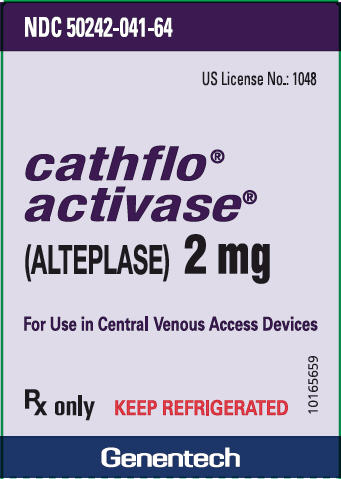
PRINCIPAL DISPLAY PANEL - 2 mg Vial Carton NDC 50242-041-64 US License No.: 1048 cathflo ® activase ® (ALTEPLASE) 2 mg For Use in Central Venous Access Devices Rx only KEEP REFRIGERATED 10165659 Genentech Principal Display Panel - 2 mg Vial Carton
Medicaid utilization & spend
Medicaid utilization by pack size
Reported adverse events (FAERS)
Top reported reactions
Age at onset
Reporter sex
Serious outcomes
Where does this data come from?
About this NDC listing & data coverage
What data is (and isn’t) available for this NDC — tap to expand
| NDC identity (package / product / labeler codes) | ✓ Available |
| Labeler | ✓ Available |
| Product & package description | ✓ Available |
| Marketing category & status | ✓ Available |
| Active ingredient / dosage form / route | ✓ Available |
| FDA label (SPL via DailyMed) | ✓ Available |
| Package photos | ✓ Available |
| Inactive ingredients (structured) | ✓ Available |
| NADAC pharmacy acquisition price (CMS) | — Not published for this NDC CMS publishes NADAC only for NDCs reported in its retail-pharmacy survey. |
| Orange Book / therapeutic-equivalence data | — Not published for this NDC Applies only to products approved under an NDA/ANDA; many listings are out of scope. |
| HCPCS J-code billing crosswalk | ✓ Available |
| Medicaid utilization (CMS SDUD) | ✓ Available |