
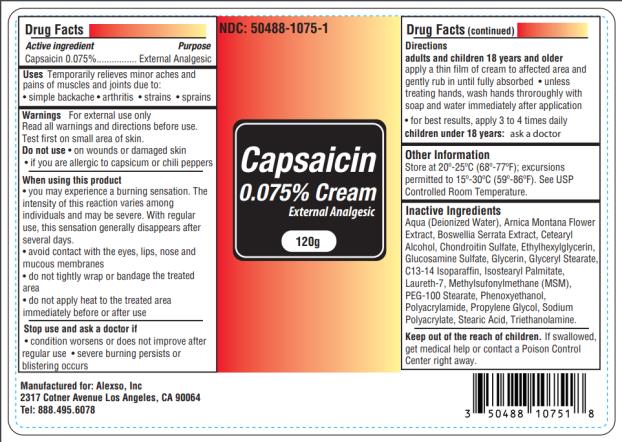
Capsaicin 0.075 Percent .075 g/100g Cream, 120 g — NDC 50488-1075-1 (Billing 50488-1075-01)
This is a package of 120 g of Capsaicin 0.075 Percent .075 g/100g Cream from Alexso, Inc, marketed since Dec 2021 and currently FDA-listed. It is the main listing for this product, which comes in 2 package sizes.
NDC database record
One package, one record: these facts belong to NDC 50488-1075-1 alone.
- Record
- FDA NDC Directory package listing · Human OTC drug
- Code segments
- 50488 labeler · 1075 product · 1 package
- Package marketed since
- Dec 8, 2021
- Sample package
- No — commercial package
- Listing certified through
- Dec 31, 2026
- Billing quantity
- 120 g per package
- Barcode (UPC-A, from the NDC)
- 3 5048810751 8
- FDA record last changed
- Jul 24, 2026
Identity & classification
Regulatory identifiers FDA, NLM and CMS codes for this package
Drug-database identifiers Medi-Span GPI and First Databank GCN / HICL / AHFS classification
- GSN (GCN sequence number): 012072
- GCN: 33561
- GPI-14 (Medi-Span): 90850025003730
- HICL (First Databank): 002577
- AHFS class code: 84:92.00.00
- RxCUI (RxNorm): 141868
Where does this data come from?
- FDA openFDA NDC Directory · synced Oct 8, 2026
- FDA label on DailyMed · label index refreshed Oct 6, 2026
- RxNorm (NLM RxNav) · catalog refreshed Oct 1, 2026
- Medi-Span GPI (licensed)
- First Databank (licensed) · refreshed Oct 8, 2026
RxNorm drug class
This medicine belongs to the Capsaicin and similar agents class.
Where does this data come from?
- RxClass (NLM) · catalog refreshed Oct 1, 2026
Clinical
- Yes, completely normal — and it actually means the medicine is working. Capsaicin activates the same pain-sensing receptors in your skin that respond to heat and spicy food. That b...
- Why does capsaicin burn when I put it on? Is that normal?
- For most OTC creams and ointments, you can apply up to 3 to 4 times a day. For OTC patches, apply to clean, dry skin and remove after no more than 8 hours — again, up to 3 to 4 tim...
- How often should I apply capsaicin cream or use the patch?
Patient education
Supplement & herbal interactions
Some supplements/herbs that may interact with Capsaicin (prescription drug) — tap one for details:
Where does this data come from?
- MedlinePlus (NLM) · refreshed Oct 1, 2026
- FDA label on DailyMed · label index refreshed Oct 6, 2026
Ask a licensed pharmacist directly — free, answered by our team.
Pricing
A drug doesn't have one price. Each row is a different public payment system, and none is what you'd pay at the counter — that depends on your insurance. The ⓘ on each row explains what it measures.
| Price system | Per g | Per package |
|---|---|---|
| Retail pharmacies payNADAC · weekly | Not in the retail survey — common for institutional, discontinued, or low-volume packs. | |
| Medicaid paysCMS SDUD · 12 mo | No recent Medicaid claims on file for this NDC — rare and low-volume NDCs are suppressed in the public data. | |
| Medicare drug plans payPart D · quarterly | No Part D plan price is available for this NDC in our data. | |
Where does this data come from?
- CMS NADAC weekly file
- CMS ASP pricing files · refreshed Sep 20, 2026
- CMS Medicaid State Drug Utilization Data · refreshed Oct 8, 2026
- CMS Part D plan pricing files · refreshed Sep 24, 2026
- VA National Acquisition Center price file
Packaging — all sizes for this product
| Package NDC | Description | Marketing start | Marketing end | Status |
|---|---|---|---|---|
| 50488-1075-06 50488-1075-6 | 120 g in 1 BOTTLE | 2021-12-08 | — | Active |
| 50488-1075-01 You're viewing this Main listing | 120 g in 1 BOTTLE | 2021-12-08 | — | Active |
Pack size FAQ
What quantity is in this package?
How does this package differ from NDC 50488-1075-06?
What NDC number is used to bill for this package of Capsaicin 0.075 Percent .075 g/100g Cream?
Therapeutic equivalents
| Product | Labeler | Pack | NADAC/unit | TE | Status | Price vs. this |
|---|---|---|---|---|---|---|
| Rugby Arthritis Pain Relieving Topical Analgesic .75 mg/g 00536-1118-25 | Rugby | 1 tube | $0.071 | — | Availability likely | — |
| Capsaicin Topical Analgesic .75 mg/g 50268-0196-57 | AvPAK | 1 tube | $0.071 | — | Availability likely | — |
| Sheffield Arthritis and Muscle Pain Relief .075 g/100g 11527-0080-60 | Sheffield | 1 tube | — | — | FDA listed | — |
| AVON HeXashield Arthritis Pain Relief Cream Capsaisin .75 mg/g 43136-0101-01 | Tai | 1 tube | — | — | FDA listed | — |
| Capsaicin 0.075 Percent .075 g/100gthis 50488-1075-01 | Alexso, | 120 g | — | — | FDA listed | — |
| Capsaicin Cream 0.075% .075 g/100g 73492-0271-60 | ALAINA | 1 tube | — | — | FDA listed | — |
| Capsaicin 0.075% Cream .075 g/100g 85231-0202-60 | ViolaCare, | 1 tube | — | — | FDA listed | — |
| Capsaicin Cream .075 g/100g 69396-0179-02 | Trifecta | 1 tube | — | — | FDA listed | — |
Where does this data come from?
- FDA openFDA NDC Directory · synced Oct 8, 2026
- FDA Orange Book · refreshed Oct 3, 2026
- CMS NADAC weekly file
Availability & generic status
We did not find an FDA-approved generic match for this exact strength, form and route.
Where does this data come from?
- FDA Orange Book · refreshed Oct 3, 2026
Inactive Ingredients / Excipients
Inactive ingredients, also called excipients, are components of the drug product other than the active ingredient. They may include fillers, dyes, coatings, preservatives, flavors, or other formulation ingredients.
🧪 Avoiding an ingredient? See Capsaicin inactive ingredients by manufacturer: every current product's list side by side, so you can ask your pharmacy for the version that does not list it.
💡 Tap an ingredient (hover on desktop) to see what it is and why it’s used.
-
UNII OZ0E5Y15PZ
A plant extract from arnica flowers, used as a flavoring agent or fragrance component in medicines. It may also provide mild soothing properties to certain topical formulations.
-
UNII X7B7P649WQ
A plant extract from boswellia serrata tree resin, used as a natural filler and binding agent in capsules and tablets to add bulk and help hold the formulation together.
-
UNII E4F12ROE70
A refined mineral oil derived from crude petroleum containing 13 to 14 carbon chains. It acts as a solvent, emollient, and carrier in topical formulations to help dissolve active ingredients and improve product texture and spreadability.
-
UNII 2DMT128M1S
A waxy solid derived from plant or animal sources. It acts as an emulsifier to blend oil and water components, and also thickens the medicine to give it the right texture and consistency.
-
UNII 6IC1M3OG5Z
Chondroitin sulfate is a naturally occurring compound extracted from cow cartilage. In medicines, it's used as a binder and thickener to help hold ingredients together and adjust the product's texture and consistency.
-
UNII 9H4PO4Z4FT
A sulfur-containing organic compound used as a solvent and penetration enhancer in medicines. It helps dissolve active ingredients and improve their absorption through skin or mucous membranes.
-
UNII 147D247K3P
Ethylhexylglycerin is a synthetic preservative used to prevent bacteria and mold from growing in medicines and personal care products. It helps keep the product safe and stable throughout its shelf life.
-
UNII 1FW7WLR731
Glucosamine sulfate is a natural compound derived from shellfish or made in laboratories. In medications, it acts as an active therapeutic ingredient rather than an inactive excipient, though it may also serve as a filler or binder in some formulations.
-
UNII PDC6A3C0OX
Glycerin is a clear, thick liquid derived from plant oils or fats. It acts as a humectant to retain moisture, a sweetener, and a solvent in medications.
-
UNII 230OU9XXE4
A waxy substance made from glycerin and stearic acid that acts as an emulsifier to blend oily and watery ingredients together. It also helps thicken and stabilize the medicine's texture.
-
UNII 9EHU0R7ER1
Isostearyl palmitate is a synthetic fatty acid ester used as an emollient and lubricant. It helps soften the product texture and allows ingredients to blend smoothly in topical formulations.
-
UNII Z95S6G8201
A synthetic surfactant derived from lauryl alcohol and ethylene oxide. It helps dissolve and mix oily and watery ingredients in liquid formulations, and may improve how the medicine spreads or is absorbed.
-
UNII YD01N1999R
A waxy substance made from polyethylene glycol and stearic acid. It helps mix oil and water-based ingredients together and serves as an emulsifier and solubilizer in liquid and semi-solid medicines.
-
UNII HIE492ZZ3T
Phenoxyethanol is a synthetic preservative and antimicrobial agent used to prevent bacterial and fungal growth in medicines and cosmetic products, extending shelf life and maintaining product safety.
-
UNII E2KR9C9V2I
Polyacrylamide is a synthetic polymer used as a thickening agent and binder in medications. It helps create the proper texture and hold ingredients together in the formulation.
-
UNII 6DC9Q167V3
Propylene glycol is a clear liquid derived from petroleum or vegetable sources. It acts as a solvent, humectant, and preservative in medicines, helping dissolve active ingredients and maintain product stability.
-
UNII 05I15JNI2J
A synthetic polymer that absorbs and holds moisture. Used in tablets and capsules as a super-disintegrant to help the medicine break apart quickly when swallowed, allowing faster drug release.
-
UNII 4ELV7Z65AP
Stearic acid is a fatty acid derived from plant or animal sources. It acts as a binder and lubricant in tablets and capsules, helping them hold together and flow smoothly during manufacturing.
-
UNII 9O3K93S3TK
Trolamine is an alkaline compound used as a pH buffer and emulsifier in medicines. It helps neutralize acids, stabilize formulations, and enable mixing of oil and water-based ingredients.
-
UNII 059QF0KO0R
Water is a liquid solvent that dissolves and mixes ingredients together in liquid medicines, syrups, and injections. It helps distribute the active drug evenly throughout the product.
20 inactive ingredients listed in the exact product block matched to this NDC.
Label-section wording can be broader than the structured product block and may mention additional formulation ingredients.
Where does this data come from?
ingredient classCode="IACT" elements from the exact product block matched by this NDC. Label-section narrative from DailyMed / the openFDA label index is shown separately when available.- FDA label on DailyMed · label index refreshed Oct 6, 2026
- FDA openFDA NDC Directory · synced Oct 8, 2026
Inactive ingredient FAQ
Are inactive ingredients the same for every manufacturer?
Why might an inactive ingredient be missing?
Can inactive ingredients matter?
Manufacturer & labeler
More NDCs from Alexso, Inc labeler code 50488
- Methyl Salicylate 250 mg/g Cream NDC 50488-1015-1
- Methyl Salicylate 25 Percent 250 mg/mL Cream NDC 50488-1016-5
- Capsaicin .025 g/100g Cream NDC 50488-1025-1
- Methyl Salicylate 30 Percent Cream 30 g/100g Cream NDC 50488-1030-1
- Capsaicin 0.035 Percent .035 g/100g Cream NDC 50488-1035-1
- Capsaicin 0.1 Percent .1 g/100g Cream NDC 50488-1060-6
- New Terocin Methyl Salicylate, Capsaicin, and Menthol 25 g/100mL; .025 g/100mL; 10 g/100mL Lotion NDC 50488-1129-1
- Lidocaine 4 g/g Patch NDC 50488-2004-1
- Methyl Salicylate 10 g/100g Patch NDC 50488-2010-1
- Capsaicin .025 g/100g Patch NDC 50488-2025-1
- Capsaicin 0.035 Percent .035 g/100g Patch NDC 50488-2035-1
- Methyl Salicylate 40 Percent 400 mg/g Cream NDC 50488-6040-6
Where does this data come from?
- FDA openFDA NDC Directory · synced Oct 8, 2026
- Drugs@FDA
FDA label — Drug Facts FDA SPL
🎯 Indications and Usage ▾
Uses Temporarily relieves minor aches and pains of muscles and joints due to: • simple backache • arthritis • strains • sprains
⏱️ Dosage and Administration ▾
Directions Adults and children 18 years of age and older: Apply a thin film of cream to affected area and gently rub in until fully absorbed unless treating hands. Wash hands thoroughly with soap and water immediately after application for best results. Apply 3 to 4 times daily. Children under 18 years : Ask a doctor
⚠️ Warnings ▾
Warnings For external use only Read all warnings and directions before use. Test first on small area of skin. Do not use • On wounds or damaged skin • If you are allergic to capsicum or chili peppers Whe n us ing this product • You may experience a burning sensation.
The intensity of this reaction varies among individuals and may be severe. With regular use, this sensation generally disappears after several days. • Avoid contact with the eyes, lips, nose and mucous membranes • Do not tightly wrap or bandage the treated area • Do not apply heat to the treated area immediately before or after use Stop use and as k a doctor if • Condition worsens or does not improve after regular use • Severe burning persists or blistering occurs
📦 Storage and Handling ▾
Other information Store at room temperature 15°-30°C (59°-86°F)
🧪 Active Ingredient ▾
Active ingredient Capsaicin 0.075%
🧪 Inactive Ingredients ▾
Inactive ingredients Aqua (Deionized Water), Arnica Montana Flower Extract, Boswellia Serrata Extract, Cetearyl Alcohol, Chondroitin Sulfate, Ethylhexylglycerin, Glucosamine Sulfate, Glycerin, Glyceryl Stearate, C13-14 Isoparaffin, Isostearyl Palmitate, Laureth-7, Methylsufonylmethane (MSM), PEG-100 Stearate, Phenoxyethanol, Polyacrylamide, Propylene Glycol, Sodium Polyacrylate, Stearic Acid, and Triethanolamine
🎯 Purpose ▾
Purpose External analgesic
📄 Do Not Use ▾
Do not use • On wounds or damaged skin • If you are allergic to capsicum or chili peppers
📄 When Using This Product ▾
Whe n us ing this product • You may experience a burning sensation. The intensity of this reaction varies among individuals and may be severe. With regular use, this sensation generally disappears after several days. • Avoid contact with the eyes, lips, nose and mucous membranes • Do not tightly wrap or bandage the treated area • Do not apply heat to the treated area immediately before or after use
📄 Stop Use and Ask a Doctor If ▾
Stop use and as k a doctor if • Condition worsens or does not improve after regular use • Severe burning persists or blistering occurs
📄 Keep Out of Reach of Children ▾
Keep out of reach of children. If swallowed, get medical help or contact a Poison Control Center immediately.
📄 Package Label / Principal Display Panel ▾
PRINCIPAL DISPLAY PANEL Capsaicin 0.075 % C ream NDC 50488-1075-1 120 grams Alexso, Inc Capsaicin 0.075% Cream NDC 50488-1075-1 120 grams Alexso, Inc
About this NDC listing & data coverage
What data is (and isn’t) available for this NDC — tap to expand
| NDC identity (package / product / labeler codes) | ✓ Available |
| Labeler | ✓ Available |
| Product & package description | ✓ Available |
| Marketing category & status | ✓ Available |
| Active ingredient / dosage form / route | ✓ Available |
| FDA label (SPL via DailyMed) | ✓ Available |
| Package photos | ✓ Available |
| Inactive ingredients (structured) | ✓ Available |
| NADAC pharmacy acquisition price (CMS) | — Not published for this NDC CMS publishes NADAC only for NDCs reported in its retail-pharmacy survey. |
| Orange Book / therapeutic-equivalence data | — Not published for this NDC Applies only to products approved under an NDA/ANDA; many listings are out of scope. |
| HCPCS J-code billing crosswalk | — Not published for this NDC Most self-administered / retail products have no J-code — that is normal. |
| Medicaid utilization (CMS SDUD) | — Not published for this NDC CMS reports utilization only for NDCs with Medicaid claims above its privacy threshold. |