
YCANTH Cantharidin 3.2 mg/.45mL Solution, 1 applicator — NDC 71349-070-01 (Billing 71349-0070-01)
This is a package of 1 applicator of YCANTH Cantharidin 3.2 mg/.45mL Solution from Verrica Pharmaceuticals Inc., marketed since Jul 2023 and currently FDA-listed. It is the main listing for this product, which comes in 4 package sizes.
NDC database record
One package, one record: these facts belong to NDC 71349-070-01 alone.
- Record
- FDA NDC Directory package listing · Human prescription drug
- Code segments
- 71349 labeler · 070 product · 01 package
- Package marketed since
- Jul 21, 2023
- Sample package
- No — commercial package
- Listing certified through
- Dec 31, 2026
- Billing quantity
- 1 EA per package
- Barcode (UPC-A, from the NDC)
- 3 7134907001 7
- Medicaid fills, this package
- 2,758 prescriptions in the last four reported quarters
- FDA record last changed
- Jul 24, 2026
Identity & classification
Regulatory identifiers FDA, NLM and CMS codes for this package
Drug-database identifiers Medi-Span GPI and First Databank GCN / HICL / AHFS classification
- GSN (GCN sequence number): 085085
- GCN: 54524
- GPI-14 (Medi-Span): 90750010002007
- HICL (First Databank): 002578
- AHFS class code: 84:04.06.00
- RxCUI (RxNorm): 244521
Where does this data come from?
- FDA openFDA NDC Directory · synced Oct 8, 2026
- FDA label on DailyMed · label index refreshed Oct 8, 2026
- RxNorm (NLM RxNav) · catalog refreshed Oct 8, 2026
- Medi-Span GPI (licensed)
- First Databank (licensed) · refreshed Oct 8, 2026
Clinical
Cantharidin is used to treat molluscum contagiosum (molluscum bumps; a viral skin infection that causes raised, pearl-like bumps on the skin) in adults and children 2 years of age and older. Cantharidin is in a class of medications called vesicants. It is not known exactly how cantharidin works to treat molluscum contagiosum.
Read the full MedlinePlus article ↗Patient education
Supplement & herbal interactions
Some supplements/herbs that may interact with Cantharidin — tap one for details:
Where does this data come from?
- MedlinePlus (NLM) · refreshed Oct 8, 2026
- FDA label on DailyMed · label index refreshed Oct 8, 2026
Ask a licensed pharmacist directly — free, answered by our team.
Pricing
A drug doesn't have one price. Each row is a different public payment system, and none is what you'd pay at the counter — that depends on your insurance. The ⓘ on each row explains what it measures.
| Price system | Per mL | Per package |
|---|---|---|
| Retail pharmacies payNADAC · weekly | Not in the retail survey — common for institutional, discontinued, or low-volume packs. | |
| Medicaid paysCMS SDUD · 12 mo | $1,467.75 | $660.49 / 0.45 ml |
| Medicare drug plans payPart D · quarterly | No Part D plan price is available for this NDC in our data. | |
Where does this data come from?
- CMS NADAC weekly file
- CMS ASP pricing files · refreshed Sep 20, 2026
- CMS Medicaid State Drug Utilization Data · through Q1 2026
- CMS Part D plan pricing files · refreshed Sep 24, 2026
- VA National Acquisition Center price file
Packaging — all sizes for this product
| Package NDC | Description | Marketing start | Marketing end | Status |
|---|---|---|---|---|
| 71349-0070-01 You're viewing this Main listing | 1 APPLICATOR in 1 PACKAGE / 1 AMPULE in 1 APPLICATOR / .45 mL in 1 AMPULE | 2023-07-21 | — | Active |
| 71349-0070-06 71349-070-06 | 6 PACKAGE in 1 CARTON / 1 APPLICATOR in 1 PACKAGE / 1 AMPULE in 1 APPLICATOR / .45 mL in 1 AMPULE | 2023-07-21 | — | Active |
| 71349-0070-12 71349-070-12 | 12 CARTON in 1 CARTON / 6 PACKAGE in 1 CARTON / 1 APPLICATOR in 1 PACKAGE / 1 AMPULE in 1 APPLICATOR / .45 mL in 1 AMPULE | 2023-07-21 | — | Active |
| 71349-0070-11 71349-070-11 | 1 PACKAGE in 1 CARTON / 1 APPLICATOR in 1 PACKAGE / 1 AMPULE in 1 APPLICATOR / .45 mL in 1 AMPULE | 2023-07-21 | — | Active |
In Medicaid, this is the most-dispensed pack of this product — about 70% of fills over the last four reported quarters. See all packs ↓
Pack size FAQ
What quantity is in this package?
How does this package differ from NDC 71349-0070-11?
What NDC number is used to bill for this package of YCANTH Cantharidin 3.2 mg/.45mL Solution?
Therapeutic equivalents
| Product | Labeler | Pack | NADAC/unit | TE | Status | Price vs. this |
|---|---|---|---|---|---|---|
| Ycanth 3.2 mg/.45mLthis 71349-0070-01 | Verrica | 1 applicator | — | — | FDA listed | — |
| Ycanth 3.2 mg/.45mL 71349-0999-01 | Verrica | 1 applicator | — | — | FDA listed | — |
Where does this data come from?
- FDA openFDA NDC Directory · synced Oct 8, 2026
- FDA Orange Book · refreshed Oct 3, 2026
- CMS NADAC weekly file
Availability & generic status
We did not find an FDA-approved generic match for this exact strength, form and route. Patent/protection dates below may affect future generic timing.
Why the date isn’t exact: Generic timing can change because patents may be challenged, settled, licensed, added, removed, or worked around with a narrower label — and FDA approval does not always mean a pharmacy can get the generic today.
🛈 What do these terms mean?
- Patent
- Legal protection listed in the Orange Book that may delay generic approval or launch. Issued by the U.S. Patent & Trademark Office.
- Substance patent
- Covers the active drug molecule itself — the hardest to design around. A generic generally can’t launch until it expires.
- Formulation (product) patent
- Covers a specific formulation or dosage form. A generic can sometimes work around it with a different formulation.
- Method-of-use patent
- A patent covering one specific approved use of the drug — not necessarily the whole molecule. A generic can sometimes launch with a “skinny label” that carves out the protected use and keeps the others.
- Skinny label
- A generic label that omits a still-patented use when the FDA allows it — letting a generic reach the market for the unprotected uses.
- Exclusivity
- FDA-granted marketing protection, separate from patents — e.g. 5-yr new chemical entity, 7-yr orphan drug, or a +6-month pediatric extension.
- Paragraph IV
- A generic applicant’s formal challenge to a listed patent. It can potentially lead to earlier generic entry, but often involves litigation or a settlement.
- RLD / RS
- Reference Listed Drug — the brand product the FDA uses as the reference for generic applications. Reference Standard — the product the FDA expects generics to compare against in bioequivalence testing.
- TE / AB rating
- FDA therapeutic-equivalence rating. An AB rating generally means the FDA considers a generic therapeutically equivalent to — and substitutable for — the brand.
- LOE (loss of exclusivity)
- The latest patent or exclusivity currently listed — the loss-of-exclusivity / latest-listed-protection date shown on this page. Paragraph-IV challenges and settlements can move the real date earlier; FDA approval and a manufacturer’s decision to market can move it later.
Built from the FDA Orange Book. The bars above are scaled to each protection’s expiry; the red LOE marker is the last one to lapse.
| Patent | Type | Use code | Expires |
|---|---|---|---|
| US 12233042 ↗ | Method of use | U-3663 | Aug 22, 2038 |
| US 11147790 ↗ | Method of use | U-3663 | Aug 22, 2038 |
| US 11147790 ↗ | Method of use | U-3664 | Aug 22, 2038 |
| US 11052064 ↗ | Method of use | U-3665 | May 28, 2035 |
| US 11052064 ↗ | Method of use | U-3663 | May 28, 2035 |
| US 12290651 ↗ | Drug product | — | Feb 19, 2041 |
| Code | What it grants | Expires |
|---|---|---|
| NCE | New Chemical Entity (5-year) | Jul 21, 2028 |
Is there a generic version of YCANTH 0.7% SOLUTION?
The FDA approved a generic — why can’t I get it at my pharmacy yet?
Why do different websites show different generic release dates?
What does “FDA listed” mean?
What does a patent or protection date mean here?
What does “current Orange Book estimate” mean?
Can a generic come out before the last patent expires?
Can a generic come out after the listed dates?
What is the difference between patents and exclusivity?
Why are there multiple patent dates?
Where does this data come from?
- FDA Orange Book · refreshed Oct 3, 2026
Inactive Ingredients / Excipients
Inactive ingredients, also called excipients, are components of the drug product other than the active ingredient. They may include fillers, dyes, coatings, preservatives, flavors, or other formulation ingredients.
Where does this data come from?
IACT rows and label-wide narrative are kept separate; availability and product-level specificity depend on the submitted label.- FDA label on DailyMed · label index refreshed Oct 8, 2026
- FDA openFDA NDC Directory · synced Oct 8, 2026
Inactive ingredient FAQ
Are inactive ingredients the same for every manufacturer?
Why might an inactive ingredient be missing?
Can inactive ingredients matter?
Manufacturer & labeler
More NDCs from Verrica Pharmaceuticals Inc. labeler code 71349
Where does this data come from?
- FDA openFDA NDC Directory · synced Oct 8, 2026
- Drugs@FDA
Full prescribing information FDA SPL
🎯 Indications and Usage ▾
1 INDICATIONS AND USAGE YCANTH is indicated for the topical treatment of molluscum contagiosum in adult and pediatric patients 2 years of age and older. YCANTH is indicated for the topical treatment of molluscum contagiosum in adult and pediatric patients 2 years of age and older. ( 1 )
⏱️ Dosage and Administration ▾
2 DOSAGE AND ADMINISTRATION All healthcare professionals should receive instruction and training prior to preparation and administration of YCANTH. ( 2.1 ) For topical use only. Not for oral, mucosal, or ophthalmic use.
( 2.1 ) Apply a single application directly to each lesion every 3 weeks as needed. ( 2.2 ) Do not use more than two applicators during a single treatment session. ( 2.2 ) Remove with soap and water 24 hours after treatment.
( 2.2 ) For additional instructions on preparation and administration of YCANTH, see Full Prescribing Information. ( 2.1 , 2.2 , 2.3 )
2.1Important Administration Instructions All healthcare professionals should receive instruction and training prior to preparation and administration of YCANTH. YCANTH is for topical use only. YCANTH is not for oral, mucosal, or ophthalmic use.
Avoid contact with the treatment area, including oral contact, after YCANTH treatment. Do not apply YCANTH near the eyes [see Warnings and Precautions (5.1) , Overdosage (10) ] . If YCANTH contacts any unintended surface, including healthy skin, immediately remove by wiping with a cotton swab or gauze.
Avoid other topical products on treated areas until 24 hours after YCANTH treatment or until washing [see Warnings and Precautions (5.2) ]. Avoid fire, flame or smoking near lesion(s) during treatment [see Warnings and Precautions (5.3) ] .
2.2Dosage and Administration Overview Regarding YCANTH dosage and administration: Use nitrile or vinyl gloves and eye protection during preparation and administration. Apply topically as a single application to cover each lesion. Use no more than two YCANTH applicators during a single treatment session.
Remove with soap and water 24 hours after treatment. Administer YCANTH every 3 weeks as needed. Do not cover any treated lesions with bandages.
If severe blistering, severe pain, or other severe adverse reactions occur, remove YCANTH with soap and water prior to 24 hours after treatment [see Warnings and Precautions (5.2) ]. Regarding use of the YCANTH applicator and break tool: Do not reuse the applicator. The applicator is for a single treatment session only.
Do not attempt to use a clogged applicator. Do not cut or modify the applicator in any way; doing so could reduce dispensing control. Do not remove the applicator cap prior to breaking the glass ampule.
If any damage or leaks are observed on the applicator, applicators should be discarded in a sharps container and handled in accordance with accepted medical practice and applicable law. The YCANTH Break Tool should be managed as solid waste and placed in plastic recycling containers or the general trash.
2.3Dosage and Administration Instructions Instructions for preparing the YCANTH Applicator and administering the YCANTH Solution are presented below. YCANTH includes the following components [see How Supplied/Storage and Handling (16.1) ] : Outer Protective Tube The YCANTH Applicator The YCANTH Break Tool Step 1. Put on Personal Protective Equipment (PPE) Put on gloves and eye protection.
Step 2. Remove the YCANTH Applicator from Outer Protective Tube Use pull ring to remove purple end cap out of white outer protective tube. DO NOT remove the applicator cap.
Slide the YCANTH Applicator out of the outer protective tube. Step 3. Remove the Paperboard Sleeve Completely remove the white paperboard sleeve so that the glass ampule is visible.
DO NOT remove the applicator cap prior to breaking the glass ampule. Step 4. Inspect for Damage Inspect the YCANTH Applicator for the following types of damage: Broken glass ampule Cut or cracked applicator tube No damage (for reference) If any damage is observed, dispose of the YCANTH applicators in a sharps container and handle in accordance with accepted medical practice and applicable law.
Step 5. Break Ampule using the YCANTH Break Tool Set the YCANTH Break Tool on a horizontal surface. Ensure the applicator cap is in place.
Place the YCANTH Applicator in the YCANTH Break Tool with the ca… [Excerpted — this section continues on DailyMed.]
💊 Dosage Forms and Strengths ▾
3 DOSAGE FORMS AND STRENGTHS Topical solution 0.7%: Each mL of YCANTH contains 7 mg (0.7%) of cantharidin in a light violet to dark purple, slightly viscous liquid. Topical solution: 0.7% cantharidin. ( 3 )
⛔ Contraindications ▾
4 CONTRAINDICATIONS None None
⚠️ Warnings and Cautions ▾
5 WARNINGS AND PRECAUTIONS Toxicities Associated with Inappropriate Administration: Life threatening or fatal toxicities can occur if administered orally. Avoid contact with the treatment area, including oral contact, after treatment. Ocular toxicity can occur if YCANTH comes in contact with eyes.
If YCANTH gets in eyes, flush eyes with water for at least 15 minutes. ( 5.1 ) Local Skin Reactions : Reactions at the application site have included vesiculation, pruritus, pain, discoloration, and erythema. Avoid application near eyes and mucosal tissue, and to healthy skin.
If YCANTH contacts any unintended surface, or healthy skin, immediately remove. If severe local skin reactions occur, remove prior to 24 hours after treatment. ( 5.2 ) Flammability : YCANTH is flammable, even after drying.
Avoid fire, flame or smoking near lesion(s) during treatment and after application until removed. ( 5.3 )
5.1Toxicities Associated with Inappropriate Administration YCANTH is for topical use only. YCANTH is not for oral, mucosal, or ophthalmic use. Life threatening or fatal toxicities can occur if YCANTH is administered orally [see Overdosage (10) ].
Adverse reactions to oral ingestion of cantharidin have included renal failure, blistering and severe damage to the gastrointestinal tract, coagulopathy, seizures, and flaccid paralysis. Advise patients and/or caregivers to avoid oral contact and to avoid touching lesions after YCANTH treatment and to seek medical attention immediately if YCANTH is accidently ingested. Ocular toxicity can occur if YCANTH comes in contact with the eyes.
Adverse reactions from contact of YCANTH with the eyes can include corneal necrosis, ocular perforation, and deep ocular injuries. Do not apply YCANTH near or to the eyes. If YCANTH comes in contact with the eyes, flush eyes with water for at least 15 minutes and seek medical attention immediately.
5.2Local Skin Reactions YCANTH is a vesicant. Local skin reactions at the application site were observed in 97% of subjects treated with YCANTH during clinical trials. Local skin reactions included vesiculation, pruritus, pain, discoloration, and erythema [see Adverse Reactions (6.1) ] .
Avoid application near the eyes and mucosal tissues, and to adjacent healthy skin. If YCANTH contacts any unintended surface, including healthy skin, immediately remove by wiping with a cotton swab or gauze . Avoid other topical products (e.g. creams, lotions, or sunscreen) on treated areas until 24 hours after YCANTH treatment or until washing.
Application of other topical products could spread YCANTH and cause blistering or other adverse reactions to healthy skin. If severe blistering, severe pain or other severe adverse reactions occur, remove YCANTH prior to the recommended 24 hours after administration by washing with soap and water .
5.3Flammability YCANTH is a flammable liquid, even after drying. Avoid fire, flame or smoking near lesion(s) during treatment and after application until removed.
🤒 Adverse Reactions ▾
6 ADVERSE REACTIONS The following adverse reactions are described elsewhere in the labeling: Local Skin Reactions [see Warnings and Precautions (5.2) ] Most common (incidence ≥1%) adverse reactions are the following local skin reactions at the application site: vesiculation, pain, pruritus, scabbing, erythema, discoloration, application site dryness, edema, and erosion. ( 6.1 ) To report SUSPECTED ADVERSE REACTIONS, contact Verrica Pharmaceuticals Inc. at 1-877-837-7422 or FDA at 1-800-FDA-1088 or www.fda.gov/medwatch.
Local skin reactions are expected and should be reported if they are severe.
6.1Clinical Trials Experience Because clinical trials are conducted under widely varying conditions, adverse reaction rates observed in the clinical trials of a drug cannot be directly compared to rates in the clinical trials of another drug and may not reflect the rates observed in practice. YCANTH was studied in two randomized, double-blind, placebo-controlled phase 3 trials, Trial 1 (NCT03377790) and Trial 2 (NCT03377803) (n = 266, and n = 262, respectively) in subjects with molluscum contagiosum. Most patients received a single 24-hour dermal administration of YCANTH or vehicle for each lesion every 3 weeks for up to 4 treatments.
YCANTH Solution or vehicle were removed prior to the 24-hour timepoint in 109/311 (35%) subjects treated with YCANTH Solution and 46/216 (21%) subjects treated with vehicle due to treatment-emergent adverse events. Table 1 presents the percentage of subjects with selected adverse reactions (incidence ≥ 1%) by the most severe grade reported during Trial 1 and Trial 2. Adverse reactions were primarily local skin reactions at the application site.
Local skin reactions at the application site were observed in 97% of subjects treated with YCANTH during both trials. Table 1. Percentage of Subjects with Selected Adverse Reactions (Incidence ≥1%) by Severity in Trial 1 and Trial 2 (Safety Population) YCANTH N=311 Vehicle N=216 Preferred Term Name Mild Moderate Severe Mild Moderate Severe Application site vesicles 60% 32% 4% 27% 2% 0% Application site pain and pain 41% 20% 2% 16% 1% 0% Application site pruritus and pruritus 47% 8% 1% 30% 7% 0% Application site scab and scab 39% 9% 0% 20% 1% 0% Application site erythema and erythema 24% 21% <1% 20% 7% 0% Application site discoloration 28% 4% <1% 12% 1% 0% Application site dryness 19% 2% 0% 14% 1% 0% Application site edema 7% 3% 0% 3% 1% 0% Application site erosion 6% 1% 0% 1% 0% 0% Contact dermatitis 0% 1% 0% 0% 0% 0% There were no serious adverse reactions reported in the two controlled trials.
The discontinuation rate due to an adverse reaction was 2.3% among subjects treated with YCANTH and 0.5% among subjects treated with vehicle.
👥 Use in Specific Populations ▾
8 USE IN SPECIFIC POPULATIONS
8.1Pregnancy Risk Summary There are no available data with use of YCANTH in pregnant women to evaluate for a drug-associated risk of major birth defects, miscarriage or adverse maternal or fetal outcomes. Animal reproduction studies were not conducted with cantharidin. Given that systemic exposure to cantharidin following topical administration is low, maternal use is not expected to result in fetal exposure to the drug [see Clinical Pharmacology (12.3) ].
The background risk of major birth defects and miscarriage for the indicated population is unknown. All pregnancies have a background risk of birth defect, loss, or other adverse outcomes. In the U.S. general population, the estimated background risk of major birth defects and miscarriage in clinically recognized pregnancies is 2% to 4% and 15% to 20%, respectively.
8.2Lactation Risk Summary Avoid application of YCANTH topical solution to areas with increased risk for potential ingestion by or ocular exposure to the breastfeeding child. There are no data on the presence of cantharidin in either human or animal milk, or the effects on the breastfed infant or on milk production. Breastfeeding is not expected to result in exposure of the child to the drug due to the low systemic absorption of YCANTH following topical administration [see Clinical Pharmacology (12.3) ].
The developmental and health benefits of breastfeeding should be considered along with the mother's clinical need for YCANTH topical solution and any potential adverse effects on the breastfeeding child from YCANTH topical solution or from the underlying maternal condition.
8.4Pediatric Use Risk Summary The safety and effectiveness of YCANTH for the treatment of molluscum contagiosum have been established in pediatric patients aged 2 years and older. The use of YCANTH in pediatric patients is supported by results from adequate and well-controlled trials in patients 2 years of age and older; although the safety and efficacy of drug use for longer than 12 weeks has not been established [see Clinical Studies (14) ]. The safety and efficacy in pediatric patients below the age of 2 years have not been established .
8.5Geriatric Use Risk Summary YCANTH has not been studied in geriatric patients.
🤰 Pregnancy ▾
8.1Pregnancy Risk Summary There are no available data with use of YCANTH in pregnant women to evaluate for a drug-associated risk of major birth defects, miscarriage or adverse maternal or fetal outcomes. Animal reproduction studies were not conducted with cantharidin. Given that systemic exposure to cantharidin following topical administration is low, maternal use is not expected to result in fetal exposure to the drug [see Clinical Pharmacology (12.3) ].
The background risk of major birth defects and miscarriage for the indicated population is unknown. All pregnancies have a background risk of birth defect, loss, or other adverse outcomes. In the U.S. general population, the estimated background risk of major birth defects and miscarriage in clinically recognized pregnancies is 2% to 4% and 15% to 20%, respectively.
🧒 Pediatric Use ▾
8.4Pediatric Use Risk Summary The safety and effectiveness of YCANTH for the treatment of molluscum contagiosum have been established in pediatric patients aged 2 years and older. The use of YCANTH in pediatric patients is supported by results from adequate and well-controlled trials in patients 2 years of age and older; although the safety and efficacy of drug use for longer than 12 weeks has not been established [see Clinical Studies (14) ]. The safety and efficacy in pediatric patients below the age of 2 years have not been established .
🧓 Geriatric Use ▾
8.5Geriatric Use Risk Summary YCANTH has not been studied in geriatric patients.
🆘 Overdosage ▾
10 OVERDOSAGE Oral ingestion of cantharidin has resulted in renal failure, blistering and severe damage to the gastrointestinal tract, coagulopathy, seizures, and flaccid paralysis. In the event that YCANTH topical solution is ingested, patients should seek medical attention immediately and contact a Poison Control Center (1-800-222-1222) or a medical toxicologist for additional overdosage management recommendations.
🧬 Clinical Pharmacology ▾
12 CLINICAL PHARMACOLOGY
12.1Mechanism of Action The mechanism of action of cantharidin in the treatment of molluscum contagiosum is unknown.
12.2Pharmacodynamics Cantharidin is a vesicant. The pharmacodynamics of cantharidin in the treatment of molluscum contagiosum are unknown.
12.3Pharmacokinetics Pharmacokinetics of cantharidin were assessed in 16 subjects aged 2 years and older with at least 21 molluscum contagiosum lesions at baseline. Subjects were administered a single, dermal application of cantharidin solution to each lesion. The average number of lesions treated for subjects in the exposure treatment group was 47.4 (median was 35.0).
Cantharidin was not detectable in 15 out of 16 subjects. Only one subject had a detectable cantharidin plasma level of 3.391 ng/mL at the 2-hour post-dose. Drug Interaction Studies No studies evaluating the drug interaction potential of cantharidin have been conducted.
🧬 Mechanism of Action ▾
12.1Mechanism of Action The mechanism of action of cantharidin in the treatment of molluscum contagiosum is unknown.
📦 How Supplied / Storage and Handling ▾
16 HOW SUPPLIED/ STORAGE AND HANDLING
16.1How Supplied YCANTH topical solution is supplied in a sealed glass ampule contained within a single-use applicator and enclosed in a protective paperboard sleeve. Each ampule of YCANTH contains approximately 0.45 mL of 0.7% cantharidin solution. Each mL of YCANTH contains 7 mg cantharidin (0.7%).
A YCANTH Break Tool is co-packaged as 2 units per each 6 count and 12 count carton of applicators and 1 unit per each 1 count carton with 1 applicator. A listing of the available carton packages is provided in Table 3. Table 3.
Available Carton Configurations for YCANTH Dosage Strength Single-Use Applicator Single Applicator NDC (Each) Number of YCANTH Applicators (Each) per Carton YCANTH Break Tool Part Reference Number Number of YCANTH Break Tools (Each) per Carton NDC 0.7% (7 mg/mL) 1 each 71349-070-01 1 71349-000-01 1 71349-070-11 6 71349-000-01 2 71349-070-06 12 71349-000-01 2 71349-070-12 Individual YCANTH Break Tools are available separately (Part Reference Number 71349-000-01). To request additional YCANTH Break Tools, contact Verrica Pharmaceuticals at 1-973-298-1390.
16.2Storage and Handling Store at 20°C to 25°C (68° to 77°F); excursions permitted between 15°C to 30°C (59°F to 86°F) [see USP Controlled Room Temperature], protect from light.
📦 Storage and Handling ▾
16.2Storage and Handling Store at 20°C to 25°C (68° to 77°F); excursions permitted between 15°C to 30°C (59°F to 86°F) [see USP Controlled Room Temperature], protect from light.
📋 Description ▾
11 DESCRIPTION YCANTH (cantharidin) topical solution is a light violet to dark purple, slightly viscous liquid for topical administration. Each mL of YCANTH topical solution contains 7 mg of active ingredient cantharidin (0.7%), a lipophilic compound. Cantharidin is a white to off-white solid at room temperature and is only very slightly soluble in water.
The chemical name for cantharidin is 1,2-dimethyl-3,6-epoxyperhydrophthalic anhydride. The molecular weight is 196.20 g/mol and the molecular formula is C 10 H 12 O 4 . The structural formula for cantharidin is represented below: The inactive ingredients of YCANTH topical solution are acetone, camphor, castor oil, denatonium benzoate, ethanol (32%), gentian violet, hydroxypropyl cellulose, and nitrocellulose.
The inactive ingredient denatonium benzoate is an oral deterrent to help mitigate the risk of accidental ingestion. Chemical Structure
💬 Information for Patients ▾
17 PATIENT COUNSELING INFORMATION Advise the patient and/or caregivers to read the FDA-approved patient labeling (Patient Information). Toxicities Associated with Inappropriate Administration Inform patients and/or caregivers that YCANTH can be fatal if ingested orally. Instruct patients and/or caregivers to avoid oral contact and to avoid touching lesions after YCANTH treatment.
If YCANTH is accidentally ingested, inform patients and/or caregivers to seek medical attention immediately. Advise patients and/or caregivers that severe eye injury can occur if YCANTH gets into the eyes. If YCANTH gets in the eyes, advise patients and/or caregivers to flush eyes with water for at least 15 minutes and seek medical attention immediately [see Warnings and Precautions (5.1) ] .
Local Skin Reactions Inform patients and/or caregivers that treatment with YCANTH can lead to local skin reactions [see Adverse Reactions (6.1) ] . Advise patients and/or caregivers not to use other topical products (e.g. creams, lotions, or sunscreen) until 24 hours after YCANTH treatment or until washing. Advise patients and/or caregivers to remove YCANTH with soap and water prior to 24 hours after treatment and contact the healthcare provider if severe blistering, severe pain or other severe adverse reactions occur [see Warnings and Precautions (5.2) ] .
Flammability Inform patients and/or caregivers that YCANTH is flammable, even after drying. Instruct patients and/or caregivers to avoid fire, flame, or smoking near the lesions treated with YCANTH until YCANTH is removed [see Warnings and Precautions (5.3) ] . Important Dosage and Administration Information Inform patients and/or caregivers to remove YCANTH with soap and water 24 hours after treatment.
Inform patients and/or caregivers that more than one YCANTH treatment may be necessary [see Dosage and Administration (2.2) ].
🧬 Pharmacokinetics ▾
12.3Pharmacokinetics Pharmacokinetics of cantharidin were assessed in 16 subjects aged 2 years and older with at least 21 molluscum contagiosum lesions at baseline. Subjects were administered a single, dermal application of cantharidin solution to each lesion. The average number of lesions treated for subjects in the exposure treatment group was 47.4 (median was 35.0).
Cantharidin was not detectable in 15 out of 16 subjects. Only one subject had a detectable cantharidin plasma level of 3.391 ng/mL at the 2-hour post-dose. Drug Interaction Studies No studies evaluating the drug interaction potential of cantharidin have been conducted.
🧬 Pharmacodynamics ▾
12.2Pharmacodynamics Cantharidin is a vesicant. The pharmacodynamics of cantharidin in the treatment of molluscum contagiosum are unknown.
🔬 Clinical Studies ▾
14 CLINICAL STUDIES In two double-blind, randomized, placebo-controlled trials (Trial 1 [NCT03377790] and Trial 2 [NCT03377803]), 528 subjects ages 2 years and older with molluscum contagiosum were randomized by household to treatment with either YCANTH or vehicle. Subjects ranged from 2 to 60 years of age, with a median age of 6. 51% of subjects were male and 91% were Caucasian.
The baseline lesion count among subjects ranged from 1 to 184, with a mean of 23 and 19 lesions among subjects in Trial 1 and Trial 2, respectively. Subjects' lesions were treated with either YCANTH or vehicle at intervals of approximately 21 days until complete clearance of the lesion or for a maximum of 4 applications (on Days 1, 21, 42, and 63). Study drug solution was applied and left on the lesions for approximately 24 hours before the lesions were washed with soap and water.
A healthcare professional who was blinded to the treatment group counted the number of lesions at each visit. The primary efficacy endpoint was the proportion of patients achieving complete clearance of all treated molluscum contagiosum lesions by Day 84. The secondary efficacy endpoints were the proportions of patients achieving complete clearance of all treated molluscum contagiosum lesions at Day 63, Day 42, and Day 21.
Table 2 presents the efficacy results for Trial 1 and Trial 2. Table 2. Percentage of Subjects Exhibiting Complete Clearance of Treatable Molluscum Contagiosum Lesions in Trial 1 and Trial 2 (Intent-to-Treat Population) Trial 1 Trial 2 YCANTH N = 160 Vehicle N = 106 Treatment Difference (95% CI) Treatment difference and 95% CI based on Generalized Estimating Equations (GEE) model for logistic regression with an exchangeable working correlation structure, a factor for treatment, and repeated measurements allowed for a household.
Subjects with missing data are imputed as non-responders. YCANTH N = 150 Vehicle N = 112 Treatment Difference (95% CI) CI = confidence interval. Day 84 46% 18% 29% (19%, 38%) 54% 13% 40% (30%, 51%) Day 63 32% 17% 15% (4%, 25%) 28% 5% 23% (15%, 32%) Day 42 21% 9% 10% (2%, 19%) 13% 4% 9% (3%, 16%) Day 21 11% 4% 8% (2%, 14%) 5% 2% 3% (-1%, 8%)
🧪 Nonclinical Toxicology ▾
13 NONCLINICAL TOXICOLOGY
13.1Carcinogenesis, Mutagenesis, Impairment of Fertility Carcinogenicity studies have not been conducted with cantharidin. Cantharidin was not mutagenic in a bacteria reverse mutation (Ames) assay. An in vitro chromosomal aberration assay in human lymphocytes with cantharidin was inconclusive.
Cantharidin was positive in an in vitro micronucleus assay in TK6 cells, primarily through an aneugenic mechanism. The effects of cantharidin on fertility have not been evaluated.
📄 Carcinogenesis, Mutagenesis, Impairment of Fertility ▾
13.1Carcinogenesis, Mutagenesis, Impairment of Fertility Carcinogenicity studies have not been conducted with cantharidin. Cantharidin was not mutagenic in a bacteria reverse mutation (Ames) assay. An in vitro chromosomal aberration assay in human lymphocytes with cantharidin was inconclusive.
Cantharidin was positive in an in vitro micronucleus assay in TK6 cells, primarily through an aneugenic mechanism. The effects of cantharidin on fertility have not been evaluated.
📄 Patient Package Insert ▾
This Patient Information has been approved by the U.S. Food and Drug Administration. Issued: 10/2024 PATIENT INFORMATION YCANTH (WYE' KANTH) (cantharidin) topical solution What is YCANTH?
YCANTH is a prescription medicine used on the skin (topical) to treat molluscum contagiosum (molluscum bumps) in adults and children 2 years of age and older. It is not known if YCANTH is safe and effective in children under 2 years of age. Do not receive treatment with YCANTH if you are allergic to any of the ingredients in YCANTH.
See the end of this leaflet for a complete list of ingredients in YCANTH. Before receiving treatment with YCANTH, tell your healthcare provider about all of your medical conditions, including if you: are being treated or have had treatments for molluscum bumps. have other skin problems. are pregnant or plan to become pregnant. It is not known if YCANTH can harm your unborn baby. are breastfeeding or plan to breastfeed.
Your healthcare provider should avoid applying YCANTH to areas of your skin where your baby could come into contact with YCANTH and get it in their mouth or eyes. Talk to your healthcare provider about whether you should breastfeed while YCANTH is on your skin. Tell your healthcare provider about all the medications you take , including prescription and over-the-counter medicines, vitamins and herbal supplements.
How will I receive treatment with YCANTH? Your healthcare provider will apply YCANTH to the areas on your skin with molluscum bumps. YCANTH is for use on the skin (topical use) only.
YCANTH is not for use in your mouth, nose, genital areas, or in your eyes. You may need more than 1 treatment with YCANTH. Your healthcare provider may apply YCANTH about every 3 weeks as needed.
Preparing for your treatment with YCANTH. On the day of treatment, do not apply topical steroids, creams, lotions, or sunscreen to areas with molluscum bumps. After your healthcare provider applies YCANTH to your molluscum bumps: Allow YCANTH to dry completely before leaving your healthcare provider's office or clinic (up to 5 minutes).
Do not touch the treated areas for 24 hours or until washing. Do not allow treated areas of your skin to come into contact with your mouth, nose, genital areas, or your eyes for 24 hours or until washing. Do not allow children to lick or bite the treated areas.
YCANTH contains a bittering agent to discourage young children from putting it in their mouths. See " What are the ingredients in YCANTH? " Do not apply topical steroids, creams, lotions, or sunscreen to treated areas for 24 hours after treatment or until you wash YCANTH off of your skin. Do not cover any of the treated areas with bandages.
YCANTH contains a violet-colored dye. You may temporarily see the violet color on the treated areas of your skin. You may take over-the-counter pain relief medicines as needed.
Wash the treated skin area with soap and water 24 hours after treatment unless your healthcare provider instructs you otherwise. You may wash YCANTH off of your skin sooner if you develop severe blistering, severe pain or other severe reactions. Do not use a washcloth, abrasive material or vigorous rubbing because this could be painful.
Contact your healthcare provider with any questions. What should I avoid after receiving treatment with YCANTH? Avoid contact with the treated areas of your skin, including contact with your mouth (oral contact).
Avoid applying other products to the treated areas of your skin until 24 hours after receiving treatment with YCANTH or until after washing YCANTH off of the treated areas of your skin . YCANTH is flammable, even after drying. Avoid fire, flame or smoking near lesion(s) during treatment and after treatment until YCANTH is washed off of your skin.
What are the possible side effects of YCANTH? YCANTH can cause serious side effects, including: Serious side effects if YCANTH is swallowed or it comes into contact with your mouth or eyes . YCANTH can cause life threatening reactions o… [Excerpted — this section continues on DailyMed.]
📄 Package Label / Principal Display Panel ▾
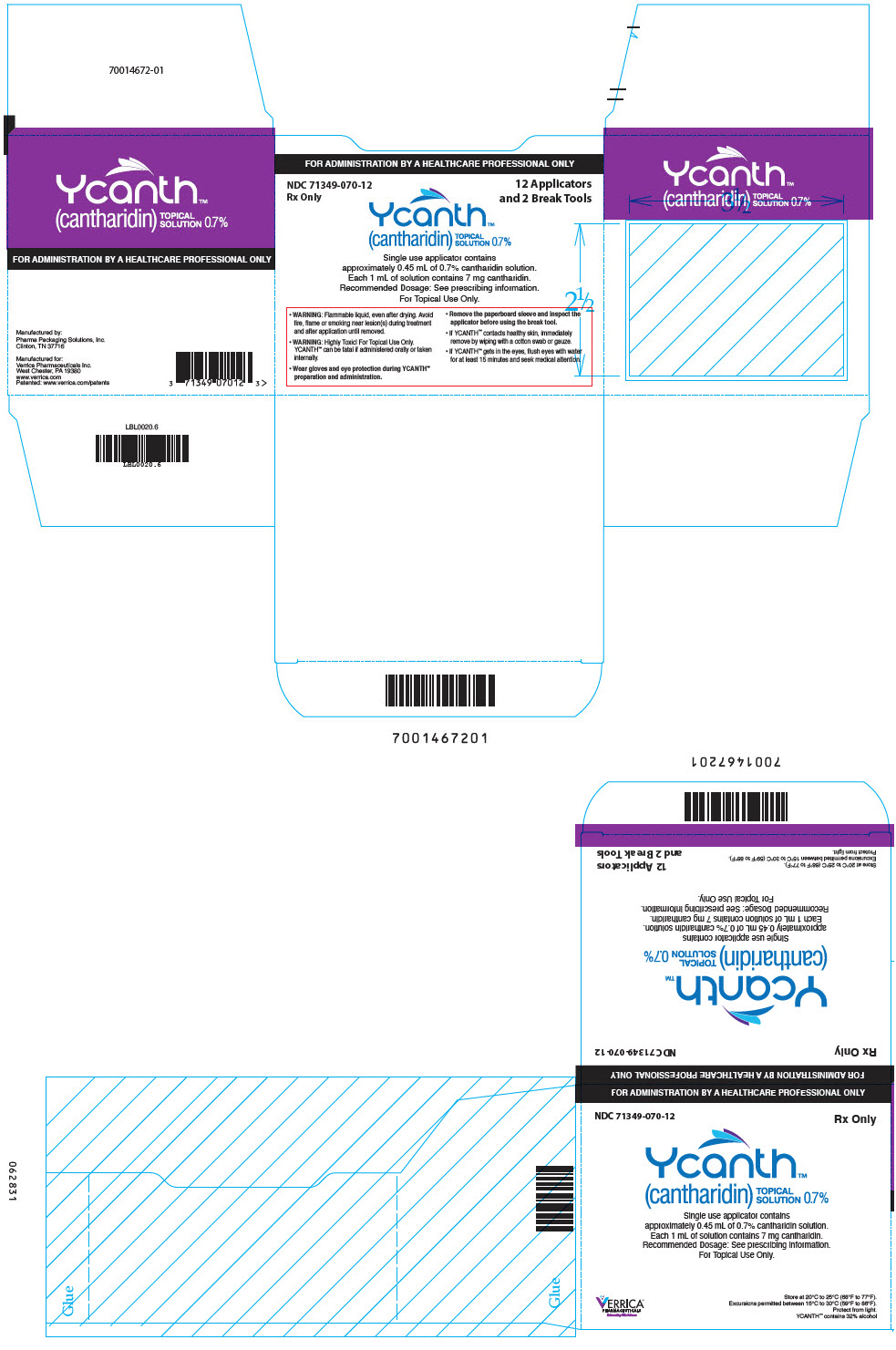
PRINCIPAL DISPLAY PANEL - 12 Ampule Applicator Package Carton FOR ADMINISTRATION BY A HEALTHCARE PROFESSIONAL ONLY NDC 71349-070-12 Rx Only 12 Applicators and 2 Break Tools Ycanth ® (cantharidin) TOPICAL SOLUTION 0.7% Single use applicator contains approximately 0.45 mL of 0.7% cantharidin solution. Each 1 mL of solution contains 7 mg cantharidin. Recommended Dosage: See prescribing information.
For Topical Use Only. WARNING: Flammable liquid, even after drying. Avoid fire, flame or smoking near lesion(s) during treatment and after application until removed.
WARNING: Highly Toxic! For Topical Use Only. YCANTH can be fatal if administered orally or taken internally.
Wear gloves and eye protection during YCANTH ® preparation and administration. Remove the paperboard sleeve and inspect the applicator before using the break tool. If YCANTH contacts healthy skin, immediately remove by wiping with a cotton swab or gauze.
If YCANTH gets in the eyes, flush eyes with water for at least 15 minutes and seek medical attention. PRINCIPAL DISPLAY PANEL - 12 Ampule Applicator Package Carton
PRINCIPAL DISPLAY PANEL - 6 Ampule Applicator Package Carton FOR ADMINISTRATION BY A HEALTHCARE PROFESSIONAL ONLY NDC 71349-999-06 Rx Only 6 Applicators and 2 Break Tools Ycanth ® (cantharidin) TOPICAL SOLUTION 0.7% Single use applicator contains approximately 0.45 mL of 0.7% cantharidin solution. Each 1 mL of solution contains 7 mg cantharidin. Recommended Dosage: See prescribing information.
For Topical Use Only. Professional Sample. Not for Sale.
WARNING: Flammable liquid, even after drying. Avoid fire, flame or smoking near lesion(s) during treatment and after application until removed. WARNING: Highly Toxic!
For Topical Use Only. YCANTH can be fatal if administered orally or taken internally. Wear gloves and eye protection during YCANTH ® preparation and administration.
Remove the paperboard sleeve and inspect the applicator before using the break tool. If YCANTH contacts healthy skin, immediately remove by wiping with a cotton swab or gauze. If YCANTH gets in the eyes, flush eyes with water for at least 15 minutes and seek medical attention.
PRINCIPAL DISPLAY PANEL - 6 Ampule Applicator Package Carton
Medicaid utilization & spend
Medicaid utilization by pack size
Medicare Part D spend CMS · PART D · 2025 (Q1-Q4)
About this NDC listing & data coverage
What data is (and isn’t) available for this NDC — tap to expand
| NDC identity (package / product / labeler codes) | ✓ Available |
| Labeler | ✓ Available |
| Product & package description | ✓ Available |
| Marketing category & status | ✓ Available |
| Active ingredient / dosage form / route | ✓ Available |
| FDA label (SPL via DailyMed) | ✓ Available |
| Package photos | ✓ Available |
| Inactive ingredients (structured) | — Not published for this NDC The labeler did not submit a structured excipient list, or no SPL is available. |
| NADAC pharmacy acquisition price (CMS) | — Not published for this NDC CMS publishes NADAC only for NDCs reported in its retail-pharmacy survey. |
| Orange Book / therapeutic-equivalence data | ✓ Available |
| HCPCS J-code billing crosswalk | — Not published for this NDC Most self-administered / retail products have no J-code — that is normal. |
| Medicaid utilization (CMS SDUD) | ✓ Available |