
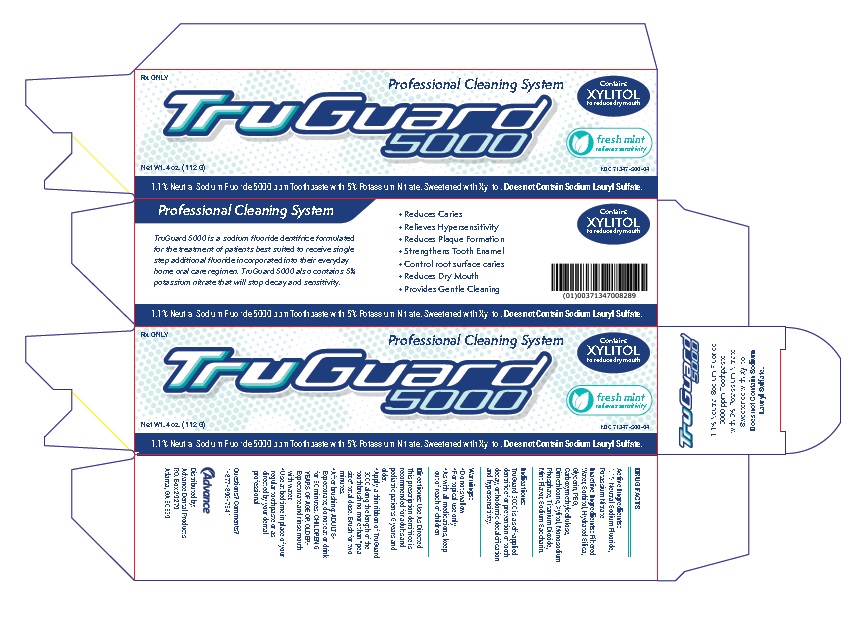
TruGuard 5000 Sodium Fluoride Toothpaste 1.1 g/100g; 5 g/100g Paste, Dentifrice
🆔 Identity & classification
Where does this data come from?
🏭 Manufacturer & labeler
Where does this data come from?
🩺 Clinical
TruGuard 5000 is a prescription toothpaste containing sodium fluoride and potassium nitrate. Sodium fluoride is commonly used in dental products to help strengthen tooth enamel and reduce tooth decay. Potassium nitrate is typically included in toothpastes to help reduce tooth sensitivity. This product is an unapproved drug and has not received FDA marketing approval.
Patient education
Supplement & herbal interactions
Where does this data come from?
Ask a licensed pharmacist directly — free, answered by our team.
🧪 Inactive Ingredients / Excipients
Inactive ingredients, also called excipients, are components of the drug product other than the active ingredient. They may include fillers, dyes, coatings, preservatives, flavors, or other formulation ingredients.
💡 Tap an ingredient (hover on desktop) to see what it is and why it’s used.
-
UNII 05JZI7B19X
A plant-based thickener made from cellulose that holds water and creates texture. It works as a binder and thickening agent to give the medicine its proper consistency and help ingredients blend together.
-
UNII 92RU3N3Y1O
Dimethicone is a silicone-based oil that acts as an anti-foaming agent and lubricant in medicines. It reduces gas bubbles in liquid formulations and helps coat and protect the stomach lining when ingested.
-
UNII PDC6A3C0OX
Glycerin is a clear, thick liquid derived from plant oils or fats. It acts as a humectant to retain moisture, a sweetener, and a solvent in medications.
-
UNII Y6O7T4G8P9
Hydrated silica is a fine powder form of silicon dioxide with absorbed water. It works as an anti-caking agent and absorbent in medicines, helping powders stay free-flowing and preventing clumping.
-
UNII 3WJQ0SDW1A
Polyethylene glycol is a synthetic liquid or solid polymer used in medicines as a solvent, lubricant, and humectant. It helps dissolve active ingredients, reduces friction during manufacturing, and retains moisture in the final product.
-
UNII SB8ZUX40TY
Saccharin sodium is an artificial sweetener made from saccharin salt. It's added to medicines to improve taste, especially in liquid formulations for children or bitter drugs.
-
UNII 593YOG76RN
A salt made from sodium and phosphate that helps regulate acidity and maintain proper pH balance in the medicine. It also acts as a buffer to keep the product stable.
-
UNII 506T60A25R
Sorbitol is a natural sugar alcohol derived from glucose. It serves as a sweetener, humectant, and bulking agent in medications to improve taste and help maintain moisture in the product.
-
UNII 15FIX9V2JP
Titanium dioxide is a bright white mineral powder commonly used as a colorant and opacifying agent. It makes pills and tablets white or lighter in color and helps make coatings non-transparent.
-
UNII 059QF0KO0R
Water is a liquid solvent that dissolves and mixes ingredients together in liquid medicines, syrups, and injections. It helps distribute the active drug evenly throughout the product.
-
UNII VCQ006KQ1E
Xylitol is a naturally occurring sugar alcohol derived from plants. It's used in medicines as a sweetener, bulking agent, and to improve taste, especially in liquid formulations and chewable tablets.
11 inactive ingredients listed in the exact product block matched to this NDC.
Label-section wording can be broader than the structured product block and may mention additional formulation ingredients.
Where does this data come from?
ingredient classCode="IACT" elements from the exact product block matched by this NDC. Label-section narrative from DailyMed / the openFDA label index is shown separately when available.Inactive ingredient FAQ
Are inactive ingredients the same for every manufacturer?
Why might an inactive ingredient be missing?
Can inactive ingredients matter?
💲 Pricing
A drug doesn't have one price. Each row is a different public payment system, and none is what you'd pay at the counter — that depends on your insurance. The ⓘ on each row explains what it measures.
| Price system | Per g | Per package |
|---|---|---|
| Retail pharmacies payNADAC · weekly | Not in the retail survey — common for institutional, discontinued, or low-volume packs. | |
| Medicaid paysCMS SDUD · 12 mo | No recent Medicaid claims on file for this NDC — rare and low-volume NDCs are suppressed in the public data. | |
| Medicare drug plans payPart D · quarterly | No Part D plan price is available for this NDC in our data. | |
Where does this data come from?
🔁 Therapeutic equivalents
| Product | Labeler | Pack | NADAC/unit | TE | Status | Price vs. this |
|---|---|---|---|---|---|---|
| TruGuard 5000 1.1 g/100g; 5 g/100gthis 71347-0500-04 | The | 1 tube | — | — | FDA listed | — |
Where does this data come from?
⏳ Availability & generic status
We did not find an FDA-approved generic match for this exact strength, form and route.
Where does this data come from?
📦 Packaging — all sizes for this product
| Package NDC | Description | Marketing start | Status |
|---|---|---|---|
| 71347-0500-04 You're viewing this | 1 TUBE in 1 BOX (71347-500-04) / 112 g in 1 TUBE | 2023-03-16 | Active |
🧭 About this NDC listing & data coverage
Listed without an FDA application
This product's marketing category indicates it is marketed without an approved FDA application (no NDA, ANDA, or BLA on file). Having an NDC does not by itself establish FDA approval — the NDC Directory is a listing system, not an approval decision. Approval-linked data such as Orange Book therapeutic-equivalence ratings therefore does not apply.
What data is (and isn’t) available for this NDC — tap to expand
| NDC identity (package / product / labeler codes) | ✓ Available |
| Labeler | ✓ Available |
| Product & package description | ✓ Available |
| Marketing category & status | ✓ Available |
| Active ingredient / dosage form / route | ✓ Available |
| FDA label (SPL via DailyMed) | ✓ Available |
| Package photos | ✓ Available |
| Inactive ingredients (structured) | ✓ Available |
| NADAC pharmacy acquisition price (CMS) | — Not published for this NDC CMS publishes NADAC only for NDCs reported in its retail-pharmacy survey. |
| Orange Book / therapeutic-equivalence data | — Not published for this NDC Applies only to products approved under an NDA/ANDA; many listings are out of scope. |
| HCPCS J-code billing crosswalk | — Not published for this NDC Most self-administered / retail products have no J-code — that is normal. |
| Medicaid utilization (CMS SDUD) | — Not published for this NDC CMS reports utilization only for NDCs with Medicaid claims above its privacy threshold. |
Questions about this listing
Is this NDC FDA-approved?
Why is there no price listed?
Is the NDC printed on the package the same as the 11-digit billing NDC?
What do the three segments of this NDC mean?
Is this package still being marketed?
Who lists this product with the FDA?
Do I need a prescription for this product?
Where does this data come from?
📄 Full prescribing information FDA SPL
🎯 Indications and Usage ▾
INDICATIONS AND USAGE : A dental caries preventive; for once daily self-applied topical use. It is well established that 1.1% sodium fluoride is safe and extraordinarily effective as a caries preventive when applied frequently with mouthpiece applicators. 1-4 TruGuard brand of 1.1% sodium fluoride in a squeeze tube is easily applied onto a toothbrush.
This prescription dental cream should be used once daily in place of your regular toothpaste unless otherwise instructed by your dental professional. May be used whether or not drinking water is fluoridated, since topical fluoride cannot produce fluorosis. (See WARNINGS for exception.)
⏱️ Dosage and Administration ▾
DOSAGE AND ADMINISTRATION: Follow these instructions unless otherwise instructed by your dental professional: 1. Adults and pediatric patients 6 years of age or older, apply a thin ribbon of TruGuard to a toothbrush. Brush thoroughly once daily for two minutes, preferably at bedtime.
2. After use, adults expectorate. For best results, do not eat, drink or rinse for 30 minutes.
Pediatric patients, age 6-16, expectorate after use and rinse mouth thoroughly. Directions: Use As Directed This prescription dentifrice is recommended for adults and pediatric patients 6 years and older. • Apply a thin ribbon of TruGuard 5000 along the length of the toothbrush no more than "pea size” total dose. Brush for two minutes. • After brushing: ADULTS - Expectorate; Expectorate; do not eat or drink for 30 minutes.
CHILDREN 6 YEARS OF AGE OR OLDER -Expectorate Expectorate and rinse mouth with water. • Use at bedtime in place of your regular toothpaste or as directed by your dental professional.
⛔ Contraindications ▾
CONTRA INDICATIONS: Do not use in pediatric patients under age 6 years unless recommended by a dentist or physician.
⚠️ Warnings ▾
WARNINGS: Prolonged daily ingestion may result in various degrees of dental fluorosis in pediatric patients under 6 years, especially if the water fluoridation exceeds 0.6 ppm, since younger pediatric patients frequently cannot perform the brushing process without significant swallowing. Use in pediatric patients under age 6 years requires special supervision to prevent repeated swallowing of the cream which could cause dental fluorosis. Read directions carefully before using.
Keep out of reach of infants and children.
🤒 Adverse Reactions ▾
ADVERSE REACTIONS: Allergic reaction and other idiosyncrasies have been rarely reported.
🤰 Pregnancy ▾
Pregnancy : Pregnancy Category B. It has shown that fluoride crosses the placenta of rats, but only 0.01% of the amount administered is incorporated in fetal tissue. Animal studies (rats, mice, rabbits) have shown that fluoride is not a teratogen.
Maternal exposure to 12.2 mg fluoride/kg of body weight (rats) or 13.1 mg/kg of body weight (rabbits) did not affect the litter size of fetal weight and did not increase the frequency of skeletal or visceral malformations. Epidemiological studies conducted in areas with high levels of naturally fluoridated water showed no increase in birth defects, Heavy exposure to fluoride during utero development may result in skeletal fluorosis, which becomes evident in childhood.
🧒 Pediatric Use ▾
Pediatric Use: The use of TruGuard in pediatric age groups 6 to 16 years as a caries preventive is supported by pioneering clinical studies with 1.1% sodium Fluoride gels in mouth trays in students age 11-14 years conducted by Englander, et al. 2,3,4 Safety and effectiveness in pediatric patients below the age of 6 years have not been established. Please refer to the CONTRA INDICATIONS and WARNINGS sections.
🆘 Overdosage ▾
OVERDOSAGE : Accidental ingestion of large amounts of fluoride may result in acute burning of the mouth and sore tongue. Nausea, Vomiting and diarrhea may occur soon after ingestion (within 30 minutes) and are accompanied by salivation, hematemesis and epigastric cramping abdominal pain. These symptoms may persist for 24 hours.
If less than 5 mg fluoride/kg of body weight (i.e., less than 2.3 mg fluoride/lb body weight) have been ingested, give calcium (e.g., milk) orally to relieve gastrointestinal symptoms and observe for a few hours. If more than 5 mg fluoride/kg body weight (i.e., more than 2.3 mg fluoride/lb body weight) have been ingested, induce emesis, give orally soluble calcium (e.g., milk, 5% calcium gluconate or calcium lactate solution) and immediately seek medical assistance. For accidental ingestion of more than 15 mg fluoride/kg of body weight (i.e., more than 6.9 mg fluoride/lb body weight), induce vomiting and admit immediately to a hospital facility.
🧬 Clinical Pharmacology ▾
CLINICAL PHARMACOLOGY: Frequent topical applications to the teeth with preparations having a relatively high fluoride content increase tooth resistance to acid dissolutionand enhance penetration of the fluoride ion into tooth enamel.
📦 How Supplied / Storage and Handling ▾
HOW SUPPLIED : 4 oz. (112 gm) net wt. tube
🧪 Inactive Ingredients ▾
Inactive Ingredients: Filtered Water, Sorbitol, Hydrated Silica, Glycerin, PEG, Carboxymethylcellulose, Dimethicone, Xylitol, Monosodium Phosphate, Titanium Dioxide, Mint Flavor, Sodium Saccharin.
📋 Description ▾
DESCRIPTION : Self-topical neutral fluoride dentifrice containing 1.1%(w/w) sodium fluoride for use as a dental caries preventive in adults and pediatric patients.