
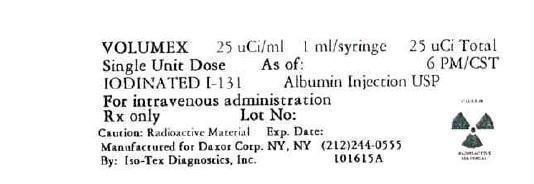
Volumex Iodinated I-131 Albumin .025 mCi/mL Injection, Solution, 1 mL — NDC 50914-7720-8 (Billing 50914-7720-08)
This is a package of 1 mL of Volumex Iodinated I-131 Albumin .025 mCi/mL Injection, Solution from Iso-Tex Diagnostics, Inc., marketed since Aug 1993 and currently FDA-listed. It is this product's only package size.
NDC database record
One package, one record: these facts belong to NDC 50914-7720-8 alone.
- Record
- FDA NDC Directory package listing · Human prescription drug
- Code segments
- 50914 labeler · 7720 product · 8 package
- Package marketed since
- Aug 1, 1993
- Sample package
- No — commercial package
- Listing certified through
- Dec 31, 2026
- Barcode (UPC-A, from the NDC)
- 3 5091477208 2
- FDA record last changed
- Jul 24, 2026
Identity & classification
Regulatory identifiers FDA, NLM and CMS codes for this package
Drug-database identifiers Medi-Span GPI and First Databank GCN / HICL / AHFS classification
- GSN (GCN sequence number): 087845
- GCN: 57867
- HICL (First Databank): 047851
- AHFS class code: 36:00.00.00
Where does this data come from?
- FDA openFDA NDC Directory · synced Oct 1, 2026
- FDA label on DailyMed · label index refreshed Oct 3, 2026
- RxNorm (NLM RxNav) · catalog refreshed Oct 1, 2026
- Medi-Span GPI (licensed)
- First Databank (licensed) · refreshed Oct 1, 2026
Clinical
Patient education
Supplement & herbal interactions
Where does this data come from?
- MedlinePlus (NLM) · refreshed Oct 1, 2026
- FDA label on DailyMed · label index refreshed Oct 3, 2026
Ask a licensed pharmacist directly — free, answered by our team.
Pricing
A drug doesn't have one price. Each row is a different public payment system, and none is what you'd pay at the counter — that depends on your insurance. The ⓘ on each row explains what it measures.
| Price system | Per mL | Per package |
|---|---|---|
| Retail pharmacies payNADAC · weekly | Not in the retail survey — common for institutional, discontinued, or low-volume packs. | |
| Medicaid paysCMS SDUD · 12 mo | No recent Medicaid claims on file for this NDC — rare and low-volume NDCs are suppressed in the public data. | |
| Medicare drug plans payPart D · quarterly | No Part D plan price is available for this NDC in our data. | |
Where does this data come from?
- CMS NADAC weekly file
- CMS ASP pricing files · refreshed Sep 20, 2026
- CMS Medicaid State Drug Utilization Data · refreshed Oct 4, 2026
- CMS Part D plan pricing files · refreshed Sep 24, 2026
- VA National Acquisition Center price file
Packaging — all sizes for this product
| Package NDC | Description | Marketing start | Marketing end | Status |
|---|---|---|---|---|
| 50914-7720-08 You're viewing this Main listing | 1 mL in 1 SYRINGE, PLASTIC | 1993-08-01 | — | Active |
Therapeutic equivalents
| Product | Labeler | Pack | NADAC/unit | TE | Status | Price vs. this |
|---|---|---|---|---|---|---|
| Volumex .025 mCi/mLthis 50914-7720-08 | Iso-Tex | 1 ml | — | — | FDA listed | — |
Where does this data come from?
- FDA openFDA NDC Directory · synced Oct 1, 2026
- FDA Purple Book · refreshed Sep 5, 2026
- CMS NADAC weekly file
Availability & biosimilar status
Biologics have no small-molecule generics; biosimilar competition is tracked in the FDA Purple Book.
Where does this data come from?
- FDA Purple Book · refreshed Sep 5, 2026
Inactive Ingredients / Excipients
Inactive ingredients, also called excipients, are components of the drug product other than the active ingredient. They may include fillers, dyes, coatings, preservatives, flavors, or other formulation ingredients.
💡 Tap an ingredient (hover on desktop) to see what it is and why it’s used.
-
UNII ZIF514RVZR
A protein derived from human blood plasma. In medicines, it acts as a stabilizer and binder, helping maintain drug potency and form, and may improve how the medication disperses or dissolves in the body.
-
UNII LKG8494WBH
Benzyl alcohol is a clear liquid used as a preservative and solvent in medicines. It helps prevent bacterial and fungal growth and dissolves other ingredients to create uniform liquid formulations.
2 inactive ingredients listed in the exact product block matched to this NDC.
Where does this data come from?
ingredient classCode="IACT" elements from the exact product block matched by this NDC. Label-section narrative from DailyMed / the openFDA label index is shown separately when available.- FDA label on DailyMed · label index refreshed Oct 3, 2026
- FDA openFDA NDC Directory · synced Oct 1, 2026
Inactive ingredient FAQ
Are inactive ingredients the same for every manufacturer?
Why might an inactive ingredient be missing?
Can inactive ingredients matter?
Manufacturer & labeler
More NDCs from Iso-Tex Diagnostics, Inc. labeler code 50914
Where does this data come from?
- FDA openFDA NDC Directory · synced Oct 1, 2026
- Drugs@FDA
Full prescribing information FDA SPL
🎯 Indications and Usage ▾
INDICATIONS AND USAGE Volumex (Iodinated I 131 Allbumin injection) is indicated for use in determinations of total blood and plasma volumes and in protein turnover studies
⏱️ Dosage and Administration ▾
DOSAGE AND ADMINISTRATION Volumex (Iodinated I 131 Albumin Injection) is administered intravenously. Parenteral drug products should be inspected visually for particulate matter and abnormal coloration prior to administration whenever solution and container permit. Volumex (Iodinated I 131 Albumin Injection) may be colorless to very pale yellow.
Solutions with excessive coloration should not be used. When a procedure such as a blood volume or a circulation time determination is to be repeated, the total dosage administered in any one week should not exceed 200 microcuries. To minimize the uptake of radioactive iodine by the thyroid, prior administration of Lugol’s Solution (Strong Iodine Solution USP) may be used.
Ten drops of Lugol’s Solution three times daily, beginning at least 24 hours before administration of Volumex and continuing for one or two weeks thereafter, is a suitable dose. Complete assay data for each single unit dose are provided on the container. Note: The expiration date given on the container pertains to the biologic properties of the material and not to the radioactivity level.
It is important to make certain that the radioactivity in the dose at the time of administration is sufficient for the intended use. The patient dose should be measured by a suitable radioactivity calibration system immediately prior to administration. Note: A shielded syringe may be used for withdrawing and injecting the iodinated I 131 albumin.
Total Blood and Plasma Volumes Dosage may range from 5 to 50 microcuries. Blood Volume Determination A. Reference Solution Reference solution is provided with each single unit dose of Volumex.
Determine the radioactivity concentration (net cpm/mL) of the reference solution. Care must be taken to assure that the reference solution and the blood samples (Step B3) are assayed using the same geometric configuration. B.
Administration of Dose After withdrawing a background blood sample as described below, insert an intravenous (IV) line into a large vein in patient’s arm. Inject the entire Volumex dose (one milliliter) through the IV line for immediate delivery.Measure the residual radioactivity in the syringe and needle. Destroy syringe after injecting.
Do not attempt to resterilize. CAUTION: The syringe should be disposed of in accordance with the US Nuclear Regulatory Commission or Agreement State regulations pertaining to the disposal of radioactive waste. At 12, 18, 24, 30 and 36 minutes after injecting the dose, withdraw blood samples from the patient with a sterile syringe or evacuated sample tube containing anti-coagulant.
C. Calculation of Blood Volume 1. Take a known aliquot from each blood sample and determine radioconcentration in net cpm/mL.
2. Plot the 12, 18, 24, 30 and 36 minute sample counts (net cpm/mL) on semilog graph paper using the average count value of each sample and determine the radioconcentration at injection time (zero time) by drawing a straight line through the 12, 18, 24, 30 and 36 minute points to zero time. The x ordinate of the graph is the sample withdrawal time and the logarithmic y ordinate is radioconcentration in net cpm/mL.
3. Calculate patient’s blood volume (in mL) using the following formula: Net cpm/mL reference solution blood Net cpm/mL patient’s blood sample x DF = volume (in mL) Sample Blood Volume Calculations Volume of Blood sample aliquot = 1.0 mL Volume of Reference Solution aliquot = 1.0 mL Net counts at zero time = 48,100 Net counts obtained from reference solution aliquot = 52, 430 If, for example, DF, dilution factor of the reference solution = 4000 Using the above formula gives = 52,430 x 4000 = 4360 mL 48,100 Serial Blood Volume Determinations Iodinated I 131 Albumin Injection is administered in sufficiently low dosage to permit repetitions as often as required by clinical circumstances.
It must be remembered that it is always necessary to correct for background radioactivity remaining in the blood from former determinations. Therefore, f… [Excerpted — this section continues on DailyMed.]
⛔ Contraindications ▾
CONTRAINDICATIONS None known.
⚠️ Warnings ▾
WARNINGS A few instances of hyperpyrexia and aseptic (chemical) meningeal irritation have been reported with the use of iodinated I 131 albumin in cisternography. Iodinated I 131 Albumin Injection is not approved for use in cisternography.
🤒 Adverse Reactions ▾
ADVERSE REACTIONS Although the immunological properties of albumin human are believed to be virtually unaltered by the iodination process, there is a theoretical possibility that allergic reactions may occur in patients receiving additional doses a number of weeks after an initial dose.
🧬 Clinical Pharmacology ▾
CLINICAL PHARMACOLOGY Following intravenous injection, radioiodinated albumin human is uniformly distributed throughout the intravascular pool within 10 minutes; extravascular distribution takes place more slowly. Iodinated I 131 albumin also can be detected in the lymph and in certain body tissues within 10 minutes after injection, but maximum distribution of radioactivity throughout the extravascular space does not occur until two to four days after administration. The time at which extravascular activity is maximal has been designated as the “equilibrium time.” When this point has been reached, the radioactivity remaining in the intravascular and extravascular spaces decreases slowly and exponentially in parallel fashion.
The administered radioactivity is eliminated almost entirely in the urine, only about 2 percent of the total dose ultimately appearing in the feces. The biologic half-life of iodinated I 131 albumin is dependent upon a number of factors, and published studies have varied considerably in their reporting of this figure. It has ranged, in the literature, from below 10 days to over 20 days.
One important factor affecting the biologic half-life is the initial rate of excretion, and this depends in part on the quality of the iodinated I 131 albumin. With Volumex, the biologic half-life in normal individuals has been reported to be approximately 14 days.
📦 How Supplied / Storage and Handling ▾
HOW SUPPLIED Volumex (Iodinated I 131 Albumin Injection USP) is available in single unit dose syringes containing 25 microcuries of activity in one milliliter per syringe on the date of calibration. Each single unit dose syringe is supplied with reference solution. Complete assay data for each single unit dose syringe and reference solution are provided on their respective containers.
The maximum concentration of a single unit dose syringe of Volumex does not exceed 26.3 microcuries per milliliter at time of calibration
📦 Storage and Handling ▾
Storage Store in a refrigerator, 2-8°C (36-46°F)
📋 Description ▾
DESCRIPTION Volumex (Iodinated I 131 Albumin Injection) is a diagnostic radiopharmaceutical containing iodinated I 131 albumin for intravenous use. Each mL of sterile, nonpyrogenic, aqueous, colorless to very pale yellow solution provides approximately 10 mg protein (albumin human), 16 mg dibasic sodium phosphate, 1.6 mg monobasic sodium phosphate, not more, than 0.4 mg guanidine hydrochloride, sodium chloride for isotonicity, and 9 mg benzyl alcohol as a preservative. The stabilizer acetyltryptophanate and sodium caprylate have a concentration of less than 0.0089M.
The pH has been adjusted to 7.2-7.8 with sodium hydroxide or hydrochloric acid. Volumex was prepared from blood that was nonreactive when tested for hepatitis B surface antigen (HB s Ag). The structure of the complex is unknown.
⚠️ Precautions ▾
PRECAUTIONS General In the use of any radioactive material, care should be taken to insure minimum radiation exposure to the patient and occupational workers consistent with proper patient management. Radiopharmaceuticals should be used only by physicians who are qualified by training and experience in the safe use and handling of radionuclides and whose experience and training have been approved by the appropriate government agency authorized to license the use of radionuclides. Carcinogenesis, Mutagenesis, Impairment of Fertility No long-term animal studies have been performed to evaluate carcinogenic potential or whether iodinated I 131 albumin affects fertility in males or females.
Pregnancy Category C Animal reproduction studies have not been conducted with Iodinated I 131 Albumin Injection. It is also not known whether this agent can cause fetal harm when administered to a pregnant woman or can affect reproduction capacity. Iodinated I 131 Albumin Injection should be administered to a pregnant woman only if clearly needed.
Ideally, examinations using radiopharmaceuticals, especially those elective in nature, of a woman of childbearing capability should be performed during the first few (approximately 10) days following the onset of menses. Nursing Mothers Since iodine 131 is excreted in human milk during lactation, formula feedings should be substituted for breast feedings. Pediatric use Safety and effectiveness in children have not been established.
📄 Package Label / Principal Display Panel ▾
Packaging Volumex
Reported adverse events (FAERS)
Top reported reactions
Reporter sex
Where does this data come from?
About this NDC listing & data coverage
What data is (and isn’t) available for this NDC — tap to expand
| NDC identity (package / product / labeler codes) | ✓ Available |
| Labeler | ✓ Available |
| Product & package description | ✓ Available |
| Marketing category & status | ✓ Available |
| Active ingredient / dosage form / route | ✓ Available |
| FDA label (SPL via DailyMed) | ✓ Available |
| Package photos | ✓ Available |
| Inactive ingredients (structured) | ✓ Available |
| NADAC pharmacy acquisition price (CMS) | — Not published for this NDC CMS publishes NADAC only for NDCs reported in its retail-pharmacy survey. |
| Orange Book / therapeutic-equivalence data | — Not published for this NDC Applies only to products approved under an NDA/ANDA; many listings are out of scope. |
| HCPCS J-code billing crosswalk | — Not published for this NDC Most self-administered / retail products have no J-code — that is normal. |
| Medicaid utilization (CMS SDUD) | — Not published for this NDC CMS reports utilization only for NDCs with Medicaid claims above its privacy threshold. |