
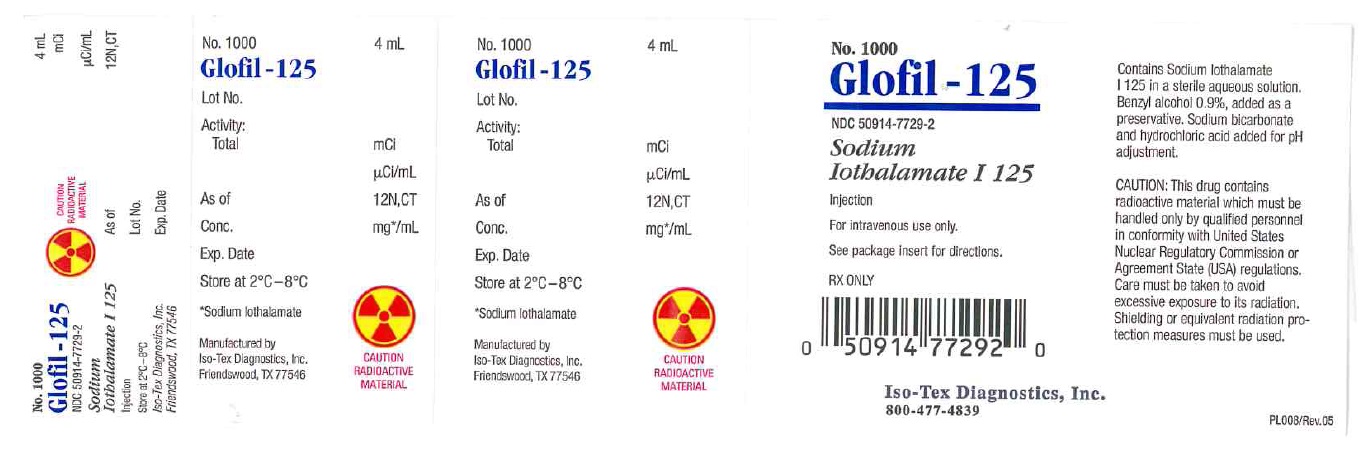
Glofil-125 Sodium Iothalamate I-125 injection .275 mCi/mL Injection, Solution — NDC 50914-7729-2 (Billing 50914-7729-02)
This is a package of Glofil-125 Sodium Iothalamate I-125 injection .275 mCi/mL Injection, Solution from Iso-Tex Diagnostics, Inc., marketed since May 1983 and currently FDA-listed. It is this product's only package size.
NDC database record
One package, one record: these facts belong to NDC 50914-7729-2 alone.
- Record
- FDA NDC Directory package listing · Human prescription drug
- Code segments
- 50914 labeler · 7729 product · 2 package
- Package marketed since
- May 1, 1983
- Sample package
- No — commercial package
- Listing certified through
- Dec 31, 2026
- Barcode (UPC)
- 0050914772920
- FDA record last changed
- Jul 24, 2026
Identity & classification
Regulatory identifiers FDA, NLM and CMS codes for this package
Drug-database identifiers Medi-Span GPI and First Databank GCN / HICL / AHFS classification
- GSN (GCN sequence number): 000424
- GCN: 01573
- HICL (First Databank): 000149
- AHFS class code: 36:68.00.00
Where does this data come from?
- FDA openFDA NDC Directory · synced Oct 8, 2026
- FDA label on DailyMed · label index refreshed Oct 8, 2026
- RxNorm (NLM RxNav) · catalog refreshed Oct 8, 2026
- Medi-Span GPI (licensed)
- First Databank (licensed) · refreshed Oct 8, 2026
Clinical
Patient education
Supplement & herbal interactions
Where does this data come from?
- MedlinePlus (NLM) · refreshed Oct 8, 2026
- FDA label on DailyMed · label index refreshed Oct 8, 2026
Ask a licensed pharmacist directly — free, answered by our team.
Pricing
A drug doesn't have one price. Each row is a different public payment system, and none is what you'd pay at the counter — that depends on your insurance. The ⓘ on each row explains what it measures.
| Price system | Per mL | Per package |
|---|---|---|
| Retail pharmacies payNADAC · weekly | Not in the retail survey — common for institutional, discontinued, or low-volume packs. | |
| Medicaid paysCMS SDUD · 12 mo | No recent Medicaid claims on file for this NDC — rare and low-volume NDCs are suppressed in the public data. | |
| Medicare drug plans payPart D · quarterly | No Part D plan price is available for this NDC in our data. | |
Where does this data come from?
- CMS NADAC weekly file
- CMS ASP pricing files · refreshed Sep 20, 2026
- CMS Medicaid State Drug Utilization Data · refreshed Oct 9, 2026
- CMS Part D plan pricing files · refreshed Sep 24, 2026
- VA National Acquisition Center price file
Packaging — all sizes for this product
| Package NDC | Description | Marketing start | Marketing end | Status |
|---|---|---|---|---|
| 50914-7729-02 You're viewing this Main listing | 1 VIAL, MULTI-DOSE in 1 BOX / 4 mL in 1 VIAL, MULTI-DOSE | 1983-05-01 | — | Active |
Therapeutic equivalents
| Product | Labeler | Pack | NADAC/unit | TE | Status | Price vs. this |
|---|---|---|---|---|---|---|
| Glofil-125 .275 mCi/mLthis 50914-7729-02 | Iso-Tex | 1 vial | — | — | FDA listed | — |
Where does this data come from?
- FDA openFDA NDC Directory · synced Oct 8, 2026
- FDA Orange Book · refreshed Oct 3, 2026
- CMS NADAC weekly file
Availability & generic status
We did not find an FDA-approved generic match for this exact strength, form and route.
Where does this data come from?
- FDA Orange Book · refreshed Oct 3, 2026
Inactive Ingredients / Excipients
Inactive ingredients, also called excipients, are components of the drug product other than the active ingredient. They may include fillers, dyes, coatings, preservatives, flavors, or other formulation ingredients.
💡 Tap an ingredient (hover on desktop) to see what it is and why it’s used.
-
UNII LKG8494WBH
Benzyl alcohol is a clear liquid used as a preservative and solvent in medicines. It helps prevent bacterial and fungal growth and dissolves other ingredients to create uniform liquid formulations.
-
UNII QTT17582CB
A strong acid used to adjust and maintain the proper pH level in liquid medicines, ensuring stability and preventing breakdown of active ingredients.
-
UNII 8MDF5V39QO
A white powder form of baking soda that acts as a buffer and pH regulator in medicines. It helps maintain the right acid-base balance and may aid tablet disintegration.
3 inactive ingredients listed in the exact product block matched to this NDC.
Where does this data come from?
ingredient classCode="IACT" elements from the exact product block matched by this NDC. Label-section narrative from DailyMed / the openFDA label index is shown separately when available.- FDA label on DailyMed · label index refreshed Oct 8, 2026
- FDA openFDA NDC Directory · synced Oct 8, 2026
Inactive ingredient FAQ
Are inactive ingredients the same for every manufacturer?
Why might an inactive ingredient be missing?
Can inactive ingredients matter?
Manufacturer & labeler
More NDCs from Iso-Tex Diagnostics, Inc. labeler code 50914
Where does this data come from?
- FDA openFDA NDC Directory · synced Oct 8, 2026
- Drugs@FDA
Full prescribing information FDA SPL
🎯 Indications and Usage ▾
INDICATIONS AND USAGE GLOFIL-125 (Sodium Iothalamate I-125 Injection) is indicated for evaluation of glomerular filtration in the diagnosis or monitoring of patients with renal disease.
⏱️ Dosage and Administration ▾
Dosage The suggested dose range employed in the average patient (70 kg) is as follows: Continuous intravenous infusion: 20 to 100 μCi (0.74-3.7 megabecquerels) (Sigman, et al (1) method). Single intravenous injection: 10 to 30 µCi (0.37-1.11 megabecquerels) Cohen, et al (2) method) The patient dose should be measured by a suitable radioactivity calibration system immediately prior to administration. Technique Continuous intravenous infusion Sigman 1 method I.
Preparation: Adequate diuresis (a urine flow exceeding 3 mL/min.) is established, preferably by an oral water load of 1,500 mL two hours prior to the beginning of the clearance study. 2. It is not necessary to withhold breakfast or admit the patient the night before.
II. Procedure: After the establishment of adequate diuresis, a number 14 or 16 French Foley catheter is aseptically inserted into the bladder. An intravenous infusion of Lactated Ringers (Hartmanns) solution is started in each arm, one to maintain a site for injection of the GLOFIL-125, the other to serve as a site for serial withdrawal of blood.
A two-way stopcock connects the needle and intravenous tubing of each arm. The dose is equally divided into (1) an intravenous priming dose to be injected as is and (2) a sustaining dose to be diluted in 30 to 60 mL of isotonic sodium chloride, depending on how many collection periods are anticipated. The priming dose is slowly injected into one arm.
This is immediately followed by infusion of the sustaining solution through the same site, usually at the rate of 0.5 mL/min., by means of an automatic pump. During this infusion, the Lactated Ringers solution in the same arm is discontinued, and 40 to 45 minutes are allowed for equilibration in order to reach a state of constant plasma concentration of radioactivity. After attaining equilibrium, consecutive 15 minute collection periods are started.
From the arm opposite the injection site, 5 mL of blood (allowing duplicate plasma counting volumes) is drawn six minutes prior to the midpoint of each collection period, placed in heparinized tubes, mixed, and centrifuged. The blood samples may be obtained through the two-way stopcock after discarding the first 30 mL aspirated into the syringe. This 30 mL contains the contents of the tubing, including infusion fluid, and must be cleared in order to obtain an undiluted blood sample.
If desired, this step may be eliminated and blood samples obtained by direct venipuncture. During each collection period, total urine must be accurately collected and the volume accurately measured. Three such consecutive collection periods are sufficient for most clinical studies.
III. Clearance Calculations: 1. Aliquots (1 mL each) of plasma and urine from each collection period are counted in a standard gamma-ray scintillation well detector.
2. All counts are corrected for background activity. 3.
Glomerular filtration rate is calculated by the formula C=UV/P, in which: C = glomerular filtration rate in mL/min U= urinary concentration of radioactivity in net counts/min/mL V= urinary flow rate in mL/min P = plasma concentration of radioactivity in net counts/min/mL 4. Average glomerular filtration rate (GFR) is calculated from the rates for the individual collection periods. GFR can be expressed in terms of body weight (mL/min/kg) or body surface area (mL/min/m 2 ).
5. Unilateral glomerular filtration rates can be determined by the same technique by utilizing ureteral catheterization. Single intravenous injection Cohen 2 method: The method of Cohen, et al 2 requires little preparation, few and small blood samples, no bladder catheterization, and no constant intravenous infusion.
It is simple to perform, rapid, and utilizes equipment which is readily available in most modern laboratories. I. Preparation: 1.
Lugol's solution, 3 drops orally, three times a day, is administered for one or two days prior to the test. No diet or water restriction is necessary. 2.
Oral water load is begun one hour befor… [Excerpted — this section continues on DailyMed.]
⛔ Contraindications ▾
CONTRAINDICATIONS GLOFIL-125 should not be administered via a central venous line.
⚠️ Warnings ▾
WARNINGS None known
🤒 Adverse Reactions ▾
ADVERSE REACTIONS None Reported
🧬 Clinical Pharmacology ▾
CLINICAL PHARMACOLOGY The renal clearance of sodium iothalamate in man closely approximates that of inulin. The compound is cleared by glomerular filtration without tubular secretion or reabsorption. Following infusion administration of I-125 iothalamate, the effective half-life is about 0.07 days.
📦 How Supplied / Storage and Handling ▾
HOW SUPPLIED Identity No. 1000, GLOFIL-125 is a clear, colorless, sterile, and nonpyrogenic solution available as a 4 mL vial. It is supplied in a concentration of approximately 1 mg/mL sodium iothalamate (range is 0.5–2.0 mg sodium iothalamate per mL), with a radioactivity concentration of 250 to 300 μCi/mL at the time of calibration.
Benzyl alcohol 0.9%, is added as a preservative. Sodium bicarbonate and hydrochloric acid are added for pH adjustment. The calibration and expiration dates are shown on the label.
📦 Storage and Handling ▾
Storage Refrigerate the product upon receipt at 2°C to 8°C.
📋 Description ▾
DESCRIPTION General GLOFIL-125 (Sodium Iothalamate I-125 Injection) is a sterile, nonpyrogenic aqueous injection containing approximately 1 mg sodium iothalamate per mL, and 0.9 percent benzyl alcohol as a preservative. The radioactive concentration of the material is 250-300 µCi/mL as of the calibration date. Sodium bicarbonate and hydrochloric acid are present for pH adjustment.
⚠️ Precautions ▾
PRECAUTIONS General As in the use of any radioactive material, care should be taken to minimize radiation exposure to the patient, consistent with proper patient management, and to insure minimum radiation exposure to occupational workers. Radiopharmaceuticals should be used only by physicians who are qualified by training and experience in the safe use and handling of radionuclides. Rapid or bolus-like injections should be avoided.
Carcinogenesis, Mutagenesis, Impairment of Fertility No long-term animal studies have been performed to evaluate carcinogenic potential, mutagenic potential, or whether this drug affects fertility in males or females. Pregnancy Category C Animal reproduction studies have not been conducted with GLOFIL-125. It is also not known whether GLOFIL-125 can cause fetal harm when administered to a pregnant woman or can affect reproduction capacity.
GLOFIL-125 should be given to a pregnant woman only if clearly needed. Nursing Mothers Radioiodine is excreted in human milk during lactation. It is not known whether GLOFIL-125 is excreted in human milk.
Therefore, formula feedings should be substituted for breast feedings. Pediatric Use Safety and effectiveness in children have not been established.
📚 References ▾
REFERENCES 1. Sigman EM, Elmwood CM, Reagan ME, Morris AM, Calanzaro A. The renal clearance of 131 I labeled sodium iothalamate in man.
Invest Urol 1965; 2:432. 2. Cohen ML, Smith FG Jr., Mindell RS, Vernier RL.
A simple reliable method of measuring glomerular filtration rate using single low dose sodium iothalamate 131 I. Pediatrics 1969; 43:407 ADDITIONAL REFERENCES 3. Maher FT, Nolan NG, Elveback LR.
Comparisons of simultaneous clearances of 125 I labeled sodium iothalamate (Glofil) and of Inulin. Mayo Clin Proc 1971; 46: 690-691. 4.
Skov PE. Glomerular filtration rate in patients with severe and very severe renal insufficiency. Acta Med Scand 1970; 187:419-428.
📄 Package Label / Principal Display Panel ▾
Packaging image description
About this NDC listing & data coverage
What data is (and isn’t) available for this NDC — tap to expand
| NDC identity (package / product / labeler codes) | ✓ Available |
| Labeler | ✓ Available |
| Product & package description | ✓ Available |
| Marketing category & status | ✓ Available |
| Active ingredient / dosage form / route | ✓ Available |
| FDA label (SPL via DailyMed) | ✓ Available |
| Package photos | ✓ Available |
| Inactive ingredients (structured) | ✓ Available |
| NADAC pharmacy acquisition price (CMS) | — Not published for this NDC CMS publishes NADAC only for NDCs reported in its retail-pharmacy survey. |
| Orange Book / therapeutic-equivalence data | — Not published for this NDC Applies only to products approved under an NDA/ANDA; many listings are out of scope. |
| HCPCS J-code billing crosswalk | — Not published for this NDC Most self-administered / retail products have no J-code — that is normal. |
| Medicaid utilization (CMS SDUD) | — Not published for this NDC CMS reports utilization only for NDCs with Medicaid claims above its privacy threshold. |