
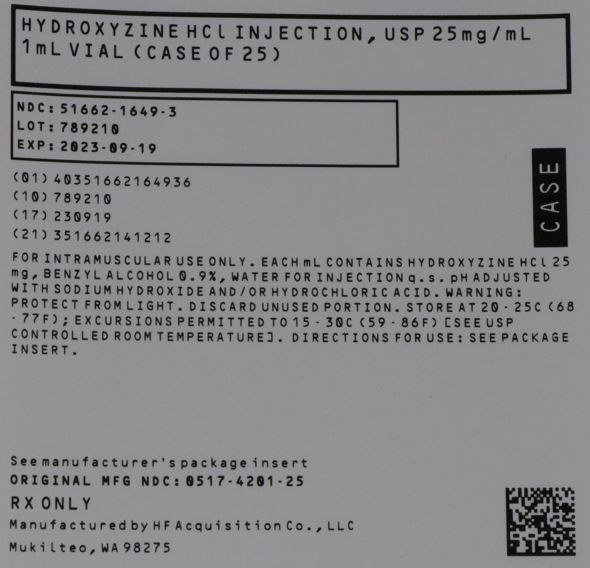
HYDROXYZINE HYDROCHLORIDE 25 mg/mL Injection, Solution — NDC 51662-1649-3 (Billing 51662-1649-03)
This is a package of HYDROXYZINE HYDROCHLORIDE 25 mg/mL Injection, Solution from HF Acquisition Co LLC, DBA HealthFirst, marketed since Sep 1990 and currently FDA-listed. It is this product's only package size.
NDC database record
One package, one record: these facts belong to NDC 51662-1649-3 alone.
- Record
- FDA NDC Directory package listing · Human prescription drug
- Code segments
- 51662 labeler · 1649 product · 3 package
- Package marketed since
- Sep 30, 1990
- Sample package
- No — commercial package
- Listing certified through
- Dec 31, 2026
- Barcode (UPC-A, from the NDC)
- 3 5166216493 8
- FDA record last changed
- Jul 24, 2026
Other active recalls for Hydroxyzine Hydrochloride (different manufacturers) — 1 · tap to view
Identity & classification
Regulatory identifiers FDA, NLM and CMS codes for this package
- RxCUI (RxNorm): 995270
Where does this data come from?
- FDA openFDA NDC Directory · synced Oct 1, 2026
- FDA label on DailyMed · label index refreshed Oct 6, 2026
- RxNorm (NLM RxNav) · catalog refreshed Oct 1, 2026
- Medi-Span GPI (licensed)
- First Databank (licensed) · refreshed Oct 1, 2026
RxNorm drug class
This medicine belongs to the Antihistamine class.
Where does this data come from?
- RxClass (NLM) · catalog refreshed Oct 1, 2026
Clinical
- Taken by mouth, it's used for anxiety and tension, itching from allergic skin conditions like hives and eczema, and sedation around anesthesia. The injection has additional uses in...
- It can. Drowsiness is the most common effect, though it often fades in a few days or with a lower dose. Don't drive or use dangerous machinery until you know how it affects you.
- It's best not to. Hydroxyzine can strengthen alcohol, narcotics, barbiturates and other sedating drugs. Tell your prescriber about everything you take, since doses of some may need...
- Can I drink alcohol or take other sedating medicines with it?
Patient education
Supplement & herbal interactions
Where does this data come from?
- MedlinePlus (NLM) · refreshed Oct 1, 2026
- FDA label on DailyMed · label index refreshed Oct 6, 2026
Ask a licensed pharmacist directly — free, answered by our team.
Pricing
A drug doesn't have one price. Each row is a different public payment system, and none is what you'd pay at the counter — that depends on your insurance. The ⓘ on each row explains what it measures.
| Price system | Per mL | Per package |
|---|---|---|
| Retail pharmacies payNADAC · weekly | Not in the retail survey — common for institutional, discontinued, or low-volume packs. | |
| Medicaid paysCMS SDUD · 12 mo | No recent Medicaid claims on file for this NDC — rare and low-volume NDCs are suppressed in the public data. | |
| Medicare drug plans payPart D · quarterly | No Part D plan price is available for this NDC in our data. | |
| Medicare Part B allowsASP · J3410 | $15.209 / J3410 unit | — |
Where does this data come from?
- CMS NADAC weekly file
- CMS ASP pricing files · refreshed Sep 20, 2026
- CMS Medicaid State Drug Utilization Data · refreshed Oct 6, 2026
- CMS Part D plan pricing files · refreshed Sep 24, 2026
- VA National Acquisition Center price file
Billing & reimbursement
Where does this data come from?
- CMS ASP NDC-HCPCS crosswalk · refreshed Sep 22, 2026
- DMEPDAC NDC-HCPCS crosswalk
- openFDA NSDE billing units · refreshed Sep 7, 2026
Packaging — all sizes for this product
| Package NDC | Description | Marketing start | Marketing end | Status |
|---|---|---|---|---|
| 51662-1649-03 You're viewing this Main listing | 25 POUCH in 1 CASE / 1 VIAL, MULTI-DOSE in 1 POUCH / 10 mL in 1 VIAL, MULTI-DOSE | 1990-09-30 | — | Active |
Therapeutic equivalents
| Product | Labeler | Pack | NADAC/unit | TE | Status | Price vs. this |
|---|---|---|---|---|---|---|
| Hydroxyzine Hydrochloride 25 mg/mL 00517-4201-25 | American | 25 vials | — | — | FDA listed | — |
| Hydroxyzine Hydrochloride 25 mg/mLthis 51662-1649-03 | HF | 25 pouches | — | — | FDA listed | — |
Where does this data come from?
- FDA openFDA NDC Directory · synced Oct 1, 2026
- FDA Orange Book · refreshed Oct 3, 2026
- CMS NADAC weekly file
Availability & generic status
This product is an FDA-approved generic. Other versions of the same drug are listed under Therapeutic equivalents, least expensive first.
Where does this data come from?
- FDA Orange Book · refreshed Oct 3, 2026
Inactive Ingredients / Excipients
Inactive ingredients, also called excipients, are components of the drug product other than the active ingredient. They may include fillers, dyes, coatings, preservatives, flavors, or other formulation ingredients.
🧪 Avoiding an ingredient? See Hydroxyzine inactive ingredients by manufacturer: every current product's list side by side, so you can ask your pharmacy for the version that does not list it.
💡 Tap an ingredient (hover on desktop) to see what it is and why it’s used.
-
UNII LKG8494WBH
Benzyl alcohol is a clear liquid used as a preservative and solvent in medicines. It helps prevent bacterial and fungal growth and dissolves other ingredients to create uniform liquid formulations.
-
UNII QTT17582CB
A strong acid used to adjust and maintain the proper pH level in liquid medicines, ensuring stability and preventing breakdown of active ingredients.
-
UNII 55X04QC32I
A strong alkaline chemical used to adjust and maintain the pH balance of liquid medicines. It helps keep the medicine stable and ensures it stays effective during storage.
-
UNII 059QF0KO0R
Water is a liquid solvent that dissolves and mixes ingredients together in liquid medicines, syrups, and injections. It helps distribute the active drug evenly throughout the product.
4 inactive ingredients listed in the exact product block matched to this NDC.
Where does this data come from?
ingredient classCode="IACT" elements from the exact product block matched by this NDC. Label-section narrative from DailyMed / the openFDA label index is shown separately when available.- FDA label on DailyMed · label index refreshed Oct 6, 2026
- FDA openFDA NDC Directory · synced Oct 1, 2026
Inactive ingredient FAQ
Are inactive ingredients the same for every manufacturer?
Why might an inactive ingredient be missing?
Can inactive ingredients matter?
Manufacturer & labeler
More NDCs from HF Acquisition Co LLC, DBA HealthFirst labeler code 51662
- Narcan Naloxone HCL 4 mg/.1mL Spray NDC 51662-1642-2
- ADENOSINE 3 mg/mL Injection, Solution NDC 51662-1643-3
- XYLOCAINE MPF 10 mg/mL Injection, Solution NDC 51662-1644-1
- XYLOCAINE 10 mg/mL Injection, Solution NDC 51662-1645-3
- CYANOCOBALAMIN 1000 ug/mL Injection, Solution NDC 51662-1647-3
- HYDRALAZINE HYDROCHLORIDE 20 mg/mL Injection, Solution NDC 51662-1648-3
- LIDOCAINE HYDROCHLORIDE 10 mg/mL Injection, Solution NDC 51662-1651-1
- GLYDO- lidocaine hydrochloride jelly 20 mg/mL Jelly NDC 51662-1652-1
- XYLOCAINE MPF lidocaine hydrochloride 5 mg/mL Injection, Solution NDC 51662-1653-1
- XYLOCAINE MPF lidocaine hydrochloride 10 mg/mL Injection, Solution NDC 51662-1654-1
- LIDOCAINE HYDROCHLORIDE AND DEXTROSE 8 mg/mL Injection, Solution NDC 51662-1657-1
- NALOXONE HYDROCHLORIDE 4 mg/.1mL Spray NDC 51662-1659-2
Where does this data come from?
- FDA openFDA NDC Directory · synced Oct 1, 2026
- Drugs@FDA
Full prescribing information FDA SPL
🎯 Indications and Usage ▾
The total management of anxiety, tension, and psychomotor agitation in conditions of emotional stress requires in most instances a combined approach of psychotherapy and chemotherapy. Hydroxyzine has been found to be particularly useful for this latter phase of therapy in its ability to render the disturbed patient more amenable to psychotherapy in long term treatment of the psychoneurotic and psychotic, although it should not be used as the sole treatment of psychosis or of clearly demonstrated cases of depression.
Hydroxyzine is also useful in alleviating the manifestations of anxiety and tension as in the preparation for dental procedures and in acute emotional problems. It has also been recommended for the management of anxiety associated with organic disturbances and as adjunctive therapy in alcoholism and allergic conditions with strong emotional overlay, such as in asthma, chronic urticaria, and pruritus. Hydroxyzine hydrochloride intramuscular solution is useful in treating the following types of patients when intramuscular administration is indicated: 1.
The acutely disturbed or hysterical patient. 2. The acute or chronic alcoholic with anxiety withdrawal symptoms or delirium tremens.
3. As pre-and postoperative and pre- and postpartum adjunctive medication to permit reduction in narcotic dosage, allay anxiety and control emesis. Hydroxyzine hydrochloride has also demonstrated effectiveness in controlling nausea and vomiting, excluding nausea and vomiting of pregnancy.
(See CONTRAINDICATIONS). In prepartum states, the reduction in narcotic requirement effected by hydroxyzine is of particular benefit to both mother and neonate. Hydroxyzine benefits the cardiac patient by its ability to allay the associated anxiety and apprehension attendant to certain types of heart disease.
Hydroxyzine is not known to interfere with the action of digitalis in any way and may be used concurrently with this agent. The effectiveness of hydroxyzine in long term use, that is, more than 4 months, has not been assessed by systematic clinical studies. The physician should reassess periodically the usefulness of the drug for the individual patient.
⏱️ Dosage and Administration ▾
The recommended dosages for hydroxyzine hydrochloride intramuscular solution are: As with all potent medications, the dosage should be adjusted according to the patient's response to therapy. FOR ADDITIONAL INFORMATION ON THE ADMINISTRATION AND SITE OF SELECTION SEE PRECAUTIONS SECTION. NOTE: Hydroxyzine hydrochloride intramuscular solution may be administered without further dilution.
Patients may be started on intramuscular therapy when indicated. They should be maintained on oral therapy whenever this route is practicable. Parenteral drug products should be inspected visually for particulate matter and discoloration prior to administration, whenever solution and container permit.
Table 1
⛔ Contraindications ▾
Hydroxyzine hydrochloride intramuscular solution is intended only for intramuscular administration and should not, under any circumstances, be injected subcutaneously, intra-arterially or intravenously. Hydroxyzine is contraindicated in patients with a prolonged QT interval. This drug is contraindicated for patients who have shown a previous hypersensitivity to it.
Hydroxyzine, when administered to the pregnant mouse, rat, and rabbit, induced fetal abnormalities in the rat at doses substantially above the human therapeutic range. Clinical data in human beings are inadequate to establish safety in early pregnancy. Until such data are available, hydroxyzine is contraindicated in early pregnancy.
⚠️ Warnings ▾
Tissue damage: Intramuscular hydroxyzine hydrochloride may result in severe injection site reactions (including extensive tissue damage, necrosis and gangrene) requiring surgical intervention (including debridement, skin grafting and amputation).
🤒 Adverse Reactions ▾
Therapeutic doses of hydroxyzine seldom produce impairment of mental alertness. However, drowsiness may occur; if so, it is usually transitory and may disappear in a few days of continued therapy or upon reduction of the dose. Dryness of the mouth may be encountered at higher doses.
Extensive clinical use has substantiated the absence of toxic effects on the liver or bone marrow when administered in the recommended doses for over four years of uninterrupted therapy. The absence of adverse effects has been further demonstrated in experimental studies in which excessively high doses were administered. Involuntary motor activity, including rare instances of tremor and convulsions, has been reported, usually with doses considerably higher than those recommended.
Continuous therapy with over one gram per day has been employed in some patients without these effects having been encountered. Hydroxyzine hydrochloride is associated with Acute Generalized Exanthematous Pustulosis (AGEP) in post marketing reports.
🧬 Clinical Pharmacology ▾
Hydroxyzine hydrochloride is unrelated chemically to phenothiazine, reserpine, and meprobamate. Hydroxyzine has demonstrated its clinical effectiveness in the chemotherapeutic aspect of the total management of neuroses and emotional disturbances manifested by anxiety, tension, agitation, apprehension or confusion. Hydroxyzine has been shown clinically to be a rapid-acting true ataraxic with a wide margin of safety.
It induces a calming effect in anxious, tense, psychoneurotic adults and also in anxious, hyperkinetic children without impairing mental alertness. It is not a cortical depressant, but its action may be due to a suppression of activity in certain key regions of the subcortical area of the central nervous system. Primary skeletal muscle relaxation has been demonstrated experimentally.
Hydroxyzine has been shown experimentally to have antispasmodic properties, apparently mediated through interference with the mechanism that responds to spasmogenic agents such as serotonin, acetylcholine, and histamine. Antihistaminic effects have been demonstrated experimentally and confirmed clinically. An antiemetic effect, both by the apomorphine test and the veriloid test, has been demonstrated.
Pharmacological and clinical studies indicate that hydroxyzine in therapeutic dosage does not increase gastric secretion or acidity and in most cases provides mild antisecretory benefits.
📦 How Supplied / Storage and Handling ▾
Storage Condition: Store at 20° to 25°C (68° to 77°F); excursions permitted to 15° to 30°C (59° to 86°F) (See USP Controlled Room Temperature). Protect from light. Discard unused portion of the single dose vial. Distributed by: HF Acquisition Co LLC, DBA HealthFirst HOW SUPPLIED
📋 Description ▾
Hydroxyzine hydrochloride has the chemical name of (±)-2-[2-[4-(p-Chloro-α-phenylbenzyl)-1-piperazinyl]ethoxy]ethanol dihydrochloride and occurs as a white, odorless powder which is very soluble in water. It has the following structural formula: Hydroxyzine Hydrochloride Injection, USP is a sterile aqueous solution intended for intramuscular administration. Each mL contains: Hydroxyzine HCl 25 mg or 50 mg, Benzyl Alcohol 0.9%, and Water for Injection q.s. pH adjusted with Sodium Hydroxide and/or Hydrochloric Acid.
Structure
⚠️ Precautions ▾
THE POTENTIATING ACTION OF HYDROXYZINE MUST BE CONSIDERED WHEN THE DRUG IS USED IN CONJUNCTION WITH CENTRAL NERVOUS SYSTEM DEPRESSANTS SUCH AS NARCOTICS, BARBITURATES AND ALCOHOL. Rarely, cardiac arrests and death have been reported in association with the combined use of hydroxyzine hydrochloride intramuscularly and other CNS depressants. Therefore, when central nervous system depressants are administered concomitantly with hydroxyzine their dosage should be reduced up to 50 percent.
The efficacy of hydroxyzine as adjunctive pre- and postoperative sedative medication has also been well established, especially as regards its ability to allay anxiety, control emesis, and reduce the amount of narcotic required. HYDROXYZINE MAY POTENTIATE NARCOTICS AND BARBITURATES, so their use in preanesthetic adjunctive therapy should be modified on an individual basis. Atropine and other belladonna alkaloids are not affected by the drug.
When hydroxyzine is used preoperatively or prepartum, narcotic requirements may be reduced as much as 50 percent. Thus, when 50 mg of hydroxyzine hydrochloride intramuscular solution is employed, meperidine dosage may be reduced from 100 mg to 50 mg. The administration of meperidine may result in severe hypotension in the postoperative patient or any individual whose ability to maintain blood pressure has been compromised by a depleted blood volume.
Meperidine should be used with great caution and in reduced dosage in patients who are receiving other pre- and/or postoperative medications and in whom there is a risk of respiratory depression, hypotension, and profound sedation or coma occurring. Before using any medications concomitant with hydroxyzine, the manufacturer"s prescribing information should be read carefully. Since drowsiness may occur with the use of this drug, patients should be warned of this possibility and cautioned against driving a car or operating dangerous machinery while taking this drug.
As with all intramuscular preparations, hydroxyzine hydrochloride intramuscular solution should be injected well within the body of a relatively large muscle. Inadvertent subcutaneous injection may result in significant tissue damage. Adults The preferred site is the upper outer quadrant of the buttock, (i.e., the gluteus maximus), or the mid-lateral thigh.
Children It is recommended that intramuscular injections be given preferably in the mid-lateral muscles of the thigh. In infants and small children the periphery of the upper outer quadrant of the gluteal region should be used only when necessary, such as in burn patients, in order to minimize the possibility of damage to the sciatic nerve. The deltoid area should be used only if well developed such as in certain adults and older children, and then only with caution to avoid radial nerve injury.
Intramuscular injections should not be made into the lower and mid-third of the upper arm. As with all intramuscular injections, aspiration is necessary to help avoid inadvertent injection into a blood vessel. Geriatric Use A determination has not been made whether controlled clinical studies of hydroxyzine hydrochloride included sufficient numbers of subjects aged 65 and over to define a difference in response from younger subjects.
Other reported clinical experience has not identified differences in responses between the elderly and younger patients. In general, dose selection for an elderly patient should be cautious, usually starting at the low end of the dosing range, reflecting the greater frequency of decreased hepatic, renal or cardiac function, and of concomitant disease or other drug therapy. The extent of renal excretion of hydroxyzine hydrochloride has not been determined.
Because elderly patients are more likely to have decreased renal function, care should be taken in dose selections. Sedating drugs may cause confusion and over-sedation in the elderly; elderly patients generally should be started on low doses of hydroxyzine hydrochloride and obse… [Excerpted — this section continues on DailyMed.]
📄 Package Label / Principal Display Panel ▾
NDC 51662-1649-2 Pouch label
NDC 51662-1649-3 Case Label RFID Label
About this NDC listing & data coverage
What data is (and isn’t) available for this NDC — tap to expand
| NDC identity (package / product / labeler codes) | ✓ Available |
| Labeler | ✓ Available |
| Product & package description | ✓ Available |
| Marketing category & status | ✓ Available |
| Active ingredient / dosage form / route | ✓ Available |
| FDA label (SPL via DailyMed) | ✓ Available |
| Package photos | ✓ Available |
| Inactive ingredients (structured) | ✓ Available |
| NADAC pharmacy acquisition price (CMS) | — Not published for this NDC CMS publishes NADAC only for NDCs reported in its retail-pharmacy survey. |
| Orange Book / therapeutic-equivalence data | — Not published for this NDC Applies only to products approved under an NDA/ANDA; many listings are out of scope. |
| HCPCS J-code billing crosswalk | ✓ Available |
| Medicaid utilization (CMS SDUD) | — Not published for this NDC CMS reports utilization only for NDCs with Medicaid claims above its privacy threshold. |