
Triamcinolone Acetonide 1 mg/g Paste — NDC 51672-1267-5 (Billing 51672-1267-05)
This is a package of Triamcinolone Acetonide 1 mg/g Paste from Sun Pharmaceutical Industries, Inc., marketed since Oct 1986 and currently FDA-listed; retail pharmacies pay about $2.58 per g (NADAC). It is the main listing for this product, which comes in 2 package sizes.
NDC database record
One package, one record: these facts belong to NDC 51672-1267-5 alone.
- Record
- FDA NDC Directory package listing · Human prescription drug
- Code segments
- 51672 labeler · 1267 product · 5 package
- Package marketed since
- Oct 1, 1986
- Sample package
- No — commercial package
- Listing certified through
- Dec 31, 2026
- Barcode (UPC-A, from the NDC)
- 3 5167212675 9
- Medicaid fills, this package
- 19,736 prescriptions in the last four reported quarters
- FDA record last changed
- Jul 24, 2026
Other active recalls for Triamcinolone Acetonide (different manufacturers) — 1 · tap to view
Identity & classification
Regulatory identifiers FDA, NLM and CMS codes for this package
Drug-database identifiers Medi-Span GPI and First Databank GCN / HICL / AHFS classification
- GSN (GCN sequence number): 002599
- GCN: 31870
- GPI-14 (Medi-Span): 88250020104410
- HICL (First Databank): 002891
- AHFS class code: 48:10.08.00
- RxCUI (RxNorm): 1085728
Where does this data come from?
- FDA openFDA NDC Directory · synced Oct 8, 2026
- FDA label on DailyMed · label index refreshed Oct 6, 2026
- RxNorm (NLM RxNav) · catalog refreshed Oct 1, 2026
- Medi-Span GPI (licensed)
- First Databank (licensed) · refreshed Oct 8, 2026
RxNorm drug class
This medicine belongs to the Corticosteroid class.
Where does this data come from?
- RxClass (NLM) · catalog refreshed Oct 1, 2026
Clinical
Triamcinolone, a corticosteroid, is similar to a natural hormone produced by your adrenal glands. It often is used to replace this chemical when your body does not make enough of it. It relieves inflammation (swelling, heat, redness, and pain) and is used to treat certain forms of arthritis; skin, blood, kidney, eye, thyroid, and intestinal disorders (e.g., colitis); severe allergies; and asthma. Triamcinolone is also used to treat certain types of cancer. This medication is sometimes prescribed for other uses; ask your doctor or pharmacist for more information.
Read the full MedlinePlus article ↗- It depends on the product. Injections treat severe allergic conditions, joint inflammation, certain skin problems and eye inflammation. Creams and ointments calm itchy, inflamed sk...
- Injections are given by a healthcare professional. Ointment is applied as a thin film to the affected area two to three times daily. Nasal spray bottles need priming before first u...
- Possible effects include injection site pain, joint swelling, headache, muscle spasms, cough, sinusitis and bruising. People with diabetes may see higher blood sugar. Tell your doc...
- Call right away for signs of an allergic reaction, fever or infection, a very painful and swollen joint, vision changes, or mood changes. Also report black stools, severe stomach p...
Patient education
Supplement & herbal interactions
Some supplements/herbs that may interact with Triamcinolone Acetonide — tap one for details:
Triamcinolone Acetonide may be associated with lower levels of 8 nutrients — worth a chat with your pharmacist, not a cause for alarm.
Where does this data come from?
- MedlinePlus (NLM) · refreshed Oct 1, 2026
- FDA label on DailyMed · label index refreshed Oct 6, 2026
Ask a licensed pharmacist directly — free, answered by our team.
Pricing
A drug doesn't have one price. Each row is a different public payment system, and none is what you'd pay at the counter — that depends on your insurance. The ⓘ on each row explains what it measures.
| Price system | Per g | Per package |
|---|---|---|
| Retail pharmacies payNADAC · weekly | $2.583 | $12.92 / 5 g |
| Medicaid paysCMS SDUD · 12 mo | $4.33 | $21.63 / 5 g |
| Medicare drug plans payPart D · Q2 2026 | $4.56 | $22.81 / 5 g |
Where does this data come from?
- CMS NADAC weekly file · file of Sep 30, 2026
- CMS ASP pricing files · refreshed Sep 20, 2026
- CMS Medicaid State Drug Utilization Data · through Q1 2026
- CMS Part D plan pricing files · refreshed Sep 24, 2026
- VA National Acquisition Center price file
Packaging — all sizes for this product
| Package NDC | Description | Per unit | Per pack | Marketing start | Marketing end | Status |
|---|---|---|---|---|---|---|
| 51672-1267-05 You're viewing this Main listing | 1 TUBE in 1 CARTON / 5 g in 1 TUBE | $2.58 / g | $12.92 | 1986-10-01 | — | Active |
| 51672-1267-08 51672-1267-8 | 1 TUBE in 1 CARTON / 7.5 g in 1 TUBE | — | — | 1986-10-01 | — | Active |
In Medicaid, this is the most-dispensed pack of this product — about 100% of fills over the last four reported quarters. See all packs ↓
Pack size FAQ
What quantity is in this package?
What NDC number is used to bill for this package of Triamcinolone Acetonide 1 mg/g Paste?
Prices are the latest CMS NADAC pharmacy acquisition cost per NDC; per-pack figures are per-unit × pack quantity, shown only when the pack is denominated in the same measure NADAC prices.
Therapeutic equivalents
| Product | Labeler | Pack | NADAC/unit | TE | Status | Price vs. this |
|---|---|---|---|---|---|---|
| Triamcinolone Acetonide 1 mg/g 00713-0655-40 | Cosette | 1 tube | $2.583 | AT | Availability likely | — |
| Triamcinolone Acetonide 1 mg/gthis 51672-1267-05 | Sun | 1 tube | $2.583 | AT | Availability likely | — |
| Triamcinolone Acetonide 1 mg/g 64980-0320-05 | Rising | 1 tube | $2.583 | AT | Availability likely | — |
| Oralone 1 mg/g 51672-1335-05 | Sun | 1 tube | $2.789 | AT | FDA listed | +8% |
| Triamcinolone Acetonide 1 mg/g 68788-7814-05 | Preferred | 1 tube | — | AT | FDA listed | — |
| Triamcinolone Acetonide 1 mg/g 68788-8386-05 | Preferred | 1 tube | — | AT | FDA listed | — |
| Triamcinolone Acetonide 1 mg/g 68788-8841-05 | Preferred | 1 tube | — | AT | FDA listed | — |
| Triamcinolone Acetonide 1 mg/g 70752-0140-16 | QUAGEN | 1 tube | — | AT | FDA listed | — |
| Triamcinolone Acetonide 1 mg/g 72162-2318-02 | Bryant | 1 tube | — | AT | FDA listed | — |
| Kourzeq 1 mg/g 82682-0001-05 | MidAmerica | 1 tube | — | AT | FDA listed | — |
Where does this data come from?
- FDA openFDA NDC Directory · synced Oct 8, 2026
- FDA Orange Book · refreshed Oct 3, 2026
- CMS NADAC weekly file · file of Sep 30, 2026
Availability & generic status
This product is an FDA-approved generic. Other versions of the same drug are listed under Therapeutic equivalents, least expensive first.
Where does this data come from?
- FDA Orange Book · refreshed Oct 3, 2026
What it looks like
Where does this data come from?
- FDA label on DailyMed · label index refreshed Oct 6, 2026
Inactive Ingredients / Excipients
Inactive ingredients, also called excipients, are components of the drug product other than the active ingredient. They may include fillers, dyes, coatings, preservatives, flavors, or other formulation ingredients.
🧪 Avoiding an ingredient? See Triamcinolone inactive ingredients by manufacturer: every current product's list side by side, so you can ask your pharmacy for the version that does not list it.
💡 Tap an ingredient (hover on desktop) to see what it is and why it’s used.
-
UNII K679OBS311
Carboxymethylcellulose sodium is a plant-derived thickening agent made from cellulose. In medicines, it acts as a binder to hold ingredients together, a disintegrant to help the tablet break apart, or a thickener in liquids.
-
UNII 2G86QN327L
Gelatin is a protein derived from animal collagen, commonly used in medicines as a gelling agent and capsule material. It helps create soft or hard capsule shells that hold and release medication, and can also thicken liquid formulations.
-
UNII T5L8T28FGP
Mineral oil is a clear, odorless liquid derived from crude oil. It acts as a lubricant and emollient in medications, helping pills slide smoothly during manufacturing and aiding moisture retention in topical products.
-
UNII 89NA02M4RX
Pectin is a natural fiber extracted from fruit and plants. It's used in medicines as a thickener, binder, and gelling agent to create the right texture and help the product hold together.
-
UNII 3WJQ0SDW1A
Polyethylene glycol is a synthetic liquid or solid polymer used in medicines as a solvent, lubricant, and humectant. It helps dissolve active ingredients, reduces friction during manufacturing, and retains moisture in the final product.
5 inactive ingredients listed in the exact product block matched to this NDC.
Where does this data come from?
ingredient classCode="IACT" elements from the exact product block matched by this NDC. Label-section narrative from DailyMed / the openFDA label index is shown separately when available.- FDA label on DailyMed · label index refreshed Oct 6, 2026
- FDA openFDA NDC Directory · synced Oct 8, 2026
Inactive ingredient FAQ
Are inactive ingredients the same for every manufacturer?
Why might an inactive ingredient be missing?
Can inactive ingredients matter?
Manufacturer & labeler
More NDCs from Sun Pharmaceutical Industries, Inc. labeler code 51672
- Clobetasol Propionate .5 mg/g Ointment NDC 51672-1259-1
- Clotrimazole 10 mg/mL Solution NDC 51672-1260-3
- Desoximetasone .5 mg/g Gel NDC 51672-1261-1
- Desoximetasone 2.5 mg/g Ointment NDC 51672-1262-1
- Nystatin and Triamcinolone Acetonide 100000 [USP'U]/g; 1 mg/g Cream NDC 51672-1263-1
- Fluocinonide .5 mg/g Ointment NDC 51672-1264-1
- Betamethasone Valerate 1 mg/g Cream NDC 51672-1269-1
- Desoximetasone 2.5 mg/g Cream NDC 51672-1270-1
- Desoximetasone .5 mg/g Cream NDC 51672-1271-1
- Nystatin and Triamcinolone Acetonide 100000 [USP'U]/g; 1 mg/g Ointment NDC 51672-1272-1
- Fluocinonide .5 mg/mL Solution NDC 51672-1273-2
- Betamethasone Dipropionate .5 mg/g Cream NDC 51672-1274-1
Where does this data come from?
- FDA openFDA NDC Directory · synced Oct 8, 2026
- Drugs@FDA
Full prescribing information FDA SPL
🎯 Indications and Usage ▾
INDICATIONS AND USAGE Triamcinolone Acetonide Dental Paste USP, 0.1% is indicated for adjunctive treatment and for the temporary relief of symptoms associated with oral inflammatory lesions and ulcerative lesions resulting from trauma.
⏱️ Dosage and Administration ▾
DOSAGE AND ADMINISTRATION Press a small dab (about 1/4 inch) to the lesion until a thin film develops. A larger quantity may be required for coverage of some lesions. For optimal results use only enough to coat the lesion with a thin film.
Do not rub in. Attempting to spread this preparation may result in granular, gritty sensation and cause it to crumble. After application, however, a smooth, slippery film develops.
The preparation should be applied at bedtime to permit steroid contact with the lesion throughout the night. Depending on the severity of symptoms, it may be necessary to apply the preparation two or three times a day, preferably after meals. If significant repair or regeneration has not occurred in seven days, further investigation is advisable.
⛔ Contraindications ▾
CONTRAINDICATIONS Triamcinolone acetonide dental paste is contraindicated in those patients with a history of hypersensitivity to any of the components of the preparation; it is also contraindicated in the presence of fungal, viral, or bacterial infections of the mouth or throat.
🤒 Adverse Reactions ▾
ADVERSE REACTIONS The following local adverse reactions may occur with corticosteroid-containing dental pastes: burning, itching, irritation, dryness, blistering or peeling not present prior to therapy, perioral dermatitis, allergic contact dermatitis, maceration of the oral mucosa, secondary infection, and atrophy of the oral mucosa. Also, see PRECAUTIONS for potential effects of systemic absorption. To report SUSPECTED ADVERSE REACTINS, contact Sun Pharmaceutical Industries, Inc., at 1-866-923-4914 or FDA at 1-800-FDA-1088 or www.fda.gov/medwatch.
🤰 Pregnancy ▾
Pregnancy Category C Teratogenic effects Triamcinolone acetonide has been shown to induce teratogenic effects in several species. In mice and rabbits, triamcinolone acetonide induced an increased incidence of cleft palate at dosages of approximately 120 µg/kg/day and 24 µg/kg/day, respectively (approximately 12 times and 10 times the amount in a typical daily human dose of triamcinolone acetonide dental paste when compared following normalization of the data on the basis of body surface area estimates, respectively).
In monkeys, triamcinolone acetonide induced cranial skeletal malformations at the lowest dosage studied (500 µg/kg/day), which was approximately 200 times the amount in a typical daily human dose of triamcinolone acetonide dental paste when compared following normalization of the data on the basis of body surface area estimates. There are no adequate and well-controlled studies in pregnant women. However, a retrospective analysis of birth defects among children born to mothers that used drugs of the same class as triamcinolone acetonide dental paste (corticosteroids) during pregnancy found an approximately 3 times increased incidence of cleft palate.
Triamcinolone acetonide dental paste should be used during pregnancy only if the potential benefit justifies the potential risk to the fetus.
🧒 Pediatric Use ▾
Pediatric Use The safety and efficacy of triamcinolone acetonide dental paste in children is unknown. Pediatric patients may demonstrate greater susceptibility to topical corticosteroid-induced HPA axis suppression and Cushing's Syndrome than mature patients because of a larger skin surface area to body weight ratio. Administration of corticosteroid-containing dental pastes to children should be limited to the least amount compatible with an effective therapeutic regimen.
Chronic corticosteroid therapy may interfere with the growth and development of children.
🧓 Geriatric Use ▾
Geriatric Use Clinical studies of triamcinolone acetonide dental paste did not include sufficient numbers of subjects age 65 and older to determine whether they respond differently from younger subjects. Other reported clinical experience has not identified differences in responses between the elderly and younger patients.
🧬 Clinical Pharmacology ▾
CLINICAL PHARMACOLOGY Like other topical corticosteroids, triamcinolone acetonide has anti-inflammatory, antipruritic, and vasoconstrictive properties. The mechanism of the anti-inflammatory activity of the topical steroids, in general, is unclear. However, corticosteroids are thought to act by the induction of phospholipase A 2 inhibitory proteins, collectively called lipocortins.
It is postulated that these proteins control the biosynthesis of potent mediators of inflammation such as prostaglandins and leukotrienes by inhibiting the release of their common precursor, arachidonic acid. Arachidonic acid is released from membrane phospholipids by phospholipase A 2 . Pharmacokinetics The extent of absorption through the oral mucosa is determined by multiple factors including the vehicle, the integrity of the mucosal barrier, the duration of therapy, and the presence of inflammation and/or other disease processes.
Once absorbed through the mucous membranes, the disposition of corticosteroids is similar to that of systemically administered corticosteroids. Corticosteroids are bound to the plasma proteins in varying degrees. Corticosteroids are metabolized primarily in the liver and are then excreted by the kidneys; some corticosteroids and their metabolites are also excreted into the bile.
📦 How Supplied / Storage and Handling ▾
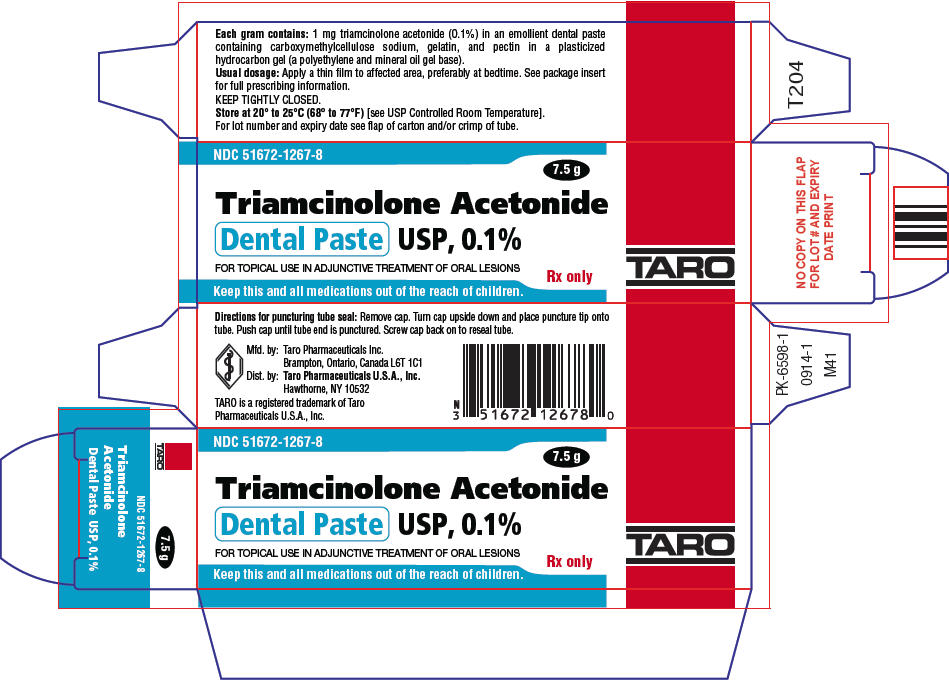
HOW SUPPLIED Triamcinolone Acetonide Dental Paste USP, 0.1% is supplied in tubes containing 5 g of dental paste (NDC 51672–1267-5) and 7.5 g of dental paste (NDC 51672-1267-8). Storage Keep tightly closed. Store at 20° to 25°C (68° to 77°F) [see USP Controlled Room Temperature].
📦 Storage and Handling ▾
Storage Keep tightly closed. Store at 20° to 25°C (68° to 77°F) [see USP Controlled Room Temperature].
📋 Description ▾
DESCRIPTION Triamcinolone Acetonide Dental Paste USP, 0.1%, contains the corticosteroid triamcinolone acetonide in an adhesive vehicle suitable for application to oral tissues. Triamcinolone acetonide is designated chemically as 9-fluoro-11β, 16α, 17, 21-tetrahydroxypregna-1, 4-diene-3, 20-dione cyclic 16, 17-acetal with acetone. The structural formula of triamcinolone acetonide is as follows: C 24 H 31 FO 6 MW 434.50 Each gram of triamcinolone acetonide dental paste contains 1 mg triamcinolone acetonide in an emollient dental paste containing carboxymethylcellulose sodium, gelatin, and pectin in a plasticized hydrocarbon gel (a polyethylene and mineral oil gel base).
Chemical Structure
💬 Information for Patients ▾
Information for the Patient Patients using topical corticosteroids should receive the following information and instructions: This medication is to be used as directed by the physician or dentist. It is for oral use only; it is not intended for ophthalmic or dermatological use. Patients should be advised not to use this medication for any disorder other than for which it was prescribed.
Patients should report any signs of adverse reactions. As with other corticosteroids, therapy should be discontinued when control is achieved. If no improvement is seen within 2 weeks, contact the physician or dentist.
⚠️ Precautions ▾
PRECAUTIONS General Triamcinolone acetonide dental paste may cause local adverse reactions. If irritation develops, triamcinolone acetonide dental paste should be discontinued and appropriate therapy instituted. Allergic contact sensitization with corticosteroids is usually diagnosed by observing failure to heal rather than noting a clinical exacerbation as with most topical products not containing corticosteroids.
Such an observation should be corroborated with appropriate diagnostic patch testing. If concomitant mucosal infections are present or develop, an appropriate antifungal or antibacterial agent should be used. If a favorable response does not occur promptly, use of triamcinolone acetonide dental paste should be discontinued until the infection has been adequately controlled.
If significant regeneration or repair of oral tissues has not occurred in seven days, additional investigation into the etiology of the oral lesion is advised. Systemic absorption of topical corticosteroids has produced reversible hypothalamic-pituitary-adrenal (HPA) axis suppression, manifestations of Cushing's syndrome, hyperglycemia, glucosuria, and other adverse effects known to occur with parenterally-administered steroid preparations; therefore, it may be advisable to periodically evaluate patients on prolonged therapy with corticosteroid-containing dental pastes for evidence of HPA axis suppression (see PRECAUTIONS, Laboratory Tests ).
If HPA axis suppression is noted, an attempt should be made to withdraw the drug or to reduce the frequency of application. Recovery of HPA axis function is generally prompt and complete upon discontinuation of therapy. Information for the Patient Patients using topical corticosteroids should receive the following information and instructions: This medication is to be used as directed by the physician or dentist.
It is for oral use only; it is not intended for ophthalmic or dermatological use. Patients should be advised not to use this medication for any disorder other than for which it was prescribed. Patients should report any signs of adverse reactions.
As with other corticosteroids, therapy should be discontinued when control is achieved. If no improvement is seen within 2 weeks, contact the physician or dentist. Laboratory Tests A urinary free cortisol test and ACTH stimulation test may be helpful in evaluating HPA axis suppression.
Carcinogenesis, Mutagenesis, Impairment of Fertility Animal studies have not been performed to evaluate triamcinolone acetonide for potential to induce carcinogenesis, mutagenesis, or impairment of fertility. Pregnancy Category C Teratogenic effects Triamcinolone acetonide has been shown to induce teratogenic effects in several species. In mice and rabbits, triamcinolone acetonide induced an increased incidence of cleft palate at dosages of approximately 120 µg/kg/day and 24 µg/kg/day, respectively (approximately 12 times and 10 times the amount in a typical daily human dose of triamcinolone acetonide dental paste when compared following normalization of the data on the basis of body surface area estimates, respectively).
In monkeys, triamcinolone acetonide induced cranial skeletal malformations at the lowest dosage studied (500 µg/kg/day), which was approximately 200 times the amount in a typical daily human dose of triamcinolone acetonide dental paste when compared following normalization of the data on the basis of body surface area estimates. There are no adequate and well-controlled studies in pregnant women. However, a retrospective analysis of birth defects among children born to mothers that used drugs of the same class as triamcinolone acetonide dental paste (corticosteroids) during pregnancy found an approximately 3 times increased incidence of cleft palate.
Triamcinolone acetonide dental paste should be used during pregnancy only if the potential benefit justifies the potential risk to the fetus. Nursing Mothers It is not known whether oral application of corticos… [Excerpted — this section continues on DailyMed.]
🍼 Nursing Mothers ▾
Nursing Mothers It is not known whether oral application of corticosteroids could result in sufficient systemic absorption to produce detectable quantities in breast milk. Caution should be exercised when corticosteroid-containing dental pastes are prescribed for a nursing woman.
🧬 Pharmacokinetics ▾
Pharmacokinetics The extent of absorption through the oral mucosa is determined by multiple factors including the vehicle, the integrity of the mucosal barrier, the duration of therapy, and the presence of inflammation and/or other disease processes. Once absorbed through the mucous membranes, the disposition of corticosteroids is similar to that of systemically administered corticosteroids. Corticosteroids are bound to the plasma proteins in varying degrees.
Corticosteroids are metabolized primarily in the liver and are then excreted by the kidneys; some corticosteroids and their metabolites are also excreted into the bile.
📄 Carcinogenesis, Mutagenesis, Impairment of Fertility ▾
Carcinogenesis, Mutagenesis, Impairment of Fertility Animal studies have not been performed to evaluate triamcinolone acetonide for potential to induce carcinogenesis, mutagenesis, or impairment of fertility.
📄 Package Label / Principal Display Panel ▾
PRINCIPAL DISPLAY PANEL - 7.5 g Tube Carton NDC 51672-1267-8 7.5 g Triamcinolone Acetonide Dental Paste USP, 0.1% FOR TOPICAL USE IN ADJUNCTIVE TREATMENT OF ORAL LESIONS Rx only Keep this and all medications out of the reach of children. PRINCIPAL DISPLAY PANEL - 7.5 g Tube Carton SUN label