
Desonide .5 mg/mL Lotion — NDC 51672-4079-4 (Billing 51672-4079-04)
This is a package of Desonide .5 mg/mL Lotion from Sun Pharmaceutical Industries, Inc., marketed since Oct 2014 and currently FDA-listed; retail pharmacies pay about $0.5404 per mL (NADAC).
Identity & classification
Regulatory identifiers FDA, NLM and CMS codes for this package
Drug-database identifiers Medi-Span GPI and First Databank GCN / HICL / AHFS classification
- GSN (GCN sequence number): 016650
- GCN: 48971
- GPI-14 (Medi-Span): 90550035004105
- HICL (First Databank): 003322
- AHFS class code: 84:06.08.00
- RxCUI (RxNorm): 197572
Where does this data come from?
- FDA openFDA NDC Directory · synced Oct 1, 2026
- FDA label on DailyMed · label index refreshed Oct 1, 2026
- RxNorm (NLM RxNav) · catalog refreshed Oct 1, 2026
- Medi-Span GPI (licensed)
- First Databank (licensed) · refreshed Oct 1, 2026
RxNorm drug class
This medicine belongs to the Corticosteroid class.
Where does this data come from?
- RxClass (NLM) · catalog refreshed Oct 1, 2026
Clinical
Desonide is used to treat the redness, swelling, itching, and discomfort of various skin conditions, including psoriasis (a skin disease in which red, scaly patches form on some areas of the body and eczema (a skin disease that causes the skin to be dry and itchy and to sometimes develop red, scaly rashes). Desonide is in a class of medications called topical corticosteroids. It works by activating natural substances in the skin to reduce swelling, redness, and itching.
Read the full MedlinePlus article ↗- It calms inflammation and itching from skin conditions that respond to steroids. The gel is specifically for mild to moderate eczema (atopic dermatitis) in people 3 months and olde...
- Put a thin layer on the affected skin and rub it in gently. How many times a day depends on your product, so follow your label and prescriber. Don’t cover the area with tight wraps...
- Use it for the shortest time that works. The gel should not go past 4 weeks in a row. The cream and ointment should not go past two weeks unless your doctor says so. Stop once your...
- Mild burning, rash, itching, dryness or irritation where you apply it. Call your doctor if the skin gets worse, thins, looks infected, or if you notice signs of too much steroid in...
Patient education
Supplement & herbal interactions
Some supplements/herbs that may interact with Desonide — tap one for details:
Where does this data come from?
- MedlinePlus (NLM) · refreshed Oct 1, 2026
- FDA label on DailyMed · label index refreshed Oct 1, 2026
Ask a licensed pharmacist directly — free, answered by our team.
Pricing
A drug doesn't have one price. Each row is a different public payment system, and none is what you'd pay at the counter — that depends on your insurance. The ⓘ on each row explains what it measures.
| Price system | Per mL | Per package |
|---|---|---|
| Retail pharmacies payNADAC · weekly | $0.540 | $31.88 / 59 ml |
| Medicaid paysCMS SDUD · 12 mo | $0.7640 | $45.08 / 59 ml |
| Medicare drug plans payPart D · Q2 2026 | $1.48 | $87.47 / 59 ml |
Where does this data come from?
- CMS NADAC weekly file · file of Sep 30, 2026
- CMS ASP pricing files · refreshed Sep 20, 2026
- CMS Medicaid State Drug Utilization Data · through Q1 2026
- CMS Part D plan pricing files · refreshed Sep 24, 2026
- VA National Acquisition Center price file
Packaging — all sizes for this product
| Package NDC | Description | Per unit | Per pack | Marketing start | Marketing end | Status |
|---|---|---|---|---|---|---|
| 51672-4079-04 You're viewing this | 1 BOTTLE in 1 CARTON / 59 mL in 1 BOTTLE | $0.5404 / mL | $31.88 | 2014-10-31 | — | Active |
| 51672-4079-08 51672-4079-8 Main listing | 1 BOTTLE in 1 CARTON / 118 mL in 1 BOTTLE | $0.5247 / mL | $61.91 | 2014-10-31 | — | Active |
Per mL, this pack runs about 3% above the cheapest pack (NDC 51672-4079-08, $0.5247 vs $0.5404 NADAC).
This pack accounts for about 37% of this product's recent Medicaid fills; most go to a different pack size. See all packs ↓
Pack size FAQ
What quantity is in this package?
What NDC number is used to bill for this package of Desonide .5 mg/mL Lotion?
Prices are the latest CMS NADAC pharmacy acquisition cost per NDC; per-pack figures are per-unit × pack quantity, shown only when the pack is denominated in the same measure NADAC prices.
Therapeutic equivalents
| Product | Labeler | Pack | NADAC/unit | TE | Status | Price vs. this |
|---|---|---|---|---|---|---|
| Desonide .5 mg/mL 62332-0550-18 | Alembic | 1 bottle | $0.525 | AB | Availability likely | save 3% |
| Desonide .5 mg/mL 00472-0803-02 | Actavis | 1 bottle | $0.540 | — | Availability likely | — |
| Desonide .5 mg/mLthis 51672-4079-04 | Sun | 1 bottle | $0.540 | AB | Availability likely | — |
| Desonide .5 mg/mL 46708-0550-18 | Alembic | 1 bottle | — | AB | FDA listed | — |
| Desonide .5 mg/mL 63629-8739-01 | Bryant | 1 bottle | — | — | FDA listed | — |
Where does this data come from?
- FDA openFDA NDC Directory · synced Oct 1, 2026
- FDA Orange Book · refreshed Oct 3, 2026
- CMS NADAC weekly file · file of Sep 30, 2026
Availability & generic status
This product is an FDA-approved generic. Other versions of the same drug are listed under Therapeutic equivalents, least expensive first.
Where does this data come from?
- FDA Orange Book · refreshed Oct 3, 2026
What it looks like
Where does this data come from?
- FDA label on DailyMed · label index refreshed Oct 1, 2026
Inactive Ingredients / Excipients
Inactive ingredients, also called excipients, are components of the drug product other than the active ingredient. They may include fillers, dyes, coatings, preservatives, flavors, or other formulation ingredients.
💡 Tap an ingredient (hover on desktop) to see what it is and why it’s used.
-
UNII 936JST6JCN
Cetyl alcohol is a waxy, fatty substance derived from plant or animal sources. It acts as an emulsifier and thickener in medicines, helping blend oil and water components and giving products a smooth, creamy texture.
-
UNII 2968PHW8QP
A weak organic acid derived from citrus fruits or made through fermentation. It works as a buffer to control pH, a preservative to extend shelf life, and a flavoring agent in medications.
-
UNII A1A1I8X02B
A clear liquid solvent derived from ethylene glycol. It helps dissolve active ingredients and improve how the medicine flows and mixes in liquid formulations.
-
UNII 7FLD91C86K
Edetate disodium is a chemical compound that binds and removes certain metal ions. In medicines, it acts as a preservative and stabilizer by preventing metals like calcium from interfering with the product's shelf life and consistency.
-
UNII N6K5787QVP
Light mineral oil is a clear, odorless liquid derived from petroleum. In medicines, it acts as a lubricant and emollient to help the product spread smoothly and improve texture.
-
UNII A2I8C7HI9T
Methylparaben is a preservative derived from benzoic acid that prevents growth of bacteria, fungi, and mold in medicines. It extends the product's shelf life and maintains safety during storage.
-
UNII 6DC9Q167V3
Propylene glycol is a clear liquid derived from petroleum or vegetable sources. It acts as a solvent, humectant, and preservative in medicines, helping dissolve active ingredients and maintain product stability.
-
UNII Z8IX2SC1OH
Propylparaben is a chemical preservative used to prevent bacterial and fungal growth in medicines and personal care products. It helps extend shelf life and maintain product safety during storage.
-
UNII 55X04QC32I
A strong alkaline chemical used to adjust and maintain the pH balance of liquid medicines. It helps keep the medicine stable and ensures it stays effective during storage.
-
UNII 368GB5141J
A detergent and foaming agent derived from coconut or palm oil. In medications, it helps break down and mix oil and water-based ingredients, aids in tablet disintegration, and improves how the drug dissolves and spreads in the mouth or digestive system.
-
UNII NVZ4I0H58X
A waxy substance made from sorbitol and stearic acid. It acts as an emulsifier and stabilizer, helping keep oil and water mixed together and preventing separation in the medicine.
-
UNII 2KR89I4H1Y
Stearyl alcohol is a waxy, fatty substance derived from natural oils or made synthetically. It acts as an emulsifier and thickener in medicines, helping mix ingredients together and give the product the right texture.
-
UNII 059QF0KO0R
Water is a liquid solvent that dissolves and mixes ingredients together in liquid medicines, syrups, and injections. It helps distribute the active drug evenly throughout the product.
13 inactive ingredients listed in the exact product block matched to this NDC.
Where does this data come from?
ingredient classCode="IACT" elements from the exact product block matched by this NDC. Label-section narrative from DailyMed / the openFDA label index is shown separately when available.- FDA label on DailyMed · label index refreshed Oct 1, 2026
- FDA openFDA NDC Directory · synced Oct 1, 2026
Inactive ingredient FAQ
Are inactive ingredients the same for every manufacturer?
Why might an inactive ingredient be missing?
Can inactive ingredients matter?
Manufacturer & labeler
Where does this data come from?
- FDA openFDA NDC Directory · synced Oct 1, 2026
- Drugs@FDA
Full prescribing information FDA SPL
🎯 Indications and Usage ▾
INDICATIONS AND USAGE Desonide lotion is a low to medium potency corticosteroid indicated for the relief of the inflammatory and pruritic manifestations of corticosteroid responsive dermatoses.
⏱️ Dosage and Administration ▾
DOSAGE AND ADMINISTRATION Desonide lotion should be applied to the affected areas as a thin film two or three times daily depending on the severity of the condition. SHAKE LOTION WELL BEFORE USING. As with other corticosteroids, therapy should be discontinued when control is achieved. If no improvement is seen within 2 weeks, reassessment of diagnosis may be necessary. Desonide lotion should not be used with occlusive dressings.
⛔ Contraindications ▾
CONTRAINDICATIONS Desonide lotion is contraindicated in those patients with a history of hypersensitivity to any of the components of the preparation.
🤒 Adverse Reactions ▾
ADVERSE REACTIONS In controlled clinical trials, the total incidence of adverse reactions associated with the use of desonide was approximately 8%. These were: stinging and burning approximately 3%, irritation, contact dermatitis, condition worsened, peeling of skin, itching, intense transient erythema, and dryness/scaliness, each less than 2%. The following additional local adverse reactions have been reported infrequently with other topical corticosteroids, and they may occur more frequently with the use of occlusive dressings, especially with higher potency corticosteroids.
These reactions are listed in an approximate decreasing order of occurrence: folliculitis, acneiform eruptions, hypopigmentation, perioral dermatitis, secondary infection, skin atrophy, striae, and miliaria.
🤰 Pregnancy ▾
Pregnancy Teratogenic Effects Corticosteroids have been shown to be teratogenic in laboratory animals when administered systemically at relatively low dosage levels. Some corticosteroids have been shown to be teratogenic after dermal application in laboratory animals. Animal reproduction studies have not been conducted with desonide lotion.
It is also not known whether desonide lotion can cause fetal harm when administered to a pregnant woman or can affect reproduction capacity. Desonide lotion should be given to a pregnant woman only if clearly needed.
🧒 Pediatric Use ▾
Pediatric Use Safety and effectiveness in pediatric patients have not been established. Because of a higher ratio of skin surface area to body mass, pediatric patients are at a greater risk than adults of HPA axis suppression when they are treated with topical corticosteroids. They are therefore also at greater risk of glucocorticosteroid insufficiency after withdrawal of treatment and of Cushing's syndrome while on treatment.
Adverse effects including striae have been reported with inappropriate use of topical corticosteroids in infants and children. HPA axis suppression, Cushing's syndrome, linear growth retardation, delayed weight gain and intracranial hypertension have been reported in children receiving topical corticosteroids. Manifestations of adrenal suppression in children include low plasma cortisol levels, and absence of response to ACTH stimulation.
Manifestations of intracranial hypertension include bulging fontanelles, headaches, and bilateral papilledema.
🆘 Overdosage ▾
OVERDOSAGE Topically applied desonide lotion can be absorbed in sufficient amounts to produce systemic effects (see PRECAUTIONS ).
🧬 Clinical Pharmacology ▾
CLINICAL PHARMACOLOGY Like other topical corticosteroids, desonide has anti-inflammatory, antipruritic and vasoconstrictive properties. The mechanism of the anti-inflammatory activity of the topical steroids, in general, is unclear. However, corticosteroids are thought to act by the induction of phospholipase A 2 inhibitory proteins, collectively called lipocortins.
It is postulated that these proteins control the biosynthesis of potent mediators of inflammation such as prostaglandins and leukotrienes by inhibiting the release of their common precursor arachidonic acid. Arachidonic acid is released from membrane phospholipids by phospholipase A 2 . Pharmacokinetics The extent of percutaneous absorption of topical corticosteroids is determined by many factors including the vehicle and the integrity of the epidermal barrier.
Occlusive dressings with hydrocortisone for up to 24 hours have not been demonstrated to increase penetration; however, occlusion of hydrocortisone for 96 hours markedly enhances penetration. Topical corticosteroids can be absorbed from normal intact skin. Inflammation and/or other disease processes in the skin may increase percutaneous absorption.
Studies performed with desonide lotion indicate that they are in the low to medium range of potency as compared with other topical corticosteroids.
📦 How Supplied / Storage and Handling ▾
HOW SUPPLIED Desonide Lotion, 0.05% is supplied as follows: 2 fl oz (59 mL) bottle – NDC 51672-4079-4 4 fl oz (118 mL) bottle – NDC 51672-4079-8 Storage Conditions Store between 20° to 25°C (68° to 77°F) [see USP Controlled Room Temperature]. SHAKE WELL BEFORE USING.
📦 Storage and Handling ▾
Storage Conditions Store between 20° to 25°C (68° to 77°F) [see USP Controlled Room Temperature]. SHAKE WELL BEFORE USING.
📋 Description ▾
DESCRIPTION Desonide Lotion 0.05% contains desonide (Pregna-1,4-diene-3,20-dione,11,21-dihydroxy-16,17[(1methylethylidene) bis(oxy)]-,(11β,16α)- a synthetic nonfluorinated corticosteroid for topical dermatologic use. The corticosteroids constitute a class of primarily synthetic steroids used topically as anti-inflammatory and antipruritic agents. Chemically, desonide is C 24 H 32 O 6 .
It has the following structural formula: Desonide has the molecular weight of 416.51. It is a white to off white odorless powder which is soluble in methanol and practically insoluble in water. Each gram of desonide lotion contains 0.5 mg of desonide in a base of cetyl alcohol, diethylene glycol monoethyl ether, edetate disodium, glyceryl stearate/polyethylene glycol, light mineral oil, methylparaben, purified water, propylene glycol, propylparaben, sodium lauryl sulfate, sorbitan monostearate and stearyl alcohol.
Contains citric acid monohydrate and sodium hydroxide for pH adjustment. Chemical Structure
💬 Information for Patients ▾
Information for Patients Patients using topical corticosteroids should receive the following information and instructions: This medication is to be used as directed by the physician. It is for external use only. Avoid contact with the eyes.
This medication should not be used for any disorder other than that for which it was prescribed. The treated skin area should not be bandaged or otherwise covered or wrapped so as to be occlusive unless directed by the physician. Patients should report to their physician any signs of local adverse reactions.
⚠️ Precautions ▾
PRECAUTIONS General Systemic absorption of topical corticosteroids can produce reversible hypothalamic-pituitary-adrenal (HPA) axis suppression with the potential for glucocorticosteroid insufficiency after withdrawal of treatment. Manifestations of Cushing's syndrome, hyperglycemia, and glucosuria can also be produced in some patients by systemic absorption of topical corticosteroids while on treatment. Patients applying a topical steroid to a large surface area or to areas under occlusion should be evaluated periodically for evidence of HPA axis suppression.
This may be done by using the ACTH stimulation, A.M. plasma cortisol, and urinary free cortisol tests. Patients receiving superpotent corticosteroids should not be treated for more than 2 weeks at a time and only small areas should be treated at any one time due to the increased risk of HPA axis suppression. If HPA axis suppression is noted, an attempt should be made to withdraw the drug, to reduce the frequency of application, or to substitute a less potent corticosteroid.
Recovery of HPA axis function is generally prompt and complete upon discontinuation of topical corticosteroids. Infrequently, signs and symptoms of glucocorticosteroid insufficiency may occur requiring supplemental systemic corticosteroids. For information on systemic supplementation, see prescribing information for those products.
Pediatric patients may be more susceptible to systemic toxicity from equivalent doses due to their larger skin surface to body mass ratios (see PRECAUTIONS: Pediatric Use ). If irritation develops, desonide lotion should be discontinued and appropriate therapy instituted. Allergic contact dermatitis with corticosteroids is usually diagnosed by observing failure to heal rather than noting a clinical exacerbation as with most topical products not containing corticosteroids.
Such an observation should be corroborated with appropriate diagnostic patch testing. If concomitant skin infections are present or develop, an appropriate antifungal or antibacterial agent should be used. If a favorable response does not occur promptly, use of desonide lotion should be discontinued until the infection has been adequately controlled.
Information for Patients Patients using topical corticosteroids should receive the following information and instructions: This medication is to be used as directed by the physician. It is for external use only. Avoid contact with the eyes.
This medication should not be used for any disorder other than that for which it was prescribed. The treated skin area should not be bandaged or otherwise covered or wrapped so as to be occlusive unless directed by the physician. Patients should report to their physician any signs of local adverse reactions.
Laboratory Tests The following tests may be helpful in evaluating patients for HPA axis suppression: ACTH stimulation test A.M. plasma cortisol test Urinary free cortisol test Carcinogenesis, Mutagenesis, Impairment of Fertility Long-term animal studies have not been performed to evaluate the carcinogenic potential or the effect on reproduction with the use of desonide lotion. Pregnancy Teratogenic Effects Corticosteroids have been shown to be teratogenic in laboratory animals when administered systemically at relatively low dosage levels.
Some corticosteroids have been shown to be teratogenic after dermal application in laboratory animals. Animal reproduction studies have not been conducted with desonide lotion. It is also not known whether desonide lotion can cause fetal harm when administered to a pregnant woman or can affect reproduction capacity.
Desonide lotion should be given to a pregnant woman only if clearly needed. Nursing Mothers Systemically administered corticosteroids appear in human milk and could suppress growth, interfere with endogenous corticosteroid production, or cause other untoward effects. It is not known whether topical administration of corticosteroids could result in sufficient systemic absor… [Excerpted — this section continues on DailyMed.]
🍼 Nursing Mothers ▾
Nursing Mothers Systemically administered corticosteroids appear in human milk and could suppress growth, interfere with endogenous corticosteroid production, or cause other untoward effects. It is not known whether topical administration of corticosteroids could result in sufficient systemic absorption to produce detectable quantities in human milk. Because many drugs are excreted in human milk, caution should be exercised when desonide lotion is administered to a nursing woman.
🧬 Pharmacokinetics ▾
Pharmacokinetics The extent of percutaneous absorption of topical corticosteroids is determined by many factors including the vehicle and the integrity of the epidermal barrier. Occlusive dressings with hydrocortisone for up to 24 hours have not been demonstrated to increase penetration; however, occlusion of hydrocortisone for 96 hours markedly enhances penetration. Topical corticosteroids can be absorbed from normal intact skin.
Inflammation and/or other disease processes in the skin may increase percutaneous absorption. Studies performed with desonide lotion indicate that they are in the low to medium range of potency as compared with other topical corticosteroids.
📄 Carcinogenesis, Mutagenesis, Impairment of Fertility ▾
Carcinogenesis, Mutagenesis, Impairment of Fertility Long-term animal studies have not been performed to evaluate the carcinogenic potential or the effect on reproduction with the use of desonide lotion.
📄 Package Label / Principal Display Panel ▾
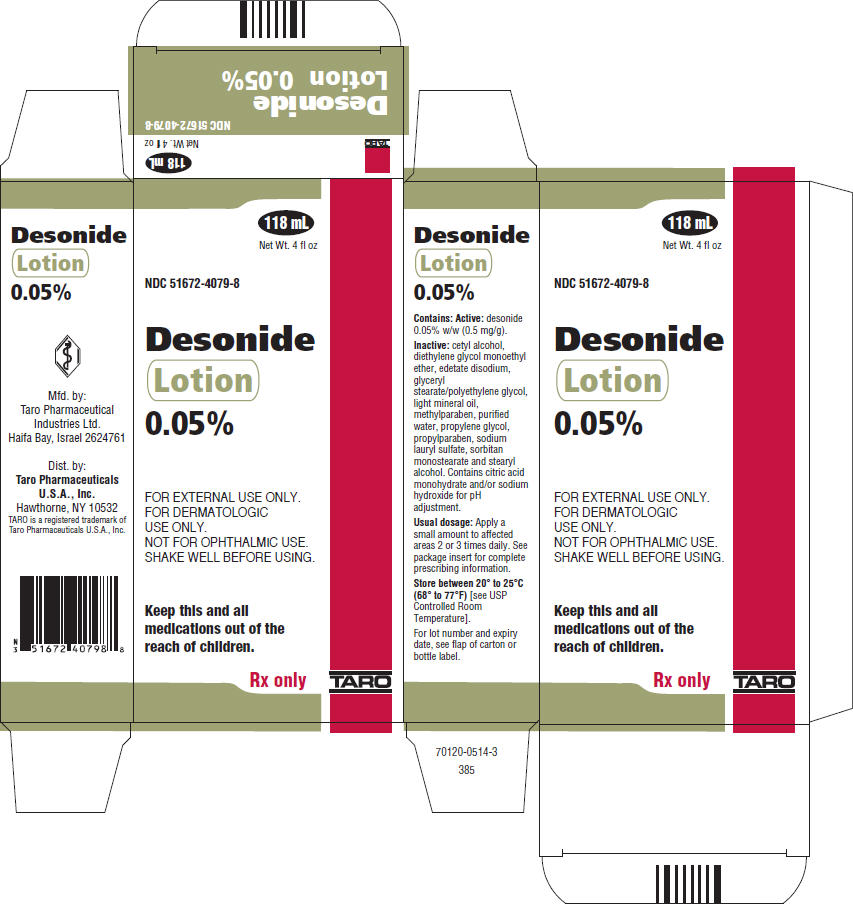
PRINCIPAL DISPLAY PANEL - 118 mL Bottle Carton 118 mL Net Wt. 4 fl oz NDC 51672-4079-8 Desonide Lotion 0.05% FOR EXTERNAL USE ONLY. FOR DERMATOLOGIC USE ONLY. NOT FOR OPHTHALMIC USE. SHAKE WELL BEFORE USING. Keep this and all medications out of the reach of children. Rx only TARO PRINCIPAL DISPLAY PANEL - 118 mL Bottle Carton