
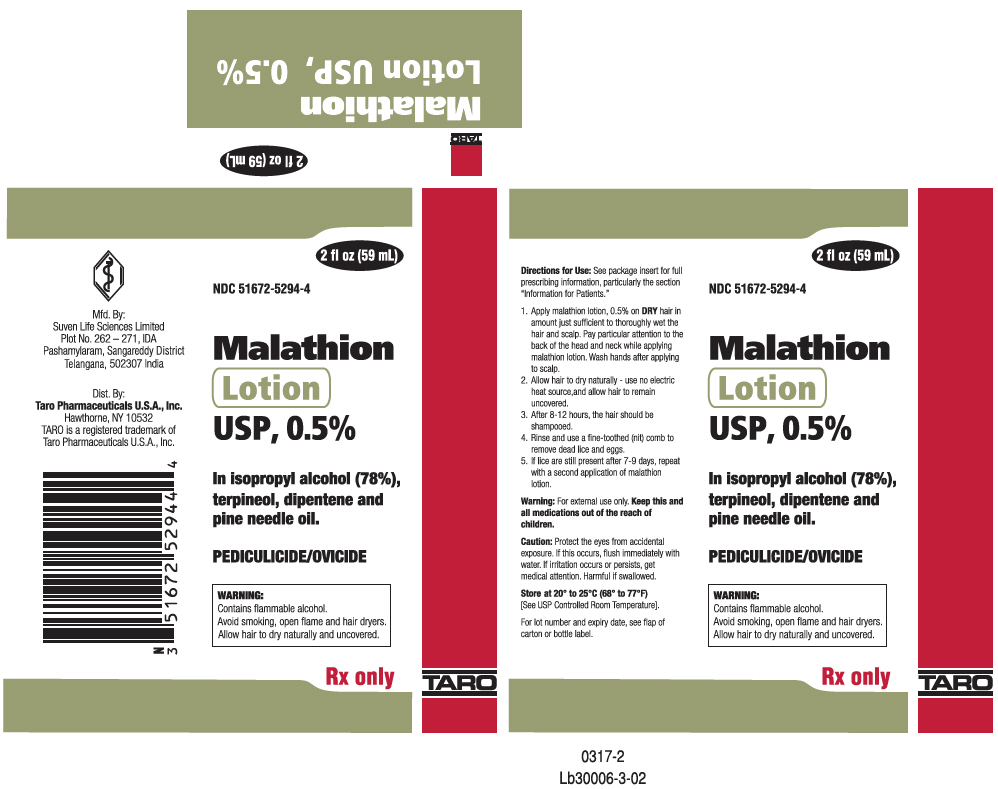
Malathion .0005 g/mL Lotion — NDC 51672-5294-4 (Billing 51672-5294-04)
This is a package of Malathion .0005 g/mL Lotion from Sun Pharmaceutical Industries, Inc., marketed since Jan 2014 and currently FDA-listed; retail pharmacies pay about $3.19 per mL (NADAC). It is this product's only package size.
NDC database record
One package, one record: these facts belong to NDC 51672-5294-4 alone.
- Record
- FDA NDC Directory package listing · Human prescription drug
- Code segments
- 51672 labeler · 5294 product · 4 package
- Package marketed since
- Jan 31, 2014
- Sample package
- No — commercial package
- Listing certified through
- Dec 31, 2027
- Barcode (UPC)
- 0351672529444
- Medicaid fills, this package
- 4,047 prescriptions in the last four reported quarters
- FDA record last changed
- Jul 24, 2026
Identity & classification
Regulatory identifiers FDA, NLM and CMS codes for this package
Drug-database identifiers Medi-Span GPI and First Databank GCN / HICL / AHFS classification
- GSN (GCN sequence number): 007657
- GCN: 31600
- GPI-14 (Medi-Span): 90900030004120
- HICL (First Databank): 003338
- AHFS class code: 84:04.12.00
Where does this data come from?
- FDA openFDA NDC Directory · synced Oct 8, 2026
- FDA label on DailyMed · label index refreshed Oct 8, 2026
- RxNorm (NLM RxNav) · catalog refreshed Oct 1, 2026
- Medi-Span GPI (licensed)
- First Databank (licensed) · refreshed Oct 8, 2026
Clinical
- It treats head lice and their eggs in scalp hair. Use it on scalp hair only.
- Apply it to dry hair, using just enough to wet the hair and scalp well, especially the back of the head and neck. Wash your hands, then let hair air dry uncovered. Shampoo it out a...
- No. The lotion is flammable, so keep wet hair away from hair dryers, curlers, flames and cigarettes. Let it dry naturally.
- Can I use a hair dryer to speed things up?
Patient education
Supplement & herbal interactions
Where does this data come from?
- MedlinePlus (NLM) · refreshed Oct 8, 2026
- FDA label on DailyMed · label index refreshed Oct 8, 2026
Ask a licensed pharmacist directly — free, answered by our team.
Pricing
A drug doesn't have one price. Each row is a different public payment system, and none is what you'd pay at the counter — that depends on your insurance. The ⓘ on each row explains what it measures.
| Price system | Per mL | Per package |
|---|---|---|
| Retail pharmacies payNADAC · weekly | $3.191 | $188.29 / 59 ml |
| Medicaid paysCMS SDUD · 12 mo | $3.07 | $181.30 / 59 ml |
| Medicare drug plans payPart D · Q2 2026 | $3.11 | $183.29 / 59 ml |
Where does this data come from?
- CMS NADAC weekly file · file of Oct 7, 2026
- CMS ASP pricing files · refreshed Sep 20, 2026
- CMS Medicaid State Drug Utilization Data · through Q1 2026
- CMS Part D plan pricing files · refreshed Sep 24, 2026
- VA National Acquisition Center price file
Packaging — all sizes for this product
| Package NDC | Description | Marketing start | Marketing end | Status |
|---|---|---|---|---|
| 51672-5294-04 You're viewing this Main listing | 1 BOTTLE in 1 CARTON / 59 mL in 1 BOTTLE | 2014-01-31 | — | Active |
Therapeutic equivalents
| Product | Labeler | Pack | NADAC/unit | TE | Status | Price vs. this |
|---|---|---|---|---|---|---|
| Malathion .0005 g/mLthis 51672-5294-04 | Sun | 1 bottle | $3.191 | — | Availability likely | — |
| Ovide .0005 g/mL 51672-5293-04 | Sun | 1 bottle | — | — | FDA listed | — |
Where does this data come from?
- FDA openFDA NDC Directory · synced Oct 8, 2026
- FDA Orange Book · refreshed Oct 3, 2026
- CMS NADAC weekly file · file of Oct 7, 2026
Availability & generic status
This product is an FDA-approved generic. Other versions of the same drug are listed under Therapeutic equivalents, least expensive first.
Where does this data come from?
- FDA Orange Book · refreshed Oct 3, 2026
Inactive Ingredients / Excipients
Inactive ingredients, also called excipients, are components of the drug product other than the active ingredient. They may include fillers, dyes, coatings, preservatives, flavors, or other formulation ingredients.
🧪 Avoiding an ingredient? See Malathion Topical inactive ingredients by manufacturer: every current product's list side by side, so you can ask your pharmacy for the version that does not list it.
💡 Tap an ingredient (hover on desktop) to see what it is and why it’s used.
-
UNII ND2M416302
Isopropyl alcohol is a clear liquid solvent derived from petroleum. In medicines, it dissolves active ingredients and other components, helps the product flow smoothly, and aids in sterilization during manufacturing.
-
UNII 9MC3I34447
A natural oil extracted from citrus peel, used as a flavoring agent and solvent to improve taste and help dissolve or distribute other ingredients in the medicine.
-
UNII 5EXL5H740Y
A natural oil extracted from Scotch pine needles, used as a flavoring agent and fragrance component in medicines. It adds taste and aroma to improve how the medication tastes or smells.
-
UNII R53Q4ZWC99
Terpineol is a fragrant alcohol derived from pine oil or other plant sources. It's used in medicines as a flavoring agent and to improve the taste or aroma of the product.
4 inactive ingredients listed in the exact product block matched to this NDC.
Where does this data come from?
ingredient classCode="IACT" elements from the exact product block matched by this NDC. Label-section narrative from DailyMed / the openFDA label index is shown separately when available.- FDA label on DailyMed · label index refreshed Oct 8, 2026
- FDA openFDA NDC Directory · synced Oct 8, 2026
Inactive ingredient FAQ
Are inactive ingredients the same for every manufacturer?
Why might an inactive ingredient be missing?
Can inactive ingredients matter?
Manufacturer & labeler
More NDCs from Sun Pharmaceutical Industries, Inc. labeler code 51672
- Acetaminophen 250 mg and Ibuprofen 125 250 mg; 125 mg Tablet NDC 51672-4258-1
- Topicort Desoximetasone .5 mg/g Ointment NDC 51672-5263-1
- Calcitrene Calcipotriene .05 mg/g Ointment NDC 51672-5278-3
- Topicort Desoximetasone 2.5 mg/mL Spray NDC 51672-5281-0
- psorcon Diflorasone Diacetate 5 mg/g Cream NDC 51672-5292-3
- Ovide Malathion .0005 g/mL Lotion NDC 51672-5293-4
- Fluoxetine Hydrochloride 60 mg Tablet, Film Coated NDC 51672-5306-2
- Glycopyrrolate Oral Solution 1 mg/5mL Liquid NDC 51672-5316-9
- Bebe Bottoms Zinc Oxide 100 mg/mL Spray NDC 51672-5318-3
- FeverAll ACETAMINOPHEN 160 mg/5mL Suspension NDC 51672-5319-8
- ibuprofen 100 mg/5mL Suspension NDC 51672-5321-1
- Phenobarbital 16.2 mg Tablet NDC 51672-5326-1
Where does this data come from?
- FDA openFDA NDC Directory · synced Oct 8, 2026
- Drugs@FDA
Full prescribing information FDA SPL
🎯 Indications and Usage ▾
INDICATIONS AND USAGE Malathion lotion is indicated for patients infected with Pediculus humanus capitis (head lice and their ova) of the scalp hair.
⏱️ Dosage and Administration ▾
DOSAGE AND ADMINISTRATION Apply malathion lotion on DRY hair in amount just sufficient to thoroughly wet the hair and scalp. Pay particular attention to the back of the head and neck while applying malathion lotion. Wash hands after applying to scalp.
Allow hair to dry naturally - use no electric heat source, and allow hair to remain uncovered. After 8 to 12 hours, the hair should be shampooed. Rinse and use a fine - toothed (nit) comb to remove dead lice and eggs.
If lice are still present after 7 - 9 days, repeat with a second application of malathion lotion. Further treatment is generally not necessary. Other family members should be evaluated by a physician to determine if infested, and if so, receive treatment.
⛔ Contraindications ▾
CONTRAINDICATIONS Malathion lotion is contraindicated for neonates and infants because their scalps are more permeable and may have increased absorption of malathion. Malathion lotion should also not be used on individuals known to be sensitive to malathion or any of the ingredients in the vehicle.
⚠️ Warnings ▾
WARNINGS Malathion lotion is flammable. The lotion and wet hair should not be exposed to open flames or electric heat sources, including hair dryers and electric curlers. Do not smoke while applying lotion or while hair is wet.
Allow hair to dry naturally and to remain uncovered after application of malathion lotion. Malathion lotion should only be used on children under the direct supervision of an adult. If malathion lotion comes into contact with the eyes, flush immediately with water.
Consult a physician if eye irritation persists. If skin irritation occurs, discontinue use of product until irritation clears. Reapply the malathion lotion, and if irritation reoccurs, consult a physician.
Chemical burns including second-degree burns and stinging sensations may occur with the use of malathion lotion. General Keep out of reach of children. Close eyes tightly during product application.
If accidentally placed in the eye, flush immediately with water. Use only on scalp hair. Information to Patients Malathion lotion is flammable.
The lotion and hair wet with lotion should not be exposed to open flames or electric heat sources, including hair dryers and electric curlers. Do not smoke while applying lotion or while hair is wet. The person applying malathion lotion should wash hands after application.
Allow hair to dry naturally and to remain uncovered after application of malathion lotion. Malathion lotion should only be used on children under the direct supervision of an adult. Children should be warned to stay away from lighted cigarettes, open flames, and electric heat sources while the hair is wet.
In case of accidental ingestion of malathion lotion by mouth, seek medical attention immediately. If you are pregnant or nursing, you should contact your physician before using malathion lotion. If malathion lotion comes into contact with the eyes, flush immediately with water.
Consult a physician if eye irritation persists or if visual changes occur. If skin irritation occurs, wash scalp and hair immediately. If the irritation clears, malathion lotion may be reapplied.
If irritation reoccurs, consult a physician. Burns and stinging sensations may occur when using malathion lotion. Apply malathion lotion on the scalp hair in an amount just sufficient to thoroughly wet hair and scalp.
Pay particular attention to the back of the head and neck when applying malathion lotion. Anyone applying malathion lotion should wash hands immediately after the application process is complete. Allow hair to dry naturally and to remain uncovered.
Shampoo hair after 8 to 12 hours, again paying attention to the back of the head and neck while shampooing. Rinse hair and use a fine - toothed (nit) comb to remove dead lice and eggs. If lice are still present after 7 - 9 days, repeat with a second application of malathion lotion.
Further treatment is generally not necessary. Other family members should be evaluated by a physician to determine if infested, and if so, receive treatment. Laboratory Tests There are no special laboratory tests needed in order to use this medication.
Carcinogenesis Mutagenesis, and Impairment of Fertility Carcinogenesis, mutagenesis and impairment of fertility have not been studied with malathion lotion (0.5% pharmaceutical grade malathion). However, following long-term oral administration of technical grade malathion to rodents via dietary supplementation, increased incidences of hepatocellular neoplastic lesions were observed in B6C3F1 mice dosed for 18 months at malathion doses greater than 1500 mg/kg/day, and in female F344 rats dosed for 2 years at malathion doses greater than 400 mg/kg/day.
These tumors occurred only in association with severe hepatic toxicity and chronic suppression of acetylcholinesterase activity, or at doses causing excessive mortality. Based on body surface area, doses at which carcinogenic effects were observed in rodents following life-time exposures to malathion were approximately 14- to 26-fold grea… [Excerpted — this section continues on DailyMed.]
🤒 Adverse Reactions ▾
ADVERSE REACTIONS Malathion has been shown to be irritating to the skin and scalp. Other adverse reactions reported are chemical burns including second-degree burns. Accidental contact with the eyes can result in mild conjunctivitis. It is not known if malathion lotion has the potential to cause contact allergic sensitization.
🤰 Pregnancy ▾
Pregnancy Pregnancy Category B There was no evidence of teratogenicity in studies in rats and rabbits at doses up to 900 mg/kg/day and 100 mg/kg/day malathion, respectively. A study in rats failed to show any gross fetal abnormalities attributable to feeding malathion up to 2,500 ppm (~ 200 mg/kg/day) in the diet during a three - generation evaluation period. These doses were approximately 40 to 180 times higher than the dose anticipated in a 60 kg adult (based on body surface area and assuming 100% bioavailability).
Because animal reproduction studies are not always predictive of human responses, this drug should be used (or handled) during pregnancy only if clearly needed.
🧒 Pediatric Use ▾
Pediatric Use The safety and effectiveness of malathion lotion in children less than 6 years of age has not been established via well-controlled trials.
🆘 Overdosage ▾
OVERDOSAGE Consideration should be given, as part of the treatment program, to the high concentration of isopropyl alcohol in the vehicle. Malathion, although a weaker cholinesterase inhibitor than some other organophosphates, may be expected to exhibit the same symptoms of cholinesterase depletion after accidental ingestion orally. If accidentally swallowed, vomiting should be induced promptly or the stomach lavaged with 5% sodium bicarbonate solution.
Severe respiratory distress is the major and most serious symptom of organophosphate poisoning requiring artificial respiration, and atropine may be needed to counteract the symptoms of cholinesterase depletion. Repeat analyses of serum and RBC cholinesterase may assist in establishing the diagnosis and formulating a long - range prognosis.
🧬 Clinical Pharmacology ▾
CLINICAL PHARMACOLOGY Malathion is an organophosphate agent which acts as a pediculicide by inhibiting cholinesterase activity in vivo. Inadvertent transdermal absorption of malathion has occurred from its agricultural use. In such cases, acute toxicity was manifested by excessive cholinergic activity, i.e., increased sweating, salivary and gastric secretion, gastrointestinal and uterine motility, and bradycardia (see OVERDOSAGE ).
Because the potential for transdermal absorption of malathion from malathion lotion is not known at this time, strict adherence to the dosing instructions regarding its use in children, method of application, duration of exposure, and frequency of application is required.
📦 How Supplied / Storage and Handling ▾
HOW SUPPLIED Malathion Lotion USP, 0.5%, is supplied in bottles of 2 fl. oz. (59 mL) NDC 51672-5294-4. Store at 20° to 25°C (68° to 77°F) [see USP Controlled Room Temperature]. Flammable. Keep away from heat and open flame.
📦 Storage and Handling ▾
Store at 20° to 25°C (68° to 77°F) [see USP Controlled Room Temperature]. Flammable. Keep away from heat and open flame.
📋 Description ▾
DESCRIPTION Malathion lotion contains 0.005 g of malathion per mL in a vehicle of isopropyl alcohol (78% v/v), terpineol, dipentene, and pine needle oil. The chemical name of malathion is (±) - [(dimethoxyphosphinothioyl) - thio] butanedioic acid diethyl ester. Malathion has a molecular weight of 330.36, represented by C 10 H 19 O 6 PS 2 , and has the following chemical structure: Chemical Structure
💬 Information for Patients ▾
Information to Patients Malathion lotion is flammable. The lotion and hair wet with lotion should not be exposed to open flames or electric heat sources, including hair dryers and electric curlers. Do not smoke while applying lotion or while hair is wet.
The person applying malathion lotion should wash hands after application. Allow hair to dry naturally and to remain uncovered after application of malathion lotion. Malathion lotion should only be used on children under the direct supervision of an adult.
Children should be warned to stay away from lighted cigarettes, open flames, and electric heat sources while the hair is wet. In case of accidental ingestion of malathion lotion by mouth, seek medical attention immediately. If you are pregnant or nursing, you should contact your physician before using malathion lotion.
If malathion lotion comes into contact with the eyes, flush immediately with water. Consult a physician if eye irritation persists or if visual changes occur. If skin irritation occurs, wash scalp and hair immediately.
If the irritation clears, malathion lotion may be reapplied. If irritation reoccurs, consult a physician. Burns and stinging sensations may occur when using malathion lotion.
Apply malathion lotion on the scalp hair in an amount just sufficient to thoroughly wet hair and scalp. Pay particular attention to the back of the head and neck when applying malathion lotion. Anyone applying malathion lotion should wash hands immediately after the application process is complete.
Allow hair to dry naturally and to remain uncovered. Shampoo hair after 8 to 12 hours, again paying attention to the back of the head and neck while shampooing. Rinse hair and use a fine - toothed (nit) comb to remove dead lice and eggs.
If lice are still present after 7 - 9 days, repeat with a second application of malathion lotion. Further treatment is generally not necessary. Other family members should be evaluated by a physician to determine if infested, and if so, receive treatment.
🍼 Nursing Mothers ▾
Nursing Mothers Malathion in an acetone vehicle has been reported to be absorbed through human skin to the extent of 8% of the applied dose. However, percutaneous absorption from the malathion lotion, 0.5% formulation has not been studied, and it is not known whether malathion is excreted in human milk. Because many drugs are excreted in human milk, caution should be exercised when malathion lotion is administered to (or handled by) a nursing mother.
🔬 Clinical Studies ▾
Clinical Studies Two controlled clinical trials evaluated the pediculicidal activity of malathion lotion. Patients applied the lotion to the hair and scalp in quantities, up to a maximum of 2 fl. oz., sufficient to thoroughly wet the hair and scalp. The lotion was allowed to air dry and was shampooed with Prell shampoo 8 to 12 hours after application.
Patients in both the malathion lotion group and in the vehicle group were examined immediately after shampooing, 24 hours after, and 7 days after for the presence of live lice. Results are shown in the following table: Number of Patients Without Live Scalp Lice Treatment Immediately After 24 Hrs . After 7 Days After Malathion lotion 129/129 122/129 114/126 Malathion vehicle 105/105 63/105 31/105 The presence or absence of ova at day 7 was not evaluated in these studies.
The presence or absence of live lice or ova at 14 days following treatment was not evaluated in these studies. The residual amount of malathion on hair and scalp is unknown.
📄 Carcinogenesis, Mutagenesis, Impairment of Fertility ▾
Carcinogenesis Mutagenesis, and Impairment of Fertility Carcinogenesis, mutagenesis and impairment of fertility have not been studied with malathion lotion (0.5% pharmaceutical grade malathion). However, following long-term oral administration of technical grade malathion to rodents via dietary supplementation, increased incidences of hepatocellular neoplastic lesions were observed in B6C3F1 mice dosed for 18 months at malathion doses greater than 1500 mg/kg/day, and in female F344 rats dosed for 2 years at malathion doses greater than 400 mg/kg/day.
These tumors occurred only in association with severe hepatic toxicity and chronic suppression of acetylcholinesterase activity, or at doses causing excessive mortality. Based on body surface area, doses at which carcinogenic effects were observed in rodents following life-time exposures to malathion were approximately 14- to 26-fold greater than the maximum dose anticipated in a 10 kg child following a single use of malathion lotion, assuming 100% bioavailability. Actual systemic exposures are expected to be less than 10% of the administered dose.
The malathion of greater than pharmaceutical-grade purity used in malathion lotion has not been tested for genotoxicity. The technical-grade malathion (95% pure) was found to be negative in Salmonella typhimurium , equivocally positive in the mouse lymphoma cell assay, and positive in in vitro chromosomal aberration and sister chromatid exchange assays. Fifteen separate in vitro gene mutation studies with malathion of unknown purity have reported negative results, while three studies reported malathion to be mutagenic in bacterial cells.
Both technical grade (94–96.5%) and purified (98-99%) malathion have been reported to cause chromosomal aberrations and sister chromatid exchanges in vitro in human and hamster cell lines. In vivo chromosomal aberration and micronucleus studies of technical- grade malathion are reported to be positive, whereas an in vivo chromosomal aberration study of >99% pure malathion was reported to be negative. Furthermore, mice exposed to malathion in their drinking water for 7 weeks demonstrated no evidence of chromosome damage in bone marrow cells, spermatogonia, or primary spermatocytes.
Lack of details makes independent evaluation of the results of these assays impossible. Ashby and Purchase have suggested that impurities may be responsible for some of the observed genetic activity of malathion. Reproduction studies performed with malathion in rats at doses over 180 fold greater than those anticipated in a 60 kg adult (based on body surface area and assuming 100% bioavailability) revealed no evidence of impaired fertility.
📄 Package Label / Principal Display Panel ▾
PRINCIPAL DISPLAY PANEL - 59 mL Bottle Carton 2 fl oz (59 mL) NDC 51672-5294-4 Malathion (Lotion) USP, 0.5% In isopropyl alcohol (78%), terpineol, dipentene and pine needle oil. PEDICULICIDE/OVICIDE WARNING: Contains flammable alcohol. Avoid smoking, open flame and hair dryers. Allow hair to dry naturally and uncovered. Rx only PRINCIPAL DISPLAY PANEL - 59 mL Bottle Carton
Carton