
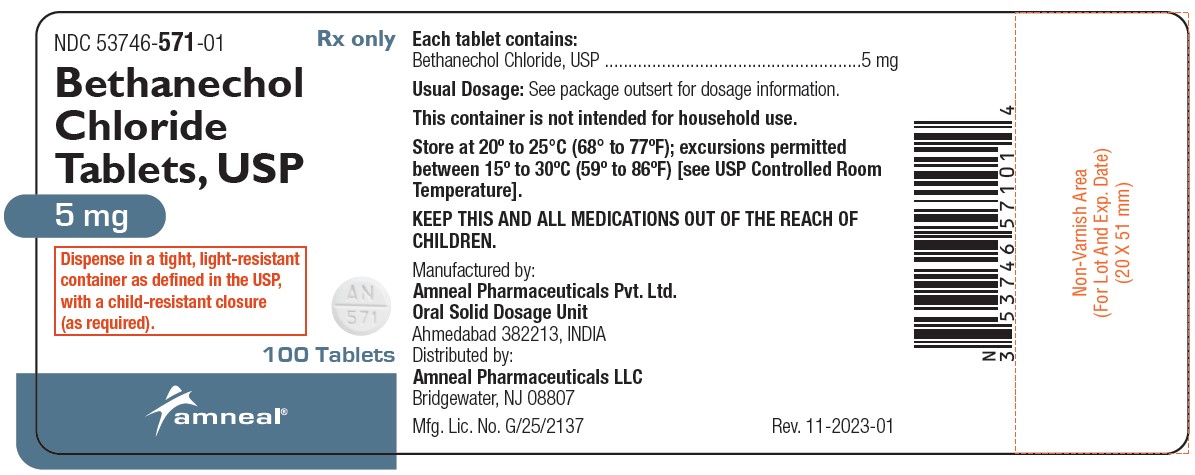
Bethanechol Chloride 5 mg Tablet, 100-count — NDC 53746-571-01 (Billing 53746-0571-01)
This is a package of 100 tablets of Bethanechol Chloride 5 mg Tablet from Amneal Pharmaceuticals of New York LLC, marketed since Apr 2022 and currently FDA-listed; retail pharmacies pay about $0.1221 per tablet (NADAC). It is this product's only package size.
NDC database record
One package, one record: these facts belong to NDC 53746-571-01 alone.
- Record
- FDA NDC Directory package listing · Human prescription drug
- Code segments
- 53746 labeler · 571 product · 01 package
- Package marketed since
- Apr 15, 2022
- Sample package
- No — commercial package
- Listing certified through
- Dec 31, 2027
- Billing quantity
- 100 EA per package
- Barcode (UPC)
- 0353746571014, 0353746572011, 0353746573018, 0353746574015
- Medicaid fills, this package
- 2,687 prescriptions in the last four reported quarters
- FDA record last changed
- Jul 24, 2026
Identity & classification
Regulatory identifiers FDA, NLM and CMS codes for this package
Drug-database identifiers Medi-Span GPI and First Databank GCN / HICL / AHFS classification
- GSN (GCN sequence number): 004742
- GCN: 18353
- GPI-14 (Medi-Span): 54300010100310
- HICL (First Databank): 001978
- AHFS class code: 12:04.00.00
- RxCUI (RxNorm): 857321
Where does this data come from?
- FDA openFDA NDC Directory · synced Oct 8, 2026
- FDA label on DailyMed · label index refreshed Oct 8, 2026
- RxNorm (NLM RxNav) · catalog refreshed Oct 1, 2026
- Medi-Span GPI (licensed)
- First Databank (licensed) · refreshed Oct 8, 2026
RxNorm drug class
This medicine belongs to the Cholinergic Muscarinic Agonist class.
Where does this data come from?
- RxClass (NLM) · catalog refreshed Oct 1, 2026
Clinical
- It helps you empty your bladder when it isn’t contracting well. It is used after surgery or childbirth when nothing is blocking urine flow, and for a weak bladder caused by a nerve...
- Take it by mouth, usually three or four times a day, as your prescriber directs. Try to take it on an empty stomach, because taking it soon after a meal can cause nausea and vomiti...
- Sometimes you’ll notice an effect within 30 minutes. More often it takes 60 to 90 minutes to work best, and the effect lasts about an hour.
- Side effects are uncommon with tablets, but you might get stomach cramps, nausea, diarrhea, extra saliva, flushing, sweating or headache. They are more likely as the dose goes up....
Patient education
Supplement & herbal interactions
Some supplements/herbs that may interact with Bethanechol Chloride — tap one for details:
Where does this data come from?
- MedlinePlus (NLM) · refreshed Oct 8, 2026
- FDA label on DailyMed · label index refreshed Oct 8, 2026
Ask a licensed pharmacist directly — free, answered by our team.
Pricing
A drug doesn't have one price. Each row is a different public payment system, and none is what you'd pay at the counter — that depends on your insurance. The ⓘ on each row explains what it measures.
| Price system | Per ea | Per package |
|---|---|---|
| Retail pharmacies payNADAC · weekly | $0.122 | $12.21 / 100 tablets |
| Medicaid paysCMS SDUD · 12 mo | $0.2418 | $24.18 / 100 tablets |
| Medicare drug plans payPart D · Q2 2026 | $0.1993 | $19.93 / 100 tablets |
Where does this data come from?
- CMS NADAC weekly file · file of Oct 7, 2026
- CMS ASP pricing files · refreshed Sep 20, 2026
- CMS Medicaid State Drug Utilization Data · through Q1 2026
- CMS Part D plan pricing files · refreshed Sep 24, 2026
- VA National Acquisition Center price file
Packaging — all sizes for this product
| Package NDC | Description | Marketing start | Marketing end | Status |
|---|---|---|---|---|
| 53746-0571-01 You're viewing this Main listing | 100 TABLET in 1 BOTTLE | 2022-04-15 | — | Active |
Therapeutic equivalents
| Product | Labeler | Pack | NADAC/unit | TE | Status | Price vs. this |
|---|---|---|---|---|---|---|
| Bethanechol Chloride 5 mg 00832-0510-00 | Upsher-Smith | 100 tablets | $0.122 | AA | Availability likely | — |
| Bethanechol Chloride 5 mg 23155-0934-01 | Heritage | 100 tablets | $0.122 | AA | Availability likely | — |
| Bethanechol Chloride 5 mgthis 53746-0571-01 | Amneal | 100 tablets | $0.122 | AA | Availability likely | — |
| Bethanechol Chloride 5 mg 62135-0755-90 | Chartwell | 90 tablets | $0.122 | AA | Availability likely | — |
| Bethanechol Chloride 5 mg 65162-0571-10 | Amneal | 100 tablets | $0.122 | AA | Availability likely | — |
Where does this data come from?
- FDA openFDA NDC Directory · synced Oct 8, 2026
- FDA Orange Book · refreshed Oct 3, 2026
- CMS NADAC weekly file · file of Oct 7, 2026
Availability & generic status
This product is an FDA-approved generic. Other versions of the same drug are listed under Therapeutic equivalents, least expensive first.
Where does this data come from?
- FDA Orange Book · refreshed Oct 3, 2026
What it looks like
Where does this data come from?
- FDA label on DailyMed · label index refreshed Oct 8, 2026
Inactive Ingredients / Excipients
Inactive ingredients, also called excipients, are components of the drug product other than the active ingredient. They may include fillers, dyes, coatings, preservatives, flavors, or other formulation ingredients.
🧪 Avoiding an ingredient? See Bethanechol inactive ingredients by manufacturer: every current product's list side by side, so you can ask your pharmacy for the version that does not list it.
💡 Tap an ingredient (hover on desktop) to see what it is and why it’s used.
-
UNII 3SY5LH9PMK
Anhydrous lactose is a milk sugar with no water content. It acts as a filler and binder in tablets and capsules, adding bulk and helping ingredients stick together.
-
UNII OP1R32D61U
Microcrystalline cellulose is a purified form of cellulose, a natural fiber from plant sources. It acts as a binder and filler in tablets and capsules, helping hold ingredients together and give the medicine its shape and size.
-
UNII 70097M6I30
Magnesium stearate is a salt made from magnesium and stearic acid, a fatty substance. It's used in tablets and capsules as a lubricant and glidant to help ingredients flow smoothly during manufacturing and prevent sticking.
-
UNII ETJ7Z6XBU4
Silicon dioxide is a naturally occurring mineral used as a glidant and anti-caking agent. It helps powder ingredients flow smoothly and prevents clumping during manufacturing and storage.
-
UNII 5856J3G2A2
A starch-based powder made from potatoes and processed with sodium. It acts as a disintegrant, helping the tablet or capsule break apart quickly in the stomach so the medicine can be absorbed.
5 inactive ingredients listed in the exact product block matched to this NDC.
Where does this data come from?
ingredient classCode="IACT" elements from the exact product block matched by this NDC. Label-section narrative from DailyMed / the openFDA label index is shown separately when available.- FDA label on DailyMed · label index refreshed Oct 8, 2026
- FDA openFDA NDC Directory · synced Oct 8, 2026
Inactive ingredient FAQ
Are inactive ingredients the same for every manufacturer?
Why might an inactive ingredient be missing?
Can inactive ingredients matter?
Manufacturer & labeler
More NDCs from Amneal Pharmaceuticals of New York LLC labeler code 53746
- Primidone 250 mg Tablet NDC 53746-545-01
- Metaxalone 800 mg Tablet NDC 53746-553-01
- Demeclocycline Hydrochloride 150 mg Tablet NDC 53746-554-01
- Demeclocycline Hydrochloride 300 mg Tablet NDC 53746-555-48
- Temazepam 15 mg Capsule NDC 53746-556-01
- Temazepam 30 mg Capsule NDC 53746-557-01
- Bethanechol Chloride 10 mg Tablet NDC 53746-572-01
- Bethanechol Chloride 25 mg Tablet NDC 53746-573-01
- Bethanechol Chloride 50 mg Tablet NDC 53746-574-01
- Calcium Acetate 667 mg Capsule NDC 53746-590-01
- Tramadol Hydrochloride and Acetaminophen 37.5 mg; 325 mg Tablet NDC 53746-617-01
- Flecainide Acetate 50 mg Tablet NDC 53746-641-01
Where does this data come from?
- FDA openFDA NDC Directory · synced Oct 8, 2026
- Drugs@FDA
Full prescribing information FDA SPL
🎯 Indications and Usage ▾
INDICATIONS AND USAGE Bethanechol chloride tablets are indicated for the treatment of acute postoperative and postpartum nonobstructive (functional) urinary retention and for neurogenic atony of the urinary bladder with retention.
⏱️ Dosage and Administration ▾
DOSAGE AND ADMINISTRATION Dosage must be individualized, depending on the type and severity of the condition to be treated. Preferably give the drug when the stomach is empty. If taken soon after eating, nausea and vomiting may occur.
The usual adult oral dose ranges from 10 mg to 50 mg three or four times a day. The minimum effective dose is determined by giving 5 mg to 10 mg initially, and repeating the same amount at hourly intervals until satisfactory response occurs, or until a maximum of 50 mg has been given. The effects of the drug sometimes appear within 30 minutes, and are usually maximal within 60 to 90 minutes.
The drug effects persist for about one hour. If necessary, the effects of the drug can be abolished promptly by atropine (see OVERDOSAGE ).
⛔ Contraindications ▾
CONTRAINDICATIONS Hypersensitivity to bethanechol chloride, hyperthyroidism, peptic ulcer, latent or active bronchial asthma, pronounced bradycardia or hypotension, vasomotor instability, coronary artery disease, epilepsy and parkinsonism. Bethanechol chloride should not be employed when the strength or integrity of the gastrointestinal or bladder wall is in question, or in the presence of mechanical obstruction; when increased muscular activity of the gastrointestinal tract or urinary bladder might prove harmful, as following recent urinary bladder surgery, gastrointestinal resection and anastomosis, or when there is possible gastrointestinal obstruction; in bladder neck obstruction, spastic gastrointestinal disturbances, acute inflammatory lesions of the gastrointestinal tract, or peritonitis; or in marked vagotonia.
🤒 Adverse Reactions ▾
ADVERSE REACTIONS Adverse reactions are rare following oral administration of bethanechol chloride, but are more common following subcutaneous injection. Adverse reactions are more likely to occur when dosage is increased. The following adverse reactions have been observed: Body as a Whole: malaise Digestive: abdominal cramps or discomfort, colicky pain, nausea and belching, diarrhea, borborygmi, salivation Renal: urinary urgency Nervous System: headache Cardiovascular: a fall in blood pressure with reflex tachycardia, vasomotor response Skin: flushing producing a feeling of warmth, sensation of heat about the face, sweating Respiratory: bronchial constriction, asthmatic attacks Special Senses : lacrimation, miosis Causal Relationship Unknown: The following adverse reactions have been reported, and a causal relationship to therapy with bethanechol chloride has not been established: Body as a Whole: malaise Nervous System: seizures To report SUSPECTED ADVERSE REACTIONS, contact Amneal Pharmaceuticals at 1-877-835-5472 or FDA at 1-800-FDA-1088 or www.fda.gov/medwatch.
🆘 Overdosage ▾
OVERDOSAGE Early signs of overdosage are abdominal discomfort, salivation, flushing of the skin (“hot feeling”), sweating, nausea, and vomiting. Atropine Sulfate is a specific antidote. The recommended dose for adults is 0.6 mg.
Repeat doses can be given every two hours, according to clinical response. The recommended dosage in infants and children up to 12 years of age is 0.01 mg/kg (to a maximum single dose of 0.4 mg) repeated every two hours as needed until the desired effect is obtained or adverse effects of atropine preclude further usage. Subcutaneous injection of atropine is preferred except in emergencies when the intravenous route may be employed.
The oral LD 50 of bethanechol chloride is 1,510 mg/kg in the mouse.
🧬 Clinical Pharmacology ▾
CLINICAL PHARMACOLOGY Bethanechol chloride acts principally by producing the effects of stimulation of the parasympathetic nervous system. It increases the tone of the detrusor urinae muscle, usually producing a contraction sufficiently strong to initiate micturition and empty the bladder. It stimulates gastric motility, increases gastric tone and often restores impaired rhythmic peristalsis.
Stimulation of the parasympathetic nervous system releases acetylcholine at the nerve endings. When spontaneous stimulation is reduced and therapeutic intervention is required, acetylcholine can be given, but it is rapidly hydrolyzed by cholinesterase and its effects are transient. Bethanechol chloride is not destroyed by cholinesterase and its effects are more prolonged than those of acetylcholine.
Effects on the GI and urinary tracts sometimes appear within 30 minutes after oral administration of bethanechol chloride, but more often 60 to 90 minutes are required to reach maximum effectiveness. Following oral administration, the usual duration of action of bethanechol chloride is one hour, although large doses (300 mg to 400 mg) have been reported to produce effects for up to six hours. Subcutaneous injection produces a more intense action on bladder muscle than does oral administration of the drug.
Because of the selective action of bethanechol chloride, nicotinic symptoms of cholinergic stimulation are usually absent or minimal when orally or subcutaneously administered in therapeutic doses, while muscarinic effects are prominent. Muscarinic effects usually occur within 5 to 15 minutes after subcutaneous injection, reach a maximum in 15 to 30 minutes, and disappear within two hours. Doses that stimulate micturition and defecation and increase peristalsis do not ordinarily stimulate ganglia or voluntary muscles.
Therapeutic test doses in normal human subjects have little effect on heart rate, blood pressure or peripheral circulation. Bethanechol chloride does not cross the blood-brain barrier because of its charged quaternary amine moiety. The metabolic rate and mode of excretion of the drug have not been elucidated.
A clinical study (Diokno, A.C.; Lapides, J.; Urol 10: 23 to 24, July 1977) was conducted on the relative effectiveness of oral and subcutaneous doses of bethanechol chloride on the stretch response of bladder muscle in patients with urinary retention. Results showed that 5 mg of the drug given subcutaneously stimulated a response that was more rapid in onset and of larger magnitude than an oral dose of 50 mg, 100 mg, or 200 mg. All the oral doses, however, had a longer duration of effect than the subcutaneous dose.
Although the 50 mg oral dose caused little change in intravesical pressure in this study, this dose has been found in other studies to be clinically effective in the rehabilitation of patients with decompensated bladders.
📦 How Supplied / Storage and Handling ▾
HOW SUPPLIED Bethanechol Chloride Tablets, USP, 5 mg are supplied as white, round, flat faced, bevelled tablets debossed with ‘AN’ above bisect and ‘571’ below bisect on one side and plain on the other side. They are available as follows: Bottles of 100: NDC 53746-571-01 Bethanechol Chloride Tablets, USP, 10 mg are supplied as white, round, flat faced, bevelled tablets debossed with ‘AN’ above bisect and ‘572’ below bisect on one side and plain on the other side. They are available as follows: Bottles of 100: NDC 53746-572-01 Bethanechol Chloride Tablets, USP, 25 mg are supplied as yellow, round, flat faced, bevelled tablets debossed with ‘AN’ above bisect and ‘573’ below bisect on one side and plain on the other side.
They are available as follows: Bottles of 100: NDC 53746-573-01 Bethanechol Chloride Tablets, USP, 50 mg are supplied as yellow, round, flat faced, bevelled tablets debossed with ‘AN’ above bisect and ‘574’ below bisect on one side and plain on the other side. They are available as follows: Bottles of 100: NDC 53746-574-01 Store at 20° to 25°C (68° to 77°F); excursions permitted between 15° to 30°C (59° to 86°F) [see USP Controlled Room Temperature]. This container is not intended for household use.
Dispense in a tight, light-resistant container as defined in the USP, with a child-resistant closure (as required). KEEP THIS AND ALL MEDICATIONS OUT OF THE REACH OF CHILDREN. Manufactured by: Amneal Pharmaceuticals Pvt.
Ltd. Oral Solid Dosage Unit Ahmedabad 382213, INDIA Distributed by: Amneal Pharmaceuticals LLC Bridgewater, NJ 08807 Rev.09-2021-00
📋 Description ▾
DESCRIPTION Bethanechol chloride, a cholinergic agent, is a synthetic ester which is structurally and pharmacologically related to acetylcholine. It is designated chemically as 2-[(aminocarbonyl) oxy]- N, N, N -trimethyl-1-propanaminium chloride. Its molecular formula is C 7 H 17 CIN 2 O 2 and its structural formula is: Bethanechol chloride, USP is a white, hygroscopic crystalline powder having a slight amine-like odor, freely soluble in water, and has a molecular weight of 196.68.
Each tablet for oral administration contains 5 mg, 10 mg, 25 mg or 50 mg bethanechol chloride, USP. Bethanechol chloride Tablets, USP also contain the following inactive ingredients: anhydrous lactose, colloidal silicon dioxide, magnesium stearate, microcrystalline cellulose and sodium starch glycolate, Type A. The 25 mg and 50 mg tablets also contain D&C Yellow No.10 Aluminum Lake and FD&C Yellow No.
6 Aluminum Lake. 1
⚠️ Precautions ▾
PRECAUTIONS General In urinary retention, if the sphincter fails to relax as bethanechol chloride contracts the bladder, urine may be forced up the ureter into the kidney pelvis. If there is bacteriuria, this may cause reflux infection. Information for Patients Bethanechol chloride tablets should preferably be taken one hour before or two hours after meals to avoid nausea or vomiting.
Dizziness, lightheadedness or fainting may occur, especially when getting up from a lying or sitting position. Drug Interactions Special care is required if this drug is given to patients receiving ganglion blocking compounds because a critical fall in blood pressure may occur. Usually, severe abdominal symptoms appear before there is such a fall in the blood pressure.
Carcinogenesis, Mutagenesis, Impairment of Fertility Long-term studies in animals have not been performed to evaluate the effects upon fertility, mutagenic or carcinogenic potential of bethanechol chloride. Pregnancy Teratogenic Effects Pregnancy Category C Animal reproduction studies have not been conducted with bethanechol chloride. It is also not known whether bethanechol chloride can cause fetal harm when administered to a pregnant woman or can affect reproduction capacity.
Bethanechol chloride should be given to a pregnant woman only if clearly needed. Nursing Mothers It is not known whether this drug is secreted in human milk. Because many drugs are secreted in human milk and because of the potential for serious adverse reactions from bethanechol chloride in nursing infants, a decision should be made whether to discontinue nursing or to discontinue the drug, taking into account the importance of the drug to the mother.
Pediatric Use Safety and effectiveness in pediatric patients have not been established.
📄 Package Label / Principal Display Panel ▾
PRINCIPAL DISPLAY PANEL NDC 53746-571-01 Bethanechol Chloride Tablets, USP 5 mg Amneal Pharmaceticals LLC 5 mg, 100c
PRINCIPAL DISPLAY PANEL NDC 53746-572-01 Bethanechol Chloride Tablets, USP 10 mg Amneal Pharmaceticals LLC 10 mg, 100c
PRINCIPAL DISPLAY PANEL NDC 53746-573-01 Bethanechol Chloride Tablets, USP 25 mg Amneal Pharmaceticals LLC 25 mg, 100 c
PRINCIPAL DISPLAY PANEL NDC 53746-574-01 Bethanechol Chloride Tablets, USP 50 mg Amneal Pharmaceticals LLC 50 mg