
teruflex blood bag system with diversion blood sampling arm 70 ml cpda-1 Anhydrous Citric Acid, Trisodium Citrate Dihydrate, Sodium Phosphate, Monobasic, Monohydrate, Dextrose Monohydrate, and Adenine 2.99 g/1000mL; 26.3 g/1000mL; 2.22 g/1000mL; 31.9 g/1000mL; .275 g/1000mL Solution — NDC 53877-110-06 (Billing 53877-0110-06)
This is a package of teruflex blood bag system with diversion blood sampling arm 70 ml cpda-1 Anhydrous Citric Acid, Trisodium Citrate Dihydrate, Sodium Phosphate, Monobasic, Monohydrate, Dextrose Monohydrate, and Adenine 2.99 g/1000mL; 26.3 g/1000mL; 2.22 g/1000mL; 31.9 g/1000mL; .275 g/1000mL Solution from Terumo Corporation, marketed since May 2012 and currently FDA-listed. It is this product's only package size.
NDC database record
One package, one record: these facts belong to NDC 53877-110-06 alone.
- Record
- FDA NDC Directory package listing · Human prescription drug
- Code segments
- 53877 labeler · 110 product · 06 package
- Package marketed since
- May 22, 2012
- Sample package
- No — commercial package
- Listing certified through
- Dec 31, 2026
- Barcode (UPC-A, from the NDC)
- 3 5387711006 9
- FDA record last changed
- Oct 8, 2026
Identity & classification
Regulatory identifiers FDA, NLM and CMS codes for this package
Where does this data come from?
- FDA openFDA NDC Directory · synced Oct 8, 2026
- FDA label on DailyMed · label index refreshed Oct 8, 2026
- RxNorm (NLM RxNav) · catalog refreshed Oct 1, 2026
- Medi-Span GPI (licensed)
- First Databank (licensed) · refreshed Oct 8, 2026
Clinical
- It is the preservative and anticoagulant solution in blood bags. It helps staff collect, process and preserve whole blood and blood components from donors.
- No. It is not meant for direct intravenous infusion. It stays in the collection bag with the blood that was donated.
- Will I be given this solution as an infusion?
- The diversion sampling arm collects the first blood for donor lab testing before the whole blood unit is collected. This keeps the testing samples separate from the unit being stor...
Patient education
Supplement & herbal interactions
Where does this data come from?
- MedlinePlus (NLM) · refreshed Oct 8, 2026
- FDA label on DailyMed · label index refreshed Oct 8, 2026
Ask a licensed pharmacist directly — free, answered by our team.
Pricing
A drug doesn't have one price. Each row is a different public payment system, and none is what you'd pay at the counter — that depends on your insurance. The ⓘ on each row explains what it measures.
| Price system | Per mL | Per package |
|---|---|---|
| Retail pharmacies payNADAC · weekly | Not in the retail survey — common for institutional, discontinued, or low-volume packs. | |
| Medicaid paysCMS SDUD · 12 mo | No recent Medicaid claims on file for this NDC — rare and low-volume NDCs are suppressed in the public data. | |
| Medicare drug plans payPart D · quarterly | No Part D plan price is available for this NDC in our data. | |
Where does this data come from?
- CMS NADAC weekly file
- CMS ASP pricing files · refreshed Sep 20, 2026
- CMS Medicaid State Drug Utilization Data · refreshed Oct 8, 2026
- CMS Part D plan pricing files · refreshed Sep 24, 2026
- VA National Acquisition Center price file
Packaging — all sizes for this product
| Package NDC | Description | Marketing start | Marketing end | Status |
|---|---|---|---|---|
| 53877-0110-06 You're viewing this Main listing | 6 BLISTER PACK in 1 CASE / 5 BAG in 1 BLISTER PACK / 70 mL in 1 BAG | 2012-05-22 | — | Active |
Therapeutic equivalents
| Product | Labeler | Pack | NADAC/unit | TE | Status | Price vs. this |
|---|---|---|---|---|---|---|
| teruflex blood bag system with diversion blood sampling arm 70 ml cpda-1 2.99 g/1000mL; 26.3 g/1000mL; 2.22 g/1000mL; 31.9 g/1000mL; .275 g/1000mLthis 53877-0110-06 | Terumo | 70 ml | — | — | FDA listed | — |
| TERUFLEX Blood Anticoagulant Citrate Phosphate Dextrose Adenine (CPDA-1) for Collection of 450mL of Blood 2.99 g/1000mL; 26.3 g/1000mL; 2.22 g/1000mL; 31.9 g/1000mL; .275 g/1000mL 53877-0108-06 | Terumo | 63 ml | — | — | FDA listed | — |
| TERUFLEX BLOOD with Diversion Blood Sampling Arm 70 mL CPDA-1 2.99 g/1000mL; 26.3 g/1000mL; 2.22 g/1000mL; 31.9 g/1000mL; .275 g/1000mL 53877-0109-06 | Terumo | 70 ml | — | — | FDA listed | — |
Where does this data come from?
- FDA openFDA NDC Directory · synced Oct 8, 2026
- FDA Orange Book · refreshed Oct 3, 2026
- CMS NADAC weekly file
Availability & generic status
We did not find an FDA-approved generic match for this exact strength, form and route.
Where does this data come from?
- FDA Orange Book · refreshed Oct 3, 2026
Inactive Ingredients / Excipients
Inactive ingredients, also called excipients, are components of the drug product other than the active ingredient. They may include fillers, dyes, coatings, preservatives, flavors, or other formulation ingredients.
💡 Tap an ingredient (hover on desktop) to see what it is and why it’s used.
-
UNII 059QF0KO0R
Water is a liquid solvent that dissolves and mixes ingredients together in liquid medicines, syrups, and injections. It helps distribute the active drug evenly throughout the product.
1 inactive ingredient listed in the exact product block matched to this NDC.
Where does this data come from?
ingredient classCode="IACT" elements from the exact product block matched by this NDC. Label-section narrative from DailyMed / the openFDA label index is shown separately when available.- FDA label on DailyMed · label index refreshed Oct 8, 2026
- FDA openFDA NDC Directory · synced Oct 8, 2026
Inactive ingredient FAQ
Are inactive ingredients the same for every manufacturer?
Why might an inactive ingredient be missing?
Can inactive ingredients matter?
Manufacturer & labeler
More NDCs from Terumo Corporation labeler code 53877
- IMUFLEX WB-RP Blood Bag System with Integral Whole Blood Leukocyte Reduction Filter (Removing Platelets) with Diversion Blood Sampling Arm Anticoagulant Citrate Phosphate Dextrose (CPD) AND OPTISOL (AS-5) Red Cell Preservative Kit NDC 53877-006-06
- TERUFLEX Blood with Diversion Blood Sampling Arm Anticoagulant CPD with OPTISOL Red Cell Preservative for Collection of 450mL of Blood dextrose monohydrate, trisodium citrate dihydrate, anhydrous citric acid, sodium phosphate, monobasic, unspecified form, sodium chloride, mannitol, and adenine Kit NDC 53877-101-06
- TERUFLEX Blood Bag System with Diversion Blood Sampling Arm Anticoagulant CPD with OPTISOL Red Cell Preservative Solution for Collection of 500mL of Blood Dextrose Monohydrate, Trisodium Citrate Dihydrate, Anhydrous Citric Acid, Sodium Phosphate, Monobasic, Unspecified Form, Anhydrous Dextrose, Sodium Chloride, Mannitol, and Adenine Kit NDC 53877-103-06
- IMUFLEX WB-SP Blood Bag System with Integral Whole Blood Leukocyte Reduction Filter (Saving Platelets) with Diversion Blood Sampling Arm Anticoagulant Citrate Phosphate Dextrose (CPD) and OPTISOL (AS-5) Red Cell Preservative for collection of 500mL of Blo Kit NDC 53877-105-06
- TERUFLEX Blood Anticoagulant Citrate Phosphate Dextrose Adenine (CPDA-1) for Collection of 450mL of Blood Anhydrous Citric Acid, Trisodium Citrate Dihydrate, Sodium Phosphate, Monobasic, Monohydrate, Dextrose Monohydrate, and 2.99 g/1000mL; 26.3 g/1000mL; 2.22 g/1000mL; 31.9 g/1000mL; .275 g/1000mL Solution NDC 53877-108-06
- TERUFLEX BLOOD with Diversion Blood Sampling Arm 70 mL CPDA-1 Anhydrous Citric Acid, Trisodium Citrate Dihydrate, Sodium Phosphate, Monobasic, Monohydrate, Dextrose Monohydrate, and Adenine 2.99 g/1000mL; 26.3 g/1000mL; 2.22 g/1000mL; 31.9 g/1000mL; .275 g/1000mL Solution NDC 53877-109-06
- ADALIMUMAB 40 mg/.8mL Injection, Solution NDC 53877-801-01
- ADALIMUMAB 40 mg/.8mL Injection, Solution NDC 53877-802-01
- ADALIMUMAB 20 mg/.4mL Injection, Solution NDC 53877-803-01
- lecanemab 360 mg/1.8mL Injection, Solution NDC 53877-901-01
- Lecanemab 250 mg/1.25mL Injection, Solution NDC 53877-902-01
Where does this data come from?
- FDA openFDA NDC Directory · synced Oct 8, 2026
- Drugs@FDA
Full prescribing information FDA SPL
🎯 Indications and Usage ▾
1. INDICATIONS AND USAGE 1.1. Read these instructions carefully before use.
1.2. Rx ONLY. 1.3.
Intended for the collection, processing and preservation of Whole Blood and blood components. Not intended for direct intravenous infusion. 1.4.
For the collection of 450 mL ±10% or 500 mL ±10% Whole Blood. 1.5. Integral Diversion Blood Sampling Arm is intended to divert and obtain donor samples for laboratory testing prior to collection of the Whole Blood unit.
1.6. For further processing, use standard component processing techniques.
⏱️ Dosage and Administration ▾
2. DOSAGE AND ADMINISTRATION 2.1. To open blister package, peel cover film back 4/5 of its length.
2.2. Prepare the blood bag following your institution's standard operating procedures. 2.2.1.
Materials Needed: VENOJECT II Tube Holder (code P-1316R) or equivalent VENOJECT II Multi-Sample Luer Adapter (code MN*2000T) or equivalent Evacuated blood collection tubes (glass or plastic) 2.3. Make a loose knot in the donor tubing below the "Y" and CLIKTIP (inline closure device) unless alternate methods are used to seal the tubing at the end of collection. 2.4.
Temporarily clamp donor tubing between the phlebotomy needle and the "Y". 2.5. Close the White Clamp below the diversion pouch.
2.6. Assemble the luer adapter and the tube holder. 2.6.1.
Connect the VENOJECT II Multi-Sample Luer Adapter to the VENOJECT II Tube Holder (or equivalent) (Fig. 1). 2.6.2.
Twist and snap to remove the blue port cap at the end of the Diversion Blood Sampling Arm (Fig. 2a). 2.6.3.
Insert the Holder/Luer assembly in the female luer port (Fig. 2b). 2.6.4.
NOTE: Alternatively, steps 2.6.1., 2.6.2., and 2.6.3. (above) may be performed at any time during bag preparation or after the blood is collected into the diversion pouch. 2.7.
Suspend the collection bag as far as possible below the donor's arm. 2.8. Apply blood pressure cuff or tourniquet to donor's arm.
Disinfect site of phlebotomy according to institutional standard operating procedures. If blood pressure cuff is used, inflate to approximately 60 mmHg. 2.9.
Remove the needle cover and perform phlebotomy. Remove the temporary clamp on the donor tubing to permit blood flow into the Diversion Blood Sampling Arm pouch. 2.9.1.
CAUTION: Do not touch the needle after removing the needle cover. 2.9.2. CAUTION: Assure that the White Clamp below the pouch is closed prior to initiating phlebotomy.
2.10. Secure the needle safety device in place following the device instructions provided on the reverse side. 2.11.
Secure donor tubing to donor's arm. 2.12. Position the diversion pouch with the notches up and the Tube Holder/Luer Adapter assembly (or port cap) down.
When the level of blood in the pouch is approximately in line with the notches, the diversion pouch is full (Fig. 3a). 2.12.1.
NOTE: The approximate fill volume of the pouch at the notches is 35 mL. 2.13. Permanently seal the tubing between the "Y" and the diversion pouch to maintain a closed system using an aluminum clip or a tube sealer approved for use with tubing connected to a donor (Fig.
3b). 2.13.1. CAUTION: Do not use a dielectric tube sealer to seal the tubing while the needle is connected to the donor's body unless it is approved for such a purpose.
2.14. To initiate blood flow into the collection bag, break the CLIKTIP between the "Y" and the collection bag. 2.15.
To avoid clot formation, collect samples as soon as possible from the diversion pouch as follows (Fig. 3b). 2.15.1.
CAUTION: Do not collect donor test samples until the tubing between the "Y" and the diversion pouch is permanently sealed. 2.15.2. Open the White Clamp on the tubing below the pouch to open the pathway for sampling.
2.15.3. Position the diversion pouch with the notches up and the Tube Holder/Luer Adapter assembly downward. Assure that any air in the pouch is at the top and will not enter the blood collection tubes.
2.15.4. Insert blood collection tube firmly into the tube holder; when full, remove sample tube from holder. Repeat to collect additional samples.
2.15.5. NOTE: The pouch may be removed after the donor test samples are collected. A second seal must be made between the diversion pouch and the permanent seal prior to removing the pouch.
2.16. Mix blood with anticoagulant in the collection bag and continue to mix at several intervals during collection and immediately after collection. If using an automated mixer, follow manufacturer's instructions.
2.17. Collect labeled volume of blood 450 mL ±10% or 500 mL ±10%. 2.18.
When the desired amount of blood has been… [Excerpted — this section continues on DailyMed.]
💊 Dosage Forms and Strengths ▾
3. DOSAGE FORMS AND STRENGTHS 3.1. 63 mL Citrate Phosphate Dextrose Adenine (CPDA-1) anticoagulant USP for collection of 450 mL Whole Blood.
Each 63 mL contains 188 mg Citric Acid (anhydrous) USP, 1.66 g Sodium Citrate (dihydrate) USP, 140 mg Monobasic Sodium Phosphate (monohydrate) USP, 2.01 g Dextrose (monohydrate) USP and 17.3 mg Adenine USP. 3.2. 70 mL Citrate Phosphate Dextrose Adenine (CPDA-1) anticoagulant USP for collection of 500 mL Whole Blood.
Each 70 mL contains 209 mg Citric Acid (anhydrous) USP, 1.84 g Sodium Citrate (dihydrate) USP, 155 mg Monobasic Sodium Phosphate (monohydrate) USP, 2.23 g Dextrose (monohydrate) USP and 19.3 mg Adenine USP.
⚠️ Warnings and Cautions ▾
5. WARNINGS AND PRECAUTIONS 5.1. Rx ONLY.
5.2. Do not use unless solutions are clear and free from particulates. 5.3.
Always inspect the blood bag set for leaks before use. 5.4. Avoid excessive heat and direct sunlight.
Protect from freezing. 5.5. Recommended storage conditions: Room Temperature (15-30°C/59-86°F).
5.6. It is normal to have condensation in the blister packaging. If the amount of moisture is greater than expected, check for leaks from the fluid-filled components of the blood bag set.
5.7. Use aseptic techniques. 5.8.
Do not use a dielectric tube sealer to seal the tubing while the needle is connected to the donor's body unless it is approved for such a purpose. 5.9. Do not touch needle after removing the needle cover.
5.10. Assure that the White Clamp below the pouch is closed prior to initiating phlebotomy. 5.11.
Do not collect donor test samples until the tubing between the "Y" and the diversion pouch is permanently sealed. 5.12. Discard the Diversion Blood Sampling Arm and phlebotomy needle/donor tubing according to institutional standard operating procedures.
5.13. The AGELESS oxygen absorber packet, (Mitsubishi Gas Chemical) contained in this package absorbs oxygen and generates heat on removal. Do not open and handle it with care.
5.14. Dispose of the AGELESS packet with the blister tray. 5.15.
Do not dispose the AGELESS packet with wastes containing volatile or flammable materials. 5.16. Due to possible exposure to infectious agents in the handling of blood, take adequate precautions at all times to prevent exposure to and transmission of such agents.
Follow your institution's standard operating procedures.
📦 How Supplied / Storage and Handling ▾
16. HOW SUPPLIED/STORAGE AND HANDLING 16.1. Single use only.
16.2. Sterile and non-pyrogenic fluid path. Sterilized by steam.
Opacity of the blood bag system may be observed. This is due to moisture absorption during the sterilization process. This is normal and does not affect the solution quality or safety.
The opacity will diminish gradually. 16.3. A Material Safety Data Sheet (MSDS) is not required for this product.
16.4. Recommended storage conditions: Room Temperature (15-30°C/59-86°F). 16.5.
Avoid excessive heat and direct sunlight. Protect from freezing. 16.6.
To open blister package, peel cover film back 4/5 of its length. 16.7. After opening the blister package, unused blood bags may be stored at room temperature for 96 hours or they may be stored for 30 days by returning cover film to original position and sealing with tape to prevent evaporation of solutions.
16.8. Blood bags in the unopened blister package may be used through the last day of the month and year as indicated on the original manufacturer's packaging. 16.9.
The AGELESS packet contained in this package absorbs oxygen and generates heat on removal. Do not open and handle it with care. 16.10.
Dispose of the AGELESS packet with the blister tray. 16.11. Do not dispose the AGELESS packet with wastes containing volatile or flammable materials.
16.12. For the Triple blood bag sets, Codes BB * TCD456A2 and BB * TCD506A2 are supplied 30/case. 16.13.
For the Quadruple blood bag sets, Codes BB * QCD456A2 and BB * QCD506A2 are supplied 24/case. MANUFACTURED BY: TERUMO CORPORATION 44-1, 2-CHOME, HATAGAYA, SHIBUYA-KU, TOKYO 151-0072, JAPAN MADE IN JAPAN © TERUMO CORPORATION Mar. 2021 All brand names are trademarks or registered trademarks of TERUMO CORPORATION and their respective owners.
Figure
📦 Storage and Handling ▾
16.4. Recommended storage conditions: Room Temperature (15-30°C/59-86°F). 16.5.
Avoid excessive heat and direct sunlight. Protect from freezing. 16.6.
To open blister package, peel cover film back 4/5 of its length. 16.7. After opening the blister package, unused blood bags may be stored at room temperature for 96 hours or they may be stored for 30 days by returning cover film to original position and sealing with tape to prevent evaporation of solutions.
16.8. Blood bags in the unopened blister package may be used through the last day of the month and year as indicated on the original manufacturer's packaging. 16.9.
The AGELESS packet contained in this package absorbs oxygen and generates heat on removal. Do not open and handle it with care. 16.10.
Dispose of the AGELESS packet with the blister tray. 16.11. Do not dispose the AGELESS packet with wastes containing volatile or flammable materials.
16.12. For the Triple blood bag sets, Codes BB * TCD456A2 and BB * TCD506A2 are supplied 30/case. 16.13.
For the Quadruple blood bag sets, Codes BB * QCD456A2 and BB * QCD506A2 are supplied 24/case. MANUFACTURED BY: TERUMO CORPORATION 44-1, 2-CHOME, HATAGAYA, SHIBUYA-KU, TOKYO 151-0072, JAPAN MADE IN JAPAN © TERUMO CORPORATION Mar. 2021 All brand names are trademarks or registered trademarks of TERUMO CORPORATION and their respective owners.
Figure
📋 Description ▾
11. DESCRIPTION / PRODUCT SPECIFICATIONS 11.1. This blood bag system includes a 16 gauge × 1 1/2 inch (1.60 × 38 mm) needle with needle cover and either a 450 mL or 500 mL (nominal capacity 600 mL) primary collection bag containing 63 mL or 70 mL, respectively, Citrate Phosphate Dextrose Adenine (CPDA-1) anticoagulant.
The Triple blood bag set has one integrally attached empty satellite bag (nominal capacity 400 mL) and one empty XT-612 5 day Platelet bag (nominal capacity 500 mL). The Quadruple blood bag set has two integrally attached empty satellite bags (nominal capacity 400 mL) and one empty XT-612 5 day Platelet bag (nominal capacity 500 mL). 11.2.
Blood bag codes ending in A2 are supplied with Integral Diversion Blood Sampling Arm intended to divert and obtain donor samples for laboratory testing prior to collection of the Whole Blood unit. 11.3. Blood bag codes ending in A2 also include a DonorCare Needle Guard pre-attached to the donor tubing.
DonorCare Needle Guard device instructions are provided on the reverse side. 11.4. The blood bag collection set is made of PVC (polyvinyl chloride with DEHP plasticizer).
11.5. The blood bag has no components made of natural rubber latex. 11.6.
Tubing internal diameter (ID) nominal 3.0 mm. 11.7. Tubing outer diameter (OD) nominal 4.4 mm.
11.8. Donor tubing line maximum 16 segments available.
📄 Patient Package Insert ▾
PROCEDURE FOR USE OF DonorCare™ Needle Guard This device is for use by trained individuals. Intended Use The DonorCare Needle Guard is incorporated onto the donor tubing to shield the needle immediately after withdrawal from the donor. Single Use Only.
Preparation 1. Move the DonorCare on the tubing ensuring that it slides easily and the arrow is pointing toward the needle hub. 2.
Ensure that the three lock points on the DonorCare are locked closed. Whole Blood Collection 3. Perform the phlebotomy as per your institution's standard operating procedures.
4. Slide the DonorCare over the needle hub so that it covers approximately one half to two thirds of the needle hub. 5.
Stabilize the DonorCare to the arm by placing a piece of tape over the front end so that the tape does not extend over the front of the DonorCare. Withdrawal of Needle Important The DonorCare must be held stationary while the needle is withdrawn into it. Caution The needle must be fully shielded by DonorCare to prevent accidental injury.
6. Hold gauze over the venipuncture site with finger tips without exerting pressure. Hold the sides of the DonorCare near the front with the index finger and thumb of the same hand.
7. With the other hand, hold the donor tubing close behind the DonorCare. Note: A hemostat may be placed on the tubing behind the DonorCare when the blood collection is complete.
This will help to prevent blood drops from forming. 8. Pull tubing smoothly and swiftly with one motion until the needle is locked in place inside the DonorCare.
9. Confirm that the needle is locked by: Listening for two 'clicks' as the needle is drawn into DonorCare. If the clicks are not heard as the needle is drawn into the DonorCare, continue to pull firmly on the tubing to assure needle is fully withdrawn into DonorCare.
10. Visually check that the needle is fully shielded by DonorCare before removing from the donor's arm. 11.
Remove the tape from the DonorCare and arm. 12. Apply pressure to the gauze covering the venipuncture site.
Warning Do not place fingers at the opening of DonorCare after removal from the donor's arm. Difficult Phlebotomy (Examples may include: Slow blood flow, deep or fine vein, steep angle) It may be necessary to delay placing the DonorCare over the needle hub until the end of the blood collection. In such situations: Leave the DonorCare on the tubing behind the needle hub.
At the end of the blood collection carefully remove the tape from the needle hub and slide the DonorCare over the hub so that it covers approximately one half to two thirds of the needle hub. Withdraw the needle into the DonorCare as stated in steps 6. through 12. above. Rx ONLY DonorCare is manufactured by ITL Corporation, Melbourne, Australia.
TERUMO CORPORATION 44-1, 2-CHOME, HATAGAYA, SHIBUYA-KU, TOKYO 151-0072, JAPAN © TERUMO CORPORATION Mar. 2021 Figure Figure Figure Figure
📄 Package Label / Principal Display Panel ▾
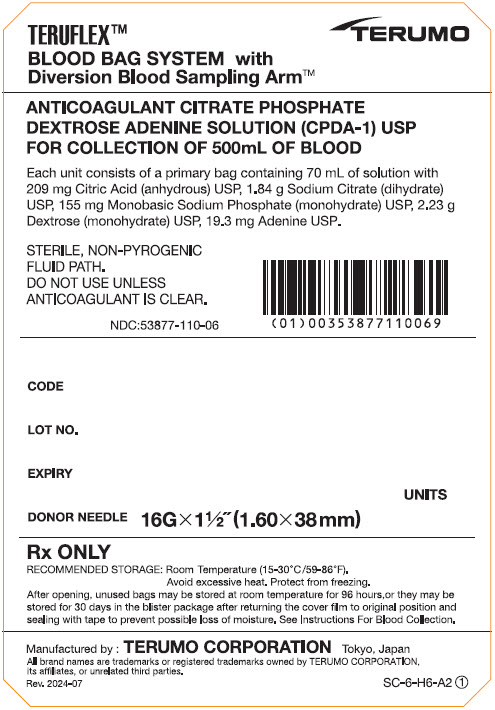
PRINCIPAL DISPLAY PANEL - 70 mL Bag Blister Pack Case Label TERUFLEX™ BLOOD BAG SYSTEM with Diversion Blood Sampling Arm™ TERUMO ANTICOAGULANT CITRATE PHOSPHATE DEXTROSE ADENINE SOLUTION (CPDA-1) USP FOR COLLECTION OF 500mL OF BLOOD Each unit consists of a primary bag containing 70 mL of solution with 209 mg Citric Acid (anhydrous) USP, 1.84 g Sodium Citrate (dihydrate) USP, 155 mg Monobasic Sodium Phosphate (monohydrate) USP, 2.23 g Dextrose (monohydrate) USP, 19.3 mg Adenine USP. STERILE, NON-PYROGENIC FLUID PATH.
DO NOT USE UNLESS ANTICOAGULANT IS CLEAR. NDC:53877-110-06 CODE LOT NO. EXPIRY DONOR NEEDLE 16G × 1½"(1.60 × 38 mm) UNITS Rx ONLY RECOMMENDED STORAGE: Room Temperature (15-30°C/59-86°F).
Avoid excessive heat. Protect from freezing. After opening, unused bags may be stored at room temperature for 96 hours, or they may be stored for 30 days in the blister package after returning the cover film to original position and sealing with tape to prevent possible loss of moisture.
See Instructions For Blood Collection. Manufactured by : TERUMO CORPORATION Tokyo, Japan All brand names are trademarks or registered trademarks owned by TERUMO CORPORATION, its affiliates, or unrelated third parties. Rev.
2024-07 SC-6-H6-H6-A2 ① PRINCIPAL DISPLAY PANEL - 70 mL Bag Blister Pack Case Label
About this NDC listing & data coverage
What data is (and isn’t) available for this NDC — tap to expand
| NDC identity (package / product / labeler codes) | ✓ Available |
| Labeler | ✓ Available |
| Product & package description | ✓ Available |
| Marketing category & status | ✓ Available |
| Active ingredient / dosage form / route | ✓ Available |
| FDA label (SPL via DailyMed) | ✓ Available |
| Package photos | ✓ Available |
| Inactive ingredients (structured) | ✓ Available |
| NADAC pharmacy acquisition price (CMS) | — Not published for this NDC CMS publishes NADAC only for NDCs reported in its retail-pharmacy survey. |
| Orange Book / therapeutic-equivalence data | — Not published for this NDC Applies only to products approved under an NDA/ANDA; many listings are out of scope. |
| HCPCS J-code billing crosswalk | — Not published for this NDC Most self-administered / retail products have no J-code — that is normal. |
| Medicaid utilization (CMS SDUD) | — Not published for this NDC CMS reports utilization only for NDCs with Medicaid claims above its privacy threshold. |