
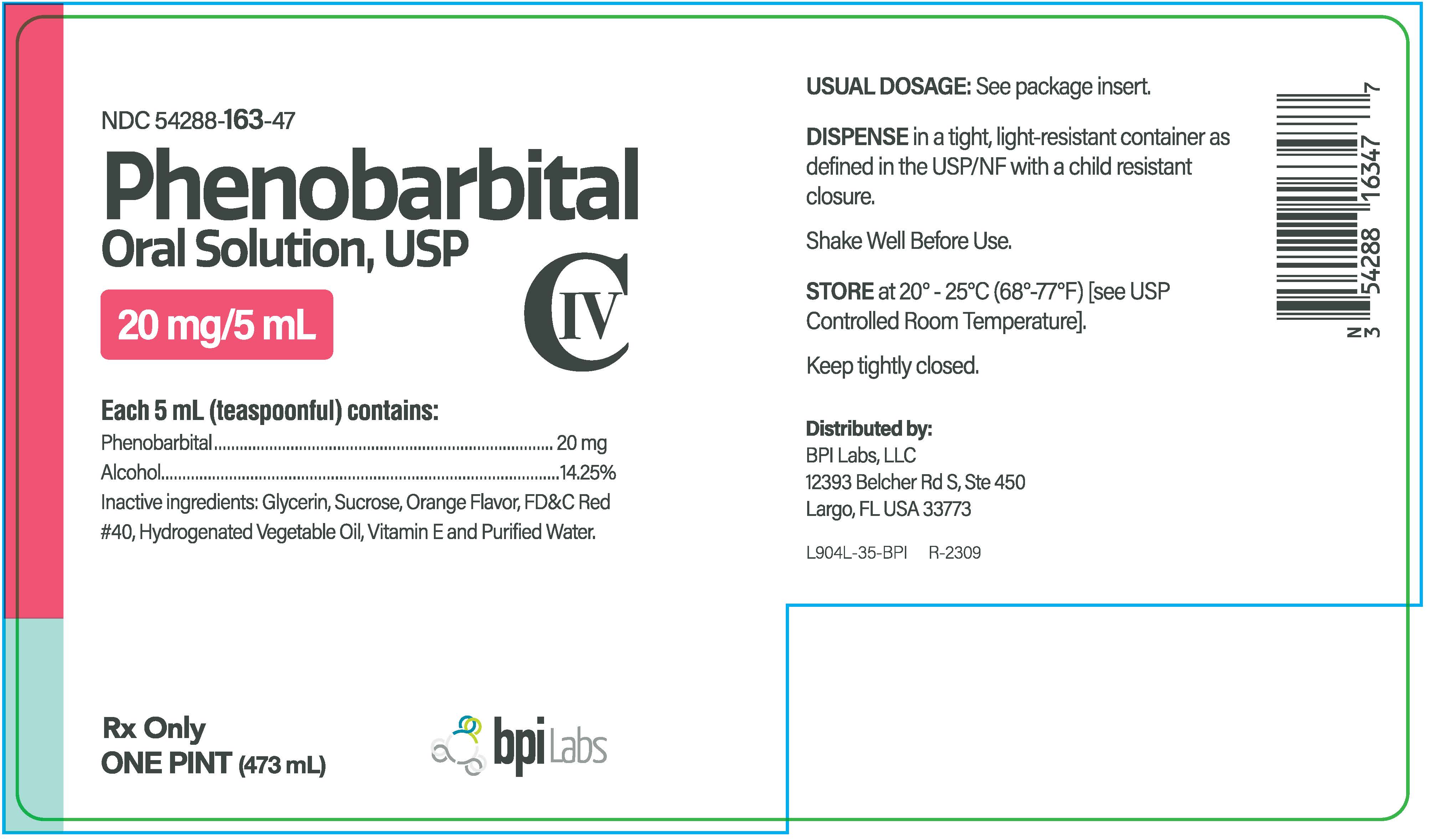
Phenobarbital Oral Solution 20 mg/5mL Solution, 473 mL — NDC 54288-163-47 (Billing 54288-0163-47)
This is a package of 473 mL of Phenobarbital Oral Solution 20 mg/5mL Solution from BPI Labs LLC, marketed since Oct 2023 and currently FDA-listed. It is this product's only package size.
Identity & classification
Regulatory identifiers FDA, NLM and CMS codes for this package
- RxCUI (RxNorm): 702519
Where does this data come from?
- FDA openFDA NDC Directory · synced Oct 1, 2026
- FDA label on DailyMed · label index refreshed Oct 1, 2026
- RxNorm (NLM RxNav) · catalog refreshed Oct 1, 2026
- Medi-Span GPI (licensed)
- First Databank (licensed) · refreshed Oct 1, 2026
RxNorm drug class
This medicine belongs to the Barbiturates and derivatives class.
Where does this data come from?
- RxClass (NLM) · catalog refreshed Oct 1, 2026
Clinical
Phenobarbital is used to control seizures. Phenobarbital is also used to relieve anxiety. It is also used to prevent withdrawal symptoms in people who are dependent ('addicted'; feel a need to continue taking the medication) on another barbiturate medication and are going to stop taking the medication. Phenobarbital is in a class of medications called barbiturates. It works by slowing activity in the brain.
Read the full MedlinePlus article ↗- It is used as a sedative and to control seizures. The tablets and oral solutions cover both. The injections have additional uses, such as short-term insomnia, sedation before surge...
- Please don't stop on your own. Phenobarbital can cause physical dependence, and stopping suddenly can lead to withdrawal problems like delirium and seizures. If you need to stop, y...
- No, this is a big one. Alcohol and other sedating drugs add to the drowsiness. Opioid pain medicines combined with phenobarbital can cause dangerously slow breathing, coma and deat...
- Is it safe to drink alcohol or take pain medicine with it?
Patient education
Supplement & herbal interactions
Where does this data come from?
- MedlinePlus (NLM) · refreshed Oct 1, 2026
- FDA label on DailyMed · label index refreshed Oct 1, 2026
Ask a licensed pharmacist directly — free, answered by our team.
Pricing
A drug doesn't have one price. Each row is a different public payment system, and none is what you'd pay at the counter — that depends on your insurance. The ⓘ on each row explains what it measures.
| Price system | Per mL | Per package |
|---|---|---|
| Retail pharmacies payNADAC · weekly | Not in the retail survey — common for institutional, discontinued, or low-volume packs. | |
| Medicaid paysCMS SDUD · 12 mo | No recent Medicaid claims on file for this NDC — rare and low-volume NDCs are suppressed in the public data. | |
| Medicare drug plans payPart D · Q2 2026 | $0.0923 | $43.66 / 473 ml |
Where does this data come from?
- CMS NADAC weekly file
- CMS ASP pricing files · refreshed Sep 20, 2026
- CMS Medicaid State Drug Utilization Data · refreshed Oct 2, 2026
- CMS Part D plan pricing files · refreshed Sep 24, 2026
- VA National Acquisition Center price file
Packaging — all sizes for this product
| Package NDC | Description | Marketing start | Marketing end | Status |
|---|---|---|---|---|
| 54288-0163-47 You're viewing this Main listing | 473 mL in 1 BOTTLE, PLASTIC | 2023-10-27 | — | Active |
Therapeutic equivalents
| Product | Labeler | Pack | NADAC/unit | TE | Status | Price vs. this |
|---|---|---|---|---|---|---|
| Phenobarbital Oral Solution 20 mg/5mL 00121-0942-16 | PAI | 473 ml | $0.047 | — | Availability likely | — |
| Phenobarbital 20 mg/5mL 13517-0207-16 | e5 | 473 ml | $0.047 | — | Discontinued | — |
| Phenobarbital 20 mg/5mL 13811-0299-08 | Trigen | 473 ml | $0.047 | — | Availability likely | — |
| Phenobarbital 20 mg/5mL 16571-0675-16 | Rising | 473 ml | $0.047 | — | Availability likely | — |
| Phenobarbital 20 mg/5mL 64380-0166-01 | Strides | 473 ml | $0.047 | — | Availability likely | — |
| Phenobarbital 20 mg/5mL 69367-0357-16 | Westminster | 473 ml | $0.047 | — | Availability likely | — |
| Phenobarbital 20 mg/5mL 69367-0367-16 | Westminster | 473 ml | $0.047 | — | Availability likely | — |
| Phenobarbital 20 mg/5mL 00121-0531-05 | Pharmaceutical | 10 cups | — | — | FDA listed | — |
| Phenobarbital Oral Solution 30 mg/7.5mL 00121-1884-50 | PAI | 10 cups | — | — | FDA listed | — |
| Phenobarbital Oral Solution 60 mg/15mL 00121-2826-50 | PAI | 10 cups | — | — | FDA listed | — |
| Phenobarbital Oral Solution 20 mg/5mLthis 54288-0163-47 | BPI | 473 ml | — | — | FDA listed | — |
| Phenobarbital 20 mg/5mL 60687-0671-67 | American | 10 cups | — | — | FDA listed | — |
| Phenobarbital 20 mg/5mL 62135-0962-22 | Chartwell | 10 cups | — | — | FDA listed | — |
| Phenobarbital 20 mg/5mL 63629-2399-01 | Bryant | 473 ml | — | — | FDA listed | — |
| Phenobarbital 20 mg/5mL 68999-0962-22 | Chartwell | 10 cups | — | — | FDA listed | — |
| Phenobarbital 20 mg/5mL 72162-1268-02 | Bryant | 473 ml | — | — | FDA listed | — |
| Phenobarbital Oral Solution 20 mg/5mL 81033-0163-54 | Kesin | 50 cups | — | — | FDA listed | — |
| Phenobarbital Oral Solution 20 mg/5mL 81033-0164-47 | Kesin | 473 ml | — | — | FDA listed | — |
| Phenobarbital Oral Solution 20 mg/5mL 82983-0417-47 | Ajenat | 473 ml | — | — | FDA listed | — |
Where does this data come from?
- FDA openFDA NDC Directory · synced Oct 1, 2026
- FDA Orange Book · refreshed Sep 3, 2026
- CMS NADAC weekly file
Availability & generic status
We did not find an FDA-approved generic match for this exact strength, form and route.
Where does this data come from?
- FDA Orange Book · refreshed Sep 3, 2026
What it looks like
Where does this data come from?
- FDA label on DailyMed · label index refreshed Oct 1, 2026
Inactive Ingredients / Excipients
Inactive ingredients, also called excipients, are components of the drug product other than the active ingredient. They may include fillers, dyes, coatings, preservatives, flavors, or other formulation ingredients.
💡 Tap an ingredient (hover on desktop) to see what it is and why it’s used.
-
UNII 9E8X80D2L0
A synthetic form of vitamin E used as an antioxidant and preservative in medications. It helps prevent the active ingredients from degrading when exposed to oxygen or light.
-
UNII 3K9958V90M
A liquid solvent derived from fermentation or chemical synthesis. In medicines, alcohol dissolves active ingredients, helps preserve the product, and improves how the body absorbs certain drugs.
-
UNII WZB9127XOA
A synthetic red dye used to color medications and make them easier to identify. It serves as a colorant in tablets, capsules, and liquid formulations.
-
UNII PDC6A3C0OX
Glycerin is a clear, thick liquid derived from plant oils or fats. It acts as a humectant to retain moisture, a sweetener, and a solvent in medications.
-
UNII 5EVU04N5QU
A natural or synthetic colorant that gives the medicine an orange hue. It helps identify the medication and may improve appearance.
-
UNII C151H8M554
A natural sugar derived from sugar cane or sugar beets. It's used as a sweetener, filler, and binder to improve taste, add bulk, and help hold tablet or capsule ingredients together.
-
UNII 059QF0KO0R
Water is a liquid solvent that dissolves and mixes ingredients together in liquid medicines, syrups, and injections. It helps distribute the active drug evenly throughout the product.
7 inactive ingredients listed in the exact product block matched to this NDC.
Where does this data come from?
ingredient classCode="IACT" elements from the exact product block matched by this NDC. Label-section narrative from DailyMed / the openFDA label index is shown separately when available.- FDA label on DailyMed · label index refreshed Oct 1, 2026
- FDA openFDA NDC Directory · synced Oct 1, 2026
Inactive ingredient FAQ
Are inactive ingredients the same for every manufacturer?
Why might an inactive ingredient be missing?
Can inactive ingredients matter?
Manufacturer & labeler
Where does this data come from?
- FDA openFDA NDC Directory · synced Oct 1, 2026
- Drugs@FDA
Full prescribing information FDA SPL
🎯 Indications and Usage ▾
INDICATIONS USAGE A. Sedative B. Anticonvulsant - For the treatment of generalized and partial seizures.
⏱️ Dosage and Administration ▾
DOSAGE & ADMINISTRATION The dose of phenobarbital must be individualized with full knowledge of its particular characteristics. Factors of consideration are the patient’s age, weight, and condition. Sedation For sedation, the drug may be administered in single doses of 30 to 120 mg repeated at intervals; frequency will be determined by the patient’s response.
It is generally considered that no more than 400 mg of phenobarbital should be administered during a 24-hour period. Adults: Daytime Sedation: 30 to 120 mg daily in 2 to 3 divided doses. Oral Hypnotic: 100 to 200 mg.
Anticonvulsant Use Clinical laboratories reference values should be used to determine the therapeutic anticonvulsant level of phenobarbital in the serum. To achieve the blood levels considered therapeutic in pediatric patients, higher per-kilogram dosages are generally necessary for phenobarbital and most other anticonvulsants. In pediatric patients and infants, phenobarbital at a loading dose of 15 to 20 mg/kg produces blood levels of about 20 mcg/mL shortly after administration.
Phenobarbital has been used in the treatment and prophylaxis of febrile seizures. However, it has not been established that prevention of febrile seizures influences the subsequent development of epilepsy. Adults: 60 to 200 mg/day.
Pediatric Patients: 3 to 6 mg/kg/day. Special Patient Population Dosage should be reduced in the elderly or debilitated because these patients may be more sensitive to barbiturates. Dosage should be reduced for patients with impaired renal function or hepatic disease.
⛔ Contraindications ▾
CONTRAINDICATIONS Phenobarbital is contraindicated in patients who are hypersensitive to barbiturates, in patients with a history of manifest or latent porphyria, and in patients with marked impairment of liver function or respiratory disease in which dyspnea or obstruction is evident.
⚠️ Warnings ▾
WARNINGS 1. Habit Forming Phenobarbital may be habit forming. Tolerance and psychological and physical dependence may occur with continued use (see DRUG ABUSE AND DEPENDENCE and Pharmacokinetics under CLINICAL PHARMACOLOGY ).
Patients who have psychologic dependence on barbiturates may increase the dosage or decrease the dosage interval without consulting a physician and may subsequently develop a physical dependence on barbiturates. In order to minimize the possibility of overdosage or the development of dependence, the prescribing and dispensing of sedative-hypnotic barbiturates should be limited to the amount required for the interval until the next appointment. Abrupt cessation after prolonged use in a person who is dependent on the drug may result in withdrawal symptoms, including delirium, convulsions, and possibly death.
Barbiturates should be withdrawn gradually from any patient known to be taking excessive doses over long periods of time (see DRUG ABUSE AND DEPENDENCE ). 2. Acute or Chronic Pain Caution should be exercised when barbiturates are administered to patients with acute or chronic pain, because paradoxical excitement could be induced or important symptoms could be masked.
However, the use of barbiturates as sedatives in the postoperative surgical period and as adjuncts to cancer chemotherapy is well established. 3. Usage in Pregnancy Barbiturates can cause fetal damage when administered to a pregnant woman.
Retrospective, case-controlled studies have suggested a connection between the maternal consumption of barbiturates and a higher than expected incidence of fetal abnormalities. Barbiturates readily cross the placental barrier and are distributed throughout fetal tissues; the highest concentrations are found in the placenta, fetal liver, and brain. Fetal blood levels approach maternal blood levels following parenteral administration.
Withdrawal symptoms occur in infants born to women who receive barbiturates throughout the last trimester of pregnancy (see DRUG ABUSE AND DEPENDENCE ). If Phenobarbital is used during pregnancy or if the patient becomes pregnant while taking this drug, the patient should be apprised of the potential hazard to the fetus. 4.
Usage in Children Phenobarbital has been reported to be associated with cognitive deficits in children taking it for complicated febrile seizures. 5. Synergistic Effects The concomitant use of alcohol or other CNS depressants may produce additive CNS depressant effects.
🤒 Adverse Reactions ▾
ADVERSE REACTIONS The following adverse reactions have been reported: CNS Depression - Residual sedation or “hangover”, drowsiness, lethargy, and vertigo. Emotional disturbances and phobias may be accentuated. In some persons, barbiturates such as phenobarbital repeatedly produce excitement rather than depression, and the patient may appear to be inebriated.
Irritability and hyperactivity can occur in children. Like other nonanalgesic hypnotic drugs, barbiturates such as phenobarbital, when given in the presence of pain, may cause restlessness, excitement, and even delirium. Rarely, the use of barbiturates results in the localized or diffuse myalgic, neuralgic, or arthritic pain, especially in psychoneurotic patients with insomnia.
The pain may appear in paroxysms, is most intense in the early morning hours, and is most frequently located in the region of the neck, shoulder girdle, and upper limbs. Symptoms may last for days after the drug is discontinued. Respiratory/Circulatory - Respiratory depression, apnea, circulatory collapse.
Allergic - Acquired hypersensitivity to barbiturates consists chiefly in allergic reactions that occur especially in persons who tend to have asthma, urticaria, angioedema, and similar conditions. Hypersensitivity reactions in this category include localized swelling, particularly of the eyelids, cheeks or lips, and erythematous dermatitis. Rarely exfoliative dermatitis (eg., Stevens-Johnson syndrome and toxic epidermal necrolysis) may be caused by phenobarbital and can prove fatal.
The skin eruption may be associated with fever, delirium, and marked degenerative changes in the liver and other parenchymatous organs. In a few cases, megaloblastic anemia has been associated with the chronic use of phenobarbital. Other - Nausea and vomiting; headache, osteomalacia.
The following adverse reactions and their incidence were compiled from surveillance of thousands of hospitalized patients who received barbiturates. Because such patients may be less aware of the milder adverse effects of barbiturates, the incidence of these reactions may be somewhat higher in fully ambulatory patients. More than 1 in 100 Patients The most common adverse reaction, estimated to occur at a rate of 1 to 3 patients per 100, is: Nervous System: Somnolence Less than 1 in 100 Patients Adverse reactions estimated to occur at a rate of less than 1 in 100 patients are listed below, grouped by organ system and by decreasing order of occurrence: Nervous System : Agitation, confusion, hyperkinesia, ataxia, CNS depression, nightmares, nervousness, psychiatric disturbances, hallucinations, insomnia, anxiety, dizziness, abnormality in thinking.
Respiratory System : Hypoventilation, apnea Cardiovascular System : Bradycardia, hypotension, syncope Digestive System : Nausea, vomiting, constipation Other Reported Reactions : Headache, injection site reactions, hypersensitivity reactions (angioedema, skin rashes, exfoliative dermatitis), fever, liver damage, megaloblastic anemia following chronic phenobarbital use. To report SUSPECTED ADVERSE REACTIONS, contact BPI Labs, LLC at 1-727-471-0850 or FDA at 1-800-FDA-1088 or www.fda.gov/medwatch
🆘 Overdosage ▾
OVERDOSAGE SECTION Signs and Symptoms The onset of symptoms following a toxic oral exposure to phenobarbital may not occur until several hours following ingestion. The toxic dose of barbiturates varies considerably. In general, an oral dose of 1 g of most barbiturates produces serious poisoning in an adult.
Death commonly occurs after 2 to 10 g of ingested barbiturate. The sedated, therapeutic blood levels of phenobarbital range between 5 to 40 mcg/mL; the usual lethal blood level ranges from 100 to 200 mcg/mL. Barbiturate intoxication may be confused with alcoholism, bromide intoxication, and various neurologic disorders.
Potential tolerance must be considered when evaluating significance of dose and plasma concentration. The manifestations of a long-acting barbiturate in overdose include nystagmus, ataxia, CNS depression, respiratory depression, hypothermia, and hypotension. Other findings may include absent or depressed reflexes and erythematous or hemorrhagic blisters (primarily at pressure points).
Following massive exposure to phenobarbital, pulmonary edema, circulatory collapse with loss of peripheral vascular tone, cardiac arrest, and death may occur. In extreme overdose, all electrical activity in the brain may cease, in which case a “flat” EEG normally equated with clinical death should not be accepted. This effect is fully reversible unless hypoxic damage occurs.
Consideration should be given to the possibility of barbiturate intoxication even in situations that appear to involve trauma. Complications such as pneumonia, pulmonary edema, cardiac arrhythmias, congestive heart failure, and renal failure may occur. Uremia may increase CNS sensitivity to barbiturates if renal function is impaired.
Differential diagnosis should include hypoglycemia, head trauma, cerebrovascular accidents, convulsive states and diabetic coma. Treatment To obtain up-to-date information about the treatment of overdose, a good resource is your certified Regional Poison Control Center. Telephone numbers of certified poison control centers are listed in the Physicians’ Desk Reference (PDR).
In managing overdosage, consider the possibility of multiple drug overdoses, interaction among drugs, and unusual drug kinetics in your patient. Protect the patient’s airway and support ventilation and perfusion. Meticulously monitor and maintain, within acceptable limits, the patient’s vital signs, blood gases, serum electrolytes, etc.
Absorption of drugs from the gastrointestinal tract may be decreased by giving activated charcoal, which, in many cases, is more effective than emesis or lavage; consider charcoal instead of or in addition to gastric emptying. Repeated doses of charcoal over time may hasten elimination of some drugs that have been absorbed. Safeguard the patient’s airway when employing gastric emptying or charcoal.
Alkalinization of urine hastens phenobarbital excretion, but dialysis and hemoperfusion are more effective and cause less troublesome alteration in electrolyte equilibrium. If the patient has chronically abused sedatives, withdrawal reactions may be manifest following acute overdose.
🧬 Clinical Pharmacology ▾
CLINICAL PHARMACOLOGY Barbiturates are capable of producing all levels of CNS mood alteration, from excitation to mild sedation, hypnosis, and deep coma. Overdosage can produce death. In high enough therapeutic doses, barbiturates induce anesthesia.
Barbiturates depress the sensory cortex, decrease motor activity, alter cerebellar function, and produce drowsiness, sedation, and hypnosis. Barbiturate-induced sleep differs from physiologic sleep. Sleep laboratory studies have demonstrated that barbiturates reduce the amount of time spent in the rapid eye movement (REM) phase of sleep or the dreaming stage.
Also, Stages III and IV sleep are decreased. Following abrupt cessation of barbiturates used regularly, patients may experience markedly increased dreaming, nightmares, and/or insomnia. Therefore, withdrawal of a single therapeutic dose over 5 or 6 days has been recommended to lessen the REM rebound and disturbed sleep that contribute to the drug withdrawal syndrome (for example, the dose should be decreased from 3 to 2 doses/day for 1 week).
In studies, secobarbital sodium and pentobarbital sodium have been found to lose most of their effectiveness for both inducing and maintaining sleep by the end of 2 weeks of continued drug administration even with the use of multiple doses. As with secobarbital sodium and pentobarbital sodium, other barbiturates (including amobarbital) might be expected to lose their effectiveness for inducing and maintaining sleep after about 2 weeks. The short-, intermediate-, and to a lesser degree, long-acting barbiturates have been widely prescribed for treating insomnia.
Although the clinical literature abounds with claims that the short-acting barbiturates are superior for producing sleep whereas the intermediate-acting compounds are more effective in maintaining sleep, controlled studies have failed to demonstrate these differential effects. Therefore, as sleep medications, the barbiturates are of limited value beyond short-term use. Barbiturates have little analgesic action at subanesthetic doses.
Rather, in subanesthetic doses, these drugs may increase the reaction to painful stimuli. All barbiturates exhibit anticonvulsant activity in anesthetic doses. However, of the drugs in this class, only phenobarbital, mephobarbital, and metharbital are effective as oral anticonvulsants in subhypnotic doses.
Barbiturates are respiratory depressants, and the degree of respiratory depression is dependent upon the dose. With hypnotic doses, respiratory depression produced by barbiturates is similar to that which occurs during physiologic sleep and is accompanied by a slight decrease in blood pressure and heart rate. Studies in laboratory animals have shown that barbiturates cause reductions in the tone and contractility of the uterus, ureters, and urinary bladder.
However, concentrations of the drugs required to produce this effect in humans are not reached with sedative-hypnotic doses. Barbiturates do not impair the normal hepatic function but have been shown to induce liver microsomal enzymes, thus increasing and/or altering the metabolism of barbiturates and other drugs (see Drug Interactions under PRECAUTIONS ). PHARMACOKINETICS Barbiturates are absorbed in varying degrees following oral or parenteral administration.
The salts are more rapidly absorbed than are the acids. The rate of absorption is increased if the sodium salt is ingested as a dilute solution or taken on an empty stomach. Duration of action, which is related to the rate at which the barbiturates are redistributed throughout the body, varies among persons and in the same person from time to time.
Phenobarbital is classified as a long-acting barbiturate when taken orally. Its onset of action is 1 hour or longer, and its duration of action ranges from 10 to 12 hours. Barbiturates are weak acids that are absorbed and rapidly distributed to all tissues and fluids, with high concentrations in the brain, liver, and kidneys.
Lipid solubility of t…
📦 How Supplied / Storage and Handling ▾
NDC 54288-163-47: 16 fl oz (473 mL) bottle. Contains alcohol, 14.25% Dispense in a tight, light-resistant container as defined in the USP/NF with a child resistant closure. Shake well before use. Keep tightly closed. Store at 20° - 25°C (68° - 77°F). [see USP Controlled Room Temperature]. Distributed By: BPI Labs, LLC. 12393 Belcher Road S, Suite 450 Largo, Florida 33773, USA L97I-BPI R-2309 Rev: 09/23
📋 Description ▾
DESCRIPTION The barbiturates are nonselective central nervous system (CNS) depressants that are primarily used as sedative-hypnotics. In subhypnotic doses, they are also used as anticonvulsants. The barbiturates and their sodium salts are subject to control under the Federal Controlled Substances Act.
Phenobarbital is a barbituric acid derivative and occurs as white, odorless, small crystals or crystalline powder that is very slightly soluble in water; soluble in alcohol, in ether, and in solutions of fixed alkali hydroxides and carbonates; sparingly soluble in chloroform. Phenobarbital is 5-ethyl-5-phenylbarbituric acid and has the empirical formula C 12 H 12 N 2 O 3 . Its molecular weight is 232.24.
It has the following structural formula: Phenobarbital is a substituted pyrimidine derivative in which the basic structure is barbituric acid, a substance that has no CNS activity. CNS activity is obtained by substituting alkyl, alkenyl, or aryl groups on the pyrimidine ring. Each 5 mL (teaspoon) contains 20 mg Phenobarbital and Alcohol 14.25%.
The oral solution also contains Glycerin, Sucrose, Orange Flavor, Hydrogenated Vegetable Oil, FD&C Red#40, Vitamin E and Purified water. image description
About this NDC listing & data coverage
Listed without an FDA application
This product's marketing category indicates it is marketed without an approved FDA application (no NDA, ANDA, or BLA on file). Having an NDC does not by itself establish FDA approval — the NDC Directory is a listing system, not an approval decision. Approval-linked data such as Orange Book therapeutic-equivalence ratings therefore does not apply.
What data is (and isn’t) available for this NDC — tap to expand
| NDC identity (package / product / labeler codes) | ✓ Available |
| Labeler | ✓ Available |
| Product & package description | ✓ Available |
| Marketing category & status | ✓ Available |
| Active ingredient / dosage form / route | ✓ Available |
| FDA label (SPL via DailyMed) | ✓ Available |
| Package photos | ✓ Available |
| Inactive ingredients (structured) | ✓ Available |
| NADAC pharmacy acquisition price (CMS) | — Not published for this NDC CMS publishes NADAC only for NDCs reported in its retail-pharmacy survey. |
| Orange Book / therapeutic-equivalence data | — Not published for this NDC Applies only to products approved under an NDA/ANDA; many listings are out of scope. |
| HCPCS J-code billing crosswalk | — Not published for this NDC Most self-administered / retail products have no J-code — that is normal. |
| Medicaid utilization (CMS SDUD) | — Not published for this NDC CMS reports utilization only for NDCs with Medicaid claims above its privacy threshold. |