
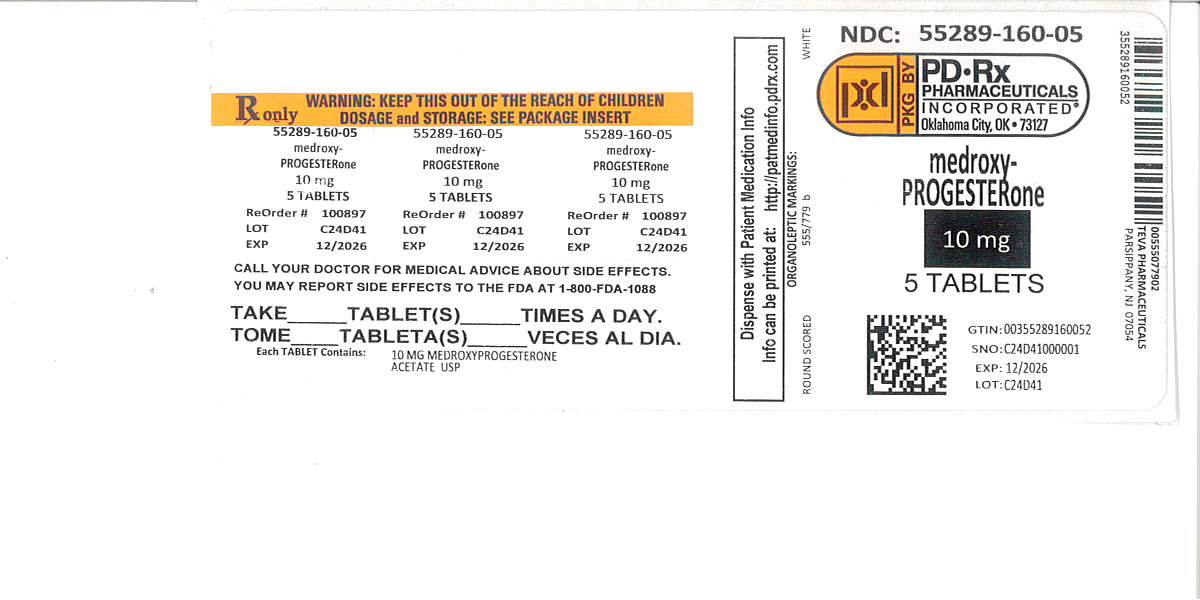
Medroxyprogesterone Acetate 10 mg Tablet, 7-count — NDC 55289-160-07 (Billing 55289-0160-07)
This is a package of 7 tablets of Medroxyprogesterone Acetate 10 mg Tablet from PD-Rx Pharmaceuticals, Inc., marketed since Dec 1996 and currently FDA-listed.
NDC database record
One package, one record: these facts belong to NDC 55289-160-07 alone.
- Record
- FDA NDC Directory package listing · Human prescription drug
- Code segments
- 55289 labeler · 160 product · 07 package
- Listing certified through
- Dec 31, 2026
- Billing quantity
- 7 EA per package
- Barcode (UPC)
- 0355289160052
- FDA record last changed
- Jul 24, 2026
Other active recalls for Medroxyprogesterone Acetate (different manufacturers) — 1 · tap to view
Identity & classification
Regulatory identifiers FDA, NLM and CMS codes for this package
Drug-database identifiers Medi-Span GPI and First Databank GCN / HICL / AHFS classification
- GSN (GCN sequence number): 003271
- GCN: 11260
- GPI-14 (Medi-Span): 26000020200315
- HICL (First Databank): 001442
- AHFS class code: 68:32.00.00
- RxCUI (RxNorm): 1000114
Where does this data come from?
- FDA openFDA NDC Directory · synced Oct 1, 2026
- FDA label on DailyMed · label index refreshed Oct 3, 2026
- RxNorm (NLM RxNav) · catalog refreshed Oct 1, 2026
- Medi-Span GPI (licensed)
- First Databank (licensed) · refreshed Oct 1, 2026
RxNorm drug class
This medicine belongs to the Progestin class.
Where does this data come from?
- RxClass (NLM) · catalog refreshed Oct 1, 2026
Clinical
- It depends on the form. The injections prevent pregnancy, and Depo-SubQ Provera 104 also manages endometriosis-associated pain. The tablets treat missed periods and abnormal uterin...
- Depo-Provera CI and other medroxyprogesterone injectable suspensions are given into a muscle about every 3 months (13 weeks). Depo-SubQ Provera 104 is given under the skin about ev...
- Changes in your bleeding pattern are the most common, and periods often stop over time. Headache, weight gain, injection site reactions and mood changes can also occur. Call your d...
- Yes, it can lower bone mineral density, and the loss may not fully come back after stopping. That is why it is not recommended for more than 2 years unless other options are inadeq...
Patient education
Supplement & herbal interactions
Some supplements/herbs that may interact with Medroxyprogesterone Acetate — tap one for details:
Where does this data come from?
- MedlinePlus (NLM) · refreshed Oct 1, 2026
- FDA label on DailyMed · label index refreshed Oct 3, 2026
Ask a licensed pharmacist directly — free, answered by our team.
Pricing
A drug doesn't have one price. Each row is a different public payment system, and none is what you'd pay at the counter — that depends on your insurance. The ⓘ on each row explains what it measures.
| Price system | Per each | Per package |
|---|---|---|
| Retail pharmacies payNADAC · weekly | Not in the retail survey — common for institutional, discontinued, or low-volume packs. | |
| Medicaid paysCMS SDUD · 12 mo | No recent Medicaid claims on file for this NDC — rare and low-volume NDCs are suppressed in the public data. | |
| Medicare drug plans payPart D · quarterly | No Part D plan price is available for this NDC in our data. | |
Where does this data come from?
- CMS NADAC weekly file
- CMS ASP pricing files · refreshed Sep 20, 2026
- CMS Medicaid State Drug Utilization Data · refreshed Oct 4, 2026
- CMS Part D plan pricing files · refreshed Sep 24, 2026
- VA National Acquisition Center price file
Packaging — all sizes for this product
| Package NDC | Description | Marketing start | Marketing end | Status |
|---|---|---|---|---|
| 55289-0160-05 55289-160-05 Main listing | 5 TABLET in 1 BOTTLE, PLASTIC | 2011-01-18 | — | Active |
| 55289-0160-07 You're viewing this | 7 TABLET in 1 BOTTLE, PLASTIC | 2011-01-18 | — | Active |
| 55289-0160-10 55289-160-10 | 10 TABLET in 1 BOTTLE, PLASTIC | 2011-01-18 | — | Active |
| 55289-0160-13 55289-160-13 | 13 TABLET in 1 BOTTLE, PLASTIC | 2011-01-18 | — | Active |
| 55289-0160-30 55289-160-30 | 30 TABLET in 1 BOTTLE, PLASTIC | 2011-01-18 | — | Active |
| 55289-0160-40 55289-160-40 | 40 TABLET in 1 BOTTLE, PLASTIC | 2011-01-18 | — | Active |
| 55289-0160-42 55289-160-42 | 42 TABLET in 1 BOTTLE, PLASTIC | 2011-01-18 | — | Active |
| 55289-0160-50 55289-160-50 | 50 TABLET in 1 BOTTLE, PLASTIC | 2011-01-18 | — | Active |
You're viewing one of 8 pack sizes for this product.
Pack size FAQ
What quantity is in this package?
How does this package differ from NDC 55289-0160-05?
What NDC number is used to bill for this package of Medroxyprogesterone Acetate 10 mg Tablet?
Therapeutic equivalents
| Product | Labeler | Pack | NADAC/unit | TE | Status | Price vs. this |
|---|---|---|---|---|---|---|
| Medroxyprogesterone Acetate 10 mg 00555-0779-02 | Teva | 100 tablets | $0.152 | AB | Availability likely | — |
| medroxyprogesterone acetate 10 mg 59762-0056-01 | Mylan | 100 tablets | $0.152 | AB | Availability likely | — |
| Medroxyprogesterone Acetate 10 mg 60687-0105-21 | American | 30 tablets | $0.152 | AB | Availability likely | — |
| Provera 10 mg 00009-0051-01 | Pharmacia | 100 tablets | — | AB | FDA listed | — |
| Medroxyprogesterone Acetate 10 mg 50090-0166-00 | A-S | 10 tablets | — | AB | FDA listed | — |
| Medroxyprogesterone Acetate 10 mg 51655-0520-52 | Northwind | 30 tablets | — | AB | FDA listed | — |
| Medroxyprogesterone 10 mg 54348-0805-05 | PharmPak, | 5 tablets | — | AB | FDA listed | — |
| Medroxyprogesterone Acetate 10 mgthis 55289-0160-07 | PD-Rx | 7 tablets | — | AB | FDA listed | — |
| Medroxyprogesterone Acetate 10 mg 63187-0382-10 | Proficient | 10 tablets | — | AB | FDA listed | — |
| Medroxyprogesterone Acetate 10 mg 63629-2612-01 | Bryant | 10 tablets | — | AB | FDA listed | — |
| Medroxyprogesterone Acetate 10 mg 63629-8824-01 | Bryant | 100 tablets | — | AB | FDA listed | — |
| Medroxyprogesterone Acetate 10 mg 68071-4132-01 | NuCare | 10 tablets | — | AB | FDA listed | — |
| Medroxyprogesterone Acetate 10 mg 68788-9899-01 | Preferred | 10 tablets | — | AB | FDA listed | — |
| Medroxyprogesterone Acetate 10 mg 70518-3070-01 | REMEDYREPACK | 30 tablets | — | AB | Discontinued | — |
Where does this data come from?
- FDA openFDA NDC Directory · synced Oct 1, 2026
- FDA Orange Book · refreshed Oct 3, 2026
- CMS NADAC weekly file
Availability & generic status
This product is an FDA-approved generic. Other versions of the same drug are listed under Therapeutic equivalents, least expensive first.
Where does this data come from?
- FDA Orange Book · refreshed Oct 3, 2026
What it looks like
Where does this data come from?
- FDA label on DailyMed · label index refreshed Oct 3, 2026
Inactive Ingredients / Excipients
Inactive ingredients, also called excipients, are components of the drug product other than the active ingredient. They may include fillers, dyes, coatings, preservatives, flavors, or other formulation ingredients.
Where does this data come from?
IACT rows and label-wide narrative are kept separate; availability and product-level specificity depend on the submitted label.- FDA label on DailyMed · label index refreshed Oct 3, 2026
- FDA openFDA NDC Directory · synced Oct 1, 2026
Inactive ingredient FAQ
Are inactive ingredients the same for every manufacturer?
Why might an inactive ingredient be missing?
Can inactive ingredients matter?
Manufacturer & labeler
More NDCs from PD-Rx Pharmaceuticals, Inc. labeler code 55289
- Erythromycin 250 mg Tablet, Film Coated NDC 55289-075-03
- Triamterene and Hydrochlorothiazide 37.5 mg; 25 mg Tablet NDC 55289-090-15
- Diazepam 10 mg Tablet NDC 55289-092-01
- Compro PROCHLORPERAZINE 25 mg Suppository NDC 55289-119-02
- Hydralazine Hydrochloride 25 mg Tablet, Film Coated NDC 55289-133-60
- Diclofenac Sodium 75 mg Tablet, Delayed Release NDC 55289-150-10
- Famciclovir 500 mg Tablet, Film Coated NDC 55289-168-03
- Amoxicillin 250 mg Tablet, Chewable NDC 55289-182-06
- temazepam 15 mg Capsule NDC 55289-196-01
- Minocycline Hydrochloride 100 mg Capsule NDC 55289-201-14
- Minocycline Hydrochloride 50 mg Capsule NDC 55289-202-30
- meloxicam 7.5 mg Tablet NDC 55289-272-14
Where does this data come from?
- FDA openFDA NDC Directory · synced Oct 1, 2026
- Drugs@FDA
Full prescribing information FDA SPL
🚨 Boxed Warning ▾
WARNING: CARDIOVASCULAR DISORDERS, BREAST CANCER AND PROBABLE DEMENTIA FOR ESTROGEN PLUS PROGESTIN THERAPY Cardiovascular Disorders and Probable Dementia Estrogen plus progestin therapy should not be used for the prevention of cardiovascular disease or dementia. (See CLINICAL STUDIES and WARNINGS, Cardiovascular Disorders and Probable Dementia . ) The Women’s Health Initiative (WHI) estrogen plus progestin substudy reported an increased risk of deep vein thrombosis (DVT), pulmonary embolism (PE), stroke and myocardial infarction (MI) in postmenopausal women (50 to 79 years of age) during 5.6 years of treatment with daily oral conjugated estrogens (CE) [0.625 mg] combined with medroxyprogesterone acetate (MPA) [2.5 mg], relative to placebo.
(See CLINICAL STUDIES and WARNINGS, Cardiovascular Disorders . ) The WHI Memory Study (WHIMS) estrogen plus progestin ancillary study reported an increased risk of developing probable dementia in postmenopausal women 65 years of age or older during 4 years of treatment with daily CE (0.625 mg) combined with MPA (2.5 mg), relative to placebo. It is unknown whether this finding applies to younger postmenopausal women. (See CLINICAL STUDIES and WARNINGS , Probable Dementia and PRECAUTIONS , Geriatric Use . ) Breast Cancer The WHI estrogen plus progestin substudy demonstrated an increased risk of invasive breast cancer.
(See CLINICAL STUDIES and WARNINGS , Malignant Neoplasm, Breast Cancer . ) In the absence of comparable data, these risks should be assumed to be similar for other doses of CE and MPA, and other combinations and dosage forms of estrogens and progestins. Progestins with estrogens should be prescribed at the lowest effective doses and for the shortest duration consistent with treatment goals and risks for the individual woman.
What is the most important information I should know about medroxyprogesterone acetate tablets (a progestin hormone)? Do not use estrogens with progestins to prevent heart disease, heart attacks, strokes, or dementia (decline in brain function). Using estrogens with progestins may increase your chance of getting heart attacks, strokes, breast cancer, and blood clots.
Using estrogens with progestins may increase your chance of getting dementia, based on a study of women age 65 years or older. You and your healthcare provider should talk regularly about whether you still need treatment with medroxyprogesterone acetate.
🎯 Indications and Usage ▾
INDICATIONS AND USAGE Medroxyprogesterone acetate tablets, USP are indicated for the treatment of secondary amenorrhea and abnormal uterine bleeding due to hormonal imbalance in the absence of organic pathology, such as fibroids or uterine cancer. They are also indicated for use in the prevention of endometrial hyperplasia in nonhysterectomized postmenopausal women who are receiving daily oral conjugated estrogens 0.625 mg tablets.
⏱️ Dosage and Administration ▾
DOSAGE AND ADMINISTRATION Secondary Amenorrhea Medroxyprogesterone acetate tablets may be given in dosages of 5 or 10 mg daily for 5 to 10 days. A dose for inducing an optimum secretory transformation of an endometrium that has been adequately primed with either endogenous or exogenous estrogen is 10 mg of medroxyprogesterone acetate daily for 10 days. In cases of secondary amenorrhea, therapy may be started at any time.
Progestin withdrawal bleeding usually occurs within three to seven days after discontinuing medroxyprogesterone acetate therapy. Abnormal Uterine Bleeding Due to Hormonal Imbalance in the Absence of Organic Pathology Beginning on the calculated 16th or 21st day of the menstrual cycle, 5 or 10 mg of medroxyprogesterone acetate may be given daily for 5 to 10 days. To produce an optimum secretory transformation of an endometrium that has been adequately primed with either endogenous or exogenous estrogen, 10 mg of medroxyprogesterone acetate daily for 10 days beginning on the 16th day of the cycle is suggested.
Progestin withdrawal bleeding usually occurs within three to seven days after discontinuing therapy with medroxyprogesterone acetate. Patients with a past history of recurrent episodes of abnormal uterine bleeding may benefit from planned menstrual cycling with medroxyprogesterone acetate. Reduction of Endometrial Hyperplasia in Postmenopausal Women Receiving Daily 0.625 mg Conjugated Estrogens When estrogen is prescribed for a postmenopausal woman with a uterus, a progestin should also be initiated to reduce the risk of endometrial cancer.
A woman without a uterus does not need progestin. Use of estrogen, alone or in combination with a progestin, should be with the lowest effective dose and for the shortest duration consistent with treatment goals and risks for the individual woman. Patients should be re-evaluated periodically as clinically appropriate (for example, 3 to 6 month intervals) to determine if treatment is still necessary (see WARNINGS ).
For women who have a uterus, adequate diagnostic measures, such as endometrial sampling, when indicated, should be undertaken to rule out malignancy in cases of undiagnosed persistent or recurring abnormal vaginal bleeding. Medroxyprogesterone acetate tablets may be given in dosages of 5 or 10 mg daily for 12 to 14 consecutive days per month, in postmenopausal women receiving daily 0.625 mg conjugated estrogens, either beginning on the 1st day of the cycle or the 16th day of the cycle. Patients should be started at the lowest dose.
The lowest effective dose of medroxyprogesterone acetate has not been determined.
⛔ Contraindications ▾
CONTRAINDICATIONS Medroxyprogesterone acetate is contraindicated in women with any of the following conditions: Undiagnosed abnormal genital bleeding. Known, suspected, or history of breast cancer. Known or suspected estrogen- or progesterone-dependent neoplasia.
Active DVT, PE, or a history of these conditions Active arterial thromboembolic disease (for example, stroke and MI), or a history of these conditions. Known anaphylactic reaction or angioedema to medroxyprogesterone acetate. Known liver impairment or disease.
Known or suspected pregnancy.
⚠️ Warnings ▾
WARNINGS See BOXED WARNINGS . 1. Cardiovascular Disorders.
An increased risk of PE, DVT, stroke, and MI has been reported with estrogen plus progestin therapy. Should any of these events occur or be suspected, estrogen plus progestin therapy should be discontinued immediately. Risk factors for arterial vascular disease (for example, hypertension, diabetes mellitus, tobacco use, hypercholesterolemia, and obesity) and/or venous thromboembolism (VTE) (for example, personal history or family history of VTE, obesity, and systemic lupus erythematosus) should be managed appropriately. a.
Stroke In the WHI estrogen plus progestin substudy, a statistically significant increased risk of stroke was reported in women 50 to 79 years of age receiving CE (0.625 mg) plus MPA (2.5 mg) compared to women in the same age group receiving placebo (33 versus 25 per 10,000 women-years). (See CLINICAL STUDIES . ) The increase in risk was demonstrated after the first year and persisted. Should a stroke occur or be suspected, estrogen plus progestin therapy should be discontinued immediately. b.
Coronary Heart Disease In the WHI estrogen plus progestin substudy, there was a statistically non-significant increased risk of CHD events reported in women receiving daily CE (0.625 mg) plus MPA (2.5 mg) compared to women receiving placebo (41 versus 34 per 10,000 women-years). An increase in relative risk was demonstrated in year 1, and a trend toward decreasing relative risk was reported in years 2 through 5. In postmenopausal women with documented heart disease (n = 2,763, average 66.7 years of age), in a controlled clinical trial of secondary prevention of cardiovascular disease (Heart and Estrogen/Progestin Replacement Study [HERS]), treatment with daily CE (0.625 mg) plus MPA (2.5 mg) demonstrated no cardiovascular benefit.
During an average follow-up of 4.1 years, treatment with CE plus MPA did not reduce the overall rate of CHD events in postmenopausal women with established coronary heart disease. There were more CHD events in the CE plus MPA-treated group than in the placebo group in year 1, but not during the subsequent years. Two thousand three hundred and twenty-one (2,321) women from the original HERS trial agreed to participate in an open label extension of HERS, HERS II.
Average follow-up in HERS II was an additional 2.7 years, for a total of 6.8 years overall. Rates of CHD events were comparable among women in the CE plus MPA group and the placebo group in HERS, HERS II, and overall. c. Venous Thromboembolism In the WHI estrogen plus progestin substudy, a statistically significant 2-fold greater rate of VTE (DVT and PE) was reported in women receiving daily CE (0.625 mg) plus MPA (2.5 mg) compared to women receiving placebo (35 versus 17 per 10,000 women-years).
Statistically significant increases in risk for both DVT (26 versus 13 per 10,000 women-years) and PE (18 versus 8 per 10,000 women-years) were also demonstrated. The increase in VTE risk was demonstrated during the first year and persisted. (See CLINICAL STUDIES ).
Should a VTE occur or be suspected, estrogen plus progestin therapy should be discontinued immediately. If feasible, estrogens plus progestins should be discontinued at least 4 to 6 weeks before surgery of the type associated with an increased risk of thromboembolism, or during periods of prolonged immobilization. 2.
Malignant Neoplasms a. Breast Cancer The WHI substudy of daily CE (0.625 mg)-alone provided information about breast cancer in estrogen-alone users. In the WHI estrogen-alone substudy, after an average follow-up of 7.1 years, daily CE-alone was not associated with an increased risk of invasive breast cancer [relative risk (RR) 0.80] compared to placebo (see CLINICAL STUDIES ).
After a mean follow-up of 5.6 years, the estrogen plus progestin substudy reported an increased risk of invasive breast cancer in women who took daily CE plus MPA. In this substudy, prior use of estrogen-alone or estrogen plus progestin th…
🤒 Adverse Reactions ▾
ADVERSE REACTIONS See BOXED WARNINGS , WARNINGS , and PRECAUTIONS . Because clinical trials are conducted under widely varying conditions, adverse reaction rates observed in the clinical trials of a drug cannot be directly compared to rates in the clinical trials of another drug and may not reflect the rates observed in practice. The following adverse reactions have been reported in women taking medroxyprogesterone acetate tablets, without concomitant estrogens treatment: 1.
Genitourinary system Abnormal uterine bleeding (irregular, increase, decrease), change in menstrual flow, breakthrough bleeding, spotting, amenorrhea, changes in cervical erosion and cervical secretions. 2. Breasts Breast tenderness, mastodynia or galactorrhea has been reported.
3. Cardiovascular Thromboembolic disorders including thrombophlebitis and pulmonary embolism have been reported. 4.
Gastrointestinal Nausea, cholestatic jaundice. 5. Skin Sensitivity reactions consisting of urticaria, pruritus, edema and generalized rash have occurred.
Acne, alopecia and hirsutism have been reported. 6. Eyes Neuro-ocular lesions, for example, retinal thrombosis, and optic neuritis.
7. Central nervous system Mental depression, insomnia, somnolence, dizziness, headache, nervousness. 8.
Miscellaneous Hypersensitivity reactions (for example, anaphylaxis and anaphylactoid reactions, angioedema), rash (allergic) with and without pruritus, change in weight (increase or decrease), pyrexia, edema/fluid retention, fatigue, decreased glucose tolerance. The following adverse reactions have been reported with estrogen plus progestin therapy. 1.
Genitourinary system Abnormal uterine bleeding/spotting, or flow; breakthrough bleeding; spotting; dysmenorrheal/pelvic pain; increase in size of uterine leiomyomata; vaginitis, including vaginal candidiasis; change in amount of cervical secretion; changes in cervical ectropion; ovarian cancer; endometrial hyperplasia; endometrial cancer. 2. Breasts Tenderness, enlargement, pain, nipple discharge, galactorrhea; fibrocystic breast changes; breast cancer.
3. Cardiovascular Deep and superficial venous thrombosis; pulmonary embolism; thrombophlebitis; myocardial infarction; stroke; increase in blood pressure. 4.
Gastrointestinal Nausea, vomiting; abdominal cramps, bloating; cholestatic jaundice; increased incidence of gallbladder disease; pancreatitis; enlargement of hepatic hemangiomas. 5. Skin Chloasma or melasma that may persist when drug is discontinued; erythema multiforme; erythema nodosum; hemorrhagic eruption; loss of scalp hair; hirsutism; pruritus, rash.
6. Eyes Retinal vascular thrombosis, intolerance to contact lenses. 7.
Central nervous system Headache; migraine; dizziness; mental depression; chorea; nervousness; mood disturbances; irritability; exacerbation of epilepsy, dementia. 8. Miscellaneous Increase or decrease in weight; reduced carbohydrate tolerance; aggravation of porphyria; edema; arthalgias; leg cramps; changes in libido; urticaria, angioedema, anaphylactoid/anaphylactic reactions; hypocalcemia; exacerbation of asthma; increased triglycerides.
To report SUSPECTED ADVERSE REACTIONS, contact Teva at 1-888-838-2872 or FDA at 1-800-FDA-1088 or http://www.fda.gov/medwatch.
🔄 Drug / Laboratory Test Interactions ▾
C. Drug-Laboratory Test Interactions The following laboratory results may be altered by the use of estrogen plus progestin therapy: Accelerated prothrombin time, partial thromboplastin time, and platelet aggregation time; increased platelet count; increased factors II, VII antigen, VIII antigen, VIII coagulant activity, IX, X, XII, VII-X complex, II-VII-X complex, and beta-thromboglobulin; decreased levels of anti-factor Xa and antithrombin III, decreased antithrombin III activity; increased levels of fibrinogen and fibrinogen activity; increased plasminogen antigen and activity.
Increased thyroid-binding globulin (TBG) levels leading to increased circulating total thyroid hormone levels as measured by protein-bound iodine (PBI), T4 levels (by column or by radioimmunoassay) or T3 levels by radioimmunoassay, T3 resin uptake is decreased, reflecting the elevated TBG. Free T4 and free T3 concentrations are unaltered. Women on thyroid replacement therapy may require higher doses of thyroid hormone.
Other binding proteins may be elevated in serum. for example, corticosteroid binding globulin (CBG), sex hormone binding globulin (SHBG) leading to increased circulating corticosteroid and sex steroids, respectively. Free hormone concentrations, such as testosterone and estradiol, may be decreased. Other plasma proteins may be increased (angiotensinogen/renin substrate, alpha-1-antitrypsin, ceruloplasmin).
Increased plasma high-density lipoprotein (HDL) and HDL2 cholesterol subfraction concentrations, reduced low-density lipoprotein (LDL) cholesterol concentration, increased triglycerides levels. Impaired glucose tolerance.
🤰 Pregnancy ▾
E. Pregnancy Medroxyprogesterone acetate should not be used during pregnancy. (See CONTRAINDICATIONS . ) There may be increased risks for hypospadias, clitoral enlargement and labial fusion in children whose mothers are exposed to medroxyprogesterone acetate during the first trimester of pregnancy. However, a clear association between these conditions with use of medroxyprogesterone acetate has not been established.
🧒 Pediatric Use ▾
G. Pediatric Use Medroxyprogesterone acetate tablets are not indicated in children. Clinical studies have not been conducted in the pediatric population.
🧓 Geriatric Use ▾
H. Geriatric Use There have not been sufficient numbers of geriatric women involved in clinical studies utilizing medroxyprogesterone acetate alone to determine whether those over 65 years of age differ from younger subjects in their response to medroxyprogesterone acetate alone. The Women’s Health Initiative Studies In the WHI estrogen plus progestin substudy (daily CE [0.625 mg] plus MPA [2.5 mg] versus placebo), there was a higher relative risk of nonfatal stroke and invasive breast cancer in women greater than 65 years of age.
(See CLINICAL STUDIES . ) The Women’s Health Initiative Memory Study In the WHIMS ancillary studies of postmenopausal women 65 to 79 years of age, there was an increased risk of developing probable dementia in women receiving estrogen- alone or estrogen plus progestin when compared to placebo. (See WARNINGS , Probable Dementia . ) Since both ancillary studies were conducted in women 65 to 79 years of age, it is unknown whether these findings apply to younger postmenopausal women. (See WARNINGS , Probable Dementia . )
🆘 Overdosage ▾
OVERDOSAGE Overdosage of estrogen plus progestin therapy may cause nausea and vomiting, breast tenderness, dizziness, abdominal pain, drowsiness/fatigue and withdrawal bleeding may occur in women. Treatment of overdose consists of discontinuation of CE plus MPA together with institution of appropriate symptomatic care.
🧬 Clinical Pharmacology ▾
CLINICAL PHARMACOLOGY Medroxyprogesterone acetate (MPA) administered orally or parenterally in the recommended doses to women with adequate endogenous estrogen, transforms proliferative into secretory endometrium. Androgenic and anabolic effects have been noted, but the drug is apparently devoid of significant estrogenic activity. While parenterally administered MPA inhibits gonadotropin production, which in turn prevents follicular maturation and ovulation, available data indicate that this does not occur when the usually recommended oral dosage is given as single daily doses.
Pharmacokinetics The pharmacokinetics of MPA were determined in 20 postmenopausal women following a single-dose administration of eight medroxyprogesterone acetate 2.5 mg tablets or a single administration of two medroxyprogesterone acetate 10 mg tablets under fasting conditions. In another study, the steady-state pharmacokinetics of MPA were determined under fasting conditions in 30 postmenopausal women following daily administration of one medroxyprogesterone acetate 10 mg tablet for 7 days. In both studies, MPA was quantified in serum using a validated gas chromatography-mass spectrometry (GC-MS) method.
Estimates of the pharmacokinetic parameters of MPA after single and multiple doses of medroxyprogesterone acetate tablets were highly variable and are summarized in Table 1. Table 1. Mean (SD) Pharmacokinetic Parameters for Medroxyprogesterone Acetate (MPA) Tablet Strength C max (ng/mL) T max (h) Auc 0-(∞) (ng·h/mL) t 1/2 (h) Vd/f (L) CL/f (mL/min) Single Dose 2 x 10 mg 1.01 (0.599) 2.65 (1.41) 6.95 (3.39) 12.1 (3.49) 78024 (47220) 64110 (42662) 8 x 2.5 mg 0.805 (0.413) 2.22 (1.39) 5.62 (2.79) 11.6 (2.81) 62748 (40146) 74123 (35126) Multiple Dose 10 mg * 0.71 (0.35) 2.83 (1.83) 6.01 (3.16) 16.6 (15.0) 40564 (38256) 41963 (38402) *Following Day 7 dose A.
Absorption: No specific investigation on the absolute bioavailability of MPA in humans has been conducted. MPA is rapidly absorbed from the gastrointestinal tract, and maximum MPA concentrations are obtained between 2 to 4 hours after oral administration. Administration of medroxyprogesterone acetate tablets with food increases the bioavailability of MPA.
A 10 mg dose of medroxyprogesterone acetate tablets, taken immediately before or after a meal, increased MPA C max (50 to 70%) and AUC (18 to 33%). The half-life of MPA was not changed with food. B.
Distribution: MPA is approximately 90% protein bound, primarily to albumin; no MPA binding occurs with sex hormone binding globulin. C. Metabolism: Following oral dosing, MPA is extensively metabolized in the liver via hydroxylation, with subsequent conjugation and elimination in the urine.
D. Excretion: Most MPA metabolites are excreted in the urine as glucuronide conjugates with only minor amounts excreted as sulfates. E.
Specific Populations Hepatic Insufficiency MPA is almost exclusively eliminated via hepatic metabolism. In 14 patients with advanced liver disease, MPA disposition was significantly altered (reduced elimination). In patients with fatty liver, the mean percent dose excreted in the 24-hour urine as intact MPA after a 10 mg or 100 mg dose was 7.3% and 6.4%, respectively.
Renal Insufficiency The effect of renal impairment on the pharmacokinetics of medroxyprogesterone acetate has not been studied. F. Drug Interactions Medroxyprogesterone acetate (MPA) is metabolized in-vitro primarily by hydroxylation via the CYP3A4.
Specific drug-drug interaction studies evaluating the clinical effects with CYP3A4 inducers or inhibitors on MPA have not been conducted. Inducers and/or inhibitors of CYP3A4 may affect the metabolism of MPA.
📦 How Supplied / Storage and Handling ▾
HOW SUPPLIED Medroxyprogesterone acetate tablets, USP are available in the following strengths and package sizes: 10 mg tablets (White, round, scored, biconvex tablet. Debossed with 555/779 on the scored side and stylized b on the other side) Bottles of 5: NDC 55289-160-05 Bottles of 10: NDC 55289-160-10 Bottles of 30: NDC 55289-160-30 Bottles of 50: NDC 55289-160-50 Dispense in a tight, light-resistant container as defined in the USP, with a child-resistant closure (as required). Store at 20° to 25°C (68° to 77°F) [See USP Controlled Room Temperature].
Keep this and all medications out of the reach of children.
📋 Description ▾
DESCRIPTION Medroxyprogesterone acetate tablets, USP contain medroxyprogesterone acetate, USP which is a derivative of progesterone. It is a white to off-white, odorless crystalline powder, stable in air, melting between 200 and 210°C. It is freely soluble in chloroform, soluble in acetone and in dioxane, sparingly soluble in alcohol and in methanol, slightly soluble in ether, and insoluble in water.
The chemical name for medroxyprogesterone acetate is pregn-4-ene-3, 20-dione, 17-(acetyloxy)-6-methyl-, (6α)-. The structural formula is: C 24 H 34 O 4 M.W. 386.53 Each medroxyprogesterone acetate tablet for oral administration contains 2.5 mg, 5 mg or 10 mg of medroxyprogesterone acetate, USP and the following inactive ingredients: crospovidone, lactose monohydrate, magnesium stearate, methylcellulose, pregelatinized corn starch, and sodium lauryl sulfate. fig1
Medicare Part D spend CMS · PART D · 2026 (Q1)
About this NDC listing & data coverage
What data is (and isn’t) available for this NDC — tap to expand
| NDC identity (package / product / labeler codes) | ✓ Available |
| Labeler | ✓ Available |
| Product & package description | ✓ Available |
| Marketing category & status | ✓ Available |
| Active ingredient / dosage form / route | ✓ Available |
| FDA label (SPL via DailyMed) | ✓ Available |
| Package photos | ✓ Available |
| Inactive ingredients (structured) | — Not published for this NDC The labeler did not submit a structured excipient list, or no SPL is available. |
| NADAC pharmacy acquisition price (CMS) | — Not published for this NDC CMS publishes NADAC only for NDCs reported in its retail-pharmacy survey. |
| Orange Book / therapeutic-equivalence data | ✓ Available |
| HCPCS J-code billing crosswalk | — Not published for this NDC Most self-administered / retail products have no J-code — that is normal. |
| Medicaid utilization (CMS SDUD) | — Not published for this NDC CMS reports utilization only for NDCs with Medicaid claims above its privacy threshold. |